Shut Up And Talk: The Many Levels Of Communication In Padel
“The single biggest problem in communication is the illusion that it has taken place.”
George Bernard Shaw, who clearly never played padel, but would have been a nightmare partner if he had.
There’s a peculiar breed of padel player who steps onto court, nods vaguely at their partner, and proceeds to communicate exclusively through grunts, sighs and the occasional death stare after a missed volley. If you’ve played with one, you know the feeling. It’s like being partnered with a mime who forgot his invisible box. In Monty Python terms, this is the Black Knight of padel communication: arms and legs flying everywhere, absolutely no coordination, yet stubbornly insisting “it’s just a flesh wound.”
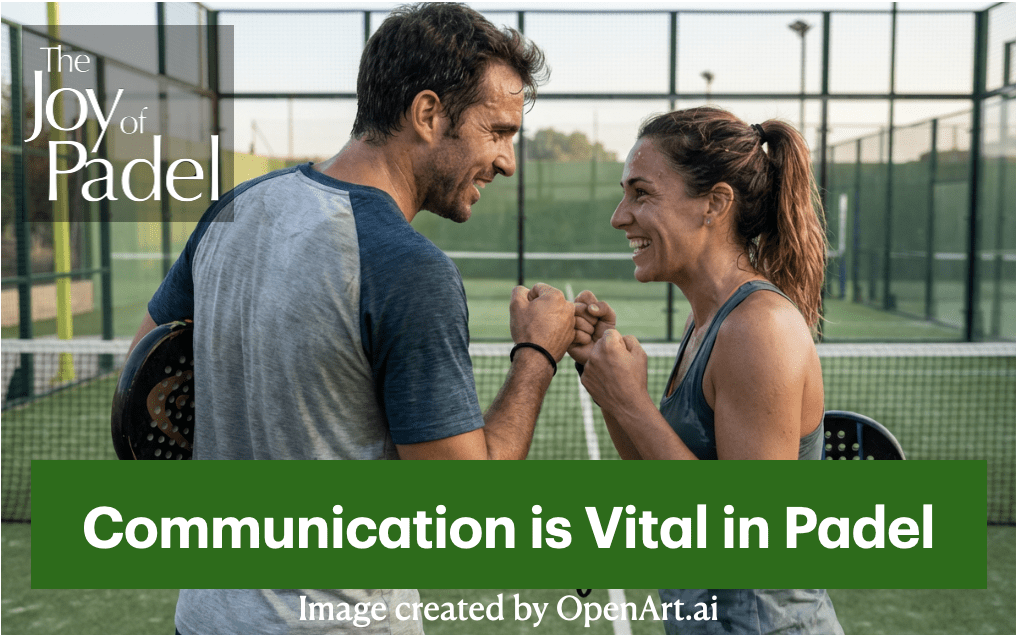
But here’s the thing. Padel is not tennis. You are not alone out there. You share a 10x20m glass cage with another human being, and the quality of your communication will determine whether you walk off court as victors and friends, or both looking for new partners on WhatsApp. For those of you (or your partner) who think communication is “hard to do” or, worse, distracting, then it’s like saying, “I don’t like to use the wall” or “I can’t lob.” Communication is a part of competitive padel, as much as effective lobbing, letting the ball by to come off the wall, and adapting your overhead to hit a víbora or rulo. In other words, even if you don’t like to communicate, you need to learn to do it. Having interviewed dozens of professional players on the Joy of Padel podcast, I’ve come to recognise that communication in padel is vital, but it’s not a one size fits all. Padel is marketed as a social sport, but on court many of us communicate like particularly introverted hedgehogs. Yet every top team, every long–standing partnership, and every “how on earth did they win that match?” comeback has one thing in common: deliberate, structured, sometimes noisy communication. Coaches and brands insist that communication is a key performance driver, not a decorative extra, because it helps anticipate plays, cover gaps, and create advantages over opponents.
As Marta Ortega, former world number 1, explained on the Joy of Padel podcast, communication with her partner (at the time it was Sophie Araújo) is constant. “We hear each other,” Marta said. “We ask each other lots of things. For example: Are you good? What do you feel? Are you seeing anything we should change?”
Communication is strategic.
Communication is entirely strategic to long-term success. If you want to understand a padel partnership, don’t look at their ranking – just watch or listen to what they say during or between points. Over the years of playing, I know that different people like different styles and calls. But not speaking, just isn’t cricket padel. I describe below the four levels of communication. If all you can hear is heavy breathing and the occasional noise reminiscent of a wounded walrus, you’re probably watching Level 0 communication. And that, dear reader, is where our story begins.
Level 0: The Grunting Era
Level 0 communication is simple: you don’t talk. You move, you swing, you grunt. If your partner hears anything at all, it’s usually “Ugh!” followed by “Sorry…” and a small internal funeral for yet another unforced error.
- Nobody calls “yours” or “mine”; the ball in the middle is treated like a live grenade.
- Lobs drift majestically between you while both of you assume the other “must have it”.
- Every collision is followed by awkward silence and a sort of British smile that clearly means, “You will never be my partner again.”
Recreational players often underestimate communication. The irony? These same people will happily talk for 20 minutes about their new racket and string tension, but not 2 seconds about who takes the smash.
Level 0 on a padel court is like a marriage where nobody says what they actually feel. You bump into each other, assume the worst, and hope the problem goes away by itself. Spoiler: it doesn’t.
Level 1: Yours, Mine, Out, Vamos
At Level 1, words finally appear. They are small, modest, and occasionally shouted with the fervour of a medieval battle cry.
The basic Level 1 vocabulary
- “Yours!”
- “Mine!”
- “Up” meaning you want to rush the net
- “Out!” (the ball is headed out)
- “Watch!” (the ball is close to going out)
- And, for the optimists and cheerleaders, “Vamos!” (let’s go!)
This is where most club players spend their lives, and to be fair, basic calls already make a big difference. Clear short commands help decide quickly who should take balls in the middle and avoid the classic “after you, no after you” comedy routine. Even simple cues like “Leave!” or “Back!” are enough to reduce confusion and improve coordination during points.
But Level 1 is still reactive. You describe what you are doing, sometimes what the ball is doing, but rarely what the opponents are doing. It’s like telling your spouse, “I’m going out,” without adding, “and I’ll be back at six with dinner.” Limited information, limited results.
Bear in mind that a simple ¡Vamos! is good, but people stuck in Level 1 will spur encouragement without any tactical adjustment. “We’ll break here” or “We’ve got this” are lovely intentions, but without exchanging on how you’re going to break or “get this”, it’s unlikely you’re going to get something different, when you’re still doing what you’ve just done.
Still, Level 1 is infinitely better than Level 0. Think of it as the “please” and “thank you” of padel. Basic civility before we get to the interesting stuff.
Level 2: They’re Back, They’re Up, One’s Cheating
Now we arrive at Level 2: actual information. This is when you start talking about the opponents while your partner is striking or preparing to strike the ball. In the pre-amble, it’s vital to know what and how your partner likes to get calls — and how you like to have the calls made for you.
Level 2 calls that change rallies
It’s best to have one-word calls and to confirm these with your partner ahead of the match.
- “Back!” meaning both of the opponents are back. This usually means you can be relaxed and ensure that the net position is retained.
- “Up” meaning they’re both up
- “Tight” meaning they’re tight up at the net (i.e. watch out for any drive, probably better to lob!)
- “Coming” meaning they’re cheating forward!
- “Middle!” meaning middle is open
- “Line” meaning down the line is free!
The hardest call to organise with your partner is usually when one of your opponents is up at the net and the other is staying back.
When your partner is lobbed, he/she must be focused on the balls’ trajectory and literally cannot (or more likely can’t afford to) see what is happening on the other side of the net. Your job, as the non‑lobbed partner, is to become their eyes. Clear, calm information like “they’re both back” or “one’s closing” can completely change the quality of their next shot and help them make better decisions under pressure. This transforms communication from background noise into a tactical weapon that wins points, not just sympathy.
At Level 2, you stop narrating your own misery and start helping your partner solve problems. You become a micro‑coach mid‑rally: short, factual, and occasionally wrong, but at least you’re trying.
In life terms, this is like saying to a friend, “Listen, your boss looks annoyed, maybe don’t ask for a raise today.” You’re not hitting the ball, but you’re absolutely influencing the outcome.
Level 3: Strategy, Tactics, And The 90‑Second Summit
Level 3 is for teams that realise padel starts before the first serve and continues after the last handshake. Here, communication expands into strategy and tactics: before the match, during changeovers (90 seconds), between points (20 seconds), and even in the post‑mortem on the bench.
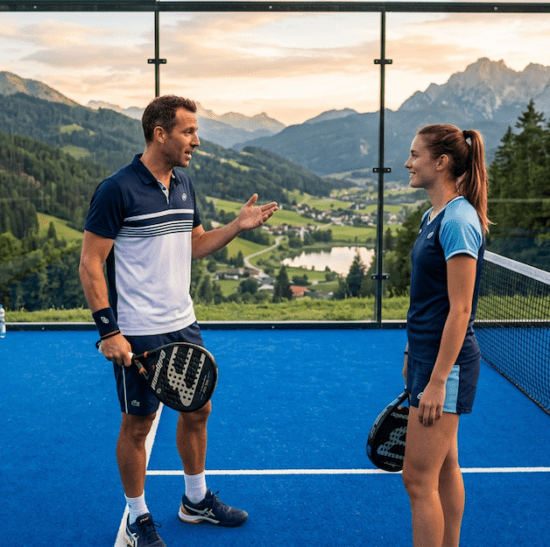
What Level 3 teams actually talk about:
- Who to target, where to serve, and which patterns to repeat before they start.
- Using changeovers to insist on or tweak tactics, adjust to conditions, and reset mentally.
- Using between‑point windows to give one clear cue: “More lobs on the left,” “He hates high balls,” “Stay on her backhand.”
- Debriefing after the match: what worked, what didn’t, and what to train next time.
Fernando Belasteguín (aka Bela), the sixteen-time world champion, is the patron saint of Level 3 communication. When he partnered the young Arturo Coello, Bela famously told him: “You want to win as much or more than I do. Don’t apologise to me. We’re in this together. And even if you put ten balls out, I’m going to keep supporting you. ¡Vamos Arturo!” That’s not just communication; that’s leadership.
Over time, the Level 3 kind of an ongoing dialogue helps partners anticipate each other’s movements and decisions almost effortlessly. The best pairs seem to move as one, often because they have spent countless hours talking, agreeing on cues, and practicing together until their coordination feels instinctive.
Here is a key insight: if your partner is making the calls for you, are you able to integrate them into your shot making? If not, that’s a whole other thing to work on!
Beyond the Court: Communication as a Life Skill
Now, here’s where it gets interesting. Because if you squint slightly and tilt your head — much like watching a John Cleese silly walk from a new angle — the four levels of padel communication map well onto the rest of life, whether it’s in life, business or the military.
In relationships: Level 0 is the couple who sit at dinner scrolling their phones in parallel silence. Level 1 is “pass the salt” and “your turn to do the school run.” Level 2 is actively paying attention to your partner’s emotional state and calling it out — “you seem stressed, what’s going on?” And, Level 3 is the deep conversations about where you’re heading, what you want, and how you’ll get there together.
In business: Level 0 is the team that works in silos, each department a lonely island. Level 1 is basic operational coordination: emails, status updates, the corporate equivalent of “mine” and “yours.” Level 2 is real-time market intelligence and contextual explanations shared across teams: “the competitor just dropped their price,” “the client’s body language says they’re not buying this.” Level 3 is strategic planning and psychological safety: the board meeting, the quarterly review, the post-mortem after a product launch.
In the military, the parallel is even more stark. As General George S. Patton put it: “The officer who doesn’t know his communications and supply as well as his tactics is totally useless.” Eisenhower was equally blunt: “Battles, campaigns, and even wars have been won or lost primarily because of logistics.” And what is logistics if not communication in action? Lines of communication — knowing where your forces are, where the enemy is, and what resources you have — are arguably more critical than supply lines themselves. Cut the supply line, and an army runs out of food. Cut the communication line, and it doesn’t even know it’s surrounded.
The Real Point: It’s About Relationship
Strip away the levels, the tactics and the military analogies, and you’re left with something beautifully simple. Communication in padel — like communication in life — is about relationship. It’s about teamwork. It’s about helping your partner. It’s about trusting them enough to delegate a shot based on their decision-making, and them trusting you speak and help with the best intentions in the first place.
Alejandra Salazar creates that trust by smiling, encouraging, and reminding young partners that she, too, is human. Marta Ortega builds it through laughter and daily honest conversation. Belasteguín forges it by telling his partner: we’re in this together, no matter what.
Whether you’re on a padel court, in a boardroom, at the kitchen table or coordinating a battalion, the principle is the same. Talk to each other. Listen. Share what you see. Plan together. And when things go wrong — because they will — don’t point fingers. Just say: “Next point. ¡Vamos!”
And for heaven’s sake, if your communication is still at Level 0, remember the immortal words of the Monty Python shopkeeper: that parrot is dead. It’s time to get a new one.
¡Vamos!