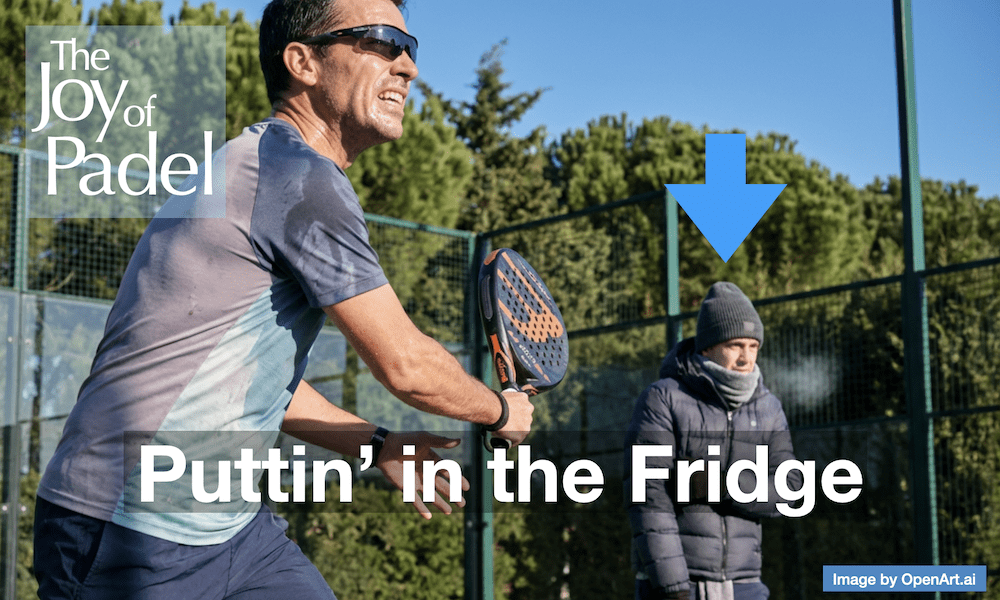
Picture the scene. It is a bright Saturday morning. Four players stride onto the padel court with the confidence of knights entering a jousting arena — helmets metaphorically on (although one year, it was a real helmet, after I had suffered a concussion), racquets gleaming, calves and glutes adequately warmed up. The match begins. After a few games, like a shimmering mirage in the desert, a tactic starts to take shape. On one side of the net, one player starts touching the ball with all the frequency of a traffic warden on a bank holiday. Meanwhile, their partner is playing the equivalent of a one-person show: returning, defending, smashing, sweating, and absolutely loving every second of it. One is hot and breathing heavily (a.k.a. in the oven). The other is dead cold.
Ladies and gentlemen, welcome to The Fridge.
What on Earth Is the Fridge?
The fridge, for those who have not yet had the pleasure of being unceremoniously stuffed inside one, is a padel tactic in which the opposition directs virtually all possible shots to one player — typically the weaker of the two — leaving their partner as cold, idle, and useful as a Norwegian Blue parrot nailed to its perch. The excluded player stands there, watching the ball sail past. They might as well be wearing a dressing gown and holding a cup of tea.
The logic is brutally simple: if one player is significantly better, you ignore them like a politely disguised lunatic at a dinner party. You hammer the other one, over and over, until the scoreboard reflects the fruits of your highly democratic decision to play the same person at every possible turn.
The Delicious Irony of the Targeted Player
Here is where it gets truly burlesque. The individual in the heat— i.e. the one being targeted — often has absolutely no idea what is going on. They are in the limelight. They are having a blast. Every ball comes to them. They feel important. Chosen. Special. A bit like the Black Knight after losing all his limbs — still shouting “Come on then!” with tremendous enthusiasm, blissfully unaware of the carnage.
Meanwhile, their fridged partner stands a couple of metres away, watching the entire match unfold from what may as well be the commentary box. At best, they spend the game calling out the opposition’s positions to their partner — Both back! Yours is coming! They’re both up now! — like a navigator in a rally car who has somehow been told they are not allowed to touch the steering wheel. The worst of it is when, on a loose ball, the opposition then thwacks the ball at the unprepared fridged individual. It adds ignominy to the futility.
The fridged player, for the record, may not even be the better player. Sometimes the opposition simply decides to play one person and one person only — perhaps out of habit, perhaps because they have an inexplicable vendetta, or as can be the case, because the targeting is subconscious. Players will naturally gravitate toward the “safer” option — for example, targeting the player whose returns are more predictable, less dangerous, more likely to result in a comfortable exchange rather than a searing winner down the line.
It is, at least in my mind, the sporting equivalent of when football teams stall when leading in a match (think: when a substituted player takes an eternity to leave the pitch, or the goalkeeper who tends to the cut grass before placing the ball down for a goalkick). Tactically sensible. Slightly cowardly. Utterly maddening.
What Can You Actually Do About It?
Now, unlike the Knights Who Say “Ni,” there are in fact practical remedies available. You do not have to simply stand there demanding a shrubbery while the match passes you by.
- Step one: Wake up and smell the freezer. Awareness is the first phase. If, after several games, you notice that nine out of ten balls are going to your partner, you are likely being fridged. This is probably not a coincidence. This is not the universe telling you to relax. This is a tactic, and having both players recognise it is half the battle. Often, the player in the oven can be oblivious. N.B. he/she can even take issue with the notion, as it can be viewed as an implied insult: are they’re playing on you because you are weaker?
- Step two: The you are the one being targeted, play the ball down the line as soon or as much as is practically possible. Rather than playing every ball cross-court/down the middle, and feeding the very pattern your opponents want, redirect your shots down the line as often as possible. This can incite the parallel player into the diagonal, which naturally pulls your fridged partner back into the game. Think of it as a gentle “excuse me, my partner exists” delivered in ball form. Beware: unless the ball is sufficiently difficult (down the line), it can just as easily be returned back down the line (and at the player in the so-called oven).
- Step three: If you are the one in the fridge, you have a few options to get out of it. Look for opportunities to intercept. Creep toward the middle. Poach a ball that is technically your partner’s. Yes, it requires communication, timing, and a willingness to occasionally whiff in spectacular fashion — but it breaks the rhythm of the fridge and reminds your opponents that there are, in fact, two of you on the court. Beware: such movement will create a gaping hole down the line. That’s the price of doing business. When it is the player on the right that is fridged and assuming he/she isn’t left-handed, the problem with trying to intercept is that you have to use your backhand. If it’s the left-sided player, it’s more natural to cover, for example, available shots (especially lobs) down the middle or to take the bajadas off the back wall.
- Step four: go nuclear. Talk to the opposition about it! N.B. This option is only conceivable in a non-competitive match, where there is nothing at stake other than possibly a point or two on Playtomic. Perhaps they’re not aware of it? There’s a big chance that talking about it will make the game even more testy. It’s often the case that they won’t agree. Or, they weren’t aware. Or, more poignantly, it shows how much they want those two Playtomic points. I’ve tried this last option a few times, and it has never gone well for me. Is it me, then?
When the Fridge Becomes a Moral Question
Here is where we leave tactics behind and wade into something more philosophical — the kind of thing that would have had Socrates banned from his local padel club.
Playing in a tournament? Fine. The objective is to win. Use the fridge. It is legal, it is common, it is a legitimate competitive strategy, and professional players apply it with surgical precision at the highest levels of the game. Just check out how many balls the smaller Fede Chingotto plays compared to Alé Galan (the team nicknamed Chingalan). The ideal, of course, is to have two evenly capable players alongside one another. Hence, the force and dominance of the Arturo Coello / Agustín Tapia partnership.
Meanwhile, in a casual game — where nothing is really on the line, where the whole point is enjoyment, exercise, and perhaps a post-match beer — fridging the better player says something rather unflattering about you (the fridger per se). It says: “I need to win so badly — and at all costs — that I am willing to play an entire match pretending one of your team does not exist.” It is the padel equivalent of only passing to the strongest player in five-a-side football because you’re terrified the others on your team will just lose the ball. Technically valid. Spiritually questionable.
And here is the kicker, the delicious irony, the punchline even John Cleese might admire: the very best way to improve at padel is to play against/at better players. To test yourself. To feel what it is like when a strong player pins you down. To throw up lobs that have to be perfect. Fridging the better opponent does not just rob them of a game — it robs you of a lesson. At the end of the day, the best learning happens through challenge, hardship, and defeat.
So, if you find yourself in a match where the fridge is being deployed in a no-stakes game, by all means finish the set with dignity. Then, when one of the culprits gleefully suggests a rematch, gracefully refer to your packed calendar. And, more importantly, stick to players who are there to enjoy padel — not just to win at it.
After all, it’s only a sport. And no one, not even the Black Knight, wants to end the day in a fridge.