
The Surprising Truth About Left-Handed CEOs, Presidents, and Power
I have long been fascinated with left-handedness. In my youth, I played a lot of racquet sports. Being right-handed, each time I faced a left-hander, whether it was in squash, or tennis, or padel, I always remember how much of a mental effort I had to make to compete against them. I thought that left-handers were special. So, when I met my wife-to-be, I had only one “requirement” in mind for my future spouse: she would be left‑handed. She is, emphatically, not. Yet our genes and the gods of laterality had other plans: both of our children are left‑handed—my daughter fully so, my son is a mix of left and right.
That little family anecdote captures something of the mystique around being a left‑hander. It’s not quite an identity, but it can feel like a tribe. Lefties are a visible minority—roughly 10% of the population—and for centuries they were treated as defective, deviant, or in need of correction. Today, however, our embrace of left‑handers (or at least our willingness to stop tying their hands behind their backs at school) tells us something about how far we’ve come.
From stigma to tolerance
Historically, left‑handedness was stigmatised in most of the world, with punishment or “training” to push children to use their right hand—especially in schools. Many Middle Eastern, African, South and East Asian countries stand out for their continuing discrimination against and/or fear of left-handedness. A 2013 article in the Smithsonian put it rather bluntly: “two‑thirds of the world still hates lefties.”[i] In particular, many Muslim-majority and Hindu-influenced cultures still consider the left hand unclean. And in Japan, Korea and China, it’s reported that parents and schools still push for right-handedness. Curiously, data on handedness in the West shows a striking dip in recorded left‑handers in the late 19th and early 20th centuries due presumably to a culturally conservative shift. Then, there was a steady rebound, flattening in the 1950s as the social pressure against writing with the left hand eased.
As I elaborate below, you can see this in political leadership too. Before the mid‑20th century, left‑handed leaders were either rare, hidden by forced switching, or simply unrecorded. Since the 1950s, recognition of left‑handed presidents and prime ministers climbs in all four countries I looked at (US, UK, Canada, France). That shift doesn’t just reflect biology—our genes didn’t suddenly change in 1950—it reflects culture catching up to reality and allowing left‑handers to be themselves in public.
Do left‑handers really “think differently”?
Popular culture loves the idea that left‑handers are right‑brain dominated, creative, and somehow wired to see the world from a different angle. Apple created a memorable slogan in 1997, Think Differently, shortly after cofounder Steve Jobs, who was left-handed, returned as CEO. That slogan has always deeply resonated with me. But it’s not just in my mind. The neuroscience backs up the difference, if in subtler tones.
Large brain‑imaging studies comparing thousands of left‑ and right‑handers show real differences in brain asymmetry, but not a binary “lefties are right‑brained” story. Left‑handers tend to have less extreme lateralisation in certain motor and sensory regions and a somewhat different pattern of asymmetry in language, attention, and visual areas. In several regions related to hand control and working memory, left‑handers show different balances of grey matter between hemispheres; some higher visual and parietal areas even show more left‑ward lateralisation in left‑handers than in right‑handers.
What does that mean in practice? The emerging picture is that left‑handers, on average, may have:
- Slightly more distributed networks across hemispheres for some functions.
- Different patterns of connectivity in attention, motor control, and perhaps social processing.
Psychology researchers have long been interested in whether left‑handers are more creative. Reviews of the literature suggest the bold claim “left‑handers are more creative” is too simplistic, but there is some evidence that left‑handers perform better on divergent thinking tasks—generating many unusual ideas or connections in a short time. For example, they have to deal with adapting to scissors, computer number pads, and handwriting with ink (albeit less these days!)… Divergent thinking is only one ingredient of creativity, but it’s a key one if you’re trying to “think differently.”
So yes: left‑handers do seem to think differently in aggregate—but in nuanced, statistical ways, not in a neat myth of right‑brain dominance. And I enjoy the fact that there’s a bit of mystery.
Left‑handers in the corner office
If you want a contemporary test of whether this “different wiring” might matter, look at founders and CEOs.
A 2025 study, published in ScienceDirect[ii], of more than 1,000 CEOs across 472 firms found that companies led by left‑handed CEOs produced significantly more patents, and more original patents, than those led by right‑handers, alongside better financial performance on metrics like return on assets and stock returns. The left‑handed CEOs also tended to hire more foreign employees, which correlated with greater innovation output—suggesting a broader openness to diversity. I don’t know about you, but that certainly got my attention.
Beyond the stats, the anecdotal list of left‑handed business luminaries is impressive. Apart from Steve Jobs mentioned above, there’s Bill Gates, Mark Zuckerberg, John D. Rockefeller, Henry Ford, Ratan Tata, Oprah Winfrey, Steve Forbes, former IBM boss Lou Gerstner, among others. It’s hard to claim causation, but it’s equally hard to ignore the clustering of high‑impact founders and CEOs among that 10% minority.
If you like slogans: think differently, act differently, be different, you might have some left‑handedness in your genes?
Political lefties?
In politics, the handedness of the heads of state paints rather different stories per the four countries I know best: United Kingdom, France, United States and Canada. I cannot fully vouch for all the data below, despite all the help from Perplexity. But the numbers have got to be close to right. What screams out is one common trend: since 1950, each country has seen more left-handed heads of state as a percentage of total. That’s not hard, since there were no recorded left-handers in the UK, Canada or France up until 1950.
| Country | Total Leaders* (All Time) | Lefties up until 1950 | % up until 1950 | Lefties Since 1950 | % Since 1950 |
| US Presidents | 45 | 2 | ~4% | 6 of 14 | ~43% |
| UK Prime Ministers | 58 | 0 | 0% | 2 of 18 | ~11% |
| Canadian PMs | 24 | 0 | 0% | 1 of 14 | ~7% |
| French Presidents | 25 (all republics) | 0** | 0% | 2 of 8 (Ve) | 25% |
*Total individuals who could have had more than one term.
**France’s data on handedness is particularly obscure and will be worth further scrutiny.
In total, for the four countries, we’ve gone from 2.0% overall pre-1950 to 16.4% post-1950.
Political irony
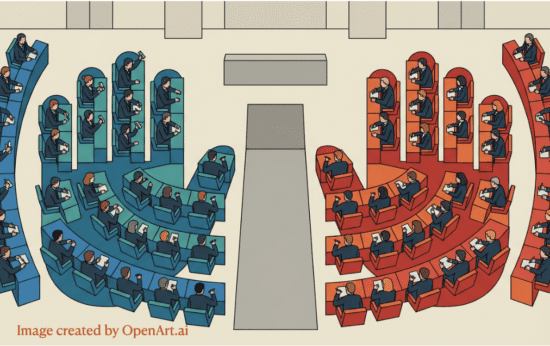
The political handedness story has a deliciously ironic twist. When we looked at the left‑handed top leaders across the US, UK, Canada, and France, more of them turned out to be right‑leaning than left‑leaning.
Among U.S. presidents commonly counted as left‑handed or naturally left‑handed—Hoover, Truman, Ford, Reagan, George H. W. Bush, Clinton, Obama, plus often Garfield—only Truman, Clinton, and Obama would be clearly placed on the left or centre‑left. Hoover, Ford, Reagan, Bush Sr., and Garfield are all on the conservative or centre‑right side.
In the UK, the two main left‑handed prime ministers identified are Winston Churchill and David Cameron, both Conservative leaders. In Canada, the one clearly documented left‑handed PM is Joe Clark, another centre‑right Progressive Conservative. And in France, if you treat François Mitterrand and Nicolas Sarkozy as “gauchers”, you get a perfect split: one Socialist, one leader of the liberal‑conservative right.
All told, across these four countries’ left‑handed leaders, you end up with roughly twice as many right‑leaning as left‑leaning. That’s politically ironic: in a world where “left” is supposed to symbolise progress, rebellion, and change, the literal left‑handers in power have often been the ones defending markets, hierarchy, and tradition. In the fluid ideological landscape since the 2000s—where “right” parties borrow social‑liberal ideas (for example: in the US, Trump broke with the right-wing orthodoxy of free trade) and “left” parties endorse market‑friendly reforms (for example: Clinton championed NAFTA, deregulation and endorsed pro-market free trade)—the symbolism becomes even more delightfully scrambled. [See the “Political Scramblings” table at the end this post for how left and right have become scrambled in each country.]
Progress, but no guarantees
What does all this tell us?
First, the growing visibility and acceptance of left‑handers—from classrooms to corner offices to presidential residences—is indeed a sign of social progress. A society that no longer forces children to write with the “correct” hand is, at least on that axis, more willing to embrace our natural selves, aka our genetic differences.
Second, the neuroscience and business research hint that diversity in lateralisation—how our brains and bodies are wired—may contribute to diversity in how we solve problems, lead teams, and innovate. Left‑handers aren’t superior, but they bring statistically different patterns of attention, motor control, and perhaps divergent thinking—precisely the raw material you want if you believe in “think differently, act differently, be different.” I’ve long been a fan of diversity of thought, rather than visible diversities (albeit handedness is observable to the keen eye). [BTW I’ll be writing in another piece about how left-handers fare in tennis and padel in a future article WTS!]
But third, the political record is a fine reminder that difference is not destiny. Left‑handed leaders have supported austerity and welfare, war and peace, deregulation and redistribution. There is no automatic alignment between the hand you write with and the values you fight for. Left‑handedness might nudge you toward a different way of processing the world; it doesn’t write your manifesto.
Acceptance of left‑handers is, in that sense, a useful metaphor for progress: essential, humane, and correlated with better outcomes—but never a guarantee. The real work remains in what we do with our differences, not just how we carry a pen. And there’s much I would like to add about what actually constitutes progress, but that will be for my new book, The Avatar Trap.
Political Scramblings – When Left Borrowed Right (and Right Borrowed Left)
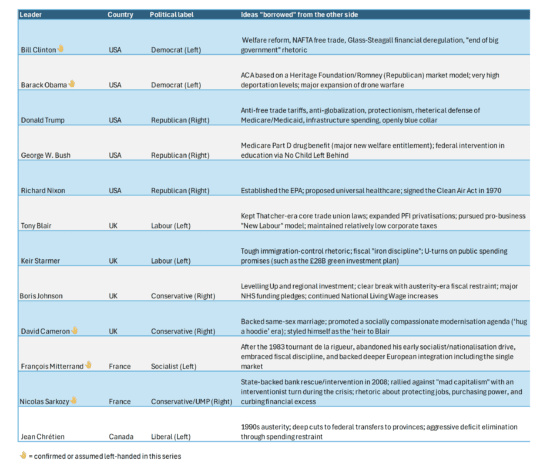
N.B. If even our left-handed leaders can’t reliably govern from the left, perhaps the only hand that truly predicts political behaviour is the invisible one — the market.
————————–
Disclosures: During the preparation of this work, I used Perplexity and ChatGPT to help source the full list of business leaders and heads of state (including their political leaning) and their handedness. After using these tools, I reviewed and edited the content to the best of my abilities and take full responsibility for the content of the publication. I reiterate that the data about heads of state may yet be improved.
[i] https://www.smithsonianmag.com/smart-news/two-thirds-of-the-world-still-hates-lefties-64727388/
[ii] https://www.sciencedirect.com/science/article/abs/pii/S2214635025000346