
The 2025 Alpine Paris Major at Roland Garros has set a new benchmark for itself, delivering an extraordinary experience that showcased padel’s rapid evolution and growing global appeal. From unprecedented attendance figures to fascinating gameplay dynamics, the tournament has established itself as a crown jewel in the Qatar Airways Premier Padel Tour calendar. While padel doesn’t yet bathe in a sea of data, in general, I wanted to plumb the depths of the available data to elevate padel!
Spectator Engagement Reaches New Heights
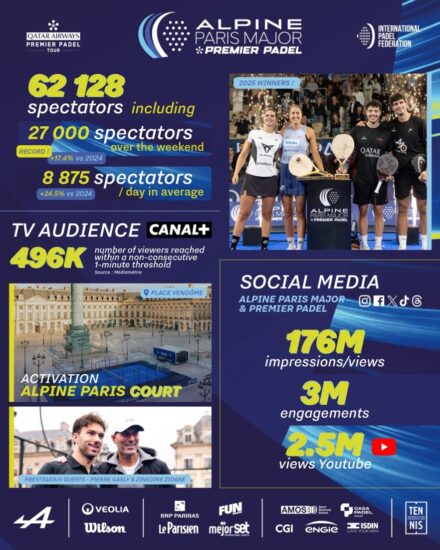
First, to note that the Paris Major 2025 delivered remarkable attendance figures that surpassed expectations across all metrics. With 62,128 total spectators – including 27,000 over the weekend alone – the tournament demonstrated padel’s ability to fill prestigious venues with passionate fans. The weekend surge shows how the tournament has become a must-see sporting event in the City of Lights. This weekend stat at the Paris Major compares favourably to levels reached at the other big dates, such as the Barcelona Masters (c. 29K), Madrid P1 (24K), Rome BNL Italy Major (20K), and Buenos Aires P1 (32K). For reference, the Hexagon Cup 2025 in Madrid had a capacity crowd estimated at around 12,000 over the weekend. The +17.4% increase in Paris versus 2024 represents significant year-over-year growth. The daily average attendance was 8,875 spectators (+24.5% versus 2024), indicating consistent fan engagement despite the constraint of workweek agendas.
Media and Digital Dominance
The tournament’s media reach was equally impressive, with the French station Canal+ achieving 496K viewers within a non-consecutive 1-minute threshold[i]. This television audience reflects the growing mainstream appeal of professional padel in France and demonstrates significant progress in broadcast engagement. [N.B. If you’re living outside of France, you have to go to RedBull.TV].
The digital footprint was even more spectacular, with the tournament generating 176 million social media impressions/views across platforms, 3 million total engagements, and 2.5 million YouTube total views. These numbers position the Paris Major as one of the most digitally engaged professional padel events globally, outperforming many traditional sports in terms of social media reach per spectator.
Gameplay Dynamics: Longer, More Strategic Points
According to exclusive data from Padel Intelligence, the Paris Major 2025 featured longer rallies than the average professional padel tournaments, indicating a slower court, higher level of strategic play and defensive capabilities.
Among the Men, their matches averaged 8.87 shots per point compared to the season average of 7.95. The slower court conditions required more patient, tactical gameplay rather than aggressive point-ending strategies. Research shows that when points last 10-11 hits, the duration is between 13.5-15 seconds.
Women’s rallies were even longer, averaging 10.99 shots per point versus the season average of 9.52, a 15% increase, where defensive prowess and strategic play were on full display. Professional women’s padel typically features longer points than men’s due to different playing styles and power, but the Paris Major amplified this characteristic quite significantly. Given the women’s style of play, it’s highly recommended for us mere mortals (i.e. amateurs) to watch and learn from the women’s professional game.
Game length for the men and women
Thanks to the prodding of MM (you know who you are!), I wanted to include some stats on the average match lengths!
| Paris Major 2025 (main draw) | Men (46 matches) | Women (39 matches) |
| Average length of match | 1h19 | 1h37 |
| Average sets per match | 2.18 (100 played) | 2.22 (89 played) |
| Average games per match | 19.7 | 20.0 |
| Average length of a set | 36.3 minutes | 43.5 minutes |
| Average length of a game | 4.0 minutes | 4.83 minutes |
These stats underline how (a) women’s matches are typically longer affairs, even though the score lines (and the number of sets and games) are roughly equivalent. The average length of game speaks less to the number of points played but the average length of a point.
Performance Analysis: Elite Players Rise to the Occasion
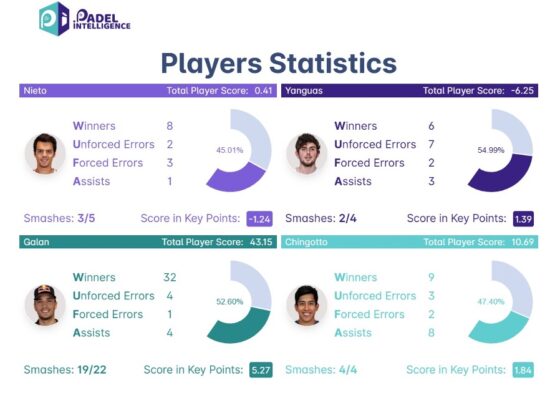
The Padel Intelligence data reveals fascinating insights about how elite players respond to high-pressure environments. The analysis of Alejandro Galán’s performance throughout the tournament demonstrates the dramatic swings possible in professional padel at the highest level. In the graph below (from Padel Intelligence), you can see the variation in Galán’s Contribution Score[2] between the semi-final and final.
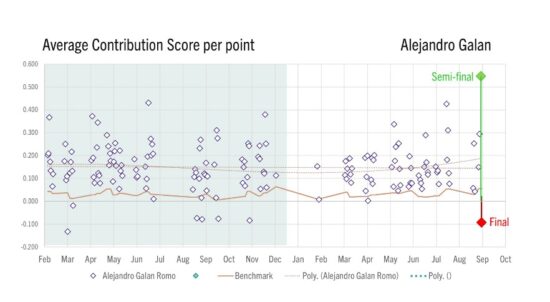
Galán’s semifinal performance (against Yanguas/Nieto) was epic, and was statistically his best match since the beginning of 2024, significantly outperforming the average professional player contribution score across all tournaments. Not only was the score an outright drubbing (6-0, 6-2), Galán hit 32 winners while only committing 4 unforced errors (and 1 forced error). His partner, Fede Chingotto, chipped in 9 winners and had only 3 unforced errors. That’s a total of 7 unforced errors in two sets by the Chingalan duo.
However, in a remarkable contrast, Galán’s final performance ranked as his second-worst match of the year, with 12 unforced errors and just 11 winners (Chingo had 8 and 7 respectively). This illustrates the psychological and physical demands of competing against the world’s number 1 pair: the magician Agustín Tapia and the King Arthur (Coello). I would suggest that it also shows how one partner’s performance (and mindset), Galán, can upset the other’s, Chingotto!
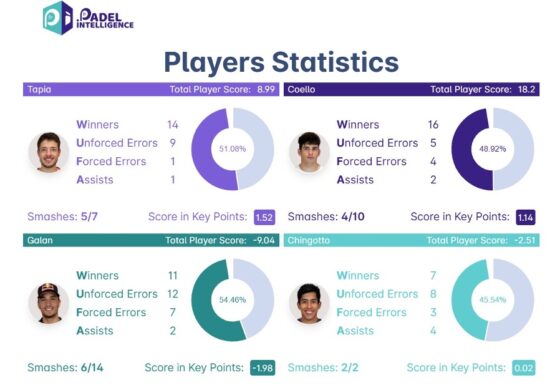
This “flip-flop” performance pattern highlights how important (and difficult) it can be to adjust to different opponents. Perhaps, the Paris Major’s setting in the huge Philippe Chatrier stadium at Roland Garros also creates a different competitive environment compared to typical padel venues.
Technical Playing Characteristics
Something that the Padel Intelligence data showed me is that, in fact, the balance of work between left and right sided players is closer than I had thought. For the men, this season, the left-sided player (“backhand”) takes 51% of shots versus 49% for “drive” side. For the women, it’s 52%-48%. Meanwhile, it is worth looking at the statistics available on PI (you can sign in… it’s FREE, and start at page 514 for the Paris Major 2025 stats). You can then see stats match by match.
Men’s Performance Highlights at Paris Major 2025:
- Winner percentage: 5.9% compared to seasonal average of 6.2%, showing slightly more conservative play (and the impact of a slower court)
- Serve efficiency: 89.3% first serve success rate, demonstrates how incredibly consistent the pros are. {Caveat: What’s your 1st serve percentage?} The difference in win rates between first and second service is typically around 3-4 percentage points, which can sometimes make the difference in a game of up to 4 points.
- Volleys comprised 27.0% of all shots, slightly below seasonal averages of 29.8%, while lobs were hoisted 25.5% of the time versus 22.8% {N.B. how many lobs the pros hit, BTW!)
Women’s Performance Highlights:
- Lob usage: 30.8% of all shots compared to 29.5% seasonally, indicating strategic patience and highlighting how essential the lob is {Again: how many lobs are you hitting?}
- Serve points won: 56.2% compared to 57.9% seasonal average which is significantly lower than for the men (61.7% and 63.3% respectively) and shows how little the service counts versus lawn tennis, for example
Celebrity and Cultural Impact
The tournament attracted an array of sporting and entertainment personalities, including Formula 1 driver Pierre Gasly, the football legend Zinédine Zidane, as well as Fabián Ruiz, Samir Nasri, and Raymond Domenech. This celebrity presence, combined with the Place Vendôme activation, underlines padel’s growing appeal among high-profile athletes and entertainers. The combination of prestigious venue, celebrity attendance, and record-breaking statistics positions the Paris Major as professional padel’s premier showcase event, setting new standards for tournament presentation and fan engagement that other events will strive to match. The Paris Major’s success occurs within padel’s broader global expansion, where Premier Padel viewership has jumped 30% globally this year and the tour now features 24 tournaments across 16 countries. I think it’s fair to say that the Roland-Garros tournament’s statistics demonstrate how prestigious venues can elevate player performance and fan engagement beyond typical professional padel events.
Conclusion
The 2025 Alpine Paris Major has racheted up the bar as to what’s possible in professional padel, combining record-breaking attendance, exceptional media reach, and elevated gameplay to create a tournament that transcends traditional padel boundaries. The statistics – which are deeply appreciated by padel geeks like myself – reveal a sport reaching new levels of professionalism and mainstream appeal, with the iconic Roland Garros setting providing the perfect backdrop for padel’s continued global expansion.
[1] The Contribution Score, according to Padel Intelligence, is a measure of the impact of each player throughout a padel match. It is obtained as a weighted combination of the game’s actions that most contribute to deciding the point (both positively and negatively).
[2] Paris-Major-Stats-2025 from Premier Padel https://fft.hosting.augure.com/Augure_FFTPresse/ImageBank/2233_638938729969668772.jpeg