The Overhead in Padel: Nobody Expects the Spanish Smash-quisition
If you’ve come to padel from tennis, let me save you some heartache: your impression of your overhead is wrong. Not your technique — well, maybe that too — but your entire concept of the overhead. In tennis, the overhead is essentially one shot: a smash. You see a lob, you wind up, you smack it. Done. In padel, the overhead is less a single shot and more a sprawling family tree of options, each with its own personality, purpose, and Spanish name you’ll gleefully mispronounce for your first year on court.
As the great Argentine Fernando Belasteguín — “Bela,” aka “The Boss,” the man who held world number one for sixteen years — once put it: “Today I am a better player than yesterday, but tomorrow I will be much better than I am today.” That relentless improvement mindset is exactly what you’ll need, because mastering padel overheads is a journey, not a destination. And unlike the quest for the Holy Grail, this one has more than three questions at the Bridge of Death.
The Three Dimensions of the Overhead
In padel, you don’t just decide to “hit an overhead.” You must make three interlinked decisions — and quickly, before the ball lands on your head like a coconut from a European swallow. First, there’s the stroke: which of the eight overhead variants will you select (more on them below)? Second, there’s location: where on your side of the court are you, and where is the ball relative to your body? Third, there’s direction and intention: where are you sending this ball, and what do you want it to do when it gets there? As the ball floats down, you must make a decision and execute. Unless you’re an advanced player, it’s best to make up your mind early and stick to it. Dithering is the enemy. As we say in Monty Python terms: “Choose wisely, or you shall not pass… the net.”
1/ La Bandeja — The Tray
The bandeja is a pure padel shot, perhaps the most iconic one [bandeja is pronounced ban-de-ha, with a guttural “ha”, think of Manuel’s accent in Fawlty Towers]. This shot does not exist in any other racket sport. It’s an overhead where the player cuts the ball on the lower side, striking it at roughly shoulder height. According to the LTA, the bandeja accounts for a staggering 69% of overheads in the women’s professional game — making it the workhorse of the padel air game. Its purpose is elegant: maintain control, retain your net position, and make the ball die before it pops invitingly off the back wall.
One of the maestros of this shot was the long-time reigning champion, Belastaguín. Indeed, the so-called “Bela Bandeja” is named after him — a technique where the arm stays a little straighter, using the chest as a prime mover rather than relying on the elbow extension of a víbora (see next). With 230 titles and 286 finals played across his 30-year career, Bela proved that control and intelligence beat brute force — a lesson the Black Knight never quite learned.
Key insights: the bandeja is a concept shot, where the real purpose is just to keep the net. Length is everything. Use the bandeja to buy yourself time to recover to the net, feathering it toward the service line on the other side. The better the cut, the less it will pop off the back wall.
2/ La Víbora (vee-bora) — The Viper
Often confused with the bandeja, la víbora — the viper — is more of an attacking overhead shot. Who better to learn from than one of the best in the business, Sanyo Gutiérrez (also Argentinian), who has described how he always tries to “scratch the ball on the side to generate as many revolutions as possible and give it the greatest depth so the ball comes out as low as possible.” The víbora is an overhead where you strike the ball on the outside — away from your body — at or above shoulder height, but a little further out in front than a bandeja. It can be hit with more aggression and produces a different trajectory, with a bounce off the back wall that, when hit cross court, tends to spin more or less viciously to the right (assuming a right-hander is hitting it). If you hit diagonally from the right side of the court, it has a nasty tendancy to come back on itself and go straight up the side wall. The reverse is true when a left-hander hits it.
Gutiérrez innovated the víbora specifically to differentiate himself from other players who relied heavily on the bandeja. His approach — speed, spin, and tactical variation — turned the shot into one of the most feared weapons in the modern game.
Key insight: it’s tremendously useful to mix up between bandeja and víbora, keeping your opponents permanently guessing. The options for the víbora change depending on your position. For example, on the right side for a right-hander, you can aim your víbora directly toward the side netting or the pico (junction between the netting and glass) on the left. On the left side, a víbora down the middle can be a good option.
3/ El Rulo — The Roll
Think of el rulo (a la verja) as a relaxed kick or second serve. It’s a rollover shot that is coming over your left shoulder (as a right-handed player) where you aim to brush the ball into the side netting on the diagonal. The maestro of this shot is the flamboyant Sevillano, Paquito Navarro, a man whose aggressive style and court intelligence earned him the distinction of being the only Spanish player who’s been Spanish Champion in every category. Nobody can anticipate what will happen with the rulo — much like nobody expects the Spanish Inquisition — and that’s precisely its charm.
Key insight: When you’re playing on the left side, choose this shot when the ball is lobbed over on the far left (think of a 2-metre alley) of the court to give you the best angle. My advice is to turn your entire body around (bum to the net) and then take the ball high with lots of wrist. And don’t forget to rush back to the centre at the net to cut down the angles of the return shot. You (and the opposition never know where it will end up). As the French soldier said in MP and the Holy Grail, “You don’t frighten us with your silly knees-bent running around advancing behavior!” — but do prepare for the unexpected.
4/ El Gancho — The Hook
El gancho is the quiet, diplomatic member of the overhead family. It’s a straight-arm shot where you strike the ball flat on the back, producing a softer delivery — typicaly down at the opposition’s feet — designed to help the you keep the net position. Think of it as the “ministry of silly walks” of overhead shots — understated, oddly effective, and misunderstood by those who haven’t studied it.
Key insight: this is a positional shot, pure and simple. A typical example is for the right-side right-handed player to hit a gancho against a lob going over the left shoulder, either back down the middle or at the diagonal player. It won’t win highlight reels, but it helps you keep the net.
5/ El Remate — The Smash
Now we talk about the big one: el remate. The smash. The headline act. The full Monty (Python) and the one tennis players thrive on. This can either be a topspin kick or a flat smash, and ex-world number one Juan Lebrón renowned for hitting it, despite playing on the right. His 60% smash success rate in 2025 places him among the most lethal finishers on the Premier Padel circuit. As Sandy Farquharson of The Padel School observed, Lebrón’s smash wins points not just through raw winners, but through the “intimidation factor” — opponents know that any lob in his zone can end the rally, so they squeeze their targets tighter and tighter until errors creep in.
The topspin smash is less about brute power and more about technique. It feels and looks like an exaggerated second-serve action in tennis — brushing over the top of the ball. If you want to bounce it out of the court off the back wall (“por tres” or by 3), hit it as high as possible, ideally arching backwards, aiming to strike the ball directly above or even behind your head. If you’re aiming to have the ball come back to your side of the court — whether flat or topspin kick — this is a high-level shot that demands precise execution. The shallower the lob, the more the chance of success. However, be wary when the court conditions are slow (including when it’s cold), as the ball may end up as a sitter for your opponents to put away.
Key insight: where you aim on the ground depends on how far back you are in the court. And remember — as Belasteguín wisely noted about the pro game: “Speed must have a purpose. I can hit every shot fast but it would lack meaning. Professional padel is speed with purpose.”
6/ El Amago — The Fake Smash
The fake smash only works when the opponents are wary of your big hit. The amago (de remate) is the con artist of the overhead family. This is the fake smash, where the player sets up as if about to unleash the full wrath of the gods, only to produce a delicate little dink instead. The idea is for the second bounce to die near or off the back wall, while the opposition rushes forward in anticipation of dealing with a hard smash. It’s the padel equivalent of the Black Knight confidently expecting a sword blow, only to find his opponent doing a silly walk right past him.
Key insight: you need to earn the right for the amago by first proving you can pop the smash. If you’ve never scared your opponents with a genuine banger, the fake loses all its power. Having a similar set-up and stance as when you hit the bona fide smash will help you disguise the fake. Deception without credibility is just… waving a racket about.
7/ Por 4 — Literally “By 4” = Popping it over the 4m wall
The ‘por 4’ is a little like a dunk. You need to get on top of the ball and smack it on the ground hard enough that it exits the court over the 4m fencing. The ‘por 4’ will be played in three different ways. First, there’s the lob that is short, barely coming on your side of the court. You’ll need to advance quickly and hit the ball well inside the court in order to clear the 4m. Secondly, there is smash that’s been hit at you so hard that it bounces off the back wall and headed back on to their side. You need to strike the ball on the return trip from the back wall and again pop it out, using a maximum amount of wrist. The third variety of ‘por 4’ is not so much an overhead, but is a wristy snap on a drive from the opponent that is so readable you can jump on it and flip it out.
Key insight: the ‘por 4’ is a terminating shot since, if it goes out over the 4m section of the wall (i.e. glass + fence), the ball is immediately dead and cannot be put back into play. However, if the ball fails to clear the wall, beware, it may yet be coming back!
8/ La Bajada — The Descender or the Bullet
This is another padel specific shot and relates to a deep lob that lands near the back glass and comes off with enough space for you to take it high and drive it. If the lob went over your head but without enough height, you play it as you would any other shot off the wall, including hitting a lob if you are in the right position. The bajada comes with a number of options, including how you strike the ball, the direction and speed. Paquito Navarro invented the bajada cuchilla, which is literally the knife shot (I think of it as a víbora, with a laser like trajectory). The leftie and world number 1, Arturo Coello, has one of the most vicious bajadas. But for us mortals, the bajada is a chance to attack from the back, knowing that most of the time, the opposition will be at the net waiting to block your bullet. As much as it may be tempting to thwack the ball, if you get your positioning and racquet head right, you can also deploy a fast lob or do a high-to-low dink over the net (either at the feet or into a space).
Key insight: if the ball doesn’t pop out enough or bounces up to the 4 metre netting, then play a safe shot. The bajada doesn’t have to be a winning shot with a low margin of error.
Bringing It All Together
The overhead in padel is a decision tree dressed up as a single shot. It demands that you read the lob, assess your position, pick your weapon, choose your target, and execute — all in the time it takes for a ball to float down from the sky. Get it right, and you’re Lebrón thundering a remate por 3. Get it wrong, and you’re the knight with no arms insisting it’s just a flesh wound. In the diagram below, I’ve cut the court up into five different areas, when playing on the left.
Left-side (Backhand) Zoning
In the image below, you have five zones on the left side, which show how I tend to divide up the court to help organise my shot decision-making.
- This #1 zone is where I will play the rulo over to the side setting. If it’s a fast lob (i.e. not very high), I may be forced to play a gancho or, depending on my speed of displacement, a high backhand volley (with the main intention just to keep the net).
- A shorter lob to this area (depending on how short), you need to be in “killer” mode. You will have a good number of options depending on your readiness and abilities. This is ideal for me to hit a smash. This can be a flat aka winter smash or a kick smash that can go out of the court. How far back you go to activate the smash will depend on your level. Alternatively, you may be able to do a simple ‘por 4’.
- In this zone, this is still an attacking shot, but I’ll only use a víbora. I’ll aim the ball mostly at the fifth panel (#1 is the far left back glass) so that it can spin over to the side. Down the middle is also a good option, depending on where the opponents are. Depth is key. You can also aim at the opponent’s feet.
- When I’m hitting an overhead in zone 4, I have a varietal which will include dropping the ball with a lot of wrist down the right side or even into the side netting on the right. Otherwise, the bread and butter shot is the víbora into the corner.
- The bandeja zone. The line that defines how far back for zone 5 will again depend on your mobility and strength. Here the shot is all about retaining the net. If the ball’s too deep for me, however, it’s best to let it bounce and reset. Striking a bandeja while back-peddling is a bad idea for a number of reasons, including never being able to get back to the net in time. You’ll also be lacking in verve in your shot.
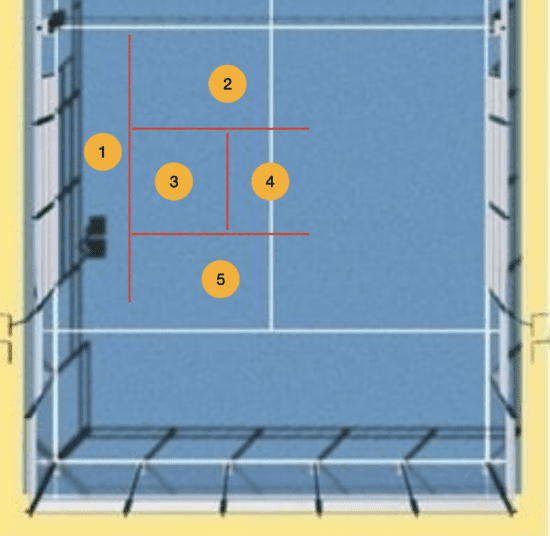
Zoning on left side padel player for overheads
Right-side (Drive) Zoning for a Right-handed player
Playing on the right side as a right-handed player is (and should be) a different experience. Although Juan Lebrón revolutionised it by adopting a far more dynamic and explosive style, the role of the right-sided player is to control and set up the play. We often talk about this player as the more consistent of the two players (see my article on “Which Side Should You Play?“). As such the shot selection and intention will change. In addition, the bio-mechanics are different as well versus playing on the left. Here are the different ways to approach your right sided overheads.
- In the far right alley, technically you have a good angle to zing the ball over into the side fence on the other side. Obviously, the shallower the ball, the better the angle. Hitting over to the side fence deeper in zone 1 requires more skill.
- As with the left side, any high ball that is in zone 2 is worth attacking aggressively. If the ball is over your left shoulder, it’s probably best to let your ready partner to latch onto it with his/her forehand. However, it’s not uncommon to see right handed players hit flat smashes or even kick smashes from here. And, depending on your footwork and reactions, you can also hit a ‘por 4’ in this zone.
- This is the bread and butter overhead for most right-sided players. It demands the víbora diagonally into the far corner. Depth, direction, variety of spin, and force can be modulated to keep the opposition guessing.
- If the lob is mid court and going over your left shoulder, this may well be a ball for your partner. Otherwise, it’s typically a gancho to the centre or diagonally. Some quick players will be able to hit a vibora-like shot down the line into the parallel corner.
- Finally, zone 5 is where you are pushed back but can still get forward momentum on your shot. The concept here is, as with the left side, to push the ball back through a space between your opponents in order to maintain or regain the net. This can take the form of a bandeja or a slow víbora.
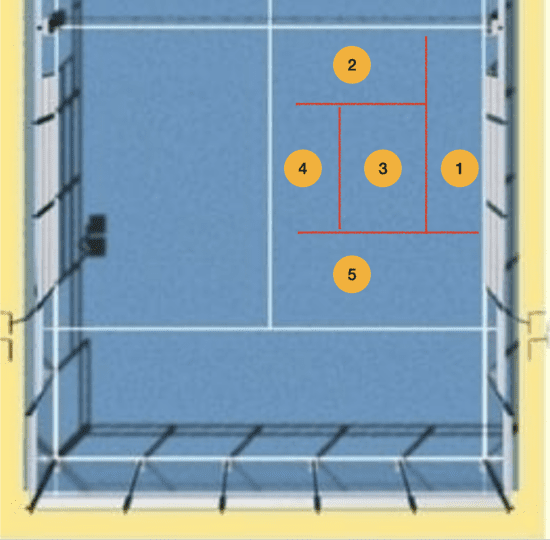
Zoning on left side padel player for overheads
Final Touches
Here are the final touches when it comes to dealing with overhead shots. There are some general principles to bear in mind for every occasion (and every level). First, the footwork is vital. Seeing the lob quickly off the opponent’s racquet will help you to anticipate. Back pedal sideways, right arm cocked with the right grip for the shot, left arm up to track the ball, and then decide on the shot placement. Once you’ve decided, it’s usually a good idea to stay with your decision, otherwise, you can end up with the proverbial #imhuman mistake. The next big principle that’s true for basically all your padel: concern yourself most with where the second bounce will be. Think of it like a cue ball in snooker. After you’ve potted your ball, you want to know where the white ball will end up! Finally, regarding the overhead, if the lob is very high (aka “pinchado” as we say in Spanish), then don’t be embarrassed just to connect with the ball and push it back with, for example, a gancho or bandeja. Even the pros will do that.
The beautiful thing about padel? There’s always tomorrow’s game to get better. And as Bela taught us: “A Belasteguín never gives up.” Neither should you. Now get out there and practice your bandeja — and for heaven’s sake, always look on the bright side of the court.