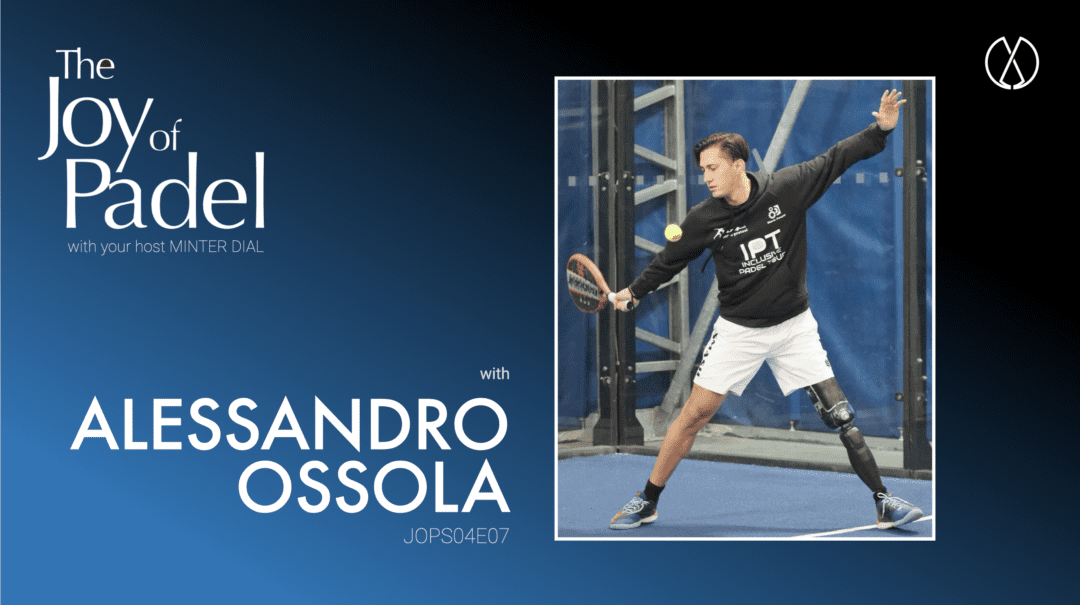
The Joy of Padel podcast with Alessandro Ossola (JOPS04E07)
On the latest episode of the JOY OF PADEL podcast, I had the true privilege of meeting Alessandro Ossola. Until our conversation, we’d never crossed paths in person. Alessandro’s story had been shared with me by our mutual friend, Arjun Singh, and I was fascinated by his journey—an extraordinary blend of resilience, optimism, and love for sport that’s nothing less than inspiring.
Background on Alessandro Ossola
From the outset, Alessandro describes himself not through achievements or titles, but as “a lucky guy” who has everything he needs to be happy. That outlook, however, is forged from hardship—a life-changing motorbike accident in 2015 left him with the amputation of half his left leg and the loss of his wife at the same time. Yet, rather than turn inward, Alessandro powered forward—emerging not only as a Paralympic sprinter, representing Italy in Tokyo, but as a joyful, adaptive athlete and social leader. His passion for sport led him to become the founder of “Bionic People” and the driving force behind the Inclusive Padel Tour, both designed to give people with disabilities renewed purpose, community, and access to sport.
Main Topics Covered
Our conversation took us from the raw realities of trauma and healing to the redemptive power of movement. Alessandro opened up about the doubts and fears that cloud a new identity after disability, and how essential friends, loved ones, and community are in keeping you moving forward. Sports, he shared, are not just a distraction, but a lifeline—a “train” that can take you out of darkness if you step aboard.
We dived into the magic of padel and why it’s so accessible—even when, as Alessandro noted, you need to “read the ball,” compensate for limits, and unlearn the urge to smash every ball out of sheer adrenaline! The Inclusive Padel Tour came alive from Alessandro’s vision: to bring people together, pairing “bionic” and able-bodied partners in competition and camaraderie, across Italy, Monte Carlo, and now beyond. We explored the joy and challenge of making padel truly inclusive—recognizing the importance of adaptation, the limits in our minds, and the role of clubs and infrastructure in breaking down barriers for every kind of player.
Three Takeaways from My Conversation with Alessandro Ossola
- Adversity is a springboard, not an anchor. Alessandro’s story reminds us that traumatic events do not have to shrink our worlds—instead, with determination, loss can open doors to new communities and renewed ambition. Padel played a pivotal role in his recovery and serves as a model for others battling setbacks.
- True inclusion is about community and attitude. The Inclusive Padel Tour shows that welcoming everyone isn’t just about access ramps or rule tweaks—it’s about fostering a spirit where people of all abilities are valued, paired up, and encouraged to connect and compete. An adaptive mindset and a joyful approach can make all the difference.
- Information and visibility change lives. Alessandro is adamant that seeing others like yourself playing padel—or even just a visible poster—can be the catalyst for someone to try, believe, and join in. Clubs, schools, and businesses have a real opportunity to break down barriers simply by spreading the word and showing what’s possible.
If you want to learn more, support Alessandro’s initiatives, or connect with bionic athletes ready to play, visit inclusivepadeltour.it or bionicpeople.it—and never underestimate the power of community. As always, let’s keep padeling forward together!
To connect with Alessandro Ossola:
- Check out Alessandro Ossola’s eponymous site here
- Find or follow on Instagram: @alessandro_ossola
- Discover Bionic People: bionicpeople.it
- Learn more about the Inclusive Padel Tour: inclusivepadeltour.com
To listen to the show:
To listen to The Joy of Padel podcast, you can use the embedded player above, or go find it on Spotify, Apple Podcasts or any number of other podcasting services listed here.
Send in your questions or reactions:
Please send me your questions — as an audio file if you’d like — to nminterdial@gmail.com. Otherwise, below, you’ll find the show notes and, of course, you are invited to comment. If you liked the podcast, please take a moment to review and/or rate it! ¡VAMOS!
Further resources for The Joy of Padel:

The Joy of Padel podcast, hosted by Minter Dial, a padel tennis player since 1974, is an exhilarating show that delves into the captivating stories of notable padel personalities worldwide.
Meanwhile, you can find Minter's other Evergreen podcasts, entitled The Minter Dialogue Show (in English and French) in this podcast tab, on Spotify, Megaphone or via Apple Podcasts.
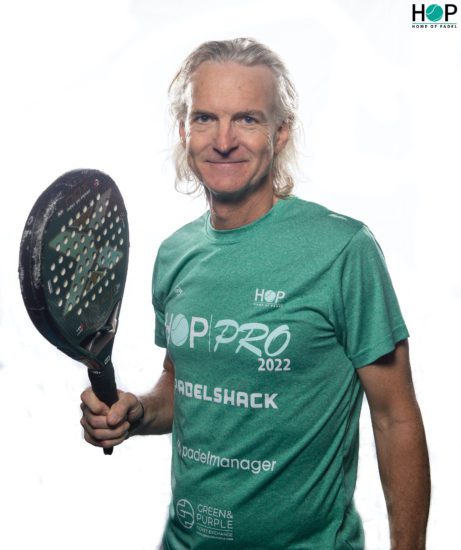
About the host: Minter Dial
Minter Dial is an international professional speaker, author & consultant on Leadership, Branding and Transformation. His involvement in sports has been a lifetime passion. Besides playing 18 years of rugby, captaining athletics teams, coaching tennis and playing squash for his university, he’s been a lifelong player of padel tennis, starting at the age of 10, from the time of its very first public courts at the Marbella Club in 1974.
Then, after a successful international career at L’Oréal, Minter Dial returned to his entrepreneurial roots and has spent the last twelve years helping senior management teams and Boards to adapt to the new exigencies of the digitally enhanced marketplace. He has worked with world-class organisations to help activate their brand strategies, and figure out how best to integrate new technologies, digital tools, devices and platforms. Above all, Minter works to catalyse a change in mindset and dial up transformation. Minter received his BA in Trilingual Literature from Yale University (1987) and gained his MBA at INSEAD, Fontainebleau (1993). He’s author of four award-winning books, including Heartificial Empathy 2nd edition (2023), You Lead (Kogan Page 2021), co-author of Futureproof (Pearson 2017); and author of The Last Ring Home (Myndset Press 2016), a book and documentary film, both of which have won awards and critical acclaim.
It’s easy to inquire about booking Minter Dial here.
Full transcript of interview via CastMagic
This transcription comes courtesy of Castmagic.io an AI service for podcasters.
Minter Dial: Alessandro Ossola. We’ve been introduced to you through our mutual friend Arjun Singh, who is a lovely fellow padeler of mine in London and jester and really wanted to get you on. I’ve, I’ve. I’ve never met you in person. I’ve seen, I’ve read about what you’ve done, you’ve done some amazing work. So, in your own words, let’s start with who is Alexandro?
Alessandro Ossola: I used to say before every kind of job title, I am a lucky guy because I felt like that, you know, I think I’m lucky because I. I have everything I need for being happy. So, this is something special. But I am also a Paralympic athlete. I was born like an able body person, so I didn’t meet this ability before, but now after an accident, a motorbike accident in 2015, I had an injury and I lost my half of my leg, left leg. And now I am a disabled person. But a long path is done so to Paralympics.
Alessandro Ossola: So, I think something special happens in my life.
Minter Dial: So, you were started with this sort of optimistic approach. As I understand it, this comes along and this is a life changing experience.
Alessandro Ossola: Yes, it is, totally. I remember before I used to play, for example, soccer or I was so supportive and now unlucky. I am the same guy, so I do the same stuff, maybe in a different way, but for sure I lost something because even in the motorway accident, I lost my wife too. So, I lost a lot of things in my life, but from the other part, I think I achieved a lot. And this is why I love sports. And sports can be a train that can pick you up and go somewhere else. You know, this is what I think about sports. Sports saved me.
Minter Dial: That’s beautiful. In the, in the process of, of healing, as you were going through it, what were the. You obviously don’t know that you’re going to be good again. You, you, you, you. You have to struggle through doubts. How, what was the, what was it that drove you to get through and then do the therapy and then figure out the new prosthetic and, and then get back into sports. What, what, what was it that drove you, Alessandro?
Alessandro Ossola: But there are a lot of things, my friend, there are a lot of things because sports is just as I told you, a train that help, but you have to put yourself on the game and you have to understand that you have something different. For example, not just physically, but also mentally, but you are always the same guy. So, it’s like a balance, you know, in Understand your limits, try to push you forward, push it forward and be the same guy that you were before. I think the people around me helped me a lot in this journey. My family, my friends, my fiance, all those people helped me. And I think I had fear to don’t be the same guy, to be different and don’t like maybe this guy, this new guy that was Alessandro after the accident. But I think the people around me help me to understand that I can do whatever I want. Maybe in a different way, for sure.
Alessandro Ossola: Maybe an adaptive way. It’s okay. And also I understood that disability is not probably a limit, but it’s a difference and it’s okay. Be different sometimes.
Minter Dial: Well, in. In funny way, I’m writing a new book and. And I look at how many people seek to have a difference. They want to have a pathology in order to feel like, look at me, I’m different. But when you have a real difference, you don’t want to be defined by it so much. You want to be. It wants to be part of you, but not your definition.
Alessandro Ossola: Yeah.
Minter Dial: Is that something you feel?
Alessandro Ossola: Yeah, that. I think the leg, Alessandro is not his leg. So, the leg is part of the Alessandro’s journey. And so, this is totally different. No, because people sometimes think just at what they don’t have anymore. Right. I always used to think about what I can achieve with what I have now. And this I think is something that drove me always in a.
Alessandro Ossola: In a good, In a good way, you know, in a good path.
Minter Dial: There’s a book called who moved my Cheese? Because as soon as you don’t have my cheese, well, ever you get. You get excited, you don’t have it anymore. So, I, I want to have you just brush into experiencing the Paralympics in Tokyo, running the 100 meters, talk us through that experience. Because that must have been just something else.
Alessandro Ossola: Yes, thank you for the question. It’s something unique, I think it’s not just about the Paralympics and the importance that has, but it’s something about what kind of experience has been. Because Tokyo was unique, honestly, totally different from all the other Paralympics and all the next probably Paralympics that they can realize, because as you remember, we had the COVID in that period. So, I remember I was scared because I was in, in. In the Paralympic village and I cannot spoke even with the, the other national team, you know, like, for example, if I have a volleyball team of the Italian country, I cannot talk with them because maybe they are infected, you know, don’t speak with anybody. So, what’s something crazy? I remember something that it’s like impressed in my memory. My heart is the feeling to feel the silence inside the stadium. I remember that this kind of silence is put me in like in another dimension, you know, and you go out and you have to compete against probably the best in the world, as you know.
Alessandro Ossola: And you can. Cannot see any supporter was totally empty. So, just you and the truck and you have to run and arrive as soon as you can to the final line. And so, it’s something special. Totally different, honestly, from Paris. That was a party, totally party of sport and was amazing, I think.
Minter Dial: Well, yeah, the, the experience of, of running. You have competition and then you have yourself and, and how did you assess success?
Alessandro Ossola: There are two reasons why I achieved this kind of. We can say success or result. Maybe one is the will that I put it on because nothing happened for chance, you know, you have to. To fight for achieve this kind of result. And. But as I always said, I was not alone. So, I am lucky. As I told you before, I’m a lucky guy because I had people that trust me and this is the most important thing in life.
Alessandro Ossola: Have people that push you forward, that trust you, that. I remember many times I was afraid to do not achieve any result, any good result or enough. Because even if you have a good result in athletics, it’s a number. And if the number is not the right one, you’re out for Tokyo. I remember the first international rush I had, it was in Dubai and I remember the. The coach said, ah, Alessandro, you are running in the 100 meters in 1354. You have to achieve 1309 for have the chance to arrive to the Paralympics. I don’t know if you have never tried to do athletics, but another sport.
Minter Dial: No, no, Let me just be clear. I was captain athletics team, okay. I did 1, 2, 4 and javelin. Those are my specialties. So, I. I know, I know down to the millisecond.
Alessandro Ossola: Yeah. So, you know that it’s like a sort of another sport.
Minter Dial: So, if you’re running half a second is 5 meters, 6 meters.
Alessandro Ossola: Yeah, yeah, yeah, totally agree, 100%. And I was, I was totally involved in this kind of rush. I said, okay, I will arrive as fast as I can, I will fight for this result. And so, probably you never trust me, but I made 1309. So, if I had 131, I was out 1309. So, they asked me for 1309 and I made 1309. I think what was like a sign, you know, it was like a spotlight on the right direction. So, that one that was Mine.
Minter Dial: That’s beautiful, right? So, I mean, as much as I’d like to talk about athletics, I. I do love athletics. We’re here to talk about padel. So, you explain to us your movement from being a Paralympic athlete, 100 meter runner to padel. Was that happening at the same time? How did that all happen? Because we know how padel is famous and strong in Italy.
Alessandro Ossola: Yeah. During COVID was one of the few sport that you cannot, you can do. So, people start to play Padel because we cannot do anything else probably. And people get in love with this kind of sport because it’s amazing. And I, I remember how it happens. I was back from, I got home from, from Tokyo and I was like a sort of upset because athletics is something that is like a continuous challenging and I like it. But after a while, after some years, I was tired because I’m like a social animal, you know, I need to speak with people, stay with people, have fun. I’m positive guy.
Alessandro Ossola: So, sometimes athletics, I was set because I go to the training and I was alone and there is just me and the truck and I have to run X times with this result, with this effort, but was just me and I cannot say alone because I. I need people. So, I talk about. I talked with the, with my coach and he said today no gym. And I said, why no gym? Try to try to imagine. Thursday I got home from Tokyo, Monday I was in the. In the gym. So, this was my mindset, you know, so four days of relax after apparently.
Alessandro Ossola: Yeah, that’s it. So, Monday I was in gym and I said, I am a bit sad. And he said, my coach said, come with me today we will play Padel Pado. I said, but in Italy a lot of football players, ex football players used to play like in all the world. And it was famous for that. And I said, okay, I tried, but I don’t know if I can because the mobility is impactful sometimes. And he said, don’t worry, you start with double rebounds with double bounce and then for sure you will. You don’t need it, you can do it like a normal puddle.
Alessandro Ossola: I said okay, I tried. I use double rebounds for the. For the first time, for some months I used double. And then I understood totally that 100, I don’t need it. So, I can play like a able body. If I learn how to read the ball and how I can put the ball in the other part and don’t let me, people hit me, you know. So, this was the secret. And I explained to all my association that it’s called Bionic People.
Alessandro Ossola: A lovely association that has the aim, the goal to change the eyes of the people and let the people appreciate the differences that all of us has and all the people start to play. So, now we are more than 100 players in the inclusive Padel Tour. A special tournament that the specialty of this tournament is that every team is composed by a person with disability and a person without.
Minter Dial: That’s beautiful, we’re going to get to that. But double bounce, by the way, I mean I coach padel and I coach double bounce for able bodied beginners. Yeah, totally. You got to, you got to enjoy the fun, the feel of achievement getting into it. If you make it like the big high barrier to get in, you’re not helping being inclusive with people who aren’t very sporty, for example. So, it, it’s, it’s important to make it fun and accessible in this, in the rules at the beginning and then you start learning about the rest. But with your bionic leg moving from running in a straight line, you know, legs up like this and chop, chop, chop, chop to now just spinning around, dealing with backwards and forwards, left and right with, with somebody on the side with you. How have you what have been most surprising, challenging technical or tactical elements for you?
Alessandro Ossola: I played with a lot of different people with different disabilities and there are some topics that we have to open. So, first of all is that there are many different kind of disabilities above the knee or below the knee that change everything because if you have your own knee, you are almost able body so you can run quicker, faster or you can achieve some different kind of movements. Or also in from the side, you know, is better for sure if you have your own knee. If you have not like in my case, for sure it’s a bit difficult at the beginning, but if you learn how to read the ball, you don’t need that much because you have the glass that help.
Minter Dial: Yeah.
Alessandro Ossola: And if you have a good hand, you don’t need nothing more. So, I used to do tournament against able body people. Now with just one rebound. So, it’s, I think it’s the limits in our mind sometimes you know for sure. Physically you have some limits. I’m not that kind of motivational speaker that said oh, limit doesn’t exist. Not true. The limit is clear.
Alessandro Ossola: So, if you put me the ball on my left leg, that I don’t have the left leg, half of my left leg, for sure I have some difficulties. But now I don’t let you do it. So, I try to fight against my limit.
Minter Dial: Well, the reality Alessandro is that we all have some kinds of limits. And, and I think that that’s what’s interesting about this conversation is that as an able bodied person, I know that I have limits. You know, I, I’m now 61 years old and I don’t move as fast as I used to. I think of myself as a 28 year old, much like you might think of yourself as an able bodied person. And yet I now have to sort of adapt. I can’t, I don’t have the power in my overhead that I used to have when I was younger. And so, I have to, you know, I change more of a VI and I have more killers in a different way than having just the power kill. And you adapt and that must be what you’re doing.
Minter Dial: So, let’s now talk about the inclusive padel tour that you have started because what I understand is it’s really about bringing the game to many more people. But what exactly is inclusive Padel Tour and where is it happening?
Alessandro Ossola: The first tournament we had, it was in the circuit was born in 2022, in May we had the first tournament, five stages, four in Italy and one in Monte Carlo the first year.
Minter Dial: And just talk, talk to us about how it came about. I mean, was it your brainchild? Was it two people sitting in a having cafe and you like, ah, this is an idea.
Alessandro Ossola: Do you remember when I, when I said that I got home from Tokyo and I spoke with my coach after five minutes playing, I said, okay, we have to realize something. We can play together, five minutes like you know, the lamp here and the idea, I said, okay, we have to realize something. Obviously it was clear because this sport will be the most played in all the world. Not just for the Olympics only, but even for the Paralympics. And this is why in four years we have more than 100 players from many countries in the world, like Chile, France, Spain, Switzerland, UK, Emirates and so on. The secret is that is one of the sport that you can do standing because if you think about volley is sitting volley. If you think about swim, you have to like swim, okay, but running you can run standing, but not a lot of sports you can do it. Rugby is in wheelchair.
Alessandro Ossola: Tennis is starting to play also standing. But for now is wheelchair also. And so, that’s crazy. I think we have to work about that like in tennis, even in Padel. And I think Padel is the perfect sport if you have a disability because the wall can help you. So, you don’t need to run a lot. You, you need just to use your brain and it’s like a chess bottle,
Minter Dial: you know, that’s a really cool insight because it’s true that if you’re on a tennis court and you don’t hit the ball well because you’re not really a good player, it can be forever to get to the ball and if it goes by you, it’s another 10 meters because you got to go to the edge to pick up the ball. Whereas in battle, even if you miss it, you lose the point. The ball’s right there and so you’re not bored by like, you know, you little kids, when they play tennis, they’re like, oh my God, the balls are all the way over there. Like it’s a long way for them. Right? But yeah, so that’s interesting. So, the inclusive tour, you make the circuit, it comes the brainchild of it. And what’s the model? Is it a sponsorship model? Is it a participation model? How do you, how do you make it come alive?
Alessandro Ossola: I confess that is it has been tough at the beginning because now that things are running, it’s. I don’t say easy because it’s not easy. It’s always difficult. Find somebody that trusts you and give you money for do something. But now we have a media coverage journalist that. Follow us Photographer, a video maker. But at the beginning we don’t have it. We didn’t have it.
Alessandro Ossola: So, now is. Is another story. But every. And this is like a sort of romantic story. The first tournament we had in the center of Italy was in a small town and we wrong everything. We were just six couples. Six couples, not so many. So, in an inclusive way, like one able body, one disabled.
Alessandro Ossola: We finished so late, all the restaurants were closed and we eat pizza on the hoodie of the. Of the cars in a parking. You know, that was so romantic because I said, remember this moment because it never happens again, you know, and we will grow up. So, the next were always better. So, we every sponsor arrived, we put something new, like the photographer, the video maker, the backdrop behind with all the sponsor. And every time we buy something more in order to realize an amazing circuit that it’s almost professional, we can say now. But it has been tough, my friend.
Minter Dial: Yeah, sure, I can imagine. I mean in the end of the day you’re, you know, you’re an entrepreneur and, and you’re making this from scratch. You’ve now got yourself aligned with the world ability sport and the FIP. Now the question is what. What do you think is needed to. To. To change or for parapadel to become a full Paralympic sport? You’re talking about in four years time?
Alessandro Ossola: Well, I’ve spoken with FIP many times with our President Carraro, that is in Italy, obviously in Rome. I have a very good imaging of him. He’s a positive person. I hope in the future we can do something together. Now we have the patronage of the FIP, but I hope in the future we can work together for realize a Paralympic movement also. I am always available, so I. I try to help the movement because I trust in this sport and I put all my skills, all what I have in this circuit for help this journey because I think it can change life of the people, not only with disability, but even for a person that maybe is scared about Padel or about sports. I cannot do it.
Alessandro Ossola: If I do it, you can do it. I think it’s clear I have a sort of difficulties in some movements that maybe if I had two legs I didn’t have, but if I do it, why not?
Minter Dial: I just zero in on your padel a second where you play. What’s your favorite shot?
Alessandro Ossola: I love to smash, but I passed two years in order to learn to do not smash everything. Two years. Because I am always, I always been a calm person. So, it’s difficult that you can find me scream or something like that because I’m always easy, always positive and so on. When I see the bolide, I don’t know what happened. I won’t kill this boat. I don’t know why. It’s just the moment, you know, where all my nervous was in, you know? Yeah, it was funny and my coach said, okay, Ale you have a powerful smash, don’t use it every time because it’s useless.
Alessandro Ossola: Use it when you have to use it. So, now I start to learn something more.
Minter Dial: Yeah, it’s such a challenge because you have to have that decision making, that split decision making. Is this the one I need to go for it or should I wait and just push, push it again a little bit more. And I love the fact you spent two years unlearning how to smash every ball.
Alessandro Ossola: Yeah, that’s crazy. If you think it’s easy, if you have a ball high and it’s not a clear occasion, don’t shout. It’s easy. But when you have to do it in training, it’s a story. But when you do a match, things change. So, it’s not that easy, the pressure
Minter Dial: and do you play on the left, I’m guessing?
Alessandro Ossola: Yeah.
Minter Dial: And when you play in the inclusive tour, just to be explaining that before we move on to the bionic people, you you, you say you play one able bodied and one disabled. That’s right.
Alessandro Ossola: Yes, correct.
Minter Dial: But then you, you know, maybe choose left, maybe you choose right. And the spirit of the inclusive padel tour. Tell me about that because I think that’s important.
Alessandro Ossola: It’s special, I think. And it’s always funny because every time I start a tournament as a president, the people expect that I said something. So, I come with the microphone and I say, hello guys, it’s really happy that you are all here, and so on, blah, blah, blah. And then after the thanks to everybody, I remember every time the spirit of the game, because sport, it’s something amazing, I think. And when you start to play, you remember that you have to play at the level of the. Of the opponent. Don’t shot too much if it’s not necessary, but if the level is good shot. So, I try to remember and every time I remember because we need to remember.
Alessandro Ossola: Because when you play, you forgot after two games, you forgot. But it’s okay like that. I love it.
Minter Dial: Well, because the idea, I mean, I think that in the spirit of padel, oftentimes, let’s say I’m a decent player is sometimes I play with lesser good players and it’s not interesting. I don’t, I mean, I don’t need to win. I just want to have fun and, and let everybody else have fun, share the fun just to the same degree that when, of course this also happens, you get fridged because maybe you’re the better player of the two, you know, And I can imagine that there’s always a little bit like in mixed double, sometimes there’s that sort of tension of, well, if we really want to win the point, we’ll better play on the weaker player.
Alessandro Ossola: And yeah, for sure. If, for example, if you are in a quarterfinal or semifinal, the level is growing. So, you don’t, you are not afraid anymore to shot as, as strong as you can. When you have two at the first round, no round robin, you can have fun with people. So, later, for sure, we divide gold tournament and silver tournament so everybody can play with their level and it’s okay. So, sometimes happens that my able body partner is weaker compared to me, or sometimes the opposite. It’s okay, it’s part of the game.
Minter Dial: It is. All right. Just before we finish on this topic, I wanted to just understand because I know in the Paralympics, which you participated, of course there’s various, you know, you said below the knee, above the knee in, in your inclusive padel tour. How are you doing? Because you obviously don’t have you know, hundreds of thousands of people just yet participating. How do you evaluate the disability? And because I know how complicated that is in the Paralympics.
Alessandro Ossola: Yes it is. There are categories in inclusive that the goal is not win, but share a moment. That is another story. We don’t need to create classification or something like all categories.
Minter Dial: It’s.
Alessandro Ossola: We don’t need it because we have fun all together and we can’t wait to see another time and stay together and spend time together. But this is the inclusive. If we have to talk about competitive, competitive championship, we have to talk about another tournament that we realize sometimes during the year that it’s called Adaptive Padel Tour, that it’s like a sort of Paralympics. So, we are divided in three categories. Hyper limb issue issues, lower issues like prosthetic or so on or wheelchair. So, with these categories you can fight against some people like you. So, this is, I think correct, because if we mix it, sometimes it is not competitive. If you want to compete, you have to compete at the same level.
Minter Dial: When we’re talking about winning and losing,
Alessandro Ossola: yeah, obviously if you have your own leg and you have just a problem to your upper limb, it’s totally different. You can run properly and you have your right arm and you can shot good. So, in this kind of situation for sure it’s different. We try to divide in these three categories for sure. In the future when we will have 2, 000 players, we will have 10 categories or more. Like in the Paralympics, when I add athletics, I cannot run against a wheelchair user. It’s no sense, of course and same in Pado. So, try to imagine a smash against a wheelchair.
Alessandro Ossola: Can cannot find some movement, you know, and this is not correct for sure.
Minter Dial: I’ve had Jack Binstead on the Joy of Paddle, so I’ve had a chance to talk about wheelchair padel. So, this is great to mix it in with that and understand better. So, both of these tours, how can people find out more about them and maybe even help support you with the inclusive padel tour, which I guess is more yours.
Alessandro Ossola: Yeah, I think there are many ways you can find us on Instagram for sure. On the social media we have a website, inclusivepaddeltour it where you can find all the. All the information and I think there are many ways that is not like just money or sponsorship for sure. This is important because we. It’s a volunteer job for us. So, we are not paid for this. So, we. All the money we collect we dedicated to give refund to the bionic players that come to our tournament.
Alessandro Ossola: So, this I think Is the special stuff that we try to invest all the money we have to the people. And so, this is our philosophy for sure. In the future can be our full time job for sure. But we need to grow and, and now actually I don’t need to be paid. I want to dedicate all the money for the people and for. Let them play.
Minter Dial: Beautiful. Right, well, let’s just talk about Bionic people, which is the other activity that you do Tell us about what is the Bionic People and what are you trying to do with that group Bionic People.
Alessandro Ossola: This one is our lovely association just before.
Minter Dial: Because I ought to say that with my age. Have you ever heard of the six Million Dollar Man?
Alessandro Ossola: Yes, it’s.
Minter Dial: I should hope so. I mean that’s. That was imprinted on my mind. The Bionic man, my goodness. Six Million Dollar Man, Steve Austin’s.
Alessandro Ossola: Yeah.
Minter Dial: We have the power, we have the technology.
Alessandro Ossola: Yeah. That time was in Italy too. I think in all the world. And so, how can I say in Bionic People there are a lot of people with disability? For sure. We stole the name from the English language because in Italian sounds like something positive.
Minter Dial: Is it Bionico? How do you say it in Italian?
Alessandro Ossola: Yeah, Bionico is in Italian.
Minter Dial: But that sounds positive.
Alessandro Ossola: Yeah, sounds positive because you understand that it’s people. So, Persona people. Bionic. Bionico. Bionico. So, the cross, the link between these two words, it’s something positive because you understand that it’s something artificial. Bionics. But maybe link it with disability also.
Alessandro Ossola: But positive. This is so important to me because I think in our history it’s important to change the idea about what is the disability. It’s just a diversity in the end. And if you change this kind of mindset, I think we can achieve more and more.
Minter Dial: So, your idea is with the bionic people is to change people’s minds?
Alessandro Ossola: Yeah, that’s it. Change the eyes of the people about limit, about diversity, about disability. And we made it in many different ways. For sure, the inclusive padded tour is one, but it’s not the unique. There are many different ways that we try to use it for achieve this goal. For example, we do a lot for the students in schools. We share our storytelling to schools, university and also business. Because sometimes some business call us and said, please come and share your story because it’s helpful.
Alessandro Ossola: This is what we do.
Minter Dial: So, if you, if you’re going around talking to schools, what about if you had a club owner and in front of you a padel club owner. And what would you encourage Them to, to do, to understand better about welcoming bionic padel players into their club, what they need to do in their community to make it better.
Alessandro Ossola: But I think we can start from like a poster. This could be something good because all of us know somebody with a disability. In the end, in some ways, you know somebody. So, one on six in the world has got a sort of disability. It’s a lot if you think. So, the first stuff is the information. So, we need to put a flyer, a poster where we can show a person with a bionic leg or a wheelchair that playing. So, people that know somebody in that situation can say, okay, maybe I can tell him and he or she can start to play.
Alessandro Ossola: So, I think this is something also special because sometimes we think we cannot do something till we don’t try. When we try, we said, okay, I could.
Minter Dial: There’s the fear of failure that sort of gets us, stops us from wanting to start. So, what about things like how important is it when you go to a club for handicap access, toilets, accessible changing rooms? How much of that is, is really important to you? I mean, my wife of course has a handicap and we look at that very much when we’re traveling and at the hotel and steps to get in and the loo and all this. What about those other elements that sometimes can be more visible elements, but not always actually done for sure.
Alessandro Ossola: Toilet or architecture barrier are something important to manage for sure for a public club, but I think in life for every kind of building because we are in 2026. So, it is not possible that if you have a disability, you cannot do something. But that’s crazy because it’s so easy. So, easy. I, I knew, I, I knew an association in Italy that realized ramp with Lego. That’s crazy because in Italy if you want to realize around, you have to, I don’t know many steps and administration. Yeah. And it’s something crazy because you need two years for realize something super easy.
Alessandro Ossola: And they realize it with Lego. So, with the ramp made on Lego, you can go in. So, it’s not that much difficult. You know, it’s easy in the end.
Minter Dial: Yeah. As long as you have the, the openness. And you do need to have a little bit of a technical ability because having just a wheelchair opening is one thing or ramp, but then sometimes you need to think through other elements of it.
Alessandro Ossola: For example, if you play, for example, if you play padel, you need a specific wheelchair. So, in, in Italy I cooperate with the important puddle club that is called Golden Guzarena. And this puddle club we Made a work together. I was like an advisor for them and I tried to help them to guide them in, in the accessibility way. No, and, and I said okay, if we have to play with a disability, we need some wheelchair. So, buy 2, 3, 4 wheelchair, put them ready to use it. Because a person with a wheelchair that can’t go in a regular wheelchair. Yeah.
Alessandro Ossola: With a regular one, he cannot play because it’s dangerous. It can falling down, you know, you need a specific one with a different angle for the wheels and so on. Totally game changer. Now people can come, go in and play. Was easy or not.
Minter Dial: Yeah, that’s brilliant. And it even makes me think that I can get into one and, and get the experience as an able bodied person just to understand it better. Last question. Alessandra, you’ve been very motivational in, in your spirit. Imagine you have on someone’s listening who has a child or who is themselves a young person who’s had a life changing injury like you had and they’re afraid that their, their sporting life is over. What would be the concrete first steps would you advise them to figure out in their journey to get back? Probably through padel?
Alessandro Ossola: Yeah, why not? It’s a strong way padel. It can help. I think the first stuff is the information. So, we talk a lot bad about social media because it can be dangerous, it can be a bad thing and so on. But actually in my case when I, in 2015, when I take a look to the, to the social media, there were nothing. There was nothing, nothing. No info. So, I was looking for, I can find nothing.
Alessandro Ossola: So, I was scared because I didn’t know if I knew something. I was not scared, you know, so I need to know because if you know how it works, what you can do or cannot do, you are calm, quiet and ready for do something or not do it. I think the information is the first step that we need to improve for the paddock lab, for the people without disability and for sure people with disability. So, the good use of social media is fundamental.
Minter Dial: And are there sort of help groups that you’ve now created? Is there, is there some sort of community online where you can send people to go and hey, listen, ask your questions because let’s say if I lost my leg, you know, wow, what would I do? How, where do I start? Do you have any addresses that you could send people to or, or maybe just Google it?
Alessandro Ossola: Yeah, but for sure also the, the website can help. No, because if you go into the, to the website and you see other people that are doing something, you are not scared, you are prepared, you are ready. Because he said, okay, if he is going to do something, I can do it too. So, this is, I think it’s a game changer. You have to win the fear that you are not able to do something. If you can win this kind of fear, the job is done. So, half of the path is done. You know, you have just to try.
Alessandro Ossola: But before you have the, you need the info. And I think all together we can do something in this way. So, the, the padel club, the, the journalists, when they, the newspaper, they write something, we have cooperation with them because we want that the people know. And this is, I think it’s so important.
Minter Dial: Alessandro, it’s been wonderful privilege and pleasure talking with you. Give, give people some addresses to go visit us to make sure that they know how to click on where to get you. Find out more about your inclusive padel tour and bionic people.
Alessandro Ossola: Yeah. Alessandrosola.com or bionicpeople.it and, and you can find all the. The information on our social media, Alessandro. Also on Instagram you can find everything. And if you share this kind of information, I think we can help many, many people more.
Minter Dial: Well, we have to play sometime soon.
Alessandro Ossola: Alessandro, are you ready?
Minter Dial: Oh yeah, I hope so.
Alessandro Ossola: It’s a pleasure grazing.