
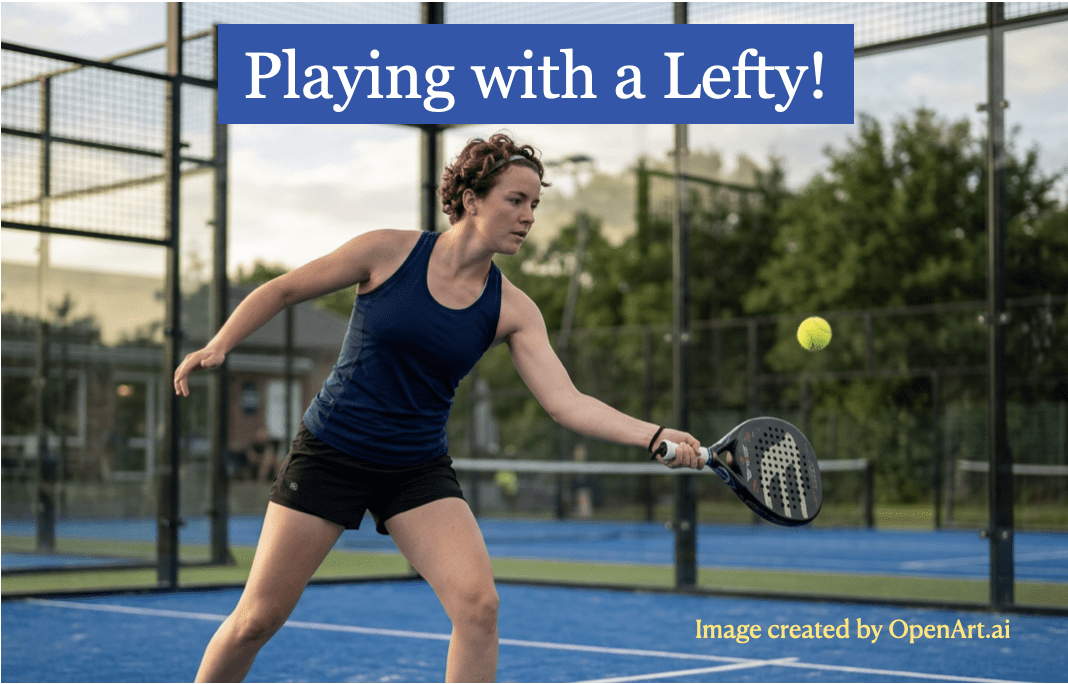
In doubles, to what extent does a left- and right-handed pair outperform?
Have you ever pondered whether the combination of a left- and right-handed player provides a legitimate advantage in doubles… whether that’s tennis or padel? (Same question surely goes for those who play doubles table tennis, real tennis, badminton, etc.)!
On a padel court, when a right-handed player plays with a left-hander, the right-hander has three tremendous advantages, even at the amateur level:
- First, there’s no mystery as to which side you, as a right-hander, will play (on the left). That’s because the lefties always play on the right. [The same is always true for the lefty]
- With a righty on the left and a lefty on the right, you will both have the forehand down the middle which is essentially a good thing, because roughly 80% of shots in padel are at or inside (down the centre in between) both of the players.
- A lefty hits shots and spins that perturb the opposition, since most of us aren’t used to their strokes and effects. And even if you know how to play against a left-handed player, it still provides a headache because the spins will be the reverse according to whether the righty or lefty is hitting the ball. BTW This issue of spins mostly relates to the overhead shots. And I’d note that a lefty playing against a lefty can have the same issue.
The right-left combo also presents a thorny problem: Who should take the ball down the middle, since both players have it on their forehand? The general rule of thumb is that, when the ball is being struck from the back and in a corner, it is the diagonal player’s responsibility to cover the centre. The other player should be covering his/her line. However, it of course depends on the trajectory, and many shots are hit from the middle in the back, too. In any event, I like to say it’s better to have two than neither player going for it; but there’s certainly room for confusion.
So, do these advantages of a left- and right-handed pair manifest themselves in the results?
I did some research on professional lawn tennis doubles and padel — knowing that padel is always played as doubles — whereas in pro tennis doubles are a less popular format.
GRAND SLAM TENNIS DOUBLES TITLES (OPEN ERA)
Here’s a recap of the left-right pairings in the Grand Slams in the modern era. Then, below, I’ll compare the results in padel (focusing only on Premier Padel [PP]).
| Category | Men’s | Women’s | Mixed | Total |
| Left-right pair | 56 (24%) | 52 (23%) | 39 (18%) | 147 (21.9%) |
| Two right-handers | 172 (75%) | 177 (77%) | 172 (81%) | 521 (77.8%) |
| Two left-handers | 1 (0.4%) | 0 (0%) | 1 (0.4%) | 2 (0.3%) |
| Totals | 229 | 229 | 212 | 670 |
We can notice that the winner percentage of a left-right pairing is significantly above the population average (8-12%). For the men, a left-right pair has won 56 titles, or 24% of the total, with women sitting at 23%, while mixed doubles sits at 18%. In all cases, that’s above the average. These results lead me to conclude that the left-right combination is indeed more effective. Naturally, it’s not a guarantee of success as good doubles partners require at least two other strong components: complementary skillsets and complicity on (and even off) the court. BTW You can find a breakdown of the results for each of the Slams in this Google Sheet I’ve created.
PREMIER PADEL TITLES (2023-2026 to date)
Let’s now look at padel pairings, with the data for just the last four years. I haven’t looked at the Padel Pro Tour which kicked off in 2005, nor the World Padel Tour (2013-2023). If anyone has the resolve to do so or knows of other research, please drop in a comment below. I note that mixed doubles is a far less common format in padel, albeit mixed doubles are indeed played as part of the Pro Padel League (PPL) in the US.
| Category | Men’s | Women’s | Total |
| Left-right pair | 30 (64%) | 20 (38%) | 50 (54.3%) |
| Two right-handers | 17 (36%) | 25 (62%) | 42 (45.7%) |
| Totals | 47 | 45 | 92 |
From this rather abbreviated view of padel, and owing largely to the specific individuals involved, of the 47 important tournaments (qualified as the annual Masters x1, Majors x4, P1 and P2) played on the Premier Padel men’s tour between 2023 and 2026, a left-right pair won 64% of the titles (27/30 of which were won by the lefty King Arturo Coelo alongside Agustín Tapia). On the women’s side, it’s only 38%, thanks in large part to the 17 victories by lefty Paula Josemaría with Ari Sánchez. But in both cases, it’s clear that the left-right pairing has been a dominant factor. The data for the World Padel Tour and the Padel Pro Tour which preceded the PP tour, is less convenient to search (handedness doesn’t even feature in the FIP listing, either). Of course, the history books are filled with a slew of enormously successful lefties, including the masterful Argentinian Juan Martín Díaz, a guest on my podcast. who recorded 170 wins in 191 finals with the great Fernando Belastaguín. There’s also the Brazilian Pablo Lima, along with several other contemporary top players, such as Jon Sanz, Álex Ruiz and the up and coming Andrea Ustero. In the Top 30 as it sits today, there are 4 lefty men (13.3%) and 5 lefty women (16.6%), so again a little over the population average. I add that the British number one woman, Aimee Gibson, sitting at world #90, is also a lefty.
If nothing else, the modern game of padel — that has become more about power and less about nuance and touch — seems to privilege having two forehands down the middle in both the men’s and women’s fields. The results in lawn tennis are a slightly less pronounced (especially since they cover a larger number of tournaments over a wider span of years).
So, in conclusion, it seems clear that a left-right combination is a strong option in tennis and an even stronger benefit when it comes to padel.
Your thoughts?
———
P.S. Over the years, I’ve enjoyed writing about left-handers. It’s been a bit of an obsession for me. Even though I’m right-handed, I’ve always paid attention to lefties, on and off the court. As I have noted before, it was about the only expectation I had of who my wife might be!
Here are some of my prior articles that discuss left-handers:
- Do left-handed people think differently? Does handedness give you a hand?
- Left-Handers, Big Smashers and Control Freaks: Who Should Play Which Side in Padel?
- The Mental Game in Padel: Insights from GB’s Number One (the left-handed) Aimee Gibson (JOPS03E18)
- Think Different — What do Feminism, Einstein & Sleep have in common?
- Left-handed people are my kind of people









Trackbacks/Pingbacks