
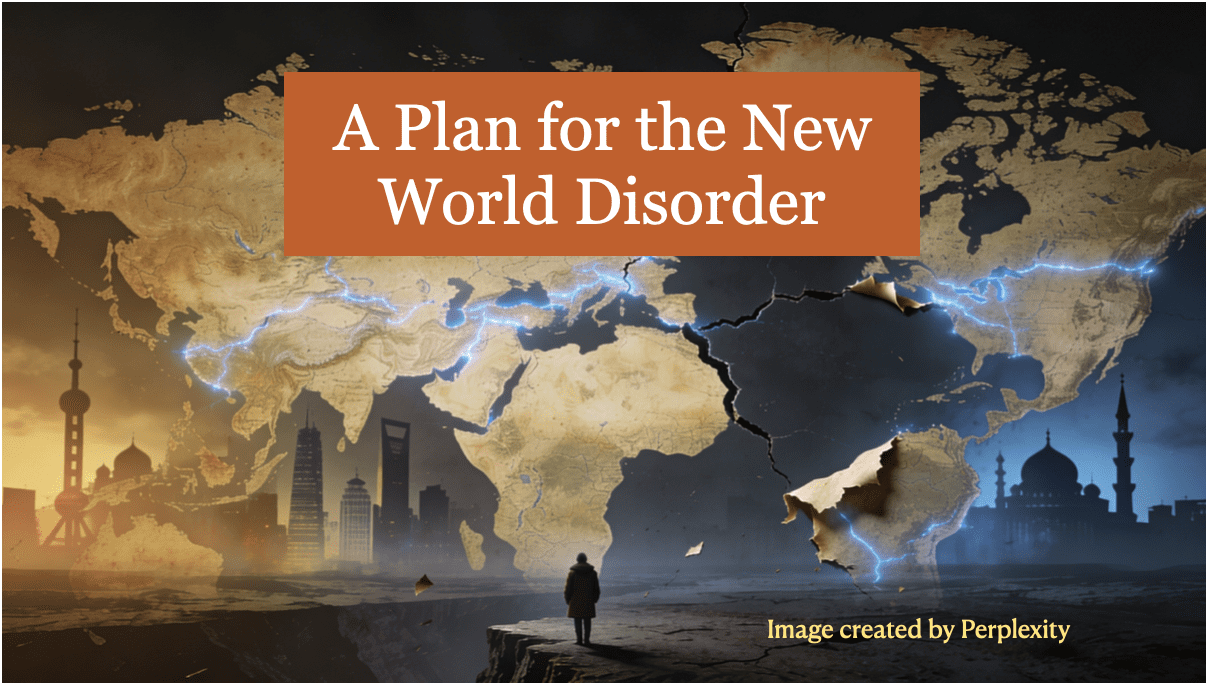
The world order is not merely shifting — it is inverting. The political coalitions, military alliances, moral standards, and civic habits that governed the last eighty years are dissolving simultaneously, and organisations, leaders, and citizens who still navigate by those old maps face compounding strategic risk. Depending on the report you read (for example, The World Now or Conflicts), there are over 50 active wars and state-based armed conflicts worldwide, involving on the order of 70–90 countries in some form. Broader counts that include local insurgencies, criminal wars, and non‑state fighting put the number of active armed conflicts closer to 120–130. The central choice of this decade is whether to meet that inversion with courage and clear standards, or to mistake comfortable relativism for sophistication.
We’re not just watching a change of government here or a market correction there; we are living through a transformation of the world order itself. The old binaries (such as good versus evil, fact versus fiction) no longer explain what is happening and inherited labels increasingly conceal more than they reveal. As I wrote in my book, Futureproof, the age is defined by major disruptive forces that must be mapped, contextualised, and met with new mindsets rather than nostalgia. It also feels as if society is in flux and passing through a crisis of meaning, where events move faster than our capacity to interpret them.
The clearest signal of this transformation is that yesterday’s impossibilities have become today’s strategy. The spectacle of Germany and Japan, long associated in the public imagination with postwar restraint, now developing as serious military actors and close allies tells us that history has not ended; it has restarted. [For further reading, check out these articles, East-Asia Forum, and Defence24 by Jakub Bielamowicz]. The old moral geography, in which certain nations were forever cast in one role and others in another (e.g. the so-called axis of evil), has given way to a more fluid geometry of threat, driven by insecurity, disrupted supply chains, energy competition, demographic anxiety, and the return of war to the centre of politics.
Any strategy, institution, or business built on the assumption that the postwar security and trade architecture is stable is now running on borrowed time — audit those assumptions before the next threshold event forces the issue. As Sir Mark Carleton-Smith, the ex-head of the British Army, said in March 2025 on my Minter Dialogue podcast:
“I think as a generation we need to recognise that we have been indulged in a post war world and we’ve had great opportunities and advantages that I think tomorrow’s generation will find more difficult and that we aren’t necessarily merely the post war generation. It may be that we’ve yet to discover that we are also the pre-war generation and that will be very much more challenging and stressful than almost anything else.”
Tech and Power
Technology is not just one factor among others in this upheaval; it is the solvent eating away at the old order. It has collapsed time, blurred the line between civilian life and strategic infrastructure, and made power more diffuse while also making it more concentrated: the citizen now carries a device with planetary reach, while a small handful of firms can shape attention, identity, commerce, and even political mood at continental scale. In that sense, innovation is not simply progress; it is acceleration without automatic wisdom. [See more on this below with Étienne Klein]. Regulatory bodies of every kind find themselves behind the proverbial eight-ball, struggling to catch up.
This is why so many people feel simultaneously empowered and diminished. They can publish, trade, create, protest, and organise with a speed once reserved for states and broadcasters, yet they also feel surveilled, manipulated, and subtly dispossessed by algorithms they neither understand nor control. We have built astonishing tools, but we have not built a matching civic grammar for living with them, and so innovation has outpaced our moral software. At the micro level, you see that people in the street walk, head in their device, into strangers; where people blithely carry out conversations or watch videos with the speakerphone on in public transportation, oblivious to those around them. At the macro level, the end (profitability and share price) continues to justify the means. The ethical frameworks of nations, businesses, leaders and citizens are scrambling to adjust, if they exist at all.
Short of total collapse, the competitive advantage in the next decade will belong not to those who adopt technology fastest, but to those who build the civic and ethical grammar to govern it — organisations that treat ethics as a strategic function rather than a compliance footnote will be better positioned when/if the regulatory tide finally turns. Bear in mind that it’s not about being goody-two-shoes either. The tolerance for risk, alignment with your culture, and the competitive landscape all need to be taken into consideration.
Voters in Motion
Politics, too, has entered an age of inversion, especially visible among the US and European working classes. Right-wing parties increasingly court the economic anxieties, cultural grievances, and anti-elite anger once thought to belong naturally to the left, while parts of the contemporary left have become the guardians of institutional prestige, managerial language, and cosmopolitan status. The worker who once voted socialist may now prefer a nationalist who promises borders, order, and industrial revival; the graduate who once distrusted power may now defend bureaucratic expertise, speech codes, and symbolic virtue as marks of enlightened belonging.
This is where the old French phrase la gauche caviar (the left that has caviar taste) regains its sting. A section of the left has not so much betrayed its ideals as relocated them upward, into the habits and tastes of the ‘secure’ classes, where moral language can become a luxury good and solidarity can sound suspiciously like etiquette. Meanwhile, parts of the right have learned to speak in the emotional register of abandonment, even as they often remain economically aligned with interests that do little to heal it. So, the voter crosses the aisle, not always because he has changed his philosophy, but because the parties may have exchanged costumes.
Any brand, institution, or movement that defines its audience by legacy political identity is working from an outdated segmentation model — the real faultlines now run through culture, recognition, and economic anxiety, not left-right coordinates.
Beauty and Good
At the same time, the moral vocabulary of the West has become radically unstable. We no longer have a common understanding of facts, or history, nor even of our language. Looking at the idea – or theory – of the Common Good as it’s been considered throughout the ages (since the time of Aristotle), the notion of what’s ‘common’ is vital for the community, for the larger group. It now feels that we no longer have enough overarching commonalities to tie us all together. We might even say that we no longer have common arch enemies to unite us. What is good for me or my gang may indeed not be good for others in my community. Along with the breakdown of a common good, we seem to have lost a common sense as well.
Further, when we consider the old transcendentals of Goodness, Truth and Beauty (bonum, verum, pulchrum in Latin), each has become reconfigured – if not torn apart – as part of a new mainstream narrative. It’s not uncommon to see article titles or social media posts that say things along the lines of:
Everyone is beautiful
or
Truth is personal
or
Goodness is everything.
As poetic as these aphorisms might appear, they are at best empty, if not unrealistic. These statements hold true specifically in the eyes of those who say them but are not universal despite their all-encompassing appearance. As sympathetic and positive as they might sound, these types of statements are also participating in the turbulence of our society. In a deconstructionist post-modernist world, words removed from their context – or, I might say, detached from their reality – are being attributed a meaning, as if authorial intent counts for nothing.
While I can applaud the well-meaningness of such messages, they come with downsides. First, the emphasis is essentially on the individual, rather than on creating a shared (“common”) vision. Secondly, there is an inherent detachment from reality. To suggest that everything and everyone is beautiful is simply to dilute the nature of the word. It’s as platitudinous as saying everyone’s a winner or every effort counts.
While being well-meaning and doing good are admirable concepts, the current crisis of meaning about which John Vervaeke and others have written, is embedded in the good intentions. The core issue is that this goodness is singled out and dissociated from the complete – and real – picture. Trying to solve world peace or eliminate hunger are fine objectives in theory. But in practice they are completely unachievable. They ignore our human nature, the inherent limitations of resources, and leave no place for the bad, the imperfect, and doubt. As French physicist and philosopher Etienne Klein said, in his desire to redefine progress, “The whole challenge is to configure a future that we know…will be accompanied by dark phenomena. Which is not at all a reason to be pessimistic.” What counts – and provides meaning – is not the destination itself, but the lived experiences and relationships forged throughout the ups and downs of the journey.
The meaning we attribute to our lives depends upon one’s perspective and attitude, and the degree to which one’s concern extends beyond the self. That insight is useful, because we now inhabit a culture in which good and beauty are treated as almost entirely relative and individualistic, not as horizons to be pursued but as preferences to be performed.
There is some truth in this relativism. I don’t subscribe to absolutes. That’s part of the charm of the human condition. People do create their own meanings, hear different truths in the same story, and filter experience through biography, fear, class, faith, and desire. But a society cannot live for long on the proposition that all judgments are merely private and that every standard is oppressive. If beauty is only projection, then ugliness has no warning in it; if good is only tribal preference, then power alone decides. We may congratulate ourselves on our tolerance, and still underneath lurks a nihilism in which nothing can be defended except appetite, core values (to the extent they’re shared), and temporary consensus.
Leaders and communicators face a genuine trade-off: affirm relativity and gain short-term approval from audiences who distrust fixed standards, or defend shared standards and risk short-term friction while building the long-term credibility that relativism quietly erodes.
Virtue and Courage
This is why the language of virtue deserves rescuing. The old etymological link between virtue and vir, the Latin root associated with man, points toward an older world in which excellence was bound up with firmness, honour, discipline, and courage; yet the deeper lesson is not that virtue belongs to men, but that moral life requires backbone. A civilisation may become richer, safer, softer, and more therapeutically self-aware, while also becoming less able to demand sacrifice, endurance, duty, or frank speech.
Here the progressive and happiness-seeking world reveals its weakness. Not because happiness is contemptible, nor because progress is false, but because a culture organised around comfort easily loses its taste for courage. Jonathan Haidt and Greg Lukianoff documented this dynamic powerfully in “The Coddling of the American Mind:” protective, comfort-seeking environments produce fragility rather than resilience, and the removal of productive friction stunts the development of the very capacities it was designed to protect. When every discomfort is medicalised, every disagreement moralised, and every setback interpreted as injustice, the soul loses muscle. As I wrote in “Dialogos” (on Substack), “if ‘no pain, no gain’ is out of vogue, our wish to escape pain and delay death is part of our current problem.” People still want meaning, of course, but they want it frictionless, safe, and affirming. Yet meaning rarely arrives that way. It is formed in tension, in honest encounter, in the willingness to listen without immediate judgment, and in the refusal to reduce every exchange to slogans or tribal signals. Meaning — and cohesion — comes through traversing challenge and hardship, not in escaping it. And as I argued in “You Lead,” authentic leadership begins when people stop pretending to be what they are not, and act from a truer sense of self and purpose, recognising that they are imperfect and part of a bigger community.
The transformation of the world order is not only about missiles, trade routes, or political coalitions. It is also about whether we can recover standards without fanaticism, strength without brutality, and conviction without self-righteousness. Technology will keep advancing, alliances will keep shifting, and parties will keep raiding one another’s electorates. The deeper question is whether we can produce citizens with enough character to live inside the disorder without becoming disordered themselves. For this, the role of the media — in all its forms — and the protection and freedom of expression will be vital. What’s at stake is nothing less than democracy.
The most undervalued investment an organisation or individual can make right now is in its capacity for uncomfortable honesty and rigourous debate — that’s to say teams and leaders who can host difficult conversations, hold a tough position, deliver a hard truth, and absorb friction without breaking.








I appreciate your insight into this topic! You touch on a wide range of topics and bring it neatly together. I did want to get your thought on something … I would argue that the cold war was the anomaly in world history regarding conflicts. So if anything, the post cold war era is a return to normalcy. And the inversion point likely happened in the early 90s. While it does not detract from any of your points, I think it does indicate a longer gestation period to get here.
Thanks for your comment Chris.
I think there is a connection to the geopolitical, societal, and business disruptions. The inversion could also be labelled as upside down. What I feel is that things are untethered and will remain dynamic — if not explosive — for the foreseeable future.
How do you describe the anomaly? What makes it the anomaly?
To be clear, I felt you made excellent points throughout. But the rate or frequency of conflicts slowed to a trickle during the cold war. I suspect that the pre-great Wars history of humanity would reveal that war and conflict is the normal state of being and that the number of conflicts we see now is a return to the norm. So the period of relative harmony that predates this period of renewed conflict was the anomaly. And the “harmony” of the cold was built on derterrence of assured mutual destruction rather than good will and peace.
That makes sense, Chris. I had not considered it was such a lull! (Depends on the exact years perhaps? Other than the notable ‘proxy’ wars, from what I can understand, they were tense times.). What I take away from your comment is that we are living in a conflict-mired time that resembles much of our world history! And this certainly shakes up the premise that we have become an evolved species!