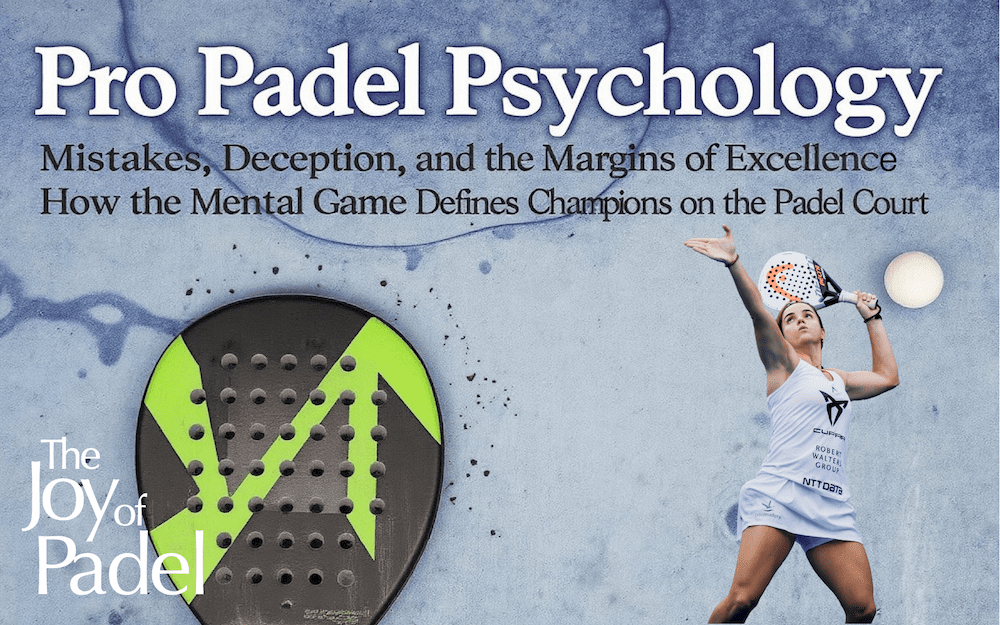
How the Mental Game Defines Champions on the Padel Court
The thin line separating professional padel’s elite from the merely excellent isn’t always visible to spectators, but it becomes crystal clear when examined through the lens of psychology and decision-making under pressure. At the Paris Major 2025, held for the fourth consecutive year at Roland-Garros, these mental nuances were on full display, revealing how even world-class athletes remain fundamentally human.
It certainly doesn’t happen that frequently, but in those moments when a pro makes a silly “human” error, some will instinctively glance at their racquet or study the glass walls, searching for external explanations for their mistakes. This universal tendency—the need to externalize failure—shows that even professionals struggle with the psychological weight of unforced errors. And, with questionable sportsmanship, the outbursts when opponents made unforced errors reveals the emotional intensity bubbling beneath the surface of seemingly composed competitors.
Deception emerged as perhaps the most critical skill separating good from great
The ability to disguise intentions—whether through fake smashes, deceptive body language, or unexpected shot selection—proved decisive in crucial moments. However, earning the right to deploy these tactics required first establishing credibility with fundamental shots. A fake smash only works when opponents respect your real smash. You can’t sell a smash, if the opponents have never bought one.
The concept of predictability haunted several players throughout the tournament. When everyone knows each other’s tendencies intimately and the shots are too easy to read, tactical transparency becomes a liability. Players who relied too heavily on familiar patterns found themselves increasingly vulnerable as matches progressed. This was especially true in the slower playing conditions at Roland-Garros.
Mental fatigue can impact performance quality, particularly in longer rallies. There’s padel-specific research that confirms that mental exhaustion directly impairs accuracy across all strokes, from drives to bandejas. The mind game in the long rallies, some of which were over 60 shots, inevitably takes its toll. You can imagine the thoughts going on inside the player’s head:
“Oh no, not another lob!”
“Ouch, my last vibora almost clipped the net!” or “Uh-oh, it almost went straight into the wall!”
“Here we go again! We’ve got to keep the net this time.”
And the killer: “I need to do something different this time…”
The pressure of expectations manifests differently across skill levels. In the upsets, the higher ranked players performed worse against supposedly inferior opponents, which suggests that the psychological burden of “should win” scenarios can be more challenging. Conversely, the genuine underdogs typically use the mindset that they have ‘nothing to lose.’ This mental trap ensnared several seeded players who couldn’t match their opponents’ freedom and fearlessness. And then, when down one set, the mistake is to think: well, “we shouldn’t be here,” or “this isn’t right.” Rather, they should be doubling down with the reality of the situation and looking to adapt. I’ve personally seen players shake their head, or heard them say things like: “we’ve got to right this ship” without any accompanying change in tactics. That’s unlikely to work. I like to recall the maxim (often attributed without verification to Henry Ford): “If you do what you’ve always done, you’ll get what you always got.”
The partnership dynamics add another psychological layer. How well does the pair get along on and off the court? How have they managed difficult times and loses? Historical “baggage” between players—past disagreements or contentious moments—surfaced during pressure situations, as evidenced in the Lebron-Stupaczuk semifinal where their chemistry deteriorated visibly toward the end of the first set having ceded a 5-2 advantage and culminated in a deflating defeat in straight sets against Chingalan (7-5 6-2). It does seem inevitable that this pairing, despite some good results, set to break up.
These psychological insights remind us that padel’s technical brilliance ultimately rests on the fragile foundation of human psychology, where small mental adjustments and pair dynamics on and off the court, can yield dramatic competitive advantages. You just have to look at how Arturo Coello will gracefully acknowledge a mistake my partner, Agustin Tapia may make. His attitude through thick and thin says: “Keep going for it, Agus, because your talent and your partnership means gold to me.”