

Padeltime and the livin’ is easy…
There’s a unique energy to stepping onto the padel court with a new doubles partner. The unknown chemistry, the sizing up of one another, the potential for miscommunication, the split-second decisions that require perfect synchronization—it can feel overwhelming. When you are rocking up to a match and playing with someone with whom you’ve never played before, the chat before the match will play a vital role in ensuring a good outing. Obviously, it’s fine to have idle small talk, but it’s important to carve out time to talk about the partnership before settling into the match. Here’s how to transform that pre-match chat to optimise for best performance.
Start With the Right Side Selection
Before you even warm up, first decide who plays which side. This decision shapes your entire partnership strategy. Of course, if your partner is left-handed, the subject is moot, because she/he naturally plays on the right side. Otherwise, here’s how to assess the choice:
- The right side (forehand side) demands control, consistency, and court intelligence. If you’re starting with a new partner, this is the stabilizing position. You’re (typically) the team’s strategist, constructing rallies, placing shots at angles that set your partner up for winners, and maintaining the rhythm. For beginners or players uncertain of their role, start here. (Pango tip: many, if not most people fancy themselves on the left. Build up your prowess on the right and you’ll be in high demand!)
- The left side (backhand side) is for the aggressor. This player handles most overhead smashes, manages more court (down the middle), and takes the riskier shots. They are supposed to finish points. If you have complementary strengths—for example, you’re the steady type and your partner is a natural finisher—let them own the left side.
The key principle: if one partner is significantly more aggressive and confident with overhead shots, they should take the left. If both have similar playing styles, assign the left side to whoever has the stronger smash and better comfort with high-pressure finishing moments.
Pango tip: don’t choose sides based on service return ability. This is only relevant for a maximum of 1 in 8 shots, so it’s not the right criterion.
Master the Core Communication Vocabulary
Padel moves fast. There’s no time for lengthy calls mid-rally. Establish at least these three essential phrases before you play and use them religiously:
- “Yours” or “Mine”: Called immediately when taking a ball, eliminating the uncertainty that causes tangled footwork and missed shots.
- “Switch”: When you’re crossing over or changing defensive positions, alert your partner with this single word. It’s possible to add non-verbal signals, such as a raised arm, to switch sides. You can use the same signal to switch back, too!
- “Leave” or “Watch”: When you’re letting a ball go out of bounds (rather than attempting a defensive shot). “Leave” when you’re sure the ball’s going out, and “watch” if it’s too close to call.
Pango tip: Try to use one-word calls and get them out as soon as possible.
Communication for Advanced Play
Beyond these commands above, there are a series of other calls that are especially useful as you get better at the game. These concern announcing what the opposition is doing when your partner is on the ball, dealing with a lob or playing the wall off the back wall (e.g. a bajada). The key concept here is to help your partner with the execution of the next shot. Different people prefer different calls, but here are the basics:
- “Back” = both opponents are at the back of the court.
- “Up” = both opponents are at the net.
- When the opponents have split, one at the back and the other at or charging the net, this is most difficult one to call. Does your partner want to know who is up or who is back? Or does she/he only want to know what the diagonal is doing in that case? The classic approach (what most pros do) is to know who is at the net. Then the typical way to call that player is to yell out “yours” if it’s the opponent down the line for your partner or “mine” if it’s the player parallel to you.
- “Coming” is a call that I personally like to know when the diagonal player is pinching up (e.g. over the service line). This is especially useful when you’re playing on the left and like to use the “rulo” into the side fencing.
Pango tip: The best pairs will learn to communicate on an ongoing basis.
This communication piece is absolutely vital for success at the higher levels. If you’re keen to get better at padel, learn to communicate like the pros. Consistency matters more than complexity—use the same signals every time, so your partner doesn’t have to decode new commands mid-match. Most emphatically, when you’re watching the opponents for your partner and calling out where they are, you’re delegating to your partner the execution. You’re putting trust into them. Energy and trust are two strong motors in a partnership.
And one thing NOT to do, unless the invitation has been made by your partner, don’t give technical advice mid-match. It is certainly tempting to do so, especially when one player has more experience, but it’s generally unhelpful (and I know that I am guilty of doing this!).
Establish the Middle Ball Rule
This is where a lot of padel points are won or lost. Down the middle—that gap between you and your partner—is contested territory. Decide in advance who takes the middle ball: the more aggressive player, the one with better reflexes, or whoever naturally gravitates there. As a rule of thumb, I say that if a diagonal shot, played from the corner, goes down the middle, it should be played by the diagonal player, as the parallel player must cover down the line.
Pango tip: The moment the ball comes through the middle, the assigned player calls “Mine” and commits. Your partner immediately adjusts their coverage to support that decision. No hesitation, no confusion.
Stick with your decisions throughout the match. However, bear in mind the need to communicate throughout the match and, if something is not right or you’ve observed some patterns or opportunities, make sure to discuss together how to adjust in between points or between changeovers (when 90 seconds are allowed).
Move As a Unit
One of the most visible signs of a partnership learning to trust each other: synchronized movement. When your partner steps forward to the net, you step forward. When they retreat, you retreat. You’re not playing as two individuals occupying the same court—you’re playing as a connected unit that moves together, adjusts together, and leaves no defensive gaps.
This requires constant awareness. Watch your partner’s footwork, not just the opponent’s shots. If they’re advancing aggressively, anticipate that you’ll need to cover more defensively behind them. Again, it can be useful to communicate with your partner about your intention to transition up to or back from the net.
Pango pro tip: sometimes it can be advantageous to have a split formation (one up, one back), to mix up the opponents and verify how well they call your movements.
Embrace Positive Reinforcement
New partnerships often stumble. Your partner might overcommit on a smash and leave the court vulnerable. They might miss an easy volley. The temptation is to critique or shake your head. Don’t. Instead, offer constructive encouragement (avoiding technical advice until such time as it is invited).
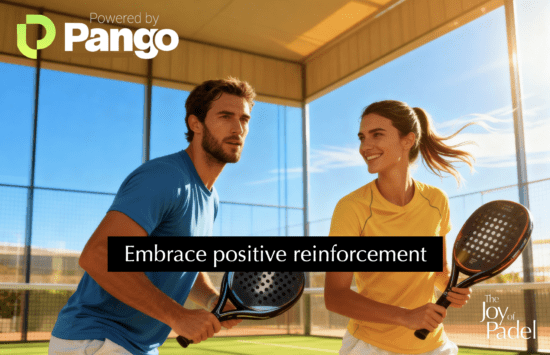
A quick “Nice try” or “Let’s go” after a mistake sustains momentum far better than visible frustration. As in any doubles (lawn tennis, badminton, etc), your energy directly influences your partner’s confidence and court presence. Small affirming gestures—a clap, a nod, a thumbs up—compound across a match.
Practice Specific Scenarios Together
If possible, of course, if you’re serious about becoming a team, it’s better to get in some practice sessions before you play a proper match. Dedicate your first practice with a new partner to understanding their strengths rather than just rallying aimlessly. Hit some lobs and see how they smash. Serve and observe their positioning at net. Notice their comfort with defensive shots and quick volleys. In a practice scrimmage, it’s also good to get your calls coordinated.
This reconnaissance phase helps you make real-time adjustments once you’re in a competitive match. You’ll know intuitively whether to trust them with a high ball overhead and understand what and where balls will go.
Stay Adaptable
Finally, remain flexible with strategy. If your predetermined game plan isn’t working, use breaks between games to recalibrate. Did the opponents exploit a weakness on your right side? Adjust your approach. Did your partner’s smash prove devastatingly effective? Feed them more opportunities.
The best partnerships don’t rely on rigid tactics—they evolve in real time, with both players listening, adapting, and learning their partner’s patterns match after match.
Your first session with a new partner is rarely your best padel. It’s your foundation. Build it well, communicate clearly, and trust the process. Chemistry doesn’t develop instantly, but with deliberate attention to positioning, communication, and positive teamwork, you’ll be amazed at how quickly two players can begin moving as one.








Exactly the advice the Padel community needs!
Communication is crucial—it can cost you the match, or even worse, strain a friendship.
Coming from a singles tennis background, this was one of the biggest adjustments I had to make. Not just communicating clearly, but learning to move as a unit, which you’ve described so comprehensively here.
Without communication, confusion is inevitable.
Thanks Arjun. It’s a topic that seems a bit cultural too. Some people will outright say that they don’t like to talk or that talking puts them off.