The Truth of the Matter
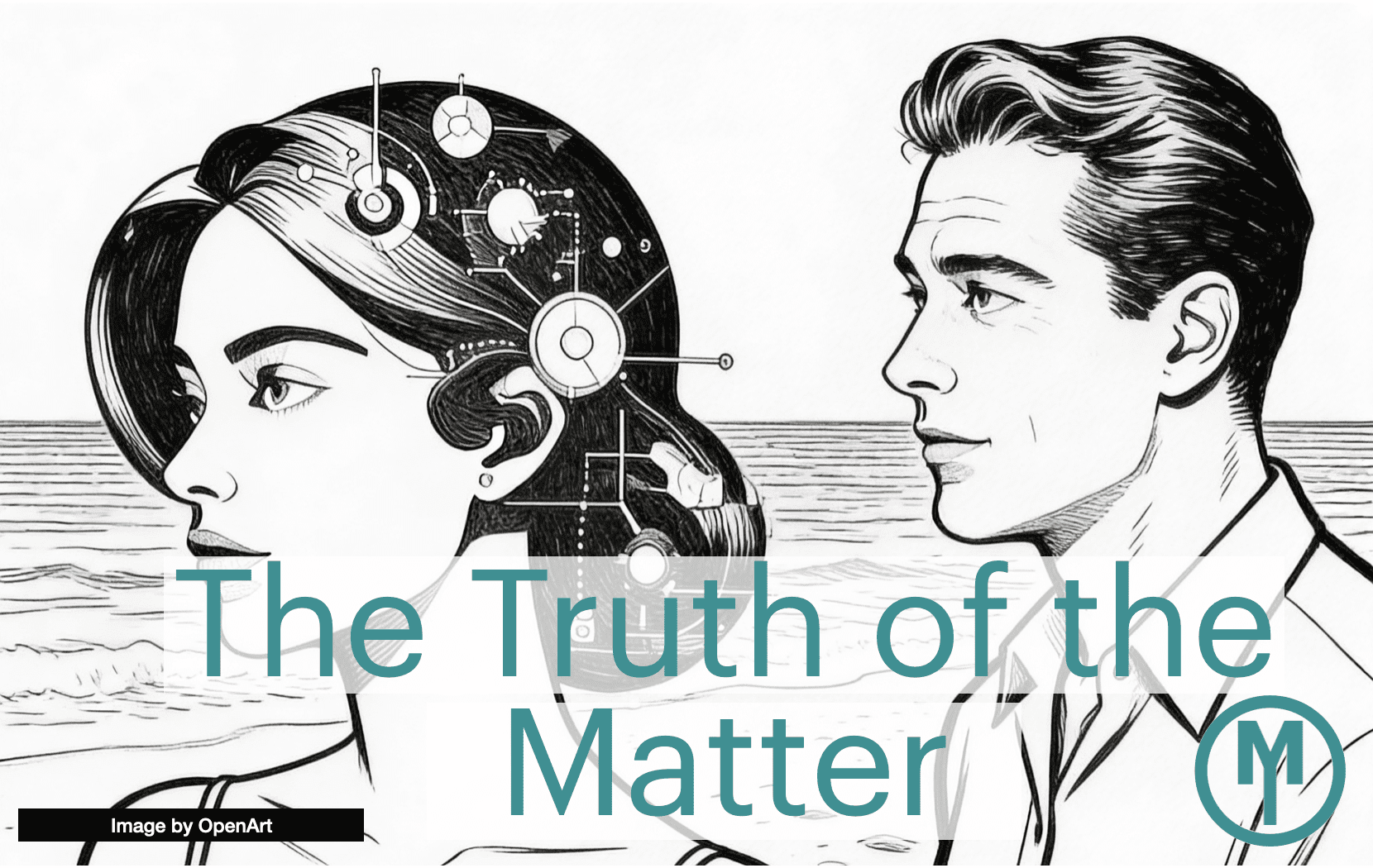
We live in a time when truth is invoked more loudly—and trusted less deeply—than at almost any point in modern memory. Politicians claim it, media debunks it, algorithms distort it, and citizens despair of ever finding it. “The truth of the matter” is one of those phrases we toss around without pausing to examine the extraordinary philosophical weight of each word. So let us do precisely that: pull the phrase apart, hold each word up to the light, and ask what it can teach us about what we most need.
The Value of Truth
Truth has long occupied the highest rung of our moral architecture. Plato placed it alongside goodness and beauty as one of the three transcendentals. The Enlightenment elevated it further, binding truth to reason, science, and the promise of progress. And in any functioning democracy, truth is not an optional extra—it is load-bearing infrastructure. As philosopher Michael Lynch has argued, no political system can be democratic that does not value truth, because democratic governance depends on citizens making informed choices grounded in evidence, not merely emotion. When knowledge is devalued, when lies circulate unchallenged, the foundations of collective self-governance crack.
Yet truth must compete daily with other core values we rightly cherish—beauty, courage, hard work, loyalty, compassion. A society that worships truth alone can become cold and clinical; one that privileges courage alone can be reckless; one that elevates beauty above all can become shallow (cf Because you’re worth it!). The question is not which value should reign supreme, but how truth relates to the others. Truth without courage is impotent—someone must be willing to speak it. Truth without compassion is brutal. And beauty, hard work, and loyalty all gain their nobility only when they are authentic, which is to say, only when they are rooted in truth.
But Whose Truth?
Here is where the ground gets slippery. In a pluralistic, hyperconnected world, every faction claims the truth. “Post-truth” was named Oxford’s word of the year back in 2016, describing “circumstances in which objective facts are less influential in shaping public opinion than appeals to emotion and personal belief”. Nearly a decade on, the diagnosis has only deepened. We are not, as some suggest, in an era where people no longer care about truth. On the contrary, we are saturated with disputes over what counts as true, real, false, and fake. Everyone is fighting for truth—their truth.
Is truth relative, then? The temptation of radical relativism—my truth, your truth, no truth—is seductive but ultimately self-defeating. If all truths are equally valid, then the claim that “truth is relative” is itself just one truth among many, with no special authority. The pragmatist tradition offers a more useful path: truth is not a fixed possession held by any one tribe, but an ongoing, communal inquiry. As political theorist Linda Zerilli argues, we the people have an essential role in discovering and evaluating truth relevant to the political realm. The unqualified insistence on objective truth can stifle debate just as dangerously as denying it. Truth, in a democracy, lives not in pronouncements from on high, but in the messy, pluralistic process of citizens reasoning together.
What democracy requires, therefore, is not that everyone agrees on the truth, but that everyone commits to the pursuit of truth—through stronger schools, independent media, scientific inquiry, open debate, and institutional accountability. Truth is less a destination than a discipline.
Now, Turn the Phrase Around: What About “Matter”?
If the first half of our phrase—”the truth”—anchors us to the intellectual and civic, the second half—”the matter”—opens a door to something far more personal and existential. What is the matter? What matters? And do I matter?
That last question, it turns out, may be the most important one a human being ever asks.
Zach Mercurio, a researcher and author of The Power of Mattering, has placed this question at the centre of his life’s work. As he put it in a recent conversation on my podcast, “mattering is the meta need. It’s the meta instinct that we need to have met before we can even make meaning of something as meaningful”. In other words, before you can find your purpose, before you can engage with a team, before you can even care about truth—you must first believe that you matter. Self-esteem, self-efficacy, resilience—all of these downstream goods depend on the upstream experience of feeling significant to those around you.
Mercurio identifies three drivers of mattering: feeling noticed, feeling affirmed, and feeling needed. These are not luxuries. They are, in his framework, survival instincts—as primal as the grasp reflex of a newborn reaching for a parent’s finger. And yet, in a world where the average adult sends 40 text-based messages a day to colleagues but where 8 out of 10 people report feeling isolated at least once a week, we have engineered a mattering deficit of staggering proportions.
The Meaning Crisis and Why Mattering Precedes Meaning
John Vervaeke, the cognitive scientist at the University of Toronto whose landmark series Awakening from the Meaning Crisis has shaped so much of this conversation, diagnoses our era as one of profound disconnection. We have undergone what the philosopher Charles Taylor calls “the great disembedding”—extracting ourselves from the participatory, sacred frameworks that once gave life coherence. The result is a wisdom famine. As Vervaeke puts it, “as we lost the religious worldview, we lost a language of two worlds, which was a mythological way of saying that certain truths are only available through deep transformation, deep transcendence”.
In my own interview with Vervaeke, we explored how this crisis manifests: the retreat into political tribalism as a substitute for genuine spiritual belonging, the loss of intergenerational mentorship, the confusion between information and wisdom. The political arena, Vervaeke warned, is exactly the wrong place to solve the meaning crisis—it frames everything in adversarial terms when what we need is connective, transformative practice.
And here is where Vervaeke and Mercurio converge beautifully. Vervaeke speaks of “relevance realization”—our fundamental cognitive capacity to determine what matters. Mercurio operationalises it at the human, relational level. In my conversation with Mercurio, I pressed him: are we in a crisis of mattering, therefore? His answer was clarifying. “I don’t think we have a crisis of meaning,” he said. “I think we have a crisis of meaningfulness. The sense that people are making of things isn’t significant anymore”. Meaningfulness requires mattering. You cannot find your “why”—to borrow from Simon Sinek—if you do not first believe you are worthy of contributing.
Knowing What Matters
And so we arrive at the full force of our title. “The truth of the matter” is not just an idiom. It is a philosophical programme for our times. We need truth—rigorously pursued, democratically debated, courageously defended. But truth alone is insufficient for a life well lived. We equally need to know what *matters*: to ourselves, to others, to the communities and institutions we inhabit.
In a world drowning in information but starving for significance, the ability to discern what matters is perhaps the defining skill of the age. It is a skill that cannot be outsourced to algorithms or satisfied by emojis. It requires what Mercurio calls “relational insurance”—the secure base of human connection from which we can explore, risk, fail, and grow. It requires what Vervaeke calls the cultivation of wisdom—not merely knowing facts, but knowing how to live in connection with reality.
The truth of the matter, then, is this: truth and mattering are not rivals. They are partners. Truth without mattering is sterile knowledge, disconnected from the human beings it ought to serve. Mattering without truth is hollow affirmation, the participation trophy that Mercurio rightly warns against. Together, they form the foundation of a life—and a society—that is both honest and humane.
In a democracy under strain, in workplaces hollowed out by disengagement, in families fractured by distraction, the most radical act may be the simplest one: to notice someone, to affirm their significance, to tell them the truth about their impact—and in doing so, to remind them, and ourselves, what truly matters.