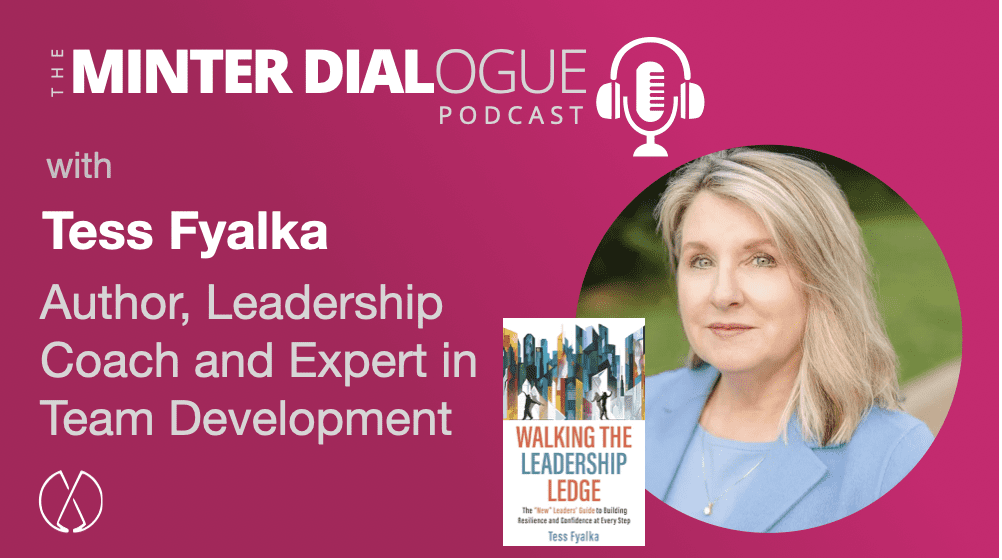
Minter Dialogue with Tess Fyalka
Tess Fyalka is a passionate advocate for leadership development, especially for those stepping into new managerial roles—whether it’s their first time in the seat or the latest in a series of leadership transitions. Based in the central United States, Tess brings years of experience in marketing, public relations, management consulting, and particularly, in nurturing healthcare leaders who are brilliant at caring for patients but often feel entirely unequipped to lead teams and businesses.
Her book, “Walking the Leadership Ledge: The New Leader’s Guide to Building Resilience and Confidence at Every Step,” offers practical wisdom on what it means to embrace leadership as an ongoing journey—one where courage, authenticity, and compassion are essential companions. In this episode, I sought her perspective on why so many companies still struggle to foster great leaders, and how new managers can carve out their own authentic styles, even within the politics and pressures of modern organisations.
Our conversation traversed the challenges of inheriting teams, handling dysfunctional cultures, and bridging the gap between espoused company values and on-the-ground realities. Tess’s approach demystifies the process of leadership, highlighting the importance of self-reflection, system-building, and clarifying the often messy connections between personal and organisational purpose. We also tackled difficult truths about delegation, the shadow of control-freak tendencies, and the critical need to build trust and alignment—well before a promotion is even on the cards.
Key Points:
- Leadership as a Liminal Journey: Tess sees stepping into leadership not as a single leap, but as a journey through a liminal ‘ledge’—the space between who you were and who you must now become. It’s fraught with ambiguity, shifting expectations, and requires self-awareness and a willingness to continuously adapt.
- The Power of Curiosity and Alignment: Early days in leadership should focus on genuine curiosity—getting to know your team, understanding their needs, and clarifying what trust, accountability, and respect look like in practice. Defining team alignment and openly discussing dysfunctions helps to prevent the culture from slipping into toxicity and frustration.
- Overcoming Fear and Embracing Authenticity: Many roadblocks to effective delegation and development—particularly a ‘control freak’ mentality—stem from fear and lack of confidence. By recognising and naming these fears, leaders can move beyond reaction toward genuine creation, cultivating both courage and flexibility in the face of paradox and uncertainty.
Tess’s wisdom is rooted in real-world practice, and her frameworks will support any leader navigating their own ledge, eager to build resilient and confident teams. Her book, available on Amazon and via her website, is a resource for anyone ready to embark on or renew their leadership journey.
Other mentions/sites:
- Marshall Goldsmith (referenced for “What Got You Here Won’t Get You There”) here
Further resources for the Minter Dialogue podcast:

Meanwhile, you can find my other interviews on the Minter Dialogue Show in this podcast tab, on my Youtube Channel, on Megaphone or via Apple Podcasts. If you like the show, please go over to rate this podcast via RateThisPodcast! And for the francophones reading this, if you want to get more podcasts, you can also find my radio show en français over at: MinterDial.fr, on MegaphoneFR or in iTunes. And if you’ve ever come across padel, please check out my Joy of Padel podcast, too!
Music credit: The jingle at the beginning of the show is courtesy of my friend, Pierre Journel, author of the Guitar Channel. And, the new sign-off music is “A Convinced Man,” a song I co-wrote and recorded with Stephanie Singer back in the late 1980s (please excuse the quality of the sound!).
Full transcript via Castmagic.io
Transcription courtesy of Castmagic.io, an AI full-service for podcasters
Minter Dial: Tess Fyalka, I didn’t even ask you if that’s how you pronounce your name, but great to have you on the show. You’re calling in from Central United States. You’ve just written a book, Walking the Leadership Ledge. But in your own words, as I like to always ask, who is Tess?
Tess Fyalka: Well, Minter, that’s a big question. So, I think I am an individual who is sincerely passionate about leadership development and particularly helping those who are in new leadership roles. Now, you decide what new is, of course, because we are new leaders many, many times in our careers. But I would say fundamentally, I am passionate about helping leaders step more fully into the leadership role and being able to lead from a position of courage, authenticity, and compassion.
Minter Dial: So, what made you so passionate about this space?
Tess Fyalka: So, it is interesting because my first career, if you will, was in marketing and public relations. And I went into business for myself many years ago for the first time. And what I found in working with organizations is that companies will spend a lot of money in promoting and, and trying to articulate what they do very, very well. But they will spend very little money in developing their people and preparing them to really execute on what it is they say that they do. And so, I began in this I began to explore training and developing individuals in organizations so that they could more effectively execute on what the company says that it does well. But also during this time, I was working with a management consulting company. And it was really in my work with them that I truly fell in love with leadership development and helping managers step more fully into what they’re capable of. And with this management consulting company, they were actually in very much a niche healthcare industry. And so, and in healthcare, what you see is that folks go into healthcare because they want to help people. They want to care for patients. And then all of a sudden, sudden they find themselves and they have to lead teams, they have to lead people, and they have to lead small businesses, and they are utterly and completely unequipped to do so. And so, the idea of how can these individuals who find themselves in leadership and just really scanning the skies for how do I do this, looking for direction, Helping them to develop the systems and the processes and their own leadership values and their own authentic leadership approach, helping them to develop that so that they can create a culture and an environment where people want to come to work. They want to deliver on the mission and the vision because they can see how they’re connected to that. They can feel the passion and the possibility as much as leader can.
Minter Dial: So, you talked about people starting up, the desire to get them in particular. And it makes me think you’re in a big company. You might have all of a sudden been attributed 2, 3 people to work for you. So, you’re now an official manager of people. And obviously that relationship between the boss and the 3 individuals is critical to those 3 individuals. As we all know, those 3 will leave if that boss is bad. The challenge sometimes is having some consistency in the management styles because you have the personality, the charisma of an individual may have done a great job and is really good at listening, but the boss is just great at executing, doesn’t like to listen, just tells it how it is. So, I mean, I would call that somewhat dysfunctional because they’re not on the same wavelength. So, how do you architect or help leaders who are in the sort of middle management zone who you believe need to have a certain, or could have wonderful leadership skills, but are existing in an environment where it’s not the same and there’s some sort of dissociation between what you’re wishing, what you would do and what the bosses Good day.
Tess Fyalka: So, let me make sure that, that I understand, um, the question. What I think I hear you saying, and please correct me if I’m not understanding this correctly, but what I think you– I hear you saying is that, that someone finds themselves suddenly as a manager, they’ve got their direct reports, and maybe they want to lead a certain way, but they’re feeling pressure from their bosses just focus on execution. Is that what I’m hearing?
Minter Dial: For example, I mean, I was just taking an example where the person’s a new leader. You’re giving them coaching. You’re providing great ideas about how to have empathy, compassion, listen, all these proper skills of a leader. But his or her leader boss isn’t exactly on the same page. And I think that kind of dissociation is so often, so frequently happened when the idealism, the new leader reads up on stuff, is super excited to be a new leader. But there’s a reality about how it is above that may not be compatible with their style.
Tess Fyalka: Yes. And thank you for clarifying that. And absolutely, that is a reality in terms of what is the context in the organization that I am leading under or within. And so, a couple of things going on there in terms of the understanding the acknowledging the realities of my boss is expecting this. And so, that is how I need to communicate with my leader so that I am delivering for them what they need from me in terms of what’s their view of what success looks like. Now, for me as a leader, as I am working with my team members, What’s my view for what success looks like? Ultimately, yes, we are here to execute, but it doesn’t mean that execution has to happen at the expense of making sure that there’s clarity around expectations, making sure that we are creating a culture of communication on the team, making sure that we are creating psychological safety on the team. Just because my manager needs to see this doesn’t mean that I have to be a clone of, and in fact I can’t be a clone of my manager because I am not my manager. So, that also understanding who am I as a leader and what does my role require of me, what does the specific situation need from me as a leader. It’s not a one-size-fits-all.
Minter Dial: I love very much how you reframed that, Tess. It reminds me of how one of the things I used to do would be lean into what the boss said. For example, at the Christmas meal or some shareholder meeting where if I could understand what he in this particular case wanted, then I would frame everything that I was going to do in the style of what he was wanting so that I can become the hero of his story, or at least help him fulfill his story and be part of it. Yet knowing all along that that’s not at all how I operate underneath in terms of how he was. But that’s one of the tricky parts of being a leader, especially when you’re starting up. Is thinking your own style as opposed to the adopted style or the one that everyone else is doing around you. And as we know that there are very few good models of leadership, of leaders in business. So, how do you craft your own version of leadership? Well, it means that, like you say, one of your values is having the courage to be yourself.
Tess Fyalka: Yes. And so, that we’d love to be able to flip a switch, wouldn’t we? And be able to do that. And so, there is a– it is, I don’t know, almost clich√© as it sounds, it is a journey. But there is really the critical piece of this, and that is the self-reflection, the making an effort to understand where you are now, in terms of your leadership development and how that has served you up to this point. You know, if we, if we look at individual contributors, and we’ll just start there, and the, the things that get them noticed around getting stuff done, you know, being able to be the person who’s the go-to person, and they are able to absolutely execute and they’re brilliant at getting the work done. And then they find themselves in leadership And that person who just got stuff done and was really, really good at execution now suddenly is being experienced as being high controlling, as perhaps being arrogant, perhaps not being able to listen to others. So, there’s that piece of recognizing what got me here, in the immortal words of Marshall Goldsmith, what got me here will not get me here. In terms of how do I get work done through others? And similarly, you have those individuals who, as individual contributors, they’re calm, they absolutely can be detached in a moment where everyone is emotional and they step into leadership and what was respected as being just calm and steady suddenly comes across as being cold, aloof. And then similarly, there’s the individuals who are like, Oh my gosh, you wanna have ’em on your team, you love ’em, they always say yes, and they’ll do whatever, you know, they’re just delightful, they never rock the boat, and yet they get into leadership and they can’t be everyone’s friend. And they’ve got to be able to step into their role as a leader. So, it’s that beginning to notice, where am I now on my leadership journey? What are the things that have served me really well? And now, how do I polish the other facets of the gemstone, as I like to say? Because it’s like those parts of you that got you noticed, that are shining bright, that are your go-to strategies, you’re so good at them. Now, your job as a leader is going to require more than that, not just those things. Yes, you still need to get work done and you have to get work done through others. Yes, you do need to be calm under pressure, but you also have to connect with your team. Yes, it’s great that you get along well with others and you build relationships. That is a fantastic ninja skill. And how do you have the difficult conversations when you need to? So, it’s like, if we think about leadership, I like to think of it, you know, like I said, as a gemstone. Part of it is because I happen to like jewelry. But the, you know, what are the other facets of the gemstone that is you that we can polish that will help you be more nimble in your role as a leader, because your role as a leader, I also like to say, is like a mosaic. And so, there are different colors of the mosaic that need to shine through at different times.
Minter Dial: Well, you also call life a labyrinth. We’re referring to Eric. Yes, the mosaic and the labyrinth. So, various versions of the journey. I think you refer to this in your book as the brutal lie where people are good at executing or competent in a role, but then they get thrust into another role. We mentioned at the beginning we weren’t going to talk about politics, capital P, but one of the things that inevitably comes into play is the ability to deal with internal politics, how company functioning doesn’t function, the vying for position and the internal competition that exists. The inherent tensions between the marketing and sales or finance and the creatives. So, to what extent is that polishing of the gem necessarily about learning how to deal and zig and zag with the politics?
Tess Fyalka: Absolutely. It is who is the leader that I need to be in this particular situation? And if we go back and think about what are my values as as a leader. And oftentimes what happens for most of us, first of all, our values change throughout our lives and throughout our careers. And oftentimes what we are doing is we may be leaning into very strongly a couple of values. Perhaps as a leader, we’re leaning into very strongly a value of compassion, but we are stepping over the value of courage. And so, as a leader, you may– those may be two very strong values for you, but are you sacrificing courage because you’re consistently leaning into compassion because the dynamics of the situation are such that you feel safer leaning more into compassion than you do leaning into courage?
Minter Dial: I would suspect that a lot more people feel safer in compassion than in courage. And that’s a value that I share. I was intrigued when you just said that we can change values. I mean, I think it is a pragmatic thing to say, but a lot of people say values are embedded, are intrinsic in you. So, talk me through how your values have changed, or if I correctly understand, How and where do your values change? I mean, for example, a company spouts off their values. They put on the board, my 10 values and all this and that. I tend to say BS, but that’s another story. But within, within a human being, you may– how do you accept that your values are going to change? Is it a function of knowing yourself? Is it a facet of going through an experience that catapults you into some sort of different position or belief?
Tess Fyalka: Yes, yes. Knowing yourself and the experiences in your life, the different stages of your life and your career, you know, at some point, if I remember correctly, I believe, I believe that you are a father, and I am a mother. And, you know, there are those seasons, you have two, I have two, okay. And so, those seasons of parenthood, our values are going to be different when we are actively raising our children than they are when our children leave the nest. And then similarly, our values as an individual contributor are going to be different than they are as a leader.
Minter Dial: And your role, the things that are needed. So, sometimes it might be different facets of courage or There’s a time and a place for more compassion or something else. When you talk about this messy middle of politics, if you had to triage that messy middle into one or two leverage points, where should a first-time manager start?
Tess Fyalka: So, the The most important step, and I would say the most important value to lean into in the early days, would be curiosity and getting to know your team and getting to know the organization. And how has your role shifted in terms of how others are viewing your role? And what, what do they need from you to be, to be most successful? What, what, what are they worried about? What are they concerned about if you’re adopting or, or or you, you’re, you have a new team now that you’re leading, or perhaps you were a peer and now you’re stepping into a leadership role, which is, is a challenging dynamic, most certainly. And so, you are curious about what are they looking forward to? What are they apprehensive about? If you’re going to be the most effective leader for them, what do they need from you? And how do you see them delivering most effectively on the department or organization’s mission? How do you see them in their role? So, that, that really being curious and open to learning how others view your role in your new role and how you can be most effective from their perspective.
Minter Dial: It strikes me, Tess, that in that situation, You want to start that journey well before you’re nominated. Because if you try to switch, you know, just toggle the switch, now I’m a leader, now I need to listen to you, I need to find out about you, I wanna hear about what your problems are and what your skills are. All of a sudden you’re sort of, wait, wait, wait, we’ve been working together for 2 years. You never asked me a single question like that. So, you do need to almost be the leader before you’re nominated for the leader.
Tess Fyalka: And I think you hit on a really important point there in terms of the relationship. You’re building these relationships from the get-go. It doesn’t just happen when you are designated the leader.
Minter Dial: A lot of times, and you talk about it, the company or the boss says, oh, I want everyone to trust everybody. I want to have a great culture. Where there’s accountability, respect, and we communicate well. So, lots of great words. We’re authentic. But then they struggle on how to create that. What is, what’s, if you, if you’re like talking to a CEO or a bigger boss anyway, what do you need to unlock that? How, what do you need? What should they be thinking about?
Tess Fyalka: So, I believe very strongly in team alignment and in team alignment, it is very much those things that you’re speaking to in terms of respect and accountability and communication and respect or trust. And every team essentially wants those core things. All right? Every organization wants those core things. But few teams will talk about what does trust look like in action? What does accountability look like? What does communication look like? What does respect look like? And you can post those things all over the the building and, you know, yay you, but it doesn’t do anything to address what does it look like in action? How do we interact when we are truly being accountable to each other? And what’s your version? How do you define accountability? How do I define accountability? How do you define respect? How do I define respect? What does trust look like for you? What does it look like for me? And until the team is able to sit down and talk about what do those behaviors look like in action, then we’re just going to get frustrated with each other because, well, you are not being trustworthy according to my definition, and I’m not communicating with you according to your definition. So, we have to have the conversations around what these behaviors look like in action. And similarly, I mean, it’s like the values that are posted around the company. What does it look like in action? And how are we making this part of the organizational system? How are we building it into the job descriptions and the performance reviews and the conversations about how the project gets executed?
Minter Dial: So, you just talked about team alignment, and you write about the team alignment PACT in the book is to define core purpose, culture, and how to handle dysfunction. And I thought that piece was really useful because so often we don’t really talk about the dirty, the messy, the dysfunctional pieces. It sort of gets pushed under the carpet and then not talked about, then becomes a bigger elephant in the room as it goes on. So, what is the question inside this process that you talk about that consistently provokes the most uncomfortable and maybe on the other side, the most productive conversation?
Tess Fyalka: There are a couple of things here that we could explore. First of all, when I’m working with a team through a team alignment process, one of the first things we talk about is what does a toxic team look like? And so, you know, and pretty much unfortunately all of us have been on a toxic team if we’ve ever been in an organization or worked with a team. And so, most people can pretty quickly come up with what does toxicity look like on the team. And then we talk about, well, okay, what does a truly high-functioning aligned team look like? And so, then that helps the team to start to define What is the culture that they want to create, that they want to be intentional about creating? So, that is, they’re articulating those things that they need from each other. But then we start talking about, okay, so if I am engaging in dysfunctional behaviors because I’m a human being and I’m most likely going to get frustrated, I’m under stress, I’m going to be feeling the pressure and fear may kick in. Imposter syndrome may kick in. Any number of these things that might trigger us to show up as not the best version of ourselves, but oftentimes the worst version of ourselves. And so, what are my teammates going to see when I’m going to the dark place, if you will, when I’m not showing up as the team member or the leader that I want to be? What are they going to see? And what do I need from my teammates to help me move to the other side, to spot what’s happening, and then coach me, if you will, or create space for me to move to the other side? And then finally, I am acknowledging that this happens to me. I am acknowledging what I need from my teammates to pull me through, to help nudge me, pull me through might be too much to ask, but help nudge me. And then also, because I’m acknowledging this and I’m articulating this to my team members, I am also working actively on addressing it and spotting it in myself so that I know when I’m going to this place that is not conducive to the team’s effectiveness. And I am actively engaging in behaviors that will help me reset myself. I’m not dependent on my teammates to reset my behavior, if you will, but I ask them for their help and I own my own behavior and I’m working on these things.
Minter Dial: It strikes me in my experience anyway, Tess, that so often a lot of the factors that get in the way of the culture and create that dysfunction are A, miscommunication, and B, ego. And yet it seems so hard for people to have the mirror up and then to figure out how to de-ego, to have the ego dissolve. Because the paradigms that we run around with are a leader is a decision maker, a leader is an inspirer, a leader gets up and is the mojo. And drives by example. And so, it seems like a lot of things that often and with good intent require the ego to exist because ego is not necessarily a bad thing by itself. So, how do you, when you’re talking to someone where there’s this sort of toxicity is happening, how do you get that mirror up? And I mean, obviously you said, you know, you can have the team try to help you and guide you, But at some point, it’s about the self at this point.
Tess Fyalka: Yes. And you hit on a few things there. Number one, the mythology of leadership, and that is so much a remnant of the 20th century command and control. I’ve got all the answers, I make the decisions. And that could work to some degree in the 20th century when we were in a world that far less complex. And leaders came up through the ranks, you know, that it was, you know, in our industrialized society and in the, you know, the manufacturing, when you’re on the line and you started at, you know, at an entry-level position and you worked your way up through the line. And so, you knew the line, you had the answers, you could give the directions and the the sphere within you that you had to work was much more limited. And you didn’t– you weren’t in a world in which things are changing. It again, it sounds so clich√©, but they are changing constantly and you’re having to adapt and you’re having to pivot. And you cannot possibly, as the leader, have all the answers. And to assume that you do or to tell yourself that you must Oftentimes first comes from a position of fear. I’m afraid that, that they’ll find out that I don’t have all the answers. And when in fact, if we give ourselves the grace or if the leader can give themselves the grace of acknowledging, I cannot possibly have all the answers and perhaps then tone down that fear, then the ego doesn’t have so much of a need to come in and protect them so they can open up some space for what 21st century leadership is calling us to step into. And that is much more collaboration. And how do we tap into the collective intelligence of the team members that are around the table, that are on the team, that are in the organization, that can help us to address why are we here? We are here in service to delivering on the mission. Trying to fulfill the vision, servicing the customers. It’s not about me. And that’s a hard place to be.
Minter Dial: My purpose, mission, vision, something I’ve long talked about, and I certainly had success in some of my functions in driving success through purpose. But it feels like we’re still these 20th century leaders that you’re talking about. It feels like it’s a far cry from what individuals at Wall Street are thinking about. And these ones are the ones at the end of the day kind of say yay or nay to the CEO. They’re the ones that end up saying, well, you’re not performing enough, not fast enough. Whereas private companies that don’t necessarily have to kowtow to the financial markets have greater freedoms in purpose. But to what extent is a purpose a viable– what pragmatic approaches can you think of that work in driving success through purpose?
Tess Fyalka: So, Minter, are you speaking to individual purpose or the organization’s purpose or both?
Minter Dial: Well, ultimately, in my mind, they need to be aligned. Or at least have some crossover. But if we were talking about the prior example, I’m thinking about subsuming whatever we’re doing in my ego to the bigger purpose of the company. If at that time I’m losing my own personal purpose, I’m detached from it, then we’re talking about disengaging because I’m not really, I don’t know why I’m here. This doesn’t fulfill me. It’s not part of my mojo. If they have actually figured out their own purpose. For the most part, I think most people have not figured out their purpose or who they want to be. And I would argue that most companies fail to have a grounded, concrete, realizable vision and purpose. Most, most of them, if they have one, are pie in the sky or not well understood throughout the organization. And therefore, it becomes hard to, to drive that change that you’re looking for some individual because, well, they interpret it as they wish. So, I guess if I were to answer the question, it is both. But let’s start with corporate.
Tess Fyalka: So, if the corporate purpose is sort of the overarching influence to What is the strategy? That the corporate purpose is our why. Why are we here as a business, as an organization? And how is the purpose informing the strategy? And then from there, how is the strategy, the larger strategy, informing the individual departments, if you will? The teams in those individual departments? And then how are the individuals in their daily work seeing the connection to the department strategy, to the organizational strategy, to the larger organizational purpose? So, that there is a connection there that helps them tie what they are doing day to day to the fundamental why. Why are we here? And if that why doesn’t align with why am I doing this job, then you have a disconnect in your individual purpose and the organization’s purpose.
Minter Dial: So, I like that. That’s a great description, Tess. Very clear. Um, I did– I meant to ask you this at the beginning, but I kind of just got involved in what you were saying. But, um, the, the name of your Walking the Leadership Ledge: The New Leader’s Guide to Building Resilience and Confidence at Every Step. Why a ledge?
Tess Fyalka: Yes. Well, it’s really very much the liminal space, if you will, the space in between where they’re stepping away from what they might have known was very clear and where they knew what was expected and they knew how they had to show up. And now all of a sudden, there’s ambiguity, and there’s uncertainty, and there’s a whole different set of competencies that they have to develop, and new expectations. And they’re standing on that, that ledge of uncertainty. And it is the liminal space in between who they were before, and who they are becoming next. And then also on that ledge, you’ve got to step off that ledge. And you don’t know if when you step off that ledge, the drop is going to be 10 inches or 10,000 feet? And depending on the day, it might be 10 inches or it might be 10,000 feet. And so, and then how do you climb back up, reorient, and prepare for the next step?
Minter Dial: Beep beep. Makes me think of the Road Runner.
Tess Fyalka: Right.
Minter Dial: There’s a term that you use that was very novel to me. And you call it the Dellen gauge. Del-Engage. So, talk us through what did you mean by that expression?
Tess Fyalka: Yeah, so, so Del-Engage is when we can think about delegation as engaging our team members because so often for new and frankly existing leaders, experienced leaders, delegation can be extraordinarily challenging. And it’s one of those concepts that is widely recognized as necessary and rarely executed well. And if we can think about delegation as a way in which we’re developing our people, our team members, we are engaging them, and we’re helping them to grow into what might be their next role or to more effectively execute on their, on their current role, then we are creating an environment where our team members can continuously learn and develop on the team and in the organization.
Minter Dial: I mean, absolutely. The idea of delegation, handing over ownership, agency to individuals, we so often talked about as as a way to garner engagement, which is in most places low, as, you know, study after study talk about disengagement, disenfranchisement, and this. But the issue is at some level, and there’s certain industries I would call, like the medical practice in the hospital where the buck, literally the life responsibility stops with the chief doctor on staff. And so, when the buck stops with you as the leader, it kind of handcuffs you into the need to be in control and feel responsible for everything. And ultimately, I think that type of requirement leads to a lot of the burnout that we see in leaders. So, it’s even beneficial for the leader themselves to learn how to delegate because the idea of being a total control freak and not noodling on everyone, but how do you How do you first of all recognize in yourself if you’re that type of a control freak, difficult to delegate? How do you have that sort of authenticity with your regard and legitimate, you know, see yourself for what you are, you know, the control freak, whereas as opposed to delengaging as you write about?
Tess Fyalka: There’s a lot there, Minter. We could spend the rest of the time on that. But it’s It’s so juicy. And so, there’s the first place of recognizing that, first of all, that is what got you noticed. That’s what distinguished you in that ability to take control and make sure that things were done right. And so, acknowledging that, you know, we hold on very, very tightly to that because that’s part of our identity. You know, if If we’re a control freak, as you refer to it, we got stuff done and we made sure that it was done right. We’re probably a perfectionist as well. And those are things that we’ve held on to because they have served us very well. And so, that– and it’s hard to let go of that. I’m not going to pretend that we just flip a switch and all of a sudden we can do this, no problem. It’s hard for sure. Also acknowledging who is the leader I need to be today. And again, if I’m going to scale my capacity and if I’m going to get work done through others, if we are going to be effective as a team, I cannot do it all. It is not physically possible. And again, if we just think very selfishly from the standpoint of, of, you know, I am going to fail if I, if I try to do it all. That’s the reality of the situation.
Minter Dial: Burnout as well.
Tess Fyalka: Burnout. Exactly, exactly. And, you know, and I, I, I’m a choice. I can make the decision that I’m going to continue to do this, you know, my way and only my way. And there will be consequences. And, or I can say, I have to begin to create space where I can let go of some things. So, what’s on my list that truly only I can do? And I might not be ready to, to let go of, you know, the, the other things that, that yes, others could do, but I’m not ready. So, what’s on my list that only I can do, but then also where can I create some space where if I’m going to delegate 3 things, what are they going to be? And what are the parameters around which I can delegate articulate those things. What does success look like? What do I need in terms of making sure that I’m in the loop? If this is something where I have very specific requirements about how I want the final product to be done, then I need to articulate that. And, you know, there’s this idea of you delegate outcomes, but not necessarily, you know, the way that they’re going to do that. Okay. That’s a lovely concept. I love it if we can get there, right? But for somebody who is, as you described, the control freak, they’re going to have to be able to have– they’re going to have to be able to let go slowly. And for the team member who’s working with, and in this case, I would describe them as a micromanager perhaps, they’re actually among the easiest to manage up, if you will, because they make it really clear what they need. And usually, not always, but usually with a micromanager or control freak, then if they feel like they know what’s going on and you as a team member have kept them in the loop and you are doing things at least early on the way they want you to do them, it might not be fun, you might not love it, but in terms of managing up, then you’re delivering on what they need from you. Eventually, that trust builds. And then they, they can focus in other areas where, again, as a leader, we’ve got to scale our capacity, we have to be able to get work done through others. So, what can I let go of? And it might just be, you know, this much space that I, that I can create to let go of a few things.
Minter Dial: So, there are a bunch of things in there, one of them being this idea of creating trust, which you don’t just do overnight, especially if you were a peer, now you’re the boss. You kind of need to have started that earlier. Then there’s another piece which I feel is relevant. You mentioned it before as well, though, is the ability to tie together what your job is. You’re working for me with what we’re hoping to do as an overall company. And when you jump off that ledge, it feels like if you can start focusing in on that, that’s one of the most, the supremely important roles you have as the new leader is to help tie up those loose ends. I mean, gosh knows the number of times that I found that the strategy of the company where I was working was not clear. The purpose felt like horseshit. So, it was my role to materialize in my best way for my team what we were going to be doing and the link that it might have had to whatever the boss or the company had suggested was what we’re all about. But at least putting some bones on that skeleton that looked very brittle. Does that, how does that rhyme with you?
Tess Fyalka: Well, what’s the question?
Minter Dial: All right, so I have another question which is, uh, related to it, which is, I can’t help myself, Tess, but think that someone who’s a control freak has issues of self-confidence.
Tess Fyalka: Yes, fear. Fear, absolutely. You know, and you know, fear, is in most cases, yeah, that, you know, the, the person who, who is the control freak, as you describe them, the micromanager, and also, you know, the person who, who is, is stepping in and agreeing to everything and not holding the line or not holding their team members accountable, you know, the sort of the other extreme, not, not setting clear expectations or letting their team members take the ball and run with it and do with it whatever they choose. Yeah, fear is a profound motivator. And if we cannot recognize what’s driving us is fear, then we can’t manage it. We can’t mitigate it. We’re just reacting all the time rather than then moving to the place where true leadership is happening, where we’re not reacting, but we’re creating. We’re creating solutions. We’re creating direction. We’re creating high-functioning teams. And we are able to not only– we’re creating our own strategy in service to what the organization needs.
Minter Dial: Love it. We’ve talked a fair amount about confidence and courage. And you talk about a lot, it’s not just about having competency, but having confidence and comfort and courage as new leaders. Two parts to this question. How do you distinguish between a deep, genuine confidence and the sort of the bravado that comes around with what looks like polished confidence? But is more of a sheen of confidence. And the second part of the question is, we talked about collaboration. I tend to think of collaboration as ability to also be flexible, to listen, think I can’t do everything. At the same time, one does need to have the courage to have a backbone, to have resolute lines in the sand. And flexibility and resolute feel like they’re at odds with one another. So, that’s sort of a messy question for you, Tess, but take it as you wish, whatever way you want to go with it.
Tess Fyalka: So, first of all, and don’t let me forget the second part because I love the paradox there. So, there’s a difference between courage and bravado. In my mind, Courage is actually the ability and the willingness to acknowledge, “I don’t know. I don’t have the answer, but we’re going to find it out.” Bravado is, “I’ve got the answer and you’re just going to do what I tell you to do because I’m the boss and I’ve got the title.” That’s where I see the difference there. The bravado is false and the courage is genuine. That’s sincere. All right. Now, bring me back. Okay. So, then the resolute and the flexibility, right? Yeah. And so, that’s the beautiful paradox, right? Or the tricky paradox or the tension of the paradox. But we’re constantly living in and leading in a perpetual state of paradox. It’s the knowing versus the learning. It’s the The, the, um, oh, I, I don’t want to go down a rabbit hole, but, but anyway, being in that place where yes, you have the flexibility to seek to understand, to ask the questions, to, to plot out, okay, if we make this decision today, if we go forward on this, we can sit here, we can ask a lot of important questions about, okay, what does success If we’re wildly successful in 6 months, what will we have done today? If this falls, and if this goes off the rails, what will we wish we had done? What data do we have? What data are we missing? Who will we wish that we had engaged in this process? So, you’re willing to ask all of these questions. And then there comes a point where it’s like you, it’s not like, it’s you have to make a decision. To move forward, but you’re not making that decision out of– from a place of ego and from a place of bravado. You’re making that decision because you have done what you can in terms of due diligence, but also acknowledging that there is still ambiguity and uncertainty and there’s still risk.
Minter Dial: Man, I’ve written about the four big paradoxes of life. And I think at the end of the day, our job, your job, my job as coaches or inspirers for leaders is about accepting that tension and accepting that messiness. And he or she who thinks that it’s, I have it all, whether I’m the perfect person, another disaster waiting to happen. Is the ability to embrace the imperfection, to embrace the fear, recognize it and embrace it, because that’s part of what we are. And the many other imponderables that we have to deal with in life, not just at work. Right, Tess, been lovely having you on the show. Where can somebody look up more about you, who you are, what you do, and of course, where can they get your book?
Tess Fyalka: Yes. Well, my book is available on Amazon and paperback, Kindle, and audio. And I am on LinkedIn.
Minter Dial: Did you do the reading?
Tess Fyalka: Did you do the audio? I did. I did do the audio. Beautiful. That’s so much better.
Minter Dial: I really say I’ve done– I mean, really, when you’re listening to the author read it through, so much cooler.
Tess Fyalka: Yes. And especially for nonfiction. You know, if it’s nonfiction, you need to write, you need to read your own book. Um, yes. So, the only social network I’m on is LinkedIn. And, uh, but I’d love to, I’d love to connect with anyone on LinkedIn. And then of course, you can reach out to me on through my website. And my, my coaching website is anglecoaching.com. And that’s anglecoaching.com. And then also my book website is walkingtheleadershipledge.com.
Minter Dial: Beautiful, very clear. Google should like that. Tess, been a pleasure. Many, many thanks.
Tess Fyalka: Thank you so much, Mentor. I really appreciate it.

Minter Dial
It’s easy to inquire about booking Minter Dial here.