There’s a funny irony about the times we live in. We’ve never been so connected, yet disconnected. Our phones ping with messages from colleagues in Cape Town, cousins in Copenhagen, and ads from brands we never knew we wanted. Yet somehow, despite this 24/7 digital party, loneliness has become one of the great epidemics of our age. We are awash in information, surrounded by algorithms, and occasionally find ourselves chatting with sycophantic AI friends (present company included). A recent Economist podcast highlighted the burgeoning singleness of people around the world, with many millions relying on AI for companionship. We’re dating and “chatting” largely through curated apps, and I fear we are losing our ability to engage in the messy nature of relationships and meaningful conversations. Human connection — the sweaty, laughing, real kind — feels rarer by the day.
Enter padel.
If humanity’s scientists were tasked with designing the antidote to our digitally drained, dopamine-depleted existences, they might just invent padel. It’s as if someone spliced the social chemistry of skating pairs, the chaos of squash, and the simplicity of playground fun, then wrapped it together in a sport that makes nearly everyone smile.
A Joyful Remix of Familiar Elements
Padel isn’t new — it was born in Mexico more than fifty years ago — but its recent popularity feels almost like a collective sigh of relief. Finally, a sport that doesn’t require marathon training, years of coaching, or the patience of saints. It’s ridiculously easy to pick up, and within half an hour, most players are giggling through rallies, attempting trick shots, and debating the proper use of the back wall.
That accessibility is part of its magic. In a world divided by expertise — where you either code in Python, trade crypto before breakfast, or feel left behind — padel levels the playing field. Anyone can join in. You don’t need to look athletic, own fancy gear, or understand obscure rules. You just need three other people, a court, and a desire to laugh.
Crucially, padel is always played in doubles. That’s not a coincidence; it’s the sport’s secret sauce. You’re never alone — literally. Each point is a mini collaboration, filled with chatter, celebration, and mutual forgiveness for the wild slice that bounced oddly off the glass. You win and lose together, and those small bursts of teamwork produce something modern life often misses: spontaneous camaraderie. It’s not that every game of padel is good, but there is good in every game.
Movement, Mindfulness, and the Missing Middle
We know that physical exercise combats depression, boosts mood, and sharpens focus. Yet traditional workouts often feel like chores — headphones on, treadmill set, zone out. Padel succeeds because it disguises exercise as play. You don’t realize how much you’re moving until your heart is racing, your shirt clings with sweat, and you’re laughing too hard to care.
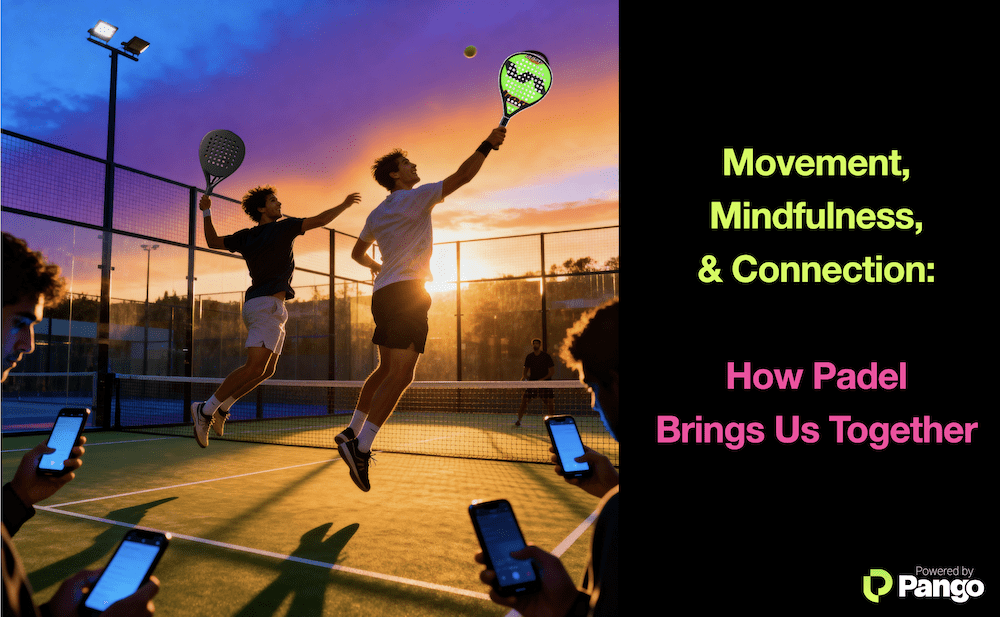
It’s also a refreshingly analogue experience. For ninety minutes, your phone stays zipped in your bag. There’s no screen, no notification, no temptation to “just check” the latest messages (or at least there shouldn’t be!). Instead, you’re fully absorbed in a rhythm that feels oddly meditative: ball-bounce, glass-smack, lunge, recover, grin. It’s mindfulness in motion — a living antidote to infinite scrolling.
And unlike more aggressive sports, padel occupies the emotional middle ground. It’s competitive enough to get the adrenaline flowing, yet social enough to prevent things from turning toxic. Nobody storms off a padel court. Even the losing team usually finishes smiling, plotting revenge over a post-match coffee or cerveza (aka caña or beer!).
The Great Equalizer
Another charm of padel is how it dissolves barriers. In a typical London or Barcelona club, you’ll see twenty-somethings rallying beside retirees, CEOs mixing with students, and total strangers teaming up as partners. In just a few games, first names become nicknames, high-fives become chest bumps, and social hierarchies melt away. There’s something egalitarian about a sport where everyone looks slightly silly at some point — chasing a rebounding ball at the back wall or misjudging a lob. It humanises us.
Even better, it’s near impossible to play padel without constant communication. “Mine!” “Yours!” “They’re up!” “Watch the wall!” These little shouts foster cooperation and trust. Compare that to Zoom calls, where half the participants are on mute, videos masked, multitasking behind polite smiles. In padel, conversation is kinetic, immediate, alive — and when you leave the court, you’ve shared something real.
Padel vs. AI: Humanity’s Friendly Reminder
In an era where artificial intelligence drafts our emails, curates our dates, and might soon outwit us in conversation, padel stands for something beautifully human. It demands no digital filter, no optimisation, no algorithm. You can’t automate a rally or outsource your overhead. Success depends on eye contact, intuition, humour, and coordination — the very traits that define our species.
There’s something profoundly grounding about that. As AI continues its march into every corner of our lives, we need physical spaces that remind us what being human feels like: the sound of a ball echoing off the walls, the slap of a high-five, the laughter that erupts after a lucky shot, or the embarrassment of mistakenly skying or whiffing on a ball. Padel courts might become our modern campfires — places where connection sparks again.
The Afterglow
Ask anyone who’s played regularly, and they’ll describe the post-padel glow. It’s not just the endorphins. It’s a cocktail of joy, belonging, and accomplishment that lingers long after you’ve showered. You step away reminded that happiness isn’t something you find online or purchase through an app; it’s something you co-create, point by point, within four glass walls.
So yes, we may live in a hyperconnected, AI-infused age — but the cure for our digital fatigue might just come with a racket and a few friends. Padel, in its playful, unpretentious brilliance, invites us to reconnect with movement, laughter, and each other. And in a world that feels increasingly virtual, that may be the most human thing we can do.
P.S. When I asked Perplexity AI, which sports or activities have high social chemistry, the response was:
“Padel and pickleball stand out for their blend of competitive collaboration and approachable, community-rich atmospheres…”
If you enjoyed this article and/or already love your padel…
 Please check out my Joy of Padel podcast here. There’s now a library of over 60 episodes with all sorts of players and personalities in the padel world, including the cofounder, Viviana Corcuera, the trainer of the Spanish national team, Juanjo Gutierrez, and a bunch of top 10 male and female players in the world, such as Mike Yanguas, Marta Ortega, Patty Llaguno or Aimee Gibson. The Joy of Padel podcast is powered by Pango, the first global community of padel players. Download the app here and get your personalised padel player card now (it’s free).