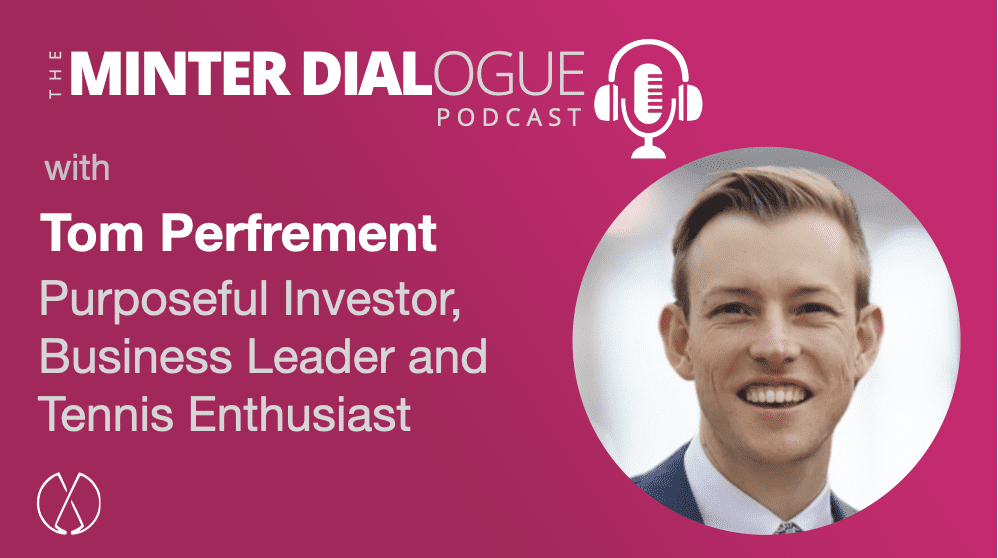
Minter Dialogue with Tom Perfrement
Tom Perfrement is a long-term investor based in Bondi, Sydney, and the co-founder of 5AM Capital—a fund that’s as committed to early mornings as it is to seeking quality in equities. Tom brings a fascinating mix: professional tennis credentials, deep roots in Australia’s multicultural community, and hands-on experience in high-growth tech such as Canva. I invited Tom onto the show to unpack the ever-evolving world of investing, and how he maintains a steady hand when markets—and the world around—feel increasingly volatile.
Our conversation dives into the art and psychology of long-term investing. Tom characterises himself as someone who truly values knowing both yourself and your investment style—suggesting that this self-awareness is fundamental not just for picking stocks, but for sticking to a strategy when others lose their nerve. I was struck by the parallels Tom draws between tennis and investing, where success comes from playing the long game and knowing which “shots” (or business models) make sense in different circumstances. We also explored how community and purpose—whether it’s the strength of Bondi’s neighbourhood or the intent behind a company’s product—play into deciding what businesses will withstand the test of time.
Key Topics:
- Long-Term Strategy vs. Short-Term Temptation: Tom advocates strongly for patience and discipline, especially when the financial markets reward frequent trading and quick wins. He outlines how focusing on companies with market leadership, deep moats, and sustainable growth enables true compounding—provided investors are willing to “sit on their hands” and ignore the noise.
- The Psychology of Investing Amid Uncertainty: We discussed how emotion and market sentiment can destabilise even the most sound investment theses. Tom’s approach? Distinguish between structural versus transient risks, debate each move internally, and look for moments when market pessimism creates opportunity for bold, long-term bets.
- The Role of Purpose and Management Quality: Tom emphasises the importance of understanding a company’s purpose, management style, and innovation cadence—insights forged during his time at Canva. Founder-led businesses and those that create genuine value for customers, employees, and shareholders stood out as the ones that most often earn his conviction.
Three Takeaways:
- Conviction and Consistency matter most: Know your investment style, stick to it, and trust the long-term fundamentals, even when markets are volatile.
- Edge Comes from Understanding, Not Speculation: True alpha arises when you can discern whether market shocks reflect real structural change or simply short-term panic.
- Purpose Drives Resilience: Companies and teams with a clear mission, strong leadership, and commitment to positive impact tend to weather storms and outperform over time.
N.B. The information provided in this podcast is for general information and entertainment purposes only, and is not intended to be financial advice.
To connect with Tom Perfrement:
- Check out the 5AMCapital website here
- mailto:tom@5amcapital.com.au – Contact Tom directly with questions about the fund or their strategy
- Find/follow Tom Perfrement on LinkedIn
Other sites:
- Subscribe to 5M Capital’s quarterly investor letter via their website.
- Resources mentioned: The Intelligent Investor (Benjamin Graham), Canva, Hemnet, Fraport, Intuit QuickBooks, Spotify, Fundsmith, Berkshire Hathaway.
Further resources for the Minter Dialogue podcast:

Meanwhile, you can find my other interviews on the Minter Dialogue Show in this podcast tab, on my Youtube Channel, on Megaphone or via Apple Podcasts. If you like the show, please go over to rate this podcast via RateThisPodcast! And for the francophones reading this, if you want to get more podcasts, you can also find my radio show en français over at: MinterDial.fr, on MegaphoneFR or in iTunes. And if you’ve ever come across padel, please check out my Joy of Padel podcast, too!
Music credit: The jingle at the beginning of the show is courtesy of my friend, Pierre Journel, author of the Guitar Channel. And, the new sign-off music is “A Convinced Man,” a song I co-wrote and recorded with Stephanie Singer back in the late 1980s (please excuse the quality of the sound!).
Full transcript via Castmagic.io
Transcription courtesy of Castmagic.io, an AI full-service for podcasters
Minter Dial: Tom, it is a great pleasure to record this interview. We’re recording it before Christmas, it’ll be released after Christmas. But what I like to do is start with a little intriguing question. Who is Tom Perfrement?
Tom Perfrement: Well, thank you Minter for having me on your show. I really appreciate it. Well, Tom, I’m a husband, I’m a son of my wonderful parents who brought me up and raised me in Canberra in Australia. I am an investor, I’m a tennis player in my spare time. I guess I’m many things to many different people. But I think today is a good chance to talk about investing, to talk about bit of my career journey and wherever else you want to take this.
Minter Dial: Well, at some level I regularly wonder to what extent one knows oneself and to what extent that’s actually important or relevant when you invest.
Tom Perfrement: That’s a really good point. I think in investing there’s just so many different styles, so many philosophies that are out there. There’s you, momentum trading strategies, short term strategies, and then there’s more strategies orientated around some of the investing grades. So, people like Benjamin Graham, who wrote the Intelligent Investor or Buffett is obviously a name that’s thrown around a lot in investing circles. And those types of investors are more of that long term investing, fundamental based investing mindset. And for us at Fivem Capital, we’re very much of that latter camp in terms of being really focused on the long-term fundamentals of businesses thinking through what actually quality means in the context of an investment. So, there’s that. And I think another element to your question is you need to stick with your strategy. A strategy is only useful insofar as it is adhered to. And, and from that perspective, you know, strategies at times will, will outperform, sometimes they’ll underperform. But in those very moments of take underperformance for example, that is where you’re taking advantage of an opportunity in a market and you’re setting yourself up for great long-term outperformance. So, that’s an interesting question, Minter. And I can, I can see where you’re coming from there. It’s so important to know your style and to stick to it.
Minter Dial: Long term. I mean, long term doesn’t seem like a term that’s well adopted or embraced by the financial markets. The idea of reinvesting long term, you don’t have any bloody transactions. If you don’t any transaction, you have no commissions and waiting for know forever for good though. I worked in investment banking for four years and I recall how Important the trading desk was and the margins that were in there and then making the quarterly earnings. And as a CEO of an organization myself, the pressures that are short term that come from the financial people are very hard to bear. How do you tick that box or cross that t?
Tom Perfrement: It’s a good point and I think Minty, you would have seen that accelerate as well in recent years that increasing focus on the short term. I think through the COVID years we saw an influx of new investors to the market, which I think is generally a great thing. ETFs opened up new avenues for the market as well. Yeah, so exchange traded funds and so these passive products are democratizing access to the share market in many ways. Now I think as the access to the share market has broadened simultaneously time horizons have compressed and I don’t have a specific stat for you, top of mind, but the average holding period of a stock or an index through an ETF has been declining over the years. So, for us that is I guess the opposite of what we’re aiming for. It’s also an opportunity. When the markets increasingly focus on the short-term investors who truly do have a long-term mindset, it actually creates an advantage for them longer term. So, it’s a source of alpha in other words. So, for us, the reason we think about it is that we like the long term is ultimately we want a collection of really high-quality businesses. We can talk about our philosophy a bit more but essentially we want market leaders, we want monopolistic businesses or duopolistic businesses that ultimately take most of the profit pool of an industry. And once we’ve found those types of businesses and we’ve spent sometimes in the order of years following them, becoming comfortable with them and their management teams and the financials and the balance sheet, it is no use to us to take a quick win and move on. And we love to compound and stay with those companies over time and let them become a key part of our compounding journey for investors. And in our view, share prices over the long term follow earnings per share. So, if you found a great quality business and its earnings per share is growing, ultimately the best thing you can do is, is to sit on your hands. There’s a great fund actually in, in the UK, Minter, from your land fundsmith and they have three, three elements to their philosophy, which is find good quality businesses, wait for the appropriate price and buy and three, sit on your hands and do nothing. And in, in some respects we have a similar approach in, in finding good quality businesses and allowing time to do the work for us.
Minter Dial: My head goes spinning but I, I want to lean into how on earth did you name yourself 5am because yeah, I’m a writer. I love to get up in the morning and listen to the buds and have a quiet moment without the bloody emails or communications. 5am is sort of the early bird gets the great worms. What was this inspiration for naming your company and how does that fit with being long term?
Tom Perfrement: It’s a great question. So, 5am is a reflection of the early starts of the team, including myself, but also my business partner and founder of the of the company, Sam Chipkin. We. We’re based out in Bondi. It is a quiet corner in Sydney. In Sydney.
Minter Dial: May we talk about this? Although this is being recorded or being published. Sorry, in January. Holy smokes. It’s the 18th of December when we record this. We. I am so sorry for what has happened in Bondi.
Tom Perfrement: Thank you Minter. We are heartbroken and devastated. Bondi, as I said, is, is our community. The Jewish community is also a core component of Bondi and of 5M Capital. And it’s hard to put into words how we feel right now. Australia was a place of peace largely and multiculturalism for many decades, but that is changing now. There needs to be a lot that happens now to change from a policy perspective to give the attention that was necessary two years ago regarding anti Semitism and it is not to make this political, but we did need to see harsher and more focused actions in the lead up to this. There were warning signs that what would happen happened and for those in our community we feel a bit angry as well as devastated that it has got to this. So, there needs to be a lot of change now. But for us more broadly, this is a really tough moment now for Australia. Our business is just a street away from where this incident happened. It hits really close to home. So, pay our respects to the families who have been hurt from this and to the Jewish community and hope Australia can heal from this point. So, thank you for mentioning that, Minter. It is such a sad moment for us but up to this point and still hopefully going forward, Bondi is an amazing part of the world and for us with 5am reflective of these early starts, we have loved this location and will continue to do so. For the perspective of being independent, being focused on the long term, not being caught up in the short term headlines of a CBD or an environment where you’ve got a lot of people in suits, you know, as you mentioned in sales desks, urgently making short term decisions for us in this in the same vein perhaps as some other funds or even Berkshire Hathaway being based not in a major financial center in the U.S. Nebraska Exactly. We, we find Bondi is a wonderful place of the world. So, we like to do good quality work, be disciplined and to run our own race. And that’s largely the reflection of the name 5M capital.
Minter Dial: I’m trying to square some circles and I want to put two things in contrast. You and I have both played a lot of tennis. You’re. You got in the top 500 of the of the Australian tennis world. I played competitive pro tennis in the United States and interesting idea long term and short term in tennis if you’re a tennis player, let’s say even Roger Federer lost 48 of every point city ever played and yet won a lot. Short term one should do things, change tactics. Short term, is it a match? How do you compare short term and long term? If you had to sort of try to connect dots between the way you invest short term, long term and the way you live as a tennis player as I mean you talk about how important tennis is the language of life and I wonder if language of life tennis is a sport and investing to make money can all sort of live in the same ecosystem.
Tom Perfrement: I’m glad you brought up tennis Minter, because as as you mentioned that is a big passion of mine and it was great to hear you love tennis as well and padel and, and exciting what you’re doing there in the padel world. We I should mention Sam the CIO and founder of 5M also loves tennis. He’s also a golf fan. I’m much better than at tennis than he is but he’s much better at golf or an order of magnitude. So, we I think there’s a lot to unpack there in that question. I think one interesting aspect of what you touched on is Roger Federer stat. And you’re right he had such a phenomenal career with winning not much more than 50% of all points played. And you could all one way to break that down is to think about all these different points and all the different strokes of tennis forehand, backhand, volley, overhead serve. And think about that almost as elements, you know, tools in, in your tool kit that can be used to win. And for us as investors, one big difference to individual or solo investors is we think in the mindset of a portfolio and it’s all about risk adjusted returns. So, just as Fedora has a range of different shots that he can use to win a Point, we have a variety of high-quality businesses that sit in our portfolio. Now to be exact, it’s currently around 27. It will fluctuate, but it’s going to sit between say 20 and 30. Now not all of those businesses are going to be up in terms of their share price over a given year, but the portfolio as a whole should present some strong risk adjusted compounding over the long term. So, we like to think different high-quality businesses across different business models that collectively come together, give good diversification and ultimately win hopefully the match for us, which is strong above market returns. And so, there’s four sections or four buckets of stocks we love provide some good diversification, the infrastructure, central business software, online marketplaces or online classifieds and then also testing and commissioning. And they’re all very different business models just like tennis players, multiple shots in their arsenal. The second thing I would say when, with, with your question is every tennis player has a different style. You know, there was that servant volley era of the, of the 2000s or not more than 1990s.
Minter Dial: Excuse me, sorry Tom. 1960s, 1960s, 70s, 80s.
Tom Perfrement: You’re absolutely right, I believe, correct me if I’m wrong, beyond boy, Leighton Hewitt came through one Wimbledon in about 21 and I think that might have been the changing of the guard and there might have been a critical match against Pete Sampras who, who was a servant volley and that I think was that turning point. So, you’re right way back into the 1900s now and, and then now this kind of baseline again, you know, epitomized by a player like Djokovic or an Adal that, that just got incredible endurance. They can, they can rally and endure over the long term. Now those are all different styles and then I think, you know, I don’t know which style matches best with, with us focused on high-quality long-term investing. I’m not sure I would, I wouldn’t want to try to put one of those styles against it. But I think that style is important. And whilst players can mix and match tactics throughout a match, they often still just follow their true style based on what’s best suited to them. And if you’re tall, maybe you’re cymbolia, if you’re short like Leighton Hewitt, maybe you’re going to be a baseliner. But for us with a steady temperament, with the focus on modeling and focused on long term cash flows, we want to be that long term investor focused on good quality businesses with strong moats. We can talk about moats as well, but they’re very Important to us, a mode is essentially just something that is going to protect that company from potential threats from alternative companies that may take its market share. So, we want really deep moats and there’s variety of ways you can form a moat. There’s a network effect like say we don’t own Facebook, but Instagram and Facebook are network effect modes. The more people on the platform, the more value they have because they can interact with their friends. So, for each incremental user that joins, there’s a greater value to the or utility to the total business. Or there’s IP and brand modes. We don’t like those as much because your flavors of the day can change or preferences. Exactly. There’s those costs involved. But we like network effects, we like switching costs. So, once you’re entrenched in a business, say you’re an accountant, you might use accounting software, say Intuit, which is the largest of it of its ilk in the US with QuickBooks. That is a very difficult proposition to move away from because you’ve got familiar with it, the accountants have got familiar with it, all your data is built up into that product. And so, we love those types of businesses that have very strong market share. It’s 85% market share in the US of small and medium sized accounting and it generates extremely high margins and lots of free cash flow that they can reinvest at attractive rates. So, yeah, those are the kind of businesses and they’re the kind of styles we like over the long term.
Minter Dial: So, what’s interesting, Tom, I kind of have a multivariate feeling about what you say. I have invested long term as in I hold stocks for 10, 20, 30, I’m 61 years old and I, I really get that. I, I totally get it. And I see around us, you know, tax laws changing all the time, impatience, extraordinary upheaval in our world wars, economic issues and general level of impatience, inability to watch a. Oh my God, it’s a one-minute video and there’s so many conflicting things that are out there. It feels like you also need to know what does the market feel? Because as much as you might think that this is the right investment, these guys are smart, they have the right tactics and strategy. Good product might have built moats, but does the market, believe it or not, because at the end of the day, as much as we might be right and, and so even with my family, I talk about now let’s just be patient. I think these guys are smart, they have a good product, then you have to the issues like regulation War can impact all these things. How are you dealing with clients in this? You know, somewhat. VUCA create chaotic world.
Tom Perfrement: I like that question. I think that’s very, very important. It’s one of the biggest challenges to our industry, but also to investors generally. Is that psychological aspect or that emotional aspect of investing. And it’s tricky and we don’t. Investors don’t always get it right. But I think there’s lots of elements to it. Firstly, when you see a stock that you might fundamentally believe is a really strong business and you see that share price moving against you, you feel those feelings of have I got it wrong? What does the market know that I don’t, etc. It is a moment to step back and think really clearly, have very big debates internally in our investment teams around what is the reality of what’s happening that business? And we ultimately can bring it back to is the issue that’s plaguing that business, Is it transient or is it structural? Is it here to stay? And then there’s a second but important question. Is that issue overstated or is it perhaps? And is, is it an. Is it an overreaction?
Minter Dial: Is it priced into the stair?
Tom Perfrement: Is it priced in. So, it comes back to the topic of valuation now when the, the other thing to mention is share prices of all of these businesses, even the most large cap companies across the world are incredibly volatile. So, some might say also, how can you find an edge in the big global businesses of the world? And we’re looking not necessarily at the biggest large cap companies, but big businesses, 10 billion plus in market cap. But you look at even some names like Microsoft, Amazon, they are pulling back at times 30%, 40%, even sometimes 50% across a period of decades. So, there are these moments where these dislocations occur between share price, perhaps an intrinsic value, which is our view of what fair value is. So, we run, we do that, we do that deep thinking. It comes back to often the moat of the company. Do we still feel it’s intact? And importantly, is it shrinking or growing? It’s often, it’s often the trend in the moat that matters more than the moat itself, where it is in that static point in time. So, and then we come back to if we feel comfortable, if we feel confident that we’ve done that work, we’ve done our research, we’ve done our modeling, we’ve built in some conservatism into our scenarios in our bear case, our base case and our bull case. You know, we’ve done our expert interviews, we’ve Spoken to some customers. We’ve touched base with the management team and we still feel comfortable after all those, those deep dives. At that point we really lean into that dislocation and we try to be transparent with clients. You asked about how do we take clients on that journey? One, we are looking for aligned long term investors. That is important to us. Often these are families with intergenerational capital and that is important to us. We often are speaking with not only that core investor who has entrusted us with their capital, which is a responsibility you take extremely seriously, but also maybe the next generation who, who you know will hopefully be on that journey with us, who is often interested in learning about the share market. And we like to be transparent. Our phones are always on for investors. We like to talk with investors. We had a few calls just earlier this week to share some of the particular ideas where doubling down on and hopefully through that process we can share that thinking, give them comfort with what we’re doing and hopefully allow them to also lean into opportunities where we think there might be a greater margin of safety than there otherwise would have been. I want to give you a really good example for maybe for this point around when the market can be erratic. What can you do to work out whether it is. And, and, and then hopefully what, what is the outcome on the return? There’s a business that we love at the moment, which is Hemnet. Hemnet is a Swedish property portal. Property portals are extremely good business models because we touched on before. These types of businesses are driven by a network effect. So, normally one key winner emerges and that winner tends to have the majority of the market. And so, Hemnet in Sweden, for all homes that are sold in the country, nine in 10 are listed for sale on that platform. So, if you’re a seller, if you’re. If you, if you’re in Sweden and you want to sell your home, you virtually need to pay to Hemnet to list it on its platform. You’ll pay a fairly moderate fee in the order of a few thousand US dollars, which is easier than me talking in Swedish kroners for our listeners for that purpose, to promote your home. But it’s very important you take that step because your home is often your most valuable asset. In most cases it is. And so, you want to maximize the amount of eyeballs or people who are looking at that home to maximize your selling price. So, because of that, Hemnet has great pricing power. Now for Hemnet, if you look at the share price as today in December of 2025, we’ll see it is down about 50% from its previous high. Now what when we distill this down, there is a few factors to why Hamnet has pulled back. But the one of the core factors and perhaps the biggest is there is a cyclical slowdown in the Swedish housing market currently. So, the market has been a bit soft despite rates coming down in Sweden under 2%. And that has meant the number of new listings onto the platform from sellers has declined 20% year on year. Now that has meant even though prices were up 20%, listings were down 20%, revenues flat. Whereas wind the clock back a few years, Hamnet was growing at a phenomenal rate. In fact, they perhaps were pushing pricing power a bit too hot for our liking because that can also draw some considerations and issues around potential regulation. But volumes are down. The share price has reacted significantly. Off the back of that we can be long term, look through the cycle in our modeling, understand that volumes will normalize, that the fundamentals of Hemnet are still intact. We look at the traffic data of visitors to Hamnet every month through our proprietary sources. We can see that they’ve retained their market share and their engagement and that the business remains really well positioned. So, we believe the moat is intact. And there are some other factors as well that this podcast is perhaps not long enough to go into all the details. There is AI, it is a consideration. There is also regulation. I mentioned in that sometimes in these scenarios where you have a monopolistic business regulator can step in and there’s some nuances there around a scheme that they have in place with their agents where they kick back some profits that the regulator might come in and stop that. That would actually give Hemnet a higher margin because they’re not giving back some of their profits again. It would also potentially slow down some of that upsell into the top tier packages. And anyway, I do digress with some of those extra details. But the core thing around your question is the market can be erratic. We like to think of it as Mr. Market can be pessimistic. He can be greedy as well. In this case we think he’s being overly pessimistic or worried with Hemnet. So, we can lean into that dislocation and as a part of a balanced portfolio, top up a business like that that we feel long term is still structurally very strong. And you know, fast forward o’clock a few years, we hope time will be the true test. That should be a good strong compounded return from, from these kind of levels.
Minter Dial: So, Tom, I own balance. I listen to all this. And I, I subscribe, I’m a long-term investor. I love fundamentals. I, I think very much as an entrepreneur, the value of the people who are running the company, the strategy and the product and even trying to take consideration the expectations, the market evaluations and, and where this is all going. I wanted to, and I appreciate all that Tom. I wanted to sort of look at this a little bit differently somehow sometimes because people who are listening to this are not necessarily just investors, they’re businesspeople. And one of the things that you talked about is edge of your seat living, which is a little bit more sort of a risk embracing, I mean the way I interpret it. So, you need to be able to embrace risk at the same time as wanting to have moats and monopolies. And it feels like as I was sort of researching this somehow there’s a paradox in the idea of risk and moats and monopolies. And how do you match those two ideas? I mean in the end of the day, believe me, I think you need to embrace risk and at the same time a hundred percent have been a long-time investor. So, even in my own self I feel like I’m living those paradox. But as when you’re trying to promote your investment strategy, the issue of risk and living by the seat of your pants and at the same time being monopolistic build long term, it feels like a funny mix.
Tom Perfrement: Yes, risk is a, is a big topic. It’s a, it’s a big topic. We like to think our strategy ultimately is a lower risk product. And I’ll get to that because it needs a bit of explanation. But equities generally are obviously a risk asset. And they’re right. Absolutely. You’ve got that, you know, the full spectrum of fixed income and bonds or even cash before that, all the way up to private credit and then and equities at the far end. So, risk is, is a big part of, of this asset class now from an academic sense. So, say, you know the, the classes I, you know, had around risk and hedge funds and the like at Oxford, doing an MBA there. Risk is always spoken about at side school of business. Yep. It’s spoken about in the terms of volatility. That is how academics in the field of equities and investing try to grapple with the term of risk is a measure of volatility essentially. Now as we talked about before, volatility isn’t necessarily always a bad thing. Volatility creates that opportunity to find a gap between share prices and intrinsic value. When we think about risk, we think about it more from the sense of the permanent impairment of capital, that that is more our consideration of risk. And what do we mean by that? Well, risk in our view is a business that’s structurally under threat or deteriorating. So, it’s a low-quality investing in a low-quality business or deteriorating business, even if the share price is flat. That is risk for us because ultimately as we started off with that statement around share prices follow earnings per share. So, we need to see a structurally sound business, growing earnings per share. That’s where we come back to moats and that’s where we come back to monopolies and businesses like. So, let’s talk about some more because it gives a bit more color to it. So, mention the four buckets. Central business software infrastructure, online classifieds and testing and commissioning infrastructure has a number of natural monopolies form around it. There can be businesses like toll roads which we don’t hold any currently. Also airports. An airport is a natural monopoly often over at City. So, we own a business, Fraport, which is a collection of airports. But the core jewel in the crown there for Frauport is Frankfurt Airport in Germany, in Europe now the German government has ownership interest in Fraport. It is the biggest airport by freight movement in all of Europe. It is a very core strategic location almost in the heart of Europe. We feel the moat of that business is very strong. It’s a physical barrier to entry and it gives us a lot of certainty over modeling cash flows. And so, with my career and Sam’s career in infrastructure investing at Macquarie, we love to focus on cash flows. We feel we can have good certainty over forecasting out those cash flows of that business over 10 or 15 or even 20 year periods, which is longer than the average investor. And for us, if we can see a margin of safety in our ultimate valuation, we can feel comfortable in that situation, that dynamic and how management are approaching that company and the leverage, the debt, which can be an issue sometimes with infrastructure. We feel a collection of those style businesses can ultimately try to minimize our overall risk when, when we run a strategy like this. But there will be periods of, of volatility and I think that’s what you’re alluding to with the, the question around leaning into risk, leaning into maybe volatility. We hope over the long term it is a sound lower risk strategy relative to perhaps some other concentrated equity strategies. It is high risk relative to other asset classes. But ultimately we try to manage that risk through the quality of our companies. So, it’s about the permanent impairment of capital is our version versus volatility we think is more of an academic distinction that we think is less relevant from our perspective.
Minter Dial: As I’ve been listening to you Tom and, and I use a, an app SAS called Canva. I’ve been using this for my making a deck for my startup Pango and, and so I, I have, I’ve been working on this for I don’t know, a year and I’m thinking about your life in Canva now. It’s a great company startup, huge valuation, gets to startup mode and then you’re now talking about monopolies and moats. I wanted to add one more piece into this. I used to run, I was a CEO of a company called Redken and we would sell hair color to hairdressers and the, the, the thing was the captive market because if, if you, let’s say you own a hairdressing salon, you have 10, 000 women or men that come by your salon and they each have a formula that’s used to change their hair color. That’s part of their identity by the way when they might switch from one hair color to another. That’s an enormous risk. Oh my God. I, I can’t possibly do that for my 10,000 customers. I have to change formulas. It’s chemicals and maybe I’m going to screw it up and they’re not going to be happy in, in some way this is like a, it’s a protected business. One might call it a moat in another way. In any event I was thinking what, what was it that maybe when your life at Canva that’s made you think now about monopolies and, and moats was there, is there a link between those two? And to what extent is in your monopolistic moat like world and, and long-term EPS that is driving the world at 5am capital that comes from your experience at Canva or is that just completely just a red herring?
Tom Perfrement: No, it’s, no, it’s a good point. And so, Canva is a phenomenal company. It’s one of the great Australian success stories and really excited by what that team there continues to do and grateful that I had the chance to be there at Canva in that strategy team working on some, some really interesting projects across 2022 and 2023. I think Canva has taught me a lot of things. Firstly, it’s really important for all investors I think to have business experience, operating experience and prior to Canva was a management consultant and I think one of the sometimes the criticisms of management consultants is they never stick around long enough to actually do some of that work. It’s, it’s, it’s an important role but it is an upfront setting. The strategy, the North Star without then the underlying execution obviously that follows. So, there is a, there’s a.
Minter Dial: If I may Tom, the same could be said of financial folks that are investing. I mean I was a CEO, I ran the business and, and I regularly get irritated by, you know, you, you oughta. That’s what you should be doing. Yeah, well, yeah. Come in the trenches with me. Roll up your sleeves, do the.
Tom Perfrement: Exactly.
Minter Dial: And it’s not quite as simple as that.
Tom Perfrement: Exactly that There’s a big distinction and there’s this statement I like which is I think, I think it’s an investing quote around I’m a better investor because I’m a businessman and I’m a better businessman because I’m an investor. And I like that, that they are intertwined these two fields. And so, part of being at Canva was to understand what, what are the inner workings of a really high quality, growing, fast growing business. Now Canva, when it back coming back to moats and the like, there’s a number of things that make Canva a truly phenomenal business. It isn’t that it isn’t a direct fit in our four buckets. The closest it would come to is essential business software, although that’s often B2B. Canvas origins were more and business to business. Canvas Origins started with this sort of freemium model for individuals, for solopreneurs, people who are launching a business maybe on their own or with small teams.
Minter Dial: I have a premium version just.
Tom Perfrement: And then they might upsell. Yeah. So. And, and then you might upsell to, to those products. So, that was an incredibly efficient motion selling motion go to market motion. And, and, and the second thing I’d say is they found a niche air of that market and, and totally upended on its head from the, at the time where that kind of instant create drag and drop interface to bring in templates and your brand colors, build something really quick and efficiently all online. Collaborating together in the cloud wasn’t a thing until, until Canva came along. So, category creation, which is an important thing. Another point that I’d mentioned, which is very important to Canva, and this is where we do try to take some of these learnings into our portfolio is the management team, quality of team and pace of innovation. And when I think about Canberra, I score it extremely highly both of those two metrics. So, the team Itself. Obviously when you think about management teams and founder teams you need visionaries and you often want to see a founder in the seat. So, for our portfolio, just over a third of our portfolios at 5M Capital, founder led and we love founder led dynamics because they do. They often are those visionaries who can continue to motivate, grow, innovate, find the next new thing for the company and often they’re most aligned with shareholders. So, we like to see what we call skin in the game which you might not get with the career CEO to this to the same extent. So, the founders, Canva, Melanie and Cliff and Cam, which the three of them have huge admiration for, still have significant equity. They’re still extremely passionate about where that business is going and that shows through in the work that they can do, the pace of innovation. So, an example of that is they’ll hold an event annually or even in more recent years biannually called Canva Create. It’s the big showcase which they’ll, they’ll get on stage. The last one was over in the States when I was there, there was a couple in, in Sydney and they’ll unveil the new products that they’d been working on and for, for a big company like, like Canva, which is now north of 40 billion in valuation and, and several billion in, in top line in revenue. For them to be able to have that kind of product cadence of product release is extreme is extraordinary. And they’re operating at a startup level pace, at more of an enterprise level scale. And that is that pace of innovation is something we love to see and we do see it in some of our other portfolio companies as well. And when we see that, we feel comfortable that the management teams are attuned to the risks, the changing dynamics, particularly in this world at the moment where I think a lot is happening, a lot is changing with AI and we, that gives us also more comfort on, on the, the quality of those business teams. So, management I think was, was a really key lesson and innovation was a really key lesson from Canber.
Minter Dial: Fair. I like that. Thank you for explaining. Just going to take a. One last question which really you mentioned North Star. To what extent is purpose a value?
Tom Perfrement: Well, purpose is super important. I mean it is. Everyone has a driving reason behind what they do, what they do. I think for us, 5M capital, it does come back to our love of investing. The whole team. We are in it because for decades now that Sam, myself, the broader team, we’ve found investing to be our most enjoyable pursuit that We’ve come across. We want this to be our career for the next few decades, for the rest of our lives and importantly for the company, we want to maintain a boutique feel. We have put a hard cap on the fund. 750. Yep. Million. Yeah. You’ve done your, your research, thank you for checking that. And is important to us because we ultimately don’t just want to be an asset gatherer. There are so many funds out there that change their nature and their cultures because you get to the point where maybe you start to be institutional scale or not even institutional scale, but you know, a large business, a large boutique where you have a lot of sales teams, you have a lot of additional functions of that company in terms of compliance, counting, legal, etc. And it detracts the more senior members, the investing team from their core duty which should be to focus on investing. So, for us we really want to ensure that we stay boutique, we stay small, we can continue to focus on investing, can be here for the long term with clients over the next few decades. And that’s our purpose ultimately. And you know, if we can do that and achieve great returns, risk adjusted returns for, for shareholders and also be a good, a good business as well and focus on giving back in various ways as well. And we have signed the giving pledge as a business that would also give us and the team a lot of great satisfaction, I’m sure.
Minter Dial: So, I’m not going to question the sense of purpose that you have as an investment, although I could. My real question was to what extent when you make a decision on an investment purpose of the company fits into it. I mean I’ve been on many boards and, and dealt with many shareholders and typically, and I worked in investment banking DLJ and typically the main thing was how much freaking money are you going to make me and you know, is my share going to go up? So, when and I was a CEO of a company that had a legitimate purpose and I was idealistic often in thinking that purpose actually is really powerful and I’ve written about it in many of my books. Yet the issue is does Wall Street give it to us? Does the share price have a real understanding of purpose? What I call purpose North Star something missionary doing something more than just freaking making money. You know I, I speak as a non-financial folk, and I feel like you guys at 5am you talk about purpose, you certainly have it within your gestalt amongst yourselves. But when you are evaluating a company to what extent is purpose part of the long-term plan?
Tom Perfrement: It is it is key. We think about it in a variety of ways. If we didn’t touch this on to touch on this today. But we do have a tool as well that’s used to rank our businesses from best or to, to least attractive. One of the inputs into that force ranking tool is our view of, of ESG and our view of purpose of the company.
Minter Dial: Sorry, sorry, just me. Are you talking? ESG is purpose.
Tom Perfrement: ESG can be it. I think these two are still separate, but they are, they’re definitely overlap in terms of how that company puts itself out into the world, how it acts, is it a responsible entity in its society and community. So, I think that they are connected. Purpose is important too. That feeds into our thinking. Ultimately what we want with our businesses and as I mentioned, their market leaders, sometimes them are not pleasant duopolies. And that can often have a bad name. What we’re looking for is that win, win, win. We, we have, we talk about it in variety of situations and with clients. We want a business that is generating great returns. Yes. And is focused on shareholders, but it’s also focused on its customers. It’s also focused on its employees. And that’s really important. And it is very important because we want to see that business, even though it might have pricing power, we want to see it adding value to the customer. So, mentioning Intuit again. Yes, they have 85% market share and they’re monopolistic. But their customers love that company, they love that software. It makes their life so much easier. And when you think about the value to cost ratio, it’s very high and it keeps growing more val. Yes, cost goes up, price goes up a little bit. The amount of value they’re giving back with how they can innovate that product, make it so much easier to either lodge your tax return or do your business accounting or a whole variety of other things. Now as they’re expanding into payroll and other functions, it brings joy to those customers. So, we love those dynamics. Another example is Spotify. I mentioned like online classifieds model. In a way, Spotify is a, is this kind of classified, you know, bringing together the inventory of all the music of the world and now audiobooks and podcasts and on the other side, the listeners. And it’s number one by market share. We think it’s phenomenal business. Daniel Ek, as a founder has had for a long time a vision of providing a wonderful experience for customers as a very passionate lover of music and the arts and culture. So, that is something we love to see too. We know that it ultimately then can feed through into the quality of the product and ultimately hopefully create that win-win-win. So, we really look for it and we’re not looking for a monopoly that is taking advantage but looking for a monopoly that’s creating more value than it that charges.
Minter Dial: Well the funny thing is of course I am a premium Spotify member and a Intuit Quickbooks for my business so lots of things that resonated with me Tom I you know those too well I do and Canva good God the only thing I haven’t got is 5am capital in my list but working on that so Tom how can someone follow you Right Read what you.
Tom Perfrement: Yeah so if you if anyone is curious to learn more about 5M Capital our website is www.fivemcapital.com we love talking with investors as I said our mobiles are on our emails are open you can also see our contact our website we do release a quarterly letter where we talk about a lot of these topics businesses we like moats long term thinking every three months and how.
Minter Dial: Can someone get that and someone.
Tom Perfrement: Could subscribe to our letters via our website. They can reach out also to me directly at tom@5amcapital.com.au if they’d like to email and we yeah we appreciate the chance to have a chat Minter it’s an excellent chat. Keen to chat a bit more with you later maybe about padel as well. You’ve had a very fascinating background in in in that space. I want to get involved a bit more.
Minter Dial: Tom it’s been a pleasure wishing you presently the wonderful holidays and hopefully a wonderful 2026 which will be the this will be the first edition of the 2076 of the Minter Dialogue. Many thanks, Tom.
Tom Perfrement: Thank you Minter. Really appreciate it.

Minter Dial
It’s easy to inquire about booking Minter Dial here.