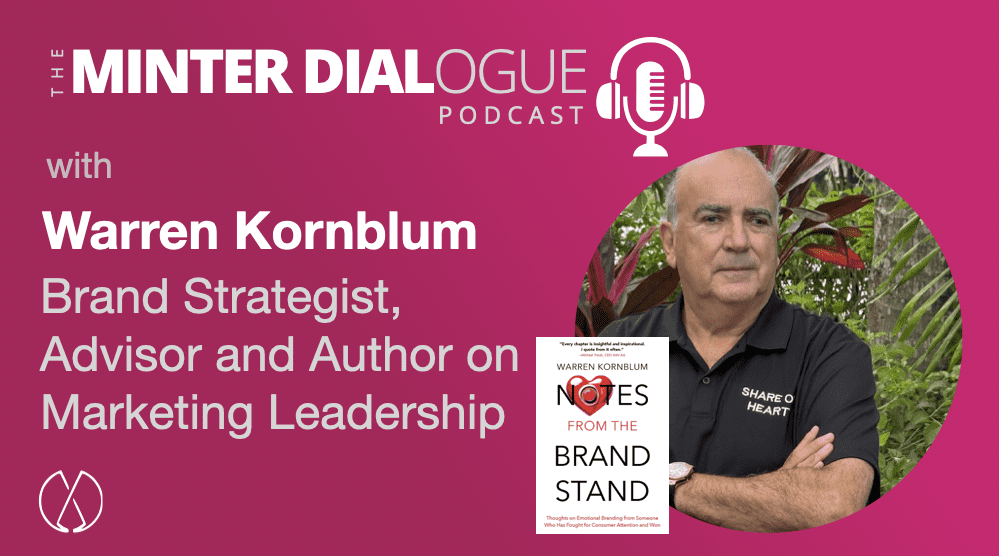
Minter Dialogue with Warren Kornblum
To connect with Warren Kornblum:
- Check out Warren Kornblum’s hub site here
- Find/buy Warren Kornblum’s book, “Notes from the Brand Stand,” here on Amazon
- Find/follow Warren Kornblum on LinkedIn
- Send an email directly to Warren
Further resources for the Minter Dialogue podcast:

Meanwhile, you can find my other interviews on the Minter Dialogue Show in this podcast tab, on my Youtube Channel, on Megaphone or via Apple Podcasts. If you like the show, please go over to rate this podcast via RateThisPodcast! And for the francophones reading this, if you want to get more podcasts, you can also find my radio show en français over at: MinterDial.fr, on MegaphoneFR or in iTunes. And if you’ve ever come across padel, please check out my Joy of Padel podcast, too!
Music credit: The jingle at the beginning of the show is courtesy of my friend, Pierre Journel, author of the Guitar Channel. And, the new sign-off music is “A Convinced Man,” a song I co-wrote and recorded with Stephanie Singer back in the late 1980s (please excuse the quality of the sound!).
Full transcript via Castmagic.io
Transcription courtesy of Castmagic.io, an AI full-service for podcasters
Minter Dial: Warren Kornblum, I am delighted to have you on the show. We had a little chance to catch up beforehand, a lot of little crossed things in common and as we will probably dig into and learn about as we go forward. But in your own words, let’s start with who is Warren?
Warren Kornblum: Ah, well that’s a, that’d be throwing me right off. No, not really. So, I’m a lover of brands and have spent my life in that world on a business and professional level. Started in the advertising business, had my own agency originally from Toronto, expanded into the United States, sold that, I’ll try and do it slowly or quickly I should say sold that business, became a managing partner at a multinational ad agency called Bozell Worldwide. It was originally Bozell, Jacobs, Canyon and Eckerd ran their global retail practice. After three years, while I met a lot of wonderful people and got to work on a lot of great international business, I decided I liked being an entrepreneur and by myself more than I liked sitting in a corner office, you know, worrying about HR reports and things like that. Decided I would leave at that point and by a strange twist of fate was recruited to be the first global Chief marketing officer at Toys R Us. In the days of, you know, early days of E commerce and early days of Walmart and Amazon attacking Toys R Us, they decided they needed some more marketing firepower and for better or worse, chose me. So, I was there for six years until it went from being a public company to a private company and then I decided to leave. Then again by twist of fate, wound up in the furniture business and ran the global marketing and was a senior advisor to Certus Simmons Betting. And then after that I decided that I would start helping brands as a, as an advisor and that’s what I’ve been doing for the last few years and then as of very recently became an author later in life.
Minter Dial: Bravo. I I so how did you embrace the idea of being of entitled as a, being titled as an author?
Warren Kornblum: Well, you know, it’s the book is called Notes from the Brand Stand and it really is the byproduct of a year of many years of if you would come into my office, all the way back to my advertising agencies, I had post it notes all over my wall, little pithy things I wanted to remind myself of and they sort of form the foundation of the book. It’s by no means a textbook. What it is is it’s kind of anecdotal stories of my life times with clients, brands. I like brands. I question some. I worked with Some I didn’t. But how am I handling being an author? It’s been an interesting journey. You know, I didn’t, Fraser, I didn’t do it necessarily because of money at all. I don’t mean that arrogantly. I did it because I wanted to have a little bit of a legacy out there of my thought process. And so, I’m enjoying it. I enjoy doing these kinds of things. The jury’s out on what the book, what the book will do, but I’m, I’m proud of it. I am proud of it. And I’ve gotten a lot of very positive feedback.
Minter Dial: Well, in some way, I’d like to say your Warren isms are sort of a brand, a branded element of you.
Warren Kornblum: Yeah, well, thank you. And those really are many of the notes that I could remember or find that we, you know, at the beginning when I started to do that, my, my project manager, I said, I don’t know if I should do this. It’s kind of like egocentric and war isms. And she said, there’s no other name for it. That’s what you should do. Just put it in there, kind of, you know. Yeah, own it. Right. And so, yeah, so thank you for mentioning that. It’s, it’s sort of the last chapter of the book.
Minter Dial: So, I went to business school and I recall in France, and I recall very much thinking I need to figure out what this thing called marketing is. But it turned out that very little of that conversation, those courses discussed what is a brand. And I suspect there’s a lot of different definitions out there. But how would you say your understanding of brand has evolved over the years? And if I could par. Or at least, you know, it’s not a setup, it’s the reverse. How is it that so many advertising companies have terrible brand names? BBDO, WPP. I mean, talk about the cobbler with bad shoes. What is the brand today and how’s it evolved over in your lifetime?
Warren Kornblum: Well, first of all, having just come off the comment you made about Warrenisms, I made me feel guilty even saying this because my first answer would be that most of those companies have named themselves after the founders. Right. So, it was a people driven thing. And I think that from a brand perspective, to me, a brand is really the personality of a business. That’s a kind of a gross oversimplification, but it really is. I mean, when brands have done a good thing, you know, as you know in the book, I talk a lot about share of heart and you talk about business school, it kind of morphed from my studies in business school where in the, you know, in the, in the traditional days or the legacy days we were always taught about, you know, top of mind. So, you want people to, or sorry share of mind, you want people to think of you top of mind. You want them to think of you first share of wallet, you want them to do business with you. And long, long, long time ago I said, you know, if you could ever get past all of those and actually earn like ability and have an emotional connection as a business same as you would as a person and you achieve share of heart, then all of a sudden I think you have, you know, you have the game beat in terms of your relationship with your customers. You also have an obligation to make sure you ensure that. So, to me we’re, you know, marketing in its simplest form to me is selling. Right. But instead of selling on a car dealers lot or online forum or something like that in the advertising business, as you know as well or better than I do, you’re, you’re selling to the masses and sort of narrowing that down, finding out who they are. And you know my, my focus has always been that businesses should think more like people and business leaders should think more like people. And if, if you and I are meeting each other, which we are, obviously it’s important for us, for us to, to build a relationship there has to be a connection. And I think it’s the same for businesses and, and a big part of that connection is the brand. What does it stand for? What’s its purpose? You know, what can I expect from it as a customer? So, that you know, to me I think in, in practical terms that’s what the brand is. It’s the personality of the business.
Minter Dial: Yeah, I like that answer. The issue of course is that somehow the personality is sometimes shaped by an entrepreneur that puts his or her name on the top and then that entrepreneur may or may not continue on then the other sort of side. And I’ve talked about this in one of my books about the three elements that make a brand possible and one of them is the presence of the founder. Yes. So, if it’s in the title perhaps, but at least within the, the concept and the, the problem solving, the, the courage that goes into founding. Then the second one which is raises the eyebrow is public versus private, privately held and the freedoms that are allowed to express personality. Which sort of what caught me when you said when it went private you left it. I’m thinking that that’s when you can do you have more freedom to roam. And I wanted to quote Greg Ahern who wrote about your book. He said I could hear Warren’s voice like the OB1 Kenobi of branding. Luke, remember, branding is always personal. And that’s an, I mean, that’s a statement that I have long believed. You’ve got to make it personal. Like when someone says to me, don’t take it personally, Warren, you’ve done a bad job. Well, I want people to take it personally, yes, to get that sort of vibe going. But how do you reconcile the deeply personal nature of branding then that we’re talking about with the need for scalable systems and processes in large organizations and all the worse, publicly traded large organizations?
Warren Kornblum: Well, that’s a broad question, so I’ll try and do it in piecemeal. So, the first, you know when one of my habits, for better or for worse, when I’m advising companies today is I’ll go in and meet leadership and have a very brief meeting with them. And then I say, if you don’t mind, what I’d like to do now is walk around. And they’ll always say to me, and walking around is not just physically walking. Yes, it is. But it’s going on the website, it’s talking to customers, it’s experience, it’s shopping it. Because to me, it’s got to be to your point, top down, but also bottom up. And it’s all about the personal experience that your customers have with you. Right. And it’s amazing often times how I’ll go back in and say, well, this is what’s happening out here. This is what people are saying. And they’ll say, no, it’s not. That’s not what our research says. Or that’s not. And I’m like, well, that’s what your customer says and that’s what counts. So, that, that would be the first thing that the, the, the top down, bottom up. It’s about the customer personality. I think when you talk about the public markets, I think it’s a flawed system that’s changing a bit. And the flawed system I remember going from entrepreneurship into a public company, been there is how we would, on the leadership team, run the business the way we thought it should be run for two months. And then for one month, everybody was scurrying to get ready for the analyst call, the quarterly call. And we did some things that I don’t think we ever would have done if it weren’t for the fact that we were going to have the call. That’s not even talk about the annual Meeting that’s just every. So, you know, basically you’re doing what? Yeah, it’s like crazy. And, and then also we didn’t talk about. But then I had experience with private equity and you know, love those guys and, and ladies in private equity. But the kind of that parallel story to me is, you know, a lot of times they’ll buy a company because of its brand, the power of its brand and inevitably, and you know, in my experience anyway, one of the first things that the, that the financial people do after they close the transaction is look at the financial statement and the juicy item that they see first is marketing, advertising, call it what you want and it gets chopped. Yeah. So, it’s let’s go buy a Ferrari and let’s put unfiltered petrol in it. Right. It’s like something’s going to happen, it’s going to backfire and it just happens all the time. Where. So, I think, I think when you talk about. And also that’s part of the founder mentality that you referred to or asked about as well is you know, there’s a driving force of vision and I think that the really brilliant people who have the best ideas also have an ability to get alignment and shared vision throughout the organization. The last point I would make on that, that sort of puts back to the original question is, and it goes to my walking around theory is, you know, I’ll often ask people, well, you know, what, what does the brand and the company stand for? And like many companies will have a mission statement either on their website or sitting in their lobby and you ask people and you can tell when people just sort of recite it back, that’s not buy in when they articulate it in their own mind, but it’s in line with the, with the founder’s vision or the leadership vision. Then you say, okay, I think this organization has that top down, bottom up. But to me that’s, you know, personality is, is got to be attractive but it’s also got to be embraced especially when you’re talking about a business.
Minter Dial: Right. So, when I meant privately held in my mind I’m thinking more about hers where the family, the original founding family still owns it because I kind of consider private equity just another version of the stock market where they’re all there. I mean they’re about the three-year turnaround and, and, and zip, zip, zip and exit. And as you say, they, they don’t really know or want care so much about brand even though they buy it that way. But when, when My experience on, on being on, on several boards is that the topic of brand is usually vastly misunderstood and if, if not completely forgotten as a topic within board meetings, which are about strategic things. But the topic of brand is, is far, it seems, for me, far from most board discussions. What’s your experience and how do you carve a space out for it?
Warren Kornblum: I think you’re absolutely right. And I think that the, the first thing is, and I think it’s the Chief marketing Officer’s job in, in part, and listen, a lot of times founders are marketing driven because at the end, you know, you’ve come up with a business idea unless it’s really something technical, because you have a vision of what you want, what people will want from you, or what, you know, a niche in the market, if you will, the problem you’re solving.
Minter Dial: Yes.
Warren Kornblum: And I think that as a, as a CMO in a business, I would say that a huge part of the job in the boardroom, as you’re saying, is convincing people that marketing and branding is an investment, not an expense. Is it an expense? Sure it is. But is it an expense that has a payback to it? That is a worthwhile thing, similar to buying a building or buying a new machine? I would argue it’s more important, but that is, that is an argument that often falls on, on deaf ears, particularly when you have, you know, financial power within that room or logistic power or, you know, operational power. I think, and I, I believe this for young people coming up that, you know, I’m sure, like you have had the opportunity to, to mentor who are going to go into that marketing leadership. I say you have always got to be an evangelist for the need for the protection of the brand and the need to market the message. And if you just sort of keep, if the conversation evolves to strictly, you know, cost engineering or value engineering the business, and you don’t fight that fight, you can’t save your way to success and growth, in my opinion. So, that to me, being an evangelist for a brand is a huge part of marketing leadership.
Minter Dial: I have many thoughts listening to you, one of which is that when I was running Redken, we had an unofficial title for our business development woman, and, and her title was Director of Love. But whenever I spoke to my l’ Oreal henchmen, I never talked about that because they looked at me like, you know, what that kind of a statement would be like? Well, you’re on drugs mentor again, by the way, you know, and, and that the idea of love and personality and. Because that obviously leads to, well, you know, you just want to smoke your own, you know, weed and talk about you. No. Well, that’s actually not what I have to do. I need to incarnate. I need to embrace the values and I need to model the behaviors that go into that brand. So, I allow. But I need to do it in an authentic way, because if it’s sort of like in a suit and I’m sort of just accommodating it as opposed to leaving it and believing it, then it’s really hard to go. And so, what, what are the, what are the, what are the arguments that allow for a board or, you know, the CEO chairman to say, oh, well, this is actually something we really ought to be doing?
Warren Kornblum: Well, I think the first. The first tough job, and you got it when you were doing it, and it’s sort of, you know, you’re, You’re. The love analogy, I think, is an important one, is to say to people, look, it’s not about us. It’s just not about us. It’s about our customers. And the listening part is far more important than the talking part. And I think that when you talk about, you know, the, the Director of Love, what is that saying? That’s the person who’s going to find a way for the brand to embrace the people we want to do business with. Right. And you can’t do that by. It’s, you know, it’s the old push pull thing. It can’t push. You can push people a little bit. I always say you can buy awareness, but you can’t buy a connection. You have to earn it. And I think that that’s where Director of Love comes in. You know, that it’s taking that, the brand, the essence of the business, but understanding and finding ways to connect with the people that you want to be wearing your products on. You know, if they’re beauty products or sitting in your cars or whatever. You know, it really is about finding ways to, to make that connection with them. And you can’t do that if it’s outward. I remember just quickly when I first got to Toys R Us, I had never been on the client side. I’d always been an agency guy. And I walked in and, you know, it wasn’t rocket science. We. Our target customer was with mom, was mom with kids or secondary and all that kind of stuff. Grandparents. But the primary target was a mother with kids. For Toys R Us, the entire executive team was. Was guys with ties to your suit story. It was like, okay, you know, some of us are probably Better than others at getting out of our own way and thinking like a customer rather than thinking like ourselves. But not a lot. There’s a, you know, those are special people that can do that. And I pride myself on, I think, you know, having been able to do that a lot in my career, because it isn’t about me. I don’t believe it. It’s, it’s about the people I’m trying to speak with, but most people can’t. So, immediately I said, we’ve got to get some moms in this business. This is like nuts where, you know, they know what they go through. We can learn it and have an affinity for it or, you know, sympathy for it, but we can’t be them. So, that doesn’t mean that you have to go out and hire a million of your customers, but it does mean that the organization needs to think like a customer.
Minter Dial: Well, you can imagine I worked in the cosmetics industry. Yeah. And there we’re talking really more than 90% of our of the dollars purchased were women. Of course, you had men buying presents at Macy’s and whatever for their wives or whatever. But, you know, having that, that ability to relate to their customers at a deeper level. You had to sort of lean into your feminine side. And, and, and of course, in our world, I was selling hair to hairdressers while there were men. There was, you know, different sensibilities. And what does it take to make those connections with authenticity? And if you’re wearing a tie, God help you. Yeah. I wanted to share a little photograph that you were talking about. This is a. You won’t be able to see it if I go because I have a mask. These are my two children wearing a Redken shirt. This is back in my time in New York. And if I were doing that and my wife allowed it, there was something legitimate about that because we weren’t going to go prancing or children around in some sort of fake, you know, whatever kind of brand it had, it had to be real for us. I feel like that’s part of, you know, embracing the brand and allowing it to exist. There’s something that I’ve talked a lot about in, in my past when I wanted you to, to pick up on it, which is obviously you’ve emphasized a lot about brand purpose and that it needs to be communicated, lived with throughout the organization and that employees must be empowered to live it. I’ve called this usually the inside out element of branding, that it needs to be coherent from the inside all the way out. How much is brand about purpose.
Warren Kornblum: I think, I think it’s disproportionately about purpose. Purpose and trust are the two things I think are the, you know the, the verticals if you will that come right under that if, if, if the brand doesn’t have a purpose and if that purpose isn’t felt within the organization because you know the people, whether it’s one person entrepreneur or whether it’s thousands of people, if there’s not a sense of we’re in this together and we believe in what we’re doing and, and most of all that our purpose is to make our customers happy and happy. Maybe it’s kind of like a silly word I guess, but you know what I mean? I mean fulfilled that we meet their expectations or exceed them. I think purpose in an organization, in any brand is you just see it everywhere, you see success and I think some people pay a lot of lip service to it. But the ones, the brands that really not only have a sense of purpose but live with purpose are the ones that are, you know, they achieve share of heart. I mean because they just elevate above just doing business. They become, they become relevant in their customers lives for sure. But I to, I think to your point, if you roll that back, I think it’s almost impossible. The more people you have, the less chance you have of being relevant in your customers lives. Unless you start by being relevant within your own organization. And if people don’t embrace that purpose or that sense of purpose and an understanding of purpose and what you stand for, I don’t care how many memos and emails and you know, mission statements you put on a wall, it’s not going to happen. And I think that to your reference of outside in, inside out, mine, top down, bottom up, I think we’re saying the same thing. It’s not just a CEO going out and doing speeches. It’s got to be something that everybody just embraces. And I think the painful decision is if people don’t, they shouldn’t be there. And I would say that I don’t even mean that in a hard ass way like let’s go start firing people. If they don’t toe the line, I’m, they’re not going to be happy. In a purpose driven organization if you don’t share that purpose, then you’ve got the wrong job.
Minter Dial: I’m in split mind. Warren discussed two things. One is Patagonia the typical reference sort of 99 of my profits give it away. That’s all we do. Everything is, is sort of tailored and geared towards purpose. And that’s, that’s part of their gestalt. But it’s certainly not possible for most companies to go that far. They don’t have a Chouinard at the top. They haven’t sort of created that gestalt the whole way through. You know, look at all the other competitors they have. They’re dealing with the wild, you know, going outdoors. There’s a, there’s a lot of commonalities that are sound, purposeful, but just how do you measure how purposeful you need to be and what is a good purpose? How do you, how do you sort of qualify when you’re talking to a brand? What is the good purpose?
Warren Kornblum: And I think it’s a, it’s a really good question. I think that, you know, when you look at a Patagonia, it’s, that’s an obvious one. And their purpose is, is clearly to the mission. I was going to say more than the profits. I don’t think that’s necessarily true, but it’s an integral part of it because obviously you can’t be in business if you’re not, you know, you got to pay for things. Right.
Minter Dial: Well, I, I like to say, Warren, if you aren’t making money, you serve no purpose.
Warren Kornblum: That’s probably, certainly that’s what the shareholders are going to think. Right?
Minter Dial: That’s right. But I mean, in general, if you don’t have money, you can’t do. So, you have to make money 100%.
Warren Kornblum: 100%. We’re complete agreement. And it, but, you know, I mean, I, I mentioned them in the book, a little bit like hospitality company like Amman. I, I had never even known what an Amman hotel was until a couple of years ago when I went to, to Greece. And I’m like, and it, you know, forget about the fact that they’re beautiful and they’re well-constructed and the food is great and all that. The people from top to bot, from the maid whose housekeeping person was looking after our room to the greeter, there was like, there was just like, we are here to look after you, I think. You know, and again, it’s going to go to, to a strong founder. But you look at like Chobani, the yogurt company who’s, you know, it’s not giving away profits, but it is looking after, which is kind of interestingly topical in the United States right now. But it’s, you know, it’s the immigrants and it’s the people who work for him and it’s the commitment to, to the communities and it’s not, you know, it’s giving ownership to people in the organization.
Minter Dial: There’s.
Warren Kornblum: I think that, again, purpose far too often in my mind winds up being a headline on a piece of paper as opposed to an ethos of an organization. And I think that it also means having the strength of conviction to know who you are and who you’re not. And if something. Because people sense when one and one doesn’t make two. You know, I talk a lot, as you know, about this, the Share Heart concept. And you know, one of the things that I say when I do speak about it is it’s also, aside from the fact that it’s really hard to earn and you got to work at keeping it every day. And purpose is a big part of Share Heart, obviously, but it’s also a heck of an obligation because you can lose it like that if you get out of character, you know, So I think that there’s, there are so many purpose driven companies, and I think that the challenge is, is that purpose has got to be almost like Little Pete, because it means a lot of things. And, you know, yes, it can mean philanthropy, yes, it can mean sharing the wealth with your employees. Yes, it can mean just a complete, purposeful commitment to the world that you’re in. Like, I don’t know, international audience, whether REI plays, but, you know, rea. As a wholesale outfit that, you know, they’re, they’re very different, but they’re very committed to people who live that outdoor life. I just think you see it in different forms, but I don’t know that purpose should be all uppercase capitals and stuff. I think purpose is more of a. It’s, it’s a, it’s an undertone that sort of permeates successful businesses in my mind, or should.
Minter Dial: Yeah, well, I, I tend to think of purpose, a good purpose, as being something that’s realistic because doing a Mother Teresa version of it just, you know, which is maybe the Patagonia version at some level, they’re like 100 focused on that. And if you, if you’re inauthentically going off to purpose, like you say, you know, written on a dashboard or on an annual report, then then the issue is how do you downsize, if you will, the. From the big P to the small P? And, and isn’t there in what you say something, Warren, about being exclusive? In other words, not accepting everybody and not in not being inclusive of all ideas. There has to be what you stand for and what you don’t stand for, who you are and who you are not thousand percent. And it just sounds like that is not part of the vernacular in today’s world.
Warren Kornblum: First of all, I, I, I couldn’t agree with you more. I mean, I think knowing what you’re not is, is probably as important as knowing what you are. And that means there are going to be, you know, you, you went through them when you were operating and, and I certainly went through them. I mean, there’s painful decisions because a part of it is, is that you’re, you’re, you feel like you’re chartered with growth. Growth, I think can happen kind of holistically within your target market by getting more of them, by doing more with them, by having logical extensions of what you offer, but always true to your character as a brand or your purpose. But when people just sort of say no, we’ve just got to be all things to all people, in my opinion, usually become not a lot to a whole lot, you know. So, I think, I think those painful decisions of is it true to who we are, Is it true to our purpose, true to our brand? True to true and true. Not so much within the boardroom as within the consumer’s home or on their computer. Like if you have that emotional connection because people embrace your purpose, they expect things from you and they also don’t expect other things from you. And if you start to get, you know, schizophrenic in your zeal to get every dollar you possibly can, I think at the end of the day, you just wipe out what you stand for. Or if you don’t wipe it out totally, you certainly kind of camouflage it and, you know, smear over it and you know, the, the brands you’ve mentioned and I’m sure the list that you and I both admire and then some, I, you know, that should be added on that list. You, you just know what they stand for, you know who they are, you know what they are. And, and I think, you know, to an earlier point you made, even as generational leadership passes on, if the purpose is strong in a company, it should stay there. It shouldn’t be just one person sitting in a corner office saying this is what we stand for. That doesn’t work. I mean, what needs to happen is that there just needs to be a, just a strong overusing the word, but a strong sense of purpose within the whole organization that everybody understands. And I, I really do think that it has to, it has to flip to what the customer. Again, be that a business to business or be it a consumer, whoever’s buying your product, they need to feel it, embrace it, and, and feel like they’re never being betrayed. And it’s hard to do. It’s really hard to do.
Minter Dial: Well, it’s like you say, and, and with purpose and with trust, it’s, it takes a long time to build and it, it takes a split second to.
Warren Kornblum: Nanosecond. Yeah, nanosecond.
Minter Dial: So, I, I can’t help but think of my past employer that has made their purpose or their target anyway, the second billion customers. So, they already have a billion. They want another billion. That just sounds like going off to everybody. And, and here’s the third axis. I, I, I mentioned the first two, which is the presence of the founder and the, the, the relevance of the privacy, if you will, of the holding. So, it’s not private equity, which has privacy in it, if you will, but it’s that notion of not being beholden to shareholders, which, which really was de facto what I mean by being private. Well, the third one is about the holding. So, the corporate company and then the brands that are under it. You talk a lot about it. Your brand extensions in your book. And there, and in the beauty industry, I refer to, in my book, you lead. I talk about the big corporations that have many brands under them. So, Unilever, Procter and Gamble and l’ Oreal were the three in particular that I focus on. And the issue there is that what is the role of the corporate purpose and how does it supposed to spill into all the little brands within it? Because if the employee is also working for Proctor or Unilever or Loyal and they’re supposed to have some sort of bigger corporate purpose, is it possible underneath that to have a myriad version of different purposes that don’t relate to a top one? How do you, how do you square that circle?
Warren Kornblum: Well, first of all, I think it is a square circle. But the, you know, I, I listen, I think if, if you follow my line of thinking, which doesn’t necessarily mean I’m totally right, but it is my wet, my line of thinking.
Minter Dial: By the way, we’re on this show to hear your line of thinking.
Warren Kornblum: No, no, but I’m saying, you know, it doesn’t make it right or wrong. I’m, you know, I think one of the things that you have to do, if you’re going to focus on listening and not talking all the time or focus on, on the person you’re trying to speak with, then it can’t, you have to get out of your own way a little bit. So.
Minter Dial: Right.
Warren Kornblum: So, it’s like in my Mind, I think I would say a couple of things. That one is some companies that are holding companies grow kind of organically. They just start to see other tentacles within, but it still fits where they started. That’s not the, that’s not the majority in my mind. Most of them are, are acquisitory. So, they’re acquiring different things. And I think that there’s two ways to look at it. One is, is that the holding company or shareholder, if you work for a company, you have an obligation to produce on the behalf, on behalf of that company. So, I think that, you know, you’re not going to be, you could be the most purposeful, driven, you know, company within a holding company. If you’re losing your shirt, you’re not going to have a job for too long. But I think that that’s the end of that story. As far as I’m concerned, the next phase of it is the way you’re going to be successful and deliver that return on investment and participation in the holding company is by running a division that does well with its customers. So, my answer would be, you know, I don’t know that people, even in your past, I don’t know. I mean, l’ Oreal is obviously a huge brand name, but most like Procter and Gamble, I don’t know that the average consumer out there really, they don’t think of it as a Proctor and Gamble product. They think of it as the product they’re buying. And I, you know, to me, if you’re running a division or, or marketing a division or working for a division within a Holdco, your obligation is to make sure that brand under the umbrella. But to me, I don’t think the umbrella is that important in most cases. But that brand stays relevant, stays true, performs. And if, you know, one day they say, you know, Fraser, I’m going to move you from this one to Redken. Well, okay, do the same thing there, but in the Redken way, not in the l’ Oreal way. L’ Oreal is a little bit for me on the outside, a harder one because it’s such a strong brand itself. P and G, great company, but it’s, it’s a, that’s a traditional holding company that, you know, I don’t know that the customer in the main actually knows or cares that they own various brands. So, to me, it’s, it’s got to be about the one I’m doing business with as a consumer and that’s the one I have to love. I mean, I, if I met, you know, If I’m stepping out of my circle here. But if I met Redken like you were, my goal has to be Redken, not the holding company.
Minter Dial: That’s true. Yet there are a couple of things. First is you. Your career within l’Oreal. It requires approvals from your hierarchy that are l’Oreal-stamped. Secondly, and it brings up another topic which I write about, which I call the bastard model. The model where you have Procter & Gamble, where there’s no commercial brand that carries Procter & Gamble as its brand. It says made by P&G elsewhere. But it’s not Procter & Gamble as the brand. The bastard model is when you are selling l’Oreal-branded products as well as sub-brands that are owned by l’Oreal. And there you have that conflict, like you said. Very well, there’s that brand value, that brand recognition that’s around because they have a current. They have three actually commercially traded companies that had l’ Oreal in the name. Anyway, that’s, yeah. So, that was a, that was a good area to go into. Let me, Let me, You know, one.
Warren Kornblum: One other thing just comes to mind as I think about that. It’s almost like, and it’s probably a bad example because it’s, it’s kind of dated, but I can’t tell you how many times I’ll tell a client or someone I’m advising. What you need to do is. It’s almost like intel inside used to be for computers. Right. So, it’s a kind of. If you flip that and if, if the holding company is meaningful, the holding brand is meaningful. And, and I would. I say probably in a l’ Oreal case, because it’s such a strong brand itself against its consumers, that, by l’Oreal is meaningful. Dial Soap by Proctor & Gamble. Sorry, Procter and Gamble. I don’t know that that’s. That I don’t even know if Dial Soap is part of their.
Minter Dial: Well, by the. By the way, Dial is part of my family. Okay, so touchy topic. So.
Warren Kornblum: I don’t know. I was just trying to think of something.
Minter Dial: I’m only kidding. I’m only kidding.
Warren Kornblum: Yeah, no, no, but I was trying to think. But, you know, I mean, whatever. I mean, they, what’s their portfolio? Like 1800 different brands or something like that? Does it matter that other than to Wall Street or to somebody that it’s a Procter and Gamble product? Not that.
Minter Dial: I mean, I, I, Where I push back a little bit is if, you know, as A consumer that the product of the brand you like, the product you bought to douche, you know, shampoo your hair is basically 99.7, the same formula as the one that costs one third or one fifth, one tenth of the price of the one you’re buying. Yeah, you might have a, you might have an opinion as a consumer about that.
Warren Kornblum: That’s reciprocally it could go the other way. You might, if you have real affinity for the, for the brand you’re talking about, you may even be willing to pay slightly more because you have that affinity. Are you going to pay, are you going to pay like triple? No, for sure not. But you know, I think it works both ways.
Minter Dial: It works for the lower brands. Right. So, the. One of the last questions I wanted to talk about Warren with you. Personality, humanity, emotions. These are words that don’t quite rhyme with this little new technology that is around about us. You know, I would say agencies love to tout it because they it it, it’s able. Ability to go mass consultancies love to tout it because you know, no one understands it much like quantum computing and really knowing how to put it in there. But how do you, how does AI jive with building personality, purpose and brands?
Warren Kornblum: Well, it’s, it’s, it’s, you know, obviously interesting and a very topical conversation these days. I think I look at it and I believe that what AI and you know, technology today does is it is an amazing tool to enable you how to think through a process years ago. And it’s one of my Warren isms in the book. I say research is a valuable tool, but it’s no excuse for sound or it doesn’t substitute for sound judgment. And I think that, I think that AI is kind of the same thing as is, you know, Google searches and all this kinds of stuff gives you a sense of the lay of the land. I don’t know that it’ll ever give you what direction to take. It’ll help, it’ll inform your decision as a, as a leader or as a marketing person or as a merchant. But it will, I don’t think, tell you what to do. And I think that, you know, where I take solace is that machines aren’t humans and machines, at least in my lifetime, I don’t think are going to have the kind of emotions that we do. So, to me, what AI can do and it certainly does do, is it. I mean it completely cuts into research and being able to, you know, get a sense of what’s going on out there. But I think the most successful executives and entrepreneurs and businesspeople and just people in life going forward are going to always maintain an ability to use it as something that enables them to understand what’s going on but will never replace them to make the decisions and have the, and decide what to do with it. Machines just aren’t people machines. I mean, you know, the, the crass example is the, you know, when you want to talk to a customer service person and you sit there and you keep banging on the representative, representative, representative.
Minter Dial: Your call is important to us.
Warren Kornblum: Yeah, exactly. I mean, you know, and then you wind up talking to someone, you don’t even understand what they’re saying. And they clearly, I mean one of the things I remember completely off topic. Years ago I was involved in a company who had a huge customer service department and I was shocked as a marketing person because I’d never had that sort of report up to me that their judge, the customer service people in those days were judged on how speedily they handle a call. Well, that’s kind of counterintuitive to the whole process of making me feel important as a customer. Right. How fast can I get off this call? And I think that, you know, when you look at the ability of machines and technology today, I think it’s going to change the paradigm for sure. I mean I think some jobs are going to change, but I don’t think there won’t be a workforce. I just think it’s going to change how it happens. And you know, if I had a son or a daughter coming up today who wanted to be in the marketing business, you know, it would be learn how to learn how to think like a customer. Learn how to take all this information that you can have available to you that would have taken me six months of usage and attitude surveys and focus groups to find out or get, get an insight to. And you, you know, but, but never lose sight of the fact that the machine is not going to ever walk into your store or go shopping on your website. It’s, well, never is a long time word but it’s, it’s the human and finding a way to take and use that technology as an enabler to make decisions in a human way, not a machine way. And you can sense it as soon as that. You know, when someone doesn’t do that.
Minter Dial: I even want to say, Warren, that that kind of advice was germane to how businesses should have been run 40 years ago. Forget AI, but just like the machine element that you’re talking about is almost like how Wall street operates. Make it More efficient, cut costs, take out this human thing which is just messy, hard to control. And I mean, at Redken we used to have these. It was culture of having seven second hugs. Well, there ain’t no machine that’s ever going to give you a second seven second hug. Say that quick.
Warren Kornblum: And it’s also, you know, like in my Toys R Us days, I remember sitting in a board meeting when I did my management by walking around. I tried in the first two years, I said, I’m going to try and see all 700 US based stores. We had 1400 around the world, but. And I did pretty good. I think I made it to about 60% over the first two years. But I remember coming back in and saying, you know, we need to put change rooms stupid. We need to put not stupid, stupid, dumb to not do it. But we need to put proper change rooms in the stores. We’re talking about bringing people in who are mothers with kids or dads with their kids. And our change rooms are disgusting. Like clean them up. Well, the labor costs of that and this cost of that and that. No, it’s the customer.
Minter Dial: You’re.
Warren Kornblum: It’s a terrible experience. And it, what, you know, that’s just not a way to end it or begin that experience. So, you know, that sort of foots back to your comment on efficiency. I mean, efficiency is great, but effectiveness is like way better.
Minter Dial: So, your book is entitled Notes from the Brand Stand. I, whenever I hear that or I read it, I would say the Bandstand like this music. But it’s a place where strategy meets culture, customer experience and commercial reality. Say, Warren, that you have in front of you a founder or a CEO and who just, just read your book, which by the way, I recommend. He, he says or she says, I want to take a stand. What’s the first uncomfortable decision you think or you would advise that they should make right away?
Warren Kornblum: Who are we and who aren’t we? Because right back to what we talked about earlier, it’s like, what do we stand for? What don’t we stand for? And we can’t be all things to all people because if we are, then our brand stand is going to get clouded. And I think that’s the first thing. And then I think the second real adjacent to it is how do I, how do I build the organization, craft the organization, structure the organization so that it can fulfill that standard. From what do we buy, what do we sell, how do we do it? Who, who do we have doing it with us? And those are painful decisions. I mean Knowing who you aren’t is almost more important than knowing who you are, in my opinion.
Minter Dial: The, the. The hashtag, me too. There’s. That was. There’s that topic, but there’s a lot of just me tooing everything, you know, oh, yeah, I’m going to hashtag Ukraine. I’m going to hashtag DEI, I’m going to hashtag whatever. Whatever it is that’s the fl. The month. And, And I think therein lies some complicated questions because, you know, how can you not stand for Ukraine? How can you not stand for diversity, whatever? So, it feels like, you know, each time is some sort of cry of humanity. But at the same time, if you try to be everything to everybody all the time, you get nowhere. You’re nobody to anybody. Yeah. So. All right, so last question. Well, go ahead.
Warren Kornblum: And I was going to say, just on that one, on the hashtag, I, I think you can be, you can be sensitive and you can be understanding, but you, you don’t need to sort of jump on every trend because if you do, the authenticity of what you stand for gets. It gets muddied, I guess, for the lack of a better term. Whereas if you pick just what you really do stand for and then you live it and you prove it, you know, it’s not lips or when you. I think when you, when brands just pay lip service to something because it’s topical and they think they’re going to. Then it just falls. I mean, consumers aren’t stupid. I mean, customers aren’t stupid. They get it and they, they. You know, I think as we talked earlier about earning, you know, shared heart is really hard, but keeping it’s probably harder. And one of the ways that you lose it is, is if they just think they can’t trust you anymore, that, you know, you’re just bullshitting them. Excuse if I’m not. I don’t know if I’m allowed to say that, but I just did. So. But, you know. Yeah, no, but, you know, it’s like, I just don’t think. I think the stronger your bond is with the people you’re selling to, the more your obligation to be true to them and true to yourself is.
Minter Dial: Well. And I’m going to add to that, Warren, the, The need for discretion in your hiring because it’s awfully easy to say, well, as an employee, well, I want this too. And, and you. You do need to feel that the employees are also restricted, if you will, in this. I love everything kind of thing because it’s very simple. We make everybody happy at Our place.
Warren Kornblum: Yeah, yeah. Because you wind up making, you’re going to wind up losing more people than you get.
Minter Dial: Exactly.
Warren Kornblum: And you know, and that is, you know, particularly in a, in a business like where you come from on, on the, on the beauty side of things, you know, where there’s a gazillion SKUs, it’s really hard. I mean, why don’t we sell chartreuse twisted lemon smelling. Well, because it doesn’t, you know, whatever, it either fits or it doesn’t. And, and probably there in this, you know, there’s some kind of a funnel that, that goes, you know, that goes bottom down to somebody saying yeah, it’s true to us or it’s not true to us, but thank you for thinking of it because it shows you’re passionate about our business.
Minter Dial: Allow people to feel like they can contribute. All right, last question. If you weren’t, I always promise an on time departure. You, you talk about in notes from the Brand Stand that this is your first book in your Share of Heart series. So, without giving too much away, what territory are you exploring next? What are the questions that you feel are unresolved with regard to brands earning this lasting belief in a world that seems increasingly transactional, if not sad?
Warren Kornblum: Well, ironically because you sort of touched on it without us ever having discussed it. The one I’m working on right now, there is a number two and it’s focusing on, you have to forgive me because I am a marketing guy. So, same as name people have said I love the name of the book brand Stand and you sort of touched on it. Well, I’m just going to stay in that kind of milieu. And the second one I’m working on right now is the names behind the brands. It is focusing on the entrepreneurs. And you mentioned, we’ve mentioned two of them already that I would like to cover in the book. But it’s more the driving forces behind them but not just about the brand they created, the relevance that they created to society. So, you know, Patagonia is a, is a good example. Chobani is a good example. Jose Andres with the World Central kitchen and his restaurant is a good example. I mean so that, I mean even, even back to, you know, the Phil Knights and Nikes of the world, but people who didn’t just Richard Branson and your neck of the wood who didn’t just come up with brilliant business plans but also said we’re going to make a difference to society and the people that matter. And so, if I, if I do it right, it’s not written, it’s. It’s outlined. But if I do it right, it’ll be more about the impact that these brilliant business people have had than just about the businesses they built, which is pretty impressive too. But, you know, I guess the, the entree into the club is I’ve built a solid business that people have heard of, but that’s not what it’s about. It’s. It’s more about what is. What do I believe in as an entrepreneur and how did that translate into my brand? And then the other one that you’ll get a kick out of, I think, I think that I’ve been sort of noodling with is because I get asked this all the time, and I’m sure you probably do too, is how do I become an advisor? So, my, I have this kind of thesis in my head of, so you want to be an advisor and what. The hardest lesson about being an advisor, and I’m sure you go through the same thing, is, is that it’s not about you anymore. You’re, you know, you don’t. The operators have to run the business. You’re there not to make the decisions, but to help guide them there. So, that’s another, you know, another thought I have. But I think that the, you know, the. There’s a lot of things. What I don’t want to do, Fraser, is my goal is never to write textbooks. There’s a lot of smarter people than me that are doing textbooks. Mine are just more hopefully about life experience and maybe the greatest compliment I’ve got in the, you know, since in the amount of people who’ve read the book who know me personally have said, and, you know, now you’re getting to know me a bit, so hopefully you’ll feel the same way afterwards. But where people have said to me, you know what, I felt like you were talking to me in the, in the 190 or 200 pages of the book, as opposed to, you know, just writing a book. And that really is sort of the, I don’t know, the, the undertone of everything I tried to do with it.
Minter Dial: As you say, sort of conversing with rather than talking at 100.
Warren Kornblum: Yeah.
Minter Dial: Beautiful, Warren. So, how can people track you down, hire you, get you as an advisor, if that’s still an option. Get your book, of course. What’s the, what’s the. Where you like to people send people to as a call to action?
Warren Kornblum: Well, I have my. I have a website called not called, but the website is share of heart.com www.sheriff heart.com I’m on LinkedIn. I’m, you know, more than happy for people to ping me there. And as far as the book goes, it’s, it’s on Amazon now in paperback. The hardcover will come out in about another three weeks, I’m told, which will be available in bookstores but you know, thankfully I’ve already seen that, you know, some UK orders have come through some Germany. I the one thing we talked, we touched about Bezos earlier. I’m just shocked at how they do what they do because I’ve had friends say, you know, I’m going to order your book and then the next day they’re sending me a picture that it got there. How that happens. I’m a marketing guy that’s way beyond my scope.
Minter Dial: Wiggling, wiggling your nose.
Warren Kornblum: I don’t know but yeah, but shareheart.com is a site and again on LinkedIn I’m happy to reach out or from an email perspective. Warren sheofart.com well I’ll put all that.
Minter Dial: In the show notes as I’m used to do so some lots, lots of fun. Warren, I enjoyed I’m just writing it down. Been great chatting with you. I think we had a lot of shared thoughts and I loved hearing your perspective, your experiences, your voice and may you have a wonderful 2026. Thank you very much.
Warren Kornblum: You too, my friend. Thank you for having me. I really enjoyed the conversation.