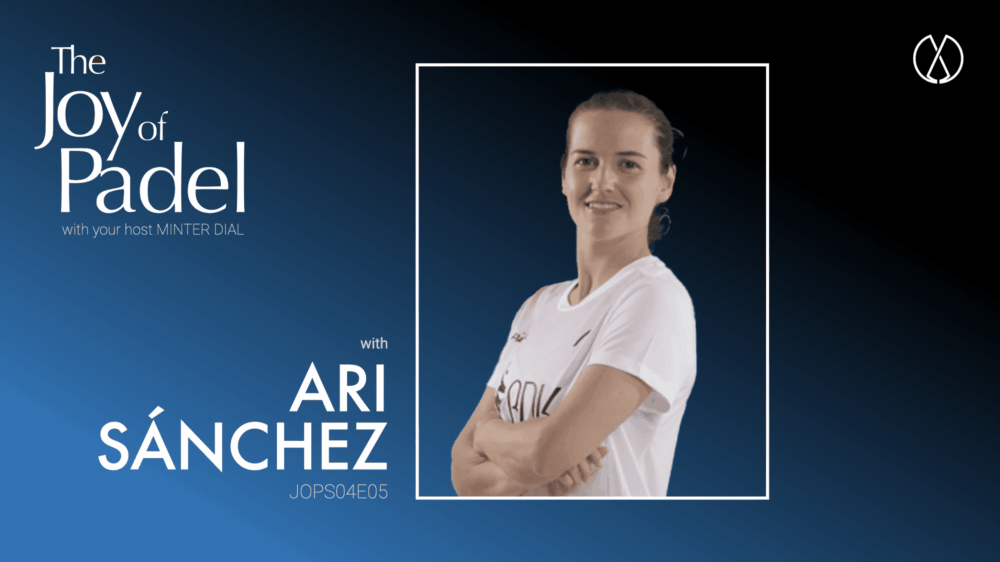
The Joy of Padel podcast with Ari Sánchez (JOPS04E05)
On the latest episode of the JOY OF PADEL podcast, I had the immense pleasure of sitting down with one of the brightest stars on the women’s circuit: Ariana Sánchez. Ariana (aka Ari) not only represents excellence on the court; she embodies the effort, consistency, and forward-thinking vision that are driving women’s padel forward by leaps and bounds. Our conversation was everything you’d expect from a world number one: sincere, approachable, and full of both sporting and personal insights.
Background on Ariana
Ariana Sánchez is, by her own definition, a 28-year-old padel player who has been fortunate enough to dedicate her life to what she loves most. She has been competing professionally since 2016, and in 2023 she fulfilled every player’s dream: reaching world number one. Ariana stands out for a profile less focused on showmanship and more on hard work—a team player, cerebral and consistent, with the humility and self-criticism necessary to continue growing at the highest level.
Main topics of our conversation
During the interview, Ariana shared profound reflections on the mental side of the sport and the pressure of staying at the top. We discussed criticism on social media and how to learn to focus on the environment, training, and self-care instead of public opinion. Ariana offered advice to young players and spoke about how toxic (and, at the same time, necessary for the growth of the sport) the digital environment can be.
We also delved into teamwork and the importance of communication within a padel pair, emphasizing that simply training together isn’t enough: a comprehensive team (technical, physical, and psychological) and clear personal goals are essential. Furthermore, we discussed the evolution of women’s padel, the challenges of being number 1, her strategies for managing emotions during competition, the daily psychological work involved, and the differences between men’s and women’s padel, where technique and tactics particularly shine in the women’s circuit.
Three Lessons from My Conversation with Ariana Sánchez
- Emotional control is what distinguishes great champions. Managing thoughts, self-confidence, and daily mental preparation are crucial when competing (and overcoming bad days).
- Padel is, above all, a team sport and a matter of communication. Ariana emphasizes that knowing how to work for your partner, communicate during the match, and build strong relationships on and off the court are just as important as technique.
- The evolution of women’s padel is more vibrant than ever. New generations, along with increased professionalization, infrastructure, and media presence, will ensure that the sport is not only valued for its own sake but also aspires to the ultimate Olympic dream.
If you’re looking for inspiration, listen to Ariana’s full story and her journey to the top. And remember: as Ariana says, quiet, daily work and positive self-talk are the keys to turning any dream into reality. Ready to continue growing together in the world of padel?
To find out more about Ari Sánchez:
- Find or follow Ari on Instagram: ASanchezFallada
To listen to the show:
To listen to The Joy of Padel podcast, you can use the embedded player above, or go find it on Spotify, Apple Podcasts or any number of other podcasting services listed here.
Send in your questions or reactions:
Please send me your questions — as an audio file if you’d like — to nminterdial@gmail.com. Otherwise, below, you’ll find the show notes and, of course, you are invited to comment. If you liked the podcast, please take a moment to review and/or rate it! ¡VAMOS!
Further resources for The Joy of Padel:

The Joy of Padel podcast, hosted by Minter Dial, a padel tennis player since 1974, is an exhilarating show that delves into the captivating stories of notable padel personalities worldwide.
Meanwhile, you can find Minter's other Evergreen podcasts, entitled The Minter Dialogue Show (in English and French) in this podcast tab, on Spotify, Megaphone or via Apple Podcasts.
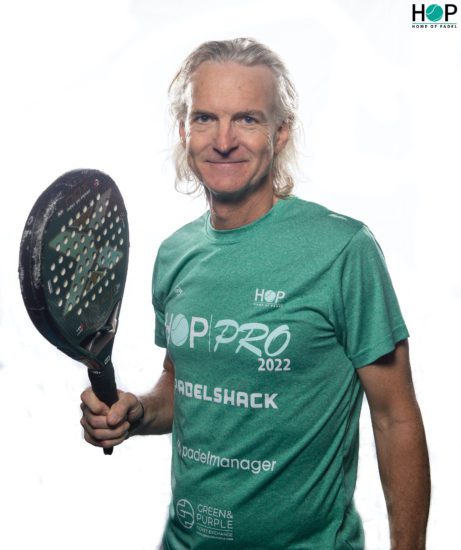
About the host: Minter Dial
Minter Dial is an international professional speaker, author & consultant on Leadership, Branding and Transformation. His involvement in sports has been a lifetime passion. Besides playing 18 years of rugby, captaining athletics teams, coaching tennis and playing squash for his university, he’s been a lifelong player of padel tennis, starting at the age of 10, from the time of its very first public courts at the Marbella Club in 1974.
Then, after a successful international career at L’Oréal, Minter Dial returned to his entrepreneurial roots and has spent the last twelve years helping senior management teams and Boards to adapt to the new exigencies of the digitally enhanced marketplace. He has worked with world-class organisations to help activate their brand strategies, and figure out how best to integrate new technologies, digital tools, devices and platforms. Above all, Minter works to catalyse a change in mindset and dial up transformation. Minter received his BA in Trilingual Literature from Yale University (1987) and gained his MBA at INSEAD, Fontainebleau (1993). He’s author of four award-winning books, including Heartificial Empathy 2nd edition (2023), You Lead (Kogan Page 2021), co-author of Futureproof (Pearson 2017); and author of The Last Ring Home (Myndset Press 2016), a book and documentary film, both of which have won awards and critical acclaim.
It’s easy to inquire about booking Minter Dial here.
Full transcript of interview via CastMagic
This transcription in English comes courtesy of Castmagic.io an AI service for podcasters. I used Google Translate for the Spanish-English translation.
Minter Dial: Ariana Sánchez, what a pleasure to have you on my podcast Joy of Padel. In a few words, who is Ariana Sánchez?
Ariana Sánchez: Well, that’s about it, a 28-year-old padel player who, well, I think she’s lucky enough to dedicate her life to what she loves, and that’s about it.
Minter Dial: You started being a professional in 2016.
Ariana Sánchez: Yes, I remember.
Minter Dial: Yes, me too. But in 2023 you became number 1 in the world. What happened to you when you reached number 1 at that moment?
Ariana Sánchez: Well, in the end it’s like fulfilling your dream, because my dream since I was little has always been to become number 1 in padel. In 2023 I was lucky enough to achieve it for the first time. And the truth is, when that happens, all the tough times you’ve been through come flooding back, everything you’ve been through, all the sacrifice, all the training, and of course, my family who have always supported me, and the team. I think a lot of things come to mind that have happened to you and that have helped you reach your goal and fulfill your dreams.
Minter Dial: You’ve said that even after winning titles, and reaching the end, doubts still sometimes linger. What kind of doubt still affects you, and which have you learned to turn into fuel?
Ariana Sánchez: Well, in the end, I think padel is a sport that’s growing a lot, and that’s noticeable in the number of podcasts and, well, in everything related to social media; it’s grown a lot. A lot of people comment, they talk about a bit of everything, and it’s true that I ‘m perhaps a player who gets criticized a bit if I don’t win a tournament, or if I’m not at my best for a few months. But, well, I think I take it all in stride. I think I’m the kind of player that people don’t value as much because I don’t have a very, very flashy, explosive game, with lots of highlights . People might just focus on that highlight , that powerful shot, that smash. But, well, in the end, to get those kinds of shots, there has to be someone working the point and making sure those shots are won. So, I’m very aware that my playing style doesn’t necessarily sell as well as some other players’, but I believe it’s a necessary style in padel today. There need to be players who work the point. I love working for my partner, trying to help her bring out her best and hit her best shots, because I think it’s a team sport and you need both, right? A player who works hard and one who finishes the points. I think that’s the perfect partnership in padel today, especially for women. So, yes, I often receive criticism and people sometimes doubt me, but I’m just a player who doesn’t like the spotlight. I keep working quietly, and ultimately, the proof is on the court. I always show that I’m there, and I have a lot of confidence in myself, and so does my team. So, I know what I have to do, and I’m very calm.
Minter Dial: You’re a great worker and very successful. You’re a star in padel. What advice can you give to young people, especially girls, who also have these doubts about social media? How can they better manage what’s going on?
Ariana Sánchez: Well, I think that’s ultimately part of an athlete’s life and life in general. I think nowadays people live a lot through social media. Social media, they only show the good things, but I think you shouldn’t pay too much attention to it. In the end, you have to control the things that depend on you, which is working hard, training hard, surrounding yourself with a good environment, your team, your family. I think you have to focus on these things you can control, and the rest is just people’s opinions, things that are external, that you shouldn’t pay too much attention to. And for me, well, I would tell them not to read social media too much, not to pay too much attention to it, because also, when you win, one day you win and you’re the best, and the next week you lose and they practically retire you. So, I think it’s a somewhat toxic thing that has to exist, because it means that the sport is growing. I mean, for me, social media, the people who comment, and all the talk shows are essential, and I think that’s very positive for padel. But as a player, you have to focus on training, on the day-to-day, on yourself, on the things that depend on you.
Minter Dial: also hinted that staying number 1 can be harder than getting there. What changed within you when you stopped chasing and became the benchmark?
Ariana Sánchez: Yes, I think, as the saying goes, the difficult part isn’t getting there, but staying there. Because when you’re at the top, you have to constantly reinvent yourself since you’re the focus of all the players below you. They all study you down to the last detail to figure out how to play against you, they study you to see what you do to improve. They even train harder to try and beat you, and when you’re at the top, you’re the center of attention; everyone is focused on you. You’re in a privileged position, but you have to work incredibly hard. You have to live with that pressure every day, the pressure of having to improve, of stepping onto the court and having to win. So, I think that’s what’s complicated, right? When you’re at the bottom and you want to be number one, you have a little more hunger—not hunger, really—but you have that focus and that goal. And when you’re at the top, well, everyone wants to beat you. So, I think they’re two completely different things, which I’ve experienced both of, and I’m telling you, being at the top is harder than being in second place and climbing to first.
Minter Dial: And now, are you focusing on being number one again?
Ariana Sánchez: Well, yes, in the end…
Minter Dial: That’s the project with Andrea.
Ariana Sánchez: Well, I think the project with Andrea is a medium- to long-term project. The thing is, I think we’ve started too well, I don’t know if that’s good or bad. I think that just because we won the first tournament, we can’t expect to win every single one or reach every final. We know it’s a process, a long process. After all, Andrea is 18 years old, very young, and this is the first season she’s starting to train a bit more professionally, because before she trained , but I don’t think she took it that seriously. She lacks a lot of habits, so she’s a player who has to build all her eating, physical, and on-court habits from scratch. She needs to develop that discipline, to suffer while training, because then, for example, this week in Gijón we had two matches that were total suffering the whole time, and we have to train for that during the week, right? We have to train while suffering, and she still needs to get used to that kind of suffering, which is a good kind of suffering, like stress. There’s a good kind of stress, of course; these are things she has to experience for the first time, gaining experience in different situations. But that’s something only tournaments and matches will give her. So, we have to take it easy; we can’t expect that of winning every tournament or reaching the finals like we’re doing. That’s why I say we’ve started too well, and people are already putting us in a position where we can become number 1, but I think we shouldn’t be thinking about that. For me, it’s a medium- to long-term project, and I have complete faith in her. We both have a lot to improve individually as a pair, and obviously my goal is to be number 1 again, but not right now. Right now, it’s about helping Andrea grow, building a very solid partnership, creating a long and beautiful project. And I think if we keep working like this, we’re going to achieve great things together.
Minter Dial: In an interview, you spoke very interestingly about not having to train with your partner every day. If you could design the perfect high-performance environment, what aspects would you handle individually, and what aspects would you always build together?
Ariana Sánchez: Well, I think the ideal formula right now, for me, is the one I have this year, the one Andrea and I have, which is a team, a single team with a single coach, a single physical trainer, and a psychologist. The same, a single team. I think that’s what adds up the most these days. We train together, we do everything together. It’s true that then each of us, for example, Andrea in preseason has done more physical training sessions with the physical trainer, while I might have had a few more afternoons because she lacks a stronger foundation, since I’ve been training physically for many years and I already have that. So, she might do extra work on things she’s still lacking. Similarly, on the court, on the technical side, she’s done a few more hours than I have with Ángel alone to work on things she needs to improve. I’ve done that too, but I think the foundation of the project is having the same team, a single team, training together, but also finding those moments when each of us trains separately to work on our individual aspects. So, I think we’ve found a combination that works really well. And honestly, I always say that I consider padel a total team sport, right? In the end, if you play well but your partner doesn’t play well, it’s useless, or vice versa. I think we’re really playing as a team now, and that’s going to benefit us a lot in the long run.
Minter Dial: So, Ariadna, what are you working on? Since women’s sports have developed so much, what aspect of your game do you need to improve on individually?
Ariana Sánchez: Yes, well, I think I’m a player who’s very good at controlling the game, who really likes to manage the plays, setting up the point for my partner. And maybe I need to improve on trying to finish more points myself, being a little more aggressive at times, but I’m working on that with the team. I’m a player who works hard for my partner, to give her clean shots to hit winners , but sometimes I also need to focus on hitting more winners myself .
Minter Dial: So, it may be that you are left- handed but you play like the driver, like the right hand, to assist the winners of your left hand.
Ariana Sánchez: Yes, absolutely. Ultimately, that’s why it’s always been good for me to play with a left-handed player, because she makes up for the winners I lack. I’m a slightly different kind of backhand player, with more control, more volume, and better point management. That’s why I need a left-handed player alongside me, or a player with more winners , who’s more aggressive and powerful, so I can work for her and give her easy shots to win and capitalize on.
Minter Dial: That’s my project too, but when a rivalry pushes you, what do you feel you improve first in your game? Tactics, discipline, or emotional control?
Ariana Sánchez: Well, I think everything, all things, are super important. I’d probably say emotional control is key, because that’s what makes the difference between players who are at the top and those who don’t reach that level, because getting to the top isn’t easy. And I think it’s more mental, that emotional control, knowing how to choose the right moment, playing well under pressure or tension. And I think that’s what sets you apart from other players. I think the mental and emotional aspects are very, very important, along with daily discipline, training every single day. In the end, if you don’t do your daily routine well and with discipline, when you go to play and compete, you won’t have that discipline, which is something that also needs to be trained.
Minter Dial: I write a lot about padel and about introducing English people to the sport. For example, the globalization symbol is the globe. The walls are your friends. And communication is so important to me, just like the wall and the globe—communication.
Ariana Sánchez: According to you, yes, for me, the lob is the most important shot in padel because it allows you to go from defending in the back to getting past your opponents and attacking, which is ultimately where you can win points. So, I think it’s a shot that doesn’t look as flashy as a smash, a powerful shot that people seem to prefer, but in terms of effectiveness, the lob is incredibly important. I mean, you could win a match without a smash, but without lobs, I don’t think you would. You’d never win a match without a good lob. So, I think it’s very important, even though it’s not such a pretty or spectacular shot , which is why people might not give it that much importance. I mean, you go to the court with amateur players , and they keep coming up and saying, “No, I want to.” The first thing they ask for is, “No, I want to do a smash.” Instead of saying, “Okay, let’s see how to do a lob.”
Minter Dial: And in terms of communication between players in pairs, how important is communication?
Ariana Sánchez: No, of course, for me it’s fundamental. First, communicating well about the court situation, where your opponents are, and then also the emotional aspect, that too, right? Knowing when you’re playing and you’re ahead, maybe knowing when you need to stop the point, you have to make the seconds tick by, transfer the pressure to the others. So, I think it’s also very much about communication, going to your partner and talking to her, saying, okay, what are we going to do in the next point? What’s happening? What would you change? So, I think communication is a fundamental thing in padel.
Minter Dial: Are there those who don’t communicate about the track?
Ariana Sánchez: Who?
Minter Dial: There are some, especially in England, I think. And how do we make them understand the importance of communication?
Ariana Sánchez: Well, I think maybe I’d show them professional matches and say, “Look, see how Chingotto is talking to Galán? They’re all talking, all the time, constantly communicating. It’s really important because you have to know where your opponents are and where your partner is to know whether to make one shot or another.”
Minter Dial: I completely agree, of course. You’ve also spoken about the importance of psychological work and training the mind like you train the body. What does your inner dialogue sound like on the most difficult days, and how has it changed for you in recent years?
Ariana Sánchez: Well, I think that psychological work, as I said before, is super important because for me it’s what makes the difference between reaching the top or falling behind, right? Knowing how to control your thoughts. Sometimes you’re on the court and you’re tired, and your mind is subconsciously telling you: you’re tired, you’re tired. And in the end, you end up believing it, right? Ultimately, I think it’s about being able to control your thoughts, to guide your mind where you want it to go and not let it sabotage you. So, I think it’s something you have to work on every day so that when you reach tense moments in a match or moments with pressure, you have that trained ability to change your mindset, to say: “No, I can do it, I’m going to do it.” To get rid of negative thoughts, because often a lot of negative thoughts or fears come to mind when you’re playing. So, being able to get them out in a very short time is something that also needs to be practiced on a daily basis, because otherwise, when it happens to you on the court, you don’t know how to handle it.
Minter Dial: And what goes through your mind when your colleague fails at something simple, easy, but online? What goes through your mind? What’s your method?
Ariana Sánchez: No, well, in the end it’s, I mean, it’s not a big deal, don’t show the others that it bothered you or show your teammate. Of course, that’s precisely what you shouldn’t do. Instead, you should act a little and hide it, like, well, it’s not a big deal, she’ll get in next time, and then go and cheer on and support your teammate, so they feel your support and the other players don’t see that they bothered you.
Minter Dial: Because the next worker could be you, the one who fails.
Ariana Sánchez: Yes, absolutely. I mean, maybe one day your colleague is having a bad day and the next day it’s yours. So, when you’re having a bad day, it’s nice when your colleague comes to cheer you up and says, “Well, it’s okay, let’s keep going.”
Minter Dial: You’ve talked about the growth of women’s padel, its physical evolution, and its professionalization. What do you think is still needed for it to be fully valued for what it is, and not just compared to men’s padel?
Ariana Sánchez: Well, I think women’s padel is becoming more and more valued. It’s changed a lot since I started playing a few years ago. I think that, as the sport has grown economically, there are many more girls who can dedicate themselves exclusively to training. They train very hard from a young age, with a really complete team. And I think it’s a sport that spectators really enjoy because amateur players or people who watch us on TV see it as a bit more similar to their own sport than to men’s, who ultimately have more strength, more physical attributes, and do things that are impossible for the rest of us mortals , even for women. But it’s a physiological thing, isn’t it? Men have more strength, more power than women, although we do have our strengths. So, I think it’s the same sport, but at the same time a little different, but they complement each other very well, because in women’s padel you see more technique, more tactics, and things you can do yourself on the court. So, people like it too because they learn a lot. And men’s padel is perhaps more spectacular, isn’t it? They make some very spectacular plays.
Minter Dial: But the spectacle is more in the , in the lies , in the strategy, how it changes.
Ariana Sánchez: Of course, that’s in women’s padel. So, it depends on the people. Some people like to focus more on the mental aspect, the strategy, seeing how they get out of these situations. There are also people who like it when the ball is hit from behind the baseline and sent out for the third point, when it goes out. So, I think it’s a sport that’s there, that’s a good combination because you can see very different things, and different people like watching you, Ari, from the outside, getting the feeling that you’re a player who thinks a lot about the game.
Minter Dial: At what points in your career have you felt that your best performance came not from hitting the ball better, but from understanding the game better?
Ariana Sánchez: Well, I think that with age, time, and experience, you learn to read matches and situations better. I couldn’t say for sure, but I think the first year I was number 1, which I believe was 2023, was a year I felt incredibly good playing. When things are flowing and you don’t have to think about anything, and it just happens, yes, that’s it, I felt it, I felt it that year, it was incredible. And now, well, in the end, we’re athletes, we go through phases, we can’t be at our peak all season long because it’s true that it’s getting tougher, we travel more and more. Well, it’s quite tough, but the truth is that over the years I’ve learned more about reading matches, about knowing how to play them, about tactics.
Minter Dial: So, I couldn’t give you a very clear answer, but to finish up, the Premier Padel rule changes this year regarding the serve, the star point serve—what do you think of those changes?
Ariana Sánchez: Yes, well, the serve thing isn’t very noticeable, so it’s true that I think if they’re going to implement that rule, they should have someone watching the whole time, because, well, there are still high-flying players, and people still cheat. They implement the rule, but in my opinion, they should put a referee on the lines to make it more realistic. Anyway, I think it’s a good rule, but there should be someone enforcing it consistently. And then there’s the star. I think that’s fine, I mean, I think they’ve looked for a middle ground between golden point and star point , because in the end the golden The point game is a bit more unpredictable, isn’t it? I think you might have a bad day and then play two bad points and go home without having time to fight for a win. I think they’ve tried to find a middle ground, which I think is good, because before there were games that dragged on for a long time with many equals and advantages, which isn’t as appealing to the viewer and TV, and we need to shorten the time a bit for television reasons . So, I think it’s a pretty good measure and I think it’s working well.
Minter Dial: Are there any rules you’d like to change in the future?
Ariana Sánchez: Honestly, no, for now I like it like this, I don’t have any specific idea in mind, but just putting referees on the lines would be good to ensure everyone follows the rules regarding the serve and the height, because I think a lot of people cheat a little.
Minter Dial: And what do you think about the Olympics? Will it happen? And what about you? What will change? What if padel is included?
Ariana Sánchez: I think so, it’s going to happen, it has to happen, because I think padel is the sport of the moment, even here in London. And well, I think I’ve been told it’s growing a lot; it’s one of the countries outside of Spain and Argentina—well, not very well, of course—but it’s one of the countries that has installed the most padel courts. I think the British market is super important, so having a Premier Padel tournament is fantastic. Finally. Finally. No, I really think it’s great, that it’s an important market for padel, for its growth, and I’m sure a tournament here will help in the future when it becomes an Olympic sport. They’re taking huge steps. I think we’re close, and now it’s also been included in the Asian Games. That’s important too.
Minter Dial: So, little by little, let’s see if other countries, other than Spain and Argentina, can reach that level.
Ariana Sánchez: Yes, but I think that takes years, right? Years of developing players, which is crucial for the sport to eventually become Olympic, years of seeing many different countries represented in the top 100 of the rankings, not just Spain, Argentina, Italy, France, the Netherlands, and Germany. I think that’s one of the important things, that there are more and more countries and more people involved. But I think that’s a years-long process that needs to be developed in each country from the ground up, so that children can start playing padel from a young age. So, I think it’s more about that kind of work, about infrastructure and developing the grassroots level. But first, the country has to start playing padel, and then start from the ground up to try and produce players.
Minter Dial: The last question, as the jewel of padel, do you have a memory of any padel event that was an incredible jewel?
Ariana Sánchez: For me?
Minter Dial: Yeah.
Ariana Sánchez: In other words, the best moment.
Minter Dial: Yes, how about a story?
Ariana Sánchez: For me, when I won my first tournament as a professional, which was in 2017 in Santander, and then clearly when we reached number 1 for the first time in the Netherlands, that was a different feeling because so many things come flooding back. Just the year before, we lost the number 1 ranking in the last match of the year, at the Masters Final in Barcelona. We had it right there and we lost it. And in the end, when we finally achieved it, that moment came flooding back, which was a very tough moment, very tough, but it made me very mentally strong. Then I remembered everything I had been through, that it had all been worth it, because in the end I had fulfilled my dream. Thank you very much, Ari.
Minter Dial: A pleasure.