
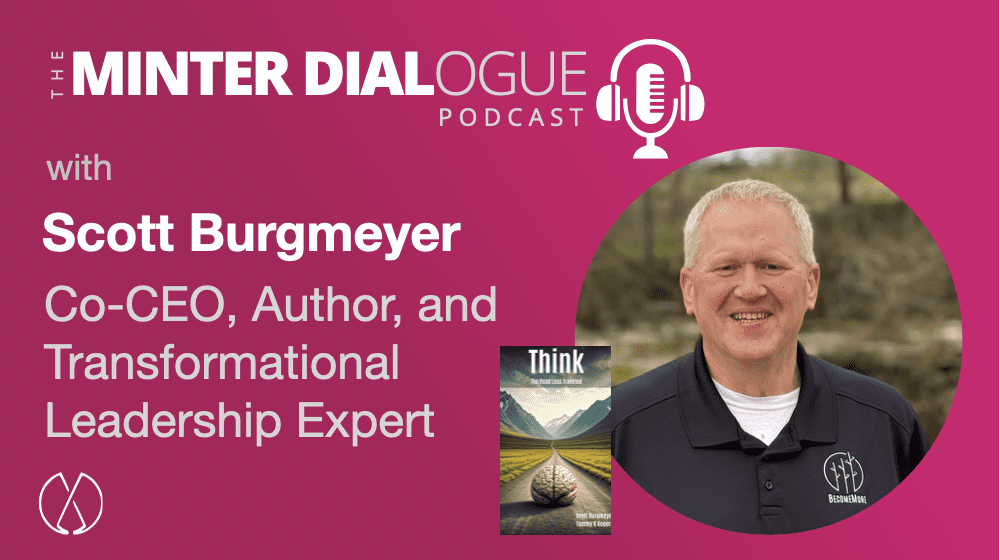
Minter Dialogue with Scott Burgmeyer
Scott Burgmeyer is a transformational leadership powerhouse and the co-CEO of Become More Group, an organisation with over three decades of experience helping people and teams go from point A to point B—wherever their “more” might be. Scott’s journey started in chemistry but quickly pivoted into the world of organisational development, where his love for problem-solving and curiosity for human friction converged. Alongside his partner, Tammy Rogers, he’s co-authored five books, each rooted deeply in the art of thinking, deep listening, and better execution in business.
In our conversation, Scott unpacks the nuances of writing books as a duo, how leaders can nurture their top performers (and spot those on autopilot), and why feedback—genuine and frequent—matters more than ever. We dive into the ongoing tension leaders face between flexibility and holding moral or strategic “red lines,” and how to foster a culture where “I was wrong” and “I’m sorry” are healthy, routine admissions, rather than admissions of failure.
Scott also shares why so many companies fall short on deep thinking or real conversation, what invisible forms of “interference” trip up leadership, and the critical need for a “Chief Optimization Officer”—that rare person who can challenge an organisation to truly level up, not just settle for the status quo. He’s refreshingly honest on the shifting boundaries of what’s personal (and political) at work these days, and how organisations must create space for authenticity without letting performance slip.
Key Points:
- Co-Writing and Ego Management: Scott credits the success of his co-authored books to a process of honest debate, mutual respect, and most importantly, parking the ego. He stresses that blending perspectives—not defending your turf—leads to richer outcomes and a truer sense of “we” in leadership.
- Personal Engagement—The Heart of Performance: Leaders must know their people beyond the transactional—a relationship that enables honest check-ins about aspirations, motivations, and wellbeing. Scott is clear: performance slumps require immediate, compassionate feedback, and leaders should never shy away from tough conversations, but always offer grace for life’s inevitable disruptions.
- Deep Thinking and the Art of Feedback: Organisations too often drift into shallow routines and “robot mode.” Scott recommends making time for deep thinking and meaningful dialogue, supported by a culture of regular feedback and honest questions. Real change happens when top leaders are willing to look in the mirror and invite others to challenge their blind spots.
Further resources for the Minter Dialogue podcast:

Meanwhile, you can find my other interviews on the Minter Dialogue Show in this podcast tab, on my Youtube Channel, on Megaphone or via Apple Podcasts. If you like the show, please go over to rate this podcast via RateThisPodcast! And for the francophones reading this, if you want to get more podcasts, you can also find my radio show en français over at: MinterDial.fr, on MegaphoneFR or in iTunes. And if you’ve ever come across padel, please check out my Joy of Padel podcast, too!
Music credit: The jingle at the beginning of the show is courtesy of my friend, Pierre Journel, author of the Guitar Channel. And, the new sign-off music is “A Convinced Man,” a song I co-wrote and recorded with Stephanie Singer back in the late 1980s (please excuse the quality of the sound!).
Full transcript via Castmagic.io
Transcription courtesy of Castmagic.io, an AI full-service for podcasters
Minter Dial: Scott Burgmeyer, great to have you on the show. I understand you are in beautiful British Columbia as we record this. We crossed wires because you are a powerhouse in transformational leadership. And as I like to start off all of my podcast interviews, all 650 or whatever of them are, who is Scott Burgmeyer?
Scott Burgmeyer: Oh boy, that’s a, that’s a loaded question, I think. Yeah, I mean, I, so I’m the co-CEO of a company called the Become More Group. We’ve, we’re 30, 33 years old now, I think, 33, 34. And, you know, we focus on working with individuals and teams and organizations to, to level up or be better and move from point A to point B, whatever, whatever that is, more sales, more engagement. We’ve written a few books here and there. I don’t know, I just kind of hang out, right? Tour the globe, you know, not too much interesting about me.
Minter Dial: Sure, sure, sure. So, when we, when you say we, we’re talking about Tammy, Tamara Rogers, you are?
Scott Burgmeyer: Yeah, Tammy Rogers, my co-CEO, co-founder, co-CEO. Yes.
Minter Dial: And become more. How did you get that name? What was the origin story of the name Become More Group?
Scott Burgmeyer: Yeah, it’s interesting because, you know, Tammy had her own company and I had my own company and we were just like, we knew each other and we worked together on different things and we were referring work back and forth and we started to, both of us started to kind of grow and we had some need for some employees, but Neither of us were like, well, I don’t really need a full-time employee, and I don’t need a full-time employee. So, we started up this company and we said, well, what would we name it? And, and it was funny because Tammy said something like, you know, I’ve always, you know, I love that we become more, and I’ve always kind of like–and I’m like, well, why don’t we just call it Become More? Like, it’s a unique name. It’s, it’s–and really it was just that really random conversation that created this the company name and we’ve had a couple acquisitions over the years and just everything about 2022, we have, you know, we were running 5 different companies and we said, you know, this is kind of silly. Why don’t we just fold everything in? And so, we did that. And it’s frankly, it’s been fantastic.
Minter Dial: So, not only the way you became more, you came bigger.
Scott Burgmeyer: Yeah.
Minter Dial: Yes. So, um, you, you’ve, you’ve had, you have a really interesting background. I wanted to just talk first about your co-writing because as a writer, I’m always interested in the process of writing and particularly interesting concept of co-writing. Uh, since you’ve co-written 5 books, obviously you not only enjoy the process, you know how to do it. I wonder what, uh, what is the secret to co-writing books? And, you know, if you have someone who’s listening who says, I want to co-write a book with somebody, maybe also think about what are the things to watch out for when you co-write?
Scott Burgmeyer: Yeah, yeah. I think we’re–the creative process we use, I don’t–some may think it’s unique.
Minter Dial: I don’t–
Scott Burgmeyer: personally, I don’t feel it’s that unique. What we do is we kind of talk about what are we hearing out in the world? What is–what do we think is our unique perspective on this and we bounce ideas and that usually is kind of not our quote argument. Argument number one is what one are we going to focus on? And, you know, we typically pick our top one or two or three and then we narrow it down and we say, okay, that’s the topic for the next book. And it usually is What do we think is going to land? What do we think is not out there? Because lots of people have written lots and lots of things, and some of it’s really, really great, and some of it is, it’s okay. And we then do what I would call research, and most of our research is why do we think this idea is unique and special? And we’ll kind of outline it. The actual writing is, you know, a lot of times Tammy will take certain chapters, I’ll take certain chapters, and then we bring it together and we review it and we’ll critique each other’s. Sometimes it’s, hey, you know, Tammy will write 60% and I’ll write 40. Sometimes it’s I’ll write 60%, she writes 40%. Your question about what to watch out for, I actually think it’s one primary thing and it’s ego. That if you think your stuff is right and you’re getting feedback from someone who cares about you and respects you and really wants it to be, you know, better, it’s like being able to set your ego aside and like accept that feedback and consider it. Because I think that’s where I–it’s funny, we’ve really never argued. Now we’ll, we’ll debate, we’ll say, hey, here’s my perspective. She’ll say, here’s my perspective. And what we’ve learned over the years is my perspective might be great, her perspective might be great. When we blend them, it actually comes out better. And being okay with it not, not being, quote, your idea. That you contributed to it and it’s us or we versus me or I.
Minter Dial: Well, let me just curiously think about this idea of debate versus argue. Let’s say that there’s the idea of the couple and the married couple and it strikes me, my lesson learned is that if you don’t know how to get over an argument, that’s the issue. And if you don’t argue, then you don’t have texture to your relationship, which will help you learn to get through the shit that happens inevitably in life. And I wonder to what extent that’s a modeling behavior for a board of governors or a board of directors, the ability to debate, sure, but what about to argue?
Scott Burgmeyer: Yeah. And maybe, you know, it might depend on your–
Minter Dial: it’s–
Scott Burgmeyer: wow, now it’s–I did not think we were going to get this philosophical this early. And it may depend on what’s your definition.
Minter Dial: For everyone else listening, you’re–it’s 7 AM in the morning for you. So, sorry. That’s okay. Yeah, it’s okay.
Scott Burgmeyer: It’s interesting because when I think of argue, I think of, I’m pushing my perspective, and I’m not listening and considering other perspectives. Versus, you could probably say that with debate. In my mind, it is, am I doing it one way, whatever definition you use, am I doing it one way, I’m trying to prove my perspective? Or am I sharing my perspective and considering other perspectives? To me, that is, that is the difference. And it, to me, I think it comes down to what’s, what are you going to fight on? Like, are there some things that I would say I probably wouldn’t give in on? Yeah, there are, there are a handful. But sometimes it’s, I think about it, am I, am I more interested in being right? Am I, or am I more interested in being in relationship?
Minter Dial: Indeed. One of the things, the typical tensions that I love to look at with regard to leadership, Scott, is this idea of being flexible, listening, learning, curiosity, and at the same time, trying to eventually have a backbone, things, red lines. Maybe that’s ethics, but it also can be beliefs. I believe that we need to invest in widget A and I’m prepared to invest X amount in widget A because I believe in it. And of course, beliefs are tricky domains because they’re not necessarily truthful. But having that tension between flexibility and rigid backbone, how do you square that circle?
Scott Burgmeyer: Yeah, I think, you know, we would say there’s, there’s a few non-negotiables, and many times we call them red rules, right? So, if, if, if you’re working with us, if you’re an employee, and you lie, like, that’s a red rule. And that, that’s like, that’s a non-negotiable. Like, just own it. You mess up, you mess up. It happens.
Minter Dial: I–
Scott Burgmeyer: the other part for me is being curious is crucially important. Because number one, it means you’re not done yet. Because the moment you say like, oh, yeah, I know, I know everything, or I don’t need to learn anymore. You’re right, you’re done. Like you will not level up, you will not become more, you will not grow. And, and that is a choice. We all have choices. If I’m passionate about something and I’m thinking a couple of years ago, I was pretty passionate against a specific, a specific strategy we were going after. And it was going to more conferences, right? Looking at how, as part of new business generation, my experience was kind of not worth it. And a couple of our team were like, no, I think. And so, I, in my mind, I’m like, no, it’s a waste of time. We shouldn’t do it. No, hell no, no, no, no. And that was the moment where, you know, they were talking to me and I’m like, you know what, let’s try it. Let’s, let’s say, hey, we’re going to spend no more than this. That’s your budget for the year. And then let’s track it and actually measure it. And we tracked it and measured it and it had a pretty decent return. And I said, I was wrong. Like, am I, am I, um, mature enough that I can say I was wrong and let’s let the data speak for itself? And, you know, your point about, um, I believe, I believe–yeah, I believed it was a waste of time. It’s not for us anyway. And so, can you be mature enough to set that belief aside based on the data.
Minter Dial: Well, I like that. And like, what I also hear is that the ability to say I’m sorry or I’m wrong. Yeah, posture.
Scott Burgmeyer: Yeah, well, and then the other side of that is don’t be a jackass and say, yeah, remember that time you were wrong? Yes, I remember. Trust me. I don’t need to relive it, be reminded all the time.
Minter Dial: All right. So, Scott, the book you published with Tammy, the last one in May last year, 2025, was called Think: The Road Less Traveled. So, I understand that that’s a hat tip to Scott Peck’s book, I imagine anyway, The Road Less Traveled. Is that correct?
Scott Burgmeyer: Yes, it’s a little bit of tongue in cheek. And There’s a, for anyone who hasn’t read it, there is a section where we introduce a thinking model called The Road. So, there is a little tongue-in-cheek inside that, inside the title as well. And the book is really focused on kind of the idea that our thinking is about as deep as a parking lot puddle. That we’re working and society in general, and lots of people will be insulted when I say this, is we just don’t think. We are going through the motions and we are in robot mode many, many times. And what we, the premise of the book is we introduced 7 characters which are based on cognitive biases. We’re firm believers in normal human language versus very deep scientific jargon. What we find is that’s not super helpful. We put characters around. For example, my favorite is All-Knowing Albert. We all know an All-Knowing Albert. Albert knows everything about everything. You can’t Right? So, he is only thinking about his perspective and not others. And so, the road is one tactic or one methodology to overcome this habit of not thinking deeply.
Minter Dial: Love it. So, I, in my research just before, you know, preparation anyway for our chat, What I saw that Peck, who wrote the book The Road Less Traveled, he opened the book with the first opening line is, “Life is difficult.” And to the extent that you’ve just finished your fifth book, I was wondering if you were to write, you and Tammy were to write the opening line of your next book, what would that be?
Scott Burgmeyer: Well, I’m laughing because we are currently writing a manuscript for our next book to publish next year. And we haven’t written the opening line. But I think what we’ve talked about is there is–the book is Execute. And it’s what we’re seeing is people aren’t executing for lots and lots of reasons. And there is this capacity bias. I don’t have enough capacity to. Fill in the blank. Okay. And what the, probably the opening line would be, if you’ve ever said I’m out of capacity, you should probably slap yourself.
Minter Dial: So, you’ve gone from thinking to executing.
Scott Burgmeyer: Yes.
Minter Dial: All right. So, I saw your background and you are, you have a PhD and an MBA. So, a whole bunch of stuff. And what it said is that you got a Bachelor of Science in chemistry and graduate studies and, and little chemistry. I’m an artsy guy, so that’s just all double Dutch to me. But then you pivot into organizational development, and I was just wondering, yeah, I’m sure there’s some link. What did chemistry, the study of chemistry, teach you about diagnosing the human side of organizations?
Scott Burgmeyer: Yeah, you know, it’s interesting because most people don’t ask me about this because I, I don’t talk about it. I just, I haven’t worked in chemistry a long, long, you know, a long, long time. When we talk about it, I am, I know that Tammy is a lot more kind of human focused. I’m a lot more operationally focused, right? So, she has to stretch into the operationally and I have to stretch into the human. And we both can do that. And when I think about, oh, just the science, right? In my mind, everything is a problem and we’re just problem solving. And so, yes, there are human problems and there are machine problems and there are relationship problems. And so, it’s just saying, hey, I have a hypothesis on what I think the root of that problem is. Let’s test it. Let’s explore what that is. So, in my mind, it’s all fundamental science, which people will say that’s weird. And that’s–that is just how my brain thinks. Yeah.
Minter Dial: Well, Scott, I pride myself in asking questions that the interviewees don’t usually get, because otherwise–
Scott Burgmeyer: that’s a great question.
Minter Dial: They get to trot out the usual blurbs and it’s fun for me to see where the boundaries of our thoughts are and stuff like that. So, another thing, so I was researching and looked in, you began with Tammy, the Creative Solutions Group, or I don’t know if you began with her, but you began it anyway because the organization within which you were working was happy with your performance.
Scott Burgmeyer: Yes. Yeah.
Minter Dial: But you weren’t.
Scott Burgmeyer: So, no, I was, I was bored.
Minter Dial: Describe the precise moment you realize that the comfort of others with your work was actually becoming a ceiling for you.
Scott Burgmeyer: Yeah, it, you know, it really was this moment of, oh, I felt like, and hopefully this doesn’t come off too egotistical, I felt like, you know, I’m putting in 60, 70% effort, and I’m getting 110% results as far as this organization’s mind was. And if I put–what I was seeing is if I tried to push it further, that actually created stress and friction. And I’m like, well, why create stress and friction when I can–when people are saying, hey, can you help me over here? And I was like, well, if they don’t want my help here, but they want my help over here and they’re going to pay me for that. Okay. And so, that’s when I realized, you know what, I can take some vacation. I have a lot of vacation. I can go do that. You know, we had, I think at that moment we were having our second child. We had, we were moving into a different house and we’re like, that could help with the bills. And so, I’m like, okay, let’s, let’s, let’s, let’s give it a go. The other thing for me it has realized is how your leader engages with you in your work environment is crucial.
Minter Dial: So, tell, tell us What should that engagement look like? What, I mean, or make it another way, if a CEO is listening to this chat here, or running, you know, some business leader, how do they identify the Scots that are bored that have 30% more capacity and are just dummying down, if you will, just to keep them happy without feeling menaced? Because you’re obviously more capable than they’re prepared to let you be.
Scott Burgmeyer: Yeah. And, and I think number one is, are you in relationship with them? That doesn’t mean, hey, let’s go have beers after work or wine or what. Like, do you really know them? We work with leaders, like, some of them don’t even know if their employees are married or have kids. Like, that is so weird to me. And I, and again, I know there’s a line, like, okay, You know, there’s probably a line for all of us. I then want to talk about and understand what are their aspirations at work and outside of work. Are there ways to marry those? And you have, as a leader, you have to be willing to ante in. You have to be willing to say, hey, hey, Jim, hey, Mary, you know, You’re doing pretty well. How are you feeling? We ask all of our employees every year, on a scale of 1 to 5, how are you feeling about us right now? 5 is I never want to leave. A 3 is, you know, I’m feeling pretty good. A 1 is I’m, I’ve been updating my resume. And what we tell them is if it ever gets to a 3, we need to have a conversation. No pressure. No, you know, whatever that is. Are you, and then as a leader, are you willing to hear that number and not defend to consider, to listen? Now, the other side of that is, you know, we all heard about quiet quitting and all those, like, if I am going to ask them to ante in more, there needs to be a place where the business is going to ante in as well so that the relationship is constantly in balance. And for us to remember that at any one moment, it will not be in balance. Every decision I make is going to teeter one way or the other. And over the course of time, is it balanced? And I heard I occasionally like to watch Jimmy Carr. If you are not familiar with Jimmy Carr, he’s a fantastic comedian. His humor may not be for everyone, but someone–his gig is he asked people to heckle them at the start of his show. And someone said, what’s the secret to a happy marriage? And his answer, frankly, is the best I’ve heard. He said, you know, many people have this thing that it’s supposed to be 50/50 and rarely is it. That some days it’s going to be 60/40 and some days you’re going to come home and you, you’ve had a really miserable day and you, and you’re at a 20 and they need to be an 80. But over the course of time, it’s 50/50. I actually believe the same applies to work. As an employee, it’s not 50/50. Sometimes it’s going to be 60/40. Sometimes it’s going to be 80/20. And as a leader, can you extend that grace when that person needs that grace? And do they anti-back in? That to me is crucial.
Minter Dial: So, a couple of things. First one, Scott, is the issue with bad performance. You know, if–because we also have the situation where someone who’s not doing what they’re doing and, well, I’m a 2. ‘Well, good for you. I need you out of here. Can you be a 1 quicker?’ How do you sort of manage, contain that piece or get ahead of it, if you will, so that you don’t end up with that kind of an awkward situation?
Scott Burgmeyer: Well, I firmly believe it is all about feedback. Are you giving feedback Early and often, and is it honest feedback? So, if someone’s performance is not good, you don’t wait till the end of the year at performance review. You don’t wait till next week. You go to them right now and you say, here’s what I’m noticing. And I, because I care enough about you that I am going to give you that feedback. Many times we skip the feedback or we think, oh, they’ve had a hard, hard time. I’d say the other part is when someone has–I think you said SH number 1T going on in their, in their world. It’s okay to have their volume of work go down. Like, I’m very willing to make space for that. The quality of work cannot. So, it’s okay if it was, hey, I was doing 10 of these, but you know, I’m going through a hard time. You know, my dog just died, my, you know, whatever is going on, because we all have stuff. I get it. The volume can go down, but the quality cannot. And the more we can have that conversation about, hey, I got this crap going on, I can give you grace. If I don’t know that you have crap going on, my assumption is you don’t care, or you’re incompetent. And I am going to have that conversation with you.
Minter Dial: So, I very much believe in the idea. I’ve long had a maxim, which is branding is personal. If you as a boss say to somebody, don’t take this personally. You’re starting at the wrong end of the stick. Things need to be wished to be taken personally if you want personal engagement. But we, in a world today, Scott, it seems, and I’m going to categorize you in a similar vein as myself, where it used to be a little bit of just suck it up, stiff upper lip, and deal.
Scott Burgmeyer: Yeah.
Minter Dial: Now, people come in and say, my dog’s toenail is hurt. And that’s a big deal. You know, so I need time off.
Scott Burgmeyer: Yeah.
Minter Dial: So, you talked about the lines. You know, there, there are lines where, which we’re not supposed to talk about it, sexuality, politics. And yet those are two quite importantly personal elements I mean, and quite defining in some regards. I mean, you know, whether or not they’re defined by it is another story, but these are elemental elements. You know, what your belief is in politics, what you do in terms of your sex and how you are. If you’re having to take off your dress where you prefer to wear a dress to go to work, you’re leaving behind you or the one you wish to have to be this other individual at work. So, it feels like the lines that you and I might have been brought up with have vastly moved. The question is, how do you define those lines? And is it a case-by-case, or is it really about trying to create a culture where these are allowed, but this is not allowed? I mean, how on earth do you manage that these days?
Scott Burgmeyer: Yeah, you know, it’s, it’s–I think what’s for me, what has always been tough is I can remember when Reagan was elected president and I was in 8th grade. So, now you get–people can figure out how old I am. And we’re–we were studying government. I asked my family, like my parents, hey, who did you vote for? Because I was curious. And I got a lecture about how you don’t ask those questions, which then said, all right, we don’t talk about that. Now you fast forward to I meet my wife, right? We’re not married at the time, and I’m meeting her family. They very openly talk about it. Active enough that they’re invited to inaugural balls, kind of active. Okay, so like, now it’s night and day difference. And I’m trying to redefine like, Okay, how do I now see the world? Because that’s not how I was brought up. And then how do we talk about it with our kids, right? And, and we’ve been really open with our kids about it. The line I draw at work, and I tell staff, actually, last week was one of our employees’ first week. And, you know, I told her, like, I don’t talk about it. At least at the beginning, because I don’t want people to feel like, oh, he’s the boss, therefore I have to see things his way. Because I actually don’t want people to see things my way. I want people to be informed. I want people to educate themselves and have an opinion. Now, have whatever opinion you want. See the world in whatever perspective you want. If that, if you bring that to the business and it hurts the business, that’s a problem. Okay, which means, you know what, sometimes we’re going to work with clients who we may not see the world in the same lens. And they may be way more open about, hey, I voted for or I think this, or I, you know, whatever it is. We’re not there to change their opinion about how they see the world. We’re there to execute something. That can be really hard for some people. And so, in our interview, we talk about how do you manage that? You’re being paid to grow better leaders. You’re being paid to support their equipment to run better. We’re not being paid. Now, are there lines? Yes. Are they harassing people sexually? Are they, you know, yeah, child labor? Like, of course, please say something. Barring any of those lines, our role is to make that client better. Now, we may decide we don’t want to work with that client anymore after this contract. That then is a business decision. But that can be hard for people to look at this and say, what is my role in this moment? My role is, which I think we can talk about, well, that’s generation. No, I don’t know that business is going to change in the near future that we have a role to play. When I take a job?
Minter Dial: Well, I mean, at the end of the day, I think it’s also very true that businesses and people are by definition political, by definition. And it’s sort of peculiar that it’s one of those things we’re not supposed to talk about yet. I mean, of course, I understand the contours of the story, but at the end of the day, when you talk about relationships, when we talk about believing in what we’re doing, if it’s to help child labor get younger, that doesn’t seem like the right road to be helping to become more, right? And then I can’t remember what you said exactly, but, you know, you can’t please everybody. And I don’t think that’s a desirable position to be in, to be in a mode of we’re pleasing everyone, we do everything for everyone. That’s no good. So, it’s about having, going back to the initial question, Scott, about having that backbone, sort of laying that down. The issue like with consultants that you and I are today, or let’s say an agency, like an advertising agency, they don’t actually end up having their own brand. I think of it very much like a Walmart. Walmart has a brand, but it lives thanks to the brands that have been created that they now have on their shelves. Yeah, so that distinction between being the carrier of brands and being the brand, whereas consultant is you’re sort of helping the brands within to grow. You have your own brand over there, but you end up being the mishmash of the companies for whom you work for. And find that way to have that contour. And I think it’s true at any level, you know, where we are with the number of people you have. Every person is their own brand. Every person is their own identity. And finding ways to shape that, that’s not all the same, but there is some cohesion, some congruency. Do you find with your clients this type of conversation is something that’s dealable, talkable about, or is it sort of off base?
Scott Burgmeyer: No, I mean, if, and we, we do, we have a ranking method that we use with our, that we use internally where we, we look at our clients and are they an A, B, C, or D? Our A’s and B’s are people that we could have that open conversation with that, yeah, we’re seen as a partner, which is our preference. We don’t, we don’t want to be a vendor. We don’t, we know we don’t do our best work when we’re a vendor. Do we do some work that is vendor-like? Yes. Many times does it start vendor-like?
Minter Dial: Yes.
Scott Burgmeyer: And then it evolves. Because if you really want to, to change or improve an organization, you typically want a partner for that.
Minter Dial: It’s like a lot of what we’re talking about is this notion of a relationship moving away from being transactional to having these deeper understandings of one another. So, that’s pretty cool. All right. There are a few. I have a few more questions for you before I let you go and have your normal day. But you have this equation, which is performance equals potential minus interference. Which inverts the typical principle, which is usually add more, become more, instead of demanding removal. Where are the most stubborn, invisible forms of interference that leaders are typically blind in themselves?
Scott Burgmeyer: I mean, well, you said it, it is in themselves. I mean, it is many times, it’s It’s–and beliefs may be not quite the right word, but it’s, it’s what are the self-limiting behaviors that we’re doing that is saying, you know, I’m, I’m so stubborn that–and I may not be outwardly saying that, but am I really reflecting and thinking about that interaction or that perspective? Am I putting myself in that other person’s shoes? That doesn’t mean I want to give away the farm. That doesn’t mean I want to give in on everything. It just means, am I willing to consider? And so, a lot of times that, that interference is, oh, I really don’t know that person. Oh, I make an assumption about They don’t like me, or they’re a jerk, or they’re stupid, or they’re lazy. Well, that–yeah, the moment you say that out loud, I mean, you’re done with them. And is that fair? Well, I kind of want to know why, and I want to at least have the conversation. If I really think that they’re not capable or they’re not willing, I need to find out, is that true? Oh, Mentor, you’re on mute.
Minter Dial: Indeed, I was. It reminds me, sorry, of someone who told me that whenever you make an assumption, you are making an ASS out of yourself if you haven’t done that other work.
Scott Burgmeyer: Yes.
Minter Dial: So, when you’re faced with a client, a boss, and the the thing is just glaringly obvious, the interference in his or her situation. The easy way is to say, “You know what, Scott, you are blinded in this particular regard,” or, “This is whatever, your belief system is letting you down, this limiting.” But I have to imagine it’s a whole lot better if they are the ones that out their interference as opposed to you tell them. Is that A, true, and B, how do you get them to then look up at the mirror in a different way?
Scott Burgmeyer: Yeah, we ask a lot of questions. So, if we recognize what we think might be the problem, we’re going to ask some questions around it to see if they say it. Now, if they don’t say it or they’re dancing around it, We’re going to just plainly say, hey, here’s what we’re seeing. When you hear that, what do you think? Now they can adamantly deny it. They can say, yeah, that’s true. Like, it is up to them. We’re not going to run straight at it and say it. We’re going to ask some questions. Well, what do you think is causing that? What have you tried before to get over that hurdle? Whatever, you know, whatever they’re saying. Oh, my staff just doesn’t get it. My staff just doesn’t get it. Oh, okay. Well, let’s talk about what, what’s going on. Are you hiring bad? Like, do you suck at hiring? You know, I’m just, we’re, we’re, we’re going to do process of elimination to kind of get them to the, hey, maybe it’s option A, maybe it’s option B. In our experience, it normally is an interference in the leader. And coming at it directly, at least at the beginning, is not going to be the way to go. It’s going to be, what are you seeing? And that’s why, you know, all the research says I can do a whole bunch of training. I can train all of these individuals and all the mid-level managers and all the emerging managers. If it is not expected and reinforced from the top, it’s wasted training. And so, to me, that’s always the question. If they say, well, I need to train my staff, cool. After training, How will you be reinforcing this?
Minter Dial: So, last area of question, your book about, say, think, you make a distinction between having a thought and deep thinking, or proper thinking, if you will. In your experience of working with so many companies, like, how Have we actually lost the art of deep thinking, or is it possible that we might have lost the art of deep conversation? Which one? How? And what do we do now?
Scott Burgmeyer: Yeah, boy, it’s probably a cop-out if I say maybe it’s both. It’s almost like a chicken.
Minter Dial: That’s what we always say.
Scott Burgmeyer: That’s what we’re supposed to say. It depends. It depends which one is going to allow allow me to write the bigger contract. No, no, when I think about it, there’s a little bit of chicken and egg. So, if I’m not thinking deeply, how can I have real conversation? If I can’t have real conversation, how can I think deeper? And I mean, so I don’t know the answer to that. I like, I’m not sure which, I mean, In my mind, I would suggest it’s probably a little more–I would lean more towards the thinking because I can’t really have good conversation if I’m not doing that. Otherwise, I’m just saying, you know, gobbledygook, yabba dabba doo, or whatever else that has little to no meaning, no context to that conversation.
Minter Dial: So, I get that, of course. And I think in the end of the day, both deep thinking and deep conversations require a commitment and time. And this is something that’s oftentimes, I don’t have time for that. Of course, the reality is they don’t give the time for it. They don’t mark it out. I think that’s the true learning. So, it makes me bounce on one last question, which is you have this book, which you call The Chief Optimization Officer, where you see that it’s something that most companies don’t have at the C-suite. It’s been my observation that, uh, the titles that people have at the C-suite are already rather vast and vague, and that they, they really miss out on a few others, one of them being this piece of culture. And they sort of label it on the HR person where it should be everybody’s The other one is branding, which in my mind is something that belongs to everybody. Every–the finance people should have a branded P&L. Every–I feel everything should have the brand seeping into it. So, maybe the thought is, do you think that by having a Chief Optimization Officer, that’s the missing piece that can help make companies more profitable?
Scott Burgmeyer: Yeah, and our perspective is it’s the role. Now, whether you call it that title, or not, I don’t know, is super important. But who is the person who is going to say the hard truths inside the organization, who is going to push the organization harder or further than it, than it ever has? Now, some would argue, well, that’s the role of the CEO, or that’s the role of the chief strategy officer, or this, what, like, okay, that’s fine. Are they actually doing it? And when they push, is the organization, I’m going to say, responsive or receptive or willing to move that direction? Or are they being met with, well, that won’t work here. Well, we’ve tried that already. Oh, that’s too hard. So, the concept is, who is that? That person who’s really pushing the organization and, you know, supporting the organization through the cycle of changes that have to happen to be that better organization on the other side.
Minter Dial: Love it. Well, I don’t know how many of the questions I asked you were the hard ones, but it’s been a pleasure chatting with you, Scott. For people who are interested in following more checking out your work, your books, what sort of calls to action would you like them to run and do before they switch off?
Scott Burgmeyer: Yeah, I mean, you can look at us at our website, becomeorgp.com. We have a podcast called The Leadership Line. That episode drops every Wednesday. You can check us out there. You can reach out to me on LinkedIn. Any of those options would be totally applicable.
Minter Dial: So, it’s Scott Burgmeyer, B-U-R-G-M-E-Y-E-R.
Scott Burgmeyer: Correct.
Minter Dial: Scott, it’s been a pleasure. Thanks for coming onto the show to talk about it. You obviously have a lot of passion, great experiences, and thought about this, to say the least. Many, many thanks.
Scott Burgmeyer: Thanks, Matt Turner. It was great.

Minter Dial
It’s easy to inquire about booking Minter Dial here.