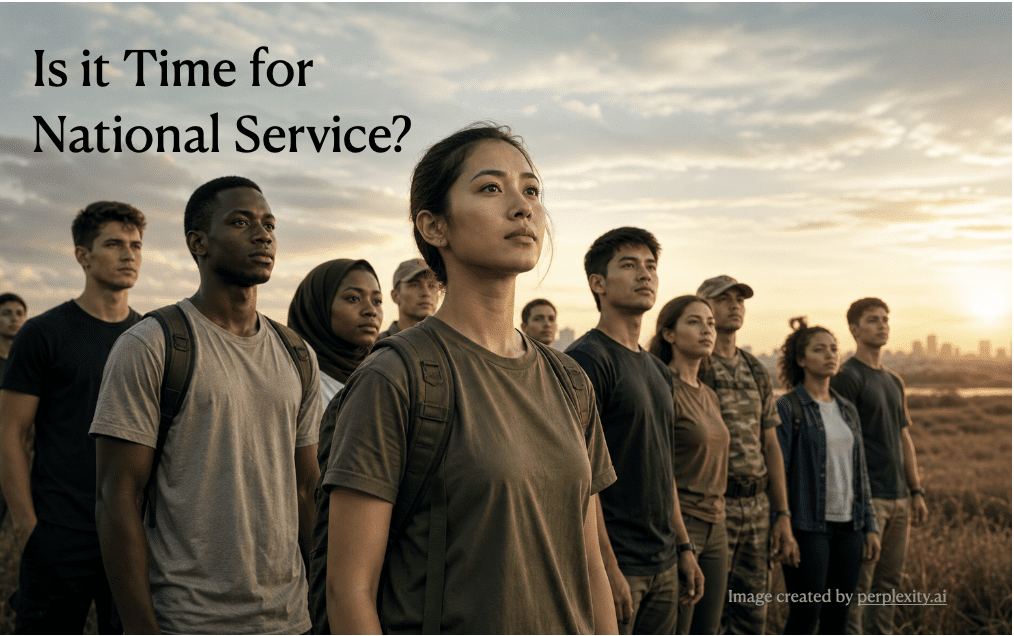
In the face of so many issues and divisions in our society, I feel like it might be time to reconsider a radical if old idea. What if we considered some kind of return to a new style of national service? What on Earth are you saying, Minter? Well, let me explain.
On pre-war footing?
Obviously, I’m not the first person to talk about a militarised national service. Ranging from Christopher Miller, who was briefly Donald Trump’s acting Secretary of Defence 2020-2021, to Rishi Sunak (the former British PM 2022-2024) and Michael Caine (actor) in the UK, to Sébastien Chenu (RN) in France, others have identified (or campaigned for) mandatory military service as a good idea. From my standpoint, instituting national service would benefit us on a first level to meet the rising geo-political upheavals. The threat of more transnational wars and civil strife (if not wars) has apparently never been higher in the post-WWII era, according to various think tanks and observatories. As I wrote in The New World Disorder, there are over 50 active armed conflicts worldwide, rising to over 120 if one includes local insurgencies, criminal wars, and non‑state fighting. The form of national service will of course have to be adapted to the new styles of warfare. However, as much as the use of AI and drones in wartime are the talk of the media, it’s likely that conventional warfare — involving “boots” on the ground — will remain a necessity. We are likely in pre-war mode, as suggested by numerous figures, including Grant Shapps, prior UK Secretary of State for Defence, Donald Tusk, Poland’s Prime Minister, and Sir Mark Carleton-Smith, (prior head of the British Army). Many see the writing on the wall, including Mark Rutte, NATO Secretary General, who issued a stark warning in a December 2025 interview on the BBC: “Russia could attack a NATO country within the next five years. We must be prepared for the magnitude of conflict our ancestors faced.” He called explicitly for a “wartime mindset” shift across all alliance members. The problem is that we, as a society are very far from being ready for what that entails. I’ve spoken to many veterans of war (for the making of my WWII documentary, The Last Ring Home), including a number of Ukrainians who’ve lost limbs or been imprisoned by the Russians, and it’s a very dark place. So, getting ramped up for war is a strong argument for re-instituting some form of militarised national service.
National service for national healing?
In a somewhat counter-intuitive move, I believe national service would also help to solve another pressing problem. It would help improve the cohesion within each country, especially in the West, where we have seen a breakdown in the fabric of society. These are the principal issues that concern me and why national service — even a non-militarised version in some cases — could be a healing activity:
- The divisive nature of politics and the lack of good hearty debate in our society. I don’t have any statistics to prove this, but from anecdotal evidence and my own experience, it certainly feels true. What I tend to see if grandstanding in the form: “I’m right, you’re wrong,” and no intention of listening to or learning from one another.
=> National Service would help by forcing people into close proximity with strangers from entirely different class backgrounds, political tribes, geographies, and worldviews, and then tasks them to achieve something together. - A widening gap between the have and the have-nots. Here I’m not focused on the rich/poor split, so much as the perception and sense of injustice that the have-nots faced with the rising status of the haves. It’s the perception that is the real risk. Even if the poor might be better off than they were a century ago, they still tend to see the gap as unfair. The real crunch, though, is how the middle class are faring and, under current circumstances, there is a real risk of the middle classes drifting lower.
=> For this, national military service would do two things: (1) individuals from all walks of life (up and down the scale of society) would have to go through the ringer together, hopefully altering the perception gap. And (2), especially for the middle and lower classes, it would provide an equal training, including on leadership, as well as a stable job during the time of the service. - Resilience is down and mental health conditions are rampant. There’s a tremendous amount of anxiety, depression and suicide, especially high among younger men, but also true of women and older men. Suicide rates are 4x higher for males versus females [all ages], according to the CDC, with 22.4 per 100,000 for males and 6.1 for females, both numbers in 2017. Again from the CDC, suicide rates in the US increased 36% between 2000 and 2022.
=> Military service and quasi-military environments are associated with the deliberate cultivation of psychological hardiness — a trait shown to be the single most protective factor against depression, anxiety. The mechanism is exposure to manageable adversity: discomfort, exhaustion, and failure encountered in a structured, supported environment where nobody is allowed to simply opt out. - We live in an overly precautionary society that does not wish to countenance any form of hardship. I believe that risk aversion has contributed to a drop in the resilience noted above. To wit, the increase in allergies and the resistance to antibiotics. We’ve seen how, during the pandemic, some countries strove for a zero-COVID status, under the proviso that ELM… Every Life Matters, no matter the collateral damage (the younger generation’s education, the economy, reduced personal liberties, etc.).
=> Why national service would help: The (American) Democracy Project, writing in 2026, put it starkly that service “gets at something intangible that is absolutely critical to a nation’s future — it would help young people feel a true ownership stake” in their society, forcing them to confront “the problems we face and the solutions that exist, if we are willing to raise our hands”. - Finally, patriotism (and its ugly brother, nationalism) is getting a dirty rap. Flying a national flag from your window is seen more as a provocation than a signal of pride.
=> National service? This is surely the easiest one to defend as national service addresses the problem through the mechanism of earned pride. Through national service we could introduce a shared tradition and understanding of what our country stands for, its history and values. Heck, everyone would learn to sing and respect their national anthem.
Is it not time to fix society?
According to an article published in April 2026 by Business Insider, there are roughly 24 countries with mandatory military service that’s 2 or more years. There are roughly 15 countries in the world that have compulsory military for both sexes, with different levels of enforcement. There are, meanwhile, 106 countries that have no enforced military conscription, 22 of which have no armed forces whatsoever.
Is it possible that this general trend away from militarisation has actually contributed to the world’s general problems?
I feel it’s time that we look at trying something new in the “developed” world. I believe that national military service — for both sexes — can go some way to help right this ship and prepare us all better for the future. In the process, we might rehabilitate national pride, breakdown prejudices, reinforce our resilience, increase cohesion and, let’s not shy away from the fact that it will us be ready us for a more bellicose future.
In the immortal words of JFK, ask not what your country can do for you, but what you can do for your country!