
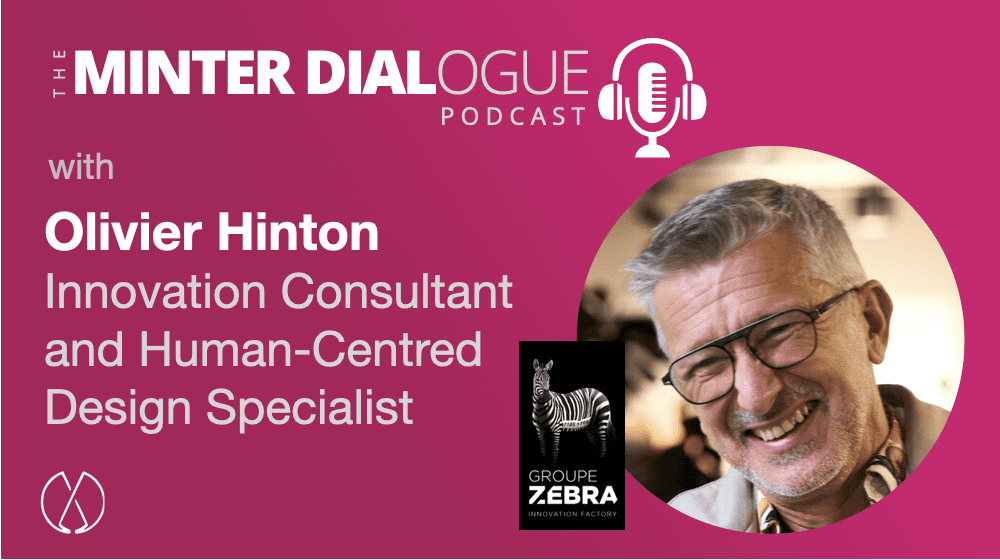
Minter Dialogue with Olivier Hinton
Key Points:
Further resources for the Minter Dialogue podcast:

Meanwhile, you can find my other interviews on the Minter Dialogue Show in this podcast tab, on my Youtube Channel, on Megaphone or via Apple Podcasts. If you like the show, please go over to rate this podcast via RateThisPodcast! And for the francophones reading this, if you want to get more podcasts, you can also find my radio show en français over at: MinterDial.fr, on MegaphoneFR or in iTunes. And if you’ve ever come across padel, please check out my Joy of Padel podcast, too!
Music credit: The jingle at the beginning of the show is courtesy of my friend, Pierre Journel, author of the Guitar Channel. And, the new sign-off music is “A Convinced Man,” a song I co-wrote and recorded with Stephanie Singer back in the late 1980s (please excuse the quality of the sound!).
Full transcript via Castmagic.io
Transcription courtesy of Castmagic.io, an AI full-service for podcasters
Minter Dial: Olivier Hinton. Great to have you on the show. We’ve had a chance to catch up. We share both a Franco-Englishness and by your name, Olivier is French. Hinton is English. But in, in your own words, who is Olivier Hinton?
Olivier Hinton: Good morning. As it still just about is the morning, even though I’m an hour ahead of you. Just to make the point about the fact that we’re cross-channeling this all the time, even though your background cheeks and so yeah, born from a British father, Yorkshire and a French mother, born in Nice though actually of Paris origins and to put it, you know, dragged through the hedge back and forth from France to England every two or three years through my father’s job and when they stopped moving when I was 17, I took over the baton and never stayed more than three years in the same place with the exception of now where I think I’m onto my fifth year in the Lyon region. But with crazy. Yes, it has a few things to offer, but you know, and I, and I think that sort of some. The reason why I say that is I think what the most important word is change. I love it.
Minter Dial: So, the funny thing Olivier, about that is that the three years was also very familiar. Mark in the transitions that I made, I regularly changed within three years and I, I was wondering if you have a narrative about why three years and not four, not two. Is there anything that sticks out?
Olivier Hinton: Probably because you know, we, we were brought up with a, a background of Christianity and the trilogy is what is what carries us forward. No, I, I have, I have no idea, honestly. Well, certain things like you know, education, you know, university of university education in the UK bachelor course is three years. So, I did that. So, that was over. Certain things are built into the system. Others I wouldn’t know.
Minter Dial: Well, the, my, my little, the story in my little head, Olivier, is the first year it’s all about discovery. You know, you move to a new place, you don’t have friends, you need to find out which Boulanger you use. And also this, the second year you, you establish yourself. The third year you consolidate it all and by the fourth year you’ve been there, done that. That’s, that’s, that’s been my little story and I. There many, many changes from. Of me of. I’ve changed countries 15 times and many of those were sort of three-year stints that also had to go with the job routine. Like you say, installed changes. Anyway, so Olivier, that was fun. So, you’ve worked across many countries, France, the UK and Italy and beyond. What, what would you say are the experiences that most shape the way that you now think about innovation?
Olivier Hinton: The fact that we focus on what we know, and therefore people need to zoom out and need to learn how to zoom out from where they are in order to innovate better.
Minter Dial: So, when you, when you say that there’s an element of having your, your nose too close to the business, you’re too much in it, and the fact is it’s better to have some distance. How does one materially get that distance, do you say?
Olivier Hinton: Well, ideally, by coming to people like us who by definition are outside their business and help them. And I’m saying that half as a joke, but half seriously. It is extremely difficult for somebody who is employed or a business owner and whose whole obsession is to do what they do well as best as possible, be the top of their class, etc. To suddenly switch the thinking cap totally and say, okay, what is it that’s not being done now, that could be done, that can be tested then, etc. And there are various sort of approaches, et cetera, which help you do it. But it’s a pretty tough ask on a brain. You, you’ve been asked to do eight or ten hours a day of, you know, being excellent at what you are, and suddenly you’ve got to wipe that slate clean and say, okay, what’s the next step?
Minter Dial: It feels like there’s certain mantras that get just drilled into us. If it’s not broken, don’t fix it. That’s the way things are done. We’ve always done it this way and it works. And yet I would suspect that those are many of the biggest breaks, the front for making innovation come around.
Olivier Hinton: Yes, yes, absolutely. I mean, you know, but the way we perceive innovation is that it’s. You’ve always got to have it as the next thing around the corner. Nobody’s saying, you know, we, you know, get rid of what you have. As long as it works, there’s no prince. There’s nothing bad about if it ain’t broke, you know, don’t fix it. The, the problem is that it will break one day. The greater problem even is that we’re in a very competitive society, so it’s likely that even if it’s not broken, if we continue the, you know, you’ll be overtaken by something else. So, you’ve got to be sort of aware that, that you need to be able to come up with something else. The two have to run in parallel. That’s difficult because you can’t suddenly put on pause what you’re doing. And that’s why it’s very difficult for companies to innovate themselves. And they try different systems, they try to isolate people, they have independent things and different systems work. But asking people to know, oh, from the first, on the Thursday afternoon, you’ll be innovators. That is a pretty tough ask.
Minter Dial: You, you use the word thorny on your site. The thorniest projects are often innovation projects. Is that what you mean by thorny?
Olivier Hinton: Well, it’s also because there are unexpected things in innovation projects because even when you get into it, a lot of companies don’t necessarily have the time, don’t allocate the people, et cetera, but just to get into. Once you get into an innovation project, by definition you’re going to come across the unknown. If you’re not, you’re probably not innovating very well. And it’s what is unknown which is thorny. And it doesn’t mean it’s unknown to the whole world. It’s unknown to you. Yeah, and that’s, you know, there are lots of ways that obviously we present to work your way around that. But that’s, that’s what I mean by the thorny. Yeah.
Minter Dial: So, cool. When you, when you address a client, a client comes to you for the first time, how do you gauge whether it’s a company that’s genuinely after transformation rather than one that’s just sort of yappity?
Olivier Hinton: I, I guess you just have to, you, you just have to have a conversation with them. You have to be open minded and see what, what the ask is underneath. It’s, it’s very much, I’m a psychologist by training and, and you know, it’s, it’s the same principle as, you know, people are coming with a superficial a, a symptom but you have to listen to them, to what, what is causing the symptom. And it’s true that there are times at which they will come to you and it’s, it’s innovation, but possibly not with a capital I that they’re looking for, but there’s no harm in not helping them along that way as well. You know, where I work, Groupe Zebra is innovation and design. And of course design is often associated with innovation, but design is also, you know, keeping up to date and doing things and et cetera. So, the two are very much interlinked and it’s normal that when people come to you, it can be a little messy. But our job is to try to clear that up and get a proper brief.
Minter Dial: Right. That brief Gosh, it’s so true that so many briefs are wonky and not transmissible to the agency that’s working it. So, refastening that brief with them helps clarify probably for them as much as it does for you.
Olivier Hinton: Absolutely. It’s absolutely indispensable. And in fact always go back with a client of with a principle. This is how we’ve understood what you’ve told us and therefore this is how we tackle it.
Minter Dial: Right. And hopefully clarify if we misinterpreted and it’s on us. We didn’t understand you correctly. Perhaps your brief was not very good. So, you mentioned you have a psychology training. And therefore, I’m thinking to what extent when you evaluate the client or at what point do you look at tolerance for risk?
Olivier Hinton: We try not to. In the sense that if you’re already looking at what the client are, his pluses and his minuses, you’re probably closing off certain of the areas that you should be exploring once they are in the innovation, you shouldn’t, you know, preempt things. And when we therefore go forward with a client, we always try to present at early stages different possibilities. And one could be more extreme, a middle of the road thing, a traditional. So, that then they can decide we will have a favorite, we will be pushing something, but we will give them the opportunity. The easiest obviously is when we’re doing. When the innovation is design innovation. So, you have creative ideas for the design, be it object or graphic design, and then you present different approaches to it and you see where they go.
Minter Dial: So, if we just stick with design. Because naturally I inclined to understand notions of design. If, if I think of, of how we would design certain, let’s say advertising programs.
Olivier Hinton: Yeah.
Minter Dial: How we might talk about a claim because there are, of course there are many things that can with. On which you can be innovative. But when it comes to design, is there a. Probably a stricter box within which you have to work because of the functionality that has to be there? I mean, because if your bottle doesn’t open. Not a good bottle.
Olivier Hinton: Absolutely. And I like the way you mentioned a stricter box. We believe that in design, but even in innovation, you shouldn’t be thinking out of the box. That’s ridiculous. If somebody comes to us and they’re a car manufacturer, they don’t want us to be telling them you should be replacing McDonald’s. And that’s silly. So, what you could be thinking is in a bigger box. That’s what we like to say. And the bigger box means looking under the edges, stretching the Corners, playing with this, etc. And that is very much what we do in and which you have to do in design as well. But there are obviously certain basics that you can’t do away with. Take your example, the bottle, it has to open, fine. You can still work on how the million ways in which you can open something. So, that’s not a problem. We have lots of tools which we’ve built up at Groupe Zebra over the years. For example, in this sort of case, because we’ve gone on to design and product, we have a call structure, function, symbol. And the idea is that in any item that is created, it has a structure, what it’s actually made of, it has a function, what it needs to serve, what it needs to do. And it has a symbolic part. In other words, what is the. What are these. The emotional. What are the strings that it’s pulling? Typically we work on all three of them and you can work on all three of them independently and then try to bring them together. So, your example, functionally, the bottle needs to be able to, you know, let a liquid out.
Minter Dial: And I, for having worked on a number of bottles with shampoos and the like within, I recall distinctly one moment where our labs after our brief came back with a new shampoo. Revolutionary, innovative, this and that. The only thing was it didn’t mousse when you put it in your wet hair. And yes, so as soon as you. It doesn’t move, it still may have washed your hair, but it didn’t feel like it was like a regular shampoo. Because when you put your, your, the liquid in your hair, on wet hair and you start rubbing it, it mousses. And that gives the impression that it’s cleaning, whereas it may not actually be necessary for the cleaning. How would you call that? Is that, is that functional or even symbolic?
Olivier Hinton: Symbolic. That’s the symbolic side we need needs to emotionally hit us because maybe that shampoo was even better on a functional side, maybe it was even better at washing there. But it’s just. It needs that symbolic aspect as well. And that was another very important to interplay these things. And a good product, but it goes beyond the product. A good service, good anything needs to have all three facets.
Minter Dial: There was a functional aspect of that foaming which was to let the fragrance appear.
Olivier Hinton: Yeah.
Minter Dial: So, that was.
Olivier Hinton: But is the fragrance really necessary or is the fragrance just because people like that fragrance?
Minter Dial: Oh, we’re totally symbolic in the, in the fragrance zone. 0.3% of a shampoo is. Is the fragrance. But the, the fact is to let the fragrance come out. Much like adding a little bit of water to a whiskey allows the aroma to appear. But anyway we, we get even some
Olivier Hinton: know how there if I may interrupt. Because the technology needs to ensure that with the right quantity of water the right quantity of aroma comes out. It’s. That’s why those three things, all three need to be taken into account.
Minter Dial: I love that. Right. So, at, at Zebra, as we would say in. In London, not Zebra, you help companies generate ideas and select the right ones and make sure that they see the light of day. So, that execution piece seems. Is a. Is an addition which often agencies don’t do. But which of these three do you believe is actually or usually the weakest link
Olivier Hinton: in companies? Yeah, clients and the people who consult us. I think a lot of companies, A lot of companies because of the reason we were talking earlier where innovation is not something that is done on a day to day basis because people are doing the day job of running the company is often put in a corner. So, you have people who are good or less good or whatever depending on the company who are doing it, but they’re sidelined, they are not central. So, there is this huge risk that the quality of the idea of the innovation, et cetera is almost not going to be tested properly. I think that’s the taking away all the people who just don’t have any innovation or have no time to be thinking, et cetera. But those who do, I think have this immense mismatch between the two parts of the company and tremendous problems having the innovation being taken seriously. Because obviously the innovation is tomorrow’s world. Today’s world is what hits the bottom line and shows where the company’s going and how well it’s going. Which is why we try to deal with. With high, fairly high up in the hierarchy. If you don’t deal with somebody who has the capacity and the foresight to know that they need to spend on the future even it might just be human time spent, you’re not going to get anywhere.
Minter Dial: So, this for me leads us into this notion of culture of a company. And assuming you’ve worked with many large companies and smaller companies, when you’re at a small company you usually don’t have as many different departments. The resources are somewhat clustered together when it comes to the marketing. Innovation component might be the operational marketing is also responsible for the development of the new products for tomorrow. And there’s always the challenge between marketing and then commerce and bringing it out to market and so on. But when you’re Working with customers. To what extent do you feel the need to understand the culture in which they are operating in order for your ideas to be executable?
Olivier Hinton: It’s absolutely fundamental. It’s absolutely fundamental. I mean, you know, if you don’t, you will just do a project and it’ll end whether it was good or bad, it’ll just end up on a shelf. It’s not going to go anywhere. And I feel there’s also another way. And there’s also another aspect, of course, is the content of the project back to where we were going earlier, needs to reflect the culture of the company for the thing to stick anyway. We always like to take the jokes. Whenever the French car company Renault tried to be Ferrari, the models they came out with were not the most successful ones in the world. If you don’t stick to your culture, you’re also going to have problems all the way around, even from the end, the way people perceive you. So, when we work with companies, we have to be very aware of their internal culture and how culture outside perceives them so that the whole thing matches. And on the upside, of course, Renault, when they come out with, what was it called? La Voiture Avivre and they had the first seven seaters that they were in Europe, huge success. So, culture is absolutely fundamental at two levels within companies, how things work and what does the company represent within the wider culture so that what you’re offering is coherent.
Minter Dial: All right, so for having been on the inside in a company that many would consider innovative, each to their own and different cultures, you know, sort of like different couples have different secrets to success. But when you’re in a room, you’re, you’re, you’re now with the, the C suite and you’re observing the, you know that it all revolves around the, the guy or the woman at the head or, or you see people biting their lips or you, you can see palpable signs of how they operate in the political environment, what comes to mind or how do you try to deal with that when you know that that could be a breakdown of the innovation and the execution?
Olivier Hinton: I guess we always try to go back to the humans that they’re trying to touch. The way we market ourselves is to see human-centered design thinking. Now, all design thinking is somewhat human-centered, but you could say that a lot of people take it on a very much a customer segment-centered or something like that, you know, and because we’re hitting what in French they used to, what did they call it? La Minajer de Moines. They, you know, the, the, the, the, the home. Well, obviously it was homemaker because she, she was a homemaker at the time. Not and not he. And it was, you know, of under 35. We tried to say, no, no, no, we’re trying to touch a certain types of humans and what we’re offering here fits that bill. So, it’s to try to get past this sort of. Yeah, it doesn’t fit in our little squares. There’s no guarantee it’ll always work. We have that one advantage being from the outside, being an innovation company we can open to. We can afford to push down doors and say, look, if you wanted to be replicating what you’re already doing, we wouldn’t be here. By definition, we’re asking. We, we will be asking you to take a step sideways.
Minter Dial: All right, well, that, that leads me. Lovely. For those of the listeners who are not on video, they won’t know that behind you is a colored zebra. It reminds me of the. The leopard that lost his spots by Kipling. The zebra that got some other colors. Why a zebra? And, and what do you think a zebra would think of if they could get blue and red and green stripes?
Olivier Hinton: Now, that one I’ll think about for a second. The other one I do actually have an answer to. The idea of was to take an animal which is very powerful when it’s together because the idea of all those stripes together when they form is that they are protected from predators because, you know, it’s the. The same idea as when they painted bright colors on first World War ships so that they couldn’t adjust the right distance to the ship. Well, apparently the eyesight of lions and other things that want to attack Deborahs have the problem that when they’re together and moving together, all this shimmering of the stripes makes it difficult for them to focus the distance. And typically that means the power is together, separate one, leave it by itself, that’s the one that’s going to be eaten. And we believe in basically, you know, hybridization. We believe that the power and the strength of what we do is because it’s not a single person working. It’s because it’s different characters, different things. So, it’s the parallel with that that we’ve taken.
Minter Dial: And so, naturally, when you talk about sort of creating ideas, selecting the right idea and then bringing to market, that obviously means you need to have sort of the innovation team connected with the people, the salespeople on the street.
Olivier Hinton: Yeah, exactly. It needs to be all the way along. And we need to take the whole ranger’s Opinion from the start, which is the weakness and maybe what certain things which you might have seen something brilliant comes out of the lab, even your example of your shampoo earlier, but didn’t froth. Well, if earlier on somebody had been there to say make sure it froths at least a minimum. Well, that is one fewer loops and one greater approach to being more effective and efficient.
Minter Dial: This is a question a little bit out of left field in some regard, but there’s sometimes an expression Silicon Valley might say is shoot first and ask for forgiveness afterwards. When you bring in upstream the legal team, the CFO for example, they typically are risk averse and will cut quickly into any two zany ideas. To what extent would you like to bring them in or would you rather go shoot first and ask them questions afterwards?
Olivier Hinton: Okay, take opinions early, not orders. Yeah, so that’s why I’m saying, you know, get, get the guy who’s in the sales, the marketing, the etc. The engineers who have an idea of how much it’ll cost to produce, maybe even the finance team to give the give so that they can give you an idea of the time on return on investment and all that sort of thing. Don’t let a single one of them block you. Hence the importance to always have a sponsor who’s high enough in the hierarchy, who has enough power to say yeah, obviously there’s risk, but I know exactly how much this is costing me and it’s within what I’m prepared to risk.
Minter Dial: So, you know that you and I have affinities with the notion of brands. Yes, and yet innovation than I am though. But we both will typically understand that innovation is generally. Of course you can have innovations in many areas, you can have innovation in your P and L, how you do things, but to what extent when you’re considering innovation, the, the issue comes from being a product question to more of a brand question.
Olivier Hinton: Well, the two are intertwined as I told you, within the, the as I tried to, you know, the Renault, the silly Renault and Ferrari example I gave you. And we at Groupe Zebra, we have a general view of, of seeing the world, which is, which is summarized in French as vision, oblique, which can be translated to English as oblique vision. And the idea is that within any market there are certain things that have to be done, key criteria you might want to call it and et cetera. And then within that market, your brand positions itself within relationship. It has to still tick the boxes of what’s on top and then it gives itself specificity. Angle d’ attack in French Angle of attack. Not very comfortable in English with that word. But anyway. But the idea my take on things. Okay. And so, you have to take both into account and therefore that take your take on things. For me is the filter of the things you’re going to do and the ones you’re not going to do. Do they stick to your DNA? If I want to put it in a very caricature way. And that’s how you sort of try to get innovation. That is the right innovation for you. Which doesn’t mean it’s necessarily the right information caricature example of what I’m trying to explain which we take from somebody who’s not a client so that there’s no sort of, you know, a Dyson product. Original product vacuum cleaner. What did he do? He understood that what a vacuum cleaner has to do is the power of vacuum. That is what everybody does. He couldn’t not have it. His take on things. Well, managing air. I’m going to manage air in such a way that my power remains the same. There were lots more powerful vacuum cleaners on the market but they were powerful at the beginning and then the bag gets filled up and they’re less powerful at the end. So, he has a special take on things. Very clever. Does that wonderful success. Then he starts doing other products. Hand dryers. Brilliant. It’s the same thing. It’s air management. It’s my same take on things I can do that people recognize me for that I’m good at that, etc. Then he tries washing machines. Mmm. Management of water just didn’t work. There was a short. And I don’t know if you were in the UK at the time but I remember they came out and they lasted three months or something. Very clever company. Of course business wise as well because they didn’t try throwing good money after bad. They realized it and they stopped it. Same thing, same company again because he’s a beautiful example. That why they tried a car as well. Electric car they thought they’d go into because having developed lots of technology for battery etc. They thought we’ll try car. They realized that was not for them after a few million spent then put it to market. Obviously I suspect the R&D is not all lost for then the usage on other equipment. But if you think of them so that no good. But hair dryers and everything else to do with airflow, airflow management, etc. Have been huge successes. That’s a way. And it goes back to what you’re saying at the very Beginning, it’s not out of the box, it’s not a car, it’s not washing machine, it’s a bigger box. He’s pushing airflow.
Minter Dial: Nice. Including hot air sometimes. But anyway, so one of one of your public themes at Groupe Zebra, unleashing AI in understanding customers. AI is such the hot ticket and I love this idea. To what extent. How can AI detect stuff or insights about customers that traditional research tends to miss? How do you. How do you use AI? Smarter.
Olivier Hinton: Basically, if we were talking today, as we’re talking today, we could theoretically have our facial expressions, our words, everything captured. That information can then be fed to extract all the verbal and no nonverbal emotions, implications, etc. That we are emitting and receiving both ways. In order to do that in any way effectively, you need to not only have the upfront technology which can measure the size of which way my eye is going, how many times I’ve touched my hair and all those sorts of things, but also the machine that can analyze all that. That is a fundamental place where AI comes in in order to build up models, to propose things to analyze to, et cetera. And of course the wonderful thing with AI is that it’ll then detect patterns, see things which, you know, as a psychologist, there are certain basic ones which we know it’s the origin of how you program things in a non-AI world. But then it, it just goes so much faster and overtakes everything else.
Minter Dial: To what extent do you see so that what I hear from that Olivier was more sort of doing group sessions or interviews with individuals, that you capture video and audio and then analyze that. I would imagine that there are other ways that AI is being used nowadays to stimulate innovation. You know, you can go to, to a. Claude or whatever and say, hey, listen, I’m. My context is I’m a shampoo company and I want to make a new shampoo. What should I do? Do you see AI playing a role that’s useful in that? Because, I mean, the end of the day, the, the narrative can also be that AI just spits back to you what we’ve produced in the past and is not quite as good about predicting in a more chaotic future?
Olivier Hinton: Yeah, the answer is yes, very useful, indispensable. All our different teams use it. Obviously it’s AI’s early days to a certain extent, so where it’ll end, nobody can tell. Your point is taken that there’s still a certain amount of garbage in, garbage out, even in the AI world, that if you’re not clever enough, precise enough with what you’re asking it, it’s only going to come out with the banalities of whatever’s in the market. Absolutely true. Up to us to be smart enough. And that’s why we’re in the process of, I don’t know how to say it, AI-fying our tools and our concepts or whatever, because typically those three aspects of structure, symbol and function which I told you about, AI is not going to come up with that automatically, but we can build an agent which knows exactly what that means and tell it to work on different subjects in these things. And then obviously it’ll accelerate what we’re doing, potentially open things which we might not have thought about. So, as a. As an enhancer. Absolutely.
Minter Dial: Well, I love that. I’ve long, long. I mean, maybe for the last five years I have believed that the future of AI for companies will be to create proprietary AI that is fed by proprietary data points and communication threads with customers and making the language learn from the model, learn from a base that is highly centric to your customer and your company’s sort of history of DNA at the same time in today’s world. So, proprietary sounds great, but it also is very difficult to have it closed off in confidential unless you start creating your own perplexity or your own Claude. Um, which involves, you know, millions and millions of. Of investment in itself. So, to what extent do you manage to. How do you deal with the confidentiality story? Because if you’re saying you’re working on a brief for, let’s say Canon or whomever, Toshiba, and you, you’ve got your three domains that you figured out that are rel. Relevant for them. How do you. Is. Is that not a worry to be feeding a beast that could then sort of spew out to the rest of the world?
Olivier Hinton: Well, the first thing we do is we stick to whatever the customers or the clients, you know, approach is. In other words, if they have closed off, AI is limited, et cetera, they don’t want stuff to go outside, then we can take our agents and put them in there so that they have the security and that it’s not filtering out for ourselves, for our own research and development, etc. We’re, you know, small consulting company. We’ve taken the risk, as much as risk it is to build our agents and have our agents sitting within the normal perplexities, chat, GPTs and others.
Minter Dial: I have to imagine that this is a thorny question because in the end of the day it’s sort of like it is a risk, but it’s also an amazing opportunity. And the fear factors that get in the way of innovation might say, well, you can’t possibly put this in anything to get anywhere, go out. I recall very much being sort of traumatized by my first visit to Samsung’s head office in Incheon in Korea. And it literally took me 50 minutes to get through the security because they checked every single device I had. My watch, any USB keys, obviously phone, computer, looked through all my elements to capture anything that could take a photograph or capture sound or whatever, or be a virus, for example. So, this, that, that type of fear, I think is a clampdown on the opportunities that AI has.
Olivier Hinton: Yes, absolutely. I mean, and again, you know, there are rules and regulations to which we stick. Obviously when we’re on developing a brief, doing something for a client, etc. They never get named in the queries. They never, I mean, there are, you know, we have a whole set of sort of good management sort of thing, which is good management for us as well as much as for them. There’s no, you know, so there’s no issue there. But, but, and the other way I think where protection come in is that you don’t do the whole chain in AI, so you’re not giving it the A to the Z. You’ll be using at specific times to broaden. Then you will be making choices which are yours, and then you’ll be going into a development process which is specific, which is probably off AI most of the time, and then you might be going back into AI when you’re on the back end. And if we’ve got a contract where it’s more a question of how we’re going to take it to market and there where you need to be open to the outside world again. So, a certain amount of Chinese walls, a certain amount of risk, but you know, that’s we’re in innovation. If we didn’t believe that a certain amount of risk is worth it, I suspect we’d be doing another business.
Minter Dial: I appreciate your candor, Olivier. So, when you’re dealing with your customers, to what extent and this idea of using AI within an innovation type of project, to what extent do you see leaders overestimating or underestimating the potential power of AI, for example, in explaining or exploring customer sentiment or intent?
Olivier Hinton: Oh, I think as a general rule, if people haven’t thought about it a lot, they think, oh, it’s going to give us all the answers.
Minter Dial: Huh?
Olivier Hinton: It’s the new technology, it’s going to give us all the answers and soon I’ll be able to get it all myself just talking to my computer in a few minutes. And then reality creeps in when, when you’ve got a, when you’re discussing with them in a project. So, I would say as a general rule, it’s, it’s a. Yes, it’s like any new toy. It’s going to solve all the problems in the world at the moment is where, where we’re being and which is a challenge for us sometimes of course as well, because they’ll come back to us. I mean, you were talking you about brand and there are people now who come back to us on our. For our branding department and they say, oh well, you don’t need to do the brand platform because I did it with chat, GPT and perplexity. And there it is. And you get the, the same for the. Yeah, your face would be the face that our brand experts would have say. And you’re calling this a brand platform and for you and all that. But there is this tendency. Well, yeah, I spent two hours with, you know, exchanging and there it is.
Minter Dial: By the way, it looks just as good as a McKinsey deck. I didn’t say that. Just sticking maybe one last piece on innovation. And this is, I mean, basically it’s my fundamental belief that a company will not survive without innovation. Yet there’s plenty of conservative companies that don’t do it. But if you were to imagine one buzzword that you say sounds smart and you know, is designed to not just design, but is intended to spur your innovation, what buzzword do you think would block actually progress or proper innovation?
Olivier Hinton: The negative word that blocks everything.
Minter Dial: Yeah, buzzword that you say for, you know, watch out for that one.
Olivier Hinton: Well, I mean the obvious ones are, you know, the financial led ones where people early, you know, return on investment.
Minter Dial: All right, there you go.
Olivier Hinton: That would be the caricature one, I suspect because. Because how do you expect to measure return on what by definition is unknown and compare it to a return on comparison which is known and people do. Which means there are. I am assuming this and I’m assuming that, which means that they led into a false sense of security as well. Because that’s how company politics works. If people want their project to move forward and they know that certain KPIs need to be hit, well, they make sure that they are hit, aren’t they?
Minter Dial: Yeah. Probably another one of the KPIs then. It reminds me of a, of a statement I, I once had the pleasure of being on stage with Gary Vaynerchuk who’s quite a rowdy, provocative speaker and entrepreneur in the United States. And he said, ROI. What do you mean, ROI? Tell me the Roi of your mother.
Olivier Hinton: Yeah, yeah.
Minter Dial: And. And a lot of the. What I was thinking about as you were speaking and thinking of Gary’s comment is the idea of, like, what is the ROI of? Surprise. Yeah.
Olivier Hinton: My screensaver is a quote which I think came out of the Vietnam War, where. And it’s along the lines of measure what is important. Don’t make important what you measure. And the reason why it came out is that during the Vietnam War, the Americans were measuring their success in different ways. And when it wasn’t going right, they just changed the way they were measuring the success. And it’s been then applied to the, you know, the. The First World War did it originally when they were measuring the meters that they gained or they lost by the trenches. And in fact, it was brilliantly. There was a skit by Blackadder once, I don’t know if you remember that, a comedy series where they brought in to the Chiefs, etc. This is all the terrain that we’ve won this week. And the guy looks at them, oh, what scale is it? No, no, this is all the terrain that we’ve won this week. It was just a slap.
Minter Dial: Blackadder is impregnated in what, you know, say in my brain.
Olivier Hinton: Sorry, you’ll be in the wrong frame of mind for the rest of the day.
Minter Dial: No, no, no, Exactly. All good. Blackadder is great for the mind. I was. Since you guys at Groupe Zebra work on design. A topic I write a lot about is a notion of beauty. And obviously different cultures have different ideas of beauty, and it yet feels like we have changed the notion of what is beautiful in our society. Most recently, the painful or poignant question is, do you believe there’s a. An absolute with regard to beauty at all, or is it entirely and only in the eye of the beholder all the time?
Olivier Hinton: Well, in this case, I can reply on three levels. I can’t say personally for the different people here what their opinions are. I can tell you that I personally feel that it’s in the eye of the beholder. As somebody who’s, as we said at the beginning, moved around a lot, I’m relatively convinced that the universals of humans do not go as far down as that. And on a work level, I would say that the rule here is don’t presume on beauty. You know, apply the, let’s see what works and let’s. Even in design, not even worry whether it’s beautiful or not our job that you mentioned that we have a zebra as a, as a, as a symbolic animal. It is also because it has a barcode on the front. We are not here to create the beautiful. We are here to help companies create the commercially successful. So, you know, if it happens to be beautiful, if people happen to feel that it’s beautiful, et cetera, so be it. Wonderful. But that’s not the core issue in, on the business level, obviously.
Minter Dial: And what, what’s fun about what you just said earlier? So, I obviously something like 700 different interviews I’ve done often I, I like to inquire about this notion of having a backbone and yet being flexible. So, oftentimes I’m talking about things like your ethical line or it might be your profit line. You know, you need to have the profit, otherwise you go out of business and that serves no purpose. And at the other time, we have, we have to be flexible, we have to be pivoting, we have to be adjusting. Be customer centric. Listen to what everyone says, consider their perspective and everything. So, I’m wondering to what extent and how do you manage that tension at Groupe Zebra between, or you personally, maybe between the idea of having a backbone and, and where, and how to be flexible. Is there, is that attention you’ve ever felt and had to exercise?
Olivier Hinton: I don’t. It so happens that we have never had to work for, you know, gun manufacturers and things like that. Therefore, I would say that we’ve never really been confronted to it directly. There are certain aspects where we will flag when we feel that people might think or that we might think that this is on the border of, you know, sort of abusing the confidence of people or something like that because you’re using some bias or something in a claim. But as I said, it’s very, very much borderline for us. It’s never really been an issue and the few times that we’ve had to flag it or mention something to clients, they’ve been very much on board with us by saying, yeah, too borderline. Let’s get rid of that. Not ethically liable. Yeah, maybe there’s a sort of, maybe, I don’t know, people who are not, who are ethically beyond the pale, take a look at us and don’t want to contact us. I don’t know, maybe we, we carry the right vibes that way. If after this, on the other hand, I have half a dozen gun manufacturers call me, I’ll, I’ll, I’ll ask you about it.
Minter Dial: Yeah, it strikes me that oftentimes those types of companies look to find people with credibility and credentials because then they can borrow yours.
Olivier Hinton: All right, yeah.
Minter Dial: To overcome the, the foibles of their own. All right, so just in the last
Olivier Hinton: question for that, honestly, I think we’d be too niche for somebody to want to ride on us and anyway, riding a zebra is not very comfortable.
Minter Dial: That’s funny. All right, so last question for you. Leadership is something I often talk about and you’ve had a chance, you’ve. You like. I have had a multinational career, worked at so many different companies that how do you think leadership has changed over your career in terms of successful projects or failed ones? Where what do you think is the leitmotif for good leadership going forward?
Olivier Hinton: It’s every day less about the knowledge and more about the relationships that you are capable of establishing with other people. And here I speak in. It’s in my greatest comfort zone given that my specialty in this Groupe Zebra thing is very much the human facets ensuring that people understand, accept what’s being done by them or for them and when it’s being done by them, how they move forward. We do all this sort of transfer of knowledge of our way of managing innovation projects for certain companies that want to at least partially integrate it and that sort of thing. And you know, we work also for this, the big French company Veolia, and we work in their, for their Asia Pacific branch. And so, go out there and you’re teaching them about the vision oblique, this enhanced design thinking that we have and et cetera. But, but let’s face it, within two hours, any one of them with AI could probably be a better expert on one facet of this than me who’s been sort of building 30 years of it. So, the knowledge factor of what you’re carrying is really, really shrinking. However, what was always there in good leadership, which was establishing the right bonds, the right relationships is now coming. That is the only thing you need to do because then everybody has the capacity to be good and efficient and, etc, and that’s how the project’s going to take forward.
Minter Dial: Well, what I like about that, Olivia, is it ties back into a conversation I had with Dr. Chris Kerr. And Chris has been a hospice doctor for his entire career, so that’s over 30 years. And he interviewed a number of hundreds of his customers, patients, as in, in the moves towards their final breath. And, and the, the, the. There are two things that were the only two things that were deemed important when you’re around about to make your meet your maker was relationships and experiences. Yeah. On this final note, Olivia, how can someone track you down or read more about what zebra is all about? Groupe Zebra.
Olivier Hinton: Well, I guess the best thing is just to go to groupezebra.com or Groupe Zebra Groupe with an E because it’s a French company. Dot com, that’s the website is. And you can look me up on LinkedIn. And I think that my LinkedIn standards, what I write there is relatively truthful.
Minter Dial: Beautiful. Olivia Hinton, lovely to come on. Thank you for sharing. I enjoyed very much conversation and the candor you allowed because it’s not a perfect world, but in the world of zebras with multicolors or black stripes. I read you loud and clear.
Olivier Hinton: Thank you very much. And see you in Lyon one day, I hope.
Minter Dial: Indeed.
Olivier Hinton: Bye bye.






That’s a really interesting perspective on shifting away from just ‘outside the box’ thinking. It makes a lot of sense to consider cultural influences alongside design strategies.