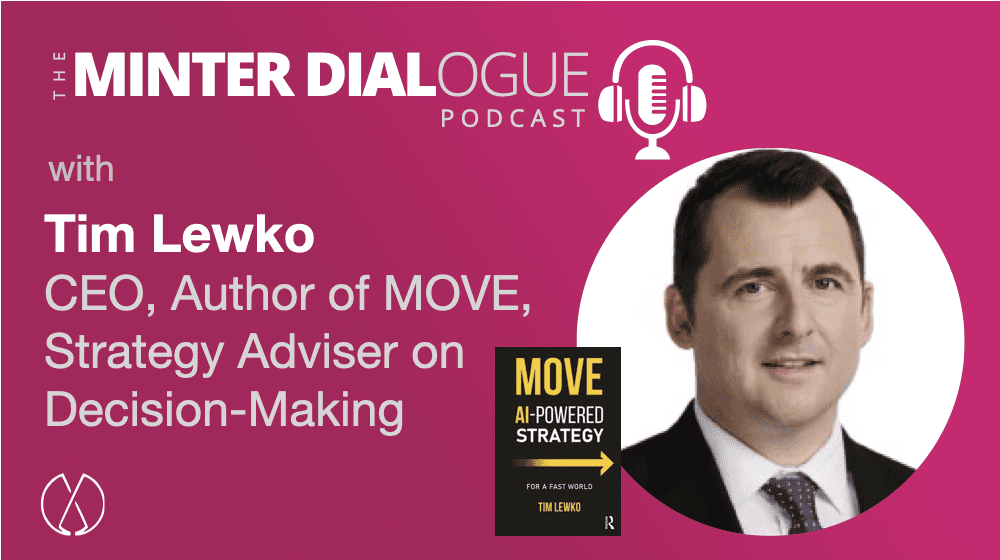
Minter Dialogue with Tim Lewko
Tim’s story resonated on a personal level, not just for his breadth of international experience, but also for the values he draws from his own family’s history. Early in our conversation, Tim shared the moving story of his uncle Larry, a World War II veteran and former prisoner of war, whose deep positivity and zest for life stemmed from profound hardship. For Tim, “freedom is not free” is more than a mantra; it’s a guiding principle that shapes both his work and how he inspires others to lead with authenticity.
Our conversation delved into the true role of strategy in companies, the perils of static mission statements and endless priorities, and why making decision-making criteria visible can galvanise teams in powerful ways. Tim’s MOVE framework—Make thinking visible, Orient around advantage, Visibly choose bets, and Execute in rhythm—is more than a catchy acronym. It distils decades of lessons into clear, practical actions that leaders can apply today, supercharged by the possibilities of AI.
Key Points:
Further resources for the Minter Dialogue podcast:

Meanwhile, you can find my other interviews on the Minter Dialogue Show in this podcast tab, on my Youtube Channel, on Megaphone or via Apple Podcasts. If you like the show, please go over to rate this podcast via RateThisPodcast! And for the francophones reading this, if you want to get more podcasts, you can also find my radio show en français over at: MinterDial.fr, on MegaphoneFR or in iTunes. And if you’ve ever come across padel, please check out my Joy of Padel podcast, too!
Music credit: The jingle at the beginning of the show is courtesy of my friend, Pierre Journel, author of the Guitar Channel. And, the new sign-off music is “A Convinced Man,” a song I co-wrote and recorded with Stephanie Singer back in the late 1980s (please excuse the quality of the sound!).
Full transcript via Castmagic.io
Transcription courtesy of Castmagic.io, an AI full-service for podcasters
Minter Dial: Tim Lewko, I am delighted to have you on the show. We have a lot of things in common. Funnily enough you were actually in Paris as we speak as we record this, although you know it’ll be published well after. And I put up my background because as we’re speaking, Tim, there are four valiant astronauts circling the moon and now headed back. So, that’s a hat tip to them, the Artemis project. But as I usually do in my all of my podcasts, Tim, I like to start. Who is Tim Lewko?
Tim Lewko: Okay, I’ll give you a little background. So, my name again is Tim Lewko. I’m the CEO of Thinking Dimensions. So, we’re a UK-based company, 12 partners, about 300 resources worldwide and we work on strategy consulting and working with CEOs to advise them on growth. Essentially, I’ve been doing this for 25+ years across four continents and hundreds of companies, and I’ve enjoyed it and still enjoy it today, which is again why I contacted you. I believe you’re in London today.
Minter Dial: Indeed I am.
Tim Lewko: I’m here around Paris and so looking very forward to the talk today.
Minter Dial: Splendid. Well, we’ll get to your work at Thinking Dimensions. But before you and I hit the record button, a little warm up chat. And we talked about a shared thing in our family past and, and it led us to U.N. you know, maybe connected a different way. So, everyone who’s listening, most of them will have heard about my song and dance about the last string home my grandfather who was a prisoner of the Japanese. Turns out you had an uncle with another story. So, give us an understanding of what that story is. I think that’d be really interesting.
Tim Lewko: Yeah, I’ll give you a little understanding for sure. Some context on that. Again the last ring home without kind of the pun is it rang true to me because growing up my uncle Larry again from Manitoba, so he was went to World War II and again was captured Christmas Day 1941 in Hong Kong. He was probably 18 at the time and then was a prisoner of war for four years. Again the, the data is the data. You know, he came back, he’s a big scrappy man from farm in Manitoba to kind of less than 100 pounds. And so, you know, through he didn’t speak a lot of it. But as he got older I was if you will, summoned to his place and he was at a later stage and he, I could see a chair kind of in the back part of the room that was for me to sit on it. So, I was going to Obviously be a listener there. And he really, you know, spoke a lot about the detail and about really the day to day survival of what you have to do, even mentally what keeps you going, you know. And he went on to have, you know, kids and a fantastic life and for sure a very spirited and adventurous kind of mindset. And the thing though, that really showed me again, and he helped underscore that is as I was saying earlier, is freedom is not free. And we can’t let not having an understanding of our purpose or really of our values get artificial. And I think to some time these days, everything wants things fast. It’s a bit artificial to some degree. And we have to question and really, I think listen to those who have went through, you know, literally battles to support where. And I tell my kids this all the time, is that, you know, where you’re at 12 and 14, the privileges again for Canada, that’s where I’m from. The freedom, the ability to walk around and not look behind your head. That’s because people have sacrificed before you and you cannot forget that and continue to pass that on. So, that’s why, you know, your book the Last Ring Home Again, as I said, rang true to me.
Minter Dial: I assume, Larry, your uncle was a prisoner who’s taken to Japan, Correct?
Tim Lewko: In Japan, four years. He kind of went in detail, which I won’t today, about just some of the, let’s say the discipline or the beatings and really just the food. And that gets back to how can someone, if you will survive between the amount of, you know, nutrition they had, which was barely anything the size of them, and again, it goes back to kind of as he said to me, it’s just, it’s really the values, the purpose, where am I going? And how clear is that? And if you can take that in your head, whatever that is, that’s kind of the step by step or day by day approach that you have to take. And so, profound impact. Yeah. Freedom is not free.
Minter Dial: And to what extent did his experience really paint or color his life afterwards? What, what? And maybe what were the lessons that maybe you feel, yeah, you can take away other than the, the notion of freedom. What, what sort of lessons learned did he take away from him transmit to you?
Tim Lewko: Yeah, that’s a good question actually for one is, you know, most people have like a favorite uncle. He was one of the favorites, if not the favorite, on my mum’s side. I got to watch what I say here for the family and. But the reason was positivity. And he would be the smiling Uncle. So, whatever the case, and again at that time, even when I, you know, you begin to know the uncle, you know, five, six, seven, you don’t know his background. You just see someone who’s positive, someone who’s there for the kids, who’s happy to do things and probably would go the extra step and you know, to be helpful. And one, one quick example, I just remember I was staying at their place in Winnipeg and my, my friend and I, who were kind of billeted with my uncle, we’re at a hockey camp and this is in the summer and we really wanted to make a movie. The movie was Greece. You remember Greece, of course. And when hockey practice ended, they were downtown, but is basically at a 15 minute window to drive 20 minutes. And we’re like, you know, these are the days that, okay, he goes, we can do it. Hopped into the Monte Carlo in the back again, no seat belts at the time, and just shot off. And we were one minute early. And it was just, you know, those kind of things, particularly when you reflect back on it, you know, as a parent or as an uncle, that, wow, that guy saw something that we wanted to do and put his things to the side and made it happen. And that’s the type of thinking where, you know, to even leverage a bit of the end of my book with the intent is what I always say to people and explain is when they say, why do I. Well, I’m a CEO advisor or help companies with strategy. And I always tell them the same thing because it’s the right question, why do you do what you do? And for me, it’s the fastest way to help the greatest number of people. And many CEOs or presidents, they go, okay, I get it. How do you get that? I said, it’s very easy. As an example, your company has 1,000 people. Yep. Or employees. I always kind of go times four, meaning for a family unit, this is a 4,000 person plus customer suppliers. But you’re stewarding the decisions and the execution of at least 4,000 people. So, let’s really find the, the purpose and passion. Again, I don’t do motivational stuff, but find what is real and that is authentic in what you’re going to do as you make these decisions. And that is, so to speak, half the battle. And makes people think that it’s not like they’re doing strategy or execution. There has to, there’s a whole group behind it that if you will, is counting on you. So, let’s think through it correctly and make that stick.
Minter Dial: What I Like about what you say, Tim, is that it’s sort of a moderate, bigger scope. I mean moderate in a good way because it’s realistic. What are you going to do that’s bigger than your company? Well, I’m going to save the planet. Okay, well that turns out to be a little bit ambitious as in too much. So, what is the scope that’s outside of you that makes it bigger than just you and your company? And that framing, Tim, seems to be very realistic. It’s sort of, it says to the CEO hey listen, let’s move outside of just you, even you and your family. But we have a thousand employees and they have all families. So, what we’re doing here is more than just you, sir or madam, at the top and it broadens their scope.
Tim Lewko: Yeah, yeah, you said it right. I couldn’t add to it other than that’s kind of part of my job as well is to help frame really what we’re trying to do. We’re not trying to, if you will, do strategy. We’re trying to set the organization up for success with all the financial things we, we can talk about later. Just it has to be based on something that there’s passion and the scope that they understand. And as I you look around the room when I’ve worked with many thousands of, of, you know, executives, some are get it and some are checked out. And it’s those companies though and I’ll give you just one other example if I may on that, that’s brilliant right now is those that are connected to something and you can see it around the room because you work with them over X number of days. You can see where the passion lies. They light up. They admit what’s wrong. They say they don’t know all these kind of things but what they do, they’re if you will, truly in it together to craft something that that’s going to take care of not only their 4,000, but you know, the rest of the customers in the future. So, that’s invigorating, I would say. And one example, because it just happened recently, only by chance my wife knew the new coach of LAFC. His name’s Mark DeSanto. So, that’s Los Angeles Football Club. Only by chance, his boys in Vancouver played against my son. My son scored three goals, which is always nice anyways. Indeed, Hatrick, he was a new coach and again I can wrap it up but he was, he’s the first-year coach at LAFC right now. The record they haven’t lost and I don’t believe Anyone scored on them in six games. But I said, I’m in Los Angeles frequently. He goes, come to the training facility and everything lined up. I finished client work, and I went to visit him at the facility. And I walked in and, you know, this thing we talk about, what does passion and purpose feel like here in this spectacular facility just near Los Angeles? He walked me and gave me a tour of the kitchen, of where they eat. And he goes, this is the most important place. You know, you’re thinking, the football pitch. He goes, that’s where the culture, the belief in each other, the discussions happens. And again, then we went through the training facility, walked around. But what was interesting, because they don’t know me, and I don’t really know him that well. I met the coaches who were strategizing. I met know some of the trainers. I walked into the room and you could feel it, almost an energy buzz. Now, I don’t know what will happen to the rest of the season, but he’s doing that deliberately. He. He’s not saying, I hope this works. That’s kind of his strategy and system, if you will. And it’s fascinating to see that, you know, whether it’s a sports team or a small company or big company, if you get the right people connected, the right dots, things happen.
Minter Dial: I enjoy. I often bring sports people in. I think there’s a lot to be learned from that. I wanted to connect with something else you said a little earlier that resonated with a couple of other conversations I’ve had, one of whom was a person working in opera, an opera director, and how she manages the. The full scene of all the egos and everybody. And I was like, oh, that sounds like was happening in a boardroom. Yep. And then I had another conversation with a. A Frenchman. He’s actually Franco Canadian, but lives in France. And we were talking about his role as a comedian when he goes into boardrooms. And both of them remarked this idea that you were saying, like, you go into a C suite and you. You see the ambiance, you see where the passion and purpose lies. But what they were talking about was that they often see where the. The lethargy is, where the. The lack of passion is. And. And what both of them said is they. They make it a point of honor to identify what’s going on. So, when they see somebody who’s frustrated but not speaking, when they see somebody who’s sort of distracted and not participating.
Tim Lewko: Yep.
Minter Dial: They call it out. The comedian does it with. With humor.
Tim Lewko: Yes.
Minter Dial: She does it with forthrightness when she’s, you know, managing the full scene. And, and as an external person, I’m guessing that you often see these types of dysfunctionment, which is why you’re being pulled in.
Tim Lewko: Yes.
Minter Dial: How do you manage that? And what would you say to somebody who’s actually within. Because when you’re without, in other words, from the outside.
Tim Lewko: Yeah.
Minter Dial: It’s often easier to speak.
Tim Lewko: Yeah, it’s a great point. You know, that happens in that type of, you know, who’s not engaged or who should be engaged again a lot of times. And that’s one thing about, because we really facilitate strategy. We’re not content, we don’t give solutions. We have processes. But one of the things that I always say at the start is again, this is the pretty basic one that gets them thinking is you have to take your functional hat off and your CEO hat. So, we have to take these off and put them over here. And again, this is pre done a little bit with the CEO. I need a CEO who has humility and who wants actually the best outcome. Not their, his or her idea put forth. So, that starts it off and you can almost hear the room. Okay, that seems interesting. How’s this going to work? And you can’t force that. So, the thing that we do is, as I always say, is we make thinking visible. So, what does that mean? We use flip charts. And so, what that does is, let’s say Brad has an idea, hasn’t shared much. Brad, relative to strategic assumptions or trends. Are we missing something here or is there something that you like to add that hasn’t been raised by the table? And so, I, I kind of depersonalize the information and it’s visible so that we can point to the data or the information or capture it. And that’s usually what gets people started. Because what I always tell them at the end, which has always happened 95% of the time, is usually they come and say our strategy is going to be this or that. I said, fantastic. So, let’s put those things over here on the wall and let’s walk through the process and see what happens. And that’s just again where we started. The beauty of working with executive teams. You can hear probably some drilling, there’s some construction in the area.
Minter Dial: Hey, listen, we’ve got to have business happening.
Tim Lewko: Yeah. And so, what happens though is when there’s the right people in the room and you have that ability to put your thinking and make it visible, what they end up doing is what they get at the end. It’s not really probably not one and two strategy. One or two. It’s the third or fourth variation because they’ve picked from this idea, that idea, and you almost use it. I use the example kind of as building blocks. And so, it becomes a shared learning experience. This is the big phrase today, but it’s a shared experience. So, when they walk out of it, they say, well, that’s a great strategy. And they look at me, I said, that’s not mine. That’s your thinking. They go, oh, that’s right. And so, that’s what really gives the impetus for people to speak up. But to read the room quickly to get those people talking. The right people in the room with the right information gets the right outcome.
Minter Dial: Well, we’re going to get into the V of Move with visible, but let’s start with. Because we haven’t really started with an opening, if you will, on your new book, which is published by Routledge. Yes, it’s your second book with Routledge, if I’m not mistaken. The title is Move in capitals. There’s no exclamation mark after it. Colon AI powered Strategy for a Fast World. So, it feels like, considering your first book, what made you write this book? The. The first book is. Is about making big building bets, or. I can’t remember. The.
Tim Lewko: Making big decisions Better. Yes, Sorry, go ahead.
Minter Dial: Yeah.
Tim Lewko: So, why.
Minter Dial: Why this book now?
Tim Lewko: Yeah, that’s a great question. The. The. The true answer is in May or April of last year, they sent me a note and said, would you like to write another book? And I said, about what? Again, there’s always ideas that you have, but about what? What’s the cutting edge? What’s different? And as I said, even in the book, this is the right place. I’m at the right place in the right time. I have 25 years plus of what we call. It’s not prescription consulting. So, we do compete against the big guys, but we have one or two people or just one person. We facilitate. So, we ask questions. That’s why, whether you’re in this industry or another industry, big company, small company. Again, the tools, if you will, or the questions, the framework works. I’ve been doing that for 25 years. And, you know, to be really frank, we do really well with clients. We wish we did more with clients, but a lot of people want the answer with the PowerPoint deck on their desk. But more and more particularly over the last five years, you know, CEOs have seen that deck, and we know they don’t use the deck and et cetera, et cetera. And so, as I was asked to write a book and AI was coming, and I’d taken a course probably a couple years back or a year and a half back on at London Business School just to get a framework of what’s going on, it kind of created a real passion that, hey, we have questions, which again, we’d now say prompts that are proven and work. We have a process. What we always struggle with or even with clients is, you know, we need the market data or this data. And actually, and we can probably talk about or maybe even show something or send something later, but we now have a thinking partner in the room called AI. And when we say we need this data on the competitor, no longer are people going, let’s again on the flip chart saying, hold that, let’s get that to marketing. When we meet in two weeks again, we’ll plug it in and then see where we go. That’s now literally in minutes, minutes. And so, as I was writing the book, and I wrote the book again because the content and what I do is I’ve been doing it two months, I wrote the book and again, what is if, As I was saying, even to my kids, but you know, to clients, if you like, change and you like to have to pressure yourself on how we’re going to do things different. Because even in the book I write, AI is changing. You know, how they’re getting into the data, the quality of the data, and there’s ways you can count that back and forth, but literally by the week at least, or day, things are changing for whoever, whichever version you use. And again, if you’re someone who needs the best data from a strategy situation, it’s fascinating. It’s. It’s a revolution for me and I’ll talk about that. It is like somebody saying, it’s the perfect storm. Someone says, do you have proven tools with questions? Yep. Well, we have a thinking partner that’s going to supplement the executive thinking. They still need to pressure test it and have judgment, but wow. So, it changes it. And that’s why, back to where you started, it’s not. This is kind of one of my mantras. Companies don’t need an AI strategy because my question to CEOs or to boards is, relative to what? Back to purpose. Back to relative to what? It’s just a capability. Like the web was like Six Sigma was like, again. And I list those through. So, we need a framework which is move, and that’s why it’s AI enabled for Fast World. And we can talk more about fast, but you Know, two weeks to do research, now is done in two minutes.
Minter Dial: AB Well, I don’t want to completely reveal everything that’s in the book. That’s for why people need to go grab it.
Tim Lewko: Sure.
Minter Dial: But let’s just in top line manner, figure out what is move the M O V E. Because it, I mean, it’s a wonderful word. You’re moving people. There’s the emotion of motion. But let’s, let’s start just understanding that. I want to break down some of the thoughts after that.
Tim Lewko: Yeah, well, you know, you’ve written books, so there’s a couple good things about writing books. One is when you, when somebody asks you to write another one or they accept your first one, it’s like a bit of euphoria. Oh, fantastic. And so, I, you know, I came back to Rutledge and said, yeah, I’ll write another book. Then when you, if you will, hang up the phone or send the email, it’s like, now what? Now what? And so, but again, it was the summertime and having done enough work again, globally, I did, and I’m 25 years, you begin to sit down and say, okay, let me actually kind of unpack or think through what were really like, where were some really good clients, what were some really good CEOs, what did they do? Where did things again, as I said to you earlier, where did things not go right for a session that we did with a client or, you know, a training session or whatever. And as you begin to. Again, I always want things simple, one page, three points kind of thing. Because no one else wants more than that usually.
Minter Dial: And so, true, by the way, it’s. I mean, I just to cut in there, how often you get this list of six 10 points. 10. My 10 values?
Tim Lewko: Yeah.
Minter Dial: Or my six priorities.
Tim Lewko: Yeah. Well, again, you know, I’m 58. And that’s where again, I start seeing myself a little bit, being able to look back with a bit more clarity. So, back to the question though, is that. So, when I sat down, because I do have, you know, the library of experiences, what actually worked. And that’s where. Yeah, you know, I wanted a shorter title than the first one. That’s part of it. But I started thinking back to each of the episodes. And again, I’d even start with the E is, you know, strategy can’t be static. We know that there needs to be adjustments. So, execute, you know, and adjust. Execute with rhythm. As I said, V, you know, back to Visible Bets. I’m doing it backwards. I hope that’s okay.
Minter Dial: Of course. It is. It’ll make people think, wondering.
Tim Lewko: I can’t wait for the M and visible bets. And again, the bets are essentially where the. This works for anyone. The only choices organizations have, they can string it as much as they want, but what products to offer, what customers or markets to serve. And you know, at l’ Oreal you had multiple and then what capabilities to invest in either organic or inorganic. I won’t go much more into that. But there’s visible bets that have to be tied to the P and L with return. And you need to make those visible. And that’s one of the tools that helps do that. And I was always amazed by two things. Again, just briefly on that one, we would give the tool and you know, products, markets and people would go. That’s so obvious. And again, that’s even from Ansoft initially way back. But this is tied to the P L and they look at. Why didn’t we think of that? I mean products crosses customers down the side. So, if you have four by four, you got 16 spaces. How do you allocate resources? That’s a good question. You can’t give everybody everything. So, that’s again visible and orient to advantage. This again is where competitive advantage a lot of the words that we hear. And I was asked where does it show up in your balance or in your P L? Where does it show up? And this is again where. And it does spur from purpose and the passion. What really are you good at? Why do customers pick you over the competition and should pay you a premium? It’s not basic. Just show me where it is. And that’s again where you. You have to. You can’t be everything to everybody. I did write an article on a car company a while ago where they have so many brands now. You know, this one, this and this one. And I like it baffles me in the sense that if you do your products across the top by your markets, just the complexity of that alone is mind is breathtaking. And then the last one, so I’ve got evo. All I need is an M. And that’s where we started with is if I’m known for one thing with clients is oh right, Tim, make thinking visible. Make it visible. So, if I put those together, we’ve got move which are really the four principles that underpin the success the thinking of all the rest, if you will, of the tools. If you have to boil it down to four. Tried to get it to three, but again I went with four.
Minter Dial: Well, I think four is. Is. Is okay. I mean, one has to. It can’t be too dogmatic about these things. But so, just to put it back all in shape, M is making things visible.
Tim Lewko: Correct.
Minter Dial: O is orient around your advantage.
Tim Lewko: Yes.
Minter Dial: V is again, about visibility. It’s visibly. Choose your bets.
Tim Lewko: Yes.
Minter Dial: And E is execute in rhythm.
Tim Lewko: Yes.
Minter Dial: So, a little bit of the movement story. What was interesting about that for me, Tim, was a comment. My long, longtime friend and sort of a real ally in, in so many areas who worked with me while I was at l’, Oreal, Pat Brenty, to name him. He said, the most important thing is execution. Yep. And. And at the time, I was oftentimes, let’s say, excited by the beauty of the image or the pantone of the pack. He says, really, you know, whether it’s 268 or 269 C, that’s not going to make the difference. Get the thing to me on time.
Tim Lewko: Yes.
Minter Dial: Execute. And that’s something I, I kept with me ever since I worked with Pat.
Tim Lewko: Yep.
Minter Dial: Anyway, the. So, one of the. So, bringing things down to these boiling things down, one of the things you do and you talk about is within the Move tool is this notion of having a single driving force. Correct. And having that one capability that propels you forward. It’s sort of like, you know, conversations I have. Well, what are your values? And then they bring out a long list. They forget six of them because they have to look them up so they can’t remember them. But it is, it is so difficult, it seems, in a corporate world to figure out which is the one, just like which is your strategy, not some sort of laundry list. Well, so what is the psychology behind the resistance that people have in business? To boil it down to the one thing, and how do you break through without just steamrolling the team into the CEO’s preferred answer?
Tim Lewko: Well, that’s a good question. I would answer it this way. Is that really the best companies and best leaders I’ve worked with are able to boil it down or understand that they need to get to know one driving force for the organization. So, I see that inherently in some people or some organizations where it’s not evident in how you do that. And I’ll do it a couple of ways. One is, as I say, because basically our tools are based on decision making. Decision making is actions executed over time. So, that’s fine. But how do we pick where we’re going? And that’s where, again, you know, been doing decision making for a long time. Chuck Kepner started our company he’s got a pedigree that goes way back. But it’s about, what is the criteria? What is the criteria? Before we look at options, we’re driving forces. What is important to whatever way we go? And people go, well, aren’t we going to just talk about the alternatives? I said, you can debate alternatives all day long and it’ll go nowhere. And they go, so. And again, this baffles me, but again, we lay out criteria and they go, what’s important in this decision? Well, profitability. Great. How do we measure that advantage? They’ll always have the right things, but they don’t have the basket that’s visible. And so, we basically. It’s like getting people to decide again. Some people like this who go for dinner with me, some people don’t, you know, they say, where are we going for dinner tonight? That’s an option, right? They’re asking me, I said, what’s the criteria? They go, we just want to go for dinner. I know, but close. Expensive is. If we don’t do that, we’re going to get to the restaurant. People go, this is not what I wanted. So, if you get those out first as a group, the criteria and we. This is what we want. The intent it’s supposed to satisfy. And then we work through different driving forces. That’s where you get people going, oh, yeah, we got to go back to the criteria. So, we’re already on the same team here, if you will. And now we’re playing back. How does this satisfy with data. And that way, and I always say this, let’s put status quo for your strategy. Well, our current version is not working. I know, but let’s put it down and score based on what you said is important. And they say, yeah, that’s why we’re not so happy. Then, you know, the one or two, it’s going to be this or that. Great, let’s get everybody a fair shake. We put them up and we evaluate them some gaps and then that’s again where for driving forces, as the team really looks at it, that’s where they start. And again, part of the value we provide is making the relevant pieces visible. That’s where they start going. Actually, what we’re really good at is ceiling in this fashion, or we’re really good at this type of manufacturing process or whatever it is. And it’s like they found themselves again. And that’s where getting the purpose at the end, having had some rigor to get through it and evaluate, it’s a bit easier than most people think. If you have the right tools or start with criteria.
Minter Dial: Well, that reminds me of the saying, how do you know you’ve achieved your destination if you don’t know where you wanted to go?
Tim Lewko: Exactly.
Minter Dial: And so, the idea of, well, I’m not happy with this restaurant. Well, we never figured out what makes you happy in the first place. So, it’s very unlikely you’re going to be happy.
Tim Lewko: It’s exactly true. And that’s where again, part of my job is to kind of remind the executives of some of those, you know, known facts and they, okay, it’s something that they own something. And it really galvanizes them because it’s their thinking they own it.
Minter Dial: What I’d like to dig in on is this word criteria.
Tim Lewko: Yes.
Minter Dial: Because it’s not what we regularly use as the word to describe what we’re trying to do. Oftentimes we might think about the how and the how, the what, the why. We can talk about the values. Yep. We can talk about purpose. We could talk about profitability and success. And each time you, it, it sometimes looks obvious, but we don’t actually understand what is behind it. So, we might use a word. Well, we are integrity. That’s one of our values. Well, what the heck do you mean by integrity? So, if you could, with criteria, break it down into a way that someone’s listening that says, actually, what are my criteria and how do I go about finding them and gelling them so that the team understands them.
Tim Lewko: Yeah, one, that’s a great question. And back to kind of the pragmatic way behind that is essentially even what we do is, you know, what, what are we trying to do? We start with kind of what is the statement of the, the decision statement. We want a new strategy that achieves, you know, or that has growth. Okay, so what’s important? And again, everybody in the room, well, it’s got to be profitable. And I always like again to kind of get the group going. Great, let’s write profitability here. Now how do we measure profitability? Wow. And ever. Well, dollars, Euros. Oh, we’re going to go with USD. Okay. And over what time frame and profitability. Now is that after tax? Fc. Fcf. Oh, and everybody. So, we begin to sort through free cash flows. What you were saying, really almost benign, objective. Because I’ll use one as well for like something like advantage. But and it’s measured by it. And I’m like, we need to be able to measure this. Whether you do it now or not. We need to measure it, otherwise it doesn’t count. And then what is the target range? Right. What’s the target? It’s 20, you know, it’s 20 million or two, whatever it is. And so, now we begin to work through those and when you get to things like. And to be honest those are the easy ones when you can quantify them. Now we get down to advantage and I again if you’re in a session I do talk about competitive advantage value proposition, where that stuff’s come from, why it’s mainstream. But it’s all mixed up when you’re actually with many teams, not all teams but at the end of the day, you know margin’s a good sense of it but we have to dig what actually do you do that creates the margin? And I need to see it through your products and markets. You know, your P and L. That’s where the rubber hits the road. Because you can say we’re good at usually when competitive advantage if you ask an a typical team you’ll get seven competitive advantages. And I always say the same thing. So, then why are you here? You should all be retired because essentially you have with seven advantages. You know, you’re running basically your own fiefdom. They go okay, well maybe it’s not that. And so, you begin anyways the. The process is really laying out kind of the whether it’s you know, we want to be a innovative company comes up a lot profitable and saying as measured by inclusive, respectable all those buzzwords I and that’s what even back to where you alluded to before about mission statements. You know along for a long time mission. They had Wordsmith them for days and then you read them and there’s books on this where if you understand where it came up along lot of the good to great pieces and all that. If you read through it it was actually the right thinking but it took a piece of it. People say we need a mission statement so we want to be great to customers. And I don’t know what business you’re in or that doesn’t get me excited but it’s on the wall. I know but how do we use it to drive. Because criteria the whole strategy is criteria for how to have success in a company. So, you have to use it.
Minter Dial: So, Tim, as you’re exploring this with with a team or a company where does any linking to these criteria have to or could link back to purpose? How much do these criteria also need to be coherent with the values and the behaviors the how you do stuff. Yeah is in you know the, the. The methods, the manners, the ethics that are underneath it. So, and, and, and, and even with these criteria linking to a singular shared strategy. Vision.
Tim Lewko: Yeah.
Minter Dial: How. So, how is that, Is that part of your work is linking the criteria into that or is that sort of a secondary kind of component?
Tim Lewko: No, as I’d say that’s the whole ball of wax. That’s the whole thing. Because at the end of the day, and I’ll allude a little bit, but answer the question. Is that each of the tools in move again, which, when you build tools one to six, right, they’re on one page. They are really a strategic algorithm that one links to another, which links to the another. Each of those tools is actually a criteria. So, I need to use them. But the main part of it, not the main, but within the vision piece and driving force, those criteria need to be used and visible. So, when we’re making decisions, as I said, placing bets, and this is, to me it’s the most powerful and the most simplest thing. I always say to CEOs, if you want to have a successful company, get people to use the same criteria consistently. And so, meaning you need to have those five or so criteria. If we’re going to invest in this market, does it address our purpose? Does it leverage our advantage like visibly check that out with the team, not cherry pick and say it’s a big growth market, values. It’s a bit. You can’t do that. Well, you can do whatever you want, I say, but you need to stick behind. Remember the ethics and really the integrity of what you’re doing. And that’s where again, you get the consistency and, and you get the people as that translates down. And they say, what do we do with this? Well, don’t send out a deck with 20 slides. What’s that going to do? You guys do that anyways? Send out the criteria that we should be using. Again, it might be shaped a bit as you get further down. Like what happens in Corp. They might be using ebitda. As I get down to an office or a store or something, it might be something different, but it’s the same thing. And people, when you actually talk to them, say that’s the best kind of fresh air that we get to help us drive what we need to do. And again, if you give someone criteria, go back to your decision or your question about dinner. Minter, we’d like you to pick dinner for us. This is our criteria. Okay, I can give you some options in the Vendome area versus where do you want to eat. So, that’s again where the tools are built really to drive visible criteria. I don’t know if that sounds dry to me. It’s fascinating because it motivates people and gives them clarity, but it doesn’t tell them what to do.
Minter Dial: All right, so the final question I have will be. I think it’s a great example of your work, Tim, as I understand it. And I wanted to just prep it. We’re going to talk about pop quizzes.
Tim Lewko: Okay.
Minter Dial: I think you’re going to know where I’m going with that one. But one of my quiz questions that I start off when I do sessions, it depends on the session. And, you know, sometimes it’s a far more provocative approach. I say, so how many of you are prepared to tattoo the name of your company on your skin? And. And what I do is I, I, of course, I take away the fact that I’m not interested in tattooing, actually, but I’m interested in why that question is of interest to you as an organization. And even if all of you are going to disappear and maybe even get fired or leave the company, how is it? And why would you want to have everyone get tattooed? That’s my pop quiz. However, you have a different one. And the one that you ask the executive team is to write down the company’s top three strategic bets. And what I like about this personally is, is that it. It’s making visible the incoherence usually that I see in boards. So, tell us how you do this, why you do it, and why anyone who’s listening to this needs to be putting this into place.
Tim Lewko: Yeah, immediately. And again, that’s something that you can do quickly. There’s really kind of two parts to it. And I do this all the time. Starting off, particularly in new sessions, is they don’t know you and you don’t know them. So, now what? Because they’re looking back at you, you’re going to tell us what to do, and then we tell them, by the way, we don’t do decks. We ask questions. Now they’re baffled. So, what do you actually do? And it’s back. So, let’s just start with something easy to warm up. Is that just so I know, because I’m new here, what’s the definition of strategy in your company? They say, our current strategy. No, just whatever the definition is. And by the way, just take two minutes, and I throw them a sticky, write it on a sticky, and just stick it up on the wall. Again, not for your group, because you guys are. You’re good, but just for me. So, I can see it you don’t have to put names, positions, whatever, and we stick them up. Let’s say there’s 10 people in the room and I. It’s not dramatic pause, but a bit. I’m like, I’m reading through them. Okay. In my head. Operational, operational end goal projects, they don’t have the same definition. That’s the starting point. And from that I don’t make too much of it other than how do we talk about strategy if as you can see, you know, like the cartoon things over your head, that’s kind of what you’re holding. So, when you talk about advantage or implementation, that person over there, they got a different starting point. So, we need a common language. And again, that’s where back to the reality is, what are the bets? Where do you think we should go? Because I want to see, you know, is it inorganic, organic, where the gaps are where really you can. It’s funny, sometimes you see where people sit on the table. Even. Even at this kind of age, if you will. It’s like they really like alternative one or bets one and two. Over here. The guys who are talking a bit more of a coffee, they like the three. So, those are kind of the ways that begin those sessions and get people. Because it’s true, we’re all here for the same reason. But now that we see there’s, as you said, some incoherence, we can’t have that because that flutters down. If I got again 10 executives or 20,000 people that just, it’s like whispering in the ear story what you think. So, let’s make that clear. And that helps get people to say, okay, we’re in it together. Yeah, let’s pull that and have one definition of strategy. We will get to the bets as we work through the tools.
Minter Dial: I want to push back one second. You just said we all are here for the same reason. I think that that is. It’s unlikely that that reason is clear to everybody. In other words, I feel that when you get into so many corporate situations.
Tim Lewko: Yeah.
Minter Dial: We haven’t spent the time to understand our deeper motivations and. And there’s always going to be internal competition, things like that, that get in the way. Politics, ego. And these things more than cloud of the. This specific singular intention. And the idea that we all have the same idea of where, why we’re here and what we want to do is really the, the, you know, the pink elephant in the room.
Tim Lewko: Yeah. And I would back to the. The what I mean by we’re all in it together. We’re all Here for the same reason I’m really referring to my first slide that says the objectives of today are to lay out strategic assumptions.
Minter Dial: That reason.
Tim Lewko: Yeah, but because you’re right. Is that you can’t just look at the team. It’s over some time spending with them and making it visible. And that’s part of my job really with working with the CEO on the team is to ask. Sorry is to ask the harder questions that there’s inclined here. This country wants to do this and they want. So, we need to work through that. And again we lot of tough decisions. But it becomes obvious if you’re make.
Minter Dial: Sorry.
Tim Lewko: Becomes obvious if you make your thinking visible. People are trying to stack the deck or if they’re trying to use only a couple criteria like this is a big client revenue is good. How’s. How’s profitability stack up? Well, not so good. And then you start thinking about comp plans and you can see where it gets unraveled.
Minter Dial: But then post rationalizations and stuff like that. All right, well Tim, been great to have you on. You must now go out and enjoy Paris. Maybe other things you have to do with your family. How can somebody track you down your business, your company, look at you as a potential supplier of great questions and of course get your new book. Okay.
Tim Lewko: Yeah. So, they can go to thinking dimensions.com, that’s the website and also have an author website which is Tim Luco L E W K O dot com. So, that will give them a flavor again to purchase the book to kind of see the what we’re about in terms of how we do strategy. The other things. If I may mentor just to end with, you know what I’d really like to happen and that’s what I’m working towards, is to have people kind of stop using the 1965 SWAT and use move because again, we didn’t talk about it as much, but with the tools and AI, you know, I was sitting down the street having coffee. I can take a picture and I took a picture of. I can send something to you later if you want. I can take a picture of a store on rue de Saint Honore and say using the move tools work through the assumptions, the vision, the P L everything. And it’ll have that competition, what it should do, what are the big bets. And even the corporate one I did as well. It took five minutes while I was having a coffee. The tools AI gets you the data. So, really from SWAT to Move, having the tools, whether any size business, it gives you a standard way again with AI to really democratize strategy. It will be the new way, is the goal I have. So, again, thank you very much for the opportunities on such quick notice. And the last kind of plug I would say is our point is on March 31, my audiobook was released. So, that’s a little bit part of that. So, happy to have a conversation with any executive who’d like to. And ideally, we’ll talk again.
Minter Dial: Indeed. Tim, been a pleasure. Thank you so much.
Tim Lewko: Great. Thanks very much. Take care.

Minter Dial
It’s easy to inquire about booking Minter Dial here.