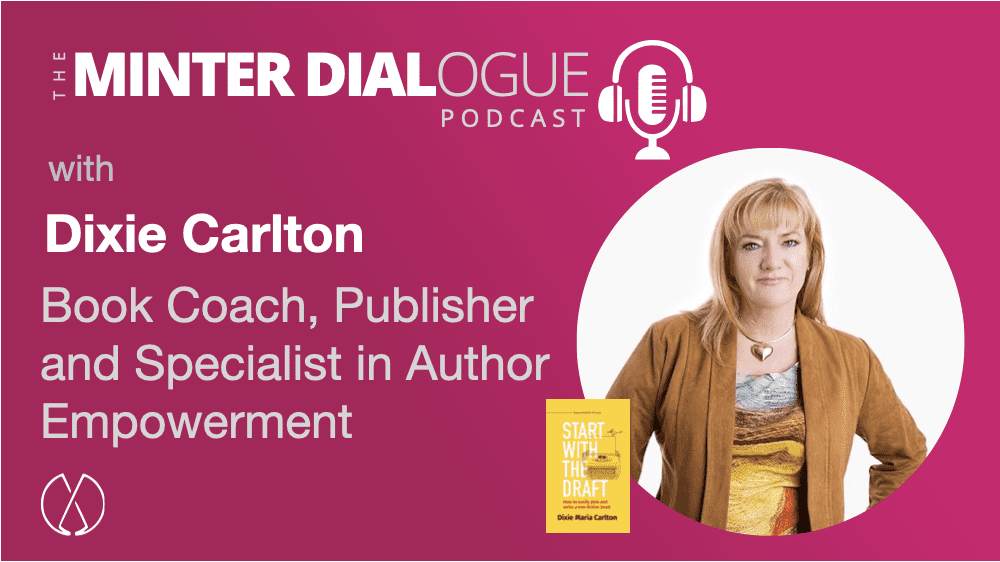
Minter Dialogue with Dixie Maria Carlton
Dixie Maria Carlton is affectionately known as “the word witch” for good reason. As an accomplished author, publisher, and book coach, Dixie’s mission is to empower others to harness the magic of words. She doesn’t just help writers publish books; she guides them on the journey from the seed of an idea, through the writing and publishing process, and onward to stages and broader influence. Curious by nature, Dixie’s conversations are as much about learning as about sharing—reflecting a lifelong fascination with people and their stories, kindled in her childhood days.
In this conversation, I delve into the current state of book publishing with Dixie, what it means to develop real expertise (and authority) in your field, and how thought leaders can translate their wisdom onto the page and beyond. We also tackle the complexities surrounding AI in writing, the importance of intentional planning, and the art of meaningful conversation—even in our increasingly distracted world.
Key Points:
- The Book as Authority, Not Merely Product: Dixie emphasises that while everyone seems to be writing and publishing, the value of a book lies less in mass sales and more in establishing expertise and credibility. Taking the time to craft a well-researched book signals authority in a way that simply consuming or sharing information online cannot.
- Planning is Everything—Even (Especially) for Self-Published Authors: For Dixie, the starting point is always: “Why this book, why now, and why you?” Many who attempt self-publishing struggle because they skip the essential groundwork. Without identifying the true purpose, audience, and what happens beyond the final page, authors risk getting lost halfway through—or losing their readers entirely.
- AI as a Tool, Not a Substitute: AI can be brilliant for research or restructuring your content, but Dixie warns against letting it write for you. Using AI without personal involvement robs your book of integrity, originality, and engagement—readers (and editors) can tell the difference. Transparency in AI usage, Dixie says, is vital, but the author’s authentic voice must shine through.
In sum, Dixie reminds us that real impact goes beyond the printed page. The best authors plan not only what to say, but how their message will live on—whether as ongoing dialogue, workshops, or speaking engagements. Writing a book is just the beginning; true influence comes from building relationships with readers, audiences, and the wider world. If you’re keen to move from expertise to wider influence and want your wisdom to reach well beyond the bookshelf, Dixie’s advice is an invaluable resource.
Three takeaways:
- Writing a book is as much about clarifying your purpose and audience as it is about filling pages.
- Be transparent and intentional with your use of technology and AI, ensuring your own voice and originality remain central.
- Influence grows when you actively engage readers to continue the journey with you, through multiple platforms and conversations.
To connect with Dixie Maria Carlton:
- Check out Dixie Maria Carlton’s eponymous site here
- Explore Dixie Maria Carlton’s publishing work at Indie Experts Publishing
- Find/buy Dixie Maria Carlton’s book, “Start with the Draft,” here
- Find/follow Dixie Maria Carlton on LinkedIn
Other mentions/sites:
- The Plasticology Project (book and initiative) here
- Jane Goodall Foundation here
- Malcolm Gladwell (author, referenced for writing and audiobooks) here
- The Thursday Murder Club by Richard Osman (referenced, audiobook narration by Lesley Manville) here
- We Solve Murders by Richard Osman here
- Dan Priestley, “Key Person of Influence” here
- “Quiver, Don’t Quake” by Nadim Sadek here
- “Shimmer, Don’t Shake” by Nadim Sadek here
Further resources for the Minter Dialogue podcast:

Meanwhile, you can find my other interviews on the Minter Dialogue Show in this podcast tab, on my Youtube Channel, on Megaphone or via Apple Podcasts. If you like the show, please go over to rate this podcast via RateThisPodcast! And for the francophones reading this, if you want to get more podcasts, you can also find my radio show en français over at: MinterDial.fr, on MegaphoneFR or in iTunes. And if you’ve ever come across padel, please check out my Joy of Padel podcast, too!
Music credit: The jingle at the beginning of the show is courtesy of my friend, Pierre Journel, author of the Guitar Channel. And, the new sign-off music is “A Convinced Man,” a song I co-wrote and recorded with Stephanie Singer back in the late 1980s (please excuse the quality of the sound!).
Full transcript via Castmagic.io
Transcription courtesy of Castmagic.io, an AI full-service for podcasters
Minter Dial: Dixie Maria Carlton. I really feel like we’re going to have a ton of stuff to talk about. But, as I like to ask, in your own words, who is Dixie?
Dixie Carlton: Oh, who is Dixie? Hi, Minter. This is so great to be here. Thank you. I’m fascinated by the question. I don’t actually get asked that very often, surprisingly, when I think about it. Dixie, I am the word witch. People call me the word witch. I work in words. I write books. I help other people write and develop and publish their books and take them beyond the book into from pages to stages. I’m all about trying to empower and educate authors about what’s possible beyond the writing and the publishing. I also am endlessly curious. I have conversations with people, deep conversations with people about things that matter, things that don’t matter as well, of course. But I have this deep-rooted fascination, which I’ve had since I was a very small child. My mother used to say instead of playing with the toys in the corner at the hospital, if I had to go for a visit for something, I would be walking around the room talking to all the old people. And I think I always still do that.
Minter Dial: Lovely. Well, curiosity is a lovely thing, as the word, which it was definitely a. I mean, you know, some in today’s world, it feels like you’re not, not supposed to say those type of words. But what would you say, Dixie, might be the most magical transformation you ever seen happen between a rough idea and a finished book?
Dixie Carlton: Well, I can see why they call you the communication expert. These are some fantastic questions. The most transformative there’s probably. There’s a guy I worked with about two or three years ago and he came to me, he’s a young scientist and he was completely fed up with all the talk about climate change. And he said, climate change is not the issue, it’s cleaning up the planet. We need to get all the plastic out of the waterways. I’m writing a book about it. Help me. So, this young shy scientist and I worked through his book, which we then called the Plasticology Project, which has gone really well. And his confidence as a scientist who was willing to speak out about big important things like plastic pollution. The work that he was doing with a young guy in Malawi who was literally going out in his canoe from his village every morning and picking up trash, you know, from the, the lakes of Lake Victoria and building it into turning it into bricks and building buildings with that. And, and Paul is telling me about all this stuff and he’s so fired up and articulate. That he doesn’t come across as being like a boring old scientist in any way, manner or form. And as we go through the project, his confidence just grows and grows. Well, he then took a lot of what he did as the book was finishing and launching and decided to start working on podcasting, because we talked about that and he’s now running two podcasts. But the last person. He was the last person, I think, to work with, Jane Goodall, and she came across what he was doing and said, oh, wow, you’re amazing. So, he had her as a guest on his podcast and has now gone forward and is creating more work with the Jane Goodall foundation, which all came from this big idea he had about, never mind climate change, we’ve got to clean up the planet. And he’s still the most interesting, one of the most interesting people I’ve ever talked to. And we. We periodically catch up and, yeah, transformation. Amazing. Yeah, it’s possible.
Minter Dial: I love that story. Well, in terms of the word, what is the witchery that’s needed to make the word good?
Dixie Carlton: I think it’s a question of looking at the meaning that you’re trying to convey with the words that you’re using. If you don’t use the right words, or if you use the right words but in the wrong way, then you have miscommunication, and miscommunication leads to misunderstandings. So, in order to get into what it is that you’re trying to achieve with the words that you’re using, you have to go behind them and say, well, what’s going on here? What’s the story? How do you need people to understand this, whether it’s one person or a thousand people?
Minter Dial: So, to have clarity of what you’re trying to communicate.
Dixie Carlton: Yeah, clarity. And maybe sometimes the words you think you need to use are not the right words. Maybe it’s different words, or maybe you need to adapt the tone or the other parts of the body language or the, the. The style of delivery. You know, like, one of the things that I’ve always leaned into is the fact that if you need to have a really serious, deep conversation with someone, the best time and place to do that is while you’re driving in the car, because you. Besides sitting beside. Yeah. And sometimes then it’s not about choosing the words beforehand. It’s about saying, I need to have this conversation, or I need to articulate this idea or investigate this thinking. How do I do that? And do it in such a way that the other person or people are going to be engaged and have time to think about what they’re trying to explain.
Minter Dial: The driving in the car imagery. I have often heard when I speak with psychologists about that’s the perfect time to talk to your son or at least another man, because that way we don’t, it’s not very intimate. You’re sort of, you’re, you’re not engaging in, in private space. You’re not sort of threatening by looking at each other. But yeah, that’s a, that’s a goodie. But the, the notion of words, naturally I’m, I’m deeply interested in linguistics and words, but it feels like you have the accurate word, that you also have the smaller word, the easier word. And in certain markets we want convenience, we want, don’t make it difficult to pronounce. And how do you manage that tension between maybe the more erudite word and the simpler word? When in the English language we have 500,000 words to choose from, so it can be a lot more complex. Whereas in French we only have 80,000 words. So, it’s a little bit simpler in one regard, but more every 17% longer to express the same thing. So, how do you cross that? What sort of approach do you have when you, when it comes to the word, which is advice, Keep it simple.
Dixie Carlton: The kiss method. I think, I think it depends how important or how well one who you, who you’re trying to, who you’re trying to reach. So, if you’re talking with people who are highly educated and they are used to a high level of or a percentage amount of the tough words of the big words, and if you really feel the need to impress them, then by all means use those. But if you’re trying to make something clear, and let’s face it, the main reason to have any form of communication, whether it’s written or spoken or even non verbal, is that you want to make sure something is understood. So, keep it simple, use the basic words. Think about the fact that maybe the person that you’re speaking to doesn’t have English as a first language or doesn’t have the reading skills above a 12 year old. You know, as professional speakers, which we both are, one of the first rules of being on stage is you slow your, your speaking down because there’s a percentage of people in the audience may not be enjoying having English as a first language. So, you need to slow down. You need to make sure that you’re not being obvious about it, but you also still need to be clear. You can’t afford to. And, and I mean I’m A kiwi. I speak quite fast in a natural sense, but if I need to be understood or if I’m on stage, if I’m doing an interview, I will very carefully slow myself down. And that also enable me to have time to think and to use less of and are and all that sort of thing. But you need to just keep it simple.
Minter Dial: All right, so in your answer, Dicky, you’re talking about the audience. It feels like the natural segue is like, well, what is the state of book reading these days and book sales? Book reading, from your angle, since you’re sort of more in the weeds than I. What? Who’s reading? Who gives a toss about books anymore?
Dixie Carlton: Weeds is right. It’s a very weedy landfill, messy place out here in publishing land at the moment. And a lot of people say, well, why should I bother to write a book? Because no one’s reading anymore. Well, the reality is that book sales are up. People are still reading. People do still look for information. And the main reason why someone should want to write a book is not because they want to sell a million copies, although that would be lovely. It’s more to expand on their own authority. Because if you are a book author, then theoretically, AI aside, if you are a book author, you have theoretically researched and written and read and understood your subject matter well enough to be classified as an authority on that subject. I mean, some people say you have to write four or five books to be able to really say that. But to some level, you are an authority on the subject. If you have taken the time to write 30, 40, 50,000 words on that subject, you are more of an authority than the person who hasn’t done that. Now, as a speaker, for example, if you think about going on stage and doing a keynote presentation, that’s around about 7 to 10,000 words worth of information. If you run a workshop, that might be two or three times that, maybe 20- or 30,000-words worth of information over the course of a day or half a day. But if you write a book, you allow or you invite the reader to find out more about where you come from, what you think, why you think that way, where your research was based, why you believe in what you’re writing about. It allows the reader to become more involved with you, to become more engaged with you, and for you also, as the author, to invite them to come on more of a journey beyond the book. So, why write a book? Why read a book? Yes, you can find out all sorts of information on Google. You can ask AI for any information. I’LL give you a classic example. I had someone ask me a few months ago, there was a young woman, she was asking me about a personal matter related to a physical situation. And she said, I’ve been on Google and I’ve looked up all of this information, etc. Etc. And I think I know how this works. It was, it was about a pregnancy and, and I said, yes, but yeah,
Minter Dial: you have to have sex before.
Dixie Carlton: Is that what you have to have sex before? Yeah, yeah, you have to have sex first. But she was reading about all of this information as she was getting ready to have a baby. And I said to her, no, you need to read these books and you need to open the book, you need to have the ability to write in the book and you know, make notes and go back and look at it. She said, but I can just look it up on Google. I can just, you know, ask my phone about it.
Minter Dial: What’s that thing on YouTube?
Dixie Carlton: But the problem with that is, is that the people who are putting that information up there, there’s no level of vetting of their information, there’s no level of assurance that they’ve got ability to back up what they’re saying. If you’re writing a book, even if it’s a self-published book, it has at least got some level of veracity that you can rely on and go back to.
Minter Dial: Well, I think that does bring up the issue of publishing and, or, you know, publisher and self-publishing. But the idea of having someone who’s written a book, roughly 90% of my guests or my podcasts are authors. And there’s a very real reason why I do that. And it always strikes me that’s peculiar when I invite an author on a show and the author then says, can you tell me what questions you want to ask? Well, actually, but you’re a subject matter expert, you’ve written a book. How on earth am I supposed to corner you and, or you know, surprise you? You know your topic to your point of being able to run a half day seminar, a full day seminar, once you’ve written the book, you know your topic. But someone who asks me questions like, well, what are you going to ask me? Always seems like a heads up as to where does that go. But you know, you said that book sales are up. I’m inquisitive as to how much book reading is up because I think that you might quickly just click on a link, download a Kindle, because I have 12 ebooks in my, in my subscription, I buy the book, put it On My Bookshelf, one of 15 books on my beside my bed stand. It feels like while there may be more books sell a, there is a plethora of actual books as opposed to, you know, just a few that everyone reads. And then the question is, does sale, sale equal read?
Dixie Carlton: I think the average book gets ready maybe the first three to five chapters and, and, or dipped into, or dipped out of. Unless you’ve got great stories in there. And if you’re a good storyteller, then you know how to breadcrumb the stories and the examples of what you do and who you are throughout the book. This is talking mostly non-fiction as far as whether anyone reads the full book. I think that’s a relative unknown. But people wouldn’t be continuing to buy books if they didn’t at least intend to read some parts of it.
Minter Dial: You hope. But I mean there’s always this performative piece, look at my bookshelves, you know, and it like having a piano in your home, it’s a, it is a good sign to have a piano and books on your bookshelf anyway. That of course is as you say, an unknown. You, you just, you talked about this lovely quip from pages to stages. What do you think that most thought leaders still misunderstand about transforming or moving from expertise into influence when it comes to taking your book and making you famous on stage?
Dixie Carlton: I think they miss the point when they’re doing their book planning that there has to be something beyond finishing the pages of the book. So, I talk about, you know, building an ecosystem. So, when you’re writing a book, you need to start with the draft, which is the title of one of my books, because you need to start with why you’re writing this, who needs to hear it, see it, you know, explore what you’re trying to put down, and then take them on a journey beyond that. So, when they finish the book, if you’ve done a great job of planning it, then you’ll know what the next steps are. And the next steps being that you want someone to invite you to come onto these stages or you want them to invite to be invited in for consulting or coaching or training or whatever, maybe just to read more of their other books, but you need to take them beyond the book. So, by the time they finish the book, if they’ve enjoyed it enough, then they’ll go and look at what else you have to offer. They’ll either Google you, search you, and if you give them a link at the end of the book, then they’ll go straight to your website or maybe a specific landing page and that then invites them to download more information, take a course, do a program, do you know, just a bit more engagement, sign up for newsletters, whatever. There’s all sorts of ways you can increase the journey or extend the journey. But what most authors don’t understand is that if you have, if you don’t have the branding right, and if you don’t have the relationship between what you’re writing and what you’re speaking on and what you’re then going to deliver as the next steps, then you’ve missed an opportunity to engage with them further and build a fan or a fan base and getting the message clear and consistent across everything. Now, we talked before we started the podcast recording that you and I are both quite unusual in that we like to write about whatever we’re interested in. So, we have many topics. So, it gets harder when you’ve got lots of topics to be the known person for that specific area. What I’m saying doesn’t detract from that. You can still write, you know, for example, a book about, you know, future proofing the world and then still write about empathy and then somehow bring it all together or at least if people like the style of how you write. Like I’m a very big fan of Malcolm Gladwell now. He writes about a lot of things, but he has a style of writing and I particularly like his audio books as well. He has a style of writing and speaking that expose the stories and bring you in. And then whatever he’s writing about next, I’m automatically interested because I like his style. So, even if you are a multi topic author and a multi topic speaker, you need to have a core style or a core something that then makes it not surprising for the reader to continue to love you after they finish the first book, the second or the
Minter Dial: third book, it sounds like having a core identity or core brand component. And when Malcolm Gladwell, you said he does audiobooks, is he that I never listened. Does he read his own books?
Dixie Carlton: Yes, very much so.
Minter Dial: Would you say that’s something if, if you’re an author listening that you would. And if there is an option to do an audiobook that you would recommend that the author be the reader speaker of the book?
Dixie Carlton: Only if you are good at it. I’ve listened to books that I’ve loved the book and I’ve heard the reading and only got as far as the first or second chapter because I can’t stand the voice or I didn’t like the style of the reading or there was no comfort or familiarity feel to the voice or maybe the tonality wasn’t right. Most people don’t understand that there’s an art to reading. And even listening to some of Malcolm’s very early reading readings of some of his books, you can see and feel the development over time. And so, a couple of books like the, the Woman, the, the Guy who wrote the Thursday Murder Club, one of his other books has got an English actress whose name I can’t recall reading the book. I think the book is called We Solve Murders. And she reads this book as an actress with an incredible range of different styles of voice for the different characters, et cetera. It is such a joy to listen to that I will read other books that she has voiced regardless of who’s written them. I can’t remember her name. But reading a book and listening to a book are two different things. Just as writing a book, how you. How we write or how we listen and how we speak are two different things. But how we write and how we listen are two different things. So, you can’t for example, go straight from transcribing a lot of information that you may have spoken, go straight into turning it into a book because we read differently than the way we hear.
Minter Dial: And I think at the end of the day that must be awfully more interesting when it comes to fiction because you have so many different parts and all that when you’re describing the planning that goes into writing a book for what I’m hearing, whether, which is something probably missing from most self-published authors is the book proposition that all that publishers ask for and that even though it’s a real hassle to do the 1215 page book proposition, it does sharpen the mind as to why you’re writing the book, who you’re writing it for, how are you going to get the book out? And maybe that’s the piece that a lot of self-publishers, self-published authors miss, that the publisher actually brings where valuable a value-added component.
Dixie Carlton: Yes. And when I sit down with any author and start looking at what the plan is going to be, what they want to have happen, I always start with why this book? Why now? Why you? Why are you the person to write this versus somebody else? What else is out there that’s in this genre? And what do you want to have happen when people finish reading your book? So, there’s a list of questions like I’ve just created an app literally that goes through all of this to help people plan this out. And the Biggest challenge that I hear is that it’s such a daunting prospect to do the planning, to do all that thinking. I don’t know what questions to even ask of myself. I can put it into AI and get AI to tell me what I should, you know, think about. But the reality is, is that AI is quite sycophantic and will only give you really what you know it thinks you want to know. But at the same time, it doesn’t cover the fact that you have to think about why people are going to want to read this book, how it’s going to impact on them and how it’s going to impact on you and why it is all so important. And that’s before you even start planning out your chapters. And so, even if you are self-publishing, like I come across a lot of authors who have written, started out, I wrote 10 chapter headings and then I started writing and Now I’ve got 80,000 words and I can’t get any further and I’m stuck. We rescue a lot of books around here and the. The problem is, is that you don’t start with a plan. You hadn’t. They hadn’t started with who they’re actually identifying that they’re writing for. How much do they know about the reader? We had a book a few years ago written by a doctor who was writing about acupuncture and he had effectively written two books within one manuscript. And I said, well, you have to write it as two separate books because one of them is targeting the patient and the patient’s relationship with the doctor, and one of them is targeting the doctors that are going to have people coming in and asking them about acupuncture. So, you need to make this a double book thing. Well, he went on to win a couple of awards for that book, which was great, those two books, which was fantastic. But he had spent two years plowing nearly a hundred thousand words into something that was just so complicated. He was completely stuck. So, the importance of having a plan cannot be underestimated. And it’s not just about what goes into the chapters, it’s all the other stuff. Publishing.
Minter Dial: Yeah. Dixie Free Plug. What’s the app called? Where is it? Where can people get it?
Dixie Carlton: The app is called Start with the Draft and at the moment they can get it on our website and it will be going live for various purpose over the next few days. Plus, he’s a Write this book. Sorry. Now write your book. YouTube channel just being launched.
Minter Dial: Brilliant.
Dixie Carlton: Yeah. I did this because I was so frustrated at the number of times I answer people the same questions, this is what you need to do, this is how to do it. And so, we developed some tools.
Minter Dial: So, you just mentioned AI. So, Dixie, it’s kind of the pregnant topic, AI. How do you approach recommending, counseling, the use of AI for people who are writing books?
Dixie Carlton: I recommend people don’t use AI to write their content. Definitely use it to explore your research, to explore your, your structure, to. Even if you’ve, if you’ve written something already that’s been edited and produced, then use that to extra. Use AI to extract chapters or extract content from things that you’ve already written and produced. That’s different because it’s already your content. But if you just sit down with AI and say, write me a book about educating five-year-olds, it’s going to write you some information that’s probably really good because there’s a lot of information it can pull from all places in the Internet and the big wide world full of information. And AI will deliver you a great book on how to educate 5-year-olds, but you won’t own the copyright on that. It’s not yours, and it lacks integrity. There is also becoming a thing where editors, for example, recognize very quickly now what is AI generated. Readers are becoming far more discerning about what they’re reading. And you hear about AI slop, it’s just unreadable because after a while, it’s like watching, you know, days’ worth of the same comedy or days’ worth of the same, you know, kind of genre of whatever you’re watching on, on Netflix, your brain starts to gloss over. And when your brain’s glossing over the content that you’re reading, you’re not getting the cut through as the author. So, if you want to write a book, and if you don’t have the skills to write it, then use a ghostwriter or collaboratively or hybrid, write the book, but get some guidance based on your topic. And again, coming back to what we said earlier, if you write your book, then you become an authority on your topic.
Minter Dial: How transparent do you suggest authors be with regard to their usage? I used AI to regularize the spelling because I wanted to use English spelling or, you know, American spelling. I used AI to cut the text from 60 to 50,000 words. How do you organize the transparency of the use of AI? I mean, because the end of the day, if you used it to make sure that you didn’t screw up the spelling, it’s not like you, you really need to tell anybody about that. You’re just Doing what you should do, like you use Microsoft Word, that helps you to understand that you spelled the wrong the word wrong wrongly. Then how far do we have to go down, this transparency world?
Dixie Carlton: I think you need to go down a reasonably long way. But what you’ve just described, I would do that as well. If I’ve got something that’s, you know, 10,000 words and I need to chop a thousand words out of it, if it’s what I’ve already written, then that’s fine. I’ve already written that. We had an interesting book a couple of years ago that my podcast buddy wrote, and he’s a firefighter and he writes about leadership and he wrote this book and I went through and helped him with a lot of it after he’d written the first draft and there was some really great dialogue that he had written. Well, sorry, he had written some good case studies about situations when he was out in the fire truck and talking to the commander and making decisions about things about, you know, the firefighting etc, which were brilliant case studies in relation to what he was writing about leadership and firefighting. So, I put a couple of those case studies into ChatGPT and said, Give me exactly this, but give me it as dialogue. And it was brilliant. And he, and he’s also a professional speaker and he and I both talk about on stage about the fact that we used AI for that, but AI didn’t create the stories. It gave us the same stories, but in a much more creative, interesting way. Now we both talk about openly about the fact that we used AI for that purpose within the book, but the content was already written. So, it’s very hard to say that’s AI generated because it wasn’t AI generated. I could have sat down just as easily and turned the whole thing into dialogue and written it and spent extra time on it myself as it was. I still took what AI gave me of those case studies in dialogue form and smoothed them out and made sure that they were humanized and, you know, checked all that sort of thing, because that’s what I do. But at the same time, that was a brilliant use of AI for that particular book. And there are many instances that that becomes a reality.
Minter Dial: If I may, I think the word just as easily is maybe a misnomer because the fact is that AI is going to chat, GPT will do that in 22 seconds, whereas it’s going to take you a bucket load longer and arguably not necessarily better to do it. So, I mean, I think a lot of us are struggling with this idea, just how far do we go down? This passage was edited by AI. This passage was reworked by AI. And at the end of the day, we might end up with an advertisement for some sort of pharmaceutical drug that gives you. End of five, you know, the five seconds at the end of the ad where they say at 2.5 times speed, all the secondary effects, you know, and this. And this ad, It feels. I mean, end of the day, if, if the product is good and you sign it with your name because you own the content, you don’t necessarily own the copyright, but you own the content because this is really. This is my prompt, this is the information I gave it, this is the. The text that I use to begin with. It’s very murky.
Dixie Carlton: It is murky. And there’s two points. You know, one thing is that you have to know what you’re prompting. You have to know how to do that intelligently. And, you know, some of us have been working in specific areas of this AI use very cleverly for a very long time now. And so, prompting is relatively easy if you’re new to it. If you’re thinking, I can sit down and write my first book and just use AI, well, that’s a whole different thing. And so, I hesitate to tell anyone that they. That that’s a good idea. But there’s a really brilliant book out by a guy called Nadim Sadiq from the UK. It’s won a couple of UK book awards in the last couple of years. He wrote a book called Quiver, Don’t Quake, and it’s specifically about AI and how AI is used in the creative industries. Brilliant book. It follows on from his first book, which was Shimmer, Don’t Shake. And both books have gone very well.
Minter Dial: There’s a theme there, brilliant theme.
Dixie Carlton: Now, Nadim writes about AI as assisted intelligence, not as artificial intelligence. And that’s the premise of the whole book, and highly recommend anyone read it if they’re fascinated by this particular area of publishing, because there are ways that you can be intelligent in using AI, where you still are the creative force behind it, and you are a creative force with a capital F, not just someone who’s dabbling and seeing what they can create. And so, he gives some brilliant examples of how that has played out over the last couple of years since AI has really taken a hold in the creative industries. But again, I come back to the fact that there’s a lot of integrity at stake when you’re writing a book or you’re writing or you’re speaking. When I’M doing a presentation now. I will use AI to help me map out what my PowerPoints should be. But unlike some speakers who I know do this brilliantly, I don’t use AI to create all my slides. I tried it a couple of times and found that it was really frustrating on so many levels. But I’ll give it, I’ll get it to give me some idea of what things I should be talking about and then I’ll create my own slide deck. But that’s how I like to work because I get intimately involved in my content when I’m creating. Personally, if you are creating using AI, you are not intimately involved in your own content. And the, the integrity of that comes through and shows when you start trying to deliver on it. And that I think is the difference.
Minter Dial: That’s fair. Have you ever come across Dan Priestley, the Aussie key person’s influence? Absolutely. In this zeitgeist of finding your zone, becoming the expert of that zone and make it precise. And I’ve, and I’ve always thought importantly, personably interesting. I mean, in other words, you’re invested in it, not just because it’s a big market and everyone can make money in it, but this is something that I, I personally am committed to and I want to be, I want to own that space. So, a last sort of zone I’d like to chat about, Dixie, is because we have a shared passion on meaningful conversations. You call yourself a curator? A conversation with meaning and depth.
Dixie Carlton: Yeah.
Minter Dial: Topic I’ve written about a lot, but I’d love to hear from you, Dixie. What makes a conversation memorable enough to make it bookworthy?
Dixie Carlton: Oh, I don’t know that all conversations are classified as bookworthy. I think conversations and books are a different thing in many instances. Like you can, you can quote, you can refer to conversations that I had. You know, it’s like saying what speeches are worthy of becoming, you know, recognized in books. I think the conversations that are noteworthy in your own history are the ones that you have where something has come from that someone has impacted on you. You have had the chance to explore your own curiosity and have that satisfied. And that meaningful engagement has come from what is said between two or more people. I had an interesting conversation with a guy who trained to be an undercover operative in the police force a few years ago. And he said, we were trained. One of our training days included going up and down in an elevator of a 25 story building. And each time we got into the elevator, if someone else got on, it was our mission to find out as much as we could about that person in the time it took to go from one floor to the next. I think that’s brilliant way to have interesting conversations with strangers and it enhances your ability to think fast about, well, how can I make a compliment or a state of play in the weather outside or whatever meaningful enough to engage someone about, well, where are you going? What are you doing? I mean, I’ve sat there and found out all sorts of interesting things about people in short conversations like that. It’s very superficial. It’s a great way of starting conversations with strangers. And I have random conversations with strangers almost daily. You know, you’re standing in the queue waiting for the bank to open, or you’re waiting for someone else to do something, or, you know, for your coffee to be ready. Random conversations with strangers are amazing and sometimes lead to the most interesting scenarios. Like I remember having one on a train one day when I was about to go to Norway and a guy who was sitting opposite me, he and I just started talking about, I can’t remember what, but being on the train in London and me saying something about heading to Norway and whether or not I would use the train system versus the, you know, hiring a car that changed my entire trip to Norway. It’s, it’s so possible to indulge in interesting conversations and to curate conversations that can leave you either wanting more, wanting to know that person better, or just leave them where they sit and, and walk away afterwards. Yeah.
Minter Dial: So, the first thought that comes to my mind is in Norway they have a taxi, which is the form of a ship that goes from port to port up the west coast, which we did. So. Yeah, well, the ferries, but actually the cruise ships operate as fairies and, and speaking with strangers or speaking with people. Oh, I thought the other. So, the other thought that came to mind is you give new meaning to the word of an elevator pitch. But the issue, I feel, Dixie, is that a. And what I’m writing about today is that people don’t have time to listen. And when you’re in, in a queue, waiting at the grocery store or wherever, everybody except for your 90 year old grandmother whips out their phone and is earphones in and oh, watch out about them, they’re dangerous. There’s a risk of talking to them. And by the way, I don’t have time for them anyway. It, it just feels like where we’re rare birds or rare people who are actually interested in meeting strangers and engaging with them as opposed to doing your emails, catching up on your whatsapps listening to the new podcast because, I mean, in the end of the day, as authors, podcasters, speakers, we’re also in the world of giving out and spewing out information. We don’t have time to listen to people and people don’t feel heard. It feels like there’s some tension that’s just not, it’s like a circle that can’t be squared.
Dixie Carlton: Yeah, I think that’s a sad state for the world to be in. And you know, fortunately there are always still people who don’t have headphones in. Like, one of the easiest things I can do as a, as a woman, it’s easy for me to do this, but a mother who’s got a child who she’s wrangling or, you know, it’s easy to say, you know, this gets better, you know, this too shall pass. And you know, oh, so cute. Where did you, where did you buy that? Or, you know, maybe it’s easier for women because we’re not deemed as being threatening to have a conversation with, be it a child, an older person, a male, a female. You know, I, I can pretty much talk to anyone and I am perhaps as we even just having this conversation, cognizant of the fact that I am deemed to be non threatening if I start a conversation. But having said that, someone has to start it and someone has to inspire other people to do the same. And if those of us who do like to do such things, you know, when we’re standing in a queue or we’re waiting or there’s a moment to, you know, have a conversation with someone, if we do it and we start it and we show that it can be so much fun, then we might inspire that person to go and do it themselves. And I know that that happens. And so, learning to have intelligent conversations, learning how to compliment each other or accept a compliment or ask directions or say what we’ve just done when we’ve come out of a fantastic, something, another exhibit, and look at the person that you’re walking out of the exhibit with and saying, wasn’t that amazing? You know, we need to learn to do that. I think it’s a real shame when we do sit on trains now and we see so many people just on their phones. But occasionally I’ll get on a train in a city and I’ll see a young person reading a book and I’ve been known to stop and have a conversation with a mother of a young person who’s reading a book on, in a restaurant or a train and say, I’m an author. I’m in publishing. I’m really inspired to see your child reading a book. That’s awesome. You know, we can find things to talk about.
Minter Dial: Of course we can. If you’re that way. Wired, I write about that in that zone. The issue that there’s also a distinction between genuine curiosity and performative curiosity, where you’re just doing it to sort of go through it. And the challenge is having that headspace being present enough to lean into the feelings, thoughts that are being expressed by that stranger who you do not know and not applying some sort of. Oh, well, that person is that kind of person.
Dixie Carlton: Yeah.
Minter Dial: You know, because we have such a quick generalization that then overlays what we’re hearing. All right, Dixie time is what it is. Your morning, my evening been lovely chatting with you as I expected. What? And how can people follow you, track you down, use your services? Who do you want to have contact you next?
Dixie Carlton: Anyone who wants to write a book and. But not just write a book, but want to actually take their wisdom that’s worth sharing with from not just some pages, but across stages, platforms. People who want to think bigger than just saying, I’ve got something to say, but really want to know, well, how do I say it in multiple ways across multiple platforms? How do I have real impact and genuine impact, not just a little bit of influence. So, I love to work with people like that. And sometimes they’re already speakers that are already authors, but they want more out of what they’ve already started to. To share. And, you know, people who are curious about the things that I’m curious about, they can find me easily by just googling my name. I’m easily found. Dixie Carlton. But also indie experts. Publishing is where you’ll find most of what I do and some examples of some of the books that we’ve created over the last few years that I think inspire other people as well.
Minter Dial: We didn’t explicitly talk about it, but your tri-variant framework where you talk about books, podcasts, and speaking so totally into it. Dixie, thank you. Thank you so much for coming on. Great to exchange, to hear your energy, your passion for what you’re doing and helping others to spread the word. May we meet soon?
Dixie Carlton: Yes, definitely. Thank you so much.

Minter Dial
It’s easy to inquire about booking Minter Dial here.