
The Grooming Game: How Fake Executive Searches Hook Senior Leaders
 I don’t know about you, but the onlsaught of AI-generated messages has reached fever pitch for me. Not only are these an unmitigated waste of time, they can be downright misleading if not costly. And it feels ever so easy to get reeled in. I just ‘finished’ an exchange (total of 4 emails) with an AI-bot supposedly representing a Pullitzer-prize winning author. I was suspicious after mail #2, but mail #3 was too obvious, and #4 was the closer. But I could easily have been suckered after the first mail. Over the past few months, meanwhile, I have been on the receiving end of what appears to be a carefully constructed and highly targeted scheme aimed at senior executives. It presents itself as retained search at the highest level. In reality, it raises serious questions about whether we are witnessing a new form of “pay-to-play” scam dressed up as board-level recruitment.
What makes this particularly noteworthy is not the existence of dubious offers—those are hardly new—but the increasing sophistication of the approach. If I were an executive search consutant (aka headhunter), I’d be jumping up and down about this, because it will definitely muddy the waters for legitimate “cold” approaches. These scams give a whole new meaning to head hunting (as in what you might imagine in some dark part of the jungle!)
The anatomy of a “confidential mandate”
Based on my numerous experiences, I’m going to be explicit about some examples and commonalities.
The outreach typically begins with what is described as a confidential executive search mandate. The positioning is deliberately exclusive: undisclosed client, sensitive transformation agenda, board-level exposure.
What immediately stands out is the degree of personalisation. The role description aligns almost perfectly with one’s own CV—sometimes to an uncanny degree. In my case, the overlap included leadership in transformation, published work on empathy, AI expertise, global brand experience, multilingual capability, and even educational pedigree.
Here were the “minimum” qualifications
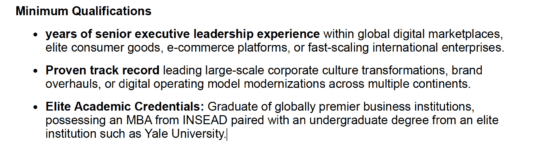
Amazing, that they cited Yale for a BA and INSEAD as an MBA. Two ticks. I note the mistake in the first bullet point (missing the number of years).
And the five-legged sheep miracle “preferred” qualifications
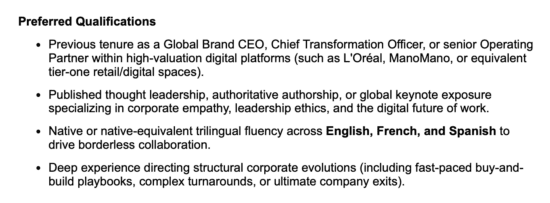
Here again, there was remarkable crossover: L’Oréal (tick) but in the same breath as ManoMano (really?), published thought leadership in corporate empathy (tick), trilingual fluencey in English, French and Spanish (tick)…
Another “recruiter” issued the following requirements:
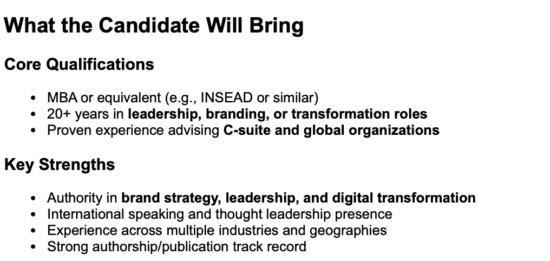
The “fluke” here is that the Minter Dialogue podcast’s subtitle is “Leadership, brand strategy, and transformation.” Eerily close, right?
The opportunity itself is inevitably framed in superlative terms: private equity backing, multi-billion valuation, significant base compensation (>$500,000), and substantial bonuses. It is, in effect, a near-perfect role—on paper. The names of the plum companies being recruited for are released… Accenture, LVMH, or Salesforce.
The engagement pattern is consistent. Once the initial outreach works, it is followed by a request for a CV. Given the prior knowledge of my profile, this was a bit odd the first time. Once submitted, meanwhile, the response is effusive: “exceptional alignment,” “rare profile,” “compelling candidacy.” The hook is now set. Curiously, none is willing to pick up the phone or have a Zoom with me, which you’d think is a basic screen for such a high-level hire.
The pivot: from opportunity to obligation
Only after interest is expressed does the underlying mechanism reveal itself.
At this stage, the recruiter introduces a “recommendation”—that candidates engage a “Board-Level Executive Positioning Consultant” before proceeding. The language is carefully calibrated. It is not presented as a requirement, but as a logical next step for candidates operating at this level. The rationale is familiar: your experience is strong, but your narrative does not sufficiently communicate your “enterprise impact” or “board-level readiness.” A specialist, we are told, can unlock this latent value.
What is left unsaid is more revealing. Progression in the process appears contingent on accepting this recommendation. In an unsaid manner, payment becomes a proxy for credibility and “genuine” interest.
Yet there is still no company name for the recruiter, no formal mandate, and no verifiable recruitment process, much less a proper contract.
Due diligence: what does not add up
Applying even basic scrutiny exposes multiple inconsistencies:
-
The individual presenting the opportunity often operates from a generic email account, without a corporate domain.
-
There is no accompanying digital footprint: no website, no regulatory disclosures, no company registration details.
-
References to established executive search firms and high-profile mandates cannot be substantiated—there are no LinkedIn profiles, no firm pages, no track record.
-
The language used is conspicuously inflated—heavy with jargon such as “Global Brand AI Architecture” or “Operating Partner AI Culture Design”—yet undermined by inconsistencies in grammar, formatting, and timing.
-
Most tellingly, the role description appears reverse-engineered from the recipient’s own background.
Individually, these might be dismissed as minor irregularities. Collectively, they point to something more systemic.
A business model in disguise?
The emerging picture is less about executive search and more about lead generation. The “confidential mandate” functions as bait. The goal appears not to be placing candidates into real roles, but rather funnelling them toward paid “positioning” or “grooming” services. By the time the recommendation is introduced, the candidate is already psychologically invested—flattered, validated, and primed to proceed (yes, I can tick THOSE boxes, too).
This is not traditional search. Nor is it transparent advisory work. It occupies an ambiguous—and potentially misleading, if not malevolent—space in between.
Why this matters
At senior levels, reputation, trust, and discretion are the currency of executive recruitment. Any model that blurs the line between opportunity and monetisation risks eroding that trust. There is, of course, a legitimate market for executive coaching, personal branding, and board preparation. Many senior leaders invest in these services with clear intent and tangible benefit. The concern here is not the existence of such services, but the context in which they are being introduced—embedded within opaque, unverifiable, and possibly fictitious recruitment processes. If access to opportunity is implicitly conditioned on payment, the model shifts from advisory to transactional in a way that deserves significantly closer examination.
An open question!
Is this an emerging niche within the executive services ecosystem, or a more coordinated attempt to exploit the aspirations of senior leaders? I reached out to individuals whose identity was presumably usurped, but as of the time of publishing this article, I never received any messages back. I would be interested to hear from others who may have encountered similar “confidential mandates” coupled with recommendations for executive positioning consultants. The pattern, once seen, is difficult to ignore.
I’d invite you to check out my Linkedin post as well, where a number of people in my network chimed in about the same problem.