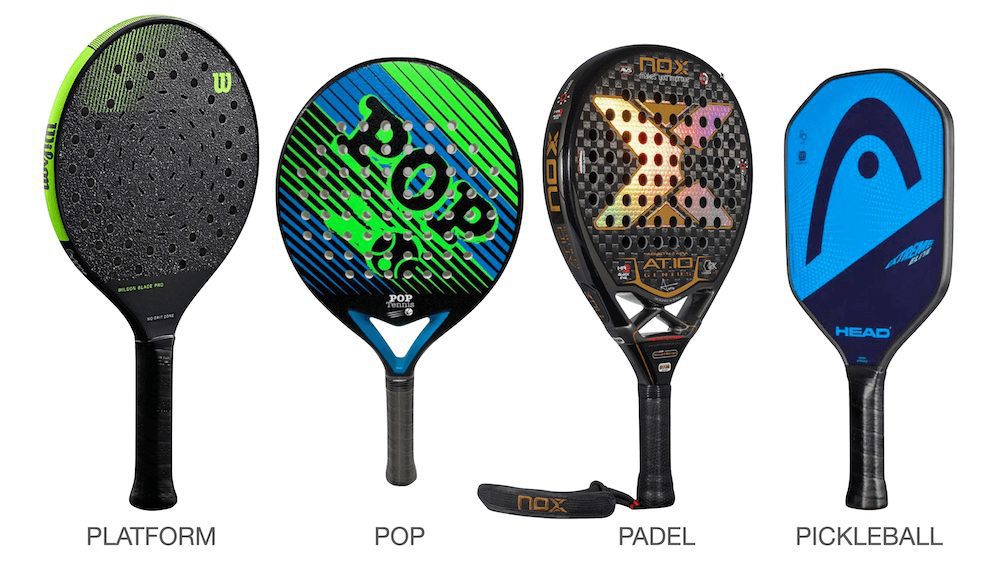

Padel is a beautiful sport. Beautiful enough, in fact, that I have heard people confess—gleefully, without a hint of embarrassment—that they are addicted to it. The court becomes a third home (to paraphrase Starbucks’ concept); the racket an extension of the arm; the weekly game a small ceremony around which the rest of life arranges itself.
And soon, as happens with any faith, we acquire doctrine.
We begin to “own” the game. We become maestros, at least in our own minds. We develop rules that feel as solid as the glass walls around us. For example:
- I’m definitely a left-side player.
- Once we’ve chosen our sides, we stick to them, religiously.
- The pros never double-fault.
- The bandeja and víbora are entirely different shots.
- Hitting topspin? Best avoided.
I’ve believed all of these things. I’ve also discovered that some don’t survive contact with the evidence.
To loosen my own hardwiring, I went back and analysed footage of two pro matches. Not to prove that every amateur should copy the pros, but to ask a more useful question: how much of what I call a rule is really just a habit?
The side you’re “meant” to play
The first match was the 2020 Menorca Masters Final, played during that peculiar Covid-era season. Fernando Belasteguín—Bela, “the Boss”—teamed up with the super talented and fellow Argentine Agustín Tapia and faced off against Juan Lebrón and Alejandro Galán, then the sport’s most formidable pairing and world number ones. It turns out, surprising for most, that Bela and Tapia won the final 6–3, 7–6.
Now, on which sides did everyone play?
If you know Tapia as one half of the brilliant left-handed Tapia–Coello partnership, you might assume he belongs on the left. And if you know Bela, you might assume the same. He was famous for playing there. I’d call him an institution on the left. Yet in this particular match, their positions were less fixed than one’s imagination would have allowed. In fact, the pair implemented unusual side-switching on their serve. Quite the tactical surprise, as they fluidly changed from left to right throughout the match.
That doesn’t mean sides don’t matter. They matter a great deal: handedness, preferred shots, movement, and the way two players cover the middle all shape a partnership. But “I’m better on the left” need not become “I can’t play the right.” Learning both sides gives a pair more choices—and, sometimes, a way to adapt when a match is going badly.
On the other side of the net, Galán and Lebrón also showed that partnerships can adjust. In the first set, they began with Galán on the left and Lebrón on the right. As you’d expect. Result? They lose the first set 6-3. The bench conversation in the changeover revealed that Galán was up for changing sides. What? Galan on the right? Lebrón, the world’s best right-side player on the left? The useful lesson is not that switching is automatically clever. It is that it can be a legitimate option when both players understand the plan and commit to it.
This is where communication matters more than ideology. A side-switch made together can be a tactic. A switch made without deep-seated agreement becomes a small domestic crisis in sports clothing.
So, yes: it pays to learn to play both sides, even if one side feels more natural. Be willing to change, but do it with your partner, not to your partner.
Service is not a tennis serve
Many amateurs bring a tennis expectation to padel: the serve should, or at least can win the point. In padel, that can create unnecessary pressure. The serve is important, but it is in reality just a way to start the point, with a useful ball and to put the serving side in a good position at the net.
Vianney Dubois (a prior guest on the show), whose work with PadelIntelligence brought valuable data into conversations about the game, has cited a benchmark that about 88% of professional padel players’ first serves go in. That is a useful reference point, though not a universal law. The figure can depend on the dataset and the pro level. But it makes the broader point. Pros practise the serve, and reliability matters. Aiming for a decent, repeatable first serve can be more valuable than trying to hit a spectacular first serve and, if out, having then to resort to a weak second serve.
There is a rulebook detail worth noting. Under FIP rules, the serve alternates between the right and left service boxes, while the returners’ positions are established for the set as soon as the first return is made. The rules allow the receiving player and partners to move within their own side once the point has begun. That leaves teams room to decide how they arrange themselves as servers. In essence, rather than taken as a foregone conclusion that one only plays on one side, be flexible in function of your partner, as well as the way you’re playing (and the results). Don’t be so dogmatic as to believe there’s only one solution.
A double fault?
I like to remind my playing buddies of the informal rule: the first double fault of the match pays the first round (of beer). I add that a second double fault means you pay a round of shots on top of the beers. And a third double fault? Well, the same culprit pays a round for everyone in the house. (All this applies assuming we’re past noon re: the alcohol).
And what about the pros never double-faulting? They do. Rarely, perhaps—but they are human.
At the 2022 Madrid Masters, in the quarter-final against Galán and Lebrón, Bela the Boss, and Arturo Coello (the King) were trying to close out a tight match. It was one set all and 5-3 in the deciding set. With the winning ball in his hand, Bela double-faulted on their first match point. An extraordinary moment. Coello and Bela actually embraced right after the embarrasing moment. They then recovered and went on to win; contemporary reports singled out the double fault precisely because it was so unexpected.
That moment stays with me not because a champion made a mistake, but because of what followed: the reset, the support between partners, the refusal to let one miss become the whole story.
So, the next time you double-fault, take heart. You have something in common with the Boss. Just don’t expect to do it as rarely as he did!
Are the shots really different?
I’ve long claimed that there are ten distinct overheadshots (see here for more). Do we need them all? No, not necessarily. But, there are two shots that are particularly important and adjacent to one another. The bandeja and víbora are often presented as two completely separate species of shot. There are differences in intention and execution: the bandeja is generally the more controlled overhead, used to manage a lob and preserve a net position. The víbora, on the other hand, is often played with more aggression, side-spin and pace to put greater pressure on the opponent.
But labels can make a continuum look like a border. Players vary the speed, spin, contact point and trajectory according to the ball they receive and the position they are in. So perhaps the better question is not, “Which named shot am I allowed to hit?” but, “What does this ball require—and what can I execute reliably?” Some coaches subscribe to the idea of merely sticking with the more comfortable and reliable stroke. I peresonally distinguish the shots differently. The bandeja is a concept shot: it’s all about hitting the overhead in such a way as to recuperate the net. That’s the singular objective of a bandeja. The vibora, meanwhile, is all about attacking the overhead in a way to force up a weaker return.
The same goes for shots with topspin. I often heard that topspin is not a proper padel shot. Don’t be dogmatic. “Avoid it” is far too absolute… at least for intermediate and higher level players. Spin is a tool, not a moral failing. The right choice depends on the shot, your intention and your control. A rule that helps one player simplify a difficult ball may become another player’s unnecessary constraint. The pro players definitely use topspin. I use the top spin especially on loose serves and on occasions where I see the opponents are hanging back from the net. The idea, then, is to drive into their feet and try to make them fall back and/or pop up an easy ball. Some top players with double-handed back hands are happy to drive some shots with overt top-spin down over the net. N.B. It’s not expected to be a winning shot, but to help force a weak shot on which to capitalise.
A faith with room to learn
Padel is full of options, accidents and serendipity. I like padel’s little orthodoxies. They give us something to discuss over a change of ends, and they make us feel that we’re progressing: we’ve learned the rules, found our side, named our shots.
But the game also rewards curiosity. Try the other side in a friendly match (even as a left-hander). Talk through a different service arrangement. Practise the serve as a way to begin a point, not as a demand that it end one. And when your bandeja starts behaving like something else, perhaps let the ball—and the opponent—tell you what it is.
I have my own padel beliefs that need challenging. I suspect you have yours. That is part of the joy: we come to the court with convictions, and the game keeps inviting us to revise them. I’ve been playing over 52 years and feel like I still huge loads to learn!
So tell me: what do you believe about padel that might be wrong?