
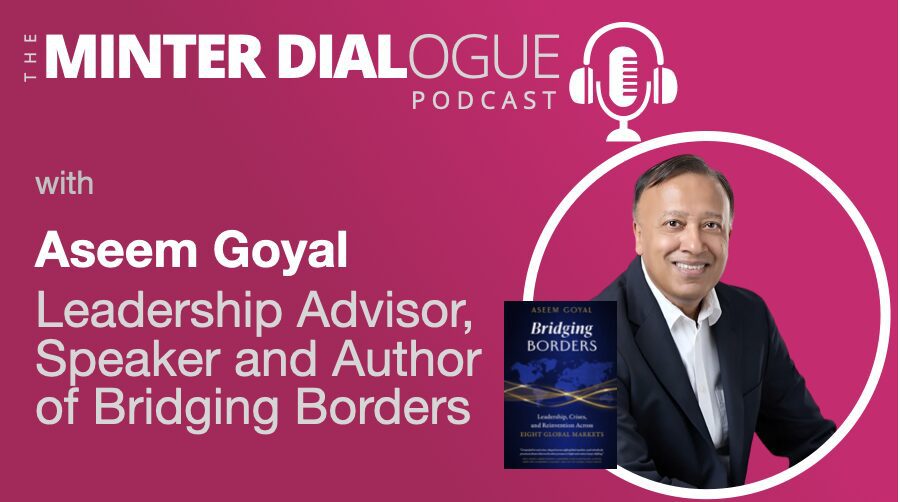
Minter Dialogue with Aseem Goyal
3 Key Points:
- Adapt Your Style, Not Your Values: Aseem explained that leading across borders means adjusting how you communicate, decide and relate to people (decisive can read as confident in one room and arrogant in another) while integrity, trust and accountability travel with you unchanged.
- Leading When There’s No Map: In a crisis you may not have a map, but you do have a compass. A key theme that emerged was bringing facts, perspective and calm to the table, as Aseem did touring European capitals during the Asian financial crisis, and leaning on your values when knowledge and expertise run out.
- Authenticity and Dignity in Hard Moments: The discussion explored how genuine leadership shows when it is least convenient: saying what you know (and what you don’t), treating people with respect when downsizing a team, and remembering that those who stay are watching how leaders treat people on the way out.
To connect with Aseem Goyal:
- Learn about Aseem Goyal and his book, “Bridging Borders: Leadership, Crises and Reinvention across Eight Global Markets,” on his site here
- Find out more about Aseem’s advisory and speaking work at aseemgoyal.com
- Find/follow Aseem Goyal on LinkedIn
Other mentions/sites:
- The Economist, where Aseem found the advert that took him to Thailand here
- ANZ and its I CARE values here
- My conversation with Rae Shanahan on the empathy gap (MDE528) here
- My conversation with Jeremy Waite on artificial intelligence (MDE268) here
- Amplify Publishing, publisher of “Bridging Borders” here
Further resources for the Minter Dialogue podcast:

Meanwhile, you can find my other interviews on the Minter Dialogue Show in this podcast tab, on my Youtube Channel, on Megaphone or via Apple Podcasts. If you like the show, please go over to rate this podcast via RateThisPodcast! And for the francophones reading this, if you want to get more podcasts, you can also find my radio show en français over at: MinterDial.fr, on MegaphoneFR or in iTunes. And if you’ve ever come across padel, please check out my Joy of Padel podcast, too!
Music credit: The jingle at the beginning of the show is courtesy of my friend, Pierre Journel, author of the Guitar Channel. And, the new sign-off music is “A Convinced Man,” a song I co-wrote and recorded with Stephanie Singer back in the late 1980s (please excuse the quality of the sound!).
Full transcript
Minter Dial: Aseem Goyal, great to have you on the podcast bright and early for me over here in London, you based out in Thailand. So as I always like to start Aseem, who is Aseem Goyal?
Aseem Goyal: Sure, Minter. And first of all, thank you for having me this afternoon, bright and early for you. And it’s quite sunny here in Bangkok, as it always is.
Minter Dial: Why don’t you just rub it in?
Aseem Goyal: So describe myself. First of all, I would describe myself as someone who’s intensely curious, still learning, like we all do, deeply care about leadership issues, because I think that’s what the world needs a lot. And I mean, just published a book, really excited about the next chapter in my life. So just briefly, you know how I ended where I am, the road started almost 30 years ago, I was working in Toronto for one of Canada’s big five on Bay Street. And things were going well. And I was always been an avid reader of The Economist. And I came across an ad, Standard Chartered Bank, looking for corporate bankers in Thailand. And after getting over the initial curiosity of why a bank in Thailand would be hiring through The Economist, and through a UK search firm, I sent in my CV. And to make a long story short, a few months later, I was in Thailand, a country I had never been to, didn’t know the language, didn’t know anyone. But that was the start of an incredible journey that took me to seven markets across Asia Pacific, building businesses, building teams, leading transformations, post-M&A integrations, and three defining crises of our times, the Asian financial crisis, the global financial crisis, and of course, the recent pandemic. And about six years ago, I decided to reinvent myself, left corporate banking, and became an advisor, speaker, and most recently, as you know, author of Bridging Borders.
Minter Dial: Phenomenal. Let’s go back to Toronto, because I lived in Canada for three and a half years out of Montreal, and I know well the Toronto Maple Leafs. Tell us about how your upbringing may or may not have prepared you well for the roles that you’ve played?
Aseem Goyal: Yeah, first of all, let me give you a little story. When I was a boy, I used to write to the embassies all over the world, asking them to send me literature, because as you know, there was no YouTube or internet or Google at that time. And I would get a lot of these envelopes come in, and I would be sitting on the floor and reading them. And in my mind, I had travelled the world many times, you know, even before I stepped on a plane. And so the seeds of curiosity, learning more about the world and all that was there. Of course, growing up in a family, my parents’ priority was education, so they didn’t travel a lot. But those seeds of curiosity were already planted. And so I became, I went into engineering, didn’t find my footing there, and really found my footing in MBA, because that’s where, you know, discussing global business, people issues, organisations, you know, there was no right or wrong. You could all have viewpoints and you could all defend your viewpoints. I think those things were sort of the initial seeds that set up an initial international career. And of course, I talked about how it happened through the Economist.
Minter Dial: I must imagine that in those getting those letters back, Like you might have received lots of fun stamps, because I remember when I was a child, we’re not so far off in terms of age, but I remember all those marvellous stamps. And for me, there was a journey within that sort of looking at the currency of the stamp because there are lots of currencies and then the types of stamps and more or less governmental. Is that something else that you might have leant into?
Aseem Goyal: Absolutely. I used to do the same thing, collect stamps. So that was another way of kind of understanding the country, what the currencies and what the picture on the stamp really meant. So I used to have that stamp album and fill them up and start a new one. Yeah. So I mean, thanks for reminding me, actually, I haven’t thought about that for a while. It’s not even in my book.
Minter Dial: Well, neither for me, but it was just, you know, thinking about you on the floor with all these envelopes
Aseem Goyal: I was thinking about that.
Minter Dial: So bridges, it’s a topic that I love, the idea of connection. And as you look at it, when does building a bridge require you to give up power rather than simply becoming better connected? Because obviously the general idea of a bridge is to connect. But it seems that in your, the way you define it or the way you approach it is also about giving up power.
Aseem Goyal: Yeah, I think the book is called Bridging Borders, and while you know we all have crossed many geographical borders, when I talk about bridges, it also means bridges between cultures, between organisations, between generations, you know, with our kids or you know whoever, and also bridges between people with different perspectives who see the world differently than we do. And when you cross these bridges, like we all do, you realise that your way is not necessarily the way you might have all the experience, that could be an anchor. But that could also become a blind spot if you don’t adapt yourself. And adapting yourself naturally involves giving up certain things, learning new things, you know, applying the intellectual curiosity to find out more. So overall, I think my definition of how you effectively cross these bridges is by building trust, by staying curious, by leaning on your values, your genuine leadership style. And, you know, communication with empathy, when you meet people with different backgrounds or people who have different expectations. Now, does this involve giving up power? I guess in a way it does, but it does build up more influence, if I could use the word. Power in itself can come from titles or whatever, but influence comes from who you are.
Minter Dial: Indeed. Yeah, well, maybe we’ll get into the empathy piece in a second. But thinking of this notion of building bridges, you’ve got the idea of power and influence. One of the things that I have always looked at, and Rae Shanahan, who I had on my podcast, talked about holding ideas lightly, or beliefs lightly, sorry, holding our beliefs lightly. And yet, as leader, we also need to be the lightning rod, the decision maker, the backbone that holds it all together sometimes. So is holding beliefs lightly something that you’ve come across in terms of giving up power, I’m thinking about, or at least in the idea of being curious and connecting with people? Maybe we’ll start with that.
Aseem Goyal: Yeah, did you say like, light?
Minter Dial: Lightly. Lightly,
Aseem Goyal: Okay.
Minter Dial: Yeah, not heavy.
Aseem Goyal: Yeah. So I think when I talk about adaptability, I talk about adjusting your communication style, how you make decisions, how you relate to people. Because as you know, being decisive can be very good in one room. It can sound arrogant in another. But I think that does not mean compromising. Now, you don’t compromise your values when you go from country to country when you cross borders, because whether you believe in integrity or trust or accountability, those values stay with you. So that’s how I would differentiate adaptability from really adjusting and not giving up what your core beliefs are.
Minter Dial: Yes. And one of the things that you’ve obviously worked on heavily is leading in different cultures. So then the question is, to what extent do you need to be flexible in terms of dealing with another culture? I’m going to give you an example, and it’s from my experience, but I’m a rather extroverted, maybe a little bit extravagant personality. And in some of the Asian countries I would go into, that doesn’t fit quite as well. Take, for example, Japan, where a dose of modesty is not such a bad idea. In general, by the way, it’s not such a bad idea. I would feel like I needed to adapt myself to accommodate the local culture, the local traditions that maybe didn’t need to be bravado or the front scene, but to maybe hold back and respect, let’s say, for example, the people with the most experience in the room or whatever. So how do you look at maybe how difficult is it to adapt to the different countries you’ve had to work in? Because most people listening to this have typically worked in their country. And while some people may have travelled, it’s unlikely that they’ve had this amount of experience in changing countries.
Aseem Goyal: Yeah. So let me answer this question in two parts. And first of all, describing the cultural differences when I moved from Canada to Asia and then moving within Asia. So when I first came to Bangkok 30 years ago, I noticed that the meetings would never start on time. You know, like it could be four o’clock, but people are strolling in at 4.15. Like you said, you know, the meetings, you know, people don’t talk or people don’t take the front seat. And space is really important. I mean, you basically have to make sure that you don’t make people lose space. So there was a lot of adaptation, you know, how things work in certain markets, but that was sort of coming from the West to Asia, but even within Asia, having gone from, you know, Vietnam to China, to Thailand, I mean, there’s so many differences. Let me just take Thailand and Vietnam. Thailand, and I’ve had teams in all these countries, and I’ve also had global teams, you know, where I have people from different countries. there’s so much difference in managing how you manage a Thai team versus you manage a Vietnamese team. In Thailand, people don’t talk back, you know, people are generally, I mean, there’s a silence, but that doesn’t mean acceptance. And there might be an undercurrent of resistance, but people will not say anything. So you have to sort of learn to understand that. But when I was in Vietnam, I noticed that people just talk back to me, you know, they would disagree with me. And they would just basically say, that’s not right. So like when we think of Asia, I mean, you and I know because we’ve travelled, a lot of people think that within Asia, it’s the same, but there’s so many differences as you go from country to country. And the last point, I mean, when I had a regional and global team, I had 10 different nationalities sitting in the room. And the only thing common about them was there’s nothing common. Because what I mean, what made sense to the person in Shanghai didn’t make any sense to the person in Singapore. And obviously, you know, different ways of communicating different ways of making the point, some would go straight, some would just go around in a long way. So, as you go from country to country, you learn to appreciate these things. And that’s what we’re talking earlier about adapting, you know, to make the best out of, come out of different people.
Minter Dial: There’s no doubt. I mean, once you’ve sort of gone in, the idea of Chinese is impossible. There’s so much diversity within China, and then you have Hong Kongers, and then you have the Chinese populations in different countries, Taiwan, Chinese speaking anyway, in different countries, Philippines, and so on. Not that we’re going to get into all of that, but I do want to talk about managing through crisis because in the end of the day, it feels like for many people, we’re going from one crisis to the other. And it does feel that your experience in having gone through those three massive crises, and I’m sure lots of little mini crises along the way. What have you learned about that? But specifically in your book, you talk about how when at Standard Chartered, their share price halved, and then they went out and bought 75% of this insolvent Thai bank, Nakornthon Bank. Anyway, what in your mind separates leaders who use crisis as a platform to grow from those who merely survive it? And how do you know which one you are in the moment?
Aseem Goyal: Yeah, so I mean, since you talked about, you know, Standard Chartered and economy, let’s talk about the Asian financial crisis. So every crisis teaches you something. And it’s the leaders who learn from the crisis and basically adjust their way forward, or, you know, some people don’t. So what I learned from the Asian financial crisis was that, you know, when things are going upside down, when there’s lack of information, a lot of misinformation, you’ve got to have facts clear, and you’ve got to be able to express them in a calm and quiet manner. I recall when the Asian financial crisis was unfolding, there was more panic in Europe than there was in Asia. And the reason was that because the European MNCs were kind of far removed from the actual crisis where it was taking place. And so I was flown to Europe and starting in London, went into five, six capitals sitting across the table. And I will give them facts in a calm manner, not give them what the future holds. That’s not what they were looking for or solutions. They just wanted facts. Somebody to tell them what’s going on. So I think that’s the learning I took from them. That the first thing is that when there’s a crisis, you’ve got to bring perspective to it. You’ve got to bring facts to it and try to calm the conversations down rather than them going off in different directions. Now, this is one of the learnings that I took from the Asian financial crisis. But as you said, there’s been a daily firefighting that you learn from. And the difference with the leaders who really learn and rather the leaders who basically don’t is that the people who learn, they think that these crises are going to, I mean, it’s not a one off thing. They’re going to come back in different forms and they have to apply their lessons. and that’s what they do. They use their experiences from lessons.
Minter Dial: What I hear from you, Aseem, and it’s a delightfully interesting new thought, is the ability to analyse and put perspective as opposed to maybe feeling responsible for it and responsible for what to do next. If you can separate from the action plan that has to follow to have a more calm, let’s say colder analysis that’s arm’s length. So, because when you’re running the business, you can very quickly feel responsible. It ties you in and you’re nervous because your job, because how am I going to get payroll paid or how am I going to get this next month’s revenues in? And it feels, it’s too difficult to extract yourself from the need to do to the need to analyse and bring perspective.
Aseem Goyal: Yeah, I mean, that’s certainly true. I mean, if you’re running a business and you’re responsible for payroll and people’s livelihoods and all that’s obviously a different situation you’re dealing with. But in my view, the situation could be different. But some of the lessons you can take about the calm you bring and being empathetic and really understanding. I think those can be applied in all situations, whether you’re working in a bank. I mean, like these happened to me when I was working in a bank. So obviously my perspective is more from that viewpoint. But I would think that the lessons that you learned, like for the last five, six years, I have not worked in a global organisation like I did before. But the lessons I carried from the Asian financial crisis, or GFC about risk management, or COVID about getting your priorities right. I think those can apply in any situation, whether you’re running your business, whether it’s your personal life, or any situation.
Minter Dial: Well, I want to actually, that makes me think, you just talked about in COVID, how you needed to assess your, maybe reassess yourself. To what extent does a crisis unhinge your values and how do you sort of stay true to yourself through the crisis? Because all the stresses that are pouring down on you and the information and the confusion and And the person who screams the loudest is supposed to be silent. How do you keep your true north when you’re in the middle of a crisis?
Aseem Goyal: Yeah, one of the things I talk about a lot is Leading When There’s No Map. That’s the title of my newsletter. And basically what I’m talking about is that how do you manage in an uncertainty and crisis? Because you might not have a map. But you do have a compass. So you might not know exactly where you’re going, but you should know the direction you’re going. And what that means is that you have to, yes, you have all the knowledge and the expertise and all that, and you can leverage that. But at the end of the day, you look into yourself for your core values. What are your core values? In my view, leading when there’s no map and relying on a compass, my compass has always been, you know, building a judgement, exercising some judgement, staying true to my values. Am I building trust? Am I providing genuine leadership? Am I being resilient? Am I adapting? So my experience has been that, yes, every crisis is different. You can, to some extent, leverage your knowledge and expertise, but that might not be enough. So you have to rely on your compass, which can mean things to different people. And for me, I just mentioned what my compass would be.
Minter Dial: In your work since leaving the corporate world, to what extent do you believe that the leaders actually know who they are, that they have a strong sense of their values? It’s been my observation that it’s often tenuous and sort of yada, yada, yada, as opposed to actually what, what do I mean? But to what extent do you see that? And to what extent is that part of the issue for leaders?
Aseem Goyal: Yeah, let me just, before I answer that question, I mean, let me just talk about my own definition of leadership has evolved. When I was a young leader, I used to think that and leadership is about being eloquent, being decisive, being a fast decision maker, delivering the numbers and all that. I thought that was leadership. And I’m not saying that’s not important. Of course, that’s important. But soon I realised that leadership is not about that. It’s about building trust. It’s about creating alignment. It’s about communication with empathy, being self-awareness. And one thing I’ve found is I’ve stepped away from corporate banking in the last five, six years and have different types of conversations with different leaders and also thinking back to some of the leaders I’ve worked with, I would say that the percentage of authentic leadership, I mean, I think that’s really lacking. I’m not sure what percentage it is, but I think the world really does need authentic leaders, leaders who are aware of their strengths as well as their weaknesses, leaders who know how to build trust stay true to the values. I think there’s, and that’s why I started out at the outset when you asked for me my introduction. I said, well, I believe in leadership that there’s such a need of it, because I still think there’s quite a deficit of good leadership in this world. and the changes underway in the world, whether it’s technology, AI, demographics, economic landscapes, and supply chains and everything, we need stronger leadership than what we have.
Minter Dial: In your answer, it makes me think of another thought, which is, why are there so many calls for authenticity? And to what extent is that a reflection of the bravado and fake personas, presentations, news that bombards us that we’re looking, we’re desperate for truth or is it because maybe inside of ourselves we’re not very authentic so we seek it in others?
Aseem Goyal: Yeah, I’m not sure about that part but I think the earlier part I totally agree with. Now what does authenticity mean? that I share with you. I’m transparent. I share with you what I know. Leaving aside things that are confidential or it might impact other things obviously. But my philosophy always has been that I’ll share what I know and you know and I’ll empathise with your feelings you know that and if I don’t know something I’ll tell you I’ll go and get it or if there’s something I cannot tell you, I’ll say I cannot answer that question. Now, I’ve been through two or three situations, you know, where I had to downsize my team by half and have 12 different conversations with people who are about to lose their job. And that’s how I always communicated, always been transparent, so that people know that he’s telling me what he knows, there’s nothing else he knows. But having worked with so many leaders, I haven’t seen that same authenticity. There’s too much of what makes them look good and just talking about the points that they have. So I think that goes back to the earlier point. I mean, there’s a genuine deficit of authentic and effective leadership in this world.
Minter Dial: I want to go back to this scene of having to get rid of your colleagues and team. Because leading with empathy could, certainly this is a topic that I talk a lot about, would be suggesting that the way you communicate with somebody in front of you is adapted to that person. Because basically communication is a two-way thing, and if you’re not being understood that you’re not communicating well, so you have to figure out a way for the person to receive the information. Yet for every person who you’re firing, who’s going to change their livelihood, many things, to what extent do you change your way as you present, listen, this is bad news that I have to deliver, and how communicating with empathy has impacted or impacts, the way you address each one. And just to put one stopper in there, it’s just a lot of people tend to roll out a discourse in these situations, because you have to do it many times. So you end up with, well, all right, he sits down, or she sits down, this is what I’m going to say then. And you have a format that goes through it, which usually doesn’t, it also includes all the legal stuff. And so it’s sometimes difficult, I think, in people’s situations to figure out if adaptability in the discourse is possible. So how did you go about that? Aseem, what lessons did you learn from that type of an instance?
Aseem Goyal: Yeah, I mean, you have a point there. When you go through these situations, you have multiple conversations and you have the sort of the notes, you know, which tell you what to say, what are the legal issues, what are the regulatory issues, and all that. As I said earlier, to me, that’s a guide that I know what the information is. What is it that I cannot say because it compromises something else? But other than that, every communication, every conversation has to be adapted. And I’ll give you some examples of that. But one of the guiding principles I’ve always had, and I’ve had these conversations on so many occasions, that you have to treat the person with lot of respect. You have to understand what they’re going through. And, you know, the conversation has to be a dignified conversation. So let me give you three examples because they kind of talk about the extremes. There was one conversation, you know, the staff, they were in financial difficulty and they were basically pleading that if I can give them three more months. Now, as you know, the standard package in front of me was what it says, and I went through the conversation. In the end, I decided to keep them for extra three months on my payroll and then gave them the package. There was a conversation where the person I was speaking with also happened to be a close friend, but friendship and fairness have to coexist in the same room. And then there was one conversation where I got threatened with a lawsuit right there. So, again, I mean, the script was in front of me, but how I had to prepare and how to respond was different. But the principle did not change that I have to have, I have to treat people with respect, integrity, and it’s going to be a dignified conversation. It cannot be kind of veering into something totally different. That’s, that’s how I have applied. And there’s one more conversation, I think we forget when we’re having this is that people who are staying back, I mean, they’re watching because they’re judging their leaders that how they treat people on their way out, not just how they treat them when they come in. And you have to be very mindful of that audience, that your action, that your leadership is not compromised in any way.
Minter Dial: I tend to call that, I label that organisational empathy.
Aseem Goyal: Yes.
Minter Dial: Because the way you have conversation with your friend, oh, he’s just taking care of his friend, You know, that kind of a side whisper. All right. Well, one of the experiences you had that was quite standout was arriving as a regional CEO and receiving on the very same day, things aren’t good. We need to wrap up Asia and you’re out of a job. You talked about the baggage that you carry earlier in the conversation, but what did that morning change for you and how you weigh an opportunity.
Aseem Goyal: Yeah, I mean, that’s a experience I would never forget. The date was 8th of October, 2008. And if you look back on Google, I mean, the Bank of England injected 50 billion pounds into their banking system. Five global banks dropped their rates by 50 basis points and the FTSE dropped by 5.2% on that day. So obviously, I remember that day. I remember that day very well. I think the lesson for me was how I look at risk. Now, most of the crisis, definitely the GFC did not kind of just come out of anywhere. There were a lot of stresses in the system that were bubbling beneath the surface. So the risk was well known, but international careers also involve risk taking. Otherwise, you’d never be able to move forward. So I would still take the risk, But the one thing I would do differently is that how do I better prepare for the fallback option? What if things didn’t go right? What would I do? And how would I kind of look after myself, you know, if that happened? So that was the key learning for me. And, you know, since then, whenever I look at the opportunity and, you know, when I left SWIFT and joined ANZ, I went through the same sort of discussion in my mind when I left ANZ after 10 years. and left corporate banking, I went through the same discussion in my mind. Like, okay, fine, if I do that, what’s the fallback option? So that was the biggest learning for me going through that experience.
Minter Dial: The other one is, well, what’s the worst thing that could happen to me?
Aseem Goyal: Exactly. Exactly. That’s something I didn’t do that well. And that was a big learning for me.
Minter Dial: Another term that you write about in the book is about silence. You say that silence in leadership speaks louder than words, and then you have your boss that never mentioned your departure. Have you ever caught yourself being a silent one? How does one assess what we should be saying versus forgetting the confidentiality piece? For example, expressing emotions. When should emotions be expressed versus being tailored back? Is it possible to communicate effectively without emotion?
Aseem Goyal: That’s a difficult one. Is it possible to communicate effectively without emotions? I mean, my experience that you have to show emotions because that’s how you project genuine leadership, that you’re feeling what you’re saying and you feel for the other person. I think if somebody, and again, I mean, there’s different leadership styles. Some of them are very dry and just say what it is. I’ve been in the audience listening to that and I have basically doubted the credibility of the person, what they’re saying, what they really mean, or they’re just basically speaking. So as I said, when there’s different leadership styles, and there’s no perfect one, my leadership style has always been, you know, emotional, not in the sense that losing control, but if I’m happy, or if I’m sad, or if I’m a little bit upset, you know, I let it be known a little bit, not in a negative way. But I mean, that’s how I feel at this time. And this is a reason. The silence, the question was silence, sorry, I didn’t quite understand about silence.
Minter Dial: Well, it’s just that you say that silence speaks louder than words. And the question is how to remember to be silent versus what should you say, and that’s forgetting the confidentiality piece.
Aseem Goyal: Yeah, what I was getting was that silence in the sense, ignoring the issue. And I think what I was coming from was that when I left ANZ after 10 years, I was very happy to leave because I was waiting for a different chapter in my life. And I was down in Melbourne, meeting my skip manager. And even though he knew it was happening the next day, he stayed silent. He didn’t say anything. So I guess the point I’m trying to make was that maybe sometime silence is just convenient for people because they don’t have to face the real issues. You know, they can somehow avoid it. But that’s again, is definitely not my style, you know, if there’s an issue, I like to confront it, not that I can help or manage it 100%. But I like to, like, I don’t ignore issues, that’s just my leadership style different from, you know, ignoring and staying silent.
Minter Dial: There are no elephants in your room.
Aseem Goyal: That’s right. Yes. Yes.
Minter Dial: Aseem, another thing that struck me and something I related to as I read your book was how you experienced I CARE at ANZ, the I CARE values that they had, and that you continue to believe in them even though you’ve left. I write about, and obviously you’re not supposed to know this, but I think of the brand tattoo test, which is to what extent would you have some element of the brand tattooed on your skin because you believe in its way and therefore can keep the tattoo even after you’ve exited. Can values live in an organisation or are they only ever carried out through individual managers?
Aseem Goyal: A lot of organisations talk about values, they have posters on the wall, they talk about them in their town hall, but I think at the end of the day it’s down to really the managers, to really show that the values mean something. And the test for this is when it’s not convenient, are you going to live your values? And I’ve used my own example in the book that even though I left ANZ, I mean, I totally admire the organisation and how it’s evolved out of it for 10 years. And I still believe in the values, but how, you know, when it’s not convenient, our values can be easily forgotten. And all it takes is a few managers to sort of shake the confidence. It could be just that 99% of the managers are living the values and the staff really think they are. But then you have one manager who’s not doing it. And then the other managers are tolerating it. I think that sort of impacts the credibility of what the organisation says. So at the end of the day, it’s down to each and every one of us to live the values, and should they really mean anything more than just posters or town hall statements?
Minter Dial: The issue, I think, Aseem, is that so often these words become reinterpreted differently, so integrity, authenticity, whatever. And each person has their own version of that. So the challenge is finding out how to align, share the same set of values. And then the second one, that comes out of what you were just talking about is identifying that rotten apple, if you will, quote, unquote, the person not living the values and then having consequences to that. Because unless the definition is tight, then the consequences are hard to apply.
Aseem Goyal: Yeah, no, that’s absolutely true. And that’s where sometimes people question the double standards, you know, because when there’s no penalty, I mean, you want to sometimes, you know, the organisation and then your manager and all. I mean they believe in values, they live the values on a daily basis.
Minter Dial: So how? They hire a bunch of consultants, of course.
Aseem Goyal: Yeah so I think and you’re absolutely right and different people interpret it differently and you’ll never have a perfect scenario where but I think it’s corporations have evolved you know when I was with Standard Chartered even though they used to talk about values but it was not to the same extent And now it’s evolving and said, now they have described what you just said, you know, different situations examples of what values really mean in real life rather than just a word. So I think it’s a process of continuous improvement, which organisations are also going through. But it starts at the top, you know, what kind of behaviour you drag down and, you know, who lives the values and leading by example.
Minter Dial: I’m reminded of a sentence that Erdogan said once before he became president of Turkey, which is that democracy is a train you ride, and once you get to the end, you get off, as opposed to continuous improvement. That’s sort of what I was thinking about there. All right. So in this same vein you talked about at the Thai bank where you mentioned how their values diverged from the behaviour. And so the notion of values in crisis, is it residing in the corporation or is it residing in the individual leader’s personal brand? how do you sort of square that circle? Because in the end of the day, everybody has their own set of values, you have the corporate values, and it’s hard to imagine that your personal and corporate values always overlap everywhere amongst all the team. So how do you stick to those values through crisis?
Aseem Goyal: Yeah, I mean, I think first of all, the corporate values, I mean, they could apply in your personal life as well. like, you know, when I talk about I CARE, I mean, that’s definitely who, you know, that can be true in their personal life and professional life. Agreed. I think it’s only when, you know, when you have a crisis, as I was saying earlier, that you have to find your compass. And if you really use your values as a compass, I think you’re more likely to move. I mean, let’s talk about values, for example. I mean, let’s say you might not know where to go, but you know the purpose, and you’re committed to the purpose. And you’re doing everything that’s, you know, that’s with integrity, and you’re showing your commitment, and you’re leading by example. I think these are the values that bring other people along with you, because you’re showing them what it really means, even though you’re saying, well, I don’t know exactly where we’re going, but I know where we’re going, and where there’s a purpose, and we’re committed to it, and I’m prepared to live by those, you know, to show you. I think that’s what gets people’s commitment, how they follow you in a crisis.
Minter Dial: Yeah, in a crisis, it seems that there’s those who need strong direction, feeling like, oh God, I can follow this person. And there’s also a complete breakdown of trust.
Aseem Goyal: Yes.
Minter Dial: You’re in fear factor, on my job, is it at risk? And so you’re battling various different emotions as you’re dealing with that.
Aseem Goyal: Yes, that’s so true. But I think the, I mean, again, I mean, the effective leadership is really, I mean, depends on how you see your role. And we talk about leadership with a title, but I’ve seen people who don’t have a title, but they take on a leadership role, you know, because they show the same commitment and purpose and are able to influence people and bring them along. So there’s different kinds of leaders, one with a title and one without a title.
Minter Dial: Thinking of different aphorisms at this point, I see one of them is, and I think of this as one of the building blocks of trust, is say what you do and do what you say.
Aseem Goyal: Yes.
Minter Dial: Another one that I heard from you though, might be…
Aseem Goyal: Say what you know.
Minter Dial: And know what you say.
Aseem Goyal: Yes, say what you know. I mean, to me, that’s very important. And of course, know what you say, I mean, that’s important. But say what you know is a measure of transparency and genuine leadership. It’s not being selective, Leaving aside what we earlier talked about, about confidentiality, I think that builds trust because when people trust you that he or she is telling them everything they know. And also what they don’t know. I mean, if you don’t know, you should be able to say this and I don’t know that because that’s not clear, but I’m trying to find out. And I think that’s how we’re going to do it. I think that builds trust because if you always say, well, I know everything, let’s go, this go, I think that to me people can see through that. So again, being genuinely honest with people, say what you know and be honest about it.
Minter Dial: I like it. So let’s talk for the last section around AI, which is the big new thing, right? And it seems to be getting bigger and crazier every day. Anyway, you write that AI can replicate knowledge, but not judgement, intent, or emotion. Not yet. After your FedEx experience, what exactly is the line that you would never let automation cross with a customer? How do you as a leader, in essence, manage the black box that is the AI that’s coming in big time?
Aseem Goyal: Yeah, I think, I mean, when I say that, I mean, AI yet cannot have empathy or emotions and all that. I mean, they can certainly write and they can certainly talk about it. But that’s different from actually feeling the pain and really showing and all that. So I think that’s the sort of, that’s the point I think that, like, I’m not sure about this, but I think that’s where humans will continue to make a difference. Because at the end of the day, you need somebody sitting across the table or screen and, and talking to you what the AI cannot bring. I mean, and that’s why that leads to the question that I get asked so many times, including by my children, you know, what are we going to do, AI is taking over everything? And my answer is that, well, first, of course, get the technical skills that you really like, but focus on your soft skills. You know, you’re communicating with empathy, with integrity, and building trust, you know, because once you have those skills, you can do almost anything. And I think, I mean, that’s something that I think, AI probably is not ready for yet.
Minter Dial: So one of the areas that I’m strongly believing, Aseem, is that a lot of leaders were talking about it, but like teenage sex: not exactly doing it well. And I’ve had a recent experience with my fabled Eurostar that travel connects me between London and Paris so frequently. And they sent me an email saying, I’m so sorry, your train on Sunday is going to arrive six minutes early. I’m so sorry that your train is going to arrive six minutes early. In what planet is that a bad news. And so what I wanted to get into was this notion of how do you encode your machines to represent you in the best way? And at what point do you want that human touch to stay with you without you becoming some big onus on your P&L?
Aseem Goyal: Yeah, I mean, there has to be a trigger somewhere that, you know, recognising the limitations of technology that at a certain point there’s a circuit breaker and human beings have to step up. Now you were talking about FedEx. I mean, I would rather than me trying to find my way through a bot, I’d rather have somebody I could talk with. I think that’s where, you know, companies need to build a trigger that, you know, at this point we need to. So, maybe that’s the natural evolution of, and, you know, differentiating some of the, rather than just looking at numbers, like six minutes early versus six minutes late, you know, that’s an entirely, you know, different scenario for a passenger. A little bit of more of, you know, ability to differentiate, like, I’m not sure how that is going to happen, but that’s how I think people would start to have more belief in AI, because they know that if it gets to a certain point, there’s going to be human intervention and they’ll be able to do it, or it knows how to separate good news from bad news.
Minter Dial: Yeah, I feel like there’s, in this, the notion of how are we and that trigger. So our culture is this way, and this needs to mean this type of trigger, because let’s say you’re a multinational with millions of customers. And some customer says, I don’t like the price you put on my yogurt. Okay, so is that going to trigger a human call? Because the person in outer wherever doesn’t like the price of yogurt at 79 pence or something, versus an important customer, let’s call it Carrefour or some sort of larger box that’s calling you and their CEO is upset. Oh, that’s a trigger. I think the feeling of understanding your culture and translating it into those triggers, into the decision-making processes that you do in AI. And it feels like that’s the hard piece right now.
Aseem Goyal: Yeah, I mean, AI to me makes it more efficient. It’s a facilitator. Now it can work alongside human beings. And I mean, let me give you an example in banking. I mean, banks collect a lot of information about customer transaction. But if they have AI that helps the salesperson talks more informed way of the customer, they have all the insights, they have all the data. I mean, that to me is a great combination of, you know, the two working together. But if you just leave up to AI to make decisions and, you know, customer relationships and not being able to differentiate whether it’s a customer out of nowhere or for the Carrefour CEO, I think that’s where I think we’ll probably have issues with the customer. So whether we have figured out that how to kind of merge the two, the human and the technology together for the best customer experience, I’m not sure we have arrived at that state yet. I mean, whether it’s banking or booking a ticket, I deal with AI all the time. And I frankly find it frustrating sometimes because at some point you need the human being to intervene?
Minter Dial: For sure. Well, as a customer, even as an agent, working on the employee side, there’s lots to be thinking about. I wanted to give a little hat tip to an old friend called Jeremy Waite, who’s on my show about 10 years ago. He said, AI is actually a misnomer. It’s an IA, an intelligent assistant. He called that 10 years ago. And I have to say that was highly incisive and insightful. All right. So Aseem, it’s been great having you on the show. I’d love for you to explain. Also, just maybe just talking about the book one second. How was writing the book for you? What experience was it for you to become an author bridging borders?
Aseem Goyal: Yeah. I mean, first of all, the motivation I was dropping our son off last year in Montreal at McGill. And after the family had come back to Bangkok, I mean, I was basically in a reflective pause and that kind of triggered the whole process. And, you know, I finished it fairly quickly, but actually I thought writing the book was the easiest part, which is, I didn’t know that before, but, you know, the part afterwards, how to get it into the hands of people, the whole process, publishing, editing and all that. I mean, that was really what I, Obviously I was a beginner, but had a lot of frustrating moments because I was learning new terminology, new jargons, talking about new things. So the whole experience, I think, is just like when you do something for the first time you struggle and that’s what people say, when you write once, you’re going to write another one. Initially I didn’t understand what they mean, but now I understand what they’re saying because you’ve already figured out the ropes, you already have a lot of things that you learned the first time out. So yes, I mean, the first time was a bit mixed, but I think I’m sure the second time will be much better.
Minter Dial: Well, I assume, you know, the relationship with Amplify, your publisher, is involved in that, those thoughts; in my experience with publishers is that they are supposed to do all that hard, the laborious piece at the end with the editing, with the selling and distributing, but well, work in progress as far as my publishers is concerned. All right, so, Aseem, how can someone get in touch with you, get your book? What are some calls to action that you would like to have people who are listening, this far in, still listening, want to hear from you?
Aseem Goyal: Yeah, I mean, the purpose is I wrote the book, I want to start a conversation about leadership. And so that happens only when people read it and they talk about it and you know, and similar to what I’ve been hearing comments from people, you know, that starts a conversation. How people can buy it, it’s on Amazon, and they can also go to my website, aseemgoyal.com. They can buy it there. But my whole objective is obviously, like, I’m not looking at a number of books, it’s about the quality of conversation that, you know, that we start. And I really hope that we have these conversations and I can contribute more, you know, through speaking and, you know, getting an advisory with people, you know, who, who need the help.
Minter Dial: Thank you very much for coming on. It’s been a great pleasure and hopefully we’ll have a chance to rub shoulders together. I have never been to Thailand, so I need to come one day.
Aseem Goyal: Yeah, absolutely. I really enjoyed it and thank you for having me.