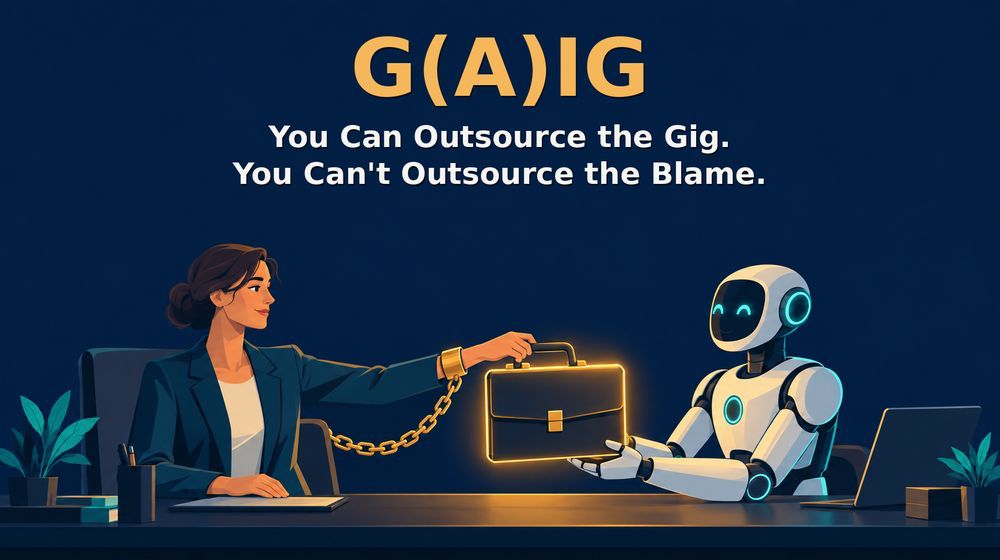
[Banner image: The work can change hands. The accountability stays with the human. AI-generated illustration.]
The ‘old’ gig economy asked a simple question: why add to headcount when you can hire someone for the job? The new one asks something more uncomfortable: why hire someone at all?
Welcome to the new G(A)IG Economy. The A stands for artificial, of course. But, as we delegate more work to machines, I’d suggest it should also stand for accountability.
The original appeal of the gig economy was flexibility. You needed a translator for a launch (e.g. ProZ.com), a designer for a presentation (e.g. Upwork), an extra pair of hands over the weekend (e.g. Taskrabbit), a chef for a home party (e.g. Take a Chef), or a specialist to create a new CX design for your business (e.g. Toptal). For almost any task, there was a temp service to be had. You didn’t necessarily need a permanent employee, with all the headaches that go into a full-time hire.
Now, however, the choice is becoming more interesting: hire a gig freelancer, subscribe to an AI tool, or hire a freelancer who knows how to get the best out of that tool. These are three different propositions. Caveat emptor: the cheapest-looking one isn’t necessarily the best business decision.
From an extra pair of hands to another subscription
Consider some familiar gigs that AI tools and agents can now help with:
- The translator. DeepL can produce a translated draft of your product sheet in a flash. But translating the joke that opens your keynote requires more than getting the words right. The language may travel; the humour (and figures of speech) may not.
- The graphic designer. Canva’s AI tools can help generate visuals and adapt content across formats. Useful when you need five versions by lunchtime. A different challenge when the brief is: “We look like everybody else. Can you fix that?”
- The customer service contractor. Salesforce’s recently acquired Fin can handle customer conversations using support content. But answering a question about your returns policy isn’t the same as rebuilding a relationship with someone who feels let down.

The distinction I find useful is whether we’re buying an output or entrusting “someone” with an outcome. A translated page is an output. Persuading a reader in another culture to trust you is an outcome.
As outputs become easier to produce, knowing whether they achieved anything becomes more important. For starters, were the intended outcomes clearly delineated and expressed in the brief? Some of the biggest issues come from a lack of clarity at the outset. Clarity, I should add, is something I consider a key trait of an empathic leader.
Cheap isn’t the same as profitable
Let’s put some money on the table. Salesforce lists Fin at US$0.99 per billable outcome, with a minimum commitment. At that unit rate, 1,000 billable outcomes amount to $990, before your own operating costs and any separately purchased helpdesk seats or add-ons. Fin says there are no separate platform, setup or integration fees for use with an existing helpdesk. Attractive? Potentially. But a vendor’s definition of an outcome isn’t necessarily your definition of a satisfied customer.
For the P&L, the subscription or usage bill is only the beginning. I’d include integration, training, data preparation, human supervision, quality checks and rework: a fully loaded cost basis. I’d also examine what happens when the service fails. Compare the all-in cost per genuinely successful task, not simply the price per generated answer.
And please, let’s stop automatically calling hours saved “profit.” They create capacity. Whether that capacity becomes a financial benefit depends on what you do with it. I don’t know about you, but for all the hours ‘saved’, I still feel very busy. If your team saves ten hours and spends them correcting other machine-generated material, you haven’t transformed the business. You’ve rearranged the furniture.
The more interesting question is whether AI helps generate value: better service, stronger customer retention, faster product launches or sales you otherwise couldn’t have handled. Measure incremental margin (outcomes) where you can, not just activity or headline revenue.
Will the bargain last?
There are reasons to expect continued price pressure. Stanford’s 2025 AI Index reported that the cost of querying a model at GPT-3.5-level performance on the MMLU benchmark fell more than 280-fold between November 2022 and October 2024. But cheaper underlying computation doesn’t guarantee a perpetually cheaper bill for your business. Nor does it necessarily mean better outcomes.
Competition could keep basic capabilities affordable. Alternatively, dependence on a small number of mammoth providers could give them room to raise prices. Neither conclusion is inevitable.
My practical test would be to model the economics at a multiple (e.g. 2x or 3x) of today’s price. Then ask: how difficult would it be to leave? Cheap entry can become expensive dependence when your workflows, data connections and team habits are built around one supplier. I know that, for me, over the course of the last four-plus weeks with Tab, Instinct and Pally (to name my suite of helpers), I have become more or less obsessed by the potential. When any one of them goes offline, all of a sudden, I almost feel abandoned, if not naked. And that is an embodied feeling!
Compared with which human?
As with psychedelics, we (society) tend to hold AI up to higher standards than those to which we hold ourselves. Obviously, nothing (AI nor psychedelics) is ever perfect. Then again, nor are we! How can it copy us or be better than us when all the data comes from us?
I’ve been particularly interested in the humanisation of AI. Is it a good thing? Is it possible? What if… it went wrong? What if it went rogue and took over, many ask? Yet, the same questions should be asked about ourselves. What if we went wrong? What if we stopped believing in one another, in community, or in the beauty of imperfection? Before getting too sanctimonious about AI slop, let’s acknowledge the human variety: human slop!
People misunderstand briefs, miss deadlines, introduce errors and produce forgettable work. If you’ve heard of FIFO (it’s an accounting term: first in, first out), you might not have heard of SISO: Sh*t In = Sh*t Out. If the initial brief is wrong, fed with bad or fuzzy information, it’s only normal to get a poor output. Comparing an average AI output with an imaginary, permanently attentive, perfect human expert tells us very little. The latter is patently unrealistic.
Test humans, AI and AI-assisted humans on comparable assignments. Assess quality, speed, total cost and the consequences of mistakes. Include the work needed to detect and correct them.
The question isn’t whether AI makes errors. It’s which arrangement produces acceptable results, with manageable risks, at which cost. Automation deserves particular scrutiny because a flawed instruction or unreliable source can affect repeated outputs before anyone intervenes. I can barely predict what’s to happen in two years’ time, but for now, my firm marching orders are: keep responsibility for whatever is published under your name.
Assemble a team, not a tool collection

That raises another question: what should your AI workforce look like?
Is it better to have all your eggs in one basket or spread yourself among many agents? One assistant offers simplicity and consistency. Specialist AI agents may perform particular tasks better. A sprawling collection, however, risks becoming the digital equivalent of a department whose members never speak to one another. We like to use the expression in French: une usine à gaz. If the AIs don’t talk to one another, aren’t coherent or consistent with one another, or lack a clear definition of their roles, it’s bound to go wrong… quickly.
I’d start with a general AI assistant and add specialists where testing demonstrates a meaningful advantage. Give them shared, approved sources, clear house rules and defined permissions. Ideally, even, you’ll bring them on board with your purpose and business strategy. It’s amazing how important and useful it is to explain to your AI assistant the context and desired outcomes. Yet, so few of us take the time… even with our own human teams.
Then, in a second phase, design the relationships. What are the core values you want to uphold throughout the network? Who briefs whom? What information passes between systems? Who resolves conflicting answers? When does an agent stop and ask a person? Who, ultimately, is responsible for the results?
A polished handoff isn’t proof of a sound conclusion. The receiving human, or agent, needs to know what was checked, what remains uncertain and what authority comes with the recommendation. Clear oversight and governance matter more than the number of assistants on your subscription list.
When the gig grows wheels
This story doesn’t stop at the laptop. Uber riders in Austin and Atlanta can already be matched with a driverless Waymo. In select cities, Uber Eats uses delivery robots alongside human couriers. Elsewhere, including in China and Japan, robots are taking on more tasks traditionally done by humans, although the scope and pace vary by industry and country.
The physical gig is up for automation too. That raises questions beyond convenience: what does this mean for the workforce, especially the younger generations entering it?
The G(A)IG economy doesn’t make the work disappear. A robotaxi still needs cleaning, charging and maintenance. Restaurants need to be conceived and built. Art needs imagination. Important clients want the human touch. The work shifts, as does who gets paid for it. And for the driver who could log on for a few hours between other commitments, a job at a fleet depot isn’t necessarily an equivalent trade.
I’m happy to let a machine resize an image or bring me lunch. What I’m less happy to outsource is the decision about when a person matters. Before handing off a gig, I’d ask: if this goes wrong, who notices, who puts it right, and who answers to the customer?
At the end of the day, now is not a time to hold ideas with dogmatic rigidity. We must hold our beliefs lightly, keep experimenting, try new courses and concepts and, taking inspiration from Brian Solis and Dave Wright’s new book “Infinite,” allow for infinite variety in our approaches to business.
The accountability stays with us
Before automating a gig, name the human who owns the result. Give that person the information and authority to stop the system, investigate failures and arrange redress. Make escalation usable for the customer, not merely visible in a policy document. These are practical expressions of human oversight, not optional finishing touches. We can delegate execution. We shouldn’t confuse that with delegating responsibility.
“The AI did it” may explain the mechanism. It doesn’t answer the customer.
The first gig economy made it easier to hire someone without creating a permanent role. G(A)IG makes it possible to complete some jobs without hiring someone at all. But it is and should not be the end-all.
Neither arrangement lets the business off the hook or guarantees the best outcome. I suggest that the bigger work is to understand better who you are (as a person and a business), what you stand for, where you want to get to and why that’s important to you. In this manner, whether you’re briefing an AI, a gig worker or a gig worker enhanced with AI, you’ll be more keenly focussed on the desired outcome. Understanding the costs and risks of using your AI is, I argue, a very important work in progress.
How do you react to this concept of the G(A)IG economy? Where are you in your journey? What questions are you asking?
Further resources
- Check out di9‘s directory of AI tools by category. Its popularity ranking is based on reader votes.
- Aimytool describes its directory as human-reviewed, clearly categorised and structured for the next generation of agents. Find out more: Aimytool.
- 10 Best AI Agents for Customer Service in 2026: take this vendor-written comparison with a pinch of salt. It is published on Fin’s own site and puts Fin first. Imagine that? Check out the comparison: Fin.