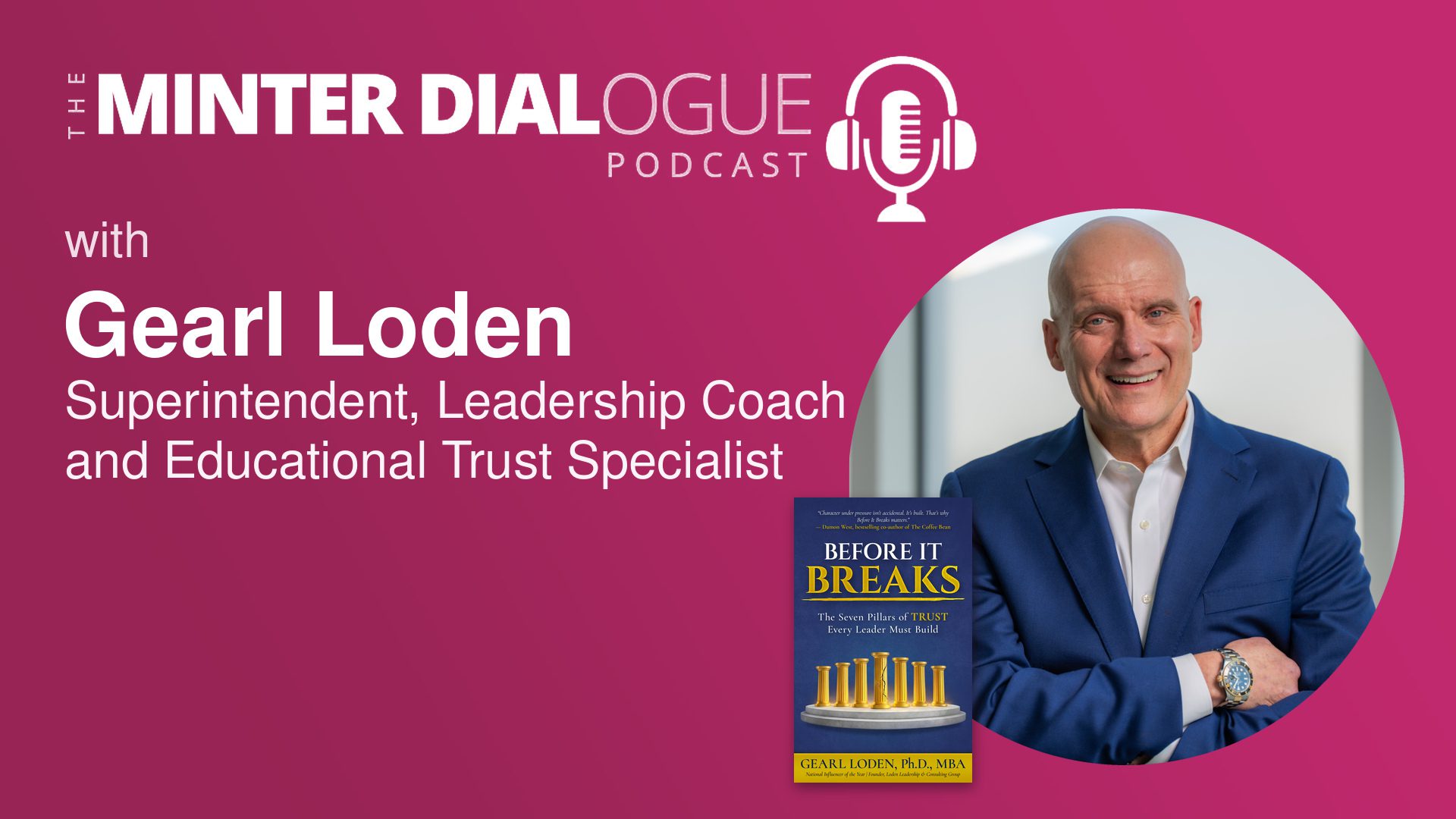
In this episode, I sit down with Gearl Loden, a seasoned superintendent and leadership coach from Missouri with over 30 years of experience. We discuss the role of imperfection in leadership, the crucial importance of self-awareness, and the evolving landscape of education as it prepares students for a fast-changing, technology-driven world. Gearl shares his practical frameworks for building trust, cultivating essential soft skills, and fostering resilient teams—whether in schools or organizations. If you care about leadership that’s grounded in purpose, adaptability, and genuine connection, this conversation will give you a fresh perspective and plenty of actionable takeaways. Let’s get started.
- Find someone who will tell you what you don’t want to hear. Gearl talks about making time to reflect and working with mentors and coaches who ask good questions rather than rushing to solve the problem for you.
- Give people a place to practise working together. As technology changes what students need to know, Gearl makes the case for clubs, sport and project-based work: places where young people can take initiative, delegate and learn what it feels like to be responsible to a team.
- Pay attention to the conversations that aren’t happening. In a school district, families, staff and the wider community are all watching how leaders behave. Gearl looks for small changes in behaviour and unresolved friction, and asks what is going on before assuming he knows the answer.
- Use the seven pillars to work out where to start. The pillars are character, consistency, communication, competence, care, clarity and courage. A team might score well overall and still have a weak spot; what needs attention can change as the team changes.
- Give a misunderstanding 72 hours, not 90 days. Gearl suggests taking a day to cool down, then making time for a direct conversation within 72 hours. Rebuilding trust across a team is a longer job: work on one weak pillar at a time and use feedback to check whether things are improving.
How to get in touch with Gearl Loden
- Loden Leadership & Consulting
- Gearl’s Nixa Public Schools profile
- Before It Breaks: The Seven Pillars of Trust Every Leader Must Build
- The Loden Trust Index (free seven-pillar assessment)
Chapters in the episode
Times are on the finished episode video.
- 00:00 Introduction
- 01:03 Meet Gearl Loden
- 02:36 Imperfection and self-awareness in leadership
- 11:26 Can schools teach attitude and teamwork?
- 15:20 What is school for when the future is uncertain?
- 24:37 Building trust under public scrutiny
- 27:19 How to spot trust beginning to break down
- 29:22 The seven pillars of trust
- 34:38 What gives a school its own identity?
- 45:21 The 72-hour repair and 90-day trust build
- 50:21 Before It Breaks and where to find Gearl
Full interview transcript
Times are on the finished episode video. The transcript has been lightly edited for readability.
Minter Dial Gearl Loden, I am excited to have you on the podcast. As usual, I like to try to find people with different experiences, backgrounds, doing different things. And your experience as a superintendent really struck, caught my attention. So in your own words, Gearl, who are you?
Gearl Loden Minter, first of all, I am so excited about being on your podcast today. And of course, asking who is Gearl Loden? I like to call myself an imperfect leader, someone that has been in the field of leadership for over 30 years. And I’ve got to see a lot, but I’m also curious and constantly learning. And not just being a person that learns and studies, but learns and takes action, is always evolving, always trying to push my boundaries in a way where you have calculated risk. I’m a person that cares about developing others and pointing to other leaders and trying to have a network, not just in the States, but a global network of people that are leaders in education and out where you can support each other and learn as you know, the world is as fast as it’s ever been, it’s going to get more faster, more complex.
And I look at it like in my generation, when I was a young teacher, and the internet was coming through, and we’re like, what is the internet? Today, our young people and all of us, we’re at the primitive stages of AI and automation with robots, and we’re going to see some amazing changes. So I love what I do, love being in a leadership role, supporting others, and then coaching and supporting leaders outside of education.
Minter Dial Wunderbar. I would also like to add that you come from Missouri, that’s where you live anyway. And that for those who don’t know where the accent is from, and so you mentioned this imperfection, and that strikes me, you wrote at one point, you say, well, I know that leader, I was one, as in the person you didn’t want to be, or the person who’s bad at leadership. To what extent do you actually believe that imperfection is the key to becoming a good leader or understanding your imperfection, perhaps?
Gearl Loden I think, you know, the research says that most people will say like 95% of people will say they’re self aware, but only about 15% are really self aware. And that’s something I’ve really been working on over the years is trying to be more aware of, you know, where I pause, where I slow down, where I have fears. And what I’ve learned is I’ve evolved, I always have boundaries, I can lean into discomfort, I can grow, but once I go to another level, then there’s still boundaries, there’s still fears and doubts. So not being afraid to fail. You know, being an educator, you look at the research, and I never told my sons this per se until they got older, but you know, your millionaires are C students, and more millionaires are C students than A students.
And often that goes back to, you know, they’re able to focus in on what matters, but they’re not afraid to fail, they can make the main thing the main thing. So as a leader, some of it is I’ve learned the hard way. And like early on, you would read books about people want to be like them. Well, I learned I need to be Gearl Loden, not someone else. And to just being reflective. I love the fact that today we have more mentoring and coaching than ever before, because in education field, I was in the early generation where you were given an old book and chalkboard and told to teach. And then when you got into administration, if you had a mentor, you were finding them on your own, even you didn’t have coaching like you have today. So we’re really blessed with some tools and resources today that around 30-35 years ago.
Minter Dial So you don’t want to lean into this idea of self-awareness, because like you say, pretty much everyone thinks that they’re self-aware, but only 10 to 15%, I guess, Tasha Eurich, who I did research on this, who are nominally properly aware, knowing that at the end of the day, it’s unlikely that we’re ever fully aware. So what kind of advice do you have to people who think that they’re aware, or not even aware that they’re not aware of their imperfections or not aware of the fact that they don’t really know themselves? How do you navigate that when you’re dealing with somebody in front of you who says, well, I know everything kind of thing, or you can bring things off that vibe?
Gearl Loden Minter, the sad part is when someone has that kind of ego, often you’re not going to get through to them unless they have an event or something that shakes them up. But your people that are real learners, not just reading books, but learning and taking action, they’re going to make sure they have good mentors. They’re going to have people that are telling what maybe they don’t want to hear, but they need to hear. Just finding time to quieten the world and get off social media and just have time to reflect and having some good rituals, either at the morning or afternoon or night, where you can reflect and think about where you’re at and where you’re successful, where you’re in the direction you need to go.
I’ve only had a coach for a handful of years and talk about transforming me, just having a coach that can sit with you and give you the space. And I’ve had some great mentors that have been very similar. They haven’t had the official training, but just people that can ask the questions and they’re not trying to solve the problems for you, but to help you just reflect and get things out and be vulnerable with so you can trust, very important. So I don’t know if I really answered your question because if someone is, they have high ego, high confidence, sometimes they don’t open it up like others.
Minter Dial It’s certainly been my observation that it takes a life-changing experience to actually wake up to what’s important. Otherwise, we tend to take on the external signals, show how big my house is, the title of my car, the size of my car, and all this thing. And then we lose track of what’s actually important. And probably more important, we lose track of who we are as individuals.
Gearl Loden That is so true. And when I spoke to groups, often like one time I had like 13 people to sign up for a one-on-one afterwards. And I think what happens is business leaders and one connection is we’re all born with a purpose of certain DNA. And we have things that happen to us, especially when we’re younger, that we process as trauma that you and I would say is not traumatic, but you are not able to process it because you have the executive functioning. Well, as you go through life, you have all the different parts that help to protect you or compensate. And then in the real world, here you are, you may be 35 years of age, you have the yacht, you have the home, you have the job.
But when you’re quiet, you realize, I’m not really the person I need to be, or am I really making a difference, or am I happy with what I’m doing? And I think I really need to do something else to be connected to my purpose. And of course, that can be very scary because if you start going through a process to change, that may mean losing some friends or changing your lifestyle. But when people do that, they make that midlife crisis or that midlife change, and they work through it, and they’re connected to the purpose. It all works out. It really does.
Minter Dial This idea of self-introspection, I was listening to a podcast [unclear] with Marc Andreessen, but he was quoted and has been famous for saying self-introspection is a disaster for a leader. Just move forward, forget the past. To what extent when you are, so you are the superintendent of a number of schools in your area. So you’re in constant interaction with the new generation. You talked about mentors and having people who can help you through. I wonder to what extent those, the Mark Andreessen’s Peter Thiels, Elon Musks of the world are influencing, quote unquote, virtually mentoring your students. Because it seems so glitzy, transhumanism. Oh, it’s amazing. I can do anything. No limits.
Talk us through your experience of how you’re, to what extent in your filtering that kind of approach to life and how much the Silicon Valley is impacting your students.
Gearl Loden I believe we have a core group, of course, that are that entrepreneurial type of kid. It’s very techie that they’re following the Elon’s of the world. And I don’t think they see all the hard work that goes on in the fact that Elon sleeps on a mattress on the floor and works like 80, 90, 100 hours a week. And it looks good. Kind of like singers, rappers, and NFL football players, but they don’t realize all the work. Well, now it’s nice when you can see someone’s been hired by open AI and pay $20 million. But you have a special skill set and it takes lots of time to develop that skill set.
So we try to expose our kids to the fact that the world’s going to be very fast paced. It’s going to change entire fields will disappear, but new innovative jobs will be created. So we do want to have the content knowledge, but also the soft skills happen, empathy, grit, determination, and working with others, just the things that play a nice in the sandbox. And in our area, we have our local economic development group and our chamber. We’ve met with their leaders a few different times and talks about what do employers say. And when I talked to employers, they kind of shifted years ago, sounded like they wanted every skill. Now they’re like, we want people to be trained that work with others that come prepared that are willing to work and work with others, especially.
And with global teams where you’re running teams, like in my book, I talk about character, you want to have people character, but they don’t have to be like us for its character. They don’t have to be the same [unclear] background, go to the same church and whatever they, they can be so global, but you know, deep down, you can understand what makes them work too, what their values are. So you can align them to their purpose.
Minter Dial All right. So I’m trying to juggle in my mind, Gearl, the notion or the difference between skill and attitude to the extent that people are looking for a skill, a specific skill. I’m able to code in blah, blah, blah, or this amount of time, or I can do this. And then the other one is the attitude, the soft skills that you talk about, the ability to get along with people. It feels difficult to train because in your leadership model, you have the infrastructure idea, this leadership infrastructure that feels like it’s something you can train. What extent can you influence, if not train attitude?
Gearl Loden You can shape it, especially in like schools where you start off from the beginning to the end, you have them for 12, 13 years. We really focus in, we call it our portrait of an eagle, but we’ve backloaded with our community from what we like a student to graduate with. And it goes into grit, resilience, character, empathy, working with others. And we infuse that in all the way from kindergarten through 12th grade. And we don’t just talk it, but we also celebrate when we see kids doing that. At our high school, we have a program in our state where all of our kids can go to the local community college for free.
But part of that is volunteering hours, working in the community, mentoring other kids. So you have some things in place that kind of enforce to help another is working together. You know, we have some of the traditional environments where you have more traditional learning, then we try to have a lot of problem based scenarios where you’re working in teams. Because you know, they were complained about teams is there’s always someone doing more work than another one. But you see that though, when you have the above the line and below behavior, behavior as a leader, where you know, when you talk to leaders, do you have silos? Do you have teams that are sharing more than others teams that are, you know, trying to go around other teams, and they always nod their heads.
So it’s out there in the real world. And if we can do a better job of teaching that, if you have an educated person, they may have a four year degree, it may, you know, a lot of educators are not in education, but you hire them in business, you can pay them a lot more money. And you know, you can train them.
Minter Dial In France, where I was just recently, where I spent a lot of my time, I’ve long criticized it for being overly individualistic in the educational process. You get scored out of 20, it’s all about you. There’s no teamwork, there’s no group work. And, and yet, I wonder if, and there’s very little sports. I wonder if, if really sports is the most incredible, fertile ground for training people for the future.
Gearl Loden There’s some essence in that I would say in the states. If you look at the United States, the top 30 countries in the world, we have more children percentage wise in poverty than all the countries, but Greece, our demographics are different from what people would think. But when you look at how our kids do academically, they hold their own, but they’re not, they’re not a, you know, a [unclear] by no means, or Canada. But if you look at something as different as in the states, we pour a lot of dollars into clubs and activities, where if you want to be in a band, choir, theater, intramural sports, the regular sports, and the activities that you’re in, you’re experiencing leadership firsthand, you have the kids taking initiative, they have roles, especially at the high school level.
And they’re learning how to work with others are learning how to delegate how to take initiative. So I do believe that helps us a lot because that’s the world we live in. And we have to work in it.
Minter Dial If, if, if, how do you describe the role of a school? I mean, let’s, if I were to write it another way, what is education?
Gearl Loden The foundation, we originally started investing in schools because we believed in citizenship education, where we’re educating our future citizens and we’d like for our children to be productive. And to the states, we have some of this transgenerational friction where I’m older, I don’t want to pay for schools. Well, someone paid for you to have schools. Well, if you live in a rural area, people paying for you to have a road, you can’t afford to build a road. But the idea that citizens understand the importance of being productive, having jobs, not just jobs, having careers that yes, we want to be frugal or a taxes, but you want to know roads and bridges and healthcare and you have educated citizens and you have ways for people to upskill.
If you do have a downturn where they can, you know, go to school at a reasonable price and develop new skills so they can be productive. And the one thing I would wish we could all do a better job of education is just being very frank with the kids that education does not stop at the schools. And you’re going to be a lifelong learner and it’s important that you are constantly learning and finding things that you love to study. You know, I love learning. I love just finding new fields and going into studying like everything, just trying to learn. And that’s so important because that helps you to stay in tune with society and my field, trying to look at the economy and what’s happening in the future and research labs, attack AI, robotics, trying to make sure that we have a clear pathway so we can have our students on solid trajectory for a known future.
Minter Dial Well, I’m going to get into your work on leadership and the framework and everything. But still, I think this is relevant is to understand what is education because these are the people who are coming into the workforce. And we talked about resilience before. Is that something you can train? You said that education is beyond school, but I would actually argue it’s beyond school at the time of school, as in what is society doing? How are the parents participating in a collaborative mode with the school? And from the number of Instagram posts I get from teachers that I’m sure that their students aren’t looking at because it says things like, well, I got this parent that came in and screamed at me.
Why didn’t give my Johnny a B grade or an A grade as opposed to a B grade? And there seems to be kind of a breakdown or at least a lot of tension between what is education, what is the role of the school, and how does it interplay with society and with the home where a lot of things are being educated as well?
Gearl Loden When you look in most states, I believe in most countries, it’s going to be very similar from birth to 18 when most people graduate. Mentors are only spending about 10 to 12 percent of your time in school. So the vast majority of the time, you’re away from us. You’re at home, you know, what’s happening at home. It seems like there’s still countries out there that get it, that the home is very involved. You have other countries where it’s not as involved with education. But the parents, the influence you have at home, especially before you start getting to the middle grades where you have more peer pressure, you have so much control over what they learn at home and how much they focus on education and value it.
It’s almost like if you have education provided, you take it for granted and the places that don’t and people have to dig and pay for school, private schools, because they don’t have public schools, they appreciate it more.
Minter Dial Yeah, so you mentioned before this idea of hunger, the maybe the the C students that you talked about, the ones who got the C’s that succeed, they have a chip on the shoulder, or they focus on other things. They’re not just looking for the grade, they’re actually looking for what it takes to make happen. In England, I think we’ve got a big issue, which is we’ve created a school system where it’s just about doing what the exam wants you to do, as opposed to learning what it’s about. In education, for me, it should be about preparing for life, not preparing you to take an exam. And it feels like I don’t know how it is for you, but a lot of the teachers I speak to feel extremely under pressure in ways that they shouldn’t from parents and aren’t allowed to say what they should say.
I mean, there are schools that I don’t know how it is for you guys, but there are schools, one school in England, in London, that I was hearing about that says, you’re not allowed to say don’t run to a child, because it’s damaging to say don’t run in the corridor or whatever. They say you have to walk, please walk. So don’t is too dangerous. Please walk is the encouragement. How do you build resilience when it’s all about positive reinforcement all the time?
Gearl Loden Oh, goodness. Now, we’re not quite like that, thankfully. You have the balance. Yes, you want to have the content. You want to know you can take a test. That’s part of school. But also the being able to have independent projects, the working of others. A lot of your neurodivergent kids, the ones he would say are ADHD, you know, they’ll look at something and say, well, I’m never going to use that. And they’re not going to worry about it. And then when they find something to walk into is perfect, you know, they can hyper focus. They’ll challenge status quo, that’s going to be the ones that often are going to be your leaders, you know, there’s a correlation between leaders and being ADHD, or dyslexic.
And, you know, they’re used to being different, not being afraid to be called out. And, you know, if you’re different, you’re going to be treated at times, some people may not be as nice. But the world’s never going to be perfect. You don’t want to have bullying or harassment. But still, sometimes you just have to say things are different. And I’m going to be myself and be independent minded. But then also know when to fluke it off and play with a team too.
Minter Dial You know, it’s like the idea of the left handers. I spent a lot of time as a professional sportsman. Whenever I faced a left hander on a tennis court, it was problematic because it’s a different spin going a different way. And as we and the statistics bear out, that there are many more left handers that have succeeded, let’s say tennis. But because they’ve also, in my opinion, had to figure out a different approach, because rather than having a right handed coach teaching a right handed player, so you can sort of mirror easily, they have to transfer the right handed shot into my left handed shot. And that’s why you have so many more Mac and rows as left handers, as opposed to unorthodox right handers, because we’re all trained to go the same way.
So having the ADHD shouldn’t be considered an illness. It should be considered a superpower or the route to a superpower just like dyslexia. So the nuances, how do we deal with that and make it something that creates resilience as opposed to, oh, woe is me, here’s a tag, my issue, my medicine.
Gearl Loden Oh, it’s the best thing in the world. I mean, I’m a I was a student that before you had an official label for ADHD, or dyslexia, I was a student that showed up at school dyslexic ADHD, colorblind, you know, if I had an art project, people make fun of I didn’t really care for art, and left handed. So I was always the one that was real quirky about things. And now, my team now we appreciate each other and value each other. But they know we may have three conversations in two minutes. And we flow together. But my profile on work and genius is is perfect. I’m the one that can imagine a future that you can’t see.
I’m the one that can take the systems you have and tele reimagine them in a different way. And that’s where that’s where my purpose is. And that’s where I played well. Now, when it comes to all the little details, it’s like an auditor would have an accountant would have. That’s not my that’s not my playground.
Minter Dial Well, you know that that’s not your strengths. So you hire for that. So I actually touched on the left-hander in you I mean, you’re you’re perfectly imperfect.
Gearl Loden And so that’s the way I mean, in school, I never really fit in. I mean, I had friends and I fit in that way. But as far as the learning, I always would learn different ways and was very smart. But by the traditional methods, I would have to do things different ways. You know, diagram in a sentence was not something I was going to be able to do, but I could still learn how to write.
Minter Dial Yeah, here’s to the misfits. So you have led in public education, and you now coach organizational leaders. I’ve always been interested in the difference between leading in a charity, leading in an educational facility that has more sort of purpose led, obviously built into it, versus leading in a team or sports team versus leading in a business environment. And trust is one of the foundational things that you you talk about and write about. What does leading a school district teach you about earning trust from people who can’t easily or necessarily choose their situation or different institution? How do you develop trust differently? Or what what insights do you have about developing trust with your organizations in your world? That could be useful for us working out in a business world.
Gearl Loden I would say the two institutions in the states, which I think will be the same in Europe, that are probably in most political are going to be churches and schools. And most people have attended a church and been to school, and they can tell you how they would how they fix it. You know, I’m not going to tell you, hey, you need to fix this L’Oréal. I’m not I mean, or you know, I’m not going to tell the local insurance agent what to do. But when you have people’s dollars and their kids, they can be very passionate about that. You’re paying taxes for schools, my child goes to school, my grandchild goes to the school.
So you have to build trust with your community. You have your teachers that are under a lot of pressure, and often it’s more self imposed, where they have such high expectations and more perfection. And then there’s the politicians, and then you have budgets where you’re really always dependent upon the state and your local community, as far as taxes. So you have a lot of things at play. And your people really are almost like volunteers, because typically, in your schools, you might go somewhere make a $5,000 more, but it’s not like someone’s going to recruit you away and pay big bucks. So the culture is so important. And when it comes to trust, you can walk into an organization and be around it for a little while, and you can say, they have a high level trust, it feels like, or there’s something off.
But the goal of my reflections over the years has been, how can you put a system in place to help you to cultivate trust on a daily basis and keep the momentum going in a positive way. And I’ve been the leader that’s walked into really good organizations, we’re on the outside, everything looked good, and you realize inside, you had some internal issues in different areas with trust. And you’ve had to be enforced, reestablishing trust and building it. And I’ve walked into organizations where you’re the turnaround person, and it’s just totally trust is fractured. So once you go through the steps, and you get things going in the right way, then how can you monitor trust?
How can you keep tabs on trust? And I just assume it’s good, I feel like it’s good, but make sure you’re checking in and looking for little habits or signals that could really change over a short period of time into something that’s major. And Minter, what I’ve learned is, you think of Enron and this big explosion where they’ve happened, it usually starts with just some difficult conversations that need to take place that don’t. Maybe there’s some friction. And mentally, you start thinking, oh, was something’s off with you? Or is he looking for a job? Or is he just not happy? And we never talk. And then it builds up over time, you realize there are some things that are happening, and I start feeling that there’s a vibe that Minter maybe doesn’t like me.
Is my evaluation going to be good. And it builds to where you have an explosion. And as a leader, I want to fix it right there and get the people to sit down, but I’ve realized we’ve got to go back to the root cause, which usually is going to be things that have been building over time. And as a leader, you know, I used to sit down with people in my mind, I would know what was wrong. And then after I realized I just needed to pause and give them space. Majority of the time, what I thought was wrong was not. It was something totally different. It may be that Minter’s going through some difficult times at home, wife’s got cancer and just hasn’t told everyone yet. And he’s just had a health issue himself. And he’s got a lot of things going on. It just needs some support.
Minter Dial Well, the issue with that, of course, and I live through that personally, is that as soon as I tell the big boss, Hey, I’m sick, that can sound like a weakness, if not a vulnerability and oh gosh, well, he’s not going to be around for much longer. We need somebody else to fix that, that role, who’s going to take care of my big client now, because he was great at that, but he’s now sick. So, you know, or, you know, pregnant another one, these issues come up. And so jumping around a little bit, but in your framework, you have these seven different qualities that you look for, and they all begin with a C.
And I can’t help but say that you’ve spoken about cultivation and culture a lot, but that’s not one of the seven pillars that you have. And the seven, I’m going to name them so you don’t have to. It’s hard. I’m going to read them off the screen because I can never remember when [unclear]: character, consistency, communication, competence, care, clarity, and courage. And I totally vibe with your seven here. The question for you, I was going to try to provoke, which is, are they mutually reinforcing or can one become stronger at another’s expense?
Gearl Loden They, of course, you want them to all be together and all strong, but I tell people I’ve got people using these with their teams. And I’ll tell them you could be [unclear] some of the people, but when your team does the study and does the trust audit, you’re still going to have a pillar or pillar or two that stand out and at different times of your journey, they’re going to be different. Like, for example, what you just gave with the boss. Someone says, Hey, I have [unclear]. I’m going to have to go through treatment. The team is watching the boss. They’re watching the leader. If you tell Gearl, Gearl, we’re, you know, we’ve got your time.
We’re going to be with you. We’ve got people can help pick up the slack. You take care of yourself and get well. We need your knowledge. You’re sending signals to the team that you care. You’re sending the signals that you have a healthy organization. Well, if someone’s trying to poach me away and recruit me and I realize when talking to people that maybe they don’t have that type of culture of why would I leave when I know that I’ve been here 15 years and I’m an organization that really values me. At the same time, if someone says they’re pregnant or they have cancer and, you know, they’re being demoted or next thing, you know, they don’t have a job when they come back after this treatment, that sends a different type of signal and that takes away from the care and there are organizations that are both ways.
And, you know, there’s pressure to make your numbers and all, but sometimes having the right processes in and the beliefs in that you take care of people is going to help you to recruit and maintain the people you have and then recruit people when you do have someone retired or leaving for another position.
Minter Dial Indeed. And so my specifics just to be up front on that was I developed type 1 diabetes and I went and secretly treated myself. I told nobody at work because it was very clear in the environment in which I was working and the boss for whom I reported to into whom I reported that I would be struck off immediately as a result. And that meant that there was no trust, there was no respect. That’s the way I looked at it. And that’s one of my big learnings was learning how to find ways not to allow for everyone to moan and groan, but to have the ability to have the more difficult conversations. And I suppose in your framework, communication and courage, they kind of combine in that mode.
Gearl Loden Oh, yes. The two anchors, the first pillar is character. And that goes back to having people that have a value system. You don’t have to have the same value system you have belief system because when you’re working with international teams or people from different cultures, but having at least a value system that as a leader, you can understand where someone’s coming from and know that when they’re under pressure, they’re going to make ethical decisions and moral decisions. They’re going to follow the policies and procedures. If there needs to be an exception, they’re going to talk to you about the exception they feel like it’s needed. And the last one I really call it an anchor pillar too is courage because you can know everything and feel like you know what you need to do, but do you have the courage to do it?
Kind of going back to the attendance factor, if you take care of your people who’ve been with you when they have illness, when they have a crisis, but that doesn’t mean that you don’t have the courage to have difficult conversations with people that if you give them 50 day or not 50, but 20 days a year and they take 35 for no reason and you can’t figure it out because you’re good employees are watching that too. And they’re like, okay, if Johnny can get away with all this, then that’s not right. And what are they going to do about it?
Minter Dial Favoritism, nepotism, unfairness, or just
Gearl Loden Being soft, you know, you want to know that you maintain a healthy culture and a healthy culture is having that brisk business like environment where you have a healthy amount of stress where you know what you need to do and you’re getting it done where you don’t have anxiety or apathy either.
Minter Dial So another area of deep interest for me, and I’ve written about this extensively, is the nature of branding in education. So obviously I worked in commercial brands and you’re selling products that are being on the shelves of Walmart or whatever. It’s one type of brand and you have a 30 second spot, you know, in a thing called television, which used to exist. I jest, but branding is a generally noted commercial concept. And then I’ve been writing recently about branding of sports teams. My mom lives in Philadelphia and I’ve always supported the Philadelphia team. So sorry about that, Missouri people. So what is the brand of the Philadelphia universities? And typically the brands of universities are better known.
They’re more global somehow. And yet they all kind of say, well, we’ve been around for such and such a time. We have a Latin motto XYZ, Luke’s this and that. And what is the brand of these universities? Putting that aside, how do you approach brand for high schools and your schools that you’re dealing with? Is there such a thing? And how do you promulgate different brands, even though you’re running 10 different schools?
Gearl Loden That is a very good question. In our schools, we were one of the first to actually have a marketing person. We had an English teacher, they had a passion that started out part-time and now we actually have a team. And we talk a lot about purple cows. What can we be remarkable at? We’re in an area.
Minter Dial Seth Godin.
Gearl Loden Oh, yes. He’s a remarkable writer. And we’re in an area though, where we have communities around us to have more manufacturing or commercial property because of the interstate highways. And we have received a lot of people in our community from outside the Springfield Metro. But we’re in the bottom 15% in our district as far as what we spend compared to other school districts in the state of Missouri. Academically, we have been in the top 1% in the state for like the last four years.
Minter Dial Congratulations.
Gearl Loden Oh, we’re very blessed athletically, where the average high school have about 3% of their kiddos to get a college scholarship, we have about 10%. So academically, we’re strong, our graduation rate is 99.3%, which is very rare when you have a larger high school graduates close to 500 kids. But we look at things that we can do that are different that have, you know, you just stand out like on our football field, you know, soccer field, football field, we have great turf. We’ve had some great projects where communities helped us to renovate buildings, and you just, you don’t go crazy, but you try to do little things. So if someone’s looking on the internet or come and visit, they’ll go, this is different.
This is where I want my daughter to be. Like wrestling is in your store for girls, and we’ve one state two years in a row, and we’re one point away from winning it three years in a row. But a lot of hours is just asking our kiddos, what, what do you want? What do we not have? We especially look at the 20% that are not as involved in vampire theater, sports or clubs, and are always trying to add new things. But our best advocates are going to be word of mouth customers, people who already have when someone gets on Facebook and says we’re looking at moving, what are the schools like, in the world we live in, you always have someone says something snarky, then the parents come in and they start telling all the good things.
And just making sure we communicate with our employees, what’s what’s special, like with our portrait of an eagle that we mentioned, we have our tenants that we develop of a community group of about 100 people. And each school has the logo and attendance, but each one does their own thing differently. And then we work in professional learning teams, which would be like the old quality circle from TQM, where the teachers talk and share together across the district, what they’re doing in their portrait of an eagle work. And then when someone has a great idea, you know, others still add idea and they tweak it and make it their own. So we want to know that in our schools, we have a system where a child goes from one school to another school, they’re similar, but then still they have their own flavor. They have their own little slogans, logos, and they do things their own way. But branding is very important.
Minter Dial The challenge, of course, outside of the fact that, you know, maybe money is not the bit, you know, there’s not so much financing and stuff like that, is figuring out how to hold a strong line as well as please your customers. Where you might have, like everybody has been to school, so everyone thinks that they know what education is, like you said at the very beginning. So how do you balance having a backbone, a strong statement, you know, standing by values with dealing with, oh, well, my Johnny deserves an A, or why don’t we have caviar for lunch, or whatever, the different types of demands that you and your teachers inevitably are facing, because I deserve more. I am the most important person in the world.
Gearl Loden You have some of that, but the vast majority of our parents are not that way, thankfully. Now, just like two or three kids can really make you take a look for a lot of your time. But a lot of it is just communicating. We have a strategic plan that we actually monitor. I mean, it’s not a, we didn’t pay professionals to make it. It’s on a shelf. We’re looking at it multiple times a year, updating our board around it. And like, if you’re calling with all these great ideas, but they don’t align with the plan, I’ll tell you, Minter, I’ve got Dave, who’s over the plan. We’re going to be revising the plan in a couple of years.
We’re going to put your name on the list. And we always make sure they’re contacted, but we also let them know when we’re having updates, so you can kind of see what we’re doing, what we’re working on. Now we try to use good common sense too, because we can have the best plans in the world. And there’s things that are not perfect exceptions you need to make. So we make notes. My principals make notes all year, things they’d like to tweak in the handbook. And then we’ll go to our board and say, Hey, we’ve had parents saying this, we feel like we need to make some adjustments. Or if it’s something really big, we may make a midyear where you can have a reset port.
And you’ve talked about like the teachers in the UK and the parents, we actually put a protocol in a few years ago, we just call it our upset parent protocol, where if you’re, if you’re blasting a teacher and saying horrible things, the principal is going to warn them, you can’t be doing this, we’ll set up a medium, you’re not going to be using, threatening the teacher, putting profanity in an email. Well, if you don’t stop, then we’ll actually ban you from communicating with the principal and the teacher about setting up a meeting. So you have to have a meeting you have to come because we’re not going to have many veteran teachers not getting paid to deal with that.
But a young teacher is new to the profession that you know, they’re they’re they’ll worry about it, they’ll lose sleepover. And we want our teachers to be protected. And teachers make mistakes. If you make a mistake, we’ll go behind the scenes and say, mentor, don’t do that again. Now, what can we do the next time to get you to walk through what you’ll do? But I mean, we have such great teachers and teachers are they’re human. And they don’t need to, you don’t have to praise them all day, every day, they didn’t want to hear good things like I’m doing a good job, they want to know if I know I can feel I’m making a difference and see the kids learning and progressing. I don’t mind working hard for that, because that’s why I’m in the profession.
Minter Dial But I, I’ve read, I read an article about 20 years ago, saying, teaching is one of the most thankless jobs you ever get. Because you get these roll through, roll through, roll through and they go do their lives. And you never know actually what happens. And so I, I, I wrote an encouragement that everyone should go back and thank the teachers that absolutely change their lives. Write them a handwritten letter and say, dear John, you know, 20 years ago, I was your student. I was a, a Gorky, probably not a great person. You know, it wasn’t perfect, but boy, did you think, you know, you did something for me. Go back and thank teachers because it is such an important role undervalued.
And yet I feel that it’s tragic that we, and you see it everywhere in all sorts of areas, customer service, you go into any store, don’t treat our staff badly. How is it that we’ve come to a point that we need to tell people to behave?
Gearl Loden Society has changed, you know, and you got into Asian countries, you know, the teachers are revving, they go to the front of the line when you hear teacher and you’ve got countries that the teachers have paid, you know, very, very well, where they value education in a different way. But what you just said makes all the difference in the world though. Do you remember Fast Times at Ridgemont High?
Minter Dial I’ve seen. Yes. My wife loved that.
Gearl Loden I had a kid that was like Sean Penn, the skateboarding guy and I’m a teacher and he has long hair and you know, he could have cared less about school by connecting with him. You encouraged him. Well, like 15 years later, he sends me an email that he’s been teaching. Now he’s about to be an assistant principal and he’s working on his doctorate. And the last time I checked in on him, he’s up at Syracuse. He’s got a doctorate working at Syracuse University. So I’m originally from the deep South. So you’re going from Tupelo, Mississippi to Syracuse. That is so cool. And the fact that he gave an IC email and told me, said, I would not be a teacher in school administration if it wasn’t for you.
And I’ve done that with some of the teachers that really connected with me with my mom being sick and having cancer and things when I was in school. I had some that could have cared less, I had others that really connected. And this gentleman, I was at his home a few months ago and he’s in his seventies now. He just, he’s so proud of me. He’s like, Oh, you did so well. I’m like, no, you, you value me. You’re the reason I did well in life. Teachers make such a difference in life.
Minter Dial So call out to anybody who’s listening and you have a teacher in your mind, go and find a way to thank them, find their address, send them a small message. It’ll mean the world to them. I want to finish because I did have a ton of other questions, but in your book, you talk about a 72 hour repair protocol as well as a 90 day trust build. So it kind of, they have two different time zones. So if you take a leader who is inherited a distrustful organization, then makes an early mistake. What belongs in the first 72 hours? And what requires the full 90 days?
Gearl Loden For the day to day, where you feel like something’s off. You’ve had a team meeting and someone’s not, not in character is [unclear], or the last few minutes they’re off. That is going to be more than 72 hour protocol, or maybe we’re not perfect. We can, we can say we have character, we have values, but you’re immediate and you’re in your zone and you say something and you realize after the fact, it’s not really aligned the way I framed it. I should have said it a different way because I know you speak and I know you never do this, but I do this. I can have the best plans to get up on the stage.
And I’m like, I didn’t say something I needed to, but I added two things and I don’t even know how you just, it just came out.
Minter Dial It does.
Gearl Loden So there’s times where maybe the way you phrase something and one of your lieutenants to come to you and say, I don’t think you were clear because someone were thinking you meant something different. That’s appropriate for the 72 hour protocol. I think the world would be a lot better place. And I’ve told this to our teachers here when I’ve had some trainings with them. If people, when they feel like things are off, would not immediately get worked up, but calm down for about 24 hours and just think through. And then within the next 48 to 72 hours, just sit down and talk. And don’t assume anything, just create space and talk.
That would help you on the front lines where your teams are performing. That would help you with the leadership team, having a leader where you can be not afraid of them and they’re vulnerable. They want you to come into aid when you feel like something’s off. That helps you because the communication is a major issue for every organization. You can go in any company and leave saying you’ve got a communication issue, the clarity. You can work with your team on making sure the message is clear. And then still there are people going in different directions or pausing or they’re asking, like on Facebook, they’re going to ask people on Facebook about the schools instead of calling the schools.
So the 72 hours, really good. The longer when you’ve had, like if you’re going into a new organization and you realize there are some pillars that are off, that can help you to focus on one at a time. I would say that you could do more than one at a time if you had a coach or someone really helping you, but most people would say, well, I can handle it. The next thing you know, they’re working on three. So I’d say just, if you look at the book, look at the protocol, work one pillar at a time, and we’re human. So like when I’m saying the 72 hour protocol, that’s a good parameter or like a 90 day protocol.
But if you’re evaluating along the 90 days and you feel like at day 70, you’ve got the right things in place and you want to start working on another pillar, that’s fine. I do have a free trust audit that’s available that you can use on your own. And I’ve had people to take it and use it with their teams. And that’s interesting because the leaders I work with when their team, just like anything else, when your team is giving you feedback, it’s not going to be perfect feedback and you’re going to see some things that you need to work on. But when you have your team to evaluate you as the CEO, and then your leaders around you on your C-suite are having their teams to evaluate them, that really helps for a lot of growth.
And it opens up trust because people are giving you feedback and they’re seeing you work in a knowledge or some pillars that you’re working on. And I encourage people to, if you got some feedback, you don’t lie, don’t assume anything, talk to your team, like how can I be more clear? Clarity is my lowest pillar or it may be that care because people feel like in other organizations, they have better bereavemently, they have better maternity leave policies. And there’s things that you could do, you think you’re doing well with it. Maybe you could still idea some other fields to make sure you have a competitive advantage in keeping your employees.
Minter Dial And there we didn’t touch about, which is the brand that you want to communicate out and the brand that your employees are living. In any event, as you did mention, the brand is something that people talk about. And the question is, how can you influence what people are talking about? And I wanted to finish just another comment, which will regards the 72 hours, which is in my company, what I did is, as I said, if you haven’t spoken within the first 24 hours, then you must consider your comment or your idea, your issue, moot. What was interesting about what you said on the other hand, Gearl, was that wait 24 hours, cool down, but then communicate between 24 and 72.
So a nice little nuance for someone who wants to pick it up. We didn’t mention the name of your book. I don’t think even first time, Before It Breaks, The Seven Pillars of Trust Every Leader Must Build. Of course, I’ll be putting that in. And I’d like to have the link to the trust audit you just mentioned. But it’s been great having you on. I’ve enjoyed this very much. I feel like I could have gone on for a couple more hours. I have those questions in my bank. But how can someone get your book, learn more about you, hire you, bring you in to talk about all the work, the important work that you’ve been doing and helping leaders to become better leaders.
Gearl Loden Oh goodness. I have a website, lodenleadership.com. And then the book is available internationally at most of your bookstores. So if you’re in London and you have a favorite bookstore, you can order it there. It’s on Amazon. And there is a workbook that comes along with it. Someone likes a workbook. I know it’s one of the advantages of writing a book. You can make a workbook too. So I have a workbook. And then I had several people that have bought the book. And then the next thing you know, you see an order online for like 40 workbooks, you know, they’re using them with their teams. I can do, I love, I do a lot of Zoom meetings, especially with me being a superintendent, the time zones, I have teams that I’ll train and work with internationally.
I do some speaking. It’s kind of limited, but I do speak and love doing that too. And the one-on-one coaching. And then occasionally, like for this, the book, all of my friends that have books that have always been told by the editors, you’ve got to cut, cut, cut. So last year, I actually had free master classes around the content, then a paid mastermind kind of vetting the material and realized I had about three different books. So that helped me to funnel into before it breaks, but I have a couple more and my goal will be within the next year and have one more book.
Minter Dial Fabulous. Well, that’s brilliant. I totally understand that. The idea of, you know, who was it that said, if I had more time, I would have written a shorter letter. Sometimes cutting is the hardest thing to do. All right. Brilliant. Great having you on. Thank you so much. I look forward to staying in touch with you.
Gearl Loden Thank you. Have a good day.