Let me start with the small print. I’m not a doctor, physio or therapist. I’m a 62-year-old who refuses to stop hitting balls. What follows is what works for me, not a prescription, and definitely not a guarantee!
Two elbows, one nuisance
Elbow pain tends to come in two flavours. Tennis elbow hurts on the outside. Golfer’s elbow hurts on the inside. Back in my track and field days, I threw the javelin and developed “javelin elbow,” which turns out to be golfer’s elbow with better branding. I’ve since had the full collection. Truth is that my current elbow problems come from padel… maybe one day, we’ll rename my condition (both spots): padel elbow? In any event, same injury, different court.
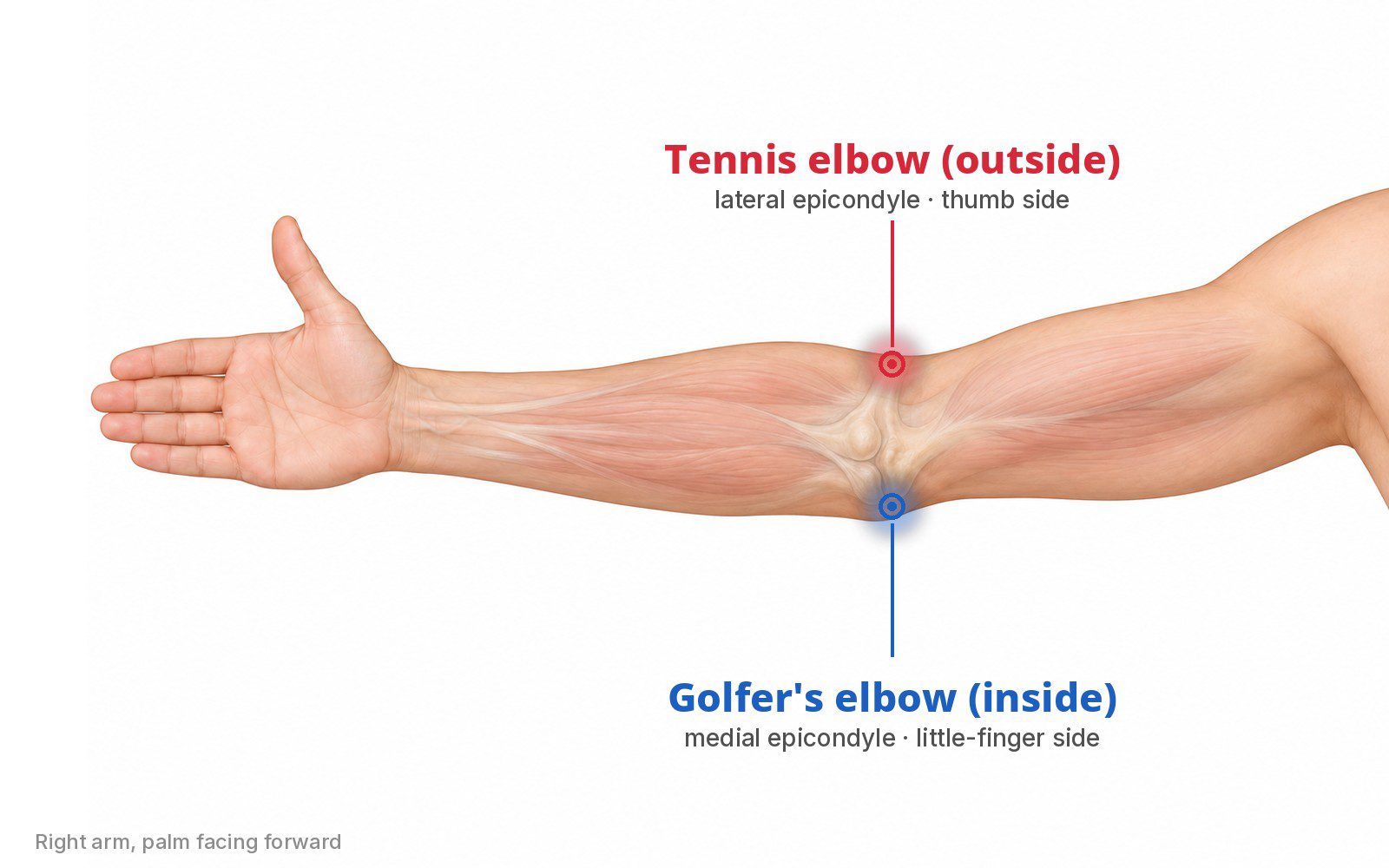
The three camps
Ask ten people how to fix it and you’ll hear three answers. (1) Rest. (2) Physical therapy (in my case: acupuncture or Active Release Therapy [ART]). Or (3) strengthening the arm, shoulder and upper back.
I’m firmly in camps two and three. For ART in London, I go to Active Backs in Chiswick. For acupuncture, I see Benjamin, who is Chinese and wonderfully holistic; he treats the whole person, not just the joint that’s complaining. And in the gym, I focus on the muscles that hold my shoulder in place: pecs, upper arms, shoulders and shoulder blades.
Why the shoulder? Context counts
My body has a long paper trail. I’ve played racquet sports competitively all my life (university squash, tennis teaching pro…) and threw in 18 years of rugby for good measure.
The story starts at 17, with a car accident that left me with a significant neck problem, which in turn set up trouble in my shoulder. In 1992, an injury in the semi-finals of the Cherry Blossom tournament ended my rugby career and weakened that shoulder further. In 2004, I had arthroscopic surgery on my right shoulder: a cyst removed, my labrum worked on and my rotator cuff repaired. A year later, it still wasn’t right. So I rebuilt it the slow way, with ART from the amazing Toronto-based Anthony Lombardi.
The lesson from all those years of breaking and mending is simple: pain shows up at the weakest link. My neck was damaged and my shoulder was a little loose, so my elbow ended up doing overtime. Fix the chain, not just the link that squeaks.
My seven-step elbow ritual
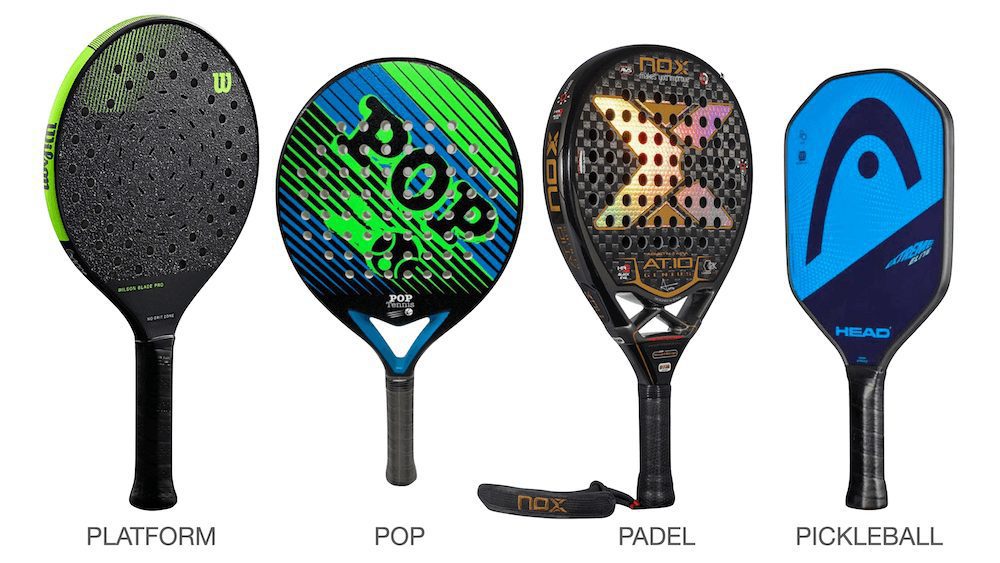
- Choose a kind racquet. Specific to padel, I play with a Cork racquet that’s about 40% cork, which softens the impact. Think of it as a shock absorber you can hold.
- Avoid wet courts. Damp balls get heavy, and heavy balls are a tax on the elbow. This is typically the problem with outdoor courts in soggy climates!
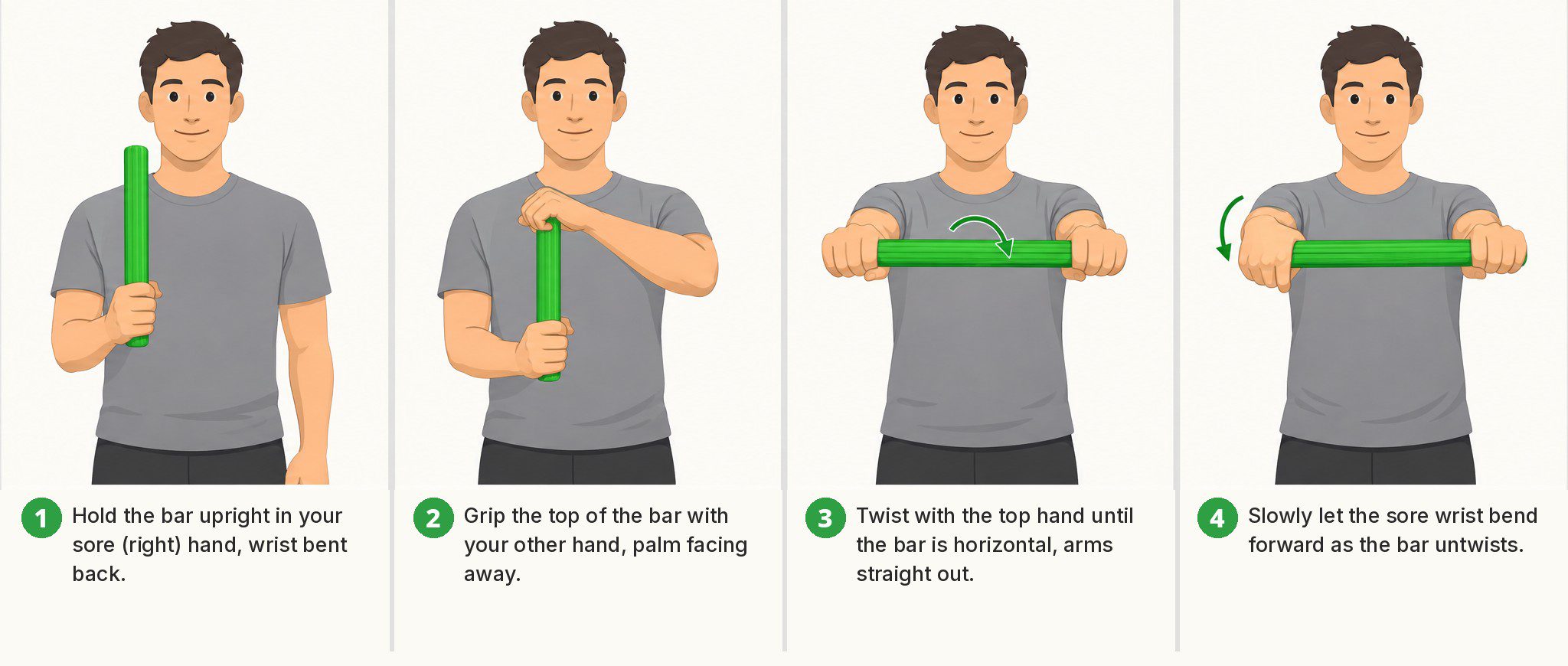
- Warm up like you mean it. I start with a green Theraband FlexBar and a few stretches that target each sore spot. The star of the show is the Tyler Twist (see the image below / guide). Then I channel my inner Bobby on the beat, swinging the bar like a truncheon through my strokes, letting its weight tug on the sore points. The neighbours have stopped asking.
- Massage, gently. A few minutes with a mini Theragun on the forearm. The word “gently” is doing a lot of work there! Be careful not to bruise the affected area.
- Rehearse the impact. With the FlexBar, I tap a wall or a pole to simulate hitting a ball, so the first real shot isn’t a shock to the system.
- Squeeze it. On court, I wear a compression sleeve: a tighter one on bad days, a lighter one on good days.
- Aftercare. Depending on the damage, some combination of Voltarol (Voltaren) gel, ibuprofen and ice.
What the experts say
I wanted to check I wasn’t just making this up, so I looked at the research. Three findings stood out:
- The Tyler Twist is the real deal. It was developed by physical therapist Tim Tyler and colleagues at the Nicholas Institute in New York. In their 2010 trial, adding it to standard treatment improved function by 76%, against 13% with standard treatment alone. Their “reverse” version for golfer’s elbow (hello, javelin elbow) did well too.
- Cortisone wins the sprint and loses the marathon. A 2013 study in JAMA by Brooke Coombes and Bill Vicenzino (University of Queensland) found that patients who had a cortisone injection were worse off at one year than those who had a placebo, with far more relapses (54% vs 12%).
- Age is on my side. Research from the Finnish Institute of Occupational Health (Rahman Shiri) finds that it peaks between 40 and 60, which squares with my therapist, who says he never sees it in the over-70s. Eight more years of padel, then I’m immune!
A few other thoughts
On rest: in theory, it’s sensible. In practice, the benefits of playing for my mental health, fitness and friendships outweigh the risk. I’d rather manage the elbow than mothball the man.
On cortisone: I had a couple of shots for my javelin elbow. They hurt like blazes and worked brilliantly… for a while. The research above suggests that’s exactly the catch. Two and done.
The bottom line: if your elbow is grumbling, look beyond the elbow. Find your weakest link, strengthen what surrounds it, and keep playing!
What’s worked for you? Tell me in the comments.
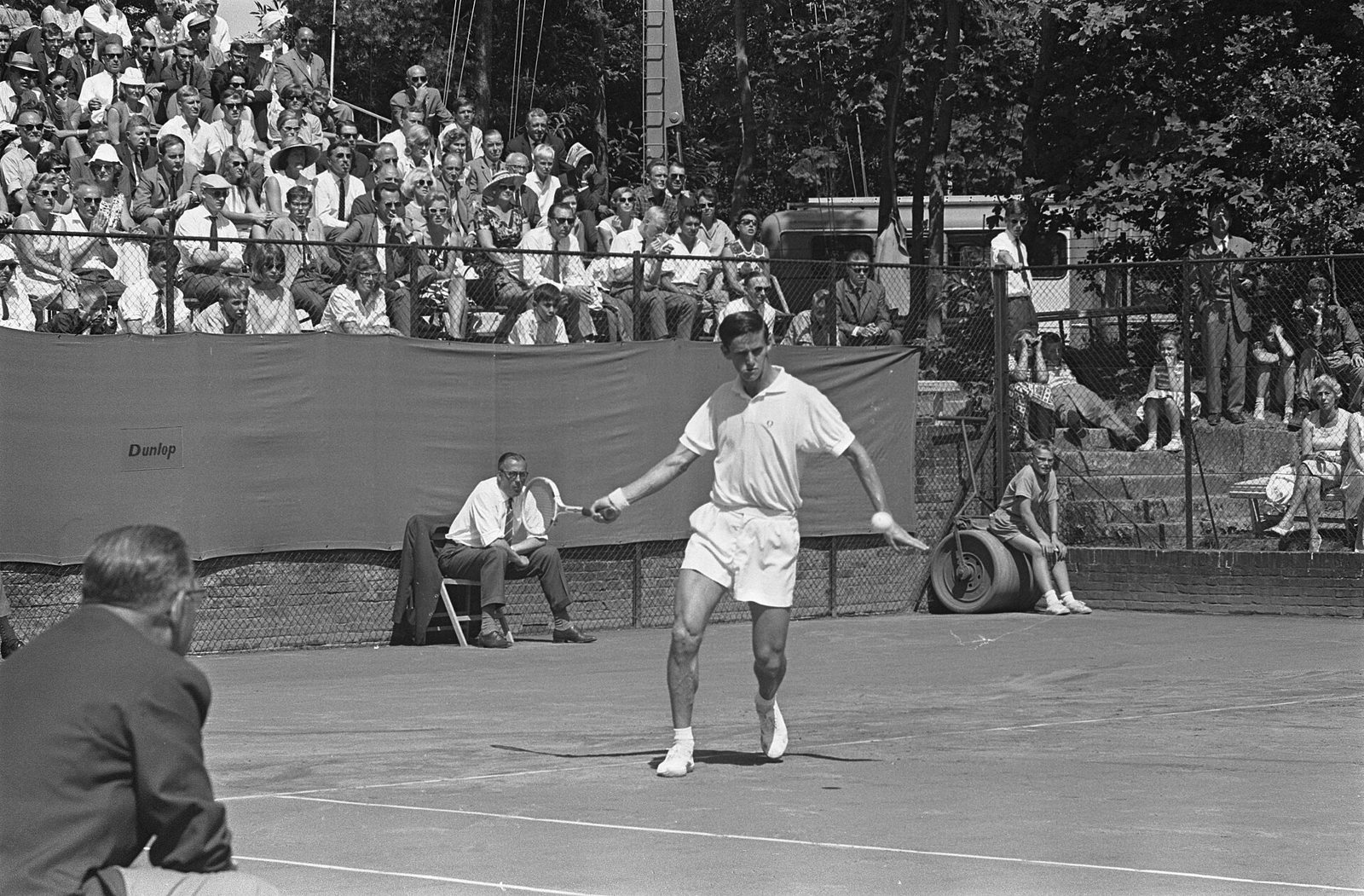
PS: The man in the photo at the top is Roy Emerson, and I was fortunate enough to know him and play with him. “Emmo” won 12 Grand Slam singles titles and 16 in doubles; his 28 majors are still the record for a man, and he remains the only male player to complete the career Grand Slam in both singles and doubles. Add a record eight Davis Cup-winning teams, and you’ll understand why, sharing a court with him, my elbow was the least of my worries. He turned 90 today on 3 November 2026: happy birthday, Emmo!