If padel is a religion, and I have written before about its little doctrines, then the World Championships would be our week of pilgrimage. However, truth be told, the organisation for the media is always rather terrible, so I didn’t make the journey out to Doha Qatar this time.
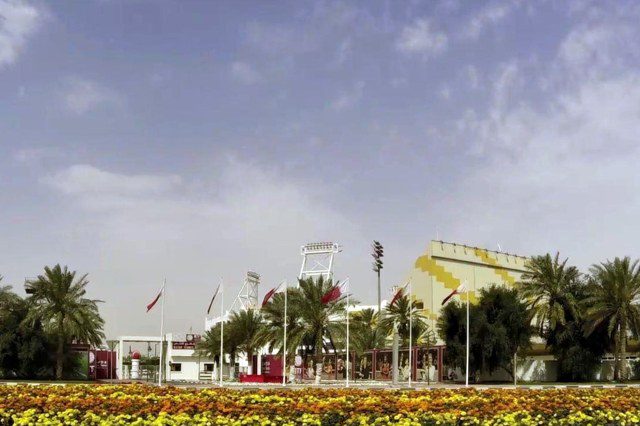
This year’s edition ran from 2 to 7 November: 32 national teams, 16 men’s and 16 women’s, all under one roof at the Khalifa International Tennis and Squash Complex. And what a week it served up: a double Spanish triumph, a men’s final that needed every one of its three matches, a batch of nations announcing themselves on the big stage, and no shortage of controversy off the court.
The men’s final: all square, then all to play for

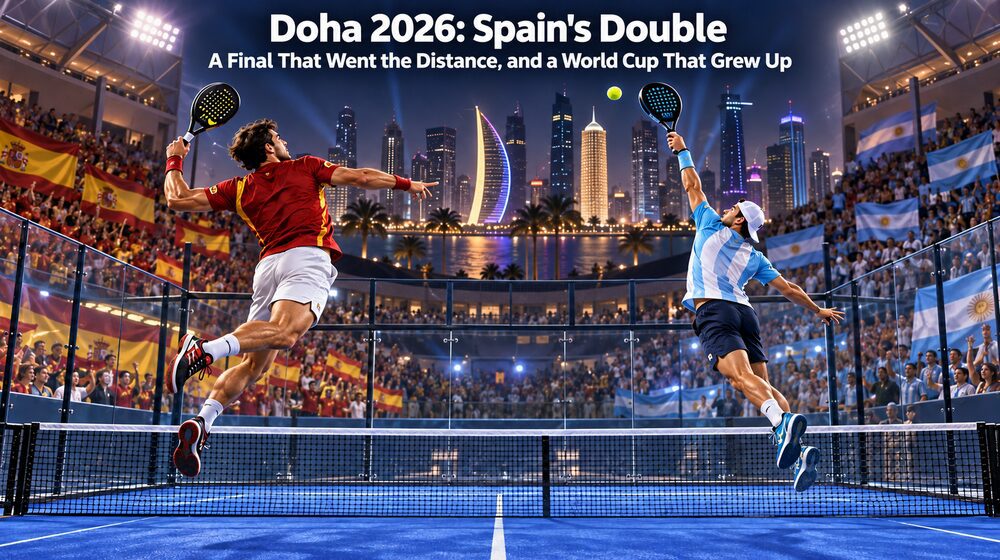
Spain against Argentina. Again. It is the rivalry that defines our sport. Argentina, the most successful nation in the championship’s history with twelve titles, arrived as back-to-back champions. Spain, without the injured Ale Galán, were chasing a first crown since 2021.
Cue a bold move from Spain’s captain, Juanjo Gutiérrez (right): sending out Juan Lebrón alongside World Cup debutant Aimar Goñi for the opening match. It nearly backfired. Martín Di Nenno and Leo Augsburger took the first set 7-5 and we’re leading 4-2 and 30-o, before Lebrón and the youngster steadied and turned the match on its head: 5-7, 7-5, 6-2. A lot of the blame has been laid on Augsberger for that loss. But it was a huge result for Spain. First blood to Spain, and real drama along the way.
Argentina’s answer was emphatic. Agustín Tapia and Fede Chingotto produced a masterclass, beating Paquito Navarro and Jon Sanz 6-1, 6-2 in under an hour. A word for Paquito: this was his final appearance in a Spain shirt. It was not the farewell he will have wanted, but what a career in red it has been.
So: 1-1, and the whole championship riding on one last match, just as it had two years earlier. King Arturo Coello and Coki Nieto against Gonza Alfonso and Tino Libaak, the man who won the decisive match of the 2024 final for Argentina. The atmosphere, by all accounts, was electric, Argentine chants answered by Spanish ones. In truth, the decider itself had no late twist: Coello and Nieto were simply too good, 6-3, 6-2, and Spain were men’s world champions for the fifth time.
And the women? Business as usual, you might say. Spain beat Argentina 2-0 for a seventh consecutive world title and a tenth overall. Andrea Ustero, playing her first World Championship, was in tears after helping to win the opening point alongside Ari Sánchez (who is also her current partner on the pro tour). Gemma Triay and Paula Josemaría then survived a two-hour-38-minute battle against Delfi Brea and Claudia Jensen, 6-2, 6-7, 6-3. Their dominance remains, frankly, ridiculous. See below in the Annex for the tally of sets and games won/lost by the Argentine and Spanish teams up until the final.
The road to the finals, by the numbers
Before a ball was struck in either final, Spain and Argentina had been close to untouchable all week. I ran the numbers on every tie from the group stage through the semi-finals, and they are worth a moment.
Spain’s men lost only two sets on the way to the final, winning the games 167-63. Argentina’s men lost just one, 173-57. The women were more emphatic still: neither Spain nor Argentina dropped a single set, Spain taking the games 168-19 (that is nineteen games conceded in fourteen matches, which is frankly absurd) and Argentina 168-38.
One quirk of the format: once a tie was settled 2-0 the third match was not played, so Spain’s men finished on thirteen matches where the other three teams played fourteen. And a detail I loved from the semi-finals: the set Spain’s men conceded against Portugal featured a disputed point at 4-5 in the first set that was initially given to Spain, until the Spanish bench (Navarro and Lebron) told the referee the point was Portugal’s. The Deus brothers went on to take the set 6-4; Tiebreak News billed it as a set handed to Portugal by Spain’s bench. Sporting, either way.
The surprises (and a few new heroes)
The tournament threw up some genuinely exciting stories beyond the usual suspects:
- France’s women knocked out the Netherlands, who had won their group with a perfect record, to reach the semi-finals. Allez les bleues! And the French men managed to extract a set from Tapia and Libaak.
- Indonesia’s women beat Germany 2-0 in the classification rounds, a landmark result for a country that does not yet have the padel tradition of the major European or South American nations.
- Germany’s men reached a World Championship quarter-final for the first time, and Sweden’s men did likewise, taking a set off Italy in both of their matches for good measure.
- Portugal’s men made a third consecutive semi-final and this time came home with bronze, beating Italy 2-1 in the playoff. I also not that the Deus brother ran Yanguas/Goñi to three sets.
This is the internationalisation of padel happening in front of our eyes, and I find it thrilling.
Who disappointed?
Argentina’s men will feel this one. Back-to-back champions, winners of five of the last six editions, and their talismanic pair won their rubber without breaking sweat. Losing the crown in a decider is no disgrace, but it will sting.
The Netherlands’ women went from a perfect group stage to a 2-0 quarter-final defeat against France in one bad afternoon.
Brazil’s men, a veteran squad with only two players under 30 and missing Lucas Campagnolo (my most recent guest on The Joy of Padel; he had his sister’s wedding, which is entirely fair enough), went down 2-0 to Spain in the quarters.
And us? Great Britain’s women finished tenth, beaten 2-1 by Belgium in the playoff for ninth after good wins over Egypt and the USA. Given a group containing Spain and Brazil, there is no shame in that, but the gap to the top table remains, let’s say, character-building.
The controversies
Off court, it was lively. Five Spanish players naturalised as Emirati (Íñigo Jofre, Arnau Ayats, Enrique Goenaga, Ignacio Vilariño and Fran Jurado) were barred from representing the UAE under the FIP’s tightened eligibility rules. Several of them flew to Doha anyway to support their teammates from the stands, and the players have taken their case to the Court of Arbitration for Sport. The bigger question, whether national teams should be built or bought, is not going away.
Sports and politics: Iran never got the chance to qualify. Their men’s and women’s teams had places in the Asia-Africa qualifier, held in Kuwait in late October, but the Kuwaiti authorities never issued their visas. Iran asked the FIP for a wildcard into Doha and got nowhere. The draw went ahead without them.
And one oddity: Qatar’s women, entitled to a place as hosts, were listed as qualified by the FIP back in September, then simply did not appear in the draw. It would have been the country’s first women’s team at a World Championship. As Padelazo reported on 2 November, the FIP had offered no public explanation. Silence is rarely a good look.
What it all means
Two finals, two Spain-Argentina battles, and real evidence that the chasing pack is closing. The good news: we do it all again in Doha in 2028, with Qatar already confirmed as host. Weeks like this one are padel’s finest advert.
So tell me: what was your moment of the tournament, and does anyone seriously see the Spain-Argentina duopoly being broken in 2028?
Annex: the numbers in full (group stage through semi-finals)
Every rubber, tie by tie, finals excluded. Game tally convention: a 6-2, 6-2 win counts as 12-4.
Spain, men: 13-0 match record, 2 sets lost; games 167-63 (5 ties, 13 matches)
- Group B v UAE, 3-0 (games 36-5): Lebron/Leal 6-0 6-1; Navarro/Sanz 6-0 6-2; Yanguas/Nieto 6-1 6-1
- Group B v Paraguay, 3-0 (36-13): Yanguas/Leal 6-4 6-3; Navarro/Lebron 6-0 6-2; Goñi/Coello 6-1 6-3
- Group B v Sweden, 3-0 (43-21): Coello/Navarro 6-3 6-2; Yanguas/Goñi 6-7 7-5 6-2 (set lost); Lebron/Sanz 6-0 6-2
- Quarterfinal v Brazil, 2-0 (24-7): Nieto/Sanz 6-2 6-2; Leal/Coello 6-2 6-1
- Semifinal v Portugal, 2-0 (28-17): Goñi/Yanguas 4-6 6-3 6-2 (set lost); Navarro/Lebron 6-2 6-4
Argentina, men: 14-0 match record, 1 set lost; games 173-57 (5 ties, 14 matches)
- Group A v France, 3-0 (games 41-21): Tapia/Libaak 5-7 6-3 6-4 (set lost); Chingotto/Stupaczuk 6-2 6-1; Di Nenno/Alfonso 6-2 6-2
- Group A v Netherlands, 3-0 (36-17): Tapia/Libaak 6-4 6-2; Stupaczuk/Arce 6-1 6-3; Augsburger/Chingotto 6-3 6-4
- Group A v Australia, 3-0 (36-3): Stupaczuk/Chingotto 6-1 6-1; Augsburger/Di Nenno 6-0 6-0; Alfonso/Arce 6-1 6-0
- Quarterfinal v Germany, 3-0 (36-9): Chingotto/Alfonso 6-1 6-1; Augsburger/Di Nenno 6-0 6-4; Stupaczuk/Arce 6-3 6-0
- Semifinal v Italy, 2-0 (24-7): Di Nenno/Augsburger 6-1 6-1; Tapia/Chingotto 6-3 6-2
Spain, women: 14-0 match record, 0 sets lost; games 168-19 (5 ties, 14 matches)
- Group A v Brazil, 3-0 (games 36-4): Ortega/Sanchez 6-1 6-1; Triay/Fernandez 6-0 6-0; Ustero/Calvo 6-2 6-0
- Group A v Great Britain, 3-0 (36-3): Ustero/Calvo 6-0 6-0; Ortega/Gonzalez 6-1 6-1; Josemaria/Sanchez 6-0 6-1
- Group A v Germany, 3-0 (36-2): Fernandez/Gonzalez 6-0 6-1; Josemaria/Calvo 6-1 6-0; Triay/Ortega 6-0 6-0
- Quarterfinal v Sweden, 3-0 (36-6): Josemaria/Gonzalez 6-0 6-1; Ortega/Calvo 6-0 6-2; Ustero/Sanchez 6-1 6-2
- Semifinal v France, 2-0 (24-4): Josemaria/Triay 6-3 6-1; Fernandez/Gonzalez 6-0 6-0
Argentina, women: 14-0 match record, 0 sets lost; games 168-38 (5 ties, 14 matches)
- Group B v France, 3-0 (games 36-6): Brea/Jensen 6-0 6-0; Osoro/Fassio 6-2 6-2; Riera/Bidahorria 6-1 6-1
- Group B v Belgium, 3-0 (36-9): Brea/Fassio 6-0 6-0; Osoro/Riera 6-4 6-2; Bidahorria/Jensen 6-1 6-2
- Group B v Chile, 3-0 (36-8): Riera/Bidahorria 6-0 6-1; Fassio/Jensen 6-2 6-0; Vilchez/Osoro 6-2 6-3
- Quarterfinal v Portugal, 3-0 (36-6): Brea/Jensen 6-0 6-0; Osoro/Fassio 6-1 6-3; Riera/Bidahorria 6-2 6-0
- Semifinal v Italy, 2-0 (24-9): Osoro/Fassio 6-2 6-2; Brea/Jensen 6-2 6-3
N.B. Dead rubbers were not played once a tie was settled 2-0, which is why Spain’s men played 13 matches and the other three teams 14.
Meanwhile, what do these numbers reveal? That Spain and Argentina are still the dominant forces. Not even close. The men’s Spanish and Argentine teams won 72.6% and 75.2% of the games respectively up until the final. The women were even more dominant, winning (Spain) 89.8% and (Argentina) 81.5% of the games played.