Padel is a game of many dimensions, even if it is often misunderstood by those looking in from the outside. Squash players may say it is not as exhausting. Tennis players may insist it is not as physical. On balance, they are right. But to judge padel solely by the quantity of sweat generated, or by the number of kilometres run, is to miss much of the point.
Padel has its own demands. Its physical intensity can be intermittent rather than linear; its mental load can be relentless. It is a sport in which the walls, the partner, the positioning, the pace of the point, the state of the score and the emotional weather all matter. It may be easy to start playing padel. Getting good at it, however, is another matter altogether.
I remember a world champion from another racquet sport dismissing padel as uninteresting. “It’s not strategic,” she told me. She was (and is), in my view, profoundly mistaken. Padel is not merely strategic; it is much like a multivariate chess game and is strategic in ways that can be invisible to the casual eye.
More than a collection of shots
Watching the professionals, many amateur players will have a familiar reaction: “I can hit that shot.” And perhaps they can. One bandeja, a vibora, a lob, a volley down the middle, or even the occasional smash may all be technically within reach.
Yet the brilliance of the best players is not simply the execution of a particular stroke. It is their choice of stroke, at a particular moment, from a particular place on the court, in relation to two particular opponents, with a particular score on the board. And they do this point in, point out.
The question shouldn’t be: can you make the shot?
The far better question is: can you make the right one now? And now? And now, again?
That is why padel has something in common with chess. Most people can learn the opening moves. You may even recognise/know the King’s Gambit or the Queen’s Gambit. But recognising an opening is not the same as playing the whole game well—especially when there is a clock, pressure, fatigue and an opponent who is intent on unpicking your plans.
In padel, a point may begin with a serve, but it can involve a sequence of adjustments: defending a difficult ball off the glass, recovering the net, lobbing to reposition the opposition, refusing an ill-advised winner, finding a small weakness, and then exploiting it. Sometimes it takes several “winning” shots before you actually win the point.
That requires technique, certainly. More importantly, it requires constant attention, adjustment, teamwork and judgment. And that constant attention and judgment consumes energy.
The theatre of the big occasion
At the finals of the Premier Padel Paris Major 2026, played in the grandeur of Philippe-Chatrier, the sport’s emotional intensity was on full display. With more than 81,000 in attendance throughout the week, around 18,000 people were present for the Sunday grande finale, and, as anyone who has played in front of a crowd will understand, an audience is never merely background noise.
Crowds bring energy. They also take it away.
In the men’s final, much of the crowd appeared to be behind the “underdog” number-two seeds, the “Chingalán” pairing of Ale Galán and Fede Chingotto, up against the number ones, their nemeses Arturo Coello and Agustín Tapia. The support was emphatic. When Coello smashed a ball that struck either Galán or Chingotto, there were audible boos. To their credit, the players met at the net afterwards, neutralising any suggestion of bad blood. That small ritual matters. At the professional level, where every detail can be magnified, sportsmanship is also a way of managing emotional temperature.
A partisan crowd can lift a player. It can also make them feel that every missed opportunity is a betrayal. The energy in the stadium has to be metabolised, not simply absorbed.
In the decisive moments of that final, Galán appeared to lose some of his verve. At 0–40 and 5–5 in the third set, he sent a monumental lob many metres outside the court. See that moment here via X. It was a startling moment—not because players do not make errors, but because of what it seemed to communicate. To me, it felt like a visible discharge of frustration: an instant when resolve was replaced by petulance. The pair then fell rather meekly 7–1 in the final tie-break.
One point never tells the full story of a match. Yet sport is rich in such gestures. They can reveal how much energy has been spent not only physically, but mentally.
Momentum is a living thing
Padel is a sport of momentum shifts. This is partly because of the scoring system inherited from tennis, where each game is its own miniature narrative and every new set provides a partial reset.
You can be 40–0 up on your serve, then suddenly lose two points. Nothing has changed on the scoreboard in a catastrophic sense: you still have a game point at 40-30. But psychologically, the terrain feels entirely different. A relaxed hand can become tight. The ball that was being struck freely starts feel heavier. The mind begins to whir.
Why did I miss that?
Don’t double fault now.
We need this game.
We can’t let them back in!
Those thoughts, once they start circling, have a distinctly rock’n’roll quality. Loud, repetitive and not particularly helpful.
The same is true within a point. A high defensive lob can appear to give you time, but it can leave you waiting beneath the ball, legs tiring, mind racing, options abounding. A ball clipping the net and dying awkwardly in the side netting can feel deeply unfair. A strange bounce off the carpet or glass can leave you frustrated. The temptation is to complain—to the court, the net, the ball, your partner, yourself or the universe. Some will even look to blame their racquet!
But the next ball does not care.
This is where managing energy becomes less about fitness in the conventional sense and more about emotional economy. How quickly can you let go? How little drama can you attach to an error? Can you distinguish between bad luck, a poor decision and poor execution? And can you do so without turning every lost point into a referendum on your ability? Or worse: on blaming your partner?
The partner is part of the equation
Padel is not singles tennis with walls. It is, fundamentally, a partnership game. That means your energy is never entirely your own.
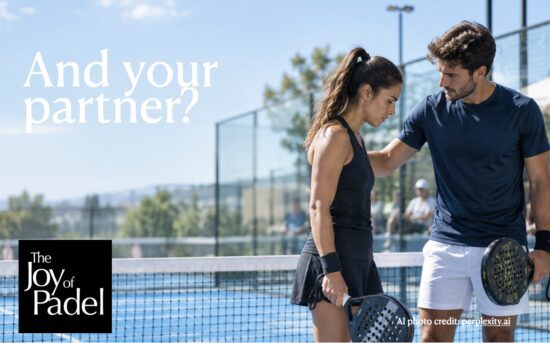
You have to manage your own breathing, legs, concentration and confidence. At the same time, you must notice your partner. Are they frustrated? Are they overplaying? Do they need reassurance, clarity or simply a calm presence? Is the plan still working? Or have you both stopped doing what you agreed to do?
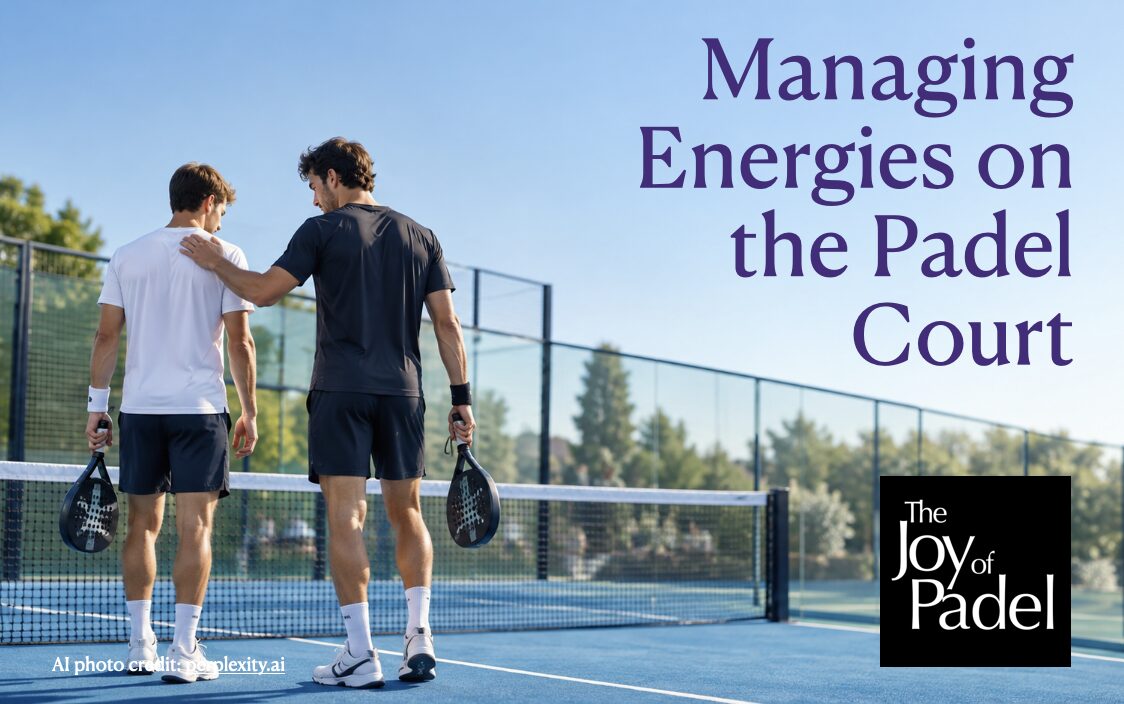
The finest professional pairings are not only technically compatible. They are emotionally literate. Watch the best players between points and you will see them communicating constantly: a tap of hands, a word of encouragement, an animated “¡Vamos!”, a tactical observation, or perhaps a quieter instruction to slow down.
Communication is not decorative in padel. It is functional.
In Paris, Frenchman Thomas Leygue offered a vivid example of the positive side of crowd energy. Playing on the central court in front of a partisan crowd, Leygue (alongside Jesús Moya) defeated two significantly higher-seeded pairs. The home support surely did not hit the balls for him, but it created an atmosphere in which courage, belief and resilience became easier to access. The challenge for every player is to find a version of that energy, even on a quiet club court on a damp Tuesday evening.
My blueprint for energy management
For amateurs, a crowd looks more like one or two people. But the mental challenge is not necessarily trivial. I remember playing the 47th rubber of the Anglo-American Cup in 2024 alongside my valiant partner, Sandy Case. Perhaps a hundred people were gathered around the court, roaring both teams on. It was splendid, of course, but it was also disorienting. Hearing my partner’s calls became harder. So did hearing my own thoughts clearly.
Over time, I have developed a simple blueprint for managing my energies.
Before a match, I make sure to warm up properly—not merely to avoid injury, but to arrive in the game physically and mentally prepared. Often I play a specific playlist on the way to the club. I think through the foundations: footwork, racquet preparation, the split-step, the ready position, and the need to stay low and alert.
I then consider one or two (max) elements of my game that I have been working on. Not ten things. Not a technical dissertation. A couple of simple intentions: perhaps better lobs under pressure, calmer volleys, more patience in defence or clearer communication with my partner.
If I feel that the match matters—say, a club championship final—I will also do some breath work. The aim is not to eliminate nerves. Nerves are energy. The objective is to breathe into the moment, to be present enough to use that energy rather than be used by it.
During the match, the task is to reset regularly. After a poor point, take a breath. Meet your partner. Say something constructive. Return to the agreed plan. Between points, do not replay the previous error endlessly. Between games, breathe and reorient. At the change of ends, remember that a match can turn quickly—for you as much as against you.
Energy given back in spades
The beauty of padel is that it asks so much of us. It asks for legs, lungs, hands, anticipation, patience, courage and humility. It asks us to tolerate uncertainty, absorb setbacks and remain generous towards a partner while wrestling with our own anxieties.
Managing energy means keeping confidence without becoming reckless. It means finding a groove, interrupting a bad spell and putting mistakes behind you. It means recognising when to slow the game down, when to deceive, when to lob, when to transition and when simply to stay in the point.
And then, when it all clicks—when the partnership flows, the feet move, the ball comes off the racquet cleanly, the tactics work and the score begins to tilt your way—padel gives something back.
Not just points. Not just victory.
Energy. In spades.