
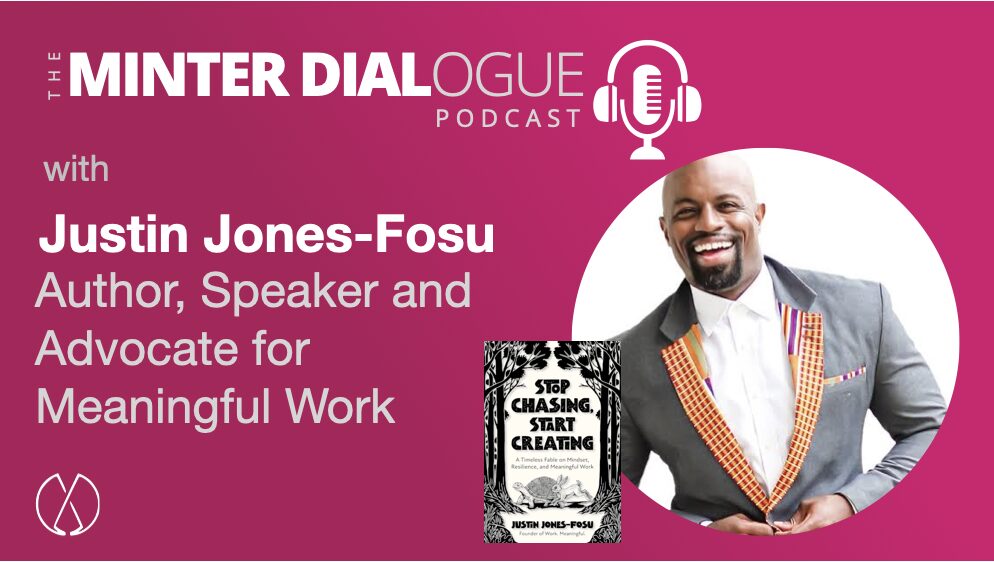
Minter Dialogue with Justin Jones-Fosu
Justin Jones-Fosu is a motivational speaker, author, and the founder of Work Meaningful, whose personal and professional journey is a striking example of intentional living and alignment with core values. I was delighted to have Justin back on the Minter Dialogue podcast to delve into his remarkable work, particularly around the themes of meaningfulness, the interplay of personal and professional identities, and the courage it takes to create rather than chase in life and work.
Justin grew up navigating the challenges of a fractured family, carrying the weight of his father’s absence and striving for external validation through achievement. His candid account of shifting from blame to ownership, embracing therapy, and reconnecting with his father echoes his core philosophy: meaning is not passively found, but actively created. His latest book, “Stop Chasing, Start Creating,” along with his national study on meaningful work in America, frames a practical yet inspiring approach to both personal development and workplace culture.
Our conversation touches on the rich dualities of identity, the misconceptions about productivity versus purpose, the strength in vulnerability, and the essential nature of community. Whether reflecting on tortoise wisdom from his deep dive into fables, or discussing raising his own sons, Justin brings a powerful focus on intentional action and resilience—lessons that resonate deeply in our current age of distraction and transactional relationships.
3 Key Points:
- Shift from External Validation to Intentional Creation: Justin’s journey underscores the importance of moving away from seeking other people’s approval towards creating meaning through small, consistent steps aligned with one’s own values. His framework, “choose, commit, cultivate,” can be utilised by anyone seeking greater fulfilment.
- The Integration of Personal and Professional Identities: We explored how vulnerability—both as a leader and as an individual—creates spaces for honest connection at work. Rejecting the old HR adage to “leave home at home,” Justin champions a more holistic approach, acknowledging the inseparability of personal and professional lives.
- Meaningful Work Is Rooted in Community: Justin’s research reveals that meaningfulness at work is less about the tasks themselves and more about the quality of relationships—trust, respect, and shared purpose. Even so-called “menial” jobs can feel meaningful when done alongside a supportive team.
To connect with Justin Jones-Fosu:
- Check out Justin Jones-Fosu’s Work Meaingful site here
- Find/buy Justin Jones-Fosu’s book, “Stop Chasing, Start Creating,” here
- Find the study on meaningful work in America here
- Find/follow Justin Jones-Fosu on LinkedIn
- Find/follow Justin Jones-Fosu on Instagram
- Download Justin Jones-Fosu’s research on meaningfulness here
Other mentions/sites:
- My first interview with Justin Jones-Fosu here
- “The Dash,” poem by Linda Ellis here and my interview with Linda is here
- “One Minute Manager,” by Ken Blanchard here
- “Extreme Ownership: How U.S. Navy SEALs Lead and Win,” by Jocko Willink and Leif Babin here
- “Leadership and Self-Deception,” by The Arbinger Institute here
- “The Power of Meaning: Crafting a Life That Matters,” by Emily Esfahani Smith here
- “Poor Charlie’s Almanack,” by Charles T. Munger here
- “The Coddling of the American Mind,” by Greg Lukianoff and Jonathan Haidt here
- Shawshank Redemption (film, based on a novella by Stephen King) here on IMDB
- Cool Hand Luke (film starring Paul Newman) here
- “Fifty Shades of Grey,” by E.L. James here
- John Vervaeke, Professor, University of Toronto and “Awakening from the Meaning Crisis” series here
- Work Meaningful national study on meaningful work in America here
Further resources for the Minter Dialogue podcast:

Meanwhile, you can find my other interviews on the Minter Dialogue Show in this podcast tab, on my Youtube Channel, on Megaphone or via Apple Podcasts. If you like the show, please go over to rate this podcast via RateThisPodcast! And for the francophones reading this, if you want to get more podcasts, you can also find my radio show en français over at: MinterDial.fr, on MegaphoneFR or in iTunes. And if you’ve ever come across padel, please check out my Joy of Padel podcast, too!
Music credit: The jingle at the beginning of the show is courtesy of my friend, Pierre Journel, author of the Guitar Channel. And, the new sign-off music is “A Convinced Man,” a song I co-wrote and recorded with Stephanie Singer back in the late 1980s (please excuse the quality of the sound!).
Full transcript via Castmagic.io
Transcription courtesy of Castmagic.io, an AI full-service for podcasters
Minter Dial: Justin Jones-Fosu, only not even 2 years since our last chat, but it seems like lots has happened.
Justin Jones-Fosu: Yeah.
Minter Dial: And maybe, you know, as I usually like to ask, who is Justin? Add in who and how much has Justin changed since December 2024?
Justin Jones-Fosu: Wow, that’s a great question. Wow. I feel like I am a more meaningful version of me. And what does that mean? That means for me, the definition of meaningful is significant and purposeful, aligned with your values, and provides an impact on someone or something, including yourself. And so, I feel like I’ve just been much more intentional with alignment. to my values. And it’s funny, even, even after launching the book, like immediately after launching this new book, I was tested with the very same message. And that was the most interesting piece of it.
Minter Dial: So, I stopped chasing, start creating. They tested you on that?
Justin Jones-Fosu: Yes, I wasn’t— not they, but June 2nd, we had the virtual book launch. It’s great time, virtual My mom stole the show and was able to share some really practical, powerful things about just even my journey of like growing up and how, you know, all the things I did that are out the box, all that kind of stuff. And then literally 2 days later, I get a call June 4th that my mom’s in the hospital and then we find out she has cancer. And so—
Minter Dial: Sorry.
Justin Jones-Fosu: what that did, it was a big shock to the system, but then I was tested because I had all these things planned in June for the book launch and tour and all these podcasts and all these pieces. And I literally had to wipe away everything. Well, I didn’t have to, I chose to because was I going to chase the numbers and the short window you have as an author, the short window you have of really maximizing the algorithms and everybody excited about the book launch and your launch party? Or was I going to choose my mom? And so, I chose alignment and what it means for my values. And so, I chose my mom. And so, we’re just getting back to relaunching the book. But it was, it was interesting talking about Stop Chasing, Start Creating, that I had to, I had to ask the question, am I going to chase or create 2 days after my own book launch? Wow.
Minter Dial: Well, so Justin, let’s, for level stakes, start with the moment you decided to get this book out. Because I mean, and frankly, Justin, we just mentioned a little bit this idea of vulnerability. It’s been a story I feel so strongly about, which is not your story per se, but the idea of mixing personal and professional.
Justin Jones-Fosu: Yeah.
Minter Dial: And some countries, some cultures, some businesses try to separate them. Yeah. And I think that is part of the big problem we have. Floor is yours.
Justin Jones-Fosu: Yeah, no, I would agree with you. Because, you know, back in the day, I’m a former HR leader, we used to tell people, you know, leave home at home and work at work, right? But everyone knew that didn’t work. And we were bringing our home with us. And that’s why you would hear stories of leaders that would tell people, like good leaders, hey, go take care of home. We got you covered and come back when everything is good. Right. Some challenging leaders at times would just try to ignore it and act like everything’s okay and not really caring for the full person. And so, what I—
Minter Dial: Even in themselves, by the way.
Justin Jones-Fosu: Oh, I said even in themselves. Yes. Yeah, I do think that COVID in many ways exposed that, that the dual nature of home and work. And I don’t think in a good way, one of the good things that came out of that is I think people better understand that there’s, there’s an integration of the two. And so, um, that’s one of the things I think that we’re processing and dealing with. And so, I, my goal, my hope is to lead by example. And so, I vulnerably share, and, and there’s some truths of Tano the Tortoise from the book, um, that are like me, but I’m also like Harold the Hare. So, it’s very interesting. as we think about the duality of the characters.
Minter Dial: If I may, just before we jump into the specifics, a lot of talk I— or stuff I write about these days is around identity. Can we hold 2 identities? And it makes us unique, but it also makes us maybe split hairs or split personalities. And I’m part this, I’m part that. And a lady beautifully described, she said, you know what? You’re part your father and you’re part your mother, even if they both come from the same side of the street in the same town.
Justin Jones-Fosu: Yeah.
Minter Dial: And I further had a lady who talked about the dash. Her name is Linda Ellis. She wrote this poem, The Dash, and the dash is in between The date of birth and the date of death. And so, we’re always dealing with dualities.
Justin Jones-Fosu: Yes.
Minter Dial: We’re born to die. There’s good and bad. There’s mom and dad. There’s me, me, me, and me. And, and how do we make sense of all that anyway? So, talk us through how you landed in and started writing about this Stop Chasing, Start Creating.
Justin Jones-Fosu: Yeah. So, for about 10 years, I’ve been railing against this concept around the tortoise because I would often say in my presentations, I was like, be the tortoise, which meant to take one intentional step forward. We often feel like we have to make these huge leaps of action in order to make progress. And I was like, no, it’s actually taking the first step. As a person who’s hiked across the world, Kilimanjaro, Machu Picchu, Patagonia, I realized the power of one step, right? And so, and so I would say like, be the tortoise. But then I started saying something unique, Mentor. I was like, we’ve gotten it wrong for all these years because what did we call the— from those who know the fable of the tortoise and the hare, what did we call the tortoise? Do you remember?
Minter Dial: Well, the slowpoke anyway.
Justin Jones-Fosu: Yes, 100%, right? And the official name was slow and steady, right? Wins the race. And I was like, For years, we’ve mislabeled the tortoise. The tortoise wasn’t slow. The tortoise was wise, strategic, and resilient because slow is a comparison term. If it was the tortoise and the snail, we’d be like, wow, that tortoise was fast. And so, it is a perspective thing. And so, I was just telling people, like, it’s not— let’s stop calling the tortoise slow. And so, anyway, I would ask people after my presentations, like, what really resonated with you? And people are like, oh, this tortoise. the concept of be the tortoise because I was like, what is that next step forward, right? And so, I was like, okay, there’s maybe something here. And so, then I decided to do something really, really crazy, Mentor. I decided I do a thing called a birthday challenge where every year I do one thing that I’ve never done before, right? Been able to marathon, learn how to sail, become a level 1 sommelier, all that kind of stuff. And so, this past year I decided to study tortoises for a year. And so, I really dove in. I went to the Galápagos, spent a week just with the conservation.
Minter Dial: Galápagos means turtle, of course.
Justin Jones-Fosu: Yes. Oh, look at you knowing your stuff!
Minter Dial: ¿Yo hablo español, por favor?
Justin Jones-Fosu: Muchas gracias. But it was really fascinating because what I wanted to learn, because I share that duality, I’m a natural hair. I’m like, let’s do this. Let’s do that. Let’s do this. Let’s go fast. And I was like, I wonder how I could be more intentional. And so, in studying the tortoise, I learned so much. And then I just had a crazy idea. I pitched it to my publisher, my editor, Steve. And I was like, hey, Steve, I have this really crazy idea. I’m not sure you’re going to like it. I feel like people are burdened right now with what I call information fatigue. So, I don’t want to just write another book to give more people content. I want to change how they feel and think towards the content. And Steve was like, Justin, do you know that I’ve actually edited over 50 fables? And he was the person who was part of Ken Blanchard’s One Minute Manager, one of the editors. And so, anyway, so that’s really how it came forward is I wanted to give somebody, I wanted to give readers something different. I wanted to challenge myself. And in the process, I wanted to learn how I could be more intentional, wise, and resilient.
Minter Dial: So, in the preamble and part of your history, There’s your father.
Justin Jones-Fosu: Yeah.
Minter Dial: And boys and fathers, there’s a story.
Justin Jones-Fosu: There is.
Minter Dial: Resonated. Yep. And, uh, it, it inevitably resonates, I think, with pretty much any man, uh, with a relationship or not with a father. And They’re all different. But what was it about your father that set you on a different path? I think it’s a very interesting and personal story.
Justin Jones-Fosu: Yeah, so I didn’t grow up with my dad. So, my parents divorced at 4. I would see my dad every other weekend and one weekend a month and sometimes 2 or 3 years where I didn’t see or talk to my dad. And many times I blamed myself for it. I thought that he wasn’t around because of me. And so, if I could just be a better son, right? And so, I became this— I need to overachieve, right? I need to win the approval of people because I was really trying to be good enough for my dad and not realizing that it was not my fault or responsibility because I carried that weight.
Minter Dial: Au contraire, please.
Justin Jones-Fosu: And so, in carrying the weight, I, you know, I would Like, okay, well, let me be the best track runner, best soccer player, football. Let me be the best in school and all these things. And I realized it was all for external validation. And a lot of that led deeper into people pleasing. And it wasn’t until, you know, one, some catalyst moments of one choosing to get therapy, which I still get to this day, continuing to have honest conversations with people like my Leadership Charlotte cohort, And choosing to eventually go confront my dad and hear his story, that I chose to forgive him. Not because he asked for it, but because it was my choice. And in doing that, all those were like catalyst moments of me leaning deeper into creating, which was internal alignment and aligning of what’s meaningful for me, what matters to me, versus the chasing, which is external validation. of am I impressing the outside world? And so, while we— they’re still chasing in me, I’m not like chase-free, but I’m getting closer and closer to creating more.
Minter Dial: So, I’d be interested to hear, what was it that made you pull over at the age of 33? Was— what was the spark that made that gush happen?
Justin Jones-Fosu: Yeah, I wish I could tell you a specific thing. I wish I had a really fancy story of like, I saw a father and their son on side of the road, right? Like, that was not it. I do think that around the age of 33, I was starting to do a lot more internal reflection. I was starting to look and think about my identity, who I am and why I am. And as I was spending that time diving deeper into that, I realized that there was something broken in me. And I didn’t know how to fix it. And so, If I could attribute it to anything, I think it was just that time of just, why am I the person that I am? Why do I make the mistakes that I make? Why am I the successes, the failures? What do I really want? And I think those just bubbled up in me. And one of those key pieces that I realized I’d never dealt with, because I dealt with my— I’d forgiven my brother for physically and emotionally abusing me growing up. I had forgiven my mom, even loosely. She had to leave when I was 11th grade and she moved to another state and I stayed with the family. So, I felt kind of orphaned, you know. So, I’d forgiven her and talked to her, but I’d never had the conversation with my dad. And I realized that I was still carrying that weight. And it just hit me on the side of the road. Well, actually, before I got on the side of the road, which is why I had to pull over, of just weeping. Uncontrolled. I mean, one of the ugly cries, mentor. Because I was just like, okay, this is, this is broken. And I have to do something.
Minter Dial: And before that, were you much of a crying guy?
Justin Jones-Fosu: Um, yeah, I’ve always been. I’ve always been.
Minter Dial: You have?
Justin Jones-Fosu: Yeah. That’s who I am.
Minter Dial: Yeah.
Justin Jones-Fosu: I grew up watching like My Girl where Macaulay Culkin comes down the stairs and, and the bee, you know, like, and the ladies, like, I was crying in the movie. So, yeah, I’m a crier.
Minter Dial: Well, I’m a secret crier. It strikes me in the way you recount the story that at some level you blamed yourself at the beginning. I’m not good enough. I don’t achieve enough. And then in the next sort of section, you say, well, I went and forgave my father.
Justin Jones-Fosu: Yeah.
Minter Dial: It’s a shifting of onus at some level. And then an ability to clear it up. I talk about my father, who’s still alive, and how he, at the age of 64, essentially told me that he felt he’d been abandoned by his father.
Justin Jones-Fosu: Hmm.
Minter Dial: And was responsible for his mother’s death.
Justin Jones-Fosu: Wow.
Minter Dial: His father having been killed in the war, Second World War. And so, this idea of attaching responsibility and blame, it’s confusing even later in age. So, talk us through how you transition from being the fault, if you will, to being able to Forgive.
Justin Jones-Fosu: Yeah. So, 3 things I’ll bring forward. One is actually what I’ve realized has been a reality in my life. And I think this is so true for others. We have these 67 wise sayings. And one of them is that when you’re blaming, you’re not building.
Minter Dial: Mm-hmm.
Justin Jones-Fosu: And I realized I didn’t have that language, you know, growing up. But I realized for a long time, I was blaming my dad. And I was blaming myself. And I was blaming— it was this external focus rather than actually internal solution. And through a series of just different things from college to therapy, there was not like this one catalyst moment, but there’s these significant moments that began to shape. And I finally started taking ownership of this question. So, I want to ask you the same question, Mentor. Who is the only person that you and I can control?
Minter Dial: Me.
Justin Jones-Fosu: Yes, our kids. And so, one of the interesting things— No, no, no, no, no, me. I’m joking. Just check it.
Minter Dial: Yeah, yeah, yeah.
Justin Jones-Fosu: I’ve tried. It doesn’t work. But I realized, like, we know that to be true, but yet we may not live it out. And I realized while I knew that, I wasn’t living it out. And so, as I chose to do work and read books and go to therapy, begin living out. I had to start doing what we call within our models, choose, commit, cultivate. Choose is take ownership. And I had to take ownership of my part. And this is one of the hardest things to do, right? Whether you’re talking about disagreement, whether you’re talking about just being in real life, it’s like, can I take ownership of my part of this? Even like, even after a 15-year marriage for myself and getting divorced, I had to ask the question, Justin, what are you taking ownership of? Because there’s always an opportunity for ownership. And that ownership with my dad was first choosing to go hear his story because I was very fortunate he’s still living. I know some people that don’t have that luxury. And I was able to say, hey, Dad, I’ve realized I’ve never heard your story. I’d love to just to hear how you grew up. Because initially I was going to go confront him Will Smith style. The Fresh Prince of Bel-Air, not the Black Rock version.
Minter Dial: Yes.
Justin Jones-Fosu: But I chose to listen to his story. And as I listened, I understood better. It’s like this empathy was given to my dad that I could see it from his perspective. He didn’t grow up with his dad. You know, he came to America at the age of 16 from Ghana. I mean, all these things that I realized better why and how he got there, even if I still disagreed with what what happened. And so, those were the catalyst moments that led me to me taking the weight and guilt and shame of it to asking, what can I actually do? And I’m still learning this, right? I’m still asking questions. Where am I taking on the shame and guilt of it versus taking ownership of what I can do? So, I’ll leave that statement with this. One of the tortoise principles that I’ve developed and built and live by Is accept what is, ask what if. And I realized I had been doing a lot of asking what if, but never accepting what is, and that’s accepting what our relationship actually is. And it’s not this father-son relationship that I’ve always wanted, that I watched in the movies where I see the dad and son going camping together or traveling, right? Like, I just, I had to accept that’s not what I’m going to get. But I can ask Well, what if? What if we had a relationship where he helped me think through the foundation and the schools we’re building in Ghana? Because he’s built like 2 libraries and things like, what if, you know, when I go to Ghana, we can spend just a day together and just kind of connect for a little bit? And so, I had to go back and accept what is to properly ask what if.
Minter Dial: Yeah, it feels like the what if is That first step feeling. Yeah.
Justin Jones-Fosu: Yeah. Um, I would actually reverse it slightly. Because I was asking a lot of what if. I was like, what if my dad could be the dad I wanted him to be? What if— so my what if without the accepting of what is was misappropriated.
Minter Dial: Oh, right. That makes total sense.
Justin Jones-Fosu: It was giving false expectation. But once I finally accepted what is, What if was calming? Yeah.
Minter Dial: So, in what you’re saying, Justin, there’s a— there feels to me there’s 2 things. One is the ownership of your role. And the other is the crafting or the authorship of what is to be.
Justin Jones-Fosu: Yeah, no, that’s brilliant. I’ve never put those 2 things together the way you said it. But that’s why you’re a mentor. And yeah, it really does. It’s that first step for all of us. Like, even right now I’m reading a book, Extreme Ownership, and it’s fascinating how much we don’t take ownership. It’s so fascinating. It’s everybody else’s fault. It’s my manager’s fault. It’s my spouse’s fault. It’s my kid. I mean, let’s go back to Leadership and Self-Deception. That’s a really good book, right? Of just like Am I going to take ownership to lead in that moment when the baby’s crying in the other room? Or am I going to blame my spouse of saying, oh, she’s lazy because she’s not getting up and taking care of the kid, right? So, it’s a lot of ownership that I think is one of the actual first steps.
Minter Dial: I’ve been— I play a sport that’s becoming popular in the United States called padel. Yeah, P-A-D-E-L. And the particularity of padel is it is always played as doubles. And so, you can come out of the match and, and, and I’ve caught myself saying, ah, my partner.
Justin Jones-Fosu: Yes.
Minter Dial: But we, we’s two on the side, same side. And what did I not do? What, how did I screw up? And, um, that’s something that I’m still working on, to use your term, Justin.
Justin Jones-Fosu: Yeah.
Minter Dial: Right. So, you’ve gone through this Beautiful journey. And you’ve really lent in on this idea of meaningfulness. So, I read your study. I can’t say I read it with a fine-tooth comb, but talk us through this research that you did and what was maybe the most surprising finding that you had in it. And hopefully we’ll be able to let people know about how to read your report. Yeah.
Justin Jones-Fosu: So, you know, I’ve really leaned into the, you know, this concept of what meaning is. We, the company Work Meaningful. And so, we conducted a national study on meaningful work in America. And one of the things that probably the most, it was surprising at first, but the more I thought about it, Mentor, it wasn’t as surprising. And it was this, it was that, well, 2 things really, is that almost 8 out of 10 people felt like the organizations they worked for confuse busyness with meaningfulness. I didn’t realize it would be that high. But the one that probably surprised me the most was around remote work, because we did some comparisons of remote, hybrid, and in-person. And this is, again, the study that we did. It was across America, and people self-reported. And what people reported is that they actually felt that they had more meaningful work in the office rather than remote working. And that was surprising because I leaned into so many people sharing about, I was able to get more done, spend more time with my family, and da da da, and work. But then there was this thing that I’m sure people, managers love this, of like those who are saying coming back into the office. They’re like, but they found that their work was more meaningful in the office rather than remote. And I think some of that ties to one big aspect of meaningfulness, and that’s community.
Minter Dial: Mm-hmm.
Justin Jones-Fosu: Is that it’s so remote and at times can be so impersonal. But when you’re in the face of someone, when you’re in the meeting, when you get to connect and, and some of the connections are informal, I think what, you know, remote work has done is formalized our relationships. And we haven’t had those informal times to connect and to be able to relate to each other. And so, that’s one of my assumptions. But, you know, we didn’t test for that in this study.
Minter Dial: Yeah, it feels like the remote work has rendered things more transactional. We’re going to meet at 9 o’clock on Zoom to do this, not chitchat. I mean, how’s your coffee?
Justin Jones-Fosu: Right.
Minter Dial: And I got— I have another Zoom at 10. Right. And in busyness, And meaningfulness, I hear hare and tortoise.
Justin Jones-Fosu: Yes.
Minter Dial: All right. So, and I spoke to my daughter about this. She probably screamed at me, Papa, what are you talking about me for? But she loves going to work. And in your report, it’s quite clear that there are different senses of meaningfulness according to age groups. And I can’t remember the exact age group, but the youngers tended to prefer who they work with as opposed to maybe for the older people like me doing projects that are more meaningful outside to contribution to society and so on.
Justin Jones-Fosu: Yeah.
Minter Dial: You mentioned the word community. To be provocative, I, or, you know, let’s maybe banal, I could say team. To be more provocative, I would say my tribe.
Justin Jones-Fosu: Yes.
Minter Dial: We are deeply human and having a team with whom you’re working and going out to battle for, which is why I’ve always liked the sports analogies in rugby in particular, where you give your body for other members of the team. Yes. And, and the ability, the idea of tackling somebody and maybe getting hurt, but for the benefit of the team, is a much more meaningful act than hitting a winning shot down the line in my tennis game where I win the point. Because that’s just for me. Right?
Justin Jones-Fosu: Yeah. Oh, wow. Yeah, I like the provocative aspect of that. Because I do think that the reality kicked in for the younger generations is that I do spend so much of my time at work that I want to work with people I love. I want to work with people that I can joke with, that I can have fun with, right? You saw the rise of especially the technology where they were spending all their time at work and/or the financial firms. And so, there was this concept of like, well, how do I develop a deeper sense of community, tribe, right where I am. And that was different, right? The perception, I think, you know, and I’m kind of in that in-between of like, you go to work, you do your work for the things that work is supposed to be, and then you go home, which is the real stuff that’s, you know, your family. And now there’s conversations even in companies like, my work is my family. So, it is interesting because there was actually a study done in 2001 by Rysnowski and Dutton And they did a study on job crafting. And one of our presentations, Work Can Lead to a Different Beat, we’ve repurposed and we call it the 3 Rhythm Model, right? And it’s these 3 research-based ways that we can bring meaning to our work and our lives. Number 1 is perspective rhythm. It’s how we choose to see things. Number 2 is the task rhythm, what we choose to do. And the 3rd one, which is the fascinating one we’re talking about, is the relationship rhythm, who we choose to engage. And sometimes in some of the studies that have been done on meaningful work, there’s been people who have been doing work that society sees as meaningless, like factory, like on the assembly line, like sewage systems. And what they found is that there was even people doing those works that found it meaningful.
Minter Dial: Why?
Justin Jones-Fosu: Because of the people they were doing it with. And that mattered to enhancing the work and the value of the work and how they showed up.
Minter Dial: Well, the 2 words I think your report highlights is the ability to respect and trust.
Justin Jones-Fosu: Yes.
Minter Dial: The people with whom you’re working. And if you’re both, all of you are doing the same shit job, but you respect and trust each other to back each other up when the boss comes in and says, hey, Justin, why didn’t this happen? Oh no, I’m with this, my fault. Or, you know, someone else stands up for you. that sense of community building together can overcome so many trite, meaningless activities that we do.
Justin Jones-Fosu: Yeah, yeah, you’re spot on. Um, I’ll sometimes liken it to movies because we see this sometimes. So, one of my favorite movies growing up, still to this day, uh, starts off with this, or You can get a kiss if you can guess it. See, what we have here is a failure to communicate. And that’s Cool Hand Luke, Paul Newman. And old movie, but they were in prison. And while they’re in prison, you know, they didn’t really like Luke as he was a new prisoner, but he began doing things for them, like when they were trying to beat the tar machine, or how many eggs could he eat. And they built such a great bond of respect and trust with each other, even though they were in prison, that they made the experience better. And in a newer movie that a lot of people would know, with Red and Andy Dufresne of Shawshank Redemption— and again, one of the things that Andy did is that when they were tarring the roof, he was like, hey, I’ll do this if I can get my buddies a beer. Right?
Minter Dial: Mm-hmm.
Justin Jones-Fosu: And so, they had a moment to rest and relax. And so, again, these are— while life is not a prison, these are great examples of how the relationship in your tribe can make even challenging experiences better.
Minter Dial: There was a theme though, and the theme that I— if I can run with the prison theme, for having written about the prisoner of war camp experiences in the Second World War, how did those soldiers, prisoners, get through the trauma that they had to go through, because 42% of them are killed as prisoners. And it goes back to, I think, a fairly masculine concept, I would say, but I don’t mean to be sexist, but it’s this idea of band of brothers that you go out and you fight and maybe die with and for each other, which in a small, very banal way is what I was talking about on a rugby pitch. Obviously nothing to do with the severity, But that, that idea of fighting for, with each other, then there comes this notion of why, what are we doing? So, the bigger purpose. And Justin, the thing that I saw, I’ve had numerous conversations around this idea of meaningfulness. In fact, it’s the only word, long word I should say, that appears in every single one of my books.
Justin Jones-Fosu: Wow.
Minter Dial: And my observation has been, and, and my realization was that I was not living a fully meaningful life. And so, my realization happened when I was 37. My event was watching the Twin Towers crumble in front of me and, and meeting my father, who then told me those words that I told you about earlier on the 12th of September. And John Vervaeke is a professor of psychology in University of Toronto, and he talks a lot about how we are living in a crisis of meaning.
Justin Jones-Fosu: Yeah.
Minter Dial: And I’m wondering to what extent you feel your work is in response to this crisis. Do you see the crisis issue as patently as John Verveke does? And how does it manifest itself at work, in your community, in your family?
Justin Jones-Fosu: Yeah, yeah, I do see it as an extreme crisis right now, um, for 2 reasons, um, mainly 2 reasons, a lot more. One is that lack of choosing to take ownership. Um, it’s always somebody else’s fault, you know, somebody like, you just made me mad. Like, even a victim—
Minter Dial: I’m the victim.
Justin Jones-Fosu: And that aspect has pervasive implications because if I don’t take ownership and it’s everybody else’s fault, then I’ll never take ownership for what I can control and how to move forward even in my own life. So, that’s number one. Number 2, and it doesn’t mean— let me be very careful. It doesn’t mean that bad stuff doesn’t happen. It doesn’t mean that you don’t have bad leadership at times. So, let me be very careful. It doesn’t mean that stuff doesn’t impact you. But one of the things that I often have communicated is that it’s not about finding meaning in our work and our lives. It’s about bringing meaning to our work and our lives, even under conditions we did not choose. And that we always have the power. So, number one, it’s about that choosing to take ownership. The second aspect I think that’s been a crisis aspect is that we’ve made life so much more transactional, Mentor. It’s transactional through our social media at times. It’s, you know, I’ll—
Minter Dial: I like yours if you like mine.
Justin Jones-Fosu: Right, 100%, right? And I mean, there’s even groups that do that, like, hey, we’ll all comment and post and share each other’s stuff, but only if you’re in the group. And it’s— so it’s become so transactional that I’ll say somebody will give it HBD Right, that’s not an STD, by the way, but an HBD, that’s happy birthday.
Minter Dial: Yep.
Justin Jones-Fosu: Rather than calling the person when they have their number, right? And so, those 2 pieces of not taking ownership, as well as it’s so much easier to be transactional— let me not even talk about the dating apps that I can easily just— you say something I don’t like and I can just block you, swipe left. Well, I don’t know the swipes because I’ve never been on one, but like That’s impacted the way our brains operate with each other. And so, one big piece of meaningfulness deals with the concept of others, right? And I love this book called The Power of Meaning, and she talks about these 4 pillars, and one of those pillars is in community. It’s in the people, right? And I love her data and her research. It’s fascinating. But this is the thing that I think we can do differently. So, while we can talk about the issue, here’s one solution. Our research centers on creating meaning. And it’s that you don’t have to wait or wait to find meaning, it’s that you can create it one intentional step at a time. So, my question to everyone listening, and this is the same question I had to ask myself, is what are you willing to do to take ownership? What is the thing? Is it going to therapy, right? For me, we created this Meaningful 67 Challenge because we wanted to study how people live more meaningful lives. And we found these 7 habits that are research-backed. And these are like one intentional step. Like, I struggled with reading. Let me give you a great example. I struggle with reading, man. There’s a whole bunch of books behind me. But yes, the author struggled with reading consistently. I love reading, but I wasn’t reading every day. And so, in doing my own challenge, man, I’m reading 20 pages every single day now. I started off with 10, then 15. Now I’m at 20. And it’s fascinating how I’m flying through books, but it’s because I took ownership, choose. I committed to small, daily, intentional steps. And then I’m cultivating through refinement and resilience. And I’ll end with this. To live a meaningful life, you don’t have to go become a monk or go to the Himalayas or Eat, Pray, Love. It’s starting to make one intentional step forward Towards something that’s significant and purposeful to you, aligned with your values, and provides a positive impact on someone or something, at times yourself.
Minter Dial: Right. So, I need— and this is maybe stepping out because I can’t say that, and I don’t know your answer. So, I hope it’s good. I’m going to trust you. Reading, how was that part of your meaning? Because reading by itself, it could have been walking, could have been running. you know, or stretching, but reading. And how did you shoehorn that craft meaning out of reading in what you are talking about?
Justin Jones-Fosu: Yeah. So, reading is one of the 7 habits, 7 meaningful habits, because we boil it down to what does the research actually say about developing meaningful lives and what we do specifically nonfiction developmental. So, not like Harry Potter, which are great books, or Fifty Shades of Grey. Okay.
Minter Dial: Wow.
Justin Jones-Fosu: But books that would help you think, develop, and form the synapses within our brain about how can I be a better person? How can I be a better leader, a better parent, a better friend, whatever that thing may be? And it does something different to you. Now, specifically, now I’m talking about reading the physical book. And here’s the thing, what we call a read with meaning. Is that you have to develop at least one takeaway. Now, why is that helpful? Mentor, every day I’m learning. And it, you know what, there’s a spillover effect in aspects of my life that not only because I’m learning, but I’m sharing the learning, I’m connecting it to what other people are learning. And I’m also, it’s allowed me to be more curious About others. And so, those are one thing that it’s been that aspect of significant to me of being the lifelong learner, um, not feeling stuck. I, I, I do believe that the, the stuckness that some people feel is because they’re not learning. They’re not asking the question again. We don’t have to learn everything, but what is the things that you need in this moment? I was trying to learn how— I’m trying to learn even right now, mentor, what is manhood? Right? Like, what does that mean? So, as I’m raising my boys, I can really develop and help them understand what is true manhood. Not what society says it is, not what other people think it’s not, but really what do I define as manhood so I can teach my sons how to be men? Like, that excites me, that invigorates me, that gives me these dopamine hits. And when you specifically ask yourself when you’re reading, What is one takeaway? And guess what? You share it with someone else. Community. So, there are things that are powerful. Yeah.
Minter Dial: I love it. And I imagine nothing less than a strong answer to that without knowing. But it would just sort of layer in on that. People ask me, you know, you’ve been podcasting for 15 years, 900 episodes. Why do you do it? How do you make money out of it? I’m like, well, That’s not what I’m doing it for.
Justin Jones-Fosu: Yes.
Minter Dial: I do it for this connection. The fact that I’m learning, I get to hear about new things, and then I connect ideas just like you said with others, and I craft the meaning out of what I do.
Justin Jones-Fosu: Yes.
Minter Dial: And it’s very purposeful. So, I color different appointments that I have in my day with different colors, and the colors have different meanings for me. And when I can look at a week, I can say, oh, it’s got enough of the colors, whether it’s sports because I need to take care of me, whether it’s meeting new people, that’s green. Brown is my podcast color. And then I have travel colors because I think traveling, visiting the world, speaking new languages is important to me. I want to ask you about the manhood question though, Justin.
Justin Jones-Fosu: Mentor, I have to stop you for a second, please. I have another book for you. I read it, I got goosebumps. You need to write a book called The Color of Meaning.
Minter Dial: Oh wow.
Justin Jones-Fosu: Literally walk people through what you just said. And so, you can ask, do I have the right colors in my life of meaning? Yeah, that’s your book, brother.
Minter Dial: Well, I— what I’m going to do out of this intentional next step is write a blog post on that.
Justin Jones-Fosu: That’s good.
Minter Dial: I’ll start with that.
Justin Jones-Fosu: I love that.
Minter Dial: It’s a first step.
Justin Jones-Fosu: That’s the first step. One intentional step.
Minter Dial: I’m 92,000 words into my current book.
Justin Jones-Fosu: Okay.
Minter Dial: The Avatar Trap. And that’s a whole—
Justin Jones-Fosu: What’s the name of that book?
Minter Dial: The Avatar Trap.
Justin Jones-Fosu: Ooh, tell me more about that.
Minter Dial: Well, it’s about society and the challenge we have in Well, how is it that we believe we’re in a state of progress when there are so many people that have issues? In fact, we have made issues a badge of honor. Wow.
Justin Jones-Fosu: Yeah. Yes.
Minter Dial: And that badge is— the symptom of the badge are the avatars that we have to represent ourselves. So, whether it’s a badge or a representation through a digital avatar or through a, a mask of some sort that represents our identity, the issue is that avatar, that identity, that mask is distanced from who we are. So, we haven’t done the real work on who we are. And as a result, we end up with chips on shoulders, unresolved problems, Fathers, we, we blame everyone, everything for. And, and so it’s about getting back down to some basics and preparing ourselves for, I think, a much harder world in front of us, rather than saying, you know, oh, look at my pinky, it’s broken, it broke, end of the world.
Justin Jones-Fosu: Yeah, that’s good. That’s brilliant, mentor. Thank you. I’m fascinated. When is the book coming out? Because I need to get this.
Minter Dial: Well, I’m, I’m, it’s, yeah, I’m, I’m in the first reread. And so, I’m hoping to be getting it out sort of in January. That’s probably a realistic timeline. But I want to go back to your quest with manhood.
Justin Jones-Fosu: Yeah.
Minter Dial: And Justin, thinking about you as a Ghanaian American, how do you architect manhood in your world? Because I think it is a bloody salient point in the world. And we, I would argue, have tended to feminize a lot of the world and poo-poo masculinity. There comes with a word like toxic.
Justin Jones-Fosu: Right.
Minter Dial: So, in your attempt and quest for manhood, to what extent are you sort of rehabilitating traditional values of masculinity? Where are you in that? Because I think that’s a fundamental question that women and men, fathers and mothers, need to be asking?
Justin Jones-Fosu: Yeah, I’m— to be completely transparent, I am still figuring that out. That is a study, potentially a birthday challenge that I want to take on, of just really studying and creating my own definition. I think my different— how I grew up with manhood was vastly different than a lot of people, just because I grew up what I call male anemic. Um, my, you know, my dad wasn’t in my life. Um, my— I never met either of my grandfathers. Um, I grew up with my mom and her girlfriends. Um, and so, and my— I had an older brother who would physically abuse me and all this stuff. And he was 8 years older than me. So, when he moved out at 18, it was just me and my mom. So, my mom taught me a lot of different things about, you know, what side of the street do you stand on? Or, you know, being mindful and respectful of women. Like, so there’s a lot of things that I don’t feel like, both good and bad, that I didn’t get as it relates to manhood. So, I’m still trying to figure that out. But I will say where it came from for me is every year I speak at the Ford Family Foundation. It’s this big program in Oregon. And there’s this guy named Wes. And he’s a descendant of the, the person of the, uh, the fort. And he would always share the story as I’ll just listen to him about how he would go to Alaska and go moose hunting. And he, and he would take— he and his buddies would take their sons. And their sons, once they, you know, hunted the moose, they had to pack out the moose and they had to carry it themselves. So, the fathers didn’t help them. And most of the times they didn’t think they could do it. The sons didn’t. But through trial and error, through attempts and all these things, through the snow in Alaska, they carried out these, you know, moose and all that they packed out. Now, my desire is not to go moose hunting, but I started asking the question, especially knowing kind of the African traditions of rites of passage.
Minter Dial: Exactly.
Justin Jones-Fosu: Which is—
Minter Dial: that was, by the way, behind my question, right?
Justin Jones-Fosu: Yeah.
Minter Dial: In Africa, I mean, that’s 54 countries, but there is a much bigger tradition Yes.
Justin Jones-Fosu: Yes. One of my years was studying Nelson Mandela, and he talks about his rites of passage in his biography. And so, I’ve been asking like, what does that look like for my sons? Even if I don’t want to go moose hunting in Alaska, but I started asking questions and connecting dots and diving in. And, one of the things I’ve come up with so far is teaching a sense of responsibility. And, I do want to— that ownership is one big piece to to me of people in general, but especially manhood. And what that looks like is I love hiking. So, I was like, what if it in different progressions of my son’s ages, we go out hiking and they learn to struggle? They learn to lean into failure. They learn to figure things out when they don’t know what to do. They learn to take ownership when the tent goes down, right? Whatever the things might be. And being very intentional with those moments. So, I can’t answer the question yet because I haven’t fully done the study, but I am saying— I am seeing— I want to do a create my own rites of passage program for my sons that teaches them to be overall good husbands, um, if they choose to, um, but just good human beings. at the end of the day. And so, we’ll figure out what that looks like. Hopefully in the next couple of years, I’ll have my own definition.
Minter Dial: Cool. Come back to me. In my thinking, I wonder where the place of courage is in this. Yeah. Where we have the courage to not be popular.
Justin Jones-Fosu: Yes. Yes.
Minter Dial: The courage to do the thing that Um, everyone else is expecting you to do?
Justin Jones-Fosu: Oh, mentor. Oh, you got me so excited. I’ve been reading. So, um, you know, Wes, the guy I told you about—
Minter Dial: Wes Ford?
Justin Jones-Fosu: Yeah. So, he’s actually Wes Sand, but he’s just a descendant. And he sent me this book, um, called Poor Charlie’s Almanac. And I’d never heard of it before, never even seen it. But it’s a very popular book and it’s about Charlie Munger, who I had no idea who he was. And Charlie Munger is a silent partner with Warren Buffett. And so, it’s going through his sayings and talking. And so, one of his speeches at Harvard School, not the Harvard, but a school, a private school in California, he was like, I don’t want to— everybody comes in at graduation and tells you about how to live a happy life and how you can live all the great things. And He’s like, I want to talk to you about 5 ways to live a miserable life. And one of his ways that he said, number one, this gets it all, be unreliable. Be unreliable. You can have the greatest skill sets, the greatest talent, the greatest everything. And if you’re unreliable, you will never materialize to a life that you desire and you will live a miserable life. And so, I’m now asking the question, how do I teach my sons How to be more reliable. And guess where reliability happens? It happens in the hard moments, Mentor. We have been trying to shelter kids and things to live an easy life versus challenging them to do hard things. I recently did a social media post where I said, I don’t want my kids to live an easy life. I want them to have the ability to handle a hard one. And so, I’ve been leaning in. We just did a 10K a couple weeks ago.
Minter Dial: Nice.
Justin Jones-Fosu: I wanted to push them beyond what their normal boundaries are, and they were scared, and they were talking about how they were nervous. But when they got done, they were so proud of themselves because they pushed themselves beyond what they normally can do. And like, those are those moments that— and we had an intentional conversation afterwards. I was like, I want you to remember this moment because when you face other hard things that you don’t know if you can accomplish it, that you don’t know if you can do, remember this as a data point that you were able to push past The hardness. Even my son, he got cramps while he was running, but he was like, Dad, I just knew I had to finish. He’s 11 years old, right? That’s the stuff I’m trying to teach them. I don’t want them to live an easy life. I want them to be able to handle a hard one.
Minter Dial: There are a number of books that I have— I’m citing in my book, um, or in The Avatar Trap, like Coddling of the American Mind. And the, the way we parent is, is so wrong now. It’s not through misintention, But it’s missing the plot. And so, what you’ve just did, you described, is beautiful. I want to finish with a little bit more terre-à-terre elements because people are listening. How do you bring meaningfulness into work? What is the— if you had one nugget to lead us to leaders who are listening, individuals at work, where and how can I to have a little bit more meaningfulness in my work?
Justin Jones-Fosu: Yeah. So, 2 quick ways. Um, one is a foundational way. I want you to consider, you can Google this, do it in ChatGPT, whatever you do AI, of doing a values assessment. So, one of the first things is asking yourself the question, what are my values? Right? And in our challenge, we have people do the values assessment. They identify their top 5. And the challenge then is the quest for them is that your top 5, your values should almost show up every single day in your life. Not all 5 of them, but some aspect of them. I’ll give you an example from my own life. I realized I wasn’t as meaningfully present with my kids. And so, I said, all right, I want to do dinner time and we’re going to have dinner, no screens, and we’re going to talk. And so, we did it and it got a little stale, just to be honest. And so, I was like, I went to ChatGPT and I was like, hey, I’d love for you to come up with 3 questions. Here’s profile of me and my kids, 3 questions and a funny one. And it’s been fascinating because we now, we sit down and the kids are like, oh, we doing 3 questions and a funny? And they’re looking forward to our dinner time because they know that the questions are going to be different and exciting. The last one was, if you could bring any teacher home to have dinner with us, What would you warn them about our family? Right?
Minter Dial: Like, that was the funny one. At the same time, what you’ve done, Justin, is you’ve added the ritual.
Justin Jones-Fosu: Yes.
Minter Dial: Also useful. Yes. So, that’s the second.
Justin Jones-Fosu: Yeah. So, number one is adding something that you can do. Number one is values assessment. Number 2 is doing something consistently. And then over time, a quarter, 90 days, 100, half a year, refining it to ask, is it working and how is it working? So, I’ll give you a great example. You may say, you know what? I just want to give a genuine compliment to one person at work every day. And then you do that and after 90 days you may say, you know what? That really worked, but I realized I could do something different. I could actually do a handwritten note to one of my team members on something significant that they did or shared. Or you see what happens once you start making that first step, right? You did that first blog post on the color of meaning, that you might see it turns into a full movement of ways that are meaningful. So, that’s the thing I want you to— for people to think through. How can you do it? So, the 3 things: perspective, how can you see the work that you do differently? How does it impact people? How does it impact the world? How does it impact society or the people you’re working with? 2 is what tasks can you do that are meaningful even at your job, right? Is it leading some of the community service initiatives that you do? Is it mentoring people? Is it coaching? Whatever the thing may be. And the last is relationships. What are the relationships that you’re forming, whether you’re mentoring others, you’re seeking mentorship, or you have a peer-to-peer Accountability, that you’re helping to make people’s lives better. Because this is what’s meaningful: things that are significant or purposeful, things that are aligned with your values, and things that provide a positive impact on someone or something, also including yourself. And you create meaning by being intentional about all 3 of those things.
Minter Dial: Uh, beautiful. I was going to add another, another expletive in there. But that’s a beautiful closing. Justin, how can someone who likes your energy, wants to know more about you, your work, your books, what leads, and can we get them to go and download your research on meaningfulness? Yeah.
Justin Jones-Fosu: So, you can go to stopchasingstartcreating.com. You’ll see all that. You’ll even see a mini documentary where you’ll see my time in Galápagos and talking a little bit about my father. For the study, go to meaningfulworkinamerica.com and you’ll see the study and can download the full report.
Minter Dial: Wunderbar. Justin Jones-Foss, so great to have you back on the show. I look forward to actually one time doing this in real. So, carry on, Justin. All right, we’ll be in touch.
Justin Jones-Fosu: Thank you, brother.
Minter Dial: Thank you so much. That was beautiful.

Minter Dial
It’s easy to inquire about booking Minter Dial here.