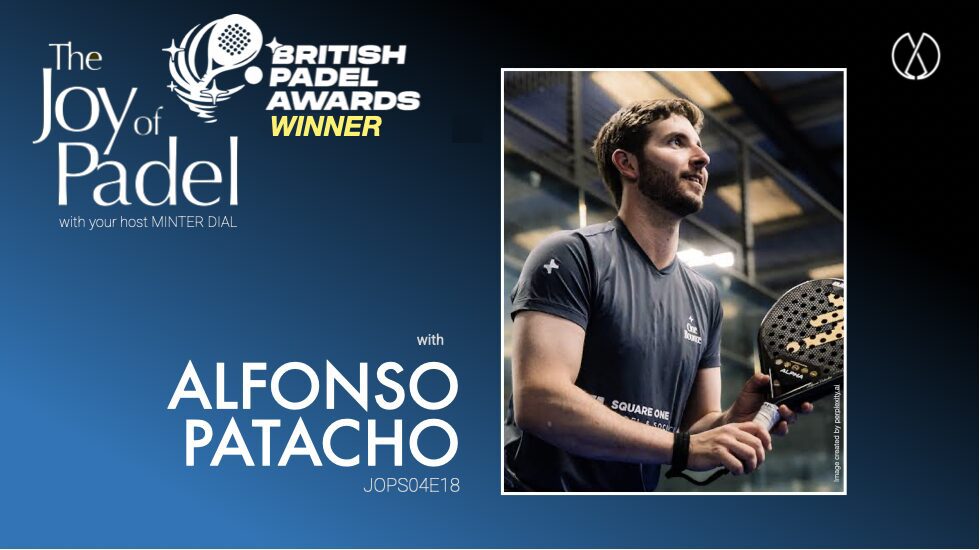
The Joy of Padel podcast with Alfonso Patacho (JOPS04E18)
On the latest episode of the JOY OF PADEL podcast, I was delighted to welcome Alfonso Patacho—one of the most charismatic and passionate figures on the British padel scene, and a player I’ve had the privilege (and challenge!) of facing on court. Alfonso’s story is as cosmopolitan as it is inspiring: with roots in Portugal, Spain, and the UK, he seamlessly blends Iberian flair with British tenacity, making him a standout member of Team GB’s padel contingent.
Background on Alfonso
People often assume from his name that Alfonso is pure Spanish, but as he explained, his heritage is a vibrant mix—Portuguese on his father’s side, English on his mother’s, and a childhood spent in Spain. Starting out in golf, a fateful shoulder injury to his father shifted his sporting focus to padel at age 12, and from there, he quickly fell in love with the game. What began as a casual switch with friends soon turned competitive; Alfonso found himself excelling through the Spanish junior ranks before discovering, thanks to a chance encounter, that he was eligible to represent Team GB. Famously, he helped secure a remarkable bronze at the Junior World Championships for Britain in 2015—a memory he holds dear to this day.Main Topics Covered
The conversation focused on Alfonso’s sporting origins and his approach to improving at padel—notably, how growth comes from both relentless training and the simple joy of playing. One concept discussed was the vital importance of “maturity” on court; Alfonso contrasted the impulsiveness of youth with the disciplined shot selection and decision-making that distinguishes top players like Tapia and Paquito Navarro. The discussion explored the balance between fun and effectiveness, especially in training, and why “showboating” needs to be backed up with practice and intention. Several points were raised, including the process of choosing sides and partners in padel, and the communication dynamic that exists between teammates—something Alfonso believes is lacking in the Anglo-Saxon padel culture. We delved into strategies for amateur improvement, from focusing on specific skills during games to actively seeking out new playing partners and embracing feedback. Alfonso also reflected candidly on the thrill (and pressure) of stepping onto centre court at the Premier Padel P1 in London—marking a milestone for British padel and for his personal journey.Three Takeaways from My Conversation with Alfonso
- Having fun is essential, but effective padel means balancing creativity with smart decision-making. Enjoyment on court is crucial, yet the best players know when to play the spectacular shot and when to keep it simple.
- Intentional play and communication drive improvement. Whether training or competing, focusing on specific areas, communicating clearly with partners, and learning from experience are the real keys to climbing the padel ladder.
- Joy and personal growth come from community. Mixing with different players, participating in socials, and sharing in the passion of events like the Premier Padel P1 bring not just better padel but lasting memories and friendships.
To find out more about Alfonso Patacho:
- Find or follow on Instagram: @alfonsopatacho_padel
To listen to the show:
To listen to The Joy of Padel podcast, you can use the embedded player above, or go find it on Spotify, Apple Podcasts or any number of other podcasting services listed here.
Send in your questions or reactions:
Please send me your questions — as an audio file if you’d like — to nminterdial@gmail.com. Otherwise, below, you’ll find the show notes and, of course, you are invited to comment. If you liked the podcast, please take a moment to review and/or rate it! ¡VAMOS!
Further resources for The Joy of Padel:

The Joy of Padel podcast, hosted by Minter Dial, a padel tennis player since 1974, is an exhilarating show that delves into the captivating stories of notable padel personalities worldwide.
Meanwhile, you can find Minter's other Evergreen podcasts, entitled The Minter Dialogue Show (in English and French) in this podcast tab, on Spotify, Megaphone or via Apple Podcasts.
About the host: Minter Dial
Minter Dial is an international professional speaker, author & consultant on Leadership, Branding and Transformation. His involvement in sports has been a lifetime passion. Besides playing 18 years of rugby, captaining athletics teams, coaching tennis and playing squash for his university, he’s been a lifelong player of padel tennis, starting at the age of 10, from the time of its very first public courts at the Marbella Club in 1974.
Then, after a successful international career at L’Oréal, Minter Dial returned to his entrepreneurial roots and has spent the last twelve years helping senior management teams and Boards to adapt to the new exigencies of the digitally enhanced marketplace. He has worked with world-class organisations to help activate their brand strategies, and figure out how best to integrate new technologies, digital tools, devices and platforms. Above all, Minter works to catalyse a change in mindset and dial up transformation. Minter received his BA in Trilingual Literature from Yale University (1987) and gained his MBA at INSEAD, Fontainebleau (1993). He’s author of four award-winning books, including Heartificial Empathy 2nd edition (2023), You Lead (Kogan Page 2021), co-author of Futureproof (Pearson 2017); and author of The Last Ring Home (Myndset Press 2016), a book and documentary film, both of which have won awards and critical acclaim.
It’s easy to inquire about booking Minter Dial here.
Full transcript of interview via CastMagic
This transcription comes courtesy of Castmagic.io an AI service for podcasters.
Minter Dial: Alfonso Patacho. You know, when you have a name like that, it does tend to sound rather Spanish, and, and, and yet you’re a GB. And, and so I, I was just thrilled at the idea of having you on Joy of Padel. I’ve had the chance, the privilege to play with you. I’ve watched you play at the FIP in London, uh, the Premier Padel P1. And, um, and I’ve watched you grow, and I wanted to have you discuss, as we do on The Joy of Padel, it’s really about learning about how to become better at padel. So, let’s start with just the game stakes. Alfonso, talk about, talk about who you are and how you got so invested in padel.
Alfonso Patacho: Well, everyone, everyone says my name feels, uh, Spanish, uh, but I’ve already had a couple people me either Italian, and my last name is actually Portuguese because my dad is Portuguese. Um, but I, I was born and grew up in Spain. Uh, mother from Hammersmith, actually very close to, to where we are, and dad from Portugal. Uh, and they both met in Spain and we grew up in Spain. And it’s very simple, to be fair. Like, my first sport was golf since I was 3. Um, that’s what my dad instilled in me until I actually wanted to be a professional golfer. Obviously, it’s not quite, quite easy. Um, and yeah, when I was— I think I was 12, my dad got injured, his shoulder. And you know, for playing golf, it’s not that easy with a bad shoulder. So, uh, we switched to padel. All my friends were playing it at the time, um, and I loved it. I wasn’t very good at the beginning, but I wanted, I wanted to get better. I did get better. And I ultimately ended up getting better than my friends and pursued a bit more of a career in not professional padel, but like the junior tour. And then in 2015, well, my mum realised that we could play for Team GB. We met one of my partners in the Spanish tour, and he was from Sotogrande, British. And so, then his mum— it’s Frankie Butt actually, he’s a coach of Padium now.
Minter Dial: Oh yeah, of course.
Alfonso Patacho: So, we played together in the Spanish Tour, but his mum realized that we could get a British team to the World Champs. And so, there we were, like Christian Medina was in the team, Sam Jones was in the team. So, I know those guys since 2015. And funny enough, Minter, we got 3rd in the world. We got the bronze medal in 2015 Junior World Champs.
Minter Dial: Fantastic. So, obviously that’s one of the highlight pieces that I’ve seen in your career. Talk us through how that came around. I mean, you wouldn’t expect GB to be number 3 in the Junior Worlds.
Alfonso Patacho: No, not at all, especially since we were struggling to get together a team. So, no, it’s that, you know, I grew up spending the summers in Sotogrande, south, very, very close to Gibraltar, and there’s a big, uh, English British community there. So, there were already a couple, uh, kids, guys like me that were playing, um, that were playing the Spanish Junior Tour as well. So, basically got a team together, we got there, and Marion Drini was the coach actually, and Matt Thomas, obviously now in Australia. And it’s the first time I ever left the continent, actually. Um, very, very long trip to Mexico. My mom came with me and my sister as well. Tía was in the— Tía Norton was in the girls’ team. And we— well, we played against Tapia first round. Me and Frankie played against Tapia.
Minter Dial: Wow.
Alfonso Patacho: Yeah, we got through group stages, obviously losing to Argentina, but we beat a couple teams, got through through to, um, groups, the quarterfinals, I think. And we played Brazil, who had never lost, uh, before the semis before that. And, and the, and the 4 teams had a very tough match, but they ended up winning it like 7-5 in the 3rd, if I’m not mistaken. And, and Frankie and I played a flawless match, and we won like 2-2 or something like that. So, we had qualified for the semis, and we had to play against Spain.
Minter Dial: Well, and you played against Spain, so that—
Alfonso Patacho: So, we lost against Spain. Frankie and I lost 7-5, 7-5. We were actually 5-2, 5-2 up in the second set. We had a couple—
Minter Dial: oh my gosh—
Alfonso Patacho: set points. Uh, so you can imagine everyone’s— everyone, everyone was quite stunned. Um, but I knew the guys. I had been playing against them in the, in the junior, junior tour in Spain. And yes, then after that we beat Paraguay, which was great for the 3rd place and bronze medal. So, you know, I think I still got the medal back home. My mom keeps it.
Minter Dial: All right, so when you played Brazil or Spain, the juniors, are there any names that are now in the top players?
Alfonso Patacho: Uh, yeah, obviously you got Tapia in Argentina. Uh, Tolito was, uh, was, uh, under-18s. I can’t remember. Yeah, and Christian will be able to tell you if he played against him. And then Spain, well, in the team there was Javi Garrido, uh, Pablo Castillo, lefty guy who I played against, Javi García, who’s now playing with— I can’t remember now— Alex Ruiz, I think he’s playing now with.
Minter Dial: Mm-hmm.
Alfonso Patacho: Um, uh, Yanguas was there, Arroyo was there, Edo Alonso. Who else? Javi Rico, Momo, Coki. Yeah, all of them. A lot of them.
Minter Dial: Wow. Well, that must be so much fun. So, let’s just— I want to, you know, circle back on playing against Tapia. When I play against you, Alfonso, it’s obvious how slow the ball comes to you.
Alfonso Patacho: Yeah.
Minter Dial: You, you feel like when you’re playing someone like me, for you, you’re like, all right, I see that ball a minute before it’s hit, I have a cup of tea, and then I’m going to hit the ball.
Alfonso Patacho: Okay, yeah.
Minter Dial: I have to imagine that’s a little bit how Tapia plays against most of his players today. What was your experience of playing against a player like Tapia? Did you see in him the world number 1 already at that point?
Alfonso Patacho: It’d be very, it’d be very, you know, cheeky of me to say yes. Of course you saw him as one of the best, uh, probably not when he was playing against us because obviously it was the first game, altitude in Mexico was I think hurting everyone, and it’s actually we lost 6-3, 6-1 I think. So, we had— no, we didn’t have a lot of chances on the first set, but we were a bit closer on the first set. You could see that they were a level up, but when you really notice is when they play against each other because they used to play the Open semifinals, and I remember Tapia and [Federico] Chiostri playing against Garrido and Pablo Castillo. That’s like a probably 3-hour match. And that’s when you realize that at that age, because Tapia is 1 year older than me, at that age they’re at a different level, especially maturity on court. For me, is that they’re older on court even if they’re the same age as you. I keep telling you—
Minter Dial: What does it mean to have maturity in padel?
Alfonso Patacho: Well, to just to, to know that you don’t have to go for a winner every single time, especially when you’re kids, right? You want the highlight, you want, you want to win, love and laugh destroying the opponent. But these guys are not scared to be on court for 3, 4 hours, just another lob, another overhead, another volley, setting up the point, right? Not, not trying to go for the winner that won’t happen.
Minter Dial: So, maturity is really about decision-making?
Alfonso Patacho: Yeah, and discipline. Yeah, which, uh, as kids not everyone has, but that’s why these guys have progressed better or earlier, because they were, they were able to adapt to those situations.
Minter Dial: So, Alfonso, you, you’re, you’re, you’re not a professional padel player in that you’re not dedicated to only playing padel to make money, correct?
Alfonso Patacho: Well, I also, I am and I’m not. So, I, I am And I, I also coach. So, yeah, uh, semi-pro, pro. I mean, I’ve played, I’ve played a P1, so I’ll call myself a pro.
Minter Dial: Absolutely. And I want to get into that. But, um, in, in terms of your progress and your game, how— what are the contours of making your game your game? What, what is it that you have done to allow you to get to the level you’ve got to?
Alfonso Patacho: So, first of all, a lot of training. Um, we— I’ve trained a lot ever since I was like 15 when I, when I, I was getting better and like playing for the county. Um, I actually, uh, represented my county a couple times. So, training a lot, obviously physical training a lot when you’re a kid. It doesn’t matter, you’re, you’re a monster anyway when you grow up. It’s when, when issues become. But I, if I’m being honest, I think what has made me, well, the, the player that I am today, or the way I play today, is first of all trying to have fun on court, uh, trying to make everyone enjoy watching you play, but mainly enjoying it myself. And I actually think, you know what, the 3 years at Uni that I spent without playing, barely playing padel because there wasn’t any courts in Leicester, I traveled to London a bit gave me again the maturity, maturity to play better. Like, it wasn’t anything that was padel-wise because I hadn’t trained as much. It was, it was just I had matured as a person, and therefore that translated into instead of winning the consolation when I was 15, 16, 17 in the UK tournaments which I came to play, I was already making finals, semis of Grade 2s, Grade 1s, but just by maybe not training so much because I was doing corporate, but just having that, you know, that growth that Uni gives you in Uni life and being away from your parents and managing your money and working a bit. So, you know, that, that I think is— there’s exceptions, but that’s, I think that’s what everyone will experience.
Minter Dial: The, the notion of Having fun on a court. Carolina Navarro, I had her on recently and she said one of the most important things for her in her entire career is having fun. And when you’re a kid, you’re trying to do the showboat, the magia, and that’s fun, but is it effective? So, how do you make fun effective?
Alfonso Patacho: I don’t know if you asked, if you asked Chris, maybe, maybe he has another, another, another view of this. Um, at the end of the day, you also train these shots during, during, during when you train, right? Like, you don’t just show up and know how to do the shots. Maybe sometimes just to get out of, of difficult situations, you end up doing difficult things, like difficult things that you shouldn’t do. you have to have a balance, like, and I found out, and that’s how I’m, I’m trying to play, like, you know, have fun. Like, I don’t know if you— I think you can see it in my, in my P1 match, like, I was having fun, but I wasn’t going for, like, sidewall boasts, uh, you know, under the, under the legs, everything, you know. I wasn’t going for crazy angles. I wasn’t going for— so I think you find the balance there, and it depends obviously who you’re playing against, but… But yeah, you want to try and find that balance of doing that shot that’s going to make everyone go, wow, but at the same time, you know, maybe not make that many mistakes with that shot, if that makes sense.
Minter Dial: Yeah. Well, the guy that really stands out for me in this regard is Paquito Navarro.
Alfonso Patacho: Yeah.
Minter Dial: Paquito’s ability to pull out— he’s got a very unconventional approach and But he’s not afraid to do that double boast, the between-the-legs thing. And you can see that he’s practiced those shots. And as much as they are wow shots and just completely out of the ordinary for the amateurs like me, you actually see that he’s controlling what he’s doing. He’s doing a lob between the legs, but it’s going to be a good lob.
Alfonso Patacho: Yeah.
Minter Dial: He’s going to hit that boast, that’s going to be painful to volley, even though it’s not your average shot, what you’re doing. But this notion of training, Alfonso, you who coach, you watch, develop yourself, it’s my observation that so many people prefer just to play and not train. And yet they get upset when they don’t improve. How do you— what’s the language that you think amateurs should be thinking about when they are trying to say, well, I actually want to improve?
Alfonso Patacho: So, uh, I’ve got a very— a bit of an opinionated mind about this. Um, I think— well, not very opinionated, but I think you have to have a mix. So, as in everything, you have to— you can’t only play and you can’t only coach. I am of the idea that coaching is great. You have to have coaching. maybe once a week, maybe once every 2 weeks, just to polish stuff. But your coach is not going to be with you every time you play. So, I think players need to do both things, don’t get me wrong, but focus more on playing. And when they’re playing, figure stuff out by themselves. If that makes sense. Like, what we tell people on court, it might not make so much sense during the lesson or during a match play, but when it happens a couple times— patterns, uh, the way you hold the racket when you go to the net, the way you prepare for the, uh, volley, the way you prepare for the overhead— it might not make sense. And it’s happened to me when I was a kid. Like, it didn’t make sense during training, it happened a couple times during the match, and that, that’s when things click. So, I am of the idea that for me, you need to figure stuff out.
Minter Dial: Well, so about coaching, if I may, it feels like it’s intentional playing. The way I, I listen to you, or the way I try to figure this out, is when I’m playing, I’ll say, what am I going to do? What am I— what do I need to work on? For example, I played today and I said there are 2 things I want to work on. I really want to work on my vibora. And there are 2 things I want to work on: having a little bit more bite on it, so a little bit more spin, and I also want to have more depth. I want to be focused on where the ball bounces so that it doesn’t— it’s not easy just to play a drive off it if it’s too short, but it’s not so deep that it comes, you know, ridiculously off the back wall and up and easy for the player to take on. So, I was like, that’s what I want to focus on while I’m playing. And is that the kind of mindset you’re thinking about?
Alfonso Patacho: Yes. So, obviously focus on a couple stuff and also play with intention. Don’t just play for having fun. If you want to have fun, that’s fine. But then don’t get angry at yourself when you don’t improve. But if you really want to improve, just focus, as you said, on a couple things. And then, you know, maybe it’s worth having a, you know, now there’s a lot of cameras around the court. maybe it’s worth filming it and having a look after. Um, but for me, you need to try and focus on, you know, where you’re playing the shot that is going to allow you to play the next shot, um, and then set up the point.
Minter Dial: All right, so I want to get into a few tricky things, uh, that, that a lot of amateurs struggle with, which is, for example, which side should I play on and who should be my best partner? When, when you, when a guy who says, right, I really want to play in some tournaments, some LTA, you know, in the Britain stuff, whatever, you know, lower-level stuff. Well, how do you provide advice on figuring out which side you should you play on? And what is your, the best type of partner for you?
Alfonso Patacho: Well, so first of all, it depends what kind of player you are. Right? If you’re a player that might not be that aggressive but have got great volleys, great overhead, great fitness. I would even say go on the right so you can set up the point a bit more to have a guy, say, like Chris, tall 3, very tall, that can finish the points, right? Or Louis. Um, and then if, if you think you can be a bit more aggressive, you know, go on the left, but maybe find a, find a, a lefty. find the lefty that can cover a bit more court, and then you focus a bit more. You can always— obviously, obviously you’re going to be aggressive, but you can focus a bit more on setting up the point. So, you end up being a right-side player on the left as well. So, you, you can have everything. And if you want to smash the crap out of the ball, just go to the left.
Minter Dial: Well, I, I was chatting with Adi Sanchez, and in my interview with her, she basically described herself as a more like a right-sided player on the left side because she doesn’t have the pounding left-side typical players. That’s why she always plays— Yeah, I find that. Yeah, she always plays with a lefty, just like you’re saying. And the tricky thing for me, Alfonso, is I’m obviously an old guy and I don’t have the power, but I feel better on the left and I feel like I have more diversity. I have— I can do a lot more on the left in terms of variety of shots. On the right, and you correct me if I’m wrong, it feels like you’re— you have your role, your role player. You’re— if you’re right-handed on the right, your role is to set up for your left-handed player to kill. And I— but yet I feel that you don’t quite have as many options when you’re a right-handed player on the right side. How do you live that?
Alfonso Patacho: Well, I just— you can’t put me as an example because I’m quite an aggressive right-sided player. So, leaving me out of the equation, I think when you’re on the left, as— let’s put you as an example. When you’re on the left, it’s fine, play on the left, but get someone lefty aggressive that can finish up the point for you. And then you end up being a right-side player on the left who can control the game, and then the other guy steps in and smashes everything. You can play with Adrian Ezra, and he’s also a member of Queen’s, you know, lefty. Yeah, easy. You set up the— you set up the points, he finishes them.
Minter Dial: Exactly. Well, I might need more like a Yanguas or Alphonse, but that show I think is more likely. Um, but what about choosing a partner? Uh, so you play with Chris Salisbury, and I’ve talked to a lot of the pros about this. You know, you’re— if you’re ranked 13th in the world, you’re unlikely to want to play with 30th in the world. So, that’s one thing. And then the second thing is, well, they play right, left, and that also limits who you can actually go after. And they also may even have already a partner. So, the challenge is finding the right partners and it’s different at different levels. But how do you go about architecting who’s the right partner for you and what sort of advice do you have for other players about finding the right partner?
Alfonso Patacho: Well, I’ve already played— I’ve played with Chris for so long that I can’t remember playing with someone else, you know.
Minter Dial: You’re not— you’re an old couple.
Alfonso Patacho: I’ve been— as I tell him, I’ve been with him longer than I’ve been with anyone else. Um, playing off the court? Yeah, on the court. Um, no, but so in this case, it was a bit random how we got together, but if I were to, let’s say, find someone else now, I would have to play with someone— maybe, you know, you’re not going to find anyone as tall as Chris, probably. Like, it’s going to be very difficult. But you’ll find someone that is able to finish a lot of points, like Chris is on the left in my case, because I can finish points. But at the end of the day, I’m a right-side player. I need someone to step in, and I can be very aggressive, and then you know, at the same time make him set up, set him up for the, for the point. And in an amateur level, I think it kind of translates the same, in my opinion. You obviously depends at the level that you’re playing, but I think the more, you know, you got to look at yourself before looking at someone else, if that makes sense. Look at, look at how you play, look at— and also, like, you know, if you get to know someone, if you have fun with someone, then play with them. So, I, I think people also like maybe overthink who they should play with instead of just getting on court and trying to improve themselves and having that communication with that and trying to have that communication with that player, which I think is quite important.
Minter Dial: I want to get to the communication in a moment, but let’s talk about your experience in London at the P1. Talk us, talk us through the arrival on the court, What, what was going through your mind and, and how did you handle that pressure?
Alfonso Patacho: Well, I was trying not to smile, uh, because— not to, not to smile because I was— I couldn’t, I couldn’t keep— I couldn’t, I couldn’t have— I could not have a smile. Like, I was trying to be serious and act serious and everything, but, but, you know, it was, it was everything, everything was just so new and so exciting that I was— especially when we were walking onto the court, that was you know, we were chatting, and me and Chris were chatting, and we’re trying not to laugh because, you know, it’s a situation that we don’t— we usually don’t have. You know, there’s walk-ins in like hop tournaments and, and everything, but it’s not quite the same that having— you know, I had all my clients, all my friends. Some friends flew over from Spain, and I was playing at the P1 centre court, you know, in your hometown. And I was the— and we were the first British pair to going on court. So, you know, you can’t really ask for anything more. Um, and I think, you know, every time someone mentions it— and I’ve had a lot of people where I coach asking me about it and telling me that they saw the game, the match, everything, which is unknown to me— it just puts a smile on my face. It’s as simple as that. Um, it was, it was, yeah, it was the best experience I’ve had padel-wise.
Minter Dial: Gorgeous. I write a lot, as you know, Alfonso, and one of the things I think about is managing energies. How do you manage? Do you control your energies? Because there’s you, there’s you and your partner in a context, in a situation. And, and one of the things that I feel is so important to good padel is to be present.
Alfonso Patacho: Let me, let me turn the lights on. One sec.
Minter Dial: Go for it. The night has come. The night has come.
Alfonso Patacho: Yeah, London summer is over.
Minter Dial: There you go.
Alfonso Patacho: Anyway, carry on.
Minter Dial: Yeah, so the notion of managing your energies, what are the— how do you manage your energies when you have so many things going on? The excitement, the emotions of the moment of playing in a P1. How, how was that for you, and how do you stay present?
Alfonso Patacho: You really don’t. I think, being very honest, you just learn that you’re going to, you’re going to have to cope with that, um, and you try and do your best in terms of, you know, you try and have a lot of, um, communication with your partner, with your coach when you’re on, when you’re on the bench, the same I think you can’t really like be that present. Don’t get me wrong, you can be present, but there’s so many things like you never have a camera on your face when you— especially a camera that has a mic. And I’m a bit hot-headed. And so, I was trying to also like keep my language PG as well. You know, you just try and focus as much as you can. And it’s not easy, but you— and enjoy the moment.
Minter Dial: Excuse me. Something that I feel is deeply missing in most of Anglo-Saxon padel is communication.
Alfonso Patacho: Yeah.
Minter Dial: It just, it’s, it’s astounding to me how little the Anglo-Saxons with whom I play, even I would say Spanish speakers who live in England, they don’t have that same sort of culture. of speaking. So, talk us through why communication is so important in a match with your partner.
Alfonso Patacho: Well, because you, you only have 2 eyes. You don’t have 3, 4 eyes in the back. You don’t have anything. So, you need— the more information you receive, if it’s transmitted correctly, the more or the better you can execute the shot. I try and coach it when I’ve got groups and everything. I know they’re already thinking about how, you know, how to prepare early, hit the ball in front of you, blah blah blah. So, to also have to listen to someone telling them, oh, um, Minter’s back, or Chris is forward, you know, I think it’ll just take time when they realize that the amount of games that they’ll, they’ll probably win or may— or, or be closer to winning just because you know, a lot of amateurs stay back when, when they lob. If you play to them, you can go back to the net. It’s as simple as that. Like, there’s, there’s no, there’s not a scientist. And, and I coach very successful people that I tell them, like, guys, you, you’re very successful, but this, and this is what’s going to help you be better at padel. Forget about so much technique. Maybe, you know, some people can even get the yips at some point. Just focus on knowing where to hit the ball. And that comes with communication, because if I’m preparing for an overhead, there’s no way I already know where they are. Simple as that.
Minter Dial: Well, I, I, my selling point is, if you don’t tell me, I’m going to keep my eye off the ball. And by the way, that’s probably not going to end up very well, because not, not if you can’t look at the ball, then how the Heck, do you actually hit it?
Alfonso Patacho: No, exactly.
Minter Dial: So, um, one of the things that I like to work on and bring to my partners and padel in general is the setting of communication. So, you and Chris have been playing for a long time, and you guys, I’m going to guess, have a fairly freaking solid understanding of what you each need, how you say it. But let’s say You and I are going to play together, and we have, but let’s say you and I have matched together. It’s an important match. How do you architect, you know, we’re just playing for the first time, how do you architect the calling pieces? What are, what is the mechanisms that you go into? Let’s say this is a serious game and you want to win.
Alfonso Patacho: Well, at the end of the day, so you always try and speak at least for a minute beforehand, or at least that’s, this is what I do is what do they prefer to receive as information? Do they prefer to receive names? Do they prefer to receive, say, down the line or yours or mine? Because if it’s yours, it would be his down the line, so it’d be my cross. So, you have to have a bit of a, you know, a bit of a conversation before, especially also to break the ice. And it’s as simple as that, you know, what do you like to be told? Names if we know the people, right, left, Or down the line, or yours or mine? Or, and then do you prefer to say, do you prefer me to tell you who’s back? Do you prefer to tell me who’s at the net? Do you prefer to tell me if they’re both back? If they’re both, you know what I mean? So, if I say nothing, what does it mean? Do they don’t move? Do they not move? You know, those kind of things. I think they come when you actually have a bit of a conversation before the match, you know. Yeah.
Minter Dial: Well, the one thing I regularly find complicated is when one is up and one is back.
Alfonso Patacho: Okay.
Minter Dial: And so, I think that’s the most complicated thing because both up, up, back, both back, that’s really simple. And that kind of goes with it. What’s complicated in a mental ability is, oh, Alfonso is up and Chris is back. So, I— what do you want to know? Do you want to know who’s back or who’s up? And, and you need to get a feeling from your partner what they need from you.
Alfonso Patacho: Yeah, in my case, I think it’s easier just say left, right, back. Whoever’s back, just tell me because I don’t want to have to think, you know, last thing I need is to think more about who am I going to hit into because if you tell me right is forward, I know I need to play to the left. But then that millisecond— I’m not a— listen, I’m not a psychologist, I’m not a sports psychologist, I’m, I’m just a player who can— who wants to optimize his time. And especially the more you think, the, the, the tired— the tired— the more tired you get. So, just tell me left back, I play to the left, we both move in, hopefully we win the point, end of story.
Minter Dial: Yeah, and I so agree with you because the, the idea of calling who’s up means that’s who I do not want to hit. And I feel like that’s just one extra thought, but a lot of the pros like that. And then there are other pros that actually tell them what they want to do. Like, I, I was listening to some, uh, I think it was Alejandra Salazar. She was calling the shot.
Alfonso Patacho: Contra pared.
Minter Dial: She was actually saying what shot to make to her partner, as in not just, you know, vibora. Oh, what? So, it can be very sophisticated, the communication, as opposed to taciturn, not saying anything. Do you feel like you can overcommunicate? Is that something that you feel too many people do?
Alfonso Patacho: Yeah, of course you can always overcommunicate. I don’t think it’s a bad thing necessarily, but if it’s going to confuse your partner, you, you know, you want to keep the information to a minimum. The thing is that, you know, we’re comparing amateurs to professionals, and professionals, they play one game a day, so all their efforts and all their focus is on that, you know. So, I might be able to see what the rebound is going to be better than, say, my partner who’s actually hitting the shot for whatever reason. So, you know, you tell them what do you think is better and then they choose, you know, they’re always going to have the last say. But yeah, you can definitely overcommunicate, um, it’s, it’s up to you to talk to your partner about that.
Minter Dial: So, I have to imagine, Alfonso, you watch the, the top pros play?
Alfonso Patacho: That I watch? I don’t watch them that often because I’ve already seen them since we were kids. I’ve actually played against all of them. We— I was actually watching the Madrid final, was it, here at home. But I don’t normally— I do watch it, I do watch highlights, and I do watch a bit, but, you know, not every single match.
Minter Dial: All right, well, my point was more about who do you enjoy watching. Do you find that there is a player that is useful for you to learn how to improve yourself, like a Yanguas on the right, or Yeah, yeah.
Alfonso Patacho: And I actually know him since we were kids, so, um, it’s very, it’s very satisfying, you know. I know Coello, Yanguas, all of them, uh, so it’s very satisfying to see them there, um, you know, glad that they’re there as well. But yeah, as a right side player and an aggressive one, Yanguas. Yanguas and Di Nenno a bit. I really like how Di Nenno plays. And then as a, as a spectator, Tapia. It’s my favourite.
Minter Dial: Yep. And, um, what’s your favourite shot, Alfonso?
Alfonso Patacho: It shouldn’t be this one, but it’s a backhand pop-out.
Minter Dial: Yeah, I mean, by the way, that’s not an easy shot to do.
Alfonso Patacho: That’s an easy shot to do?
Minter Dial: It’s not, it’s not an easy shot to do.
Alfonso Patacho: No, no, no, no, no, no, no, no, no. But I do, I do enjoy a good volley as well. Good volley I do enjoy. But yeah, my favourite shot is backhand pop-out, and if you ask anyone that knows me, then they’ll say the same thing.
Minter Dial: Yeah, well, what is it about— how is it— I mean, can you explain to me why the backhand pop-out is easier and more common than the forehand pop-out?
Alfonso Patacho: I don’t think it’s easier. I think, um, I think when I remember when I was a kid trying to do it all the time, um, and you know, it’s, it’s, uh, is the, the consequence to a great volley. is a consequence to being smart on court and, you know, kind of like reacting, knowing where the ball is going to go. So, you know, it’s the, the, the goal is to have the backhand pop out, but the setup before is as important.
Minter Dial: Okay, so I was misinterpreting. I was thinking the backhand pop out off a, a smash.
Alfonso Patacho: Oh no, no, no, no, no, no, no, no, no, no, no, no. I mean, yes as well, but no, the one, the one that comes, you get close to the net and you Just snap it out.
Minter Dial: Yeah, snap it out. Well, I mean, such anticipation in that shot. Yeah, it’s, it’s a tremendous shot. All right, so Alfonso, um, someone who wants to learn more about padel, what would you advise them to do? Is there— would you say watch pros, uh, come and train with you? What— how do— how does someone uh, who, who says I want to improve tomorrow, what, what do they need to be— what’s their regime they should be thinking about?
Alfonso Patacho: Well, in my opinion, other than the training, they need to play with different people. You need to have that variety and play with everyone, not just your group of friends, which is great, you know, you have a good time. But if you really want to improve, go to socials. You know, padel’s growing so much in the UK, everyone’s helping it. Like, you know, the LTA are doing great things. There’s so many courts now. I mean, you know, I get it’s expensive, but there are socials that you can go and play. So, many new courts popping up. So, just go do the socials. It’ll be a great way of meeting new people as well. Uh, but yeah, play against a different variety of players, not just one.
Minter Dial: All right, so this is the Joy of Padel.
Alfonso Patacho: Can you remember one particular moment which brought you tremendous joy Well, other than every time you’re selected to play for Team GB, I think is when they told, they told us that we had the wild card for the P1.
Minter Dial: Beautiful, Alfonso. How can someone follow you? Where, what are your socials? Where would you like to go?
Alfonso Patacho: Where are you training? Um, so I train, I train at various clubs. And people can just, you know, my first name and last name underscore padel. That’s where you can find me. And, you know, just support GB who’s playing to qualify for the World Champs in Qatar, the girls and the guys.
Minter Dial: I plan to be there. Alfonso, muchas gracias. Been a pleasure.
Alfonso Patacho: Thank you very much, Minter. Pleasure.