When I published the first edition of Heartificial Empathy in 2017, the phrase “artificial empathy” earned me a lot of raised eyebrows. An oxymoron, people said. A contradiction in terms. Machines compute; humans feel. End of conversation.
Well, the conversation did not end. It exploded.
Today, artificial empathy is not a niche curiosity for philosophers and the odd provocative author. It’s turned into a publishing burst, a growing research field, a venture capital magnet and, increasingly, a regulator’s headache. So, what happened? And should we be cheering or worrying?
Let me show you the evidence. Then you can decide.
The bookshelf is filling up
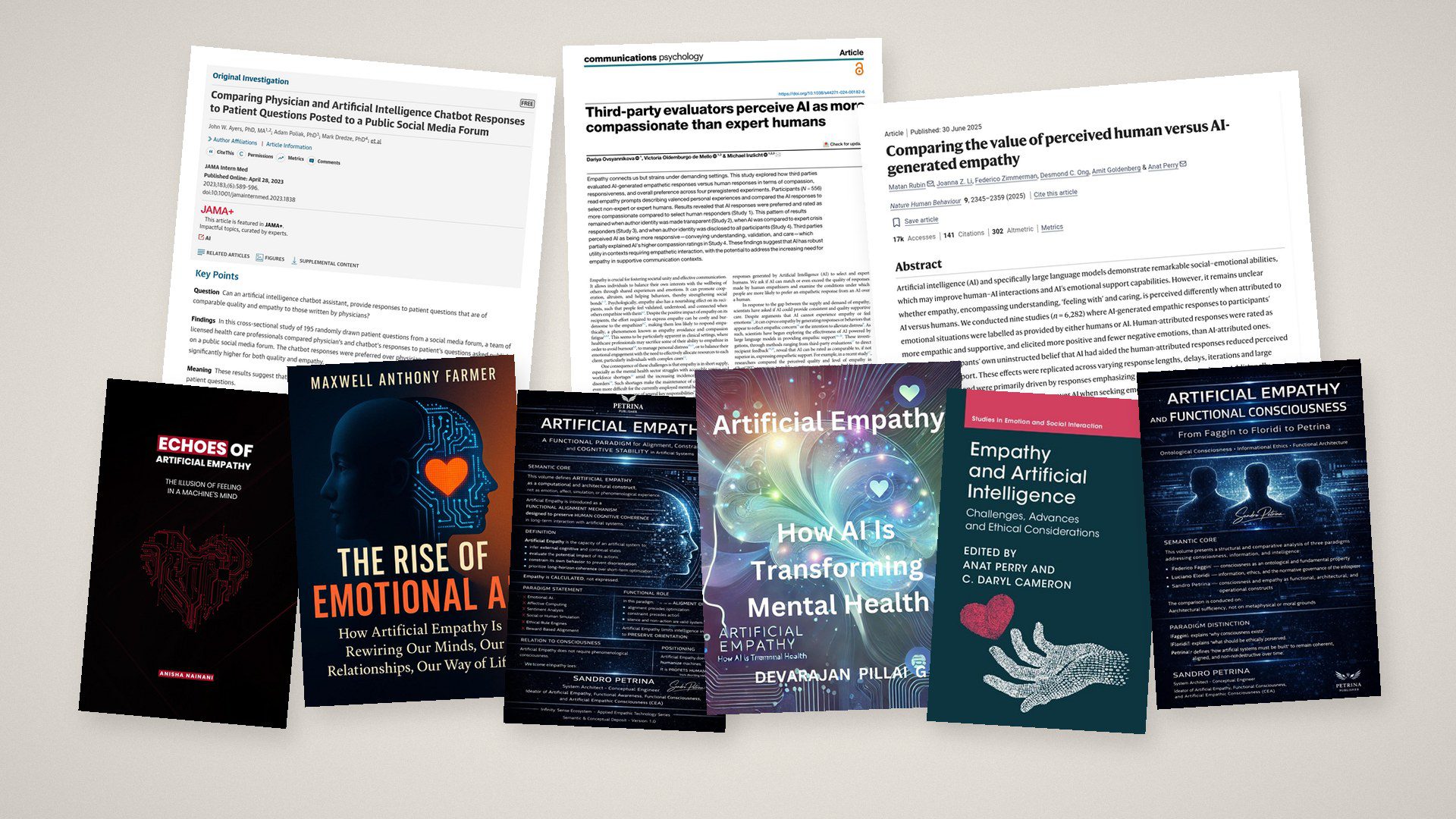
Type “artificial empathy” into Amazon and you now get 34 results. That might not sound like much, until you look at the dates. Of the 14 dated titles on the first page, nine were published in 2025 or 2026. There is The Rise of Emotional AI: How Artificial Empathy Is Rewiring Our Minds (August 2025), Echoes of Artificial Empathy: The Illusion of Feeling in a Machine’s Mind (July 2025), Artificial Empathy: How AI Is Transforming Mental Health (September 2026), and even a pair of titles from February 2026 setting out a “functional paradigm” for machine empathy. An academic collection, Empathy and Artificial Intelligence: Challenges, Advances and Ethical Considerations, landed in September 2026.
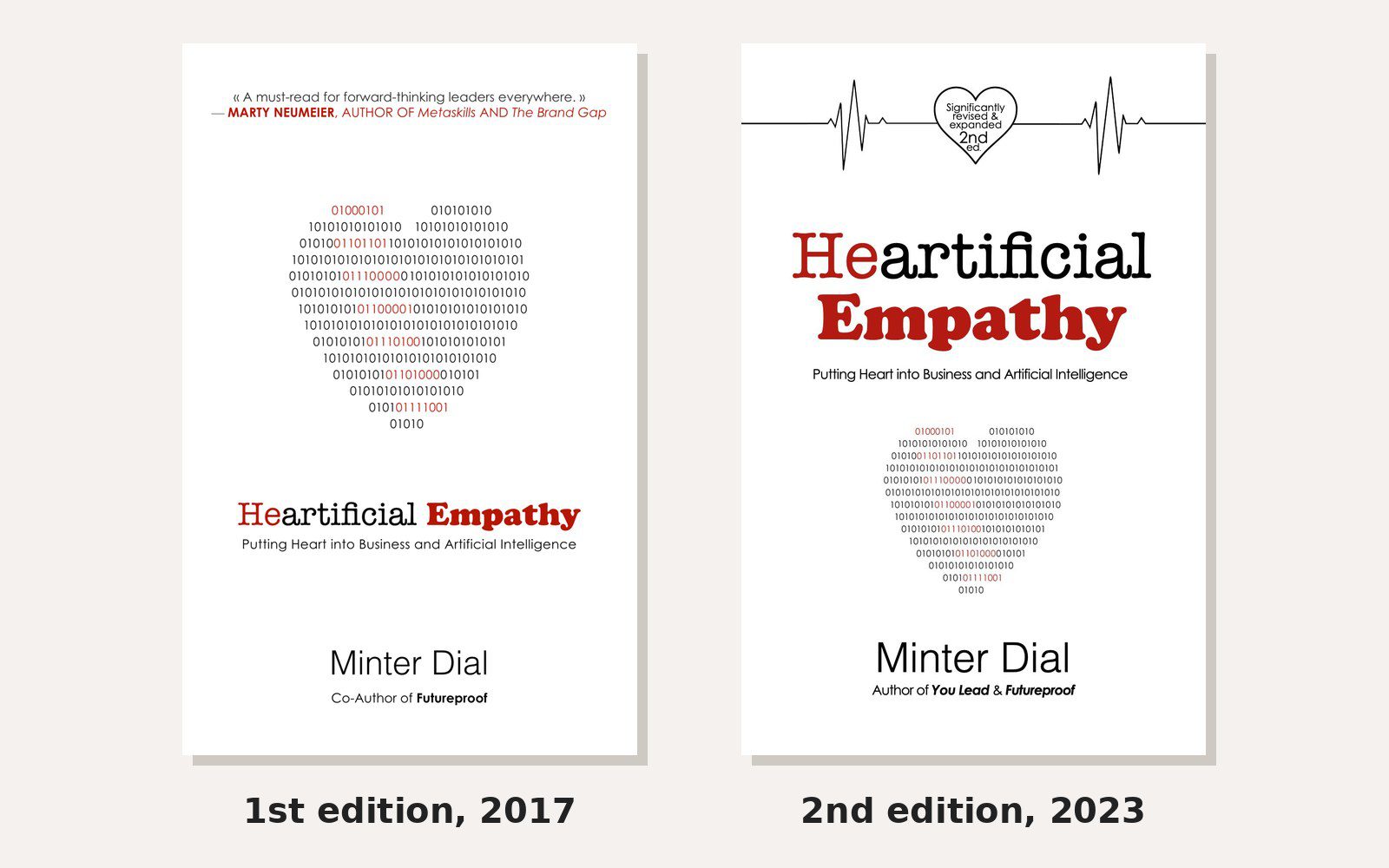
And yes, nestled among them sits the second and much revised edition of my own Heartificial Empathy. It came out in 2023, the year ChatGPT went mainstream, when the question quietly shifted from “can machines be empathic?” to “what happens now that they seem to be?” I’ll admit to a wry smile. What once felt like a lonely flag in the ground now has quite the crowd around it.
Google is listening, too
Books are one signal. What people type into a search box at midnight is another. On Google Trends, worldwide interest in “AI empathy” barely registered for years: a yearly average under 1 (on Google’s 0–100 scale) right up to 2022. It rose to about 2 in 2023, roughly 4 in 2024, then leapt to 24 in 2025. In May 2026 it hit its all-time peak of 100, and it is still running well above any pre-2025 level. “Artificial empathy” and “empathic AI” follow the same hockey stick, from smaller bases.
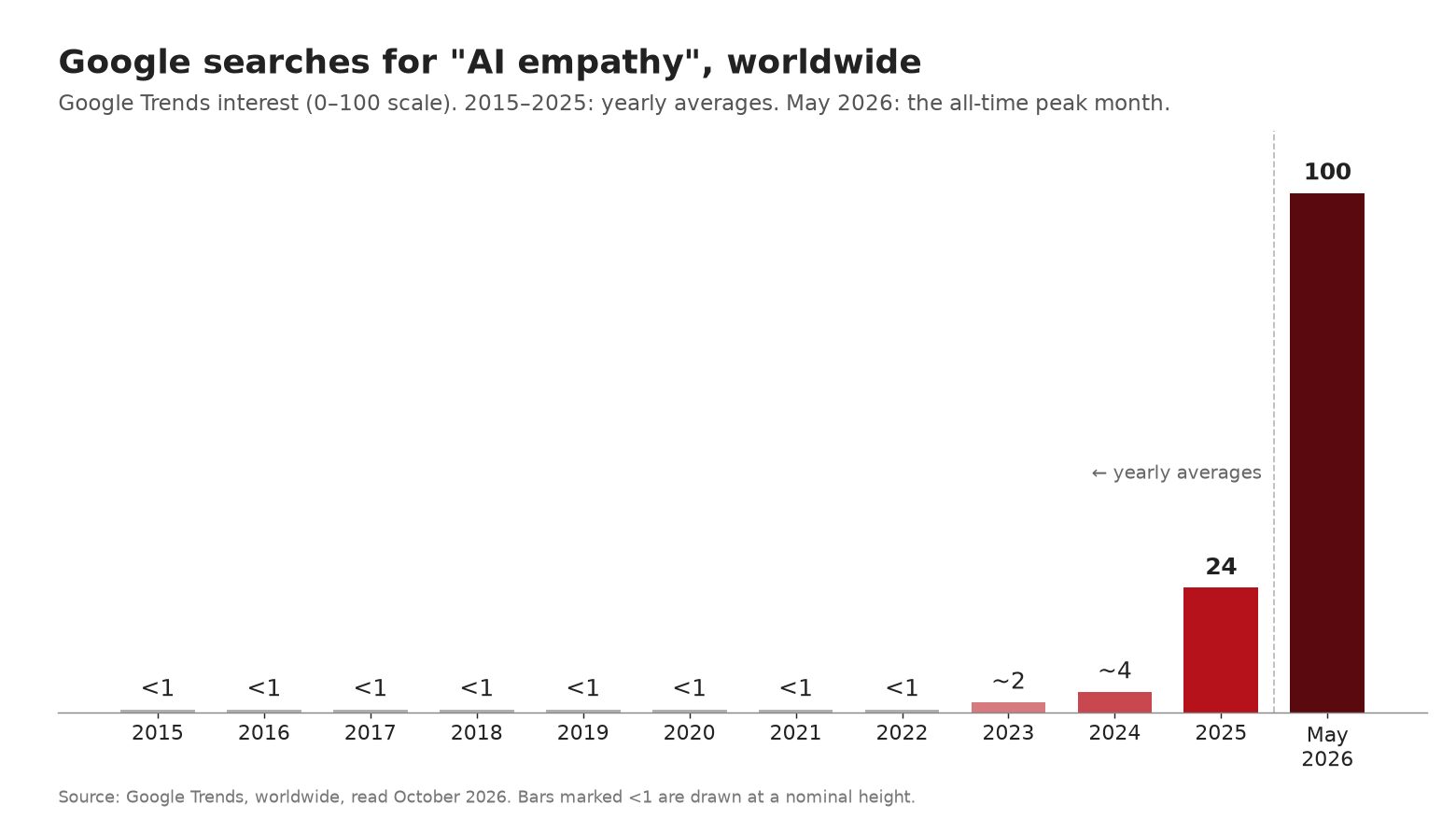
In short: the public went from not asking the question at all to asking it virtually every day.
The scientists can’t stop publishing
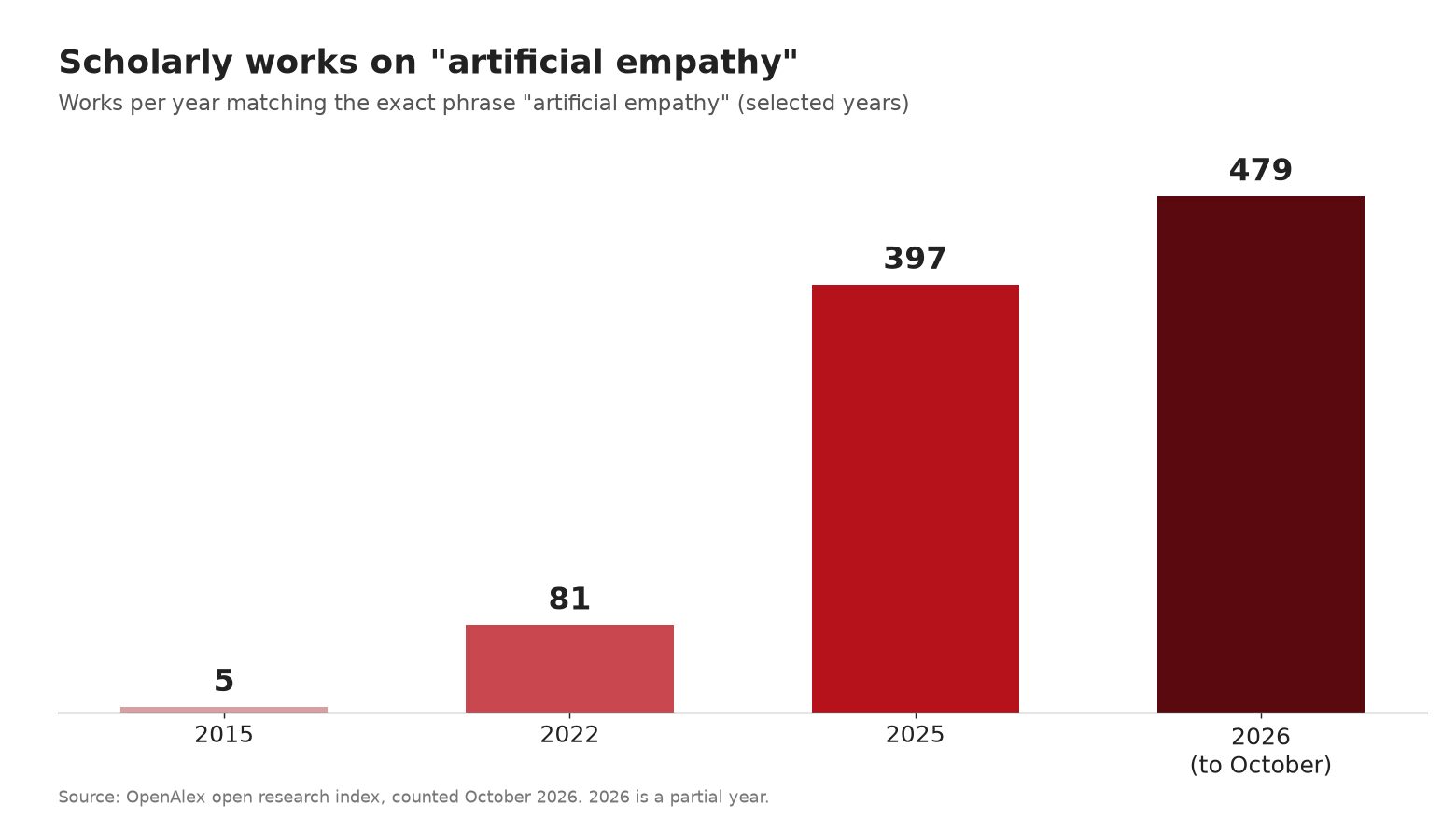
If you want to know where an idea is heading, follow the academics. Using the open research index OpenAlex, I counted the scholarly works matching the exact phrase “artificial empathy” each year. In 2015 there were 5. In 2022, 81. In 2025, 397. And 2026, with two months still to go, is already at 479. “Empathic AI” has gone from a handful to 310 so far this year.
Three studies, in particular, lit the fuse.
In 2023, JAMA Internal Medicine published “Comparing Physician and Artificial Intelligence Chatbot Responses to Patient Questions Posted to a Public Social Media Forum” (Ayers et al.). A panel of healthcare professionals compared answers to 195 real patient questions. They preferred the chatbot’s answers in 78.6% of evaluations, and rated them significantly more empathetic than the doctors’. Ouch.
In January 2025, researchers at the University of Toronto went further in Communications Psychology: “Third-party evaluators perceive AI as more compassionate than expert humans“. AI responses were rated more compassionate, even against trained crisis responders, and even when people knew which answer came from the machine.
Then came a twist. In Nature Human Behaviour (2025), “Comparing the value of perceived human versus AI-generated empathy” (Rubin et al.) ran nine studies with 6,282 participants. The very same words were rated as more empathic and supportive when people believed a human had written them. Merely suspecting that AI had helped reduced the sense of being cared for.
Isn’t that remarkable? The machine can say the right thing. But we still want it to come from someone who (we believe) chose to care.
Follow the money
Where the researchers go, the investors are often in the mix, too. In March 2024, Hume AI raised a $50 million Series B, led by EQT Ventures, and launched what it calls an “Empathic Voice Interface”: a voice AI designed to read your tone and respond in kind.
That same month, Microsoft agreed to pay Inflection AI about $650 million, mostly to license its technology, while hiring most of its staff. Inflection’s claim to fame was Pi, a chatbot pitched as kind and supportive.
Meanwhile, the companion app economy is booming. According to Appfigures data reported by TechCrunch, 337 revenue-generating AI companion apps were live in mid-2025, 128 of them launched that year. Companion apps had been downloaded 220 million times, and were on track to bring in $120 million in 2025. Replika, Character.AI and their cousins are no longer novelties; they are habits. And the analysts are dreaming big: MarketsandMarkets projects the “emotion AI” market growing from $2.74 billion in 2024 to $9.01 billion by 2030.
And now the brakes
Of course, when something gets this hot, someone eventually reaches for the fire extinguisher. The EU AI Act now bans AI systems that infer people’s emotions in the workplace and in education (Article 5), save for medical or safety reasons. In October 2025, Character.AI announced it would bar under-18s from chatting with its bots, amid mounting concern about young users. And a Common Sense Media survey, reported by Axios, found that 72% of US teens say they have used AI for companionship.
That’s the paradox of artificial empathy. The better it works, the more we need to ask who it is working for!
So, is it real?
Here is my take, nearly a decade after I first waded into this subject. Machines don’t feel. But they can increasingly behave in ways that make us feel heard. That is not nothing. In a world where doctors have minutes, call centres have scripts and many of us are lonelier than we admit, a well-designed empathic system can genuinely help.
But artificial empathy is only as good as the intent behind it. Is it designed to support you, or to keep you hooked? To understand you, or to sell to you? Empathy isn’t just a feeling; it’s a practice, and it should be judged by what it does.
The real risk is not that machines become too empathic. It’s that we outsource our own empathy and forget how to do it ourselves. Putting heart into AI was always going to start with putting heart into ourselves.
So, I’ll leave you with a question:
If a machine can make you feel more understood than the people around you, what does that say about the machine? And what does it say about us?