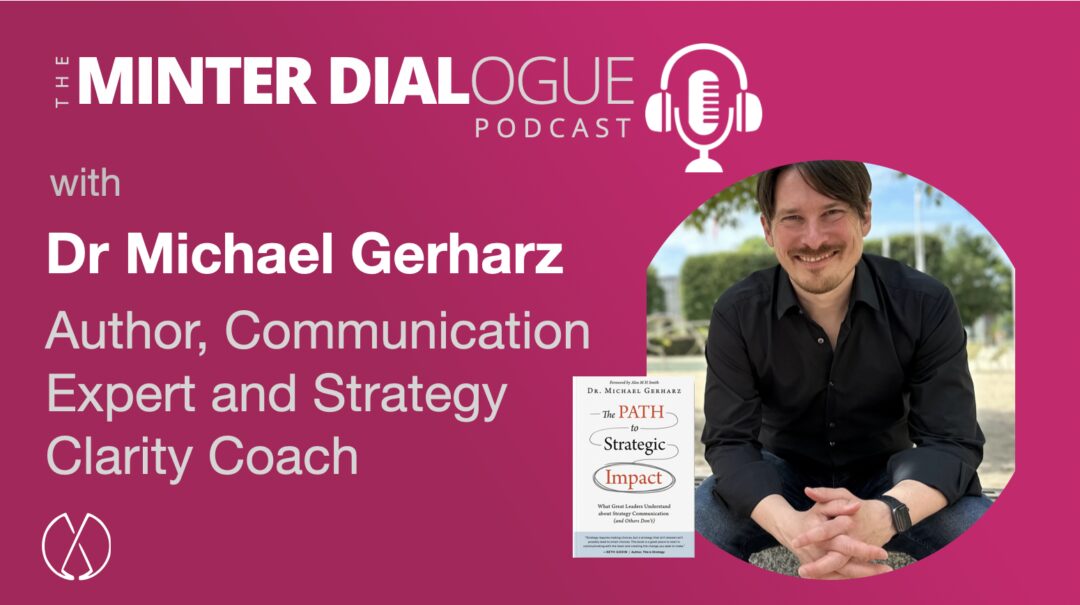
Minter Dialogue with Dr Michael Gerharz
Dr Michael Gerharz is a communicator and author with a unique perspective, bringing together the rigour of computer science and a passion for impactful human connection. I was delighted to welcome him onto the show as we share both a background in guitar and the journey of writing books. His latest work, “The Path to Strategic Impact,” explores how leaders can find the words that truly resonate—be it in strategy announcements, investor pitches, or pivotal speeches.
Dr Gerharz started his professional life with a PhD in communication systems (machine-to-machine, as it happens), but soon grew frustrated by seeing great ideas lost—not due to their quality, but because nobody found words that brought those ideas to life for others. Over the years, he has championed the importance of clear, empathetic, and meaningful communication in the workplace, helping leaders to bridge the gap between correctness and genuine understanding.
Our conversation explored how lessons from programming inform human communication, why culture and strategy intertwine, and how melody and message can both shape lasting impact.
3 Key Points:
To connect with Dr Michael Gerharz::
- Check out Dr Michael Gerharz’s eponymous site here
- Find/buy Dr Michael Gerharz’s book, “The Path to Strategic Impact,” here
- Sign up for Michael’s newsletter here
- Find/follow Dr Michael Gerharz on LinkedIn
- Find/follow Dr Michael Gerharz on X (formerly Twitter)
Further resources for the Minter Dialogue podcast:

Meanwhile, you can find my other interviews on the Minter Dialogue Show in this podcast tab, on my Youtube Channel, on Megaphone or via Apple Podcasts. If you like the show, please go over to rate this podcast via RateThisPodcast! And for the francophones reading this, if you want to get more podcasts, you can also find my radio show en français over at: MinterDial.fr, on MegaphoneFR or in iTunes. And if you’ve ever come across padel, please check out my Joy of Padel podcast, too!
Music credit: The jingle at the beginning of the show is courtesy of my friend, Pierre Journel, author of the Guitar Channel. And, the new sign-off music is “A Convinced Man,” a song I co-wrote and recorded with Stephanie Singer back in the late 1980s (please excuse the quality of the sound!).
Full transcript via Castmagic.io
Transcription courtesy of Castmagic.io, an AI full-service for podcasters
Minter Dial: Dr. Michael Gerharz, great to have you on the show. We’re fellow guitar players, fellow authors, and excited to talk to you about your book, The Path to Strategic Impact. But before, as I always do, Michael, I always like to ask, who is Michael Gerharz?
Michael Gerharz: Well, I’ll keep it short. I’m— I help I’m Michael. I help people find the right words for the moments that count, like the strategy announcement, like the investor pitch, the first speech in the new role, or like that keynote that hopefully people keep on talking about long after you’ve gone from the stage. So, that’s who I am today.
Minter Dial: Well, your book came out in 2024. What was the stimulus for you getting into it? And perhaps maybe draw in your background, how you came to have a PhD and launched into this topic?
Michael Gerharz: Well, my PhD is actually in a completely different field. Like, it sounds similar on first sight. It’s in communication systems, but of course that means machine-to-machine communication. So, I’m a computer scientist originally. My PhD is in mobile communications. And like, the reason I like Took a different path later on was like basically sheer frustration with all the great ideas that I’ve seen being thrown into a trash bin back then. Like I was around when the mobile revolution was in full steam. Like my research was actually like when I was a student, my master’s thesis was actually about Bluetooth when it was still a prototype thing. So, I was around when these things hit the market and like. Well, I’ve seen, like most of the listeners here, all the great ideas that have made it, but I’ve seen many more great ideas that haven’t made it, and that wasn’t because they were inferior. It was often because people just didn’t care for finding words that made other people care as much. Like, they, like, in part trusted that the idea would win on their own. They thought it was the audience’s job to, like, understand them, or sometimes it was just like that nobody, no one ever told them like to look for those words, that this is even possible. Like we all have certainly had a mentor in our lives who told us that like this is just the way that presentations have to be, like the boring PowerPoint presentations that are today also the death of many strategies, like the root of where the book came from, like because that’s the same thing that today happens with strategy, or that back then it did too. what still happens with strategies today. Like, that this is the thing where so many people pour so many, so much passion into, like, so much blood, sweat, and tears, and then, like, the communication is just an afterthought, and often it leads to, like, the strategy being thrown into trash bin once again.
Minter Dial: So, Michael, going back to your past in communication systems, I can’t help but think that somehow informed this idea. Why? Because when you give a prompt to a computer, if your words aren’t accurate, although it’s now becoming much more able to do with natural language processing, but in general, if your words in the directions aren’t simple and in the right order, if you will, it’s going to screw up the execution for the machine. And where my work has overlapped in that is I’ve been very deep into thinking about how to encode empathy into a machine, which requires context. It requires manipulation of words to get to the right meaning to understand what the other person’s thinking and feeling. So, as a person, to what extent does that resonate with you?
Michael Gerharz: Well, this is so spot on. Like, it put a smile on my face when you started talking about this because this is so true. Back in the day when programming was still literally manual programming, writing code that the computer was to interpret and then execute, it would happen when you started that you would get mad at the computer. It just doesn’t do what I want it to do. But in the end, what happens is that you only can get mad at yourself because the computer only does what you ask it to do. And so, when it doesn’t do what you want it to do, it meant that somehow your code wasn’t accurate enough. It didn’t say what you meant to say. And this is a tough school to go through that. It just— keep calm, look at the code, ask yourself, so what did you say? And that is something that in a way transfers very well to human-to-human communication. We tend to get mad at the other side for not getting us despite us having it explained 3 times already, and so we’re going to explain it once more, slower, louder, but it won’t change a thing because, like, it’s still the same confusing words. Like, we need to understand, like, what did they understand? What, what, what, what, what went through? How did they understand the words that made somehow completely different sense to us than it did to them?
Minter Dial: One of the things that I’ve observed is, well, if I go back to my computer days, because I’m much older, but so I was back in the world of Pascal and C++ and all that kind of malarkey. But you would say something like an order. Why don’t you go to the next room? Let’s say you want to say that to somebody, but what you actually have to say is, why don’t you get up from the chair that you’re in? Walk one leg in front of the next, and then put your hand on the knob of the door, open the door, go through the door, and then you’re in the next room. And the process of thinking through what the machine is needing to think about is somewhat similar to the orders that we might give in a business.
Michael Gerharz: Oh, just go do it.
Minter Dial: Make the customer happy. Well, that’s delegation in another word, but otherwise, are the bounds correctly given? Is the order understood?
Michael Gerharz: Yeah, there’s actually a fun experiment that my wife does. She’s a teacher and one of her topics is chemistry, and she tries to give her students a feel for what it means to describe a proper experiment and do it properly. And so, she will ask them to give her instructions to smear chocolate cream on a toast, and she will do exactly what her students tell her to do. And this is always— it ends in hilarious laughter because they always forget things. They always don’t take into account what someone else could hear or what someone else could miss. And so, this is real. This is not just a thing that we need to think about with computers. And we’ve all been in that situation where we’ve gone into a fight or an argument because we thought we were clear and the other person just didn’t get it when all we had to do is flip our perspective around, sit in their chair for just a minute to see that no, there was no way that they could understand what we said in the way that we meant it.
Minter Dial: So, Michael, I want to dig in on strategy and communication. That’s obviously the big core of what we want— we should be talking about. However, before we do that, I think it’s important to lay down what you believe or how you react to the statement that’s been trotted out for 50 years by Michael Drucker, that culture eats strategy for breakfast. Whether or not he said it is not important, but the concept of culture having a dominion over whatever you say, or at least in strategy, how do you react to that?
Michael Gerharz: So, my gut reaction to that is, that what ultimately matters is whether we as a team, as a company, as a group of people make progress in a direction on a path that makes sense for all of us, like in a direction that we want to go as a team, but also as individuals. And we want to go, we want to get there faster. And whether we call it strategy or culture or whatever gets us there, is less important than the fact that we make progress on there. Like, ideally, we, we wouldn’t need strategy because, like, the culture already informs us what is the next step. But then again, we will have, like, complex situations where it’s just useful to have, like, a common measuring stick. Like, when, when we get at a crossroad, like, How do we make a choice, or how can anyone make a choice on behalf of the team without everything having to circle back to the CEO or to the top management? What are the rules? And that is, if done properly, it’s almost indistinguishable. A great strategy in some way becomes part of the company’s culture because the way that we make choices along, along the, along our path, like, becomes so deeply ingrained in how we think that it’s like part of the company’s culture. And I think that is strategy done well, when we have built these, communicated these rules so well that there’s a chance of it becoming like part of the company’s DNA.
Minter Dial: So, I must ask then, what is your definition of strategy? How do you Who put that out in a way that a layman could understand?
Michael Gerharz: So, the way that I see strategy as a useful tool for a company is that it is a commitment to how we make choices in situations that we haven’t perfectly understood before they encounter, like in uncertain conditions. Like when a customer rings up and is mad at you, what do you, how do you react? When we start a new project, how do we set it up? Like when a competitor launches a new product that like somehow threatens our market share, how do we react to that? And a commitment to how we do that without having to like go onto a project to analyze this for 3 years for every single situation. We commit to this once. How do we make choices? And ideally, in a way that it’s not only the CEO, but it could also be the intern who makes the decision because they understand how those choices are made.
Minter Dial: Hence the importance of strong communication throughout the organization.
Michael Gerharz: Exactly.
Minter Dial: Michael, I think it may— it’s fair to say, or maybe you can correct me if I’m wrong, but implicitly you talk about, or you distinguish being correct and being heard. So, the question then is, how does a CEO recognize the breakdown being a question of the quality of the idea that I’m expressing, being correct, or the quality of my way of expressing it, being heard?
Michael Gerharz: We’ve all seen that happen, right? I mean, the team, the leadership team comes home from that strategy retreat, and they’ve brought a couple of strategy consultants, and they’ve made something up that’s based on solid analysis. The data was all there. It’s a solid It’s a solid solution that we found. We all believe in it, and we communicate it using the strategy consultant’s language. And you go on to the town hall to announce it, and nobody gets a word from the 35-slide strategy deck. So, despite all of it being correct, so despite all of the— you followed all the rules from the great books and from your intuition, it all makes sense to you. But the people who are tasked with bringing it to life, who have actually to— who are— who have to put it into work actually next morning, they don’t know what it means when you speak about like spearheading the efficiency revolution in the logistics industry. They have no clue what it means, although that’s the correct strategy. That’s what we need to do in order to win in the market. And so, the, the more important question that we need to ask is not, is it correct, but do the people that we ask to walk the path with us, to actually put it into action, do they know what that means for them in terms of actual things they need to do differently tomorrow?
Minter Dial: All right, so this is getting down to the nuts and bolts of the question here, Michael, because obviously when you’re a team of 3, you know, let’s say a startup or something. It’s somewhat simple, hopefully, to be understood and test.
Michael Gerharz: Maybe.
Minter Dial: I say hopefully.
Michael Gerharz: Yeah.
Minter Dial: Because it’s certainly a far cry from when you have 20,000 people to figure out whether they heard you correctly. So, the— and then I’ll just break this down further. Of the people in front of you that you’re talking, one will be maybe from finance, one from marketing, one from sales, HR, and all the other different functions, maybe even third-party suppliers. And they all have other tensions and attentions that they will, that become their filter for whatever you say, however clearly you think you’re saying it, it lands differently. So, how, how, I mean, even in the, let’s say the small team where you have your 3 people, so it’s manageable, and then think about the scaled version. How do you understand how it’s landing? How, what, what sort of meaning The people are making of what you said?
Michael Gerharz: That’s one of my favorite questions, and I get it quite frequently because, like, yeah, as you said, that’s the nuts and bolts of it. Like, yeah, you can want it as much as you want, but, like, but do the people really understand it? And the question that I like to ask back is, have you asked them? Like, Did you have the conversation with the people? Um, and did you shut up when you had the conversation, when, when you asked them, like, and just listen to what they understood when you explained it to them, how they understood it, what, what’s like, what’s on their mind, what troubles them? Because that, that’s often what happens. Like, we— So often, like, these words are to communicate the strategy are looked for in a meeting with closed doors. And we think that we can find those words by thinking harder. Like, what are the most fancy words or the most grandiose or most ambitious words to communicate that strategy, to really wow the team, to really get them behind, rather than have the conversations? And I think that that’s a crucial flip. Like, the right words aren’t usually found by thinking harder. They are found by listening better, having those conversations, and listening for the words that have actual meaning for the people that we’re communicating to, or ideally with.
Minter Dial: Well, of course, in reality, what that means, Michael, is having the time, carving out the time, making the time. Because it’s one thing just to say, go, go next door, as I was saying before, go next door, quick and easy. And maybe you should explain why I want you to go next door. Well, I want you to go next door because of this, but then to have the time to say, all right, so what did you hear I said? And if you have, let’s say, a town hall with, let’s say, 500 people, what did you hear? It becomes difficult because you is a bunch, you know.
Michael Gerharz: Exactly.
Minter Dial: And, and then you can, if you have the time, you say, well, you heard this. Oh, well, I heard something differently over there. Okay, so now you start getting pattern recognition and helping you as the person who’s leading the story. And then the other thing I was going to say is that I, because I was, I ran a fairly large company, 2,000 people, and the challenge was not to bore myself in repeating myself. So, I would like to shift it up so that I felt I was more energetic. more original, if you will, in my storytelling. Because if I just said the same exact words of the same exact story day in, day out, I, I felt like it was impossible for me not to be or sound like a robot.
Michael Gerharz: Hmm. Truth. True story. And I see that happening all the time. Like, that, that’s a complaint that I hear so often, and like, I can fully resonate with it. Like, coming from a research background, like, we’re always looking for the next boundary. Like, we’re quick— we’re quickly bored with that, and we feel like people are bored too. But here’s a thought. Like, think about We Will Rock You by Queen. Got it?
Minter Dial: Indeed.
Michael Gerharz: I’m pretty sure you have the melody already ringing in your head. I’m not so sure that you can immediately like repeat the second verse.
Minter Dial: Um, well, the one goes—
Michael Gerharz: Yeah, what did they—
Minter Dial: what did they do?
Michael Gerharz: Freddie actually sing there? Like, um, so, and, and let’s just imagine that Queen decided that they were— that, that they would get quickly bored by repeating the refrain. Like, they decided that, like, they sang it once and everyone should be able to understand it. Like, we will rock you and call it a day. Like, move on to the next verse. And I think that’s exactly what happens in many strategy announcements or many presentations per se. Like, that we think, like, we’ve said it once, It should be clear, so we don’t have to repeat it. And so, we add another verse and another verse and another verse, another chart, another feature, another caveat, another special case, and forget to— whenever we’ve done it, whenever we’ve sung the new verse, to repeat the refrain so that we can fill it up with more meaning. And like make it that thing that over time through repetition becomes the beloved song that we, that we all always, despite having heard it a thousand times, turn up the volume on. But when We Will Rock You comes up on radio, almost everyone I know turns up the volume and they sing along. They don’t get bored. And that’s the thing, like we get bored by the things that don’t mean anything to us, that are not close to us. But the things that have meaning or that have become a meaningful part of our lives, those we don’t get tired of. We smile when we hear someone repeat it. Like, we send— like, the same is true, like, for, for the, for the clips that you see on Instagram or YouTube when, like, one of the famous influencers, like Let’s say Brené Brown posts another video saying the same thing about vulnerability she’s said like 500 times. The audience likes it and they will pass it to someone they know thinking, that’s exactly what I mean. And I think that’s a much better model for— to think about repetition and being bored. Like, have we found something that really means something to the audience? And then if it does, we can repeat it over and over and they won’t get bored about it.
Minter Dial: Well, so you and I, before we recorded, uh, mentioned our mutual enjoyment of the guitar and, uh, and, and musicians. And there’s crossovers between musicians, music, and, and leadership, as we were thinking about. And it reminds me about Van Morrison, who, um, no longer ever wants to sing Brown Eyed Girl. So, don’t ever ask that if you ever— if he’s still alive and still performing, if he’s— if he’s— he can hear you because he’ll get very upset. However, the idea of making the song or the message you have repeated over and over again, it becomes part of a mantra, becomes part of your culture, as you were saying earlier. The trick or the challenge is moving away from nuance to simplicity. When you’re a musician, you know, you might want to add a little major 7th or something, you know, make it a little bit more nuanced, a little bit more, uh, different than just a straight A, E, D, whatever, you know, kind of song. Where— how do you manage the nuance when you want to have simplicity and repetition?
Michael Gerharz: I, I guess that’s a place where it’s a little different between music and communication. Like, when you have that, like, that mantra or core credo, or however you’d like to call it, like the thing that you repeat in communication or in, like, in strategy or in a company, you have the opportunity to fill it with meaning over time, to add nuances to what we mean by the mantra and to even slightly shift it over time so that it’s the same refrain, but it becomes more nuanced as we add more stories to that. Like Starbucks and Schultz was— Howard Schultz, the CEO of Starbucks, was a genius in that. Like, he was a phenomenally well storyteller, and he, like, had that vision of Starbucks building into that third place beyond home and work. Like, Starbucks should become the third place. And, like, this is, this is a, like, mantra or a refrain that could quickly become boring and that could quickly exhaust itself. But he added stories, and each year he had new stories to tell from baristas, how they treated customers, from experiences that he personally had from visiting an Italian espresso bar and stuff like that. And through the stories that he told and through the things that he saw happening in real life and adding it on top, he shifted what becoming the third place meant to him and also to the whole company and to customers.
Minter Dial: Which brings up the point of charisma. I had the chance to talk to Howard a couple of times, and he’s very engaging, very helpful to be that kind of charismatic person when you’re trying to send in a message. How important do you think charisma is in the ability to transmit?
Michael Gerharz: Um, that’s a trick question in a way to me, because like, yeah, in a way it is like, it is the most important thing. But I, I would argue not in the sense that most people think it is. Like, the way it’s treated is often like it’s something that you intentionally build. like you become charismatic and as a result, you can have like the impact. I would like to think that charisma is more like a side effect of what you do, like, which is being really present in the room. Like not in the sense that executive presence programs often teach it, like put on a show and like try to command things and like artificially do things, but like simply be present there. and listen attentively, really listen to what people are saying, and giving people who are with you in that moment the feeling that nothing is more important right now than the people you are with. Which is not to be confused with that they are— that they will be the most important people, period, in their whole lives. But in that moment, like in the room that we’re together Right at this moment in time, nothing is more important than us being together here, and I’m giving you my full presence. And that is what people perceive as charismatic. And like, when you do this intentionally, you will discover over time that through the things you pick up through your, through your listening and being present in the moment, will be— will feel to people like you’re putting in words what they’ve been thinking all along. And it appears to me that this might be what’s going on with most of the charismatic people that, that we admire.
Minter Dial: So, I am now jumping back to musicians and virtuosos who are in the flow.
Michael Gerharz: Yeah.
Minter Dial: And I can imagine that it’s difficult to be an athlete who’s in the flow of 100 meters to be thinking about the audience in the Olympic Stadium. I am so dedicated to this moment, being present with myself, the starting gun, the movements that I have to do, Or whatever it is, playing music or running in this case. To what extent does flow being present be something that a CEO, a leader can integrate the listening of the others? It feels like flow seems to be a very in-me kind of thing, the way a lot of people describe it.
Michael Gerharz: Yeah.
Minter Dial: I’m present with me, I’m present in this situation to execute the shot, the riff that I want to do, as opposed to the flow of being with everybody else.
Michael Gerharz: There’s a great story about Miles Davis that I can think could apply here, who is often attributed with the line that, like, when you hit a wrong note, it’s the next one that makes it good or bad. And I think that, that could explain what, what, what could be, what could be going on here. And, and this story is often told by Herbie Hancock. There are a couple of videos of him telling that, like one of his bandmates, one of the famous jazz pianists, um, who describes a situation of him playing with Miles Davis’s band on the stage. And at some point he hits the wrong chord, something that he perceives as like, okay, I’ve ruined this, like it’s on me, like this is totally off. And Miles Davis looked at him and played something over that chord that made it work beautifully. And so, he did. So, apparently Davis decided in that moment that he wouldn’t react to the wrongness, but that he simply reacted to what happened. Like, something happened, so what am I going to do with it now? And it turns out that these moments often build into very fascinating experiences for both the people involved in that, what like working from something that put us off track, but also like the audience, like, who observed that moment. And I think that, that could be— that could be used to— could be a useful lens to look on, on those experiences. Like, we’re not, we’re not only focused on ourselves, we’re not trying to please the audience or please the other musician. We’re working from what’s happening here. And of course, that works better the more experience you have, like the better prepared you are, the more of these situations you’ve already experienced, or the more often you’ve deliberately tried to go off track with something and look where it takes you. And that is the experience of a great improviser, someone who’s able to react to anything in the moment and still keep on something that the audience perceives on— we’re on track?
Minter Dial: Well, first, that it speaks to the ability to manage differently mistakes. That’s the first point. And I had an interview with another musician, member of a quartet, and the fascinating way that leadership is divided amongst the 4 players because there’s no conductor leading it. Each of them has a moment where they’re playing the note that they’ve become the leader. And if they make a mistake, then the, the operation that comes next, like you were saying with Miles Davis, is what are we doing here? And, and are we not a band that wants to stick together for some bigger purpose? And if that remains the driving force, the, the North Star, the guiding light, then it becomes easy just to say, oh, let’s move to the next thing. We, we made this happen, like you say, this, this thing happened, but let’s Make it fit. Let’s, let’s work with it and not point out the imperfection, but allow us as a group to continue. And this brings me back to the salient point for business, which is to what extent does what we stand for as a brand have dominion over the expression of the strategy? To what extent do we know what we stand for? Actually makes the arrival of the message more relevant, more powerful.
Michael Gerharz: One thought that I immediately had is that there is a difference between listening, knowing what you stand for, and saying things that please people. Like, having a brand that resonates with people is not the same thing as like only saying things that make the audience or the team happy. It like, it, it requires at times to say things that are like, that might be hard to swallow for them, but that, that make it clear that Well, this is who we are. This is how we go through things. This is how we approach things. And this is how we will prevail in the end. And having that understanding about who you are, where you stand, and the kind of terrain that you are in will perhaps give your team more trust and also the customer more trust in this is a company that I can get behind. This is a mission that I can get behind. This is a path that I want to follow. Because these people know who they are and how they approach things.
Minter Dial: You, in your book, you have a framework called PATH, and the first one is plain and simple. In the American repertoire, we talk about KISS, keep it simple, stupid. Yet, and also there’s another American saying we like to say, which is I’m going to tell you what I’m going to tell you. I’m going to tell you, and I’m going to tell you what I told you in this form of repetition. But simplicity in our VUCA world, which is chaotic, complex, running all over the place, simplicity, A, is often hard to come up with. And 2, if you use very simple words, it can sometimes be misinterpreted as naivete. As opposed to evidence of deep thinking. So, how do you, how do you square that hole?
Michael Gerharz: That is actually one of the most profound misunderstandings of simplicity, if I may say so. It’s like, it, it strikes me that most people position simplicity as the opposite of complexity. Like, things are either simple or complex. And if there’s a complex thing that’s genuinely complex and I strive for simplicity, then I can’t do the complex thing justice because I will inevitably oversimplify it. But I like to think of it in a different way because, like, much more like a shop that has a huge warehouse behind it, and the warehouse is like where all the complexity is. No one would like put all the things that are in the warehouse in the shop window because everyone understands that a shop window that’s cluttered and confusing and just a mess of all like all the things that are in the back, like will not compel anyone to enter the store. We put certain things into the shop window that make people want to enter the store, and once they are in, The complexity is there, all the details, all the nuances, they are there. And but, but now they are ready to engage with it. So, in that sense, I would argue that simplicity is much more the prerequisite to complexity. Simplicity is how we compel people to engage with the complexity. It’s how we make people curious for the complexity, and it’s also how we allow ourselves to even handle the complexity. Because if we can’t find simple words to make sense of the underlying things, it’s hard to make progress on them. And so, the question is not, can we reduce the complex things into something that sounds simple? But can we find this simple entrance that serves as, let’s call it, a representative for the underlying complexity. And that’s a much different task. And that’s something that can justice— can do justice to both, like the desire to make people— give people something that’s useful as a daily tool for their choices, but also like allows to handle the complexity that’s actually required to like— For the special cases when we actually have to look up in the manual. So, what do we do in that special case? So, I don’t think that the goal to communicate your strategy in a plain and simple way is to replace the complexity. It’s to make it accessible for everyone and to the situations where we don’t have time to look up in the manual, where, like, it’s inefficient to make a week-long discussion about what would be the ideal outcome, where we have a very rough rule of thumb to like, this is the representative, this is the way that we think about the complexity.
Minter Dial: That’s magnificently put. Uh, what about choice of words in a world where we have— I just had another German, by the way, uh, speaking about syntax and, um, punctuation. Um, in, in a world that’s sort of reduced to 140 or 280 characters now on X, or, and emojis and emoticons, and, and who cares if I’m spelling correctly, how, how important is it to have a proper vocabulary? Is it, is it, is there relevance in having complex words, or should we really just be focused on monosyllabic, the easiest words? that are rendering, as you say, the representation of the rest simple to understand?
Michael Gerharz: I’m not sure we need a universal answer to that because that’s always going to be specific to your audience. Like, if it’s a— if it’s an audience made up of scientists, it’s absolutely appropriate to use the scientific terms. But if your audience is made up of craftsmen, that might not be a good idea. You might want to reach for the vocabulary that they use in their work. A good measuring stick that I hand over to my clients is that you could ask, can you see it? When I describe it to you. And when you, when you manage that, it’s almost certainly going to be a concrete thing for you, and you’re much more likely to know what to do with what you just learned rather than me just explaining the complex concepts. And there are a couple of actually great examples that I’ve found, um, for the book that of companies who manage to do that, like companies who have brilliant strategies that you could communicate in the most complex and the most professional-sounding way. Like the efficiency thing that I mentioned, that was actually the strategy for Southwest when they conquered the market in the ’70s in the United States, where they discovered that there’s a huge efficiency gap for airlines that Because they realized that airplanes only make money while flying, while they’re transporting people from A to B. So, their strategy was to minimize airtime, to become the most efficient airline in the industry. But yet, try to communicate that to your team and ask your ground staff what that means for them. I’m not sure they, they’ll have a good answer to that. And so, the way that this became part of their culture was using just 2 words that made immediate visual sense. They called it wheels up because whenever the wheels go up, that is visual proof for that the airplane is flying and transporting people from A to B. And so, that became the measuring stick. Does it— does something like for the ground staff, for procurement, for engineers, Does that lead the plane to get their wheels up faster? Absolutely do it. Would it slow it down? Absolutely don’t. And only when it’s not a clear answer, there’s room for a second priority. But this is a way to communicate a complex thing. It didn’t replace the complex mechanisms underneath, but it was a way to make sense of it. And you can easily imagine it being shouted among the hallways or used in a meeting to cut a discussion short. When it means, yeah, wheels up. Does it bring the wheels up faster? No end of discussion.
Minter Dial: Love it. All right. So, I want to spend a little bit of time now talking about a rather trendy word, authenticity. You talk and you argue about communication that’s heartfelt, comes from a good place, from the proper place. How do you think a leader can distinguish between authentic conviction from the kind of emotional corporate hokey-pokey that employees typically, and whoever else, stakeholders typically see through? How does one get to have heartfelt, rationally composed words?
Michael Gerharz: It might be just— might be already in the word, isn’t it? Like, I think the, the trouble with authenticity is that authenticity is always in the eye of the beholder. Like, I don’t get to make the call whether you perceive me as authentic. I can try as hard as I, as I want to, to be the most Michael that I can possibly be in this moment. It can still be that you might make the call that somehow something’s off about how he’s showing up today. Um, and that’s different with heartfelt. Like, I get to make this call. Is it, is it something that I truly care about? And have I found words that I deeply believe in about this thing that I care so much about? Then this is something that I can control and that I can Absolutely do. And when I do it, chances are that your perception of me being authentic are much bigger than whatever like artificial hack I’m trying to apply to come across as more authentic. Like, do you find words that you actually believe in? And if you then find like heartfelt as I use it in the book goes actually a bit further than that. If those words actually align my interests with the interests of the people that I’m communicating with, chances are that we’ve found something that feels like worth pursuing together, like something that even brings us through the tough times, things when obstacles are thrown into our way.
Minter Dial: Yeah, well, this certainly brings up the idea of, or the difficulty of alignment. at a deeper personal level? We often get alignment. Oh, well, we all want to get 10% bonuses or whatever. Fine. However, do we have a deeper personal alignment around our values, our experiences, our personalities? In these calls for authenticity, which we so much read about, how do you gauge why there’s such a demand for authenticity? Is it about wanting more truth? Is it about being more convincing? Is it about being real? Is it a— is it too much fake around? What— how do you gauge why there’s such a constant demand for authenticity in our world?
Michael Gerharz: So, where do you find this most? Where do you see— is that something that comes from you personally, or is that something that you perceive in the audiences that you speak to?
Minter Dial: The word authenticity?
Michael Gerharz: That, that this craving for authenticity that you just described.
Minter Dial: Yeah, I see it in studies regularly, reports by large consultancies. It’s all over the place in social media, whether it’s business or outside. There’s even that social media that would— that a French startup created, which is show me, be real. So, it was the B-Reels as in the worst takes and being real with it had to be within 60 seconds or, and there were certain elements that made it as real as possible. Turned out people weren’t interested in that.
Michael Gerharz: Yeah. Interesting. I think there are 2 things that I noticed in what you said. Like, first is like studies and Reports by agencies and consultancies are one thing. They want to sell you something. So, there’s an obvious reason for them to put it up front. But the BeReal thing is obviously different. And I think that’s the more interesting one for me, at least. Like, where— so why can such a thing get traction when we can be real all day long, right? Like, I’m here. Like, where’s the need to become real virtually? Like, yeah, and, and, and there’s— there might, might be like this tension between, between like the glamorous images of the influencers that we’re presented with all day long that somehow suggests to us that there is a way of having it figured out, of having almost everything figured out, while at the same time feeling like, no, we certainly haven’t, and we’re not really buying it 100% what they’re saying. And we also feel like that might not be the way that works for us. And so, we’re constantly craving for that For that way that’s genuinely us, the way to find a way in this chaotic world that’s genuinely us. And if I look back at my own journey through those thoughts and feelings, I’m tempted to say that Society hasn’t served us well in listening to those feelings. Like, for example, when we think about how school works, there’s no place for genuinely us, for this feels right. There’s only a place for the correct answer. And so, we’re trying to strive for the correct answers. In almost all parts of, like, what’s the correct way to, to, um, to nutrition, like to eat? What’s the correct way to train? What’s the correct way to learn things? What’s the correct way to learn a language? What’s the correct way to use emojis? Um, what’s the correct way to build a company? As if there was such a thing as a correct way for all of these things rather than something that works for us, that feels right, and at the same time makes sense. And we’ve, we’ve been trained to listen to the second part, makes sense, but not so much to listen for the first part, feels right. And so, whenever something feels right, we tend to focus on the makes sense part rather than using the signal that something doesn’t feel right to question our thinking, come up with something that makes as much sense but feels right at the same time.
Minter Dial: It feels in what you’re saying, Michael, that there’s another word that might bridge those 2 areas, which is meaning. You can make sense of something. I understand what you’re saying, but making meaning feels more about it’s correct for me. The meaning, making meaning part of it. I want to finish, Michael. That was delightful. You do your podcast in 2 minutes, and so you’re very punctilious, I think, and good in getting things straight out. So, imagine you’ve got a CEO or a leader in front of you who’s about to go host a town hall or something, you know, some all-hands meeting. What advice would you give them right before they go on stage to say what shouldn’t they ever do?
Michael Gerharz: I think I’d need only 5 words: step off the hero’s pedestal. That’s the best thing that you can do in this moment.
Minter Dial: Yes. And what does that mean? What does that mean? I step off the hero’s pedestal. What is it? How should I—
Michael Gerharz: Almost everyone goes on a stage, and the bigger the moment, the bigger that need becomes to impress people.
Minter Dial: them.
Michael Gerharz: To step on that stage, like, with the need— like, that now I’m standing there, I’m sort of the hero of the show, and I need to prove them that I’m worth— worthy of standing there. I need to somehow wow them. I need to earn that applause, that standing ovation. Um, I need to, to justify being the hero of those 30 minutes in the lives of my audience. The only problem with this is that Everyone in that audience already got a hero, and it’s themselves. And almost everyone in that audience will think one way or the other that they are smarter than you in, in one way or the other. And so, what it— what happens when you step off the hero’s pedestal is twofold. But first of all, you lift the burden of having to impress them, and you can much more show up as their mentor, as their friend even. that shows them a way. Here’s something that I’ve seen, and make it compelling. And like, here, here’s something that I brought you, and it’s free for you to take. And secondly, if the audience recognizes in that moment that you’re not here to impress them, that you’re not here to ask them to cheer for a new hero, that— but that you showed up to cheer for them, to help them become better heroes of their lives, then their attitude towards you changes. Like, they’re not judging you, they’re on your side because they recognize this guy, this woman is here to genuinely help me. She’s on my side. And this is a much more comfortable and, if you ask me, much more enjoyable place to start from.
Minter Dial: Well, and a great place to end on. That was lovely, Michael. Thank you so much for coming on. How can someone get wind of more of your book, your work, hire you? What are the best places for people to go right now?
Michael Gerharz: If you’ve resonated with what we just spoke about, I suggest that the best place to start is my free guide, The Best Talk of Your Life, where I, like, in 10 pages, try to summarize what I think great communication looks like. It— you find it at michaelgarretz.com/besttalk. And from there you’ll find pointers to like my Clarity Lab where I help you actually do this, find the right words for your strategy or for your next keynote, but also find pointers to the podcast that you mentioned or my weekly newsletter called This Moment Counts. But like, start there. It’s got 10 pages, everything that I— that will help you to actually give the best talk of your life.
Minter Dial: Moments of Truth. Beautiful. Michael, viele Danke. Viele Danke.
Michael Gerharz: It’s been my pleasure.

Minter Dial
It’s easy to inquire about booking Minter Dial here.