
Meaningfulness is not a colour-by-numbers exercise. It is neither a universally prescribed destination nor a prize handed out after enough achievement, money, followers, promotions or nicely curated holidays. It is, rather, a deeply personal construction: an active, ongoing way of making sense of one’s life and feeling that it counts.
In an age of acceleration, distraction and polarisation, this is no small matter. John Vervaeke has described a pervasive “meaning crisis,” bound up with wider mental-health, environmental and political crises. The danger is not simply that we are busy. It is that we become busy in ways that remove us from ourselves, from others and from any felt sense of belonging or contribution. So much – too much – of our lives has become transactional. Each appointment or meeting has an agenda. Gifts given are evaluated against gifts received. I provide and expect a return.
Finding meaning for oneself is not about borrowing someone else’s purpose statement. The work is more intimate. Each of us must craft what is meaningful for ourselves. Each to their own.
Start with the self
The first act in finding meaning is to spend time with yourself. This sounds almost offensively simple. Yet, in a world teeming with options, an overwhelming amount of information and engineered for constant activity, being present with oneself is becoming a rare competency. This is how meditation has become so singularly important, if not life-saving, for many of us.
Before we can decide what matters, we need to notice what moves us. What gives us energy? What drains us? When do we feel most alive, useful, connected or proud? Which activities bring us into contact with the person we want to become?
This is not a call for solipsism. Far from it. Meaning tends to expand when it links us to something beyond our individual appetites: another person, a community, a craft, an idea, a cause, a place, a future generation. But the connection has to be authentic. A purpose adopted to impress others is unlikely to sustain us when the going gets difficult. As Justin Jones-Fosu (who was the instigator of this blog post!) told me in a recent podcast interview, after he’d involved his sons in running a 10K race:
“I wanted to push [my sons] beyond what their normal boundaries are, and they were scared, and they were talking about how they were nervous. But when they got done, they were so proud of themselves because they pushed themselves beyond what they normally can do… And we had an intentional conversation afterwards. ‘I want you to remember this moment because when you face other hard things that you don’t know if you can accomplish it, that you don’t know if you can do, remember this as a data point that you were able to push past the hardness.’ Even my son, he got cramps while he was running, but he was like, ‘Dad, I just knew I had to finish.’ He’s 11-years-old, right? That’s the stuff I’m trying to teach them. I don’t want them to live an easy life. I want them to be able to handle a hard one.”
As Justin did through this example, I believe we need to learn how to deal better with hardship, to build resilience and put things into perspective. In my book, You Lead, I propose the value of crafting a North Star setting: a directional phrase that serves as a touchstone for all your significant choices. It is not a rigid target, and it is certainly not a quarterly KPI. It provides direction, like a compass does. Every word should be intentional and examined for internal alignment.
My own North Star setting is:
“To elegantly elevate the debate, connect dots and people for a more meaningful existence.”
There are several loaded words in that line. Elegantly speaks to the manner, not just the outcome. Elevate implies lifting the quality of discourse rather than merely winning an argument. Connect speaks to an instinct for relationships, patterns and unexpected intersections. And “a more meaningful existence” puts the human experience, rather than a commercial metric, at the centre.
Your phrase will be different. It should be. The point is not to find the right words in an abstract sense, but the words that ring true for you.
Meaning is made, not found
There is a misleading idea that meaning lies somewhere “out there,” waiting to be uncovered like a lost set of keys. Certainly, life offers encounters, opportunities and moments of revelation. But the search for meaning requires intentionality. You have to make meaning from your life.
That verb matters. Making implies agency, effort and a willingness to create rather than consume. It means choosing how to interpret an experience, whom to serve, what to learn, which relationships to nurture and where to put one’s attention and energies.
As Justin has expressed it in the context of meaningful work and human connection, we cannot control how everyone else responds. We can, however, control how we show up. His practice of “one meaningful connection per week” is wonderfully disarming: choose to be more interested in someone than interesting to them. Meaning does not require a heroic reinvention. It can begin with one intentional step in a direction that you have decided matters.
That step might be a conversation with a person you have long meant to call. It might be volunteering a skill, joining a local club, taking a lesson, reading the book that challenges your assumptions, or putting the phone away during dinner. The scale of the action is secondary. What matters is the congruence between the act and the direction.
Enough to matter
Bear in mind that we should also resist the tyranny of the word “meaningful.” Not every hour needs to be profound. Not every meeting needs to alter the course of humanity. A life crammed with earnest significance would probably become unbearable.
I have written about a scale of meaningfulness and “true significance.” Significance is personal and contextual, but it is fundamentally related to the ability to bring about change—the intention behind it and the result it creates. At the highest level, a purpose may address grand societal or planetary challenges. At a more local level, it may make a genuine difference to a neighbourhood, a team, a family or a single person.
Both can count.
The important question is not whether every activity is “super meaningful.” It is whether there is enough meaningfulness in your life for it to matter to you. There is a difference between watching a light-hearted film with friends, which may be restorative and connective, and spending three hours in a digital fugue that leaves you more depleted than before. We need room for play, rest, frivolity and serendipity. The issue is the overall texture of a life.
Meaning becomes more durable when it is linked with mattering: the felt sense that one’s presence, work or participation makes a difference. At work, this might mean seeing how your contribution helps a customer, colleague or wider mission. In a community, it might mean becoming someone who turns up, listens, introduces people, coaches a team or makes an institution work a little better.
Kerry Halferty Hardy, a guest on Minter Dialogue, offers a powerful example through her commitment to civil society. She describes civil society as the social tissue beyond the state and the market—a space where responsibility, participation and liberty are cultivated together. Her formulation of freedom is equally germane: it is not unlimited licence, but personal freedom exercised without diminishing another person’s ability to flourish.
Zoom out, connect more
Meaning is often hidden by proximity. We are too close to the diary, the inbox, the quarterly deadline, the familiar narrative. Olivier Hinton, the Franco-British innovation and design expert, put it neatly in conversation: “people need to zoom out and need to learn how to zoom out from where they are in order to innovate better.”
The same holds for meaningfulness. Zooming out enables us to see our days not as a series of obligations but as a pattern. Are we spending time in accordance with what we say matters? Or are we allocating our most alert hours to someone else’s priorities? Are we leaving sufficient room for curiosity, friendship, movement, creativity and contribution?
Anjan Chatterjee’s work in neuroaesthetics reminds us that meaning is not exclusively cognitive or verbal. Beauty, culture, art and embodiment shape how we experience the world. A meaningful existence is not just an efficient one. It has structure, function and symbolism—three dimensions, it turns out that Olivier Hinton identifies as necessary for a good design. We need practical order, yes, but also emotional resonance and symbols that make life feel like ours.
Put colour in the calendar
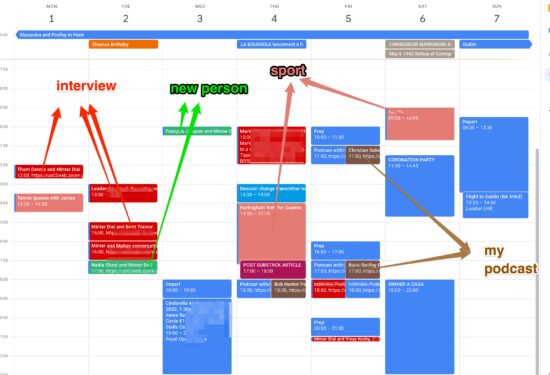
One practical way to make meaningfulness visible is to populate your agenda deliberately, then colour-code it. I’m certainly not the only person to have thought about this, but it’s a very powerful tool.
My own calendar offers a rather literal palette. Green signifies meeting new people: connecting with people is a meaningful activity in itself. Brown denotes recordings for the Minter Dialogue podcast; mauve is for the Joy of Padel podcast. Flamingo is for my sporting activities—the social and physical exertion of padel, real tennis or other. Travel within or to Europe is yellow; North America is dark blue; elsewhere in the world, red.
This is not an aesthetic indulgence. It is a feedback mechanism.
At the end of a week, month or year, the colours tell a story. Have I met enough new people? Have I created space for learning through podcasting? Have I moved my body and burnt calories? Have I ventured beyond the familiar and exposed myself to different languages, cultures and points of view? The calendar becomes a visible record of what I have honoured—not merely what I have accomplished.
For me, meeting people, the social and physical dimensions of sport, travelling internationally, learning languages and hosting conversations all carry a meaningful value, relative to my own directional phrase. Your colours may represent a whole other suite of things, such as caring for family, writing, faith, nature, mentoring, music, service, study or simply proper time alone.
The fundamental invitation is to notice. Then be intentional. Then render it visible.
Because a meaningful life is not made in one grand, cinematic decision. It is coloured in, one chosen encounter, one honest reflection, one purposeful act, one meaningful connection at a time.







This is brilliantly written and even better is when applied it creates one intentional step forward. BRAVO!!!
THANKS for the inspiration Justin!