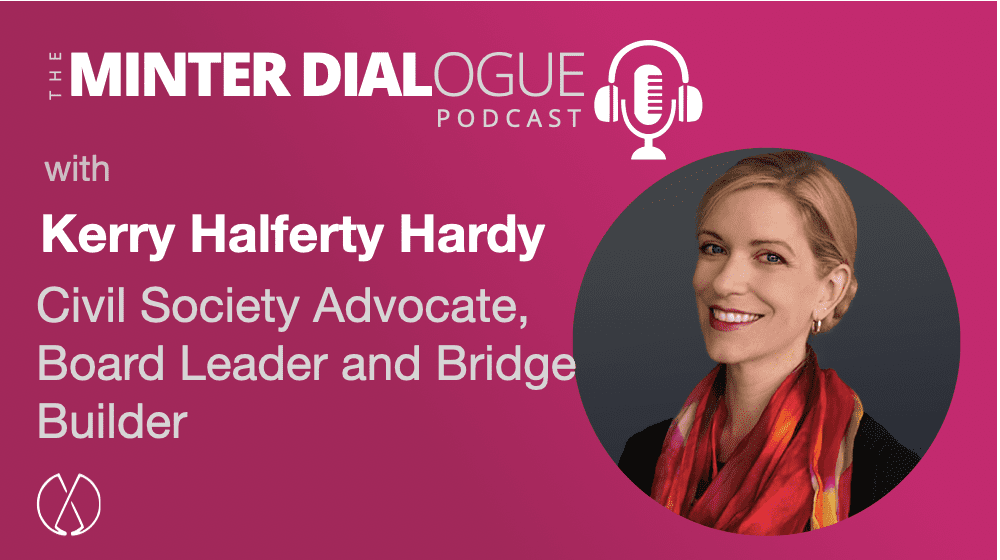
Minter Dialogue with Kerry Halferty Hardy
Key Points:
Three Takeaways:
To connect with Kerry Halferty Hardy:
- Find/follow Kerry Halferty Hardy on LinkedIn
Other mentions/sites:
- YFU Youth for Understanding (exchange program) here
- Institute for Economic Studies Europe (IES Europe) here
- The American Club of Paris here
- “L’Amie Americaine” (book on Amazon)
- Congress of Vienna here
- Hadrian’s Wall here
- Guidelon (Guédelon Castle) here
- American Hospital of Paris here
- Mayo Clinic here
- World Anti-Extremism Network
- Peter Drucker (management author and thinker) here on Wikipedia
- “How to Change,” by Katy Milkman here
- Jim Collins (author) here
- Lenore Skenazy, Free-Range Kids here
- Sesame Street (educational TV show) here
Further resources for the Minter Dialogue podcast:

Meanwhile, you can find my other interviews on the Minter Dialogue Show in this podcast tab, on my Youtube Channel, on Megaphone or via Apple Podcasts. If you like the show, please go over to rate this podcast via RateThisPodcast! And for the francophones reading this, if you want to get more podcasts, you can also find my radio show en français over at: MinterDial.fr, on MegaphoneFR or in iTunes. And if you’ve ever come across padel, please check out my Joy of Padel podcast, too!
Music credit: The jingle at the beginning of the show is courtesy of my friend, Pierre Journel, author of the Guitar Channel. And, the new sign-off music is “A Convinced Man,” a song I co-wrote and recorded with Stephanie Singer back in the late 1980s (please excuse the quality of the sound!).
Full transcript via Castmagic.io
Transcription courtesy of Castmagic.io, an AI full-service for podcasters
Minter Dial: Bonjour, Kerry Halferty. Hardy. What a pleasure to have you on the show. You and I met through our mutual friend, Karine Berthier. Karine and Louis. Always fun to make a shout out to mutual friends. But as I like to ask in my usual manner: Who is Kerry?
Kerry Halferty Hardy: Ah, well, you know, it’s a complicated story, but I’ll try and keep it brief when I’m trying, extremely brief. I tend to present myself as a human Swiss army knife. But to expand upon that. So, I’ve spent most of my career moving between different worlds. Public, private, nonprofit, healthcare, civil society, international affairs, nonprofit leadership, et cetera. And so, over time, I’ve become less interested in drilling down into any one sector and more interested and curious about the way that these sectors interact and how institutions interact, especially under stress, which is something that we’re seeing currently, and also what allows societies to remain resilient and free. That’s what interests me the most, at least on a professional level.
Minter Dial: Nice concoction. Well, one of the things that attracted me to begin with, Kerry, of course, is that we have a Franco-American melange. And of course there are more things and different things in your Swiss army knife to mine. But being multilingual, living in Paris as predominantly American, you can correct me if I’m wrong on that. Which version do you think is the most authentic version of you? How do you, how do you write? Is that question even sensible to ask?
Kerry Halferty Hardy: I think, you know, the, the way that I respond when people ask me if I feel more American or more French. I said, I feel very middle of the Atlantic Ocean. When I was a teenager, I moved to, and this is how old I am to what was West Germany for a year, and stayed with a German family for that year. And it was a transformative experience for me. It was with a group called YFU Youth for Understanding, and this is their 75th year. It was put together to allow young Germans in the post war environment to experience life in America at the time in a liberal democracy and to see how they individually could come back and shape the future of their country. And that went on to bring people on both sides of the Atlantic and then eventually globally. And so, they have something that I really like as a way of expressing how we dual nationals and how we, as people who’ve lived in more than one culture, relate to that, to those different cultures. And it’s something called colored glasses, which explains very broadly that if you live in one culture, say as an American, you see the world through that American lens and let’s call that lens red. And then you go abroad and you live in Germany, for example, and you decide that you want to become German, you want to put on those German glasses and see the world through those. But their glasses are blue. And what you can’t do is take off your original glasses. You can only lay them over top. So, now you’re seeing the world in purple. And so, then when you add on top of that, I mean, I don’t know whether it’s, I see the world in white when it comes to, you know, all the different colors of the countries that I’ve lived in. But the thing is, is that you end up impacted by each of those experiences and each of those worldviews. And so, I would say that I feel American about some things, French about some things, and very international about others.
Minter Dial: It feels because, I mean, I have three passports myself and I’m multilingual, that when people ask the question, it’s more their problem than our problem.
Kerry Halferty Hardy: I think what I tell people, and especially when I’m speaking with young people, I can think of one in particular who moved to France from Ukraine. And I told him when he was experiencing some difficulty relating and fitting in, I reminded him that you don’t get gold stars for only hanging out with monocultural people and that people who have had to adapt to other cultures tend to form their own tribe. And if you want to find people who can understand the struggles or the, you know, even sort of the delights of seeing the world in more than one lens tend to be people who have adapted to more than one culture. And it’s. And honestly, it doesn’t mean the same cultures. If you have somebody who moved from Peru to Germany, you’re still going to have something in common with them, regardless of whether the countries that you’ve lived in cross over one another.
Minter Dial: Yeah, probably the commonality must be around the sort of mindset, ability to be flexible and to see things differently.
Kerry Halferty Hardy: I believe it is, I think, especially the ability to look at one’s own home culture critically. And when I say critically, of course, that’s not a pejorative. It’s to be able to have a certain amount of remove, to be a bit more. To see things in a bit more clarity, I would say, and not to simply react from the gut. The second thing is to perhaps see and understand that differences are merely that they’re different. There’s not one that’s better or worse. That if a school, for example, in America, if you say high school there, it means having a Social life, it means sports activities, it means cheerleading, it means all of those things. Whereas for me in Germany, when I went there, what it meant nauseam. School gymnasium. Yes, exactly. So, it was school. And the other activities were things you did elsewhere. So, again, different. One is not better than the other. Each one adapted to the culture in which it was created.
Minter Dial: Well, even I, I think even in the way you express yourself about critical thinking, for example, that’s the example of being by at least bicultural, because everyone always thinks critical is critical. But I mean, I’ve been writing recently a new book about how propaganda is just given horrible connotations yet. But in the 17th century, it was how the religion Catholics spread the word, spread the faith, and therefore in a very positive element, propagation. Yeah, propagate. Exactly. All right, so you describe yourself, Kerry, as a bridge builder across knowledge silos. What is a bridge builder? And more specifically, how does it look differently when you’re talking about knowledge silos?
Kerry Halferty Hardy: So, what I mean about the bridge builder is I try and work with people who might have a particular worldview, let’s say Americans, and who are trying to get something done here in Europe, and they’re not understanding why they can’t get it done. And I can explain, because they have a certain trust in me as a fellow American with an accent and a. And a worldview and an experience that they feel they can relate to. And I can explain that things are simply different here in France or Germany or in Europe in general. And I try and take those two different worldviews and make them mutually intelligible. That’s the cultural bridge building. Now, when it comes to the others, my experience in public sector and private sector and nonprofit sector, again, I know how all three of these work. And sometimes they don’t have the same incentives. Again, try and explain how to act in such a way that you can have an impact on another sector. And then the third way would be across knowledge silos, for example, from healthcare to defense, how do you speak about health security, how do you speak about food security, how do you speak about national security without separating them into columns that don’t interact? Because I think you end up with redundancies and inefficiencies and perhaps, as we say in French, lacune between those sectors. Whereas if you understand how they can interact and how one impacts the other, you end up with a much more comprehensive view and you can deal with the challenges and the risks and the opportunities that that provides.
Minter Dial: I can’t. So, I totally relate to that, and I can’t help but think some of the structural elements in the bridge building that you do are more important than others. For example, the fact that you’ve worked in private brings a whole layer of efficacy. Not, you know, don’t want to have fat bureaucracy, go for the result and make it quick, as cheap, as fast as possible, which is not something that the public sector is known for. Would you think that’s a fair accuracy?
Kerry Halferty Hardy: Oh, absolutely. I mean, you know, if you look at sort of a public choice theory approach, when you look at the, the incentives in the public sector, particularly in bureaucracies, they tend to be keep as much budget and as much personnel as possible, and that’s where the incentives are aligned. So, again, I suppose what would be even more accurate would be to say that I like to look at incentives across these sectors and see how you can align the incentives in order to make them work together. You’re correct about the private sector and the public sector. I would add in that there is a lens through which we can also see this in the third sector. One of the reasons that I went on to do my master’s in nonprofit management was because I thought they had terrible metrics. And you devise metrics. To measure your progress towards a goal, especially in nonprofit. And you always put your resources around fulfilling those metrics. So, if you have bad metrics, that means you’re misallocating your resources. And in the nonprofit sector, it’s mission oriented. And it was Peter Druckler who said, how do you measure the bottom line if there is no bottom line? And then that stuck with me because so many, a few decades ago when I did this, so many think tanks were measuring their success by on how much money they raised because they wanted a number. They wanted something that seemed legible to the private sector. And my response to that is, so what? So, you raised a lot of money. What does that mean? What are you changing? How does that move you towards your mission? What is your goal? And so, I think taking some, some inspiration from the private sector is good because I think there’s perhaps not enough creative destruction in the nonprofit world. And on the other hand, I think the nonprofit world has something to teach the private sector about mission and about employee motivation and about fulfillment in our work.
Minter Dial: I just finished Jim Collins latest book about how to have a more meaningful life. And he goes through a whole bunch of different characters and he talks about the difference between making money before your purpose. So, it’s all about having the money or to getting to the money or to have the Money to make your purpose and sort of put the other way around, make purpose the driving force as opposed to money as the end result. Yet I think that the notion of purpose is so, so important for driving us keeping up motivation. How would you describe your purpose? Do you have. I mean, I’m sure it’s tied into bridge building, but what. How would you describe your personal purpose?
Kerry Halferty Hardy: I would say that I have a sense of purpose in a couple sectors in my life. I mean, first and foremost, and I know this may sound trite, but I have two children and they give my life purpose and meaning intrinsically. They’re adults now, but that certainly doesn’t stop that sense of purpose and meaning there. The second one would be, I am incredibly motivated by the importance of civil society and the importance that that brings to providing some sort of tissue and fabric to society outside of the private and the public. And it’s, you know, there’s. There’s so much that can be said about this. You know, de Tocqueville wrote at length about, about civil society in America, and certainly there’s. There’s many theories on it, all the way from Aristotle to Gramsci. But the way that I see civil society is that a strong and active civil society is, first of all the counterweight to the public sector. It’s what helps. That sense of responsibility is part of what keeps us free as, as. And have liberty as individuals, and as opposed to abdicating the responsibility for all sectors of our life to some sort of omniscient government or even some sort of philosopher king. I think it’s absolutely vital, and I not only teach that I lecture on this in a master’s program, but I’m active in it myself. I serve on five boards, nonprofit boards, mind you, including the American Club of Paris, where I’m the president. But I’m also on the boards of some think tanks and one which is the Institute for Economic Studies Europe, where we put on a summer university every year to teach young people the foundations of a free society, philosophical, economic, legal, etc. And I’m very, very motivated by that. That gives me a lot of purpose.
Minter Dial: Well, I love that. I want to. Maybe we’ll tap back into that in a moment, but I wanted to circle back on something. And we’re going to lead into the educational blues. But you told me before you studied German film, you’ve got masters and different educational diplomas, and oftentimes we can talk about different types of skill sets and expertises. There’s, there’s the theory of the The T, which is, you know, you. You have one strong expertise, and the pie, which is. You have two strong expertise. Then there’s the comb, and. And the comb has many teeth to its grind, if you will, or it’s to its base. So, would you describe yourself? Would it be fair to say you feel like you’re more like a comb in this regard?
Kerry Halferty Hardy: Absolutely. Absolutely.
Minter Dial: And in which case, do you. Is that something that you actively strive to propagate to using the old word again when it comes to your student base?
Kerry Halferty Hardy: Honestly, it’s the only way that I know how to be. So, I do discuss this with my students about multiple intelligences and multiple experiences. I think, you know, it also depends on personality type. Right. There are people who have a very profound and deep purpose, and I refer to that as the microscope. And I’m a telescope. I scan the horizon. I look towards, you know, this fixed star to which I want to move and figure out the map to get there. And I do think, and I mean, I’ve said it certainly to my students, it’s on collecting experiences and taking on as many experiences. Comfortable with, of course, but that it never behoves you to remain too rigid in one area because society is evolving. I mean, you know, look at all the students who were told, absolutely, learn programming. And now they say, well, in fact, it would have been better had you studied humanities. How do you remain resilient? How do you remain adaptable? That at the base of that is curiosity.
Minter Dial: Jim Collins talks in his book about having hedgehogs or being a hedgehog, which is this ability to become sort of totally proficient in making impact in one space, the space “hedgehog”. That’s what he means de facto. But the reality is, so many kids seem to be so concerned about making money, getting a job, tying down these sort of traditional elements of life, and the idea of spreading yourself thin, which is how they kind of regard the comb, is antithetical to, you know, I can get a job because I need to come out there and I can prove my thing. And even within Jim Collins, he talks about how some people are single, the hedgehogs, but others have multiple hedgehogs who go from being a president of the United States to doing things for the world or a football player who becomes a Supreme Court justice. So, you can be experts in multiple things and still make a life. But it seems such a harder map to present to students today, and your kids probably, too.
Kerry Halferty Hardy: I would say that, you know, the vision of the comb is, yes, there’s many teeth but there’s also a very strong spine that connects them. Right. And therefore, when I’m speaking about these multiple areas, I’m always looking for the connections between them. I don’t simply create numerous silos. I look for ways in which there can be synergy between them. And you know, I found that they tend to inform one another. My experience in one area, whether it was, you know, working in an energy sector in South America or whether it was doing geopolitical stuff in the east or whether it’s teaching here in France, there is something that connects all of these and that informs all of these and that allows me to bring that the bridges. Or maybe it’s more. Honestly, maybe it’s more like aqueducts because there’s some flow going back and forth between them.
Minter Dial: So, having these multiple personalities and elements of your background and as have I lived and I worked in, obviously I’ve worked in 15 countries, but the, the notion of France, America, sort of a pillar country, somehow opposite can they be in some regard in the west anyway? I mean there’s bigger differences like if you take Japan, Chinese or maybe Ethiopian. But what would you say if you had the French president and the American presidents in front of each and so say you need to learn this from him or her and vice versa. Well, is there something that comes to mind in that sort of multiply bridge building aspect?
Kerry Halferty Hardy: I wish I had finished reading L’Amie Americaine before you asked that question. But certainly I think it is when you come from the U.S. what I would say to rather than presidents, perhaps because I think they have already fixed their visions of one another. But the policymakers and the policy wonks that I know, I do try and act as that bridge builder and explain. In fact, you know, and I learned perhaps how to do this best when I was working in D.C. at the American Institute for Contemporary German Studies, which was trying to explain the two Germanies at the time, and then Germany to the US and then the US to Germany, helping to increase understanding across the Atlantic. The same holds true. Even more so for France and America. The cultural differences are greater. There is less French footprint in America when it comes to culture. And so, that plays a role. And I think what I explain primarily to the American audience is that the French way of doing things is something that you have to understand first of all through a historical lens. If you haven’t read history or if you’ve never heard of the Congress of Vienna, if you haven’t read about Talleyrand and you haven’t read about the history of France, you’re not going to understand the motivations for France and why it acts the way it does. Everything in France is colored by history and its culture. I mean, it surrounds us. I can look from my window and you can see churches and things in the horizon. We are surrounded by it. And it weighs on us here in a way that history does not weigh on America. It tends to be hurtling towards the future. And, you know, I mean, certainly there is some history, but it’s not omnipresent and it’s not a weight on the shoulders of America in the way that it is here. And those both have positive and negative impacts on the way that people interact. And I think the most important part is understanding the importance here of relationships and relationship building and not seeing things as transactional. Whereas a lot of American business tends to see, we, we have a common goal, we both want to get this accomplished. Why can’t we just shake hands and do it? And so, you end up with mutual frustration. The American thinks that French people are slow and lazy and that things will never get done. And French people are like, what are they in such a hurry about? They’re going to screw it up. So, I try and explain those from a pragmatic context to one another. And I think that specifically that notion of relationships, they refer to Europe sort of as a coconut, right? It’s a hard shell. And once you get through it, easygoing America is more like a ripe avocado. First layer is easy, but getting that deep relationship built is incredibly tough. So, you know, that, I think, is perhaps the most pragmatic advice that I give.
Minter Dial: It’s funny that you should use the word pragmatic. It’s one of those words that I’ve long talked about. Because the issue I had with that Kerry is that both France, French and American stereotypes and generalizations being allowed, tend to say pragmatic is a positive word. Yet their distinction or definition of pragmatism is completely oceans apart. Literally, absolutely. Just like the word freedom. What do we actually mean by freedom? These are words that need to be qualified and understood to be different culturally. And the thing that I was going to comment on, and maybe you, in your experience, you’ve seen that as well, but I remember reading a report saying that at Oxbridge in the UK, students are reading history, majoring in history only 2% of the time, whereas about 20 years ago was 8%. And. And I feel like that is a real risk to our society if we don’t actually understand why we’re different. What was Our history.
Kerry Halferty Hardy: I can only agree with you 100%. One of the things that was very, very important to me in raising my children was travel. Not travel to. Maybe they regret that I didn’t take them to beaches in Disneyland. I’m the boring educational parent, but, but
Minter Dial: I took them to museums, for God’s sake.
Kerry Halferty Hardy: I started when my son was three months old with the first one, took them to places like Hadrian’s Wall, took them to Rome, insisted they study Latin, took them to historical sites, not 100% of the time, but I remember when they were studying history and it was when they were in elementary school and it sort of went directly from the fall of Rome to Charlemagne. And I said, you know, there’s quite a few things that happened between those two dates. So, I took them up to the cathedral of Saint, Saint Denis so they could see Charles Martel and all of these. Not from an ideological standpoint, but really from a point of saying these things happened. And they’ve all had their impact. You know, children’s personalities are what they are. But my son is very, very interested in reading on history and I’d like to think that that was fed as a child. I don’t think, I don’t think it’s taught in a way in schools to encourage children to want to study it. I mean, as older adults, I’ve taken them, actually both of them, they’ve asked to go to Guidelon, which is a castle that’s being built in the Burgundy region of France using only methods that would have been used in the early Middle Ages. And so, it’s experiential archaeology. And if you take a child to seeing a castle being built, it becomes automatically much more fascinating, I think, you know, this notion of sort of dry words in a text does not have at all the impact of actually visiting the sites and becoming, you know, animated by the humans that inhabit it those time periods and. Yeah, no, I mean, I think it’s a pity. I think it’s from what you said earlier, it’s a focus on, you know, we’ve pushed for this idea that you must be successful in a monetary sense and we don’t emphasize enough the idea of the well-rounded intellectual.
Minter Dial: I, I was wondering how often you might have had I, I Americanize, I say this, oh, mom, not again. Do you face that? And maybe more importantly, if you have people who are listening, who have their children saying not again. What would you, what would you tell them?
Kerry Halferty Hardy: I didn’t really experience that, I have to say. But I think part of it is giving the kids agency, right? I let them pick where we went. When we went to Rome, I asked them to choose a monument or historical site that they were interested in and prepare to present it to the rest of the family. So, they were the ones responsible to explain it to the others. You know, for the same reasons. I mean, you know, speaking about even geopolitics in general, I took them. I took them to many places. We used. We went to a number of the European capitals. I took them to Israel, I took them to America. I mean, we did the tours, so to speak. So, I mean, you always try and make sure that they have a bit of say in the itinerary, and that was part of it. And I would try and find things and teach them phrases to use and not, I guess, not treat them as. As blank slates that needed to have their heads hammered in, but teach them how to ask questions about where we were going and to be curious.
Minter Dial: Well, what I. That that makes me. Reminds me of the book by Katie Milkman, who is called how to Change. I don’t know if you come across it, but she. She brings out a very counterintuitive thought, which is when you want to tell somebody to get a better grade at school, you should read more. You should go to bed early and you tell them all these things. And she did a study that showed that if you ask the student how they would advise another student or their brother to do better grades, well, it turns out just by asking the question, giving them that sort of micro agency, and then actually verbalizing what their brother should do or their sister, turns out to be very effective. So, I want to. There are a few more questions I really need to ask. One of them is entirely personal because as you know, my father works at the American, and my mom worked at the American Hospital of Paris. You worked there as the chief development officer. And I just was wondering what was your experience? Because there we have an American institution of sorts right in the middle of France. And how did you experience working at the American Council of Paris? What worked, what didn’t, what was broken, what needed fixing?
Kerry Halferty Hardy: Of course, I’ve been gone for 15 years now from there, so I say that it’s only from. With hindsight. One of the things that attracted me to it was the notion that this was the fruit of civil society engagement. It was put together by the American community in Paris at the time. And I had the archives, at least a part of the archives in my office, which was incredibly fascinating. I mean, for anybody who loves history, and reads about it. It was engrossing. I mean, I could have spent. I could have spent weeks staring at them. What I appreciated was the notion, especially then when you look from the history, not just the beginning, when it was engaged. In World War I, the doctors went to the front, and then In World War II, it remained an American institution through some very clever means and how they managed to keep the beds filled without being turned over to the occupying forces. Again, a great deal of creativity. And at the time when the hospital was built, the current hospital, the main building, in the 1920s, it was the height of medical technology. In fact, the Mayo brothers of the Mayo Clinic fame even came and visited the site to learn from it. I think when for me, at the time, what I appreciated was again, I was the bridge builder. I was told by the board that I was to be, you know, the good administration vis a vis the doctors. And I was supposed to help build the bridges between the board and the doctors, the doctors and the donors, and by extension the patients, and to kind of play that node role, which is something that I was quite comfortable with. And I thought it was interesting to hear back from the donors, specifically what their commentary was and why they wanted to go to that particular hospital. And one of them was that they didn’t feel like a number. That for them, the notion that it felt familiar and comfortable and that they would be somewhere that they didn’t feel like they were a cog in the machine, that they didn’t feel anonymous, was comforting and also strange but true that it didn’t smell like a hospital. And that was also a choice of using cleaning products that would not specifically smell like a hospital, that were just as efficacious, if not more so, but avoiding that sort of institutional scent that. That. That made people anxious. I appreciated also being invited by the physicians to be on their new technologies group so I could listen in and learn about it with them. The doctors, I found, were on the whole quite interested in integrating new technology into the offer of services. What unusual now is that most hospitals in France have moved with the state towards specialization. Center of Excellence on Heart Disease, a Center of Excellence for Cancer treatment. And that has its place, and I think a very important place. But when you have a patient who is polypathological, which means they have more than one, maybe a cancer patient who has heart disease, or if you have someone where you don’t know what’s wrong with them, having a multidisciplinary hospital like the American Hospital was quite useful. Having the. Having the imaging platform Having the labs in the hospital, very helpful. And what I also appreciated was one of my other hats while I was there was that I was responsible. I had someone on my staff who was responsible for the American patients and by extension the Anglophone patients. And they worked four days a week. So, nights and weekends and Wednesdays, that was my job. In addition, I would take off the development hat and put on that hat and visit them. And generally, if people were just passing through, especially Americans, they were convinced that the only place for decent medical care in the world was America, and they were frightened of receiving medical care in France. And it helped for them to have a familiar voice, to have a familiar accent, reassuring them, explaining to them, and also working to help the doctors, the physicians communicate with patient families, especially when they were short on time, they would often call me and ask for me to help them with that. And so, I like to think that it made a difference in the way that patients and their families could approach their medical care.
Minter Dial: So, yeah, in the way you describe that, Kerry, it’s very much bridge building in moments of crisis or, you know, at least in moments of stress when it comes to people’s health. Well, that all highly resonates with me. Kerry, a couple of other things I want to try to touch on. One of this is you mentioned you’re on five boards. One of them is the World Anti Extremism Network. Well, that is a highly provocative, evocative name, extremism. How would you define extremism in 2026?
Kerry Halferty Hardy: I think extremism in this particular context is the things that lead to loss of liberty in other people. When you look at the board members of this organization, I should say first of all that the organization itself was founded by Khalid Ramati, who is Afghan, who previously lived in Kabul before the handover, as you will, before the withdrawal of the Americans, and who had to, in extremis, leave. And he had quite a story of hopping across continents and finally ending up in Canada. But the people on the board are people who understand what that means in a particular social, in a particular societal context. We have people on the board from China, from North Korea, from Pakistan, from Raina, who previously was living in Indonesia, now in Germany, people who understand the dangers of authoritarian regimes and also the kinds of movements that lead to authoritarianism. And I would put under that, of course, the Taliban in the case of, of Afghanistan. And also, obviously you have ISIS or Daesh, if you prefer, from the French point of view. How do you, how do you inoculate society against that and how do you work to help those who are trying to push back against those forces in society?
Minter Dial: Well, it’s sort of easy enough to say, I don’t want that, that’s extremism, that’s horrible. And then you collect people and we say we want freedom. The challenge that I see in that posture is do we all have the same vision of freedom, how free is free? What do we mean by freedom? The freedom to be anything you want, limitless possibilities? Or is it freedom to just speak my language? Or how do you contain or at least coagulate around the same idea of freedom when you have so many disparate people?
Kerry Halferty Hardy: So, I would say that the idea of freedom that we promote and that perhaps we promote across all of the organizations that I am engaged with is it’s, first of all, there’s the notion of personal freedom and personal freedom, as the, as the pithy saying goes, ends where the end where my fist ends and where your nose begins. In other words, the freedom to act in so much as it does not negatively impact others. So, that’s the basic baseline. I would say the notion of freedom that we further can agree on is that which promotes human flourishing and that does not diminish individual ability to make decisions for one’s individual flourishing, the ability to, you know, to realize your potential. And, and I would say specifically we focus so much on the communist period, on what was not allowed. You couldn’t make this much money, so you couldn’t travel, you couldn’t do this. But what also angers me, and I say anger with, on purpose here, is that if you look on the delta, but between what an individual did accomplish and what they would have been capable of accomplishing under a free liberal democracy, for example, that’s huge. And all of that lost human potential that’s encapsulated in that in addition to all of the murders, imprisonments, torture and everything else that people underwent, not only because I know people who were under those regimes, but my own grandfather was from Poland and we had cousins in Poland at the time. And I think, you know, when I speak to some of the young people that I know and I say young people as in people younger than me, when they, they speak about how their parents were not able to, to achieve what they could have. And that to me is an incredible waste of human potential.
Minter Dial: When you’re on this NGO, I assume it’s an NGO, how much of what you discuss is about breaking the extremists lock or trying, is it undoing the extremism and, or how Much of it is about constructing the better future.
Kerry Halferty Hardy: I think it’s quite. There’s some similarities across all of them. One of, first is the inoculation, right. Teaching young people, as I said, the foundations of a free society. And that includes personal responsibility. You know, that you have to take responsibility for your actions. You cannot hope and expect that somebody else is going to do this for you. Hope is that you cannot. Yes. That you can wish. Cast something into being. That if you want liberty, you have to go through the trouble of actually creating it, defending it, making space for it. And so, that’s the starting point. So, there. You must start there. And that can’t be started when somebody is. Is. Is in a master’s degree in university. First of all, it starts at home. I believe in something called authoritative parenting, not authoritarian, where you, you set boundaries for a child until they reach sort of a point of reason, but that those boundaries are explained and that they are. That they are qualified and that they see. And that they are. That they see. That you keep your word on these things, that you ask them for input. You don’t simply impose. Because I said so. I hated that as a kid. I hate the notion of it’s because I said so. That’s not a sufficient reason. I said so because this, this and this. So, I think it starts first of all at home. That’s the first part. Then there’s education. And then beyond that, it’s something that people have to exercise. Right. If you take someone who has grown up and spent their entire life in an authoritarian system, they adapt because they have to. It’s a survival mode. They adapt to that and they have to be taught how to take responsibility for themselves in a free society afterwards. There’s some organizations, there’s one I know in South Korea that takes North Korean refugees and teaches them to speak about their experiences and helps them to adapt because it’s difficult. Personal responsibility requires energy. It requires exercising certain muscles. That requires being responsible for your own bank account and, and finding jobs and all of these other things that, you know may not be 100 possible in authoritarian societies.
Minter Dial: I don’t know. You surely know it. But there’s an expression along the lines, teach a girl and you teach a family or a village. To what extent that is a. A driving force in your mind in terms of. You look at the Afghanistan situation, Of course, it’s sort of a highlightable element. But is that something that you feel is relevant even in the West?
Kerry Halferty Hardy: Absolutely. I mean, the thing is, even now, I can take this from the healthcare perspective, again, women tend to make most of the healthcare decisions for their family. They take care of making doctor’s appointments, they ensure their children are up to date on their vaccines. They make sure that even their spouse goes and gets a checkup in most families, I’m not saying, of course that applies to everyone, but we know from research that is, that maintains and that remains true. So, women do carry perhaps a disproportionate amount of weight when it comes to things like healthcare and other decisions for their families.
Minter Dial: So, when it comes to authoritative parenting that you were talking about and even personal responsibility, do you think that that takes courage in today’s world?
Kerry Halferty Hardy: 100%. I would say even more in America than in France. There’s a woman, Lenore Skanasi, who started a movement called Free Range Kids and that is teaching children to do certain things on their own from a small age. And she was called the worst parent in America because she let her child ride the subway in New York by themselves, I think. And you can be, you can. I mean there’s cases in America and then she’s highlighted some of them where parents have been taken into custody because they allowed their 10-year-old child to go to the park by themselves just down the road or to play in their front yard as opposed to in the backyard. So, yeah, I mean, it takes courage because you have to be willing to explain and to counter that helicopter. It’s not even helicopter parenting, it’s steamroller parenting. Making the path so smooth that there’s no friction for your child and that leads to very bad outcomes. We have studies on this. There are paediatricians that have done studies on this that for example, playground equipment that is too safe does not teach children boundaries. So, when my son was 7, I sent him to the grocery that was downstairs and said, here you’re going to go pick up some bread and some milk or whatever it is like was shown in fact in a. There’s a sort of a famous Sesame street about a little girl going to the grocery by herself about getting butter and milk and eggs and repeating it over and over again to not forget. But yeah, children need to, that you can’t build self-esteem by telling them you’re great. They build self-esteem and they build capacity by doing things, by pressing, you know, by pushing their boundaries, by learning to do things. And yeah, there is an element of risk, but I think what parents have forgotten is that there is a commensurate risk in not allowing them to take responsibility. And it’s a different kind of risk. You end up with children who have much greater anxiety, who, who are not feeling capable of taking care of themselves, even at a university level. And you know, I think of it again as a sort of inoculation for the future and teaching them to take small doses of responsibility that lead up to adulthood. You can’t throw it on them all at once. At the age of 18, I wish
Minter Dial: I would have even one single thought that I could count you with you and critique you on. But I am into a thousand percent of that. My wife, when we were living in Paris, would give our son. Yeah, it was the time of the euro, you know, like €2. You need to go get the baguette, go downstairs then. The baguette costs a pound, you know, one euro, 20. You need 80 cents. You’re learning economics, you’re learning how to cross the street, you’re learning how to. Learning how to interact and say bonjour when you go in customary to the Boulanger. And then I was reading about the Finnish study that showed that you need to have dirt, bring back dirt, get dirty and stop this protection stuff because malarkey. Life is difficult and it’s actually learning how to deal with the difficulty. Last question. I’m going to sneak it in think tanks, because this is also a very important part of what you do. And think tanks typically in the name doesn’t sound very active. There’s a lot of thinking going on. You talked about making money to do the thing. Thinking per se, it feels. How is it that. How can think tanks actually impact and make a change? Because today it seems like there’s a lot of people talking about change, but they’ve seen and the change is happening. But the other form, the ones that we want, makes. It’s difficult to make come around.
Kerry Halferty Hardy: I think think tank is sort of a misnomer, first of all, I mean, you can talk about public policy organizations. Some of them are activists. When I was at another one, they used to call themselves a think and do tank because they all have different ways of creating change or perhaps preparing the terrain for change. So, a number of them will do deep research on particular topics that they think should be changed or that they think should be altered, or that they think need. Need additional study. And who their audience is is different in each case. For some of them, they’re trying to change or to introduce these thoughts into the public policy debate. In the governmental level, some of them are trying to introduce ideas into the general public to make those ideas more acceptable, such that public policy officials will have an easier time of making that change, because in general, politicians are not courageous. They’re not going to go completely against the flow. It’s easier if they don’t have to. And sometimes it’s coming up with policy papers that the political official can take wholesale and go forward with. But it’s also going out and collecting the data and the information from the ground to see how things are impacting individuals. And that comes back to the Bastia notion of that which is seen and that which is unseen, in which you can have a public policy that everyone thought was going to do a lot of good, but they hadn’t investigated what the impact would be. And there tend to be a lot of downstream unintended consequences. So, one of the things they can do is stop bad things from happening, which is just as important as ensuring that good things do.
Minter Dial: Love it. Phenomenal words, Kerry. I ate up everything you had to say. Loved having you on. Thank you very much. How can anybody follow you if that’s what you accept or read your writings, understand more about how they get involved, and lead a life of the backbone with a combination that you have?
Kerry Halferty Hardy: Well, first of all, I’m always open to requests on LinkedIn because that’s how you can reach out to me and you can see some of the eclectic things that I do. I do write on Substack occasionally. And again, any. If you look up all three names, I’m the only person with all three names, so you can find me that way.
Minter Dial: Kerry Halferty Hardy.
Kerry Halferty Hardy: Absolutely. Thank you so much.
Minter Dial: Been a pleasure. We’ll be in touch.
Kerry Halferty Hardy: Kerry, thank you.