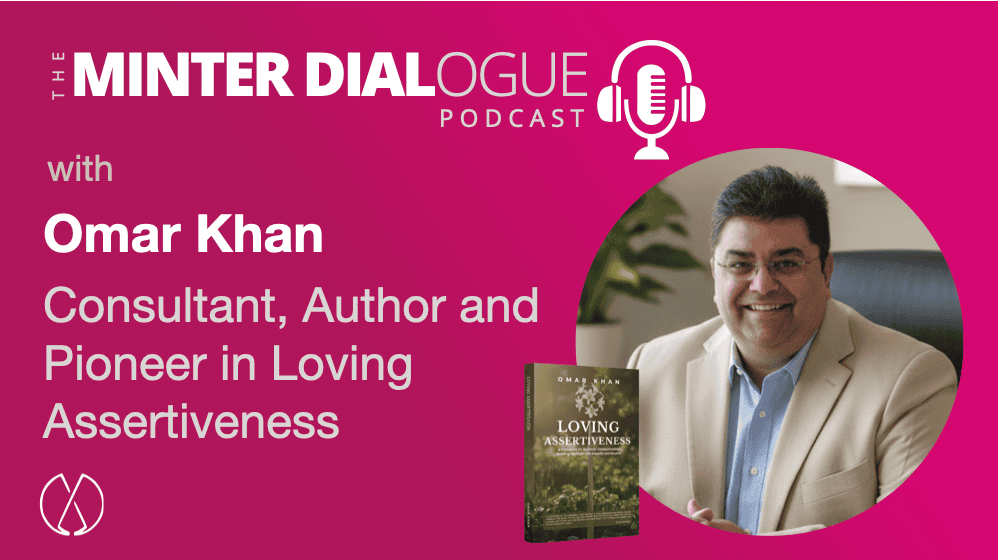
Minter Dialogue with Omar Khan
Our conversation delved deep into how these international and cross-cultural experiences have shaped his thinking, the mosaic of methodologies underpinning his philosophy of “Loving Assertiveness”, and the pressing need for more human-centred dialogue both in business and beyond. Omar drew on years of work from M. Scott Peck, Leo Buscaglia, and Marshall Rosenberg, weaving together learning from transactional analysis, releasing techniques, and nonviolent communication. He’s as comfortable in Fortune 500 boardrooms as in racially charged classrooms, making his perspective on leadership, conflict and transformation refreshingly grounded and practical.
3 Key Points:
- Education Shapes Approach: The conversation focused on the stark contrast between the American and British education systems. One concept discussed was how tutorial-based learning at Oxford—requiring close questioning by dons—cultivates independent thinking and a tolerance for ambiguity, which later proved indispensable in fields like law, psychology and consulting. [04:27](/timestamps/267)
- Judgement in an AI World: A key theme that emerged was the growing importance of judgement, synthesis and empathy in the workplace. The discussion explored why, in an age of AI and automation, deep human skills like sense-making and curiosity are now more valuable than technical prowess or decades of experience within one industry. [13:04](/timestamps/784)
- Loving Assertiveness in Leadership: Several points were raised, including the practice of blending compassion with assertiveness in tough conversations. Whether leading post-conflict groups or facilitating corporate restructures, success hinged on fostering environments where underlying needs—not just surface strategies—could be shared, heard, and harmonised. [26:03](/timestamps/1563)
Three takeaways:
- Leadership today demands the courage to balance power and compassion—creating space for both directness and genuine connection.
- The most persistent business problems often reflect gaps in conversation and relationship rather than technical or strategic deficiencies.
- Human skills—curiosity, empathy, and the ability to bridge divides—are irreplaceable, and only grow in value in a rapidly changing, automated world.
Other mentions/sites:
- “The Road Less Traveled,” by M. Scott Peck here
- “Love, What Life’s All About,” by Leo Buscaglia here
- “Nonviolent Communication,” by Marshall Rosenberg here
- Transactional Analysis resources (Eric Berne) here
- “In Search of Excellence,” by Tom Peters here
- Gerald Gunther — Clerk for Chief Justice Earl Warren/Brown v. Board of Education here (Wikipedia)
- “Letting Go,” by David R. Hawkins here
- Edgar Schein, “Humble Inquiry” here via Amazon
- Dan Sullivan, “Strategic Coach” and the Impact Filter here
- Adam Kahane, “Love and Power” (Rios Partners) here
- Reos Partners here
Further resources for the Minter Dialogue podcast:

Meanwhile, you can find my other interviews on the Minter Dialogue Show in this podcast tab, on my Youtube Channel, on Megaphone or via Apple Podcasts. If you like the show, please go over to rate this podcast via RateThisPodcast! And for the francophones reading this, if you want to get more podcasts, you can also find my radio show en français over at: MinterDial.fr, on MegaphoneFR or in iTunes. And if you’ve ever come across padel, please check out my Joy of Padel podcast, too!
Music credit: The jingle at the beginning of the show is courtesy of my friend, Pierre Journel, author of the Guitar Channel. And, the new sign-off music is “A Convinced Man,” a song I co-wrote and recorded with Stephanie Singer back in the late 1980s (please excuse the quality of the sound!).
Full transcript via Castmagic.io
Transcription courtesy of Castmagic.io, an AI full-service for podcasters
Minter Dial: Omar Khan, great to have you on the show. Author of Loving Assertiveness. And I just found out you’re based in Baltimore, the town where my lovely sister and family live. So, but in your own words, Omar, we’re going to get into it. Who are you?
Omar Khan: Well, I am somebody who has been on an odyssey throughout most of my life to find out how we can build bridges rather than barriers between people. I was born in Cairo, a child of 2 Pakistani diplomats. Dad then became Consul General here in New York where I was in kindergarten. Then off we went to Kuwait, then to Saudi where I was in junior high. in an American school.
Minter Dial: Sure.
Omar Khan: Then my aunt became ambassador to the Netherlands, and so I went to high school there and fell in love with Europe, left the US educational system, and went to Oxford and to University College. And it was an unusual departure because the Oxford does not acknowledge the American high school system as equivalent to A-levels, rightly so.
Minter Dial: Right.
Omar Khan: And so, I had a year in which I had to do 5 O-levels, 3 A-levels, and the Oxford entrance exams, something I was told was impossible. Fortunately, I was too stupid to know that. And clearly generosity abounded in the realm that year, Uh, because they snuck me in. And, um, and I still remember the Oxford entrance exam being the most interesting element of that. Yeah. And then off I went to Stanford Law School. Then my father became ambassador to Japan. I spent time there and then got involved with behavioural psychology, NLP initially, then working with a man called M. Scott Peck. who wrote a landmark book, The Road Less Traveled, after a more informal mentorship with a fellow called Leo Buscaglia, who got a copyright for writing the first ever book just called Love. Not Love Is Something, Love Is Nothing, Love Is Everything— just Love by Leo Buscaglia. And he taught the first college-accredited course on love. Off I went to Leo, on to Dr. Peck, then studied Transactional Analysis, a discipline called Releasing, most recently Nonviolent Communication that Marshall Rosenberg brought to us. And the mosaic that all of these are, a mosaic that has formed Loving Assertiveness.
Minter Dial: Fabulous. Let me just pick up on one thing, which is the transition from the US to the English system. I’m currently writing on education systems, and so I’d be curious as to how you would characterise the move from the US system to the British system.
Omar Khan: Well, Oxbridge, as they called themselves back then, I can’t say that they’ve maintained this, but at that time, the biggest difference was that if I’d gone to Harvard, or Yale, if I’d been lucky enough to get in, or Columbia, it would’ve been a laundromat. It would’ve been, you would’ve taken multiple disciplines in large teaming rooms because the strength of the American system is the graduate program, the postgraduate program. Whereas Oxbridge, its shining light was the undergraduate programme and you selected a discipline. In my case, it was still a bit of a cheat. I studied politics, philosophy, and economics called PPE.
Minter Dial: PPE.
Omar Khan: Or pretty poor education, as we jokingly spoke of it. But most people read a discipline, English or mathematics or modern languages or whatever. And the biggest difference at Oxbridge was the tutorial. So, we were not educated by the university, but by our colleges. And I had to produce 2 research paper equivalents every week and then present myself in front of a world expert. They’re called a don, nothing to do with the mafia.
Minter Dial: Don Corleone.
Omar Khan: Yes. But the Oxford dons interrogated you on something that they had spent their lives on. And so, there was nowhere to hide, really. You couldn’t just regurgitate. You had to— and that was the big difference. So, when I went to law school briefly, what I found that people found unnerving in law school is that there was no answer. You had— you were given principles, and then you have to adapt them. to situations and facts, whereas to me that was natural. That is what Oxbridge, or what university, and studying PPE had inculcated in me. So, there was nothing more natural than that. So, I think that was the difference. I think the greater empowerment, greater intimacy, greater specificity in terms of your interests is the primary distinction.
Minter Dial: And notwithstanding the thump of a year with the A-levels and O-levels and the Oxbridge exam, the preparedness of the US system to go into the UK system, I have to imagine that was rather a wake-up call. I did the reverse.
Omar Khan: Okay.
Minter Dial: I went from English boarding school and, you know, the whole malarkey, A-levels and the like, and I went to university in America. So, I have the reverse experience. So, how was that for you arriving into the UK system?
Omar Khan: Well, here’s the funny thing. I was a very bad student in my high school years and survived by the skin of my teeth. And so, Oxbridge to me was what I’d been looking for. I’d been looking for something that had what my later colleague Tom Peters would in Search of Excellence called simultaneous loose-tight properties. And that was what I was looking for, the rigour that came from a person of distinction giving you something to think about and to express an opinion regarding, and the latitude to do that at your own pace, in your own way, in your own voice. I mean, that was— it was a level of freedom that would have been unprecedented at the age of 18. In the US system. Right.
Minter Dial: And taking that sort of melting pot of an experience with travelling with all your father’s different assignments, your aunt, and the education experience you had, how did you negotiate getting business jobs? Because PP is not famous for preparing you for a job these days. It’s certainly not. current for individuals at Oxford or Cambridge to study history anymore because you need to get a job out of work. To what extent do you believe that it was instrumental in your career trajectory? And where do you think it is today in terms of how students can better prepare themselves for work?
Omar Khan: That’s very funny. I think it’s a wonderful question. I want to meander just a wee bit in answering it, but I promise not to malinger, I hope. I went on to Stanford Law School primarily for that reason, thinking that PPE, glorious as it was, might leave me, you know, without a path forward. And so, my father bullied me to go and get a law degree.
Minter Dial: And PP is not serious. You need a proper degree.
Omar Khan: Yes. And I hoped that Stanford wouldn’t let me in. But again, generosity continued to dog my steps. And but after a year, I realised I wasn’t going to continue because after a year, the year was glorious. My constitutional law professor was Gerald Gunther, who had clerked for Chief Justice Warren. when he wrote Brown v. Board of Education. I mean, these were titans. And, you know, and but after year one, you have to decide tax law, water law, property law, criminal law, and I wanted none of them. And that was fortunately around the time when Bandler and Grinder brought NLP, neurolinguistic programming, branch of behavioural psychology to the fore, and I left law school without any scaffolding. Well, I— some would argue that’s pretty good scaffolding already. Um, and I went and worked with these guys. I packed crates for them. I apprenticed at workshops. And fortunately, I had some knack at this. And because of my background and the fact I was a colourful character, they decided that they would give me a shot. And that was really the beginning. But I will tell you that I don’t know if this interests you further, but— and I will come back to what about today, but I was having good days and bad days. And then, you know, I was working in Houston. Running workshops in NLP and met and married the enduring love of my life in Houston. Um, and then my father got ill, and for the first time in my life, we went back to Pakistan. I’d never lived in Pakistan, though being of Pakistani heritage. And while looking after him, he fortunately rebounded for several decades afterwards. We had to find something to do. And I had always wanted to bring NLP to corporate culture. This was the period of the re-engineering craze, and I was very interested in re-engineering attitudes, thinking that you can re-engineer a process, but how about the ways of working and the openness? Well, the same companies that in the US would’ve said to me that you, we can’t let you in the door yet, I mean, you have no experience, you have nothing to cite. And Pakistan was very different. Pakistan could not get consultants to fly over. And here I was, I spoke Urdu and I had Oxford and Stanford. I had my father’s pedigree. I’d worked with some of the founders of NLP and they said, how bad can he be? We’ll give him a test run. So, companies like 3M and Motorola and American Express did that, and we were able to test the waters, and it worked. And we swam upstream from there to Sri Lanka, to Dubai, to Singapore, to the UK, eventually back to the US. So, this must be the most unstrategic way to build a global consultancy, which is go while your dad is unwell and find a place that no one else wants to work in. but with the companies everyone wants to work with.
Minter Dial: Yeah. What do you think about today? Well, so I, because I mean, I studied trilingual literature and women’s studies for my sins at university in the ’80s. And trilingual literature is good if you want to be perhaps a translator. Women’s studies as a dude at the time, not what people were hiring me for. And yet I felt like it was a really good, to use your words, sort of framework for architecture, which would— I get it.
Omar Khan: The scaffolding or whatever it might be.
Minter Dial: Yeah.
Omar Khan: Look, I actually believe that the beauty of your question is that we have— they say the end of all your exploration, that wonderful line, will be to come back to where you started and know it for the first time. Well, it’s what’s happening with AI. People have realised we don’t need people who can push buttons. We don’t need techno geeks. They’re inept. They can’t keep up. What we do need is people who can exercise judgment. We do need people who can synthesize. We do need people who can provoke AI. into the right explorations and journeys and so on, and then codify, present. And so, I actually think those PPEers, or those people studying women’s studies who have some behavioural savvy, are actually going to become more and more important, because what won’t be important is algorithm management. Because I mean, anybody with a ChatGPT account could pretty much learn to do that.
Minter Dial: But I think the challenge is we need, we have sort of a welcoming tissue where people and headhunters are still saying, well, do you have 20 years of experience in this industry? And are sort of still cookie cutting and probably using some old mindset.
Omar Khan: And we have to train them to say, we have to train them to say, thank God I don’t. Because, you know, if I had 20 years, you’d be hiring the past. What you want is someone to reimagine the present and pave a way to the future. And the only way to do that is to use AI and other methodologies to enhance human capabilities, not to replace them, not to be surrogates, But truly to take them where no man has gone before. Back to Star Trek we go.
Minter Dial: Exactly right. To boldly go. I wanted to just finish on one little more piece about your background, Omar, which is this word you used, releasing. What is that?
Omar Khan: So, releasing is something that a man called Lester Levinson, working with a number of people, but David Hawkins is another one who wrote probably the best-known work just called Releasing. And it is an attempt to bring Eastern spiritual practices— so let’s call it meditation without the folderol, all right? So, where you don’t have to sit in bizarre postures and extremely uncomfortable paths, but goes to the core. And what releasing argues is that there are 3 canopy wants, um, that hold us hostage. And by wants, in the sense of lack, where we perceive a lack. And they are wanting control, wanting approval, and wanting safety. Now, there’s nothing wrong with having genuine control. There’s nothing wrong with being approved of by wonderful people. There’s nothing wrong with being prudent and safe. But when we slavishly, insatiably seek control, we become a control freak. When we must have approval at all costs, then we become a politician. And when we must have safety to that extent, we become so risk-averse And that the future predicts, you know, is predicted by our past. That wonderful line by André Gide who said that to get anywhere, you must first find the courage to lose sight of that familiar shore. And so, releasing is a methodology whereby we can take those emotional encumbrances that keep us resistant and stuck. Experience them rather than suppress them and then let them go. Easier said than done, I know, but that’s the description.
Minter Dial: Well, sometimes we have to provoke some changes in mindsets and thoughts. You, in the title of your PR release, it says you went from wantrepreneur to entrepreneur. Is that related?
Omar Khan: Yeah, I mean, the wantrepreneur bit is the releasing, you know, where what we have is a stockpile of all the things we wish to accumulate, all the things that we wish to measure our lives with. And the entrepreneur bit is creating value where it didn’t exist. To me, the great entrepreneurs in history made what was impossible possible, made things we hadn’t even thought about every day. They weren’t just iterators, they weren’t just tinkering at the margins. So, and really, I suppose my job, if you think of the way I consult and coach, I was one of the first coaches in the discipline before that field had a name. And the president of Motorola University said to me, Kim, you’re going to be a coach. And I said, what the devil is that? I mean, can you imagine my going back to my father who was still reeling from my departure from law school and say, Dad, I’m going to be a coach. And he would have just said, all right, take me, Lord, I’m yours. And he said, look, I am the president of Motorola University. Where do I go to when I want someone to challenge my thinking? To whom can I confess I’m not sure? When I’m stuck, which balcony do I head onto without needing one to jump off? He said, you know, because if I tell my shareholders I’m not sure, they think I’m uncertain. If I tell my direct reports, they think the boss doesn’t know where he’s going. If I tell peers, they start sharpening the knives. But if I have no doubts, he said, I’d be a monster. He said, I hold the fate of millions of people and their livelihoods, and in some cases, their wealth in my hands. And I need somebody who will tell me the truth, and I know they have no other agenda than me getting better. He said, if you’re a coach, you don’t get hired again if I don’t improve or if I don’t stabilize. You’re not out, you know, for me to hire you. You’re not out for me to give you a promotion. And so, when I got involved in coaching in that sense, I realised that my job had to be different from the McKinsey’s and the others who gave people reports that gathered dust. I had to coach in the trenches. And that’s the entrepreneurial part as far as we mean it to be.
Minter Dial: Yeah, that makes sense. What I was hearing you is you need to have the courage to be vulnerable, to know that you don’t know everything. You have to find the right person And obviously that means garnering the trust that if I tell you something, you’re not going to use it against me kind of thing, ’cause that’s what comes behind that. And then the third thing which I heard from you is the ability to ask the right questions or the tough questions. And that probably comes both from the executive’s position as well as your ability as a coach to ask the right questions.
Omar Khan: Yeah, I mean, the interesting thing is that if as a coach you go in, and if I’m trying to find my own, uh, ego glory in coaching you, then I’ll push the buttons that I want to push to get various outcomes out of you, uh, or reactions out of you, maybe control or approval or safety or whatever it might be. But if I genuinely jump in and wish to discover the world that you want to inhabit, the world that you wish to enable, and the person you want to grow into, then I have to go into it with curiosity and wonder, right? And that is a very different undertaking. There’s a wonderful guru called Ed Shein, I’ve never known how to pronounce his name. And he came up with a discipline called humble inquiry. And he has been a hero of mine because I always tell my clients, the greatest gift I can bring you initially is my complete ignorance about what would help you.
Minter Dial: Yeah.
Omar Khan: If I could marry that ignorance with some experience, of what can help, then we can make magic.
Minter Dial: I was listening to a biography of Hamilton, and he was characterised as having a unique quality of being a thinker and a doer, which it feels a little bit the same thing. It’s the ability to have inquiry, to think, ask the right questions, but then to execute and to be in the trenches to do the stuff because There are enough consultants that just sort of say, shoulda, woulda, coulda, you just got to, and have never done it themselves in the first place. And that’s why those folders that you mentioned before from McKinsey get stuck with dust because they’re just far from the reality of the street.
Omar Khan: So, may I build on that and just—
Minter Dial: Please do.
Omar Khan: I worked with a, major pharmaceutical company, which I will not name, who encountered such a consultant because they had to restructure their R&D. And such a consultant came in, was paid a multimillion-dollar fee, and gave them the architecture, literal corporate architecture, that this restructuring should deliver. 3 years passed and nothing happened. And I got a call saying budget review is coming up, and if this is in the same position it was prior to that cheque being signed, heads are going to roll. Could you come in and find out? We all have faith that this is the right model, but it’s not happening. Well, in we went, and son of a gun. What did we discover? There were key conversations that needed to happen that never happened. In the back of my business card, it says, what would you say if you knew it would land well? And that question, what would you say if you knew it would land well? So, they, they had agendas that had to be reconciled. They had tough conversations. They had people who had to relinquish power. Uh, and nobody wanted to upset the apple cart and have those potentially divisive, destructive conversations. And so, what we did is loving assertiveness, exactly what we do teach in loving assertiveness. And what we teach is that you have to balance love and power, because if all you have— so imagine that there are 4 positions. So, you have aggression without— and no passivity whatsoever. So, you have a boot camp. Imagine that you have passivity and no aggression. Now you have a playpen, you know, or something of that ilk. Now imagine you are passive and aggressive. You have the worst of both worlds because they both misfire. You don’t have the right conversations. And nobody feels supported. Everyone just feels disdained. And then you have the 4th option, which is loving assertiveness, which is that I can be appropriately, at times constructively, dramatically assertive, and yet compassionate, and accentuate connection rather than destroy a relationship. So, if I can do that both and, if I learn, which is what we seek to teach, and that’s what we did with that pharmaceutical company. We, we had them say, all right, share, share the things that you would need to have protected in order to go along with this. And then tell us what your fear is, how you think you might be undermined or how it might be unworkable, what you need understanding for. what you need your colleagues’ support for. And in 3 months, we had it restructured, what had been foundering for 3 years. They did it. We didn’t do it. But—
Minter Dial: Yeah, well, naturally. And I mean, you sparked it, but they have to end up doing it. How— I mean, loving assertiveness by itself is quite a— not a paradox, but it’s a— there’s a tension between love and being assertive. Like you say, it’s power and compassion. What are the markers of success that you imagine identifying before you go into a job where someone says, well, we’d like to have a— we agree with your book. It sounds great. Oh, I love it, Omar. Everything you’re saying is perfect. We need, we want that. And I have to imagine that that’s often the case. However, in some cases it works and in some cases it doesn’t stick. What are the— what’s the measurement by which you will establish that this is a good fertile plot and this is going to be an infertile plot?
Omar Khan: Some of these are actually process indicators. So, for example, you know, in NLP, one of the founders of this was a person called Virginia Satir, who was a family therapist. And whenever she told families, when kids— parents would say, fix my kids, and she’d say, yes, yes, that’s fine. And, you know, you’ll have to participate because you’re part of the ecosystem. Oh, no, no, no, no, no, it’s not me. It’s the kids. The kids are the problem. And she said she always knew that would never work. Right? She always knew. And so, when I get that with bosses, yeah, just, just fix my team. Run a set of workshops for the GMs. And the next level, and the board and I will review the results. So, I, I gently tell them, I said, I can’t take your money, uh, you know, that it would be painful. Your people would enjoy the workshops, uh, you know, you’d get credit for conducting them. But if the aim is, uh, a sugar high, we can do it. But if the aim is a genuine transformation of how decisions are made and how performance is delivered, then because they look to you, then we would need to model it from the top. Now we can give you privacy, we can do that confidentially, nobody else needs to know that’s happening. And then when you are comfortable with those behaviours and reflexes, we can take it live, right? So, it doesn’t have to be a referendum on you in any way. And if they, you know, they’re open to, all right, well, I guess I could start my inner team, uh, then I know that it’s work— then we can handle it. But the biggest indicator that this won’t work is when somebody wants you to do it too. rather than do it with the organization. Because loving assertiveness presupposes that I am—
Minter Dial: Okay.
Omar Khan: I am open to, um, having my statements, uh, understood, that I’m open to Making Empathy Count, your, uh, you know, what you have adorning you, uh, behind there. Because the, the premise of loving assertiveness is essentially this: that if you go by diagnoses, my diagnosis versus your diagnosis, we will have conflict. My strategy versus your strategy. But if I can share with you and my need such that you empathise with it, and I can hear your need and empathise with it to your satisfaction, then that will not happen. So, absolutely not happen, uh, because then need to need— there are very few conflicts at the need level. That, that’s the big, big thing we realize.
Minter Dial: As opposed to the want level?
Omar Khan: The want level or the diagnosis level or the strategy level. So, would you like an example?
Minter Dial: Go for it.
Omar Khan: So, let me give you a personal example for a family and then feel free to put it in corporate terms or organisational terms or anything you like. So, let’s say there’s a couple and let’s say The, uh, one of the, one of the members says, we need to change neighborhoods. I can’t stand living here anymore, right? I need newness. Um, we’ve got—
Minter Dial: The other side, the other side of the hill, right?
Omar Khan: And the other person says, no, but all our friends are here. Everybody we know is here. This is familiarity. This is warmth, right? This is, uh, this is nurturing. So, on the one hand, you have 2 strategies, and you cannot reconcile those strategies. I mean, in the sense that you either go or you don’t go. And the diagnostics cause the conflict. We’re stale. No, that’s not the issue. We have to work on our relationship. It’s not the place. It’s us, and it’ll be us wherever we go. So, now there you can have a conflict. If you got to the need, the need is that I am feeling trapped. I am feeling that I can’t express myself. I am feeling angry. The other one says, and I’m feeling that we have a wall between us. I’m feeling that the relationships that we— I’ve built so long over here may not be there. I have a need for continuity. I have a need for some predictability. Now, there’s no conflict between that. You know, I have a need for predictability. I have a need for adventure. Great. Now, how can we make both of those? And if we explore that, strategies will occur to us that might say, okay, well, how about we start with a trip? How about we go somewhere that we haven’t been? and see how that works for us on the one hand. On the other hand, how about we reconnect with some friends that we say we’re intimate with, but we haven’t had a real chat with for a long time and not be in a rush to solve it, but to test the needs?
Minter Dial: So, Omar, in my— a lot of the work I do, one of the things that becomes apparent once the digging has started is that on the idea of strategy, it’s regularly misunderstood.
Omar Khan: Yeah.
Minter Dial: There might be a strategy, but there might also be many versions of it and certainly many different understandings of it. And it, it, when I sort of match that up with your work on conversations, you say a lot of failed leadership starts with conversations that are being avoided, are being delayed, or not, or they’re getting wrong, the conversations. So, first of all, do you think that conversation is a key disposition with regard to the creation of a shared strategy? And 2, when you are working with boards and you see these kind of conversations that are not working, what are the most reliable signals that they are not getting their conversations right?
Omar Khan: Great questions. Well, I think the first thing is that you have what we call fake conversations and dormant conversations. And fake conversations are when they’re on the surface about A, but you know they’re not really about A. And therefore, any strategies that come up, you know, are suspicious because you haven’t had the real conversation yet. And the other are dormant conversations where you talk about the very thing you need to talk about, but you don’t say what you need to say. And so, on the surface you say, yeah, we talked about that last week. Yeah, we did, but did we say what we needed to say about that? And therefore— sorry, you want to add something about that?
Minter Dial: Yeah, my question is how, when you’re an external consultant, it’s very difficult to be in the weeds sufficiently to know that there was a topic that wasn’t talked about. So, somehow you as an external consultant need to be guided. But if you’re within the team, let’s say the people listening to this, I have a team, And how do I recognise that this conversation isn’t going where it should be, where it’s stale or it’s fake or it’s dormant?
Omar Khan: It’s intellectual rather than emotional is usually a great tip-off because we’re talking artifacts, we’re talking moves and tokens and so on. That’s one tip-off. The second is that the same conversation, the same issue keeps coming up again and again. It never gets resolved. Therefore, you know, there’s either a fake conversation or a dormant conversation. Okay, so we were lousy at delivering, acting on our decisions, and yet that’s still the problem. We seem not to be able to challenge non-performance. And that’s still a problem. So, if the problem keeps recurring or the situation seems immovable, that’s almost inevitably a dormant or fake conversation. And your second question, if I’m in a boardroom and, you know, and I’m watching the interplay, I’m always looking for To what extent from the dialogue are bridges being built, or to what extent are things being stifled, shut down, abridged, or taken underground? And the biggest indicator is let’s take that offline. Why don’t we discuss that afterwards? That is, I mean, 100% of the time. Because what that means is there are certain things I cannot say here in public. There are certain things I will not say. And also, I want to become inevitable. I, as a leader, have to be the fulcrum. So, I will have private deals brokered with you, with you, with you, and then I’ll paste them together. And therefore, I always ask people, would you like a team? Or would you like a person calling the shots? Both are okay. But you have to decide which one you want. Because this behaviour will institutionalise 2 people as those who will make everything happen. No, no, no, no, we need a team. Okay. And a, and a great question, by the way, to ask a team is, what is it that this group of people acting as a team can deliver that no one else could deliver? Okay. There are many things you could do as an individual. There are many things that 2 of you could do as a group with a quick huddle, and you don’t make— need to make a team out of it to complicate things. Right. I mean, that’s just Hamilton saying, take that hill, or, you know, go get the muskets reordered, or whatever it might have been. But there are certain things that only this group of people acting as a team could possibly deliver. For example, where will the capital of the United States be? All right. I mean, that’s something which even people—
Minter Dial: Discuss.
Omar Khan: Yeah. Where even people that he didn’t agree with held. It took him and Jefferson and Adams, you know, along with Washington and others to take a perspective, to bring in people like Ben Franklin and others and have that conversation because it’s not a do-it conversation. And so—
Minter Dial: It’s a building bridge conversation.
Omar Khan: It’s a building bridge conversation, and it’s that none of us is as smart as all of us conversation, as Ken Blanchard would say.
Minter Dial: So, Omar, the challenge that we have, because obviously I talk a lot about conversation and empathy and listening and building bridges, I entirely subscribe to this notion, looking for the and as opposed to the but in conversations and things like that. The problem is so many companies seem to miss one big piece, which is knowing how to carve out the time to allow for the conversation. So, you and I are having a 1-hour planned conversation, and I always insist on an hour because that way we can’t control the conversation, neither you nor I. And I don’t wish to. I wish to create something out of it. But I don’t know what that it will be. So, I allow for the time and I listen to what you have to say, just like you’re listening to me now. But in boardrooms, egos, time pressures, the agenda with 25 things on it, it just seems like the planning for conversation just never happens correctly. Yeah.
Omar Khan: The issue is people think I’m not working. I’m talking and I also— Or you’re silent and listening. Yeah, exactly. Heaven forbid. And one of the things I point out to people is the conversation is the relationship and management is a human software. There is a human performance component. To business performance. If you think about it, it’s— you can’t argue with it. There is a human performance component to business performance. Once you’ve conceded that, how, how is that human performance activated, vitalized, mobilized, enhanced? Well, it has to be, uh, in relationship, because very few results are produced by individuals. They’re produced by networks, teams, groups, and therefore they need to communicate and listen, you know, all of that. And we used to have a wonderful saying that said, no result can be created or sustained that is larger than the relationship on which it’s based. It just won’t It just won’t happen. It’ll buckle. And so, therefore, people, when they realize, no, I am doing the— this is the work, you know, this is the work because only this way. And, you know, here’s an interesting thing to think about. Imagine if you ask most people, look at an org chart, does that actually describe how the work is done in your business? And they’ll tell you no. Okay, so why do you write it up? Oh, well, it’s just, you know, to say who ultimately calls the shots. Okay, fine. So, that’s not how things happen. So, how do things happen? Well, a social network chart is what you need that says when this happens, this is where it goes, this is who gets consulted.
Minter Dial: Who’s the node? Who’s the influencer?
Omar Khan: Exactly, exactly. And, and so if there is a disconnect between the official theory and the theory in action, then we had better be able to grapple with the theory in action, because otherwise any improvement will be like the org chart. It’ll just be, you know, a scrap. It’ll just be some pie charts. It’ll just be some empty blather. And so, I just tell people, if you don’t want to waste time, get really good at conversations. Get good at getting to the point fast. Get good at hearing each other deeply. Get good at bridging. Get good at challenging. Get good at trusting. Because then the things that you have to do, you will not be second-guessing. You will not be reworking. You won’t be revisiting.
Minter Dial: All right. Another thing I’d like to address, Omar, is, so I’ve had a profound belief most of my career, and I use it under a label, which is branding is personal. I’ve long subscribed to the idea that make business personal. So, on the one hand, when we have conversations like this and the term of psychological safety, Typically needs to be within that. And you mentioned, well, if there’s only intellect in the room, there’s no emotion. That sounds like it’s rational and not personal in the room. So, I equate emotions with personal. And finally, loving assertiveness. How can love not be personal? So, that’s my 3-prong attack. to suggest that business should be personal. Wanted you to react to that.
Omar Khan: Well, I mean, you’re singing to the choir on that front. I don’t know how business cannot be personal.
Minter Dial: Well, I mean, for example, Omar, you have a boss that says, hey, listen, Omar, you’re my, let’s say you work for me. Don’t take this personally, but you, the piece of paper you gave me yesterday, terrible.
Omar Khan: Right. And so, in loving assertiveness terms, what we would do is to say, you know, I’m thrilled to discover that you’ve brought to my attention what your real needs are, because I clearly misunderstood them, because obviously I was trying to meet those needs. So, if we could get that clarified, you know, I’d be delighted, you know, to make that happen for you. Instead of saying, hey, boss, if you knew how to communicate what your actual needs were, then maybe I would have— I mean, so what you do is, clearly, there’s a disconnect. I need to better understand what your real needs are. And the beauty of it is that in getting back to the needs, we’ve taken it out of Who’s wrong, who’s right? Now, if he says, why didn’t you understand that yesterday? Now, let’s suppose he’s a real asshole. I mean, he really has to add that. Why didn’t you understand that, you know, yesterday? And then you might say, well, you know, it’s fascinating. Yesterday, I think I took it in this following way. So, my learning here is to reflect back to you in the future.
Minter Dial: At the moment of the brief.
Omar Khan: At the moment of the brief to make sure that that is indeed what you’re after. And that’s, you know, something I’ve been working on anyway in my leadership life. So, thank you for giving me that opportunity.
Minter Dial: It makes me think of, especially you mentioned the word coach at the beginning, you know, with the role of a coach in a sporting environment. There’s sort of like with business, a specific target that everyone is, I want to win.
Omar Khan: Yeah.
Minter Dial: You know, that’s, I want to grow and meet my objectives. But that’s everybody, including the opposite team. So, how does the coach turn the situation into a favourable needs-based thing? And when we are in a leadership position, so we’re the person giving the brief, whether it’s the brief to a creative agency or to a person in your team, it seems so frequently mis-contextualized. The why isn’t there, why this is an important thing for me, why this is going to help us achieve our strategy. They just say, do task X. Just similarly, a coach on a pitch will say, well, why don’t you just tackle more or whatever the role should be? Whereas explaining the context.
Omar Khan: You’re so right. There are 2 real ways out. And I call it taking loving assertiveness and giving it structure. So, the way you do it is If I, let’s say I’m giving you a brief to say, look, 3 months from now, if you’ve delivered on this brief in the way that I hope, here’s what would need to happen for me to be thrilled. Here’s what really fulfil my highest aspirations of what I’m asking you to do. Could you reflect that back to me? Right now, notice what I’ve done is I’ve said I want to have a relationship with you.
Minter Dial: And I’m respecting your opinion of what I’ve said.
Omar Khan: Yes, but because if I tell you I don’t have time to cheque for understanding, then how important is the task and how important is the relationship? And there is something when time gets really busy. We used to teach— I worked with a man called Dan Sullivan who founded a company called The Strategic Coach. And one of the things he used to teach us, and I’ve learned it, and I always attribute where I’ve learned something because, you know, this is not about me, it’s not about Dan, it’s not about anyone else. And that is something—
Minter Dial: On the shoulders of giants.
Omar Khan: Right. And he called it the impact filter. And the impact filter was a discipline where before you gave your team a request, you filled out what you were asking them to do, why you were asking them to do it, The consequences if they got it right and the dangers of if they got it wrong. And they were brought in, they were given the impact filter, they were given an hour or whatever before the meeting to say, you know, embrace that, take a look at it, and then come and ask me for any clarifications. But with the impact filter, there couldn’t be a misunderstanding.
Minter Dial: Love it.
Omar Khan: It’s a brilliant idea if you think about it.
Minter Dial: It is. On the last question for us, a zone of questions really, and this in its context is I feel that the geopolitical situation in the world is rumbling towards some apoplectic, or at least it’s not finished, to say the least. You who have had experience in conflict zones, or at least post-conflict zones, and working in Fortune 500 boardrooms. So, you’ve seen lots of different forms of conflict. What have you learned in working in war-torn environments that most corporate leaders underestimate in terms of dealing with conflict and reconciliation or resolution?
Omar Khan: Yeah. The problem is really the same. You know, the thing is, we work with a group called Rios Partners. Um, Adam Kahane wrote a book, uh, called Love and Power, which is kind of a different angle on loving assertiveness. So, he’s talking about creating scenarios, writing scenarios, and we’re talking about the dialogues by which the scenarios are brought to life, right? But the idea there was that you need enough power to get, uh, people in the room who can make those scenarios real, and enough love for country and for possibility and for family and for, uh, culture as to want something other than nihilism or mutually assured destruction. as the only scenario outcomes that we’re willing to lapse into. And so, I’m trying mightily to find anybody, and I’ll say this openly and take me up on it, to find anybody, whether it’s a school board, whether it’s an educational council. Years ago, I worked with Bradford in the UK, uh, in a racially charged school and seeking to address this. I would love to demonstrate how creating scenarios among stakeholders using loving assertiveness can take areas of stuckness and allow people to pave that way forward. And what I’m hoping for is a microcosm demo So if you ever encounter anywhere that’s stuck where they’re willing to say, all right, I’m not going to spend 5 years on this, but, you know, I’ll take an area of stuckness where we need to get unstuck and we can get the people who can get us unstuck in a room, then everything you and I have talked about, it’s not going to be rocket science. It’ll be the same ingredients. Could be demonstrated live and in action. And if you’ll permit me, I just want to say one thing about that. I have an ebook coming out in a couple of weeks called The Wrong Fire, and it’s about how—
Minter Dial: The Wrong Fire?
Omar Khan: The Wrong Fire, and how most teaching on emotional intelligence has been throwing smokescreens. And the argument is that it suggests that becoming emotionally intelligent means I have to be galvanized. in a negative way and then behave constructively. The wrong fire shows that if you process the ingredients of the discussion differently, a different fire is kindled. It’s not an adversarial fire. It’s a Promethean flame.
Minter Dial: In the situation of a boardroom where at least you have the 2 warring factions and you’re trying to create some dialogue, We don’t go down to mass destruction. When we’re talking in a boardroom and the CFO is having an out-and-out with the CMO or the salesperson.
Omar Khan: Yeah. Been there, done that.
Minter Dial: Exactly. I equate, or at least I tend to look at trying to find a bridge to a further goal than, but needs to be a little bit bigger than just making the number for the month. In the case of 2 warring factions, well, what do we need for our country to exist? So, the higher plane is to try to pull us together with a united vision of the country, with the challenge being, well, I like my side of the country and you like your side. Civil war. So, what you were talking about before, as I understood it, was to avoid the mutual destruction as opposed to build towards a common thread or a common vision in a corporate boardroom versus—
Omar Khan: Well, it is to co-create with people all the scenarios that could happen, and those will be the disruptive ones. But could we come up with one that did not go that path? And When Rios did this in South Africa, the one that stuck, and Mandela gave it great credit for what happened, was called Phoenix from the Ashes. There were numerous other scenarios that meant they plodded along in the same old way and that they did what everyone predicted. The old joke was we can have the miracle option or the practical option. And they said the practical option would be that an angel would come in and solve this for us. And the miracle option would be that we would sit down and talk our way through to this. That would be the miracle.
Minter Dial: That’s gorgeous.
Omar Khan: We try to show that miracle and how to make it happen.
Minter Dial: I just interviewed a chap called Stuart Green who talks about the need to raze a forest with its fire and then to build on top of that. So, processes in nature exist as examples for us. Well, listen, Omar, time is of the essence, as I like to say. We still need to do other things than just have wonderful conversations. I’ve enjoyed my conversation with you, Omar, very much. I would love for people to try to contact you. What’s the best way? Get your book, your new ebook, Wrong Fire. What are some of the links you’d like people to go to right now?
Omar Khan: Easiest way to do it is lovingassertiveness.com. And on lovingassertiveness.com, welcome to write to me, omar@lovingassertiveness.com. Um, and the, uh, book will be up there in a week on that same site. Uh, the current book, Loving Assertiveness, is available on Amazon, uh, physically and Kindle and Audible.
Minter Dial: Beautiful. Did you do the audiobook?
Omar Khan: No, but I was told I should have, but I haven’t. But it was very well done. But there’s one— what’s that?
Minter Dial: I’m told the same thing with some of my books.
Omar Khan: And there’s another book coming out, which will be a little further out, called What Stories Shall We Tell? And that goes directly to what you were asking me, which is if that humanity needs to find storeys that are better worth telling and living into. And I hope you and I might be able to remain in touch and see how we might collaborate on that enterprise. Lovely.
Minter Dial: Well, tell— I have many stories to tell. So, Wrong Fire will be out by the time this goes live. So, do run and try and look for that. I will do the same. Omar, been a tremendous pleasure. Many, many thanks.
Omar Khan: My joy. Thank you very much.

Minter Dial
It’s easy to inquire about booking Minter Dial here.