
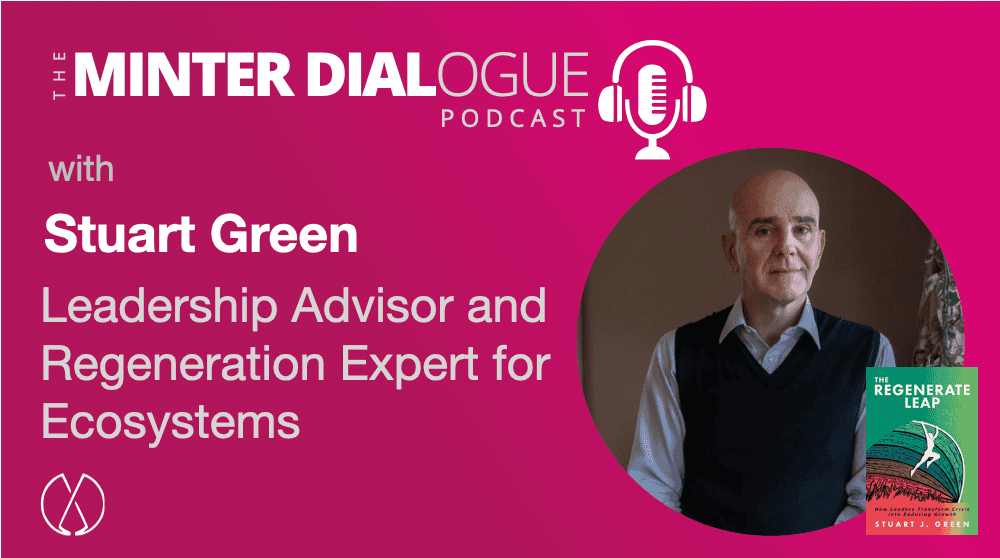
Minter Dialogue with Stuart Green
Our conversation delved into the messy realities of leadership amid crisis—a landscape Stuart knows intimately, having rebuilt his family and life after losing his wife in a brutal tragedy while abroad. Rather than dwelling in victimhood or seeking to bounce back in the traditional sense, he champions a regenerative approach to both personal and organisational recovery. His work and new book, The Regenerate Leap, challenge leaders to let go of outdated models, face vulnerability head-on, and cultivate the mindset necessary to not just endure, but to truly transform.
Key Points:
Takeaways:
Other mentions/sites:
- Book about encoding empathy into AI, Heartificial Empathy, by Minter Dial here
Further resources for the Minter Dialogue podcast:

Meanwhile, you can find my other interviews on the Minter Dialogue Show in this podcast tab, on my Youtube Channel, on Megaphone or via Apple Podcasts. If you like the show, please go over to rate this podcast via RateThisPodcast! And for the francophones reading this, if you want to get more podcasts, you can also find my radio show en français over at: MinterDial.fr, on MegaphoneFR or in iTunes. And if you’ve ever come across padel, please check out my Joy of Padel podcast, too!
Music credit: The jingle at the beginning of the show is courtesy of my friend, Pierre Journel, author of the Guitar Channel. And, the new sign-off music is “A Convinced Man,” a song I co-wrote and recorded with Stephanie Singer back in the late 1980s (please excuse the quality of the sound!).
Full transcript via Castmagic.io
Transcription courtesy of Castmagic.io, an AI full-service for podcasters
Minter Dial: Stuart Green, tremendous to have you on this show. I am delighted to have this conversation. You and I met kind of randomly at an event and then, whoa, was I impressed by your story and what you’ve been up to and what you do. Stuart, more importantly. So, in your own words, who is Stuart J. Green?
Stuart Green: Oh, thank you very much, Minter. And likewise, it’s very frame. We had a lovely time together, as I remember. And I dragged you all around the different conference rooms as we went through the meeting. But so, my name’s Stuart Green. I work with leaders and leadership now who are going through transitions and sometimes delivered to them, but sometimes of their own making as well. So, that’s me. I’m 30 years ago, I was studying my fisheries in the University of Hull up in the north of the UK and I came to find out that people were using dynamite to catch fish in Asia Pacific. And I could not. I was hooked, but I could not, so to speak. Yes, exactly. And so, I literally worked a little bit after graduation and I grabbed a backpack and I went out to see Southeast Asia to explore more and never came back until about six years ago. And have been working with ecosystems that are degrading, but working with the communities around those ecosystems and helping them transition. So, whether it be whaling or dynamite fishing, these changes and kind of working around that, as well as the reefs and the fisheries that are also going through that change and kind of helping everyone get through that change and move to a more what I would say, regenerative future mentor.
Minter Dial: Well, I have to give a shout out to my brother-in-law’s brother. I suppose that makes him my brother-in-law, too? Liam, who works on the evolution of fishing communities, he works up in Galway. So, hey Liam, listen in I have to ask you just recently, of course, this is just topical. There’s the puffery fish, which is this violent, really predator type fish which is overtaking the Mediterranean and they’re talking about having government sponsored programs to get rid of that fish because it’s basically filled with some sort of poisonous venom that’s completely within its system. So, you can’t eat it. It’ll otherwise be fatal anyway. I suppose that’s another ecosystem that. And they’re, they’re doing it to help the f. I was quite intrigued by that story recently.
Stuart Green: Interesting. Well, that’s an ecosystem collapsing. You have something coming in, it’s taking over. But if you were in Japan and it was the same species, you’d be paying top yen for that product to eat it and to actually taste Some of the poison.
Minter Dial: Well, they were saying that there are various varieties or strains of them. But anyway, I guess they need to hire you, Stuart, bring you into the Mediterranean, take care of evolving ecosystems. So, you’ve been back in Britain for six years, having lived out in the Pacific. How do you describe your return between your time in Hull before and now you’ve been six years back. How do you describe the changes that you’ve seen in Britain?
Stuart Green: Very unimpressed with way the UK has gone in some ways and in other ways impressed in other kind of aspects. But overall, yes, we don’t seem to have continued that growth upwards. It seems to be a bit bumpy. I’m very fortunate in that I never voted Brexit either way. So, it was not part of that deliberation. But I still feel very European from this part of. Of the region, so on and so on. But yeah. So, I say bumpy in response. Yes, Yeah.
Minter Dial: I think that you work on transformation, Stuart. The notion that comes to mind is fast paced and messy. And the funny thing that, you know, your book explores, which we’ll talk about is somehow the crisis. There are crises. We’re in a poly crisis mode, as you call it, with so many different crises. And within your journey you also have the personal story. It feels like legitimately the personal story is part of everybody’s crisis in today’s business, whether you’re having some issues with inflation, getting more customers, all this and the existential nature of life after Covid has made everything more personal. Is that something that resonates?
Stuart Green: Absolutely. And it’s. And it brings us exactly to the need of the moment, which is leadership. So, how do you lead into these different crises that you’re dealing with? And it’s exceedingly personal because there is no solution, There is no roadmap that deals with all these crises. So, I see a lot of people, I’d say, who were walking wounded, who have had things in their life delivered to them or being delivered to them, and they’re kind of a bit stuck with that. So, that I see since my experience and sharing my kind of vulnerability with people, many people have opened up about things in their lives that they haven’t yet dealt with. So, that’s why I use the term walking wounded mentor.
Minter Dial: So, we, I haven’t directly, or we haven’t actually directly addressed the, the tragedy that you hit, which was having your wife assassinated while you’re out there. And so, that needs to be said. And obviously huge amount of trauma, top end of the scale, you’ve Come back now and you’re working. You write in your book that when you, after your wife’s assassination in front of you and your children, this is where usually the leadership book ends. This is where you say mine begins. How did that crucible moment change the way you challenge leaders who still cling to some sort of older, old school, sanitised version of leadership?
Stuart Green: Yeah, great question. So, just to clear, I was not present, so I was the very lucky one. So, I was, I was away and the children, but the children were there at the time. I can’t talk too much about it because there’s legal implications of that, but for me, we were talking earlier about perspective. So, I really was the fortunate one in the sense of I was able to return within the day and kind of had the honour and privilege of seeing my children through what I hope is the worst time of their lives. You can never know nowadays where things are. So, that’s. Yeah, so. But that became my crucible. So, I. The initial instinct is to feel sorry for yourself and, oh, you know, I’ve got to now we’ve got to leave the country. We’ve lost our home, we’ve lost our house. Of course, I’ve lost my, my wife. How do we manage things? But for me, it was. I’ve been trained, I’ve managed large executive teams. I’ve done many things in my life and I thought I was always preparing for ocean transformation and helping the ocean sector, but actually this was the moment I had to step up and lead because there was no roadmap, there was no direction how to even begin with all of this. I kind of had had no idea. And, and as you mentioned earlier, Minton, so I came back and so I consumed hundreds of books. I was just like, there must be a secret, you know, roadmap out there for this. And literally got over 500 books through and couldn’t find any significant set of literature. There was lots of great bits and pieces, but nothing that really said need to do this, you need to go forward, etc, and so that’s. Hence I, I wanted to share the book back. Is a bit of a road map for when the proverbial hits the fan. Here’s a phased approach for getting yourself back up and running with whoever you lead and who you oversee moving forward.
Minter Dial: So, there are a couple things, but mostly when you’re dealing with leaders today and you need to get them off the can, as we say in the expression, and to move away from their more traditional approaches to leadership, how is this particular narrative that you have changed the way you sort of prod them into adopting a new approach.
Stuart Green: Great. Another great question. So, for me it’s about asking questions and clarifying, but it’s really. So, I, in my work, I use the forest fire analogy. So, you. The forest is burning, so it is raising to the ground. So, what do we need? What needs to be cleared from your current model and the assumptions that you have been working on as the first phase. And if, if we don’t get something changed at this first level, you’ll never be able to regrow into another sapling in another direction. So, for me it’s being very honest, frank, but really asking them to really rethink where what needs to go, what needs to be, what you need to let go of, what you need to clear. What are your assumptions that your model or your leadership has been based on. Because things are changing and you can either sit there and move along and it will change without you, or you can get in there, embrace it, and you can lead from the front and you can guide it to what you want it to be in the future. So, you really have to get ahead of the change that’s coming ahead. So, that’s for me is just being very honest. And to be honest and not. Not everyone, for me clears the bare barrier to join as a client. So, I’m very rigid on. I really need an open mind if we’re going to move forward as well with, with the clients that I do work with. Inter. You’re.
Minter Dial: Excuse me for thinking rigid and open is funny, you know, have a rigid, A rigid principle to be open. It’s a funny paradox. But in this, you, perhaps you mentioned in the book, but I forgot what is the perspective in this forest that we’re talking about? So, are we the forest or are we a tree in a forest that’s burning?
Stuart Green: So, our system is the forest. So, that’s the kind of. That’s when we talked earlier about the polycrisis. So, it’s climate change or kind of whatever the changes are happening. AI at the moment is changing a lot of things. So, that’s the forest. But yes, we are the sum of the contents and the knowledge of that forest. So, as it’s raising down, as it’s burning down, what we get to do is pick the little bits of compost that leave behind and we can choose some of those bits and that will become the pieces that we take forward. But it can’t be everything. We need to clean out a lot of that carbon. That’s Left on the floor, let’s say.
Minter Dial: So, the main focus and say theme that you talk about is regeneration, of course. But I’ve read, Stuart, that you’ve been called the anti-resilience strategist, which sounds rather provocative in light of how everyone’s talking about it. What’s a respected leadership idea that you now consider not just outdated, but actively harmful? And how do you politely dismantle it when you go into the boardroom?
Stuart Green: So, at its core, resilience is about returning to the past. So, it’s you be. When. When you lead the. Read the leadership books. It says, okay, you’re going through leadership crucible, be resilient, be gritty, see your way through it. All of that assumes that you are returning to your past. So, that’s why I’ve become a bit cynical about a lot of the literature around resilience. Because actually, no, you’re going. Some things have totally moved on, so you cannot go back to that past. And it’s the same I’ve seen in ecological systems, whether it’s coral reefs, ocean systems, you go back to the past. So, for me, it’s about taking what happened to you to get some of that compost and then building and regenerating something which is different and, but it’s aligned with your future. Again, if you can take control of that and lead through it, you can create what you would like your future to be rather than rely on the past, which has me done.
Minter Dial: So, crafting your…
Stuart Green: Your future, basically. Yes. Yeah.
Minter Dial: You say life does not bounce back. It becomes something different. You have to have a specific type of mindset for that. How do you un. Tangle. Rewire people’s mindsets that typically are so strung up on their past? I mean, I, I don’t know many leaders today who don’t do their budget based on last year plus six or whatever.
Stuart Green: Totally agree. So, for me, the, the serotoninous mindset is the, the one that I really adhere to. So, there’s a tree which with my children, we discovered it’s called the lodge pole pine. And in that that tree lays cones. And those cones are sealed shut and layered with resin. And they hold seeds for years and they’re just dormant. They lie on the side or on the branch. They will only open and release those seeds when there is the heat of a fire. So, that heat melts the resin, they release and they go into the fire, into the compost, and then right on top of the clearing that the, you know, the area that’s just been cleared. So, that is the beginning of the next generation of forest, which is going to be different to the one that began. So, for me, when we’re working with teams or leaders is how do we. How do we use the heat of this fire? The. The actual problem that is attacking you at the moment, that you need to lead through to create and open up new seeds for a different future moving forward. Minter. So, that’s my. The most important mindset.
Minter Dial: So, what I, What I hear. It’s funny how conversations spark different thoughts, but in the. In essence, the fire is a mechanical process that begins the regeneration itself. It opens up this. The gel on the pine cones. That pine cause fallen reseed. But it feels like, why not actually? I mean, in the end of the day farming, they do raise fields in order for better, more fertile lands later. So, there’s an intentional aspect of bringing a fire. You can see that with farmers, I suppose. I don’t know if they do it intentionally so much in forests, but, you know, after a volcano that happens. It almost feels like one of the ideas could be as a leader, get ahead of the fire and start your own.
Stuart Green: I love it. Absolutely. Don’t wait for the fire to hit you. Absolutely. But there are things in life, Minter, that you have no control over. So, that is another thing that you realise when you go through crisis is you have no control over situations outside you, but you have a hundred percent control over how you react to those situations. So, that again, is back to the mindset is really shifting your framework from, oh, this happened to me, poor old me, which I’ll admit I also went through for a long time to, wow, I need to be on top of this and I need to control this and I can steer this. There is a tiny sliver of a silver lining that I can push to, if I can achieve, you know, over the next few years, the direction that. That I need to take in this.
Minter Dial: All right, so it feels important to talk about perspective again, because what is a small fire? What is a big fire? And understanding the nature of that, it feels for me, a lot of people are trundling along dealing with the crisis and thinking I can just rationally get over it. I’m impervious to the issues. The. Well, I have eternal energy and it’ll all be better in the end. My wife and I often talk about an expression that apparently Nietzsche brought up, which is, that which doth not kill me makes me stronger. And you, with your journey with your children, went through this and you found ways to be stronger through the process. In the darkness of the aftermath, let’s say in the middle of the crisis, if you will, and as you mentioned, you know, the difficulties. But in a business, it’s the same. You have this sort of the crisis, oh, a new thing’s hitting, a war has started up or some. My competitor has a new AI that’s just blowing it out of the water. How do you latch onto that strength building component, you know, internal energy? Well, how, where do you dip into? How do you figure out to stick with the, your kite while there’s a hurricane going on?
Stuart Green: I think that’s that. So, that’s really about having vision. For me, it was. My children became my purpose. So, I had always thought I was a reasonably good father. I subsequently learned I had been a terrible father from, from the baseline. And so, I became mother and father to the children and they were my driving force. They got me up in the morning when I wanted to just lie in bed and put a pillow over my head for a few weeks at a time with a bunch of hankies. I was like, no, got to get up and they got to feed them, get, find a new home, new school, everything. So, in the space of 10 days, we transitioned from Maya family to new country. No job, no schools, everything. So, for me, let’s get a routine going as a family. And so, every morning, breakfast together as a family and plan out the day and then work from there. So, that was really. And then step by step, you build a routine from scratch, you know, and take, take some of the, take some of the compost from the previous life. So, we kept a couple of routines going, but the rest is we basically started from pretty much scratch and kind of rebuilt from there.
Minter Dial: Hence this idea of the raising.
Stuart Green: Yes, exactly.
Minter Dial: So, one of the things I enjoy discussing is time. Time. I mentioned the sort of existential ness of today’s world and how personal it all is. How we manage time, I always say, is a reflection of who you are. And because we all, it’s the thing we all share and we all know it’s constrained by 24 hours in a day and ultimately by the end of our lives. And you write that being busy is not the same as being purposeful or having purpose, and you become, as you say, ruthless about time. Yet do we need to have an ability to play and be silly and, and be messy and, and human and by the way, imperfect? How do you evaluate or help allow business leaders, yourself to have joyous, purposeless time waste, quote, unquote, play in your agenda, all the while being ruthless about time. I feel like it’s a relevant conundrum that businesses face. Time being the single most important resource we all have.
Stuart Green: Yes, I agree. I. So, for me the. My joy and fun is from playing with my children and exploring things with them for before everything happened changed to me. I would take occasional holidays with the children and so on and so on. But when we came back here. So, my personal go to is I. I said let me work during the year. I will be busy and I’ll be doing things I’m around. But I do travel a bit. But every August is yours. So, I take a month off every year with the children and we go explore different countries, different areas together. In fact, the. The book was from one of our explorations in a. In a camper van driving around Oregon and California in the US which is where we saw the forest fire and which is where my son said well dad, isn’t this a bit like. And I’m then, oh, let’s go have a look. And then we found the lodge b. The cone. And then we kind of. So, that became our analogy for our family is we’ve been raised, you know, kind of to the ground, but we’ve started again and here we are coming back. So, that’s my. Would be my advice is. And my second piece that I’ve also done now is with the children. I plan my year with them first and then work comes next. So, that’s my two promises to them.
Minter Dial: It feels like a lot of business leaders forget the personal elements. They end up very successful CEOs perhaps, but unsuccessful at home. How important is it to have an integral concept to your leadership?
Stuart Green: Oh, it’s. It is the core. It’s the. It is the ecosystem. So, you could be doing amazing on one side. If you don’t have the other piece, you are totally unbalanced and it will come to bite you. It’s just when that happens, it’s not if. So, that is very, very clear to me.
Minter Dial: Well, I like that you. You wrote that leaders must be both wounded humans and unshakable guides. It feels a little bit like that’s the conundrum that survival is an assignment, not an accident. What practices do you personally use to stay human in front of your children, yet still be the stabilizing force that they need and maybe the parallel into business. Of course.
Stuart Green: Yes. So, say sorry and say be humble and I made a mistake with your team. So, just we are expected to be these leaders who know everything and do everything. But for me is we have. Yeah we as a team. So, my. The team that I work with and the family was just say sorry. It’s all good. We learned that one. But please don’t repeat the mistake again. But then apologise for it and then be humble. And every day you need to learn new things about. You know, there’s so much to learn and especially this time. We’re living on the planet at such an amazing time with all these changes going on. So, that’s, for me is it’s amazing where I’m alive at this time in the planet’s evolution. So, very excited. So, yeah, that’s. That would be my response.
Minter Dial: I. I hear, I hear two things in that for businesses which, which resonates. First is the ability to fail. The acceptance of failure which is resident in this idea of being sorry. You somehow, I’m sorry I made a mistake. I’m sorry I made a failure out of something. And, and that is such a necessary part of learning. And then the second is I can’t know everything. Humility to say I can’t know everything. Because in the other sort of crises that we’ve had is now knowledge is no longer a privilege. It’s sort of just out there messy, hallucinogenic as it sometimes might be. But for, for business leaders, how do you translate that into their world? What do they. I mean, how does one better accept one’s failures at work?
Stuart Green: Yes, I think so for me is it’s. We have a cultural value in my team, so we actually share that. And every time, in a way, we get a little bit of an award for calling out a mistake and then learning from it. So, we try and totally flip it on its head and congratulate each other for a mistake because we’ve got the gold nugget that we learned that we won’t do that again, will we? So, I tried to do that with the family as well. Just grab it and learn from the experience. It’s very powerful that way.
Minter Dial: The notion of a CEO saying I screwed up. It’s not like my regular narrative that I hear. Obviously the purpose, the desire for me is for people to get your book. The regenerate leap. It’s got lots of frameworks and this notion of how the forest analogy can play out in a business with your raise enriched which GROW framework for CEOs that are listening to this because in the end of the day, my belief is that it all starts with how the leader operates and demonstrates and behaves. If you look and you think about the different phases that you talk about is There one or maybe different per phase non-negotiable change of behavior that you prescribe that CEOs should really buckle down and implement in the way that they operate.
Stuart Green: It’s really what we discussed earlier, Minto, is, is, is go back to what assumptions have am I making now and the world has moved on that we now need to remove. And that is the hardest thing I find working with anyone is, is they’re letting go of things. So, I had my letting go forced upon me. So. But it’s the, it’s. Yeah, humans find it very hard to let go, so. But it’s really what needs to be let go of now. What can we trim down so that we can grow into a different future?
Minter Dial: Moving forward with a client that you’ve worked with successfully through that, can you give an example of what they had to let go, the consequences of letting go and how they managed it? Because at the end of the day it’s sort of easy to say but the challenge, but it’s difficult to say actually, but it’s sort of out of my mouth. Here I go, let’s just change some stuff. But the challenge is, well, oh, but I have four clients that like this product. We should take it out of our product list. But you know, they’re long time clients and so every time there’s sort of some sort of qualifier that or some sort of element that says maybe not that, maybe we should keep that too. How do you get over the hump of oh, we should keep that too.
Stuart Green: That’s a great, great. So, I’ve got one example. I’ve got to be careful because I don’t have that many clients.
Minter Dial: Well, don’t. Yeah, right.
Stuart Green: But there’s one at the moment who I’m working with where I’m working with the board separately from the executive team and I’m trying and the, the board doesn’t understand their role very well and they keep creeping into executive and then the executive knows what, what the focus is for them. But because of this overreach coming in, they’re overreaching in the other direction at the same time. So, we’ve got this comedy in a way of there everyone’ overlapping so on and so on. But I’m, I’m quietly coaching both sides to say, well look at it from their perspective and then playing their, the executive’s role with the governance team and then the governance of the executive. So, trying to. So, instead of it’s one and two, it’s them plus Stuart, them plus executive and then vice versa so just trying to almost doing scenarios with them and just again, questions, challenge, whoa, wouldn’t that be executive’s job? And so, so just for me is providing a bit of leadership is here’s the dotted line, you can pop a little bit over here, but I’m going to nudge you back and if you really go around, going to really push you back and then vice versa. So, it just for me is just making it a bit fun, a bit of gamifying a bit of kind of scenarios and me being devil’s advocate so I can go extreme on one way, on the other and then really challenge them and that. But the lovely thing is after like two or three months, they all kind of get it now. And it’s been humbling because they’ve said, oh, oh, we didn’t think of that, did we? And then, oh, I’m learning new things now. So, that’s when I know that we’ve kind of opened things up. They’re beginning to get it and they’re beginning to see the pathway. So, from what was like this, we’re now in a, in a much nicer place and my job is to put them and their organisation in a great place for the next five years. So, I think we’re through the pain. So, that, that’s one of my more recent experiences. I’m laughing because you. I’ve just thought of it for the last.
Minter Dial: Yeah, well, what I, what I was hearing in that was something you said at the very beginning, which is the ability to ask questions and in this case a little bit sort of provocateur questions, trying to devil’s advocate questions. And so, the vision piece, which is sort of when you start prodding and pushing in different ways, it’s leading towards a vision. Of course, I’m on a board currently and they’re really not. They don’t even know what governance is as far as I’m concerned. So, long way to go. There’s always all these fractious elements with these types of organisations. I want to spend a bit of time now talking about AI. It’s the hot topic. You’ve created an AI regenerate leap clone in the form of Delphi so people can talk to this digital twin, your digital twin on a regular basis. How is building a digital mind. How is it, how was it building a digital mind? How did it force you to clarify or even change aspects of your own philosophy of regeneration in the, in the process of creating an AI? And if I just frame it one second, which is that I think Most businesses should be considering creating an AI that’s proprietary to themselves, much like Delphi is sort of proprietary to Stuart Green. It’s your thing. And in the process, I’ve always felt that in the creating of the AI for you, Mint or Dial AI, whatever, really demands clarification on who you are, what you’re about, and, and, and how somehow you are providing some value added, unique value added through even your AI as much as it represents and reflects who you are. So, that was sort of my context for that one. So, how did it clarify or change the way you have operated? Stuart, in creating your AI, it really
Stuart Green: challenged me to really think at the core, what are my values and what is my kind of message to anyone going through crisis or trauma or change and then have it again ask really good questions moving forward. So, I actually have. It has about 40 key questions that I have aligned under it, depending on where someone’s coming in with a problem and then, then it redirects them back to the basis, which is either in the raise phase, as in they still need to deal with, they need to clear some of the wood out. Are they, have they got through a bump? They’re com. You know, they are thinking about what the future means moving forward. So, they’re in the raise phase or are they just beginning there in Rich.
Minter Dial: Yeah.
Stuart Green: Enrich phase. Or are they, have they moved to the grow phase, which is kind of moving forward with them into. So, yeah, it’s really hard. It, it. And then talking to myself in the digital twin to make sure that everything it was saying aligned. And so, if you go behind the system, I would ask it a question, I would give the. Get the response and then I could edit that response from it to make sure we were quite. I think we were about 90% aligned so far. But for me, why a digital twin? Because the moments after my life changed, I didn’t know where to go, who to talk to, what to do. So, I wanted something that’s 24 hours, anyone can access it anytime to give them a quick response, you know, if, you know, just what should I be thinking about? Because yeah, you, you mentioned earlier that time is very precious. So, is relationships. And when something, when things change for the worst. One thing that. One of my big shocks, which I also share in the book, is that 80% of the people I thought would be there were not there. But there’s another 80%. There’s more than 80% of people who turn up and you’re like, wow, they. I thought you were great. But I didn’t realise how great you were. And so, they’re the people that, the angels that come along the way. But my Delphi is supposed to be a bit of an angel. I’d like people to have access to if they’re going through crisis or leadership. So, yes, that’s my basis.
Minter Dial: Minter, your oracle Delphi in the values piece. And I think that’s something that every leader talks about. You know, there’s so many things we talk about but like teenagers and sexual. There are a lot of people talking about it, but not necessarily doing it. At least good sex values. In order to transcribe your values into an AI, give us an idea of how that actually works manifest. Because you know, I, I. The leadership teams I talk about with a. My values integrity. Okay, what do you mean by that? My values family. What do you mean by that? Lovely words. But if you were to ask a number of people their idea of family or integrity oftentimes hugely different. So, words are structuring and how do you then structure that value to be implemented within an AI? What was your process for that? And maybe you can give one example.
Stuart Green: So, for, so the, the way I framed it within the AI is, is again goes back to what we were talking earlier about mindset. So, it’s really what are the key mindsets to adopt in approaching any of these situations? So, it, we touched on the serotonin mindset which is something happens, it brings something else out purpose mindset. So, having clear kind of direction, what do you lay your foundations on? And then the third mindset, which I think is also very important, which we, we haven’t touched on, is an abundance mindset. So, it’s very easy to go back and say, oh, everything’s down, the world’s changing, etc, but for me we’re actually, this is a time, you know, and especially with AI where we can actually could actually have a much more abundant global situation for humans. Knowledge has been democratised. Anyone can access them. Whether you’re in the middle of a coastal fishing village in the middle of Asia Pacific or in Africa. All the knowledge that’s been held over the years, we have access to that. So, wow, what a, an amazing opportunity anyone has to really level up, let’s say and, and this knowledge being democratised. So, abundance is the, the third kind of pillar I put in there. So, have a. Not overly optimistic in the sense of just to the ridiculous extent, but having a. What’s the upside in this situation? Framing.
Minter Dial: So, an abundant framing of each value. Is that what we’re getting to, no?
Stuart Green: An abundant mindset as a value. So, for me it’s kind of really at the core of the twin.
Minter Dial: I guess my challenge is to find out how to encode abundance. I don’t know if you’ll recall, but I, I’ve written a book about encoding empathy into AI. How does that look? How do you structure it? There are different ways to be empathic. There are different targets with whom you might need to be empathic. So, your AI, your version of AI and the empathy within it won’t be the same for everybody, which is back to my proprietary AI. So, I specifically look at the encoding of empathy, which isn’t a value, it’s a skill in my, my terminology. But it has a similar kind of root concept, which is how do you encode empathy? And I was just. For people who are thinking about AI today, they should be in my opinion, thinking about having proprietary AI and therefore becomes the, the ethical framework, the values vision piece. What, how are they making their AI more specifically theirs? Sort of where I was trying to get to with regard to Delphi. In terms, if you have abundance, how do you tell your AI to oh, just mirror my, my vote, my version of abundance. Is it a series of prompts? Is it a learning process? How, how does one actually concretely go about that?
Stuart Green: I. So, for me it was, I uploaded all, all the work that I’ve done in my literature, in, in my scientific work, in my, the book, etc. So, for me it was just here’s the kind of, the sum of all the knowledge. So, that’s where you begin. And then you, yeah, so then you start breaking down. What are the core pieces. Empathy is, is so important, especially for this, given the, the topic I was doing. But I just made it overly empathetic for the situation because you can assume if someone is coming, they’re dealing with something. So, that’s really dialled up on the settings. But, but for me, the. I just, I gave it a kind of a framework from. So, we had all my knowledge and then I gave it a bit of a framework for, you know, how to interact with different people. And here’s some of those core values. And again they came somewhat from the book, but also from all my teachings. And then here’s. Listen. So, it’s not about giving advice, it’s about asking great questions. So, for me it’s not, it’s not telling you, oh, well, this is the magic solution. It’s just, hey, you know, working on that mindset and just kind of challenging, well, where are you at now how does. And so, kind of walking them through. But of course, I’m not a psychologist and the AI is not trained in that whatsoever. So, there’s disclaimers galore around it min. But yeah, it’s just meant to be a kind of a, you know, a quick place to go to if you really are feeling some stress. But you would always need to have professional guidance from someone who knows it. So, let’s not, let’s not. As lovely as AI is, let’s not assume it is, you know, it is going to be accurate in 100% of the cases. Yeah, it’s. Well, it gets it wrong. Whether it’s to fail fast and to recognise that I don’t know yet. We should work on that.
Minter Dial: I quickly qualify that we all get it wrong. And an AI is quite the reflection of us in our world, you know, mumbly bumbly type of way. And I speak specifically about therapeutic AI and how, where does empathy show up in that AI and how I can oftentimes be better than us humans. So, I tend to speak up, speak out for these opportunities, which are 24-7 which most therapists can’t do because some of them have to sleep, for God’s sake. Wanted to just get last piece, Stuart, which is. So, you started your life in, in ocean study or oceanography. I don’t know exactly. And then you, I would say, pivoted somehow to forests. And I have no idea about either the ecosystem in a forest, the ecosystem in an ocean, obviously just layman’s ideas. What are the crossovers or maybe what are the bigger differences between these two ecosystems that you’ve noticed in your study? Because you must have a solid foundation in the wobbly world of seas. And then you have this forest which is typically on land, so to speak. Are there some crossovers in the model that you have in the regenerate leap that come from both sea and forest? Or are there some things which are different in the way oceans live and forests live?
Stuart Green: Great, great question. So, the core principles are very similar. The only difference between an ocean is everything floats in a water medium, so you have to adapt to that water medium and then everything in a forest floats in air. So, that’s literally the, the only difference otherwise competition, evolution, habitats, how species interact. Everything else kind of works from around that. But I would just say that in terms of, of diversity, we have a lot more diversity in the oceans and it’s a lot less explored than on land. And I’ll give you an example. You know, if we think about our, you know, we walk around with the Google Maps or whatever the mapping thing is. You can see down to you know, 5 centimetres this tree, that place in the oceans. We’re way behind that that you have one sensor which is kind of fixed in an area for every 50,000 km of ocean globally. So, that tells you how different we are. And what makes me laugh is in a, in a way is that you know here we are where everyone’s rushing up to space to go and explore that frontier. We haven’t yet explored the oceans which is here, which is home and is 70% of our oceans planet. We have ocean surface area with 70% ocean. So, that’s all so, so very similar ecologically. I, the reason why I went with forest for the analogy for the for the regenerate leap is because not many people really understand the oceans. So, and we’ve had lots of forest fires and as I mentioned with the children we actually got trapped in an ocean in a forest fire. So, we were, the roads were moving us away and so we’re like on one end we had you know this beautiful new forest growing up and on the other side we had another piece burning down at that particular moment. And it just. The stark reality was whoa. That is how to explain what we’ve just all been through in the last seven years together as a family. So, that’s why the forest came in. But yeah very similar settings. Just the water versus the air.
Minter Dial: And yet there’s some differences which is what got me my, my mind stirring along. I have friends whose house was burned down in Los Angeles and raised to the ground and how that’s trauma because you lose all your photos and objects and your home which a little bit similar to you just a small piece but within the fire piece similar and resonating with a conversation I had with a friend called Thom Dennis who also has written a book about how nature can be a much better guide for how leadership should be going. It feels like there, there are a few of you on this, this journey of finding new models for, for leadership and, and the way nature is with its all powerfulness and, and I would even argue maybe more appropriate it the. The ocean because there’s, there’s so much unknown that’s about to happen in the future. We, we should have this humility to be that little, a little camera looking at 50,000 square miles or sensor and, and. And remember that we’re just a little smidgen on this earth to come back to purpose. Right. Well Stuart, time has come to a fast, far too fast end. I feel like I barely covered, scratched the surface of our raised ground. But for people who have been listening, how can they go find Delphi? How can they get your book and send them to wherever you want them to send for continuing the exploration and maybe even hiring you, Stuart?
Stuart Green: Sure. So, just regenerateleap.com lays everything out and gives you all your options from there and you can find your way from there. And then if you work in the ocean sector in particular, that just BluegreenAdvisors.com which is our ocean advisory which also works with industries to see them through the change that’s going on as knowledge becomes democratised and business needs to shift in that direction and how to take the opportunity from their mentor. So, thank you for allowing me to share both those.
Minter Dial: And so, at Regenerate Leap they can find how to buy a book.
Stuart Green: It’s all there. Yes. And there’s an audiobook and Delphi is on the bottom. And we also, I also have a bit of a questionnaire on there that they can link to and tell which phase you’re in based on your kind of situation at the time. And then yeah, and there’s, there’s lots of goodies there that I’ve put up. So. Because I want people to have a guide when I hope nothing does happen, but if it does, I, I want it, this book to be a bit of the guide to help people. The one that I was looking for when, when I just didn’t know where to turn.
Minter Dial: Brilliant. Right. Stuart, lovely chatting with you. Look forward to hanging out, touching face with you again in some in real life experience.
Stuart Green: Thank you.

Minter Dial
It’s easy to inquire about booking Minter Dial here.










That’s a really helpful way to frame it – the forest fire analogy is so much more hopeful than just ‘bounce back’. It makes you think about the necessary destruction to allow for new growth.