
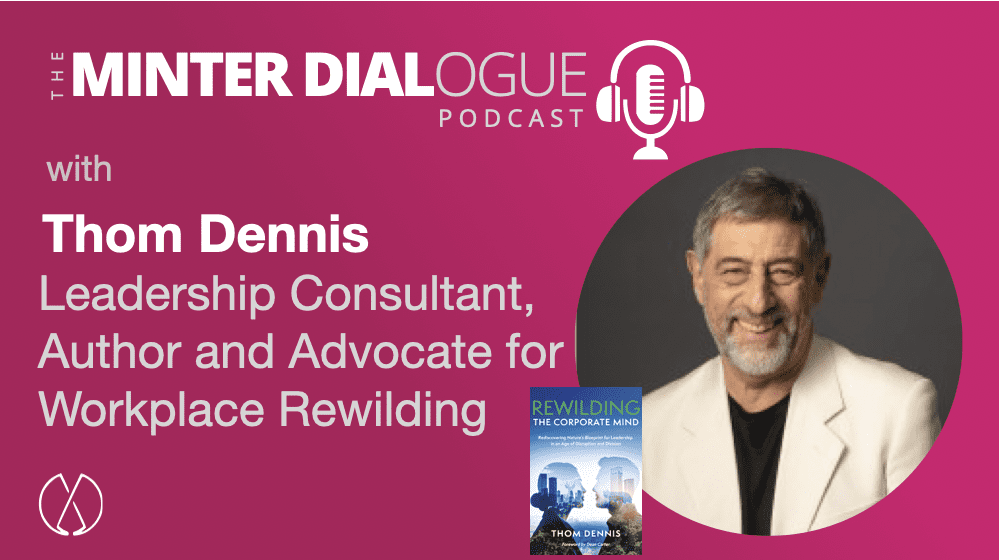
Minter Dialogue with Thom Dennis
We dug into Thom’s observations on the dangers of Victorian-style management and the relentless push for control in business, which he sees as a driver of dysfunction, anxiety, and ultimately burnout. Rewilding, in Thom’s mind, isn’t about chaos, but about restoring balance, creativity, and humanity within organisations. He challenges the dogma of binary thinking and advocates for broader inclusion—not just of ideas, but of people with diverse backgrounds, especially those grounded in the humanities.
Key Points:
- Nature as a Leadership Blueprint: The conversation focused on applying a ‘rewilding’ mindset to modern leadership, suggesting that allowing space for natural development can yield more innovative and resilient organisations than rigid control. Drawing from ecological restoration, Thom argues that nature’s way is not chaos but a dynamic balance, often far superior to human attempts at micro-management.
- The Power—and Challenge—of Letting Go: One concept discussed was the difficulty for business leaders to relinquish control, especially in the face of financial pressures and expectations from shareholders. The discussion explored how trusting teams and allowing creative freedom can be daunting, but is essential for long-term health and innovation.
- Restoring Humanity and Creativity: Several points were raised, including the need to intentionally bring back creatives and humanists—those trained in poetry, sociology, or anthropology—into corporate leadership to balance the dominance of engineers and economists. A key theme that emerged was how broad perspectives and genuine self-knowledge breed healthier, more adaptive workplaces.
Takeaways:
- Leadership, like nature, thrives not on relentless control but on trust, diversity, and the ability to adapt.
- Intentional pauses—space to think, reflect, and reconnect—are vital antidotes to burnout and disconnection in today’s workplace.
- There’s real power in returning to our roots, both individually and organisationally; rewilding isn’t about disorder, but about rediscovering balance and creativity in business.
Other mentions/sites:
- NEP/Wilding at Knepp Estate featuring Isabella Tree here
- “Lost Connections,” by Johann Hari here
- Patagonia—company giving 1% of sales to preservation here
- Frederick Winslow Taylor, “The Principles of Scientific Management” here
- Anthropic (AI company referenced for hiring practices) here
- Marianne Williamson (reviewed “Rewilding the Corporate Mind”) here
Further resources for the Minter Dialogue podcast:

Meanwhile, you can find my other interviews on the Minter Dialogue Show in this podcast tab, on my Youtube Channel, on Megaphone or via Apple Podcasts. If you like the show, please go over to rate this podcast via RateThisPodcast! And for the francophones reading this, if you want to get more podcasts, you can also find my radio show en français over at: MinterDial.fr, on MegaphoneFR or in iTunes. And if you’ve ever come across padel, please check out my Joy of Padel podcast, too!
Music credit: The jingle at the beginning of the show is courtesy of my friend, Pierre Journel, author of the Guitar Channel. And, the new sign-off music is “A Convinced Man,” a song I co-wrote and recorded with Stephanie Singer back in the late 1980s (please excuse the quality of the sound!).
Full transcript via Castmagic.io
Transcription courtesy of Castmagic.io, an AI full-service for podcasters
Minter Dial: Well, well, well, if it isn’t Thom Dennis back on the show with another book. Thom, great to have you back. For those people who don’t know you, how do you like to describe who is Thom Dennis?
Thom Dennis: That’s a hell of a question to start with. Hi, Minter. Who am I? I’m a guy who’s passionate about the way that the world is being led. I guess I’ve had all sorts of experiences in my life that have made me think about that. So, I, yeah, I’m not sure I’m a passionate leader, but I’m passionate about leadership. I’m a father, I’m a son, I’m a partner and I’m an ex-husband.
Minter Dial: Well, there you go. Many things. You’re also a former Royal Marine officer, former CEO, and you run Serenity and Leadership. So, lots of great stuff in there. Thom, last time I had you on it was a few years back and I’ll probably dip into that one in a moment, but this new book is called Rewilding the Corporate Mind. Rediscovering Nature’s A Blueprint for Leadership in an Age of Disruption and Division. How did you come up with this idea, Thom? Has it been sort of a seed in your mind for many years or did it just sort of come, become an apparent need for today’s world?
Thom Dennis: Well, I think certainly for me this is, this is brood. It’s, it, it’s come, it’s, it’s, it’s come about. I, I wouldn’t say through, through a flash, but I, I think when we spoke last, we, we talked a little bit about my, my, the sense of the masculine and the feminine and how we both have both, we all have both, but in varying degrees. And yet the feminine has been suppressed for so long that we now live in an extremely dysfunctional world. Not just dysfunctional, masculine. I think the feminine that is expressed is dysfunctional. So, I, I, I think that through the years I have unconsciously reverted to nature. I have. When I was really, really unhappy at school, I went to the trees and I, I spent time by myself and I didn’t sort of really make much of that, understand what was going on. It was much, much later. The rewilding part came from my attending actually in my bank. They had Isabella Tree, who’s the one of the owners of, of, of the NEP estate in Sussex, coming and talking about wilding, as she called it, and just hearing how through allowing nature to express itself, so much goodness could come and preventing or, or letting go of the need this sort of obsessive need that we have in so many ways in society to control and in this case control nature, which actually just warps it and kind of makes it crinkle. Whereas actually if you let it go the, then all sorts of amazing things happen. And so, I think after that talk it was like, I’ve been so wound up with leadership and what’s good leadership. How about applying a rewilding paradigm mindset to leadership? And that’s where it developed.
Minter Dial: Yeah, it’s certainly an extremely powerful metaphor. Naturally I’m going to try to look at this from the perspective or the lens of leaders in business today. And the first thing that comes to mind when I think of nature as, as you say is completely uncontrollable. There’s the doom and gloom component of everyone talking about global climate change. And then you know, for anyone who owns a house and a garden, it’s very quick to get out of control. So, the, the challenge seems to be knowing how to let it go without it overgrowing per se if you let nature do its thing because otherwise we’ll end up all living in forests. And I don’t know about you, but I like it when I have a roof over my head.
Thom Dennis: Well, actually that’s not entirely true in as much. And, and if you look at the Nepal experience, it’s not forest that has appeared over the last 25 years or that they’ve, they’ve had been running this program. It’s more, more like scrub. And part of the equation was partly to introduce and partly to allow keystone animal species to be part of the mix because we’ve eliminated pretty much all of those in the way that we’ve been controlling things. So, there was control in, in a sense by injecting the, the bits but not trying to be clever like we have in so many ways where we’ve introduced a particular mosquito to, to deal with this or that. You know, I don’t know, there’s been a number of experiments where humans have been introduced something that wasn’t native in order to deal with the problem. And actually what they’ve done is to create a nightmare. And so, it has to be really carefully thought through. I think of beavers where lots of people get very upset about beavers because they chop down loads of trees and that. But if you look at the way that the knock-on effect of having beavers in, in a particular place affects the whole water table which actually then is, is really proving beneficial to large cities. So, yeah, I think over and over again we Come up with a bright idea and ignore the fact that nature has solved that problem rather more elegantly over time. And if only we would listen to that. I mean you talk about control and of course, yeah, but it’s very Victorian, our sort of sense of needing really neatly cut grass and border shrubs. And again it’s our sense of I have a green garden but I’m very much in control of it. And yet if you do let these things go, it doesn’t mean to say that you’re going to live under the trees, although, you know, there could be worse things. But, but if you let things go, then things like bees, which are incredibly threatened because of the, the chemicals we’re putting on the land, they can, they can thrive. And, and actually if we lose our bees, we’re going to lose our food. So, these are kind of really serious things that need to be thought about.
Minter Dial: Well, in this case it sounds rather existential. Naturally I was trying to provoke Thom and let’s say in a corporate environment there are certain controls. For example the shareholder who gets bent out of shape if you, you know, miss by nickel. And so, we talk about financial controls and surely very Victorian in some regard. However, the notion of rewilding could seem very spooky to business leaders. So, the question then is how do you overcome the sort of recalcitrant, typically conservative minded business leader who’s more worried about profits and the next shareholder return than this sort of idea which is much more natural, allowing nature to take its course.
Thom Dennis: Such a big question. Again, I, I think that there are the, the, my experience of, of people in organizations right now is there are so many who if given an opportunity would have a role which was less stressful, less pressured than they’re experiencing now. You know, the, the, the obeisance to shareholder value is a model that honestly I think has limited utility in terms of time. I, I, I think things are going to change. So, I mean the, the number of organizations I see now where people are so disaffected, they are so stressed that I mean it’s almost like you, you’re blowing up the balloon, you’re blowing it and blowing it and blowing it and eventually it’s going to go pop. So, yeah, of course, particularly the board of directors, they will tend to say, I, I remember, I remember facilitating a while back for a CEO of quite a large organization and he was quite new in the job and he wanted to get his team sort of aligned and we, we, we did a, and I, I remember on the first day at tea time he came up to me, he was at, yeah, at a break, and he was ashen. He was a dreadful color. And he, he, he said, I’m not going to get what I want, am I? And I said, no, no, because what you want cannot be achieved without addressing some much more fundamental issues which are going on in the organization. The thing was, he was the third CEO that year, so he was, he was terrified and full of anxiety and that, and under enormous pressure to, To, To. To turn the business round. And none of the systemic issues in, in the, in the business were being addressed. So, what I tried to do was to support him, to say, you’ve got to take some courageous decisions now, but they’re not ones that are going to produce sort of instantaneous things that you can wave in front of the board. No, you, you’ve got to hold the line here, and then things will turn around. So, I mean, I really, I don’t want to underestimate the, the respect that I have for so many people who are running organizations. The job is so hard, and I believe it is much harder today than it has been, I mean, for a long time, if not ever. So, we, it’s just that we’re propagating and encouraging a system which is not going to last. I don’t know how long it will last, you know, and I, I think you can see lots of organizations that are hanging on to the old system, and particularly, you know, where, where you’ve got a CEO who’s got new ideas and wants to experiment in the way that you described, and you’ve got a board that says, well, no, you can’t take. You, you can’t take risks like that. And one could say, well, it’s perhaps the time that we need some fresh blood, because there’s so many people who serve on a number of boards and they bring the same level of thinking to them all.
Minter Dial: Yeah. So, I’ve had my, my French podcast, a guy who you’d really enjoy called Herve Franceschi, and he is a man who, at the age of seven, like you, had a horrible experience with a family somewhere, ran off to the local forest and sat in a tree and was found some 10 hours later having talked with trees. And it sounds like similar type of experience. Of course, I was very curious to find out, how does one talk to trees? What does that conversation look like and what does it bring to you? And my conclusion was, well, it brings some serenity, and if you get in touch with yourself, then you’re better able to listen to what the tree has to tell you to what extent do you think that type of approach is something that a leader today could bring to the craziness that they are experiencing? Is that something that you think legitimately could be done or does it have to be accompanied or guided? How does one get to that place without having it be like a child who’s been pissed off by his parents?
Thom Dennis: I mean, I love what you’ve described and the workshops that I’m running and the retreats I’m running on the back of the, the book. Really one of the fundamental aims there is to create a space where leaders can come and go through an experience which enables them to settle, feel that level of serenity and then hear maybe a tree, maybe a plant, maybe a, a, a, a bird or maybe just themselves. You know, that, that inner voice that I think we all have, but because we’re so busy and because we live in such a noisy world, we can’t hear. So, I, I think, yeah, I mean I was, I was talking to somebody who’s just written a book about talking to trees actually. And you know, she, she, she talked about well, you know, if you’re just out in nature, see which tree attracts you and go and sit by it and just allow. I colleague of mine has been running a, an off site for a business and in the pre interviews a number of them said well you know, I’m, we’re really busy. I’m really concerned about the pace of, of the, the, the, the, the workshop. And towards the end of day one a lot of these people were extremely anxious because things have been going so much slower than their natural pace. Well, natural, the, the pace that they have been living at in work. And yet by the end of day two they were all saying you created a space for us where we could actually, I mean they were talking about thinking but actually I think it’s much more than that. It’s about allowing one’s own inner wisdom and the, the signals that surround us all the time that we are completely deaf and blind to. So. I think the answer is we, we can create a space for people, for people to do it by themselves is tough because there’s always something going on. There’s the pinging of the phone and the incoming emails and you know, the, the limited time you have in your, your, your agenda. But you know, a lot of people complain, people, a lot of people, you know, coaching clients complain about well I, my relationship, you know, with my wife or my husband or whatever is, is, is suffering. And you know, there’s a classic there, which is do you have an appointment in your diary? Do you create the space in your diary to be a human being with your partner? It sounds kind of forced and weird and everything else, but it’s been the saving of an awful lot of relationships. Yeah.
Minter Dial: It reminds me of where you’re talking about a little bit before about being intentional about the animal you bring back into a. An environment there. There are stories of wolves and what they do in the plains in the United States that I sold out and, and, and yet they’re also pollutant animals like you say. You know, some of them we put in and they absolutely upend our ecosystem. Putting a space in my agenda for myself or for my sporting activities or for my time with my children, my wife is, is an intentional specific type of action. If we go back to the, the analogy of rewilding in a corporate world, what kind of other things would you suggest need to be intentionally brought back in to re wild the corporate environment?
Thom Dennis: Well, I mean one thing of course is just having plants and stuff around. You know, I think it’s extraordinary how, you know, when you have a move going on or a reorganization, just who gets a window seat and who’s got an office with no window? You know, the, the effects on morale and all of that. They really shouldn’t be underestimated. But I think another, another sort of way of looking of what, what they learned at NAP was in rewilding. They had to trust that they couldn’t ex. They didn’t know what to expect, but they knew, they trusted that the nature’s wisdom would express itself. And, and I think that in a lot of organizations there is an incredible lack of trust. You talked about control. I think the lack of trust kills creativity, kills innovation. So, allowing people and you know, I mean there’s, there’s good examples of this. Where was it Google, who. It gave a certain amount of time each week for people to just do their own thing.
Minter Dial: Yeah. 20 rule.
Thom Dennis: Yeah, that’s trust. That’s a kind of rewilding. So. I, I think, I think there is this sort of, I suppose it’s trust in, in a different way is this, and this is something that I did learn in the military, which was about set an objective and then let people get on with it. Understanding where you’re going. And in an awful lot of organizations you’ll find that the need for control will just say, well that’s your job, get on with it. And people don’t really understand where that fits into the context of the whole. So, that’s, that, that’s, that’s something. There’s an awful lot of fear in organizations. There’s an awful lot of leadership that depends on creating fear in order to achieve things. And. Nature’s not like that either.
Minter Dial: I have a few thoughts boiling in my mind. The first round trust. It’s my observation that I think that that lack of trust is spawned by the leader’s lack of trust in him or herself. Lack of knowledge of self. And then it comes out like a chip on the shoulder when they distrust everyone else because they don’t know how to let go even of themselves. Your. I was just thinking back to
Thom Dennis: the,
Minter Dial: the analogy of, of how it’s boiling and it’s going to over boil. It feels a little bit like the acceptance of overwhelming debt at the national levels where in the United States we’re talking about $40 trillion in debt and the interest itself is more than they’re spending on military. Just that. And at some level that that bubble will burst as well. And the last comment is with regard to the insertion in business rewilding and hopefully goes in your direction is let’s, let’s bring back in people who have degrees in humanities. It shouldn’t just be economics and engineering and mathematics and such great though they may be. But what about poetry and sociology? Is there not still a space for that in the idea and anthropology for that matter for rewilding our corporate invest. What does that sound like to you?
Thom Dennis: Absolutely. I was trying to think it’s either the, the CEO signal or not the CEO of Anthropic. But some, somebody else in Anthropic was saying the other day that they hire people with exactly what you’re describing. It’s very important to them that they have people who you could say have a soul. And, and you know, I, I was facilitating a, as senior leadership team, executive team in a very big company a while back and they were all engineers because it was an engineering type company and those that weren’t engineers were either lawyers or accountants. And I, I, I just, you know, there was a moment when we were discussing how to, how to look at where the future was and, and how to align for it. And, and I said how many creatives have you got in your, you know, in the, in the chain coming up towards you? And they couldn’t think of one person. And part of that is because management teams tend to promote the people that look like them, not the people that they need to, to provide a, the, the spread of abilities and thinking that Businesses actually need. So, yes, yes, let’s, let’s encourage people, of course, universities, I, I, I think there’s just been this tendency to, well, until quite recently everybody was being encouraged to learn programming until AI kind of put that one to bed. But still there’s this, this sort of, it goes back to this sort of love of mechanistic thinking that goes back to. When was it that book was written? 1911. I, I seem to remember the Taylor book. Yes, yes. And, and it’s, it seems to me that still some business schools and that are fundamentally preaching that same sermon and, and life has moved on. It really has. I, I was attending a webinar run by one of the big schools in this country the other day and it felt to me like they were so out of touch with, and they’d done a bunch of research. I don’t know who they polled. Maybe they were just ex students who were still thinking in the way that they’d been taught but was really scary that they were so out of touch so. Absolutely, absolutely. We need people who think outside the box.
Minter Dial: Well, it does sound like anthropic would appreciate having an anthropologist amongst its mist to make that. But I mean in the end of the day you are an expert in transformation and culture change and in your book you describe it as being closer to ecological restoration rather than a linear project, which is how we prefer to operate in business in the tailoring model, if you had to. Now you talked about schools and how they got it bonkers. What sort of buzzwords would you think need to be completely banned from the vocabulary of leaders today to get rid of that sort of instantaneous roi? Or maybe that’s one of them.
Thom Dennis: Well, yes, I think rois, I, I interviewed Dean Carter, you know, who was the, the head of HR in and, and shared services in Patagonia and he said in the six years he worked in Patagonia they never once spoke about roi, not once.
Minter Dial: Well, my cousin was head of finance for them at one point, so I’ll have to check, check in with him on that. That was many years ago.
Thom Dennis: And they have a company philosopher,
Minter Dial: you know, and they seem to do rather well.
Thom Dennis: You know, they got a 2 billion dollar turnover and, and they are, they give 1% of sales, not profit to preserving the land. So, they are doing some things right that, that, that company, I’m, I mean they’re an extraordinary model for me. So, what else should we ban? I, I think we very often get into this rut of it’s right or it’s Wrong. It’s black or it’s white. That binary thinking and, and organizations are not binary. So, I, I, I’d want to sort of develop the thinking, the nuances encourage nuance somehow. And something else that just came to. I, I, I think I’m thinking of the positives rather than the negatives. You wanted me to ban words. I, I, I, I, I mean well,
Minter Dial: you can, you can talk about the ones you want to re, insist on and say these are the words should be top of the benchmarking sheet or the, as we say, the, you know, your, the way you, you, you check your kp.
Thom Dennis: Yeah, I’d like to encourage purpose. I’d like to encourage the, the, the exploration of purpose. And if it is just for profit. And of course in the States it’s difficult because that’s kind of the law which makes it very, very difficult. I, I’d love them to do away with that law for sure.
Minter Dial: So. Yeah, well Thom, then we, I mentioned the jungle before. There is this expression the law of the jungle. How does the law of the jungle work in your, in your mind, in the way of your concept of your book?
Thom Dennis: Well, I think the law of the jungle and sort of Darwinism thinking is a little bit fallacious. If you actually look at nature, it’s much more about collaboration. It’s much more about mutual support. If you look at the, the whole mycelial network that is going on underneath the ground and connecting trees and diverting resources where they are needed because the trees have communicated not in the way that we talk, but they still communic. Everything is communicating all the time and this network is, is really supporting wherever it can. And so, that there, there are, it’s not all sort of perfect in that sense because there are times when something dominates and particularly where we’ve messed, messed it up by the way, where we’ve introduced something that undermines a balance. But eventually nature comes back into some sort of equilibrium. And you know, this is where I love the wisdom of IND in most indigenous peoples because they’ve lived with the land, they see themselves as part of the land. Not, they do not stand above, they are very much part of the system. And so, you know, the, the way that they have used control burning, for instance, in, in, in Australia they have managed the, the whole countryside if you like. Whereas when we do it, we being sort of the wise west, we destroy everything. So, it’s, I think there’s, allowing is another word I would like and actually holding your breath or breathing gently while you see things. It’s very interesting you talked about control, of course, because one of the. At a psychological level, you know, we, we need the control because if it. Things are out of control, it, it takes us into a place of being, feeling out of control, and that’s. Can be incredibly scary. Which goes back to what you said about. And it’s something that I really advocate is leaders having as their first priority an understanding and gaining a greater understanding of their own process, seeing inside what makes them tick, what makes them make decisions in a particular way. And the more that we can do that, the wiser, I think, will be the decisions that we, we, we, we. We see being made in, in the corporate world. I mean, we’re doing such crazy things. You know, we put all these chemicals on the ground and then the rain comes and it all goes in the river and then we kill all the fish and then we’re surprised.
Minter Dial: Yeah, well, I, I was thinking of a kind of a, an aphorism maybe you need to raise to rise the idea of burning your crop, burning your field in order for the fertility to come back. It felt like, when I was reading your book, Thom, that it was as much about healing than it was about corporate leadership or corporate profitability. It was really about healing. And in this regard, it’s more, I would say, more of an existential concept where it’s, it’s about help, helping individuals to heal themselves and become better leaders. I’ve frequently had on my podcast and speak about the extraordinary benefits of psychedelics to help you to become more at peace with one with nature, the universe, and to understand how ignominiously small, minute and insignificant we all are. And once you get to that point, it’s not about then throwing out everything and giving away everything to everybody, because that doesn’t work either. We have to be pragmatic and you still need to pay the piper. But having that ability to heal yourself at an individual level is probably the biggest healing component for a corporate level.
Thom Dennis: Amen. I mean, I, I haven’t had that much experience of psychedelics and I completely agree from the experience I have had of, you know, if it’s done not recreationally, but if it’s done, you know, in, in a contra. Controlled and, and, and, and constructive way, it’s, it’s amazing. And you know, we, Yeah, I mean, thank you for seeing the healing in the book because I, in fact, it was, I think Marianne Williamson, who talked it said in her review it was, it’s a healing book. And And I, when I first came out of the Marines and was looking at, you know, what am I in business for? One of the things I said was I, I take healing into business. I, because I, I, I think there are so many dysfunctional organizations and the people suffer as a result of that. It’s horrible for so many people going to work. And what, what would it be like if people just went to work joyfully? I mean, there would be so much less sickness, you know, and, and in this country they’re so upset about the number of people who are on disability benefits and all of that. And part of that is because they’ve been destroyed by the organizations and, and the system within which they have been living.
Minter Dial: I, we could certainly go down another rabbit hole about that. But I, I think that the people who are most likely to wish to hear your voice, read your book are the ones who are the most resistant to the very concept in the first place, whereas the people who are open to it are going to, the ones that lead it may be a little less. Despite the fact that there’s chaos and bad news everywhere. I want to spend the last few minutes, Thom, talking about the military because as you know, I have a lot of interest in that. We’ve talked about mental health and, and there’s a lot of issues of, of mental health, PTSD in the military itself. One of the books that I, I felt like you, you might have referenced somehow in the, in, in your work is by Johann Hari, the journalist who wrote Lost Connections. And it’s a beautiful book, highly recommend. That talks a lot about reconnecting with yourself, with friends, also with nature, put your hands back in the bloody mud, get dirt under your fingernails and survive. It is not trauma to have dirty hands. Whereas I think a lot of society has become very precautious and risk averse and that too has contributed to the disequilibrium that you’re talking about. So, speaking about the military, obviously you had your experience in the military and in the book you, you talk a lot about different military essences and styles. It feels at once it was a cautionary tale as well as an inspirational tale because on the one hand you had the sort of more traditional hierarchical version of the military command and control. You know, the, the command line of command, the dangers of amber blue. And then on the other hand, you, the Marines from which you came, of course, which have a practice and special Forces doctrine that demonstrates how high stakes teams can decentralize authority and work better as more eco living systems. Yet let’s say the military is hardcore. I mean to the extent that it involves life and death as opposed to business, which is just sensors and dollars, so to speak. And it seems like we’re in an environment that we may need to have more military activity geopolitically. It just feels that that is more and more likely unfortunately in the divisions that you talk about. In any event, focusing on the military, what do you, if you were talking to the head of the British army or the head of the US army or whatever, what advice would you give them in terms of the, the military leadership changes that need to happen there and maybe we’ll see if that can have any spillover into corporate world.
Thom Dennis: I be very careful about speaking to those senior people with anything other than just plain respect.
Minter Dial: Well, fair point, Thom. Imagine you’ve got a scotch, it’s the end of a dinner and Sir Mark is sitting beside you and you’re just having a good old time. 100 respect. 100 yet as you and I mean I have interviewed people from the U.S. navy. They talk about the submarine command, command and control. The, the captain says and everyone obeys. That’s the way it is. Annapolis, they haven’t changed their methods of teaching. West Point has got some more teaching with regard to empathy, but it’s still very much a command and control kind of operation in general. So, while respect do they need some rewilding as well?
Thom Dennis: I have to say this, I, I, I mean it was I think two weeks ago I was at Windsor Castle when the King presented four new colors to four commando units. And I was privileged to meet a number of my old bosses who all ended up as generals, as it happens. And we, we reminisced a bit, particularly about Northern Ireland and, and the stresses that we experienced there. But I, I, I, I, I spoke to moments with the First Sea Lord who for the first time in history is a Royal Marine and General Sir, Sir Gwyn Jenkins. And it, it’s like he’s ex Special Forces as actually was Al Khan’s who was, you know, one of the ministers who, who’s just resigned from, from the government. And I was just funny enough looking at Al Khan’s letter that he wrote to Kirstama, which I think is a masterpiece of, of authentic leadership. I mean I, so I, I think that the, the, the level of thinking I, I mean I’m, I have been down to Lympston to the Commander Training center and tried to get a little involved because the, the leadership school at Limson is kind of acknowledged by a lot of the insiders as the best leadership school in the world and their thinking, you know, their, their advanced thinking and, and, and that. So, I really don’t think that I would want to say anything. And in fact in the book I actually make the point that coming out of the military and going into the corporate world, I was amazed at how the command and control mindset in the, the, the, the corporate world is so much more embedded and entrenched than it is in the military. Now you talk about the US system and I have to say that there, my experience of the US which is a little old now was that they had an awful lot to learn. But the, the whole culture in America is so John Wayne and gung ho. And you know why?
Minter Dial: Wild West.
Thom Dennis: Yes, it’s, it’s actually in. I mean I, I don’t suppose there are many real military people who would give Pete Hegseth anything but the door out if they could. But you, you hear him speak and he is like a 10 year old rejoicing in having a toy that is just amazing to play with. And so, there is this problem with ego. And I mean it’s, it’s funny when you see the, the US guys because their, their chests are just covered in scrambled egg and medals and you know, and all of that. And I remember when, when we were, when we used to have a US guy under command, the arm marking system for performance and all that had to be completely changed because if they were marked in the same way that we marked our own people, it would be a career ending for them.
Minter Dial: It reminds me, Thom, of the recommendations. When you are going to apply for university recommendations in America you need two letters. And both of mine were written by my English speaks, my teachers. And so, they went on the lines of. Minter’s a fine chap, he does well on a sports pitch. His academics could be better. Glowing words. Were they?
Thom Dennis: Yes, yes. So, I mean you just can’t do that with, with in, in America. And you know, I mean their culture is so different. So, if I, if I was talking to, if I was talking to, to them in, in the sense that you set it out, I would say breathe. I would say. What would you do if you didn’t have air support? What would you do if you didn’t have power superiority or numbers superiority? And you. But you had to go into something. It’s like they’re so spoiled because they’ve got so much of everything that they, they. Yeah. So, I, I would want to say. Come, come just with your rifle and Walk with us and breathe. Yeah, and, and it’s, it’s like these are, some of them are really great people, but they’re very spoiled.
Minter Dial: So, Thom, I recognize that this was not the name of your book. It’s rewilding the corporate mind, not the military mind. And yet I can’t help but say that in the military, nature has its way of imposing itself just by the very nature of the three classes. You have sea, you have air and you have land. And at some level those would sound rather like natural resources, funnily enough. Anyway, Thom, great having you on. For those who are listening and would like to get your book know more about you, where would you send them? Where would you like them to come and click on? I’ll be putting them in the show notes including the Carnes letter.
Thom Dennis: Oh, thank you. Yes. So, I’m on LinkedIn, Thom, with an H: T H O M Dennis, D E double-N, I, S and I have the website serenityinleadership.com. I’m on Instagram. There’s @ThomDennisexecutivecoach on Instagram and you know, all the other sort of platforms just look for me, Google me. But buy the book, that’s what I’d really encourage people to do. I’d love, I mean it’s really been great speaking with you because you’ve got a very perceptive and, and delving mind and it’s been really interesting seeing what, what triggered you or what interested you and you wanted to explore. So, thank you for that. Thank you for, I mean I take that as a great compliment that you have done that and I’d love people to, to, to read it and, and to respond because we are in a, in a world of enormous change, but it’s a change that is creating so much anxiety and stress and it’s just not a good way to live.
Minter Dial: Indeed, Thom, I, I must say that when I do my interviews, I don’t want to you to need to reveal the entire depths of your book. Well then why buy it? So, my idea is always to sort of, sort of circumvent the actual guts of the book and come up with a thoughts that hopefully stimulate people’s minds. Thom, for those in need of healing, I’m going to recommend they get your book Real Wild in the corporate mind. And a great pleasure to see you. Hopefully we’ll see you soon.
Thom Dennis: Thanks Minter.

Minter Dial
It’s easy to inquire about booking Minter Dial here.










That’s a really insightful way to think about leadership, connecting it to the natural world’s resilience. It makes a lot of sense how prioritizing trust can be so beneficial for fostering creativity.