The 21st Century’s Three Disruptive Currents
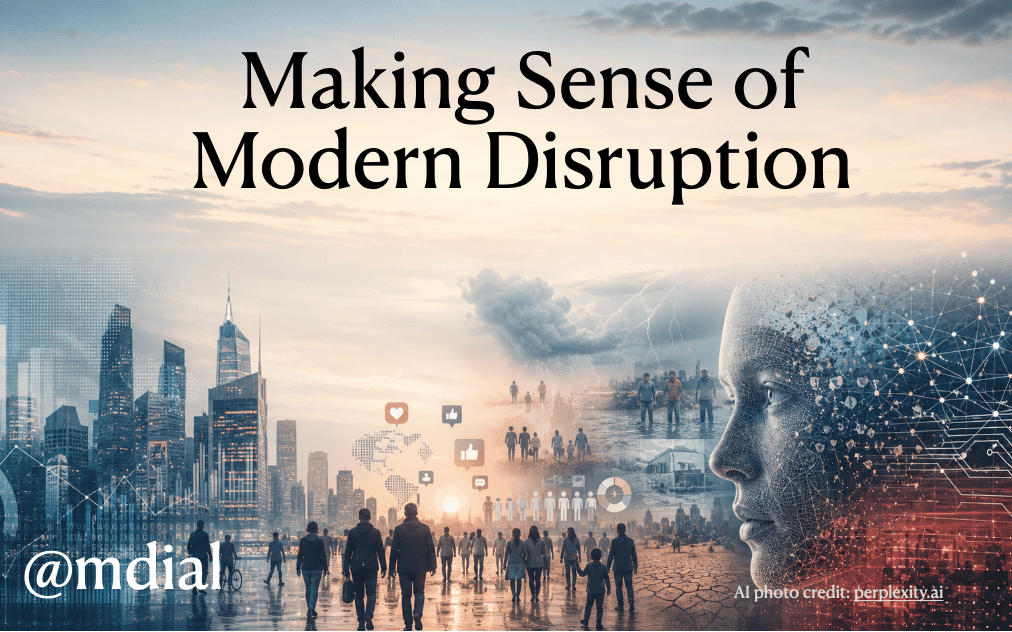
It is perhaps tempting, in 2026, to look back on the first quarter of the 21st century and flatten it into a tidy narrative of “gradual change,” as suggested by Ben Casselman, the chief economics correspondent for The New York Times. He made this comment in a recent episode of The Daily, reflecting on how the internet changed the economy. I don’t buy that framing. What we have lived through is less like a smooth slope than a series of shocks, each arriving with different speed, force, and depth — and all of them colliding with one another at once. That matters because our capacity to adapt is not just shaped by the novelty itself, but by the age and mindset of those in power when the novelty arrives. As William Gibson was quoted in a 2001 Economist article, “The future is already here — it’s just not very evenly distributed.” Some people and sectors saw the future early; others were forced to absorb it in one brutal rush. Furthermore, some of the changes have impacted the very core of our existence.
Why the Internet Felt Like an Onslaught
Casselman has argued that the Internet’s arrival was broad-based and therefore gave everyone time to adjust. There is truth in that view, but it smooths over the lived reality of the 1990s and early 2000s, when entire sectors were caught flat-footed. Media, music, film (especially porn), publishing, travel, security & intelligence, retail — all of them were disrupted in quick succession, and often before they had even understood what was happening.
So while Casselman is right that the internet’s reach was broad, the experience of its arrival was anything but gradual. It was asymmetric. Some industries were hit early and hard; others were buffered by regulation, complexity, or customer inertia.
Three Buckets of Change
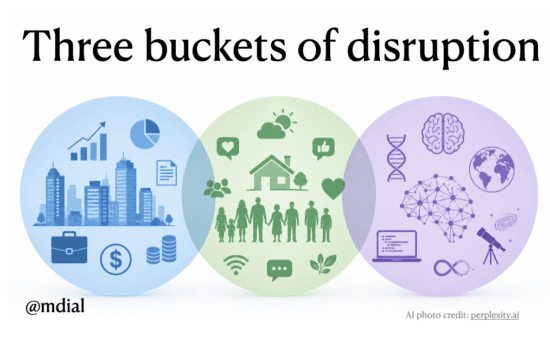
As a way to read these disruptions, I have categorised them into three different buckets: (1) business and commerce, (2) personal/societal, and (3) existential. These are less three separate boxes than three interlocking layers of impact. Business disruptions shape society. Societal disruptions shape psychology. Existential shocks then feed back into politics, work, family life, and identity. That recursive quality is what makes this era feel so intense. The deeper point is that every major disruption alters not only what we do, but how we imagine ourselves. In the words of Johann Hari, author of Lost Connections, the web arrived offering “Facebook friends in place of neighbors” and “status updates in place of status in the world”. This sums up neatly how a technological shift became a social one. Marshall McLuhan’s old insight in Understanding Media still helps here: the medium is never just a container; it shapes the message and the human behavior around it. In other words, technology does not simply enter society — it reorganises the conditions of social life.
Bucket #1: Business and commerce
Business disruptions are usually the most legible because they hit revenue and jobs first. Internet-era change ended business models, destroyed jobs, rewired customer expectations, and made “future of work” a gold mine for consultants. Financial crises then compounded the effect by forcing governments and companies into defensive postures, while climate, pandemic, and geopolitical shocks kept budgets under permanent strain. Employee engagement, leaders’ energy and business budgets have all been under siege, and that pressure inevitably spills over into life outside the office.
What should business leaders do about it? The response is not mystical; it is managerial and moral. Knuckle down on strategy. Craft a higher mission if you do not have one. Make hard calls. Hold ideas lightly, but values strongly. If a business cannot answer the question, “If we didn’t exist, how would the world be worse off?” then it is probably still trapped in a product- or profit-first rather than purpose-first mindset.
Bucket #2: Personal and societal
This is where the emotional toll becomes impossible to ignore. Climate change is no longer a distant abstraction; it is in heat waves, raging fires, and spiked insurance costs. Demographic change is reshaping the social contract through aging populations, lower fertility, housing scarcity, and labor market pressure. Social media, meanwhile, has made a generation of people live under the tyranny of visibility, comparison, and permanent performance.
Johann Hari captures the emotional logic of this beautifully: loneliness is not just being alone, but “the sense that you’re not sharing anything that matters with anyone else”. That is why the mental-health crisis cannot be reduced to individual weakness. We are living inside systems that reward distraction, status anxiety, and constant alertness. The society at large needs to wake up to these realities, but in the end of the day, each individual must take their own responsibility. The remedy begins with discipline: fewer notifications, fewer compulsive app checks, more time with nature, real friendships, and deliberate silence. And it’s also about finding a sense to one’s life. We are undergoing a meaning crisis. Together, these forces don’t just affect policies; they shape how we feel about our own lives and whether we believe they truly matter. As Professor John Vervaeke described in his interview on my podcast, one of the major challenges of our society is a patent lack of mattering, “which is a sense of being connected to something…larger than yourself.”
Bucket #3: Existential shocks
The deepest disruptions — Islamic terrorism, COVID-19 and AI — are existential because they attack our assumptions about safety, identity, and human agency. Islamic Terrorism has produced a prolonged atmosphere of insecurity and cultural defensiveness in many countries. Our way of life is under attack. Meanhile, COVID (and the way it mismanaged) confronted us with mortality, fragility, contagion, and the strange fear of one another. By relying on media gag orders, strict lockdowns, and fear, most governments have set a precedent for how they will handle the next contagion. As such, our democratic fibre has been stretched to its limit. And, finally, Artificial Intelligence now raises a different but equally profound and existential question: what remains uniquely human when machines can imitate, optimise, and perhaps eventually outthink us? All three of these disruptions represent shifts in different kinds of security, whether physical, biological or cognitive. Nick Bostrom has warned that superintelligence may become “the last invention that humanity will ever need to make.” (source). Whether one agrees with the implication or not, the underlying point is clear: AI is not just another tool. It is a civilisational variable. This is why the response cannot be purely technical. We need purpose, community, and moral formation — not just governance frameworks.
What to do now?
- I exhort you, as a reader of this blog, to work on yourself: know thyself is not a luxury, it is a survival skill. By being more aware of yourself, your good AND bad sides, your inner machinations and past issues can be better managed, rather than coming out as an unexpected outburst or chip on the shoulder.
- Diversify your media diet, because narrow information sources make fear louder and judgment poorer. Moreover, find sources that elevate, that lift you up. As discussed on my podcast with neuroscientist Anjan Chatterjee, lean into beauty as it has healing properties on the brain. In the same vein, it’ll be useful to review your relationship with your smartphone. If it’s free, you are the product and, the way capitalism works, these tech firms will inexorably be coming for you. Shoshana Zuboff’s critique of surveillance capitalism reminds us that the digital system is not neutral; it monetises behaviour and trains attention. It literally claims private human experience as free raw material for behavioural data. If we don’t consciously reclaim our attention, the machine will gladly consume it for us.
- Rebuild attachment to community and consider how to be of service to others, because disconnection is where anxiety metastasizes. In fine, Johann Hari’s work reinforces this: the causes of distress are often forms of disconnection, and the way back is through reconnection — with people, nature, meaning, and future.
And you?
So, to what extent do you agree with these broad categorisations? The real question is not whether disruption is good or bad. It is whether we are meeting it with maturity. The future is unevenly distributed, yes — but so is wisdom. The task is to become the kind of people who can recognise the difference, and act accordingly.