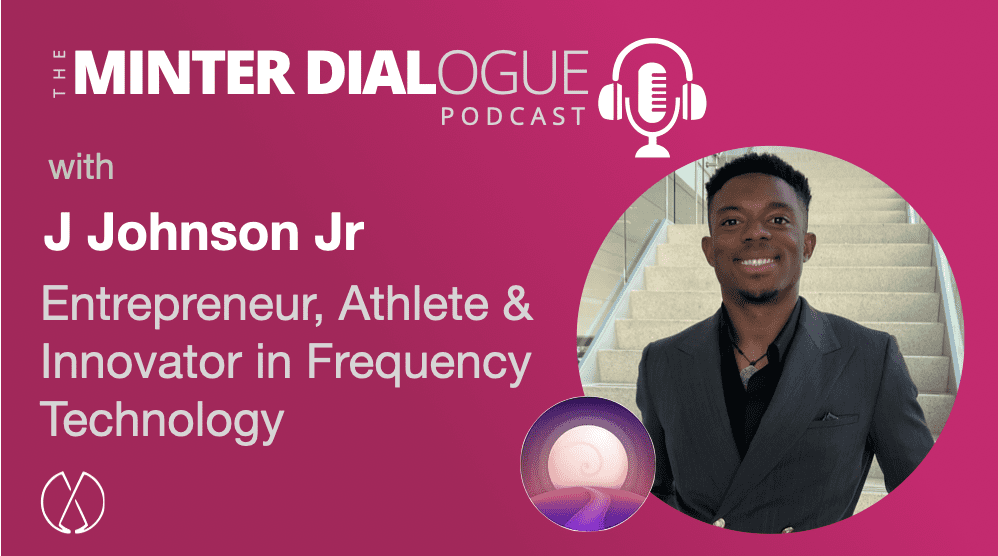
Minter Dialogue with J Johnson Jr
J’s story is rooted in overcoming early adversity: severe childhood allergies and an ADHD diagnosis. Rather than accepting limitations, J channelled his curiosity into exploring neuroplasticity, meditation, and technology. This pursuit ultimately led him to found High Frequency Highway, a performance and wellness company based on the power of sound frequency and consciousness. The brand has rapidly gathered users globally, leveraging J’s dual expertise as both its CEO and high-performance “guinea pig.”
My conversation with J explores not just how he’s hacked his own mind and body for performance, but also his mission to “raise the frequency of the planet,” blending neuroscience, quantum theory, and entrepreneurship in a way that’s anything but conventional.
Key Points:
- From Viral App to D1 Dreams: J’s entrepreneurial spark ignited early. He designed and sold a viral smartphone app while still in secondary school, using the proceeds to fund his ambition to become a Division 1 athlete. This formative experience taught him to lean into his strengths, adapt quickly, and never let perceived limits define his path.
- Leveraging Frequency for Focus and Flow: High Frequency Highway was born from J’s first-hand experience using meditation and sound frequencies to manage ADHD and enhance focus. The venture quickly evolved from light-based technology to sound-based solutions, enabling users worldwide to influence their mental state—whether for sleep, competition, or creativity.
- Mission-Driven Life and Discipline: Balancing Olympic athletic aspirations with running a global tech start-up requires discipline, routine, and a powerful sense of mission. For J, emotional resonance and mapping out time are central—setting big, meaningful goals evokes the passion and focus needed to excel in both arenas.
Three Takeaways
- Channel adversity and difference into unique strengths—J’s story underscores the value of turning challenges into catalysts for creativity and growth.
- Personalised tech can empower us to manage our state of mind, attention, and wellbeing in an increasingly distracted world.
- Pursuing an emotionally powerful mission provides the energy, resilience, and discipline needed to bridge the worlds of sport, tech, and human progress.
Other mentions/sites:
- Flippa app marketplace here
- Tony Robbins, author and speaker here
- UVC light (information on ultraviolet light sanitisation) via Wikipedia here
- Braxton Berrios, football player here
- Carl Lewis, Olympic athlete here (Wikipedia)
- Orange Sunshine documentary here via IMDB
- Iain McGilchrist, neuroscientist and author on his channel here
- Kundalini awakening (concept overview) here (via Wikipedia)
- Astral projection (concept overview) here (Wikipedia)
- Will.i.am, musician and entrepreneur here
- Conor McGregor, mixed martial artist on Instagram here
Further resources for the Minter Dialogue podcast:

Meanwhile, you can find my other interviews on the Minter Dialogue Show in this podcast tab, on my Youtube Channel, on Megaphone or via Apple Podcasts. If you like the show, please go over to rate this podcast via RateThisPodcast! And for the francophones reading this, if you want to get more podcasts, you can also find my radio show en français over at: MinterDial.fr, on MegaphoneFR or in iTunes. And if you’ve ever come across padel, please check out my Joy of Padel podcast, too!
Music credit: The jingle at the beginning of the show is courtesy of my friend, Pierre Journel, author of the Guitar Channel. And, the new sign-off music is “A Convinced Man,” a song I co-wrote and recorded with Stephanie Singer back in the late 1980s (please excuse the quality of the sound!).
Full transcript via Castmagic.io
Transcription courtesy of Castmagic.io, an AI full-service for podcasters
Minter Dial: J Johnson, I am thrilled to have you on my show. You are an entrepreneur, an athlete living in California, but that’s sort of the top line, in your words, J. Who are you?
J Johnson: I’m J Johnson. You know, I’m a beacon for the future and a peaceful future right here on a mission to raise the frequency.
Minter Dial: All right, well, let me start by asking you about. You are. Because in your bio, you’re an inventor, a CEO who built his first viral app at age 14. Yet it was deeply curious to me. I couldn’t figure out what was that app and what. What. What did you do with that?
J Johnson: Yeah, so I was really into video games as a kid, as most people
Minter Dial: are as kids, anyway.
J Johnson: Yeah, yeah, as kids. Most kids are. And I had ended up growing a huge following on vine and Instagram. But this was way before influencers and brands were, like, really sponsored, spending money on these platforms. So, in my head, I was like, I have all these followers. How can I monetize this? And then it clicked. I was like, I should create an app on the App Store, because if someone’s on Instagram, they’re on their phone. So, if they’re already on their phone, they can then go to the App Store and pay a dollar for my app. So, I combined the two biggest trends at the time, which was Flappy Bird and Kanye west, and combined them into something called Flying Yeezy, where it was basically Flappy Bird with Kanye’s face. So, ended up, like, posting it on social media, working with some people, and it ended up going really viral because Flappy Bird creator, like, I don’t know if you remember the Flappy Bird game.
Minter Dial: No, sorry, not such a game myself.
J Johnson: The app literally went so viral that the creator himself removed it from the App Store because so he was, like, overwhelmed. So, when it got removed from the App Store, everybody was going to these secondary apps that were, like, mimicking it. So, that’s where my app ended up going even. Even more viral. And we hit number seven on paid entertainment apps. It was doing extremely well, but I wasn’t doing as well in school. I had, like, a 0.9 GPA because I did not do any homework. I would come home and, like, promote my app and play outside. And I didn’t really take school seriously because, you know, I was like, what, a sophomore and freshman in high school. And then when my coach and my mom, they ended up having a meeting with me, and they were like, you know, you need a 2.5 GPA to go D1 and go to College. And that was like, my real goal was like to be a D1 athlete one day. So, I ended up selling my social media pages, selling the app, and then investing that money into my like, athleticism and stuff like that.
Minter Dial: So, 14 years old. I mean, obviously it’s sort of like a question asking your age, but what year are we talking about?
J Johnson: 2014.
Minter Dial: 2014. So, you’re born in 2000, eh? How did you go about finding a buyer? I mean, that must have been. I mean, you knew your thing, you knew your app. But finding a buyer, what price, how did that go about?
J Johnson: Yeah, I use a platform called Flippa F L I P P A and basically you can sell apps, buy apps. It’s like a marketplace where you can literally like right now you can go and acquire an app and they would transfer that app to your, you know, Apple developer account and then you own it. So, I posted it on there and somebody ended up buying it within like a couple weeks.
Minter Dial: What was that feeling like for you? And let go of this app that you’d created and so successful. And I’m, I’m sure you’re. At the time you were sort of getting lots of kudos, maybe not at the school grades, but from other people. Your online experience, letting it go. Was that a. What sort of a journey was that for you?
J Johnson: I guess for this specific case scenario, I didn’t really like, have too deep a feeling because I didn’t really understand what I was doing. You know, in my head, you know, I just created some random game and like, I didn’t even know the words tech or like computer science or co. It was just like, like, it was just like a get, like almost like a class project for me. It was just like, oh, like I did this in a couple weeks and put it out, went viral, made money. But at the end of the day, there was also concerns about like getting sued by Kanye. So, I was like trying to avoid that as well. So, I was kind of really just trying to get it off so I could like focus on school and athletics and not get sued and deal with that. So, I was like, yeah, somebody else deal with this.
Minter Dial: Yeah, I can imagine. I mean, I mean your lawyer speak and the, the threat and.
J Johnson: Yeah, but to me, like, at that time, that was more than enough money, you know, like, I could buy any shoes that I wanted and any equipment that I needed. So, like, I really wasn’t thinking long term at all. I was like, I can, I can use a quick buck right now.
Minter Dial: So, you obviously had some Parental pressure, the idea of getting the 2.5 GPA, great, great point average. But the idea of selling this to convert into going to college, I can’t imagine that is a typical path. And I’m wondering what was the mindset that set you apart so early in. In, in this way, J, and, and where do you think that mindset came from?
J Johnson: Yeah, yeah, good question. You know, I’ve always been someone to take life very seriously, and I think it stems from when I was first born and being very allergic to a bunch of different things like shellfish, peanut butter, grass, red dye, vaccine. Like, I was allergic to so many things, like doctors really didn’t know it was wrong. And I was like always in and out of the hospital, like when I was, you know, from the ages, like one to three. So, when I finally started to like, live life, I never took anything. Like, I never like half assed something, right? Like, it was always like, if I’m going to do something, I’m going to become the absolute best at it. I’m not just going to like half try and leave it to the next person. So, you know, being a football player, it was like, okay, if all the star athletes are going D1, that’s the trajectory that I want to be on. And there’s no other expert like, like, I, I have, I’m willing and able and capable to achieve this. So, I’m going to put all my marbles in that basket and, and make it happen, right? So, you know, that really ignited the fire in me and then just knowing, you know, I didn’t really have the most genetic gifted background, you know, and when I got to high school, I was a 4’11, 90 pounds. And my grandma actually didn’t even let my dad play football because she was too scared. So, you know, my parents weren’t really the most athletic. My grandparents didn’t do sports right. So. And you know, a lot of people, they had it out for me because I was like, very confident in my ability. So, people would kind of judge me and be like, J, like, you’re too confident. Like, you’re not going to make it. You’re too small. You’re this, you’re that. And you know, there was one quote by a guy named Braxton Barrios that like, I think actually changed my life. And he was also like on the smaller side, but he ended up going D1. He was like, I can’t control my height and things of that nature, but I’m going to focus on the things I can control, which is my speed, my quickness, my Agility. So, all those things that I could control, I would double down on and I would, you know, buy the equipment to enhance my speed. I would work out outside of training and do the things that I could control. So, that way I can make my success inevitable.
Minter Dial: Well, I, I feel like pushing back just a sec because I, I, as I told you we were warming up. I, I used to run. But if I were to say to the younger mentor, hey mentor, 10.9, 100 meters, you know, you can do a 10.6, you can control that. I mean, isn’t there some sort of law of biophysics that says Minter? Nuh. You can try hard but you can’t control that.
J Johnson: I, I always saw life with zero barriers. Hence why I created my first app when I was 14, right. Like I didn’t think, oh, I need a team, I need somebody older. I said, okay, how can I go from zero to one and how can I execute on something to get me there? And kind of just living life with these kind of blinders of just like, this is my goal. What can I do to get to that goal? Period, right? And just having that optimism and that belief in myself that I can achieve it. Right. And I think that’s something that helped me become number one in the nation for track and field. So, was like, you know, even when I wasn’t number one in the nation, I was telling people I’m the fastest in the nation. And I think the mind is the most powerful thing and hence my company. Like your mind can bend reality, right? And the distortion.
Minter Dial: Reality distortion, yes.
J Johnson: Like that certainty mixed with consistency and an actual plan. I truly believe most things are, you can make inevitable. Right. Success is very simple. The hard part is the consistency and not allowing the rhythm of life to steer you off your path. So, you know, if your younger self, if you were to say that to your younger self, but you tell them, you know, every day you got to do 100 push ups, you got to do 100 sit ups and you got to do this, this, this and this. And if you actually execute on those things, you will run that 10 6, right? So, I just think it’s about, you know, having that belief because once you put it in your mind, you can then start to attract the thoughts and things you need to then execute on. But that’s where most people often fall short is like they get the thought of like, oh like I want to be fast in the nation. Then you get the thought of, okay, we’ll wake up at 6am and train and you’re like maybe right over and
Minter Dial: fall asleep again or not.
J Johnson: Yeah. So.
Minter Dial: Well, I want to obviously get into high frequency highway in a moment, but I was intrigued as I sort of studied your trajectory and you mentioned your allergies. You were also identified as having what we now called adhd. So, hyperactivity, tension deficit. And rather than sort of accept that you went looking for solutions in what, at what point did you realize that your state, your situation is trainable? Was there a defining moment that that happened? And I suppose I would like to add into your prior comment about your allergies. Is that something that is something you can train away as well?
J Johnson: Well, regarding to the allergies, I actually ended up growing out of all of those. So, like, I’m not allergic to those things anymore.
Minter Dial: And. And you. Is that just because you grew out of it or do you think there’s something else that happened to make that happen?
J Johnson: I have no idea. Like, all I can remember is one time being allergic to something and then years later, I’m not now. So, like, I don’t know what that is. And I think it’s. I mean, I’m not sure how common that is, but some, like there’s been, you know, groups of people that, you know, they just grow out of being allergic to. So, I don’t know what that could be. Maybe hormones or something. I don’t know.
Minter Dial: We’re growing up. But what about the ADHD story then?
J Johnson: Yeah. Yeah. So, I learned when I was transitioning from high school to college just, like, how important your state of mind is. And really like, taking control of your state is probably one of the most optimal things. And also learning like, you know, your subconscious mind is what’s creating most of your reality. Right. So, you know, I’ve always taken that very seriously since I got to college. And when I started taking the Vyvanse and started to realize how much the side effects were affecting me, that’s when I knew that I had to like, take control of my state. Because if I’m reliant on this medication and this medication has these certain side effects, like long term, like, I just can’t do that. So, you know, I had to really think, okay, how can I actually wean myself off of this, but also create something where I can also still be in that controlled state and be in a focused state. Right. So, I tried various different things and then I came across meditation and frequencies, and those things started to really help me build that neuroplasticity and be more focused. Without the medication, every Time. But it was definitely a process. Like, I started, you know, taking it every other day and then started taking it, you know, once a week, and then started to be like, all right, I’m just going to take it as needed, like maybe finals week and things of that nature, and just slowly getting myself off of it. So, that way. Because if I would have just, like, stopped taking it, I probably wouldn’t, you know, it probably would have been bad. Right. So, started to wean myself off and look for alternatives.
Minter Dial: At no point, J, did you feel like reframing what this diagnosis of ADHD was, Or, I mean, for example, you might have said, well, it’s actually not an illness. It’s. It’s just my superpower or.
J Johnson: Yeah, yeah, I mean, I’ve. I’ve heard that. But I also know, like, I’m very. I wouldn’t say forgetful, but I’m like, I focus on things that are right in front of me. Like, I’m here now person, where, like, I can literally forget you exist if you’re not texting me or, like, we’re not, like, in person. And I. I can kind of tell that that’s how my mind is. So, I mean, I would say, like, ADHD is one of the reasons why I’m pretty gifted in a lot of different aspects. You know, I’m like a polymath. But there’s also the downsides of, you know, losing things and not being able to read a page on a book without rereading it five times. Right. So, you know, it comes with his benefits and other things. But I would say, like, I. I did have ADHD,
Minter Dial: and yet you seem to express certain positive elements of that state, I. E. Being totally present. But like any state, I would say, like any person, you. You come with foibles. So, J, your choice of the 60 meters sprint, is that related to your American football experience? Because, I mean, I know that they do the 40 meter or 40-yard dash to test people with equipment. 40 to 60, 100 meters was never something that you wanted to explore. And I. I mean, I bet I was 100 was always the sort of the shortest of my distances. I was better 2 and 4, and so I don’t have that explosive power, obviously, and. And nothing near what you have. But what about the 100 meters? How do you decide between 16, 100 meters and, you know, when you’re looking at the Olympics, when in 2028 you’re joining the team, what is it that. What is it that distinguishes those two? Because it’s quite close in some regard.
J Johnson: Yeah, yeah, I mean I, I also did run the hundred. I was just higher, more higher ranked in the 60 meter.
Minter Dial: So, that means you have a better start.
J Johnson: Exactly. So, that definitely comes from like my explosiveness playing football and mainly training for the 40 because I actually didn’t even start running track until my junior year of high school. So, I was basically just football until I was what, like 15 or 16? So, that transition and like my explosiveness easily just carried on to the 60-meter dash.
Minter Dial: So.
J Johnson: Yeah, yeah, yeah. And actually I ran a 10.3 100-meter and I also did long jump as well. Had me cooked one states and long jump. So, was also a jumper.
Minter Dial: Yeah. Carl Lewis comes to mind in that respect. Right. You know, I. What’s that said?
J Johnson: I’ve met him before, I had a little interview with him.
Minter Dial: I mean when you do athletics you’re encouraged always to do two and one so that you. Because you can’t do all three. Right. You have to do two track, one field or two field and one track, isn’t that right? It was my case anyway back in my day, back in the ancient times.
J Johnson: I mean. Yeah, I think most coaches would want that. And definitely in college they want you to do more events as well.
Minter Dial: All right, so let’s talk about High Frequency highway, which is really the big topic. Tell us how you got into this idea of frequency.
J Johnson: Yeah, yeah. So, you know, when I got into meditation, that pushed me into a totally new world. And it started off because I actually got grounded when I was in high school and it’s kind of a double meaning there. And my mom.
Minter Dial: Oh, I see, Nice. I like that.
J Johnson: My mom gave me this book by Tony Robbins and at the time I didn’t really know who he was. So, I’m like reading this book and it was just like really hitting home to me. So, I ended up looking him up on YouTube, seeing his stuff and like seeing he’s like the life coach of Kobe and Oprah and all these people. And he keeps talking about this thing called meditation. And I was like, they didn’t teach me this in school. What’s meditation? So, like I started looking into that and you know, since I’m grounded, I have nothing else to do. I started meditating for hours and hours at night. And then one night I was sitting down and I felt like energy moving through me and I was basically like controlling this energy with my mind. And that was the first time I had like felt my non-physical body because like my physical body was being still. But I was also Moving energy. So, it was like this, this new ex like sensation that I felt like was very transformative. And that started me into this world of like non-physical phenomenon. Right. And researching more about, you know, quantum physics, neuroscience and things of that n. And I got fascinated about this, like rewiring your mind and you know, all that, all that jazz. And I really started to see it work for me. Right. Things in my life started becoming better. I was in better moods. Things were happening that I needed to X, Y and Z. And then, you know, I would still be in entrepreneurship during summer while doing sports in school, during the school year when I got to college. And right when Covid hit, I started this company where we were using a specific frequency of light to actually like sanitize, you know, phones and spaces and things like that.
Minter Dial: And zapping bugs.
J Johnson: Yeah, yeah. It’s called UV-C light. What interests me was that we were using this light that was outside of the human light spectrum. So, like it’s light that you can’t necessarily perceive, but it had all these properties and abilities. So, it made me go deeper down the rabbit hole of like frequencies, light frequencies, and how, you know, if there’s this one thing we can’t see that has all these other properties, like how much of our reality that we can’t see is actually affecting our reality. Right. And from all that research, I was building this for three years. It really increased my awareness about the power of frequencies. And then as I stated earlier, I was also using like sound frequencies to help with my focus. And I started saw that worked for me. So, I ended up actually pivoting from a light frequency company to a sound frequency company. And that was because it was such a much more easily accessible way to get frequency out there into the world. And as I stated early on, like my mission is to raise the frequency of the planet. So, how I saw it was that I knew sound frequency was healing and also helped me with my focus. So, if it can help me, the amount of other people that it can impact can be global. Right. So, I started the app and you know, it really started off as something for myself because I would normally source sound frequencies off of YouTube. You could probably, you’ve probably seen those like lo fi sounds and like stuff like that.
Minter Dial: Or sleep ASMR stuff.
J Johnson: Yeah. Yes. Like on YouTube. So, you know, I knew that wasn’t the best method for it because one, there’s ads, there’s distraction, they, they, they
Minter Dial: have a way of interrupting the. The buzz.
J Johnson: Exactly. And you also never know if it’s the right frequency because somebody could put any title on a video, say, hey, yeah, this is for that.
Minter Dial: So, 432-hertz or whatever.
J Johnson: Yeah, exactly. So, I was like, there has to be a better way. So, I started looking on, on the app store for frequency apps and there was literally no apps at the time. So, I was like, I should create my own. So, that’s when I went ahead and created my own app. And, you know, I skipped a bit of the journey about, you know, living in San Francisco, working in startups, raising money, you know, making millions with various startups and things of that nature. So, I had a lot of experience now at this point, you know, building startups and knowing that I could grow platforms through social media and things of that nature. So, when I ended up launching this, I already had a lot of background in the space of like, you know, frequencies, startup world, raising money, marketing. So, you know, we quickly started getting used by every country on the planet. And you know, they were using our apps for the Binaural Beats feature. So, we created a way where you can actually generate the oscillation naturally from your device. So, you don’t need any WI fi or cellular, you’re generating the organic hertz frequency from your phone. So, you know, this got picked up worldwide. And with Binaural Beats, you actually need headphones because you have two slightly different frequencies playing in each ear and they meet together in the middle of your brain to create this like frequency following effect. Right. So, knowing this, I was like, okay, if people all over the world are using our frequencies, we need to create a wearable to make it even more effective and make sure that we can have a whole closed loop system. Instead of people wearing all their own headphones, let’s create our own. And then that’s how the whole ecosystem was born.
Minter Dial: I, I was sort of cynically wondering to what extent that was the monetizable version of what you’re doing. Because in the end of the day, like when you’re ever doing a startup, you always want to have the scalability, the, the business model and everything. And it, from the outside, I’m thinking there’s a sound, but you need to make the sound viable. And making music these days is a difficult proposition in terms of rights and the commissions that you’re paid. To what extent does that resonate or not?
J Johnson: Yeah, yeah, for sure. It was hard, like monetizing at first with just the app. We had like a freemium model, but it wasn’t nearly as, as well as it’s doing now with, with, you know, adding on the actual wearable.
Minter Dial: Yeah, it’s, it’s so much easier to sell something than, I mean, like something concrete than some sort of concept. So, moving back to the concept you mentioned, quantum physics, I. I’ve long been intrigued without being any form of astrophysicist of any sort, by the string theory and this idea that we are all vibrations. What’s your position on the string theory? And to what extent do you think that that resonates or vibrates with us?
J Johnson: Yeah, I mean, I, I totally believe in, in string theory and that like everything is interconnected. And that’s actually something that, you know, building that light company really showed me. It’s because to synthesize the frequency for this light, that was like, able to. Because at the time, covet was like the big fear around the planet, right? We use two reoccurring Earth elements, right? And these Earth elements created a light that mimicked the sun that then was able to eliminate pathogens from air surfaces and liquids and solve basically the world’s biggest problem. So, what that showed me is that all of this has to be interconnected because how do we have a sun that’s able to eliminate all the pathogens? We have elements on Earth that can then recreate this sun’s light. Like all of those things have to be in some sort of symphony together for all of that to even work. Like, there, there can’t be any separation from these things for all of those things to play out the way they do, you know, and on this planet, we have all the things we need to survive. We have an abundance of water, we have natural ways of healing. Like everything is meant for us to survive. So, that’s just showing us that we’re interconnected to this. And we honestly might be somewhat creators of this because it’s just so well done in our favor. Like, even if the sun was a couple hundred miles closer to us, we would probably all be. Be dead by now, right? So, all of these things are playing in our favor to a point where it would actually the most logical thing is that we are interconnected with all of this, right? So, you know, there’s a lot of different, you know, physiology about how our DNA, you know, can hold the amount of information as long as the years of the planet, right? There’s just so many things and like, even how our neurons look looks like how when a star is like, there’s just so many things that are just overlapping and, and showing that our inner world is the outer world that you Know, I think I know that everything is connected, and that’s why we got to raise the frequency of ourselves so we can raise the frequency of the planet and we can, you know, reach peace on Earth.
Minter Dial: I’ve had numerous guests come on and talk about the ability for psychedelics to help, well, people get better and to fix certain pathologies. In your About Us page, you describe a Kundalini awakening. I had to go and check out. What on earth was that? And an astral projection experience as pivotal to your discovery. How did that awakening occur and to what extent do you think psychedelics can be on the same frequency? Is what you’re up to?
J Johnson: Yeah, yeah. So, those things actually occurred when I was telling you about getting into meditation and meditating for hours on end. So, when I was moving that energy, you know, from my feet, all the way through my body, up my spine, through my crown, that was when I had that Kundalini awakening. And then the next night is when I had the astral projection experience where I literally floated through my roof into, you know, the stars and became like. It felt like I was, like a huge being at that point. And when I came back into my body, that’s when my life changed from, you know, just living life, you know, going to college to, I’m on a mission, right. And that. That switch of, like, oh, like, I’m going to, you know, go to the Olympics. I’m going to start a business. It went from, no, you’re here to complete this mission. And that sort of rewiring kind of gives me a lot more energy and a lot more enthusiasm and a lot more certainty on the decisions I make, my intuition and all these sort of things that has led to my life now. So. Yeah. And then to your question about psychedelics, I really don’t partake that much. I mean, I’ve. I’ve done, like, that much.
Minter Dial: It’s not one thing you can be half pregnant on.
J Johnson: Either you do or you’ve done, like, small. Like, I haven’t never done, like, a full dose of anything.
Minter Dial: Oh, so microdosing. Okay. Okay.
J Johnson: Okay. Yeah. So, I. And that was literally, like, twice in my life.
Minter Dial: Very, very San Francisco of you.
J Johnson: But I will say that people have said our technology feels like they are on these drugs. And I. From my research, I know these drugs are basically just either activating certain neurons or they’re releasing certain chemicals. So, all of that you can do internally through frequency and breath work. So, yeah, I think it’s on a similar frequency.
Minter Dial: We. We talk a lot about rewiring. I’M a psychonaut, an avowed old man who’s always enjoyed the trip as. And my feeling is that it’s been my pathway. The way you describe what you’re up to, J, it has tenure or a tenor of religiosity is how religious are you otherwise? Is this your religion? How do you. How do you put those two together?
J Johnson: Yeah, I’m omniist. So.
Minter Dial: Omniist.
J Johnson: Yes. Omnism is the belief that each religion has certain truths to it. So, you know, I grew up Christian. Like, my whole family is basically Christian. But I was always allowed to, you know, have my own freedom of thought and things of that nature. Like, we weren’t like, hardcore. So, like, it wasn’t that serious. But as I continue to do research, you just start to see the overlaps in the stories, the overlaps and the beliefs. And I think it’s really hard for me personally to, like, accept one thing and say, you know, all the rest aren’t true when there’s so much overlap. 1 and 2. At the end of the day, it’s like a game of. What do they call it? It’s like a game of phone call
Minter Dial: where it’s just like Chinese whispers to be un. Politically correct.
J Johnson: Yeah. It’s like, you know, it’s like this person says something, the next person, they say the next thing. And then years down the line, someone’s finally writing the book about it. So, you know, it’s. It’s. We can’t take it directly as God’s word because at the end of the day is written by man, and then it’s written over generations. And some of the books have also been rewritten. So, at the end of the day, it’s like, I would rather take all of the knowledge from all of the books and see, okay, which ones are resonating versus just saying, oh, I’m going to read this one book. And then all the rest believe in one.
Minter Dial: Yeah, yeah, monotheism. So, J, you. You describe High Frequency highway as a performance system built on. At the level of consciousness. What does that actually mean in practical or daily terms that some lay person could understand?
J Johnson: Yeah, yeah. So, you know, state is everything. So, when we’re talking about consciousness, it’s really like your state of being because what your state is is going to determine, you know, what thoughts you’re receiving. So, what our technology does is it influences your brain waves to reach a certain state when you need it. So, for instance, let’s say you’re about to go into a competition and you want to be in Flow state. What our tech does is it puts you, your brain in that gamma state, so that way you can be more present and reach that flow state much easier and make it more inevitable for you to reach that state of consciousness so you can go out there and achieve the things you want to achieve. And like, on the other side of that, like before bed, a lot of top CEOs, billionaires, they use our tech before bed because they’re like going at 100 miles per hour all day. They have a lot of thoughts and they overthink a lot and they want to turn their consciousness down a bit, right? Like wind down. And what our tech does is it influences your brain to slow down those brain waves so that way you can easily fall to sleep. So, that in itself is optimizing you for the next day. Right? Because the more sleep you get, the better you can be energized for the day ahead.
Minter Dial: Sleep is golden. So, a flow was obviously a term I’ve come across a lot and enjoy the concept. I represent Britain in a sport and so I play at a reasonably high level, all the same as an old man. But you also have focus and calm as two other states that the, that your headphones allow you to get to is. I understand it, you can tell me, correct me if I’m wrong. Is that, Is that first of all start. Is that right?
J Johnson: Yeah, yeah, yeah, that’s right. So, that was my main use was for the focus and ADHD, my ADHD brain. So. And we actually had a really cool finding when we were reading EEGs. So, we did this test where basically read my brain before I put on the headphones, and then I put the headphones on for like five minutes for focus, frequency, and then took them off, read my brain again. And what it showed was that instead of my brain being scattered in different parts of my brain seeking attention at the same time, it clustered and kept me in the same brainwave state for long periods of time. So, what this means is one, I’m more coherent and two, is increasing my attention span. So, that’s what happened. Like, we’re literally fighting an attention span epidemic right now because everyone is training their brain, if you’re on social media, to switch context. So, the more you swipe and scroll through social media, the more you’re basically training your brain to be able to switch to the next thing and be on to the next thing and onto the next thing. So, it’s harder for most people to sit and focus on one thing. So, what our tech does by keeping you on the same brain frequency is it keeps you focused on one thing, inevitably increasing your attention span.
Minter Dial: Have you come across Dr. Iain McGilchrist?
J Johnson: Ian, now I have it.
Minter Dial: He’s amazing.
J Johnson: He.
Minter Dial: He. Well, he’s a neuroscientist psychologist, and he Britishman who talks about how our brain is actually has two left and right brain. He recharacterizes them as being two different types of attention. Anyway, so that. That’s for you to have fun with.
J Johnson: How do you spell that?
Minter Dial: Ian? I, a, I and McGilchrist M, small c, G, I, L, C H R, I, S, T. So, in the realm of making this concrete, people are listening, they’re understanding about your product or the concept of frequency. If you are looking at me right now, interviewing you at this very moment, and, and you. And I said, hey, listen, give me your headphones right now. And what state should I set them to this headphones? And why?
J Johnson: It depends what your goal is. Right? Like if you. Some people like to use it to replace their coffee in the morning. So, we recommend like an alpha or a gamma state for. For that experience. If you want to use it to wind down at night, then it would be more of like delta data states to slow down the mind. So, like our. That’s what makes our platform so beautiful, is that it’s 100% customizable. So, you can select any frequency that you want to generate, you can overlay that with any sound and create your own experience of what you’re trying to get out of it. Because what we’ve noticed is certain frequencies people like more than others. So, there’s not like a priest. I mean, there are presets, but you can also customize it and say, okay, I want to do 100 hertz instead of 200 hertz or 300 hertz, right. So, you can customize it down to the literal decimal point. So, that’s one way to personalize it. And then on the other side, we actually created this new meditation feature where you can actually personalize meditations to basically be on exactly what you’re going through. So, you can create a meditation in real time. And of course it’s made with AI but it’s literally able to be adaptable and be whatever you want it. So, like, let’s say, you know, you’re trying to make empathy count, right? And you say, okay, I want to be empathetic about my mom going through the loss of her brother or whatever it could. It literally will create a meditation about that specific topic and use the words, the names, whatever you want. And you can even talk to it and it adapts to it in real time. So, it’s a, it’s a new take on, on. Well, I think the generic meditations, they help, but it’s not going to resonate as deep and really rewire your mind as much because you’re not feeling it, it’s not personalized.
Minter Dial: Well, I mean, in the very nature of putting in a prompt like that, I have to sort of lean into who am I talking about, what’s my intention? Bring up the names and make it. And I think that, that, that just that pre work can really help you to get focused in. So, if I understand correctly, you have a whole AI sort of LLM version that allows you to write your own prompts. The question I have is how does one distinguish between what I want and what I like or what I need? Because sometimes, oh, I like this sound. It’s, you know, hip hop or Grateful Dead as far as I’m concerned. That’s great, but that’s not actually what you need.
J Johnson: Yeah, I mean, it’s a tricky, tricky one to, to conquer, but it’s, it’s up to your own discernment. And then, you know, we do have a recommendation algorithm as well. We recommend certain sound and frequencies. We can even like detect your state and then recommend you a frequency based on your state. So, there’s a couple ways to go about it to find the frequency for you.
Minter Dial: Last question for you, J, which we haven’t really touched on regards this notion of you being the Olympic athlete. 60-meter number one in the United States, 60-meter sprint, starting up a company, being a CEO of a startup and trying to be an athlete. How do you manage that? How do you stop one from cannibalizing the other? And I assume that there’s kind of a nice overlap as well as in you’re using it and you are the pro, you are the, the guinea pig.
J Johnson: Yeah, yeah, good question. I think discipline with your time and really like valuing your time. Right. I think optimization is everything. So, one thing that I incorporate into my life is Google Calendar and I map out my entire life, right? So, from waking up to gym, to shower, to meditate, to meeting, to going to grocery shop, laundry. So, that way the, the guessing game is gone because like, you know, with, with ADHD, you can kind of get sidetracked and things of that nature. So, I learned early on, like, having a schedule helps me because I don’t have to think. I just do, you know, when, when you say, okay, well, you have to
Minter Dial: think yeah, but you have to think up front on the agenda that you.
J Johnson: Yeah, you kind of. You kind of help your future self, right? It’s like, I know from this time to this time, I’m going to be doing that. So, I don’t got to worry about that right now. I’m going to worry about this. Right. I feel like sometimes people can kind of overestimate, underestimate themselves and be like, oh, I need to do this now. I need to do that now. And then kind of go back and forth. But when you have it all mapped out, you know, a week in advance, it’s like, oh, no, I have time for that later. I can focus my time here now and I can be present with this and know that I’m going to execute that later. Right? So, optimizing my time and valuing my time. And also that kind of helps when someone is trying to make, you know, spontaneous plans. Like, oh, no, I’ve already scheduled this for that time. I can’t do that. Like, you know, I’m already training at that time. I’m already eating or grocery shopping. So, like, when you, when you map out your time, it literally makes it like you have something like, right? So, if you don’t map it out and someone says, oh, do you want to get lunch on Tuesday? It’s like, oh, nope, I have this thing, sorry. You know, like, that’s just how my life is mapped out. And also, you know, being on a mission and I think the key and the key to frequency is state and emotional state. So, I have a goal and a mission that evokes emotion within me. So, since it evokes this emotion, I’m able to take action. So, you know, the mission of raising the frequency of the planet, why is that my mission? Because I know raising the frequency will help us create peace on Earth. So, having such a big mission creates this certain emotional thing that pushes me to take action. You know what I’m saying? So, you know, there’s like, there’s like some stories where it’s like, oh, this woman, she was able to, like, lift up a car to save her son. It’s not because she just gained strength in two seconds. It was because that emotional state activated neurons and muscles and that intent to lift and become what she needed to become in that moment. So, you know, I always tell people that I mentor, you got to have goals that evoke emotion. You can’t just have a small goal. You can’t just have something that that is going to be like, oh, it’s okay. If I do it or if I don’t, it needs to be like, if I do this, my life will change. Everybody in my. That I love’s life will change, and it’ll be for the better of the planet. So, it pushes you and almost forces you to take action on it.
Minter Dial: All right, well, I. I’m. You’ll excuse me if I ask you just a couple of questions to maybe go beyond the time. But first of all, I would recommend a film documentary called Orange Sunshine that was done in. I think the film itself was produced well later, but it was filmed in the 60s and 70s in LA and it talked about this idea of the mission of bringing peace to the world. And it’s a. It’s a phenomenally interesting one, but the idea of, of the emotion as the driver. When you talk about 6.3 or whatever your time is in a 60-meter dash. It’s hard for a number, per se to have emotion. Secondly, you’re a business and, you know, you are looking at numbers like 14.3% engagement, 16.2% improved performance, because that’s how we talk in business. And if someone who’s listening to this, I a. I highly recommend them to check out, of course, this idea of frequency. I really do believe in that. Yet how do you marry numbers and emotions? Because that’s sort of how a lot of other things work. Like your Sprint or your business.
J Johnson: Yeah, yeah. How do you marry numbers and emotions? I would say there’s. There’s always a formula. And I learned this, you know, growing up, because I actually used to work at McDonald’s for like a month or two.
Minter Dial: And you’ve done a lot of things, Dre.
J Johnson: So. But what I realized was the equation stays the same, but the numbers can be different. So, when you get. When you’re trying to get a job at McDonald’s, you go through the hiring process, you go to McDonald’s, they send you to like this facility where you learn how to use the. The machines and the things of that nature. Yeah. Then you go to the McDonald’s, you put on your uniform, you have a smile on your face, and then you press the buttons. You do the things so that. That attention, that like remembrance and that awareness and all those things that you did for that McDonald’s job, if you apply those same things but with different numbers. So, you’re basically doing something that instead of, you know, getting paid $10 an hour, you do something where you use that same time and attention, that remembrance, that awareness to something that’s paying you $10,000 an hour. Right. You’re not really changing what you’re doing. You’re changing the awareness of the things you’re doing to have different numbers. So, you know, like, if you were to spend, you know, let’s say 10 hours trying to get that McDonald’s job, if you were to spend 10 hours finding a different skill that could bring you higher numbers and using that same method of remembering that skill and then applying that skill, you are now making way more than you were at McDonald’s by doing literally the same thing, spending the same amount of time. So, that’s a way to think about it when we’re talking about these sort of things, is that, like, be intentional with how you’re moving in this world because you can use that same time and attention and emotional frequency with higher numbers to achieve much bigger things for you and who you love.
Minter Dial: All right, brilliant. J, You. Your app, as I understand it, has over 100,000 users and 3 million views monthly. World peace or peace? How do you measure your success? Last question. Towards your ambition.
J Johnson: How do I measure my success towards my ambition? So, wait, what are you. What are you asking specifically?
Minter Dial: So, you, you want to achieve world peace?
J Johnson: Yes. How do I measure that?
Minter Dial: Yeah. How do you. At the end of the day, the ledger says, all right, plus one on this side, minus one on that side. You know what I mean?
J Johnson: Yeah. I mean, the. The more viewership, the more users that we have. I know we’re raising the frequency. And like you may ask, why is raising the frequency? How is that even correlated with world peace? And I’ll break it down. The reason why there’s wars and conflict is due to ignorance and low frequency behavior. Right. When you raise your frequency is much easier to empathize and see the truth. The truth is, like we were saying earlier, we’re interconnected. The truth is borders are man-made. The truth is we’re more similar than we’re different. So, with those simple truths, you can start to realize that war is literally dumb. So, when you raise your frequency and you can start to see from a higher perspective and you can empathize with people around the world, and your awareness is that we’re. We’re interconnected and you’re moving in that state of love, bliss, joy, gratitude, and things of that nature, abundance. Right. Because that’s another thing we fight over is scarcity, when in reality we live on an abundant planet where we have everything we need to survive. So, you know that sort of frequency, like, you know, one thing that our app does is it Puts you in the state that you want to be in on demand. And the reason why that’s so important is because people can take unnecessary action due to the level of their state. So, if you’re feeling depressed or down or envious or lack of focus, you can then make decisions that aren’t towards your highest good. Right? So, being in control of your reality and being a causer of your reality allows you to be at this higher point where you’re seeing from a different perspective. Right. So, let’s just start there. So, the more that we empower people to know that they’re in control of their reality, the more that people are going to basically start to move in that, in that, in that way, right? When people think things are working against them and they don’t have control over their reality, that’s when things can get chaotic for people. So, to know that you’re in control of your reality, that you’re empowered, allows you to really see reality different. So, once more people are empowered, then they start to move in this sort of way. We will start to slowly and slowly create peace on earth because you start to empathize, you start to see the truth. You start to see that it’s my actions that actually ripple out into society. So, let me be kind to that person. Let me empathize with this person. Right? So, I think it always starts there. And you know, I. The, the more and more partnerships we have. So, we’ve worked with, in collab, with Will, I am, you know, we have Conor McGregor that follows us.
Minter Dial: And so, the biter is the boxer, right?
J Johnson: Yeah, yeah. The fighter.
Minter Dial: Fighter.
J Johnson: So, we’re clearly sending ripples out into the world. And all of our content deals with this awareness of frequency. And when you can’t see something, it’s truly hard to fathom it. So, you know, my. One of my sayings is if you, if no one’s told you, you haven’t seen it, you haven’t heard it, it’s not in your reality. So, frequency is something you can’t see. And if nobody is bringing this awareness and this information to you because they’re not really teaching it in 90% of
Minter Dial: school schools, then it’s not in your 99 of schools.
J Johnson: Yeah, literally. It’s literally not in your reality. So, the more we’re getting con this content out there and bringing in millions of views, the more people can then be aware of it, to then utilize it to help themselves heal, to help themselves focus, to help themselves feel the abundance on the earth.
Minter Dial: So, J, beautiful. I Mentioned Orange Sunshine, the John. John was one of the, I think four or five he dudes and. And why this will resonate. He said, I. I think there are two things that I. I see, and the one of them is that I see a lot of war and I’m not interested in war. I think that’s a bad thing. The second thing is whenever I take LSD, I don’t want to go to war. And I mean, I’m. I’m being a little bit trite, but what he ends up saying is, well, if we give LSD to everybody, then we won’t have war. There’s a very deep philosophical consideration in Orange Sunshine, and I’m certainly not going to be professing that everybody should take LSD, but I do think that there’s a connection. The good news is, J, getting your headphones and listening to frequencies is certainly legal and it sounds very powerful. How can people find out more about what you’re doing? Do you have a place for you? Write about what you’re doing and specifically, more importantly, maybe get your headphones and dial in?
J Johnson: Yeah, yeah. So, if you Google, High Frequency, highway will be the first thing you see. We have a blog where we post on there basically every day. You can follow us on Instagram, where we post very consistently there as well, at High Frequency HT W. So, yeah, you can. You can find us there. And I think you know that. That bit about LSD, you know, that’s just a certain frequency that’s just activating a certain part of your brain that is allowing you to think those thoughts and be in that state. So, I think that’s achievable with our tech, too.
Minter Dial: Beautiful. J, I am so glad and privileged to have had this chat with you. Thank you so much. I do hope we’ll stay in touch. If you come to London, you want to do a sprint somewhere? I’m not going to be up for that game, but good luck getting to the Olympics as well, and stay in touch.
J Johnson: All right, thank you.

Minter Dial
It’s easy to inquire about booking Minter Dial here.