
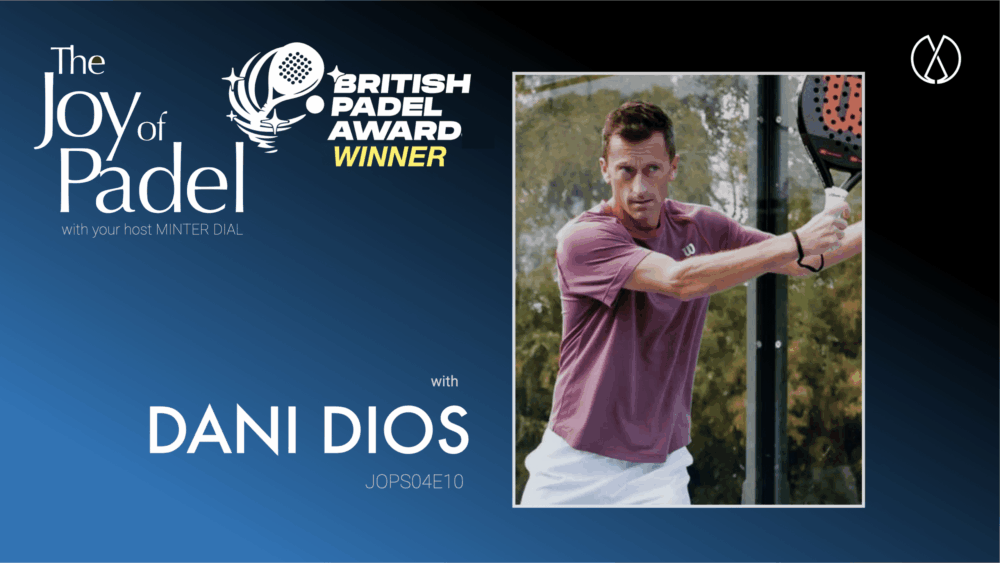
The Joy of Padel podcast with Dani Dios (JOPS04E10)
On the latest episode of the JOY OF PADEL podcast, I had the chance to reconnect with a long-time friend, mentor, and one of the most insightful minds in the world of padel—Dani Dios. Having been my coach in Marbella years ago, Dani’s influence on the European padel scene has been monumental. Now an executive director heading up the padel division at IMG/WME and the founder of Paddle Trainer, he’s been riding the wave (and sometimes the storm) of padel’s unparalleled growth across continents.
Background on Dani Dios
Dani Dios brings more than 26 years of sporting experience, with roots as an ATP tennis player before being swept up by the padel boom in Spain. After a humbling first encounter—losing 6-0, 6-0 to real padel players—he was hooked by the sport’s unique dynamics and sense of community. He evolved from coaching tennis in Spain to managing facilities, then helped drive the expansion of padel in the UK and Scandinavia, even captaining Sweden’s national teams. From building clubs to navigating investment fiascos, Dani’s journey is filled with business lessons, humility, and a deep passion for the game.
Main Topics Covered
Our conversation mapped the blueprint of sustainable growth for padel outside its home regions. Dani Dios explained how padel’s rapid expansion—from Spain to Sweden, Italy to the UK—often brings a gold rush mentality: too many courts, too fast, with not enough coaching or community. He stressed that success in new countries isn’t just about building facilities—it’s about crafting a real padel culture.
We discussed recurring mistakes: lack of a clear business plan, trying to please every player, and the vital need to know your club’s brand and audience. Dani compared it to automobile brands—do you want to build a “Ferrari” club or a “Fiat?” Each needs its own recipe.
Later, we dove into the transition from tennis to padel, focusing on the need for humility and team play. New padel clubs, he advised, must create community, set clear expectations, and foster communication between partners. And at the pro level, Dani laid out the game’s evolution—faster, more explosive, more technical, but also requiring emotional resilience and deep tactics.
Three Takeaways from My Conversation with Dani
- Humility fuels improvement. Whether you’re a seasoned tennis pro or a beginner, padel’s magic lies in embracing the unknown, learning from failure, and starting from scratch. Leave your ego at the door; your growth depends on it.
- Success hinges on community and clear identity. The most resilient clubs know exactly who they serve and how to nurture their players. Padeling isn’t just about the court—it’s about crafting experiences and lasting bonds.
- The sport is evolving—fast. Advances in athlete preparation, technology, and tactics are making the pro game quicker and more dynamic. Clubs and players who fail to adapt risk being left behind.
If you’re building a padel community, running a club, or simply trying to up your game, Dani Dios’s advice is gold. Surround yourself with real experts, focus on people (not just numbers), and savour the fun—even when you miss the open door by two and a half meters. Ready for more wisdom? Listen to this JOY OF PADEL episode and join us in celebrating the imperfect, joyful journey of padel.
To connect with Dani Dios:
- Find or follow on Instagram: @padeltrainer_official
- Check out Padel Trainer: padeltrainer.com
- Connect on Linkedin: Dani Dios
To listen to the show:
To listen to The Joy of Padel podcast, you can use the embedded player above, or go find it on Spotify, Apple Podcasts or any number of other podcasting services listed here.
Send in your questions or reactions:
Please send me your questions — as an audio file if you’d like — to nminterdial@gmail.com. Otherwise, below, you’ll find the show notes and, of course, you are invited to comment. If you liked the podcast, please take a moment to review and/or rate it! ¡VAMOS!
Further resources for The Joy of Padel:

The Joy of Padel podcast, hosted by Minter Dial, a padel tennis player since 1974, is an exhilarating show that delves into the captivating stories of notable padel personalities worldwide.
Meanwhile, you can find Minter's other Evergreen podcasts, entitled The Minter Dialogue Show (in English and French) in this podcast tab, on Spotify, Megaphone or via Apple Podcasts.
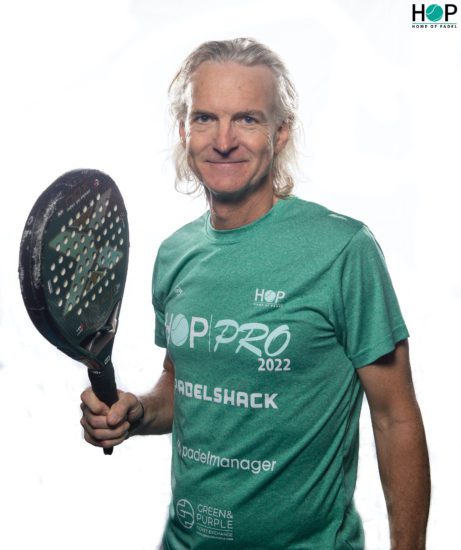
About the host: Minter Dial
Minter Dial is an international professional speaker, author & consultant on Leadership, Branding and Transformation. His involvement in sports has been a lifetime passion. Besides playing 18 years of rugby, captaining athletics teams, coaching tennis and playing squash for his university, he’s been a lifelong player of padel tennis, starting at the age of 10, from the time of its very first public courts at the Marbella Club in 1974.
Then, after a successful international career at L’Oréal, Minter Dial returned to his entrepreneurial roots and has spent the last twelve years helping senior management teams and Boards to adapt to the new exigencies of the digitally enhanced marketplace. He has worked with world-class organisations to help activate their brand strategies, and figure out how best to integrate new technologies, digital tools, devices and platforms. Above all, Minter works to catalyse a change in mindset and dial up transformation. Minter received his BA in Trilingual Literature from Yale University (1987) and gained his MBA at INSEAD, Fontainebleau (1993). He’s author of four award-winning books, including Heartificial Empathy 2nd edition (2023), You Lead (Kogan Page 2021), co-author of Futureproof (Pearson 2017); and author of The Last Ring Home (Myndset Press 2016), a book and documentary film, both of which have won awards and critical acclaim.
It’s easy to inquire about booking Minter Dial here.
Full transcript of interview via CastMagic
This transcription comes courtesy of Castmagic.io an AI service for podcasters.
Minter Dial: Dani Dios. Well, how much fun to have you. I mean, I’ve known you for quite a long time. You, you were, we were, we were down in Marbella and I think, well, you were my coach along with Gabo and I, I think I progressed since then. But let’s get. You get people familiar with who is Dani Dios.
Dani Dios: Nice to, Nice to be here, Minter. And thanks so much for the invitation. I really, really appreciate that.
Minter Dial: And so, tell us, Dani, a little bit about who you are.
Dani Dios: Well, long story. Every time I talk about my past, I feel a little bit like, Like a dinosaur, like a species in extinction. But, yeah, I mean, I’ve been connected to the Sport for over 26 years now. My background was I was a former tennis player. I was playing on the ATP until, yeah, I wasn’t good enough, didn’t make it on the top 500. And then I just ran out of money, so I had to start working, right? So, I started working as a tennis coach. As I was starting reconnecting with all the, with all my friends from back in the days and all of them, they were like, Dani, you need to try padel. Even though I knew what it was, I was like, I was very skeptical about it. I was like, no, this is not real tennis, not my thing. But you know what, with my tennis skills and across my friends, I was okay. So, all of a sudden my ego felt a little bit stimulated. And then I said, you know what, let’s. Let’s just play a little bit like a professional competition. And this is when I was hit by a lorry in my face. I mean, we, we lost 6060 in 20 minutes. And I, I could not believe what happened. So, I took it personal. I actually said, you know what, I have no idea about this sport. So, all of a sudden I started playing. As I was running my tennis academy, as at that time in Spain, this was year 2000, padel’s started booming. We had the former president of Spain, Jose Maria, playing, and all of a sudden I saw that there was a bigger demand on padel services. For me, it was kind of a nice and soft switch from tennis, which I was a little bit tired of it to padel. And then all of a sudden I started connecting more into the business side of the sport. I’ve been an entrepreneur my whole life and there I saw that there was a good opportunity to be connected to a sport on the rise. So, all of a sudden I started operating different sport facilities with both tennis and padel. Life, little by little took me to the UK As I was strongly connected to the professional sport in the UK. So, I was coaching Elena Baltacha for some years until 2011. I was offered a Padel Entrepreneurship in London, Padel Club London in Canary Wharf. And this is when I fully decided to switch completely from tennis to Padel. It was great years 2012, 13, 14, but I did not quite see myself living in London and at that time and I felt we were a little bit too early in the market. So, I was kind of hesitating about what my next move was going to be. And then I decided to live in Marbella, which was the place where I currently was born and raised. So, there that’s when I actually met you. I was hanging around thinking what could I potentially do? So, I created my, my, my consulting company, which is Padel Trainer. And this is when we actually took the management from Real Club Marbella. And that’s where we met together with Gabo. Indeed. At that time there was a lot of Nordic Scandinavian people very interested on the sport in Marbella. And this is when the Mac. Correct, correct. So, little by little, all of a sudden we were required to travel abroad to help small investors, but also institutions. So, all of a sudden Padel Trainer that was born to be more local, more like a local agency started becoming just. Just by its own nature, by its own growth nature to start giving services to basically every single federation investor. Little by little, Scandinavia took more and more of my time. So, I decided to move to Sweden. I was former captain for the Swedish national team, both men and ladies, for several years.
Minter Dial: You got to hang out with Jonas Bjorkman.
Dani Dios: Correct, Correct. So, he was actually taking my role after I decided to quit. The reason for that is because there was a couple conflict of interest between my consulting company and the national team. So, I decided to separate, to part ways. That’s when I was approached by LEDAP by We Are Padel to see if I was interested of being the sports director for the company. So, at that time it was an operator from a strong investment private equity called Triton. So, all of a sudden I was managing 175 sport facilities at a very interesting time, because I remember when I was traveling from Marbella to Sweden, I was like, oh my God, these guys are just going crazy. Either I know very little about my own business or I’m missing something here. And this has been a very funny phenomena. Every single country that has adopted the sport thought that they will never crash Spain. When started building Padel infrastructure, they said, you know what we’ve learned from the Argentinian Market, it’s not going to be the same issue. And it was. And so, it happened in Portugal and so it happened in Sweden, and so on and so on. And unfortunately, we will still see that situation happening. But it was a very interesting time. So, I remember when I was being part of this investment fund, I said, I remember I had to do like a first audit to the company. And I said, guys, have you seen the movie the Titanic Is I. Well, that’s a paper boat compared to what you guys are going to witness. And I actually was like, not regretting the move that I did because I actually learned a lot on depth management and failure management, which was a huge masters for me. I mean, through life, I’ve always learned through tough times, through challenges, no question. I had way too many. I think that I’m done with that. This is a moment where. Where I need to. Where I need to move in a different direction.
Minter Dial: And that wisdom arrive.
Dani Dios: Correct wisdom arrived. And the timing, I think, is also a matter of timing. Back in the days, things were very different. Still are. But there is more knowledge around the sport, there is more appetite, there is more global impact. So, it’s a very different situation. But anyway, at that time, this is when IMG knocked on the door. They said, look, we want to get into Padel, but we know very little about the business, so we need real expertise. We want to sign up as Arturo Coello as our first client. But a demand from him was that he was requiring professional padel expertise within the company. So, they approached me. I had a word also with Hernan, with De Aguste, who was my colleague with Bebe in LEDAP. I talked about the opportunity and we decided that it was a great moment to switch after two years of great friendships, great network in the company. But to be honest, the wrong perception. When you see that padel is growing, but at the same time you’re within a company that is handling stress and handling depth, it’s like, oh, my God. Padel should be on a completely different direction, but this is what we need to face. So, it was a nice. It was a logical, natural move. And now I sit in IMG WME as an executive director for all the padel division across all markets. So, very, very exciting and very interesting moments.
Minter Dial: Well, are you. But you’re based in Marbella now still?
Dani Dios: I’m based in Madrid, right? Yeah, yeah. From my days in Marbella with my second wife. We had a lovely daughter and we divorced, sadly. So, she moved to Madrid with. With our daughter. And then when I had the opportunity to Be close to her. Then I decided that it was the right time to, to come to Madrid. So, I’m based in Madrid.
Minter Dial: Yeah, that makes sense now. Well, I played in LEDAP, of course in Stockholm a few times. What I’m thinking about is how each of these countries sort of burst onto the scene. Excitement. Nine thousand courts or so in Italy, maybe four or five in France. But the issue is, I suppose there’s no centralized business build. It’s all lots of individuals in different cities, different towns. Oh, I want to get in on this. And then they build their club. And in countries where padel isn’t inherently intrinsically within the. You have to build the culture of Padel, you have to build the community and at that point your utilization rates aren’t there. And it feels like there’s always going to have to be a big rise in the number of courts available and then a tailoring back. But if you take the UK where we have just peaked over 1,000 courts, which leads leaves us with about two courts per 100,000 in the big cities compared to Madrid which is at 33 courts per 100,000 population. You kind of have to believe that the UK will get there. There’s so much more room for growth and yet we know that there’s going to be a tapering back because there isn’t enough good coaches, too many courts are outdoors. And how is it that people don’t compute that. What do you think is the recipe for creating a successful country growth?
Dani Dios: Well, I mean it takes time. It takes, it requires, as you said, culture. Countries need to inherit the culture around the sport. If you go to, I don’t know, to Brazil, anywhere you go, people will be able to talk about football. Right?
Minter Dial: Or football.
Dani Dios: Correct. And if you go to Argentina, anywhere you go, if you jump on a padel court, there’s going to be a 95-year-old man telling you how to do the bandeja. Why? Because there is a culture around the sport. So, most of the people now, and this is, I think current times, they step into Padel often for the wrong reasons because they see a short-term profitability, they see that there is an opportunity to do something that is on the rise. But like any other business, it requires expertise, it requires certain elements around the sport, it requires expertise, it requires knowledge of the team who is going to be working on site. So, UK in that sense, especially big cities, I think it’s a slightly more protected purely because of the fact that it’s harder to build and the cost of construction is much higher. But for sure, we’re going to see in areas where developing clubs has a lower cost, we’re going to see constructions. And this is, this is when you look into all the cycles of life on the sport, you start understanding that positively or negatively, it’s a natural cycle of evolution for the sport. We had it in Spain also. We had two huge recessions. One was 2007 with Lehman Brothers. Obviously it hit every single private club at the time where government was investing in public facilities. So, imagine you were a private investor, right? You pay a high sum of money and all of a sudden, 1km away, you have a public facility charging €4 an hour, and on top of that, you’ve got the lemon crisis. Well, this was, I mean, it knocked 60% of the clubs down. It was incredible. Even the public facilities. And then the second one that we had was around 2011 was when the government decided to change the VAT around sport from 13 to 21%. So, that 8% gap is usually almost a profit in a sport facility. So, all of a sudden you take that down. So, we have some strong contractions. But now, luckily, the market’s been stabilized in Spain and it’s still growing. I mean, there is still growth in the number of players playing. So, we are living in a very healthy ecosystem. And for outside countries, I mean, that is going to be a process that will take time, will require expertise from the management team and operational team, will require expertise from the coaches. Would also require some type of settlement in the appetite for users around Padel, because whenever Padel is coming into a new market, everybody wants to play 25 times per week. But there is a moment that those users become also more picky. They want best matches, they want a better coach, they want. They want a cheaper rate, they want a better facility. So, all of a sudden those are good and necessary filters for the sport to settle at the cost of some investments. So, it’s very nice times for Padel, but as I always say, Padel requires, like any other business, a lot of expertise. And those that get into the sport only for the sake of mathematics. If I have a chord at $30 an hour times 10, that’s $300 times 30, that’s $9,000. Oh, my God, this is a gold fever, right? Then for sure you’re going to have a very strong problem in no less than 4 or 5 years.
Minter Dial: Totally agree. And when you, I mean, obviously there’s no one recipe, but what are some of the, the key things, errors that you’ve seen in clubs that have grown or, you know, come up. And what do you think of the. The things that they really should be focusing on when you’re building a new club? I mean, obviously I’m in the UK, but I have a large number of people in the US and I know the ecosystems in all of the different countries. But in the countries where it’s still sort of like a youthful growing industry and a club owner or someone who wants to build a club is listening, what sort of advice do you give them to make it successful, potentially?
Dani Dios: Well, first of all, you need proper professional padel advice. Normally, when we look into the profile of investors, they are usually very successful people in other businesses and they think that they have what it takes from a business perspective to build and make a club successful. But Padel is a very specific sport. It’s fun, it’s social, it’s physical, it’s educational, it’s competitional. So, if you don’t know how to put all those experiences, all those ingredients on the court and you just focus on, maybe Padel must be fun. Well, great, it’s fun. But losing is not that fun. If you win, you have more fun, right? So, little by little, people need to understand that proper Padel expertise is required. You will be surprised about the amount of clubs out there that haven’t put a proper specific business plan in place. I mean, it sounds shocking, but it’s true. And the second one and biggest issue is that everybody wants to attract everyone in their club. And I always compare these to car brands, right? You have to know whether if you’re going to be a Mercedes, Ferrari seat or Fiat, right? And according to this, you’re going to create a club and you’re going to provide experiences that resonate with those users, right? So, if you mix somebody who wants to buy a Fiat with somebody that wants, wants to buy a Ferrari, often the experience is going to be very different. Somebody’s going to be very disappointed. And when we go into clubs, we see that everybody tries to fight for one particular client rather than doing a nice client segmentation and say, okay, perfect, who is my ideal client? When you go, I don’t know, into, into golf clubs, you have green fees where you pay, I don’t know, €400, but you have others where you pay 60. So, this little by little creates your network of users of your fan base, right? We don’t see that in padel. There’s not a clear segmentation in terms of good venues, very good venues, cheap venues. It’s just based normally on the location, but not really on the look and feel, on the quality of the coaches. So, I think that those two are by far the biggest issues that we see in. Unfortunately, fortunately for those that know how to run the business, unfortunately for those that have done that job, we see that as a very big issue. So, of course, when threats come, when contractions come, you need a good team of sailors that knows how to survive on the storm. And if you don’t have that team, for sure you are going to sink.
Minter Dial: So, if I were to characterize the second one you’re talking about is really about brand like, what do you stand for? Who do you want as clients, what’s your positioning and all that. And, and yet in what you say was an interesting thing I, I keep on hearing is that padel is the kind of sport that you cannot can unite a dustbin collector with a CEO. And, and because they. There’s no more titles on the court. So, that, that feels like a sort of a, a profiling that is really extensible and, and is gorgeous about padel. But what I’m hearing is that you have to be careful not to make it so fungible that it’s a sport for everybody.
Dani Dios: It is, exactly. Because at the very beginning there is so much excitement about the sport that nobody cares about all of that. Everybody’s happy to jump on the court with anyone. Everybody’s happy to pay money. Everybody’s happy. If you have a better match or a worse match, you know, you’re happy to do a little bit of charity, as we say, charity on those moments. But little by little, people get more demanding. If you’re going to pay a high sum to rent a cord, you expect a level of service that is excellent, you expect a level of matches that is excellent, you expect a level of changing rooms that is excellent, Right? But when these people, after being in different places, they go to that particular place and they say, hang on a second, I’m paying here like almost $50 for a match. And guess what? Changing rooms are terrible. I can barely have a shower. I don’t have a bar where I can actually have some nice food other than hot dogs. The match was actually not that good. What happens is that then those profiles start getting a little bit demotivated. So, rather than coming four times, they come two. And if on top of that, they discover another venue that matches a little bit more their expectations, that business itself is at risk. So, it’s kind of what we call. It’s an evolution. It’s a natural evolution process. On the first three years, you’ve got like the honeymoon period. You’re obsessed with the sport, right. It’s like, oh my God, I got married. My wife, my husband. The best of life. Yes. After it’s like, yeah, it’s good, but they snore at time, you know, it’s not. So, they smell a little bit at night and little by little they get a little bit demotivated. So, this is when, when it’s more important than ever to know who is your user, what is the level of expectations that your user has and what is it that they are looking through. Padel. Because the ambitions are very different. You might want to play the best match of your life, but others might want to socialize or others might want to have just a community to connect. So, the ambitions are very different in users. And if you don’t know how to spot all of that, then what you realize is that your business is at risk, that the foundations that where your business is set is very vulnerable. So, at the moment there is a little bit of a phase win. Businesses crash, which is expected. I mean, and we have the perfect example in Sweden. I still go to Sweden every now and then. If you ask me now, Minter, will you invest in a club in Sweden? I will say, hell yes, of course. But because the expertise was so little, the level of service was so low, the, the, the knowledge around the sport was so little that those that have a good team of coaches, that create good experiences, that have a nice venue in a fairly well connected location, their occupation is no less than 80%. So, so this is what happens when you know what you do and when you don’t know what you do.
Minter Dial: It’s very much the attitude, I would call it typically an American attitude, which is so Minter, I want to invest it, or Dani, I want you. And you say, well, I failed two times, great, I’ll invest right now. Because you, you know what bankruptcy is like, you know what failure comes from and you’re not wishing to do it three times, which is such a different. I mean it feels like that’s sort of the spirit within which you would invest.
Dani Dios: Totally. I mean, I’ve been entrepreneur by nature. I’ve been bankrupt three times, so.
Minter Dial: And, and I’ve just done it twice.
Dani Dios: Yeah. And what happens is that I always compare it like a bamboo, right. You’re sitting on top of the bamboo and you’re kind of testing how flexible that bamboo is. And two things can happen, either brakes and you crash or you grab power just to bounce up and evolve and create a better version of Yourself.
Minter Dial: So, just to finish, Dani, then on this piece, what if someone is wanting to build a club or is building a club and would like your advice? Padeltrainer.com but is that, is that something that Padel Trainer provides this type of advice to help figure out the ecosystem and modeling we do?
Dani Dios: Unfortunately, now, because most of my time goes through WME, they are the ones that have taken that expertise from me and monetize on that, which is the way they do business. And this is how I feel most helpful to them. But, yes, I mean, we also have a large number of people connected to Padel Trainer, padel advocates and padel experts that they actually provide also that service. So, it’s whether if it’s through us, whether if it’s through WME, just surround yourself with experts, with the ones that have been the most unconscious, people from early stages that have seen those expansions and contractions, because there’s very valuable teachings behind those people that unfortunately are very rare to find in the padel space.
Minter Dial: All right, so last part of the conversation, Dani, with you. I’d like to talk more about padel itself. This is because that’s what I generally want to have to talk about.
Dani Dios: Love it.
Minter Dial: And. And you still get to play padel, as I can imagine.
Dani Dios: I do. I cannot wait to jump on the court. I mean, I’m the happiest kid in life when I go on the court.
Minter Dial: I love it. And so, let’s talk about what typically happens. Someone gets in the padel, they came from tennis typically like you did, and you get the six love. Six love.
Dani Dios: Yeah.
Minter Dial: What does it take to move from being a really good tennis player to being a really good padel player?
Dani Dios: First of all, humbleness. You need to be very humble to accept that you know nothing about a sport. So, I remember when, when I had that crash that we were saying, six love, six love. 20 minutes, I was destroyed. And actually, the tennis club that I was running had padel courts. And the head coach that I had there was Christian Jensen, Claudia Jensen’s father.
Minter Dial: Right.
Dani Dios: He was actually doing lessons there. So, I went to him, like when you go to the church, you know, to confess your sins. And I said, Christian, this happened. And he said, well, what did you expect? Right? And he did a very simple exercise. He said, hit a forehand. I hit a forehand without the wall. Best forehand ever. Said, hit a forehand from the wall with a cross court ball. And I started grabbing the ball in completely different ways. I was like, you see, this is a problem. And he said, you know what? Drop the racket and catch the ball with a hand. And I was like, what, me? That I’ve been a former ATP player, You’re telling me that I need to catch the ball with a hand like a baby? And he said, yes, because that’s where you are. And I totally understood. It took me 10 minutes to realize that I had no idea. And little by little, he kind of destroyed my confidence to recompose it like a surgeon. So, it takes humbleness. It takes understanding that it’s a team game. You think like an individual and you don’t understand that you have a player on the side and whatever you do exposes or gives an opportunity to your partner. And then just. I would say those two things, really. Humbleness, drop the ego expectations and understand that this is a team of two. So, you start from zero. I’m not saying that the tennis skills are not good, but I will say that at the end of the day, they are a threat to the game because it’s so inherited, it’s in the backbone. So, whenever you are not constantly working on a habit, the tennis habit comes in again. So. And this is when we saw a change of an era with Paquito Navarro, with this type of players that they were playing Padel from the age of four, and all of your players at the age of 16, they were smoking everyone. Juan Martin, Diaz. These were tennis players. I mean, back in the days, their very first sport was tennis, but of course, cannot compare it with those that pick the sport at the very early stages. And it’s implemented on the DNA. Complete different profile of player.
Minter Dial: You know, when you look at Paquito, you see how unorthodox his shots are. You know, as a tennis player, you’re like, that’s not how you hit a ball. But it goes right where he wants it to go. Yeah, with great deception.
Dani Dios: And.
Minter Dial: And so, when you are. With this humbleness, you’re figuring out a team. What about things like communication?
Dani Dios: Of course, it’s. It’s part of the. It’s part of the. It’s part of the team. Right? I mean, it’s like, I remember I was just playing one. One friendly match with a padel guy. He just got lobbed, so we lost the net. We had to go back. And it’s the first time I was playing with that guy, and all of a sudden he was going to do some type of bajada. And he caught the ball with a hand and stared at me and said, dude, the hell is wrong with you? And I was like, what? He’s like, are you going to Tell me what to do. But, like, very arrogant. Very, very. So, I was like, all right, I got the message. For the first 20 minutes, I didn’t know what to say. I was completely freestyling to the next level. But I swear to God that I was trying my very best to start understanding that I needed to speak to my partner as much as I spoke to my ex wife 20 years ago.
Minter Dial: Well, one of the things that, I mean, I go on the court these days and I say, so what would you like in terms of calling conventions? And most people look at me like a deer in the headlight of a car, but what do you mean, calling conventions? Yeah. So, how do you like to be spoken to when the ball’s in the air? You’re doing playing a bajada and the one that’s always the trickiest one. This is what I think, Dani, but you can tell me if I’m wrong. Is when one helps, one is up, one is back.
Dani Dios: Correct.
Minter Dial: And they feel. Or cheating, you know, like, it’s those moments where you have to be able to say quickly one word, you know, or whatever you know, or you. You. You bring up the word, the quickest word that. That as a convention, you’ve created together, but when you started, you’re as two new people together. It’s really hard to lean into. I find that if most difficult, Very difficult.
Dani Dios: And also for the person playing, because sometimes the other person is talking, but the person hitting the ball, it’s so obsessed with the ball that doesn’t have the ears to listen to what the other person is saying. I remember in. In very funny stories in Sweden. People in Sweden are very calm, right?
Minter Dial: So, don’t like to talk too much.
Dani Dios: Don’t like to talk. So, everybody was like, dude, stop talking to me. You’re stressing me like hell. I’m already stressed enough about what to do with the ball, and then I have to listen to you. Please shut up. And I said, fine, I get the message. So, it’s a tricky one. It’s a tricky one. Yeah.
Minter Dial: Well, I mean, I. I like to. You know, the other type of topic I have as well, you know, you might want to hit a few lobs here. Oh, I don’t like hitting lobs.
Dani Dios: There you go. End of the conversation.
Minter Dial: What? You don’t like talking and you don’t like hitting lobs? Go back to tennis.
Dani Dios: Yeah, correct. Correct. There’s so many stories behind those things that is just. It’s just. And this is the fun part, right? And this is why also, you need to understand what type of player are you psychologically to know who you need on the side that is a perfect match. I always say it’s more difficult to find a partner than to get married in life. True with that because some people prefer a more aggressive communication, other one’s more passive. Somebody has to be the leader, other one has to be the follower. So, it requires a lot for two players to connect on the court. So, when magic happens, this is when people leave their honeymoon. Oh my God, I found the partner of my life. Until they lose the first match and then he’s not so good, this partner anymore. Right. I need to find somebody better. That’s the beauty of.
Minter Dial: It’s always my partner’s, my partner’s fault. Just quickly back to Christian Jensen. Is he left-handed as well?
Dani Dios: No, he’s right-handed. I mean.
Minter Dial: And both of his kids are lefties.
Dani Dios: Yes, he’s right-handed. Claudia, the mother is lefty, so.
Minter Dial: And she played too, right?
Dani Dios: Yeah, yeah, yeah, yeah. They were both very good. I remember. I mean it was the, it was the biggest humiliation because Christian is old fashioned padel, meaning he plays at the back of the court. He will not win one point, but it’s impossible to win a point out of him. So, I remember in some matches when we were playing, he was always wearing his jacket. He will not even take his jacket off. He wasn’t sipping it a little bit and he had his hat pretty loose in the head, so it felt like everything was going to fall off. And there I was smacking the ball 350km an hour. And he will just not move one foot for the whole match. You were sweating your life out. Guess what the score was. 6, 2, 6, 1 down. I was like, how do you do it? How is that possible? This is when Pavel was much slower at the time. Compounds were slower, chords were slower, balls were slower, the rackets were not so powerful, so that was more allowed. But it was like for me, Christian, I mean if for people that don’t know who he is, go to 1984, you will see almost black and white videos and you will see him and he’s like. It’s like a complete. It’s. It’s something very necessary for many beginners and for many people who start playing the sport to watch these players. Because this is when you understand the true nature of the sport. The problem is that those amateurs, beginners, they go on social media and they see Juan Lebron, Ale Galan or Tapia doing the trick of their lives. And beginners think, right, that’s who I want to be. So, they get a misperception on the true nature of the sport. For those that play beginners, Intermediate, Intermediate, advance.
Minter Dial: Yeah, I typically say I swear off the boys. The boys are being sort of the showmen, La magia. But look at the women. And it’s a little bit more, more accessible. Even though the women, of course, will wipe me clean. Oh, without batting an eye. Let’s talk about. Because the transition I’ve had Roby Gattiker on, I’ve had, you know, so I’ve talked with people who have been in and Viviana Corquera. So, I’ve had people from the beginning of padel, if you will. And the Argentinians always. I always used to feel like the Argentinians had a, had an even slower game than the Spaniards. But today, let’s talk about the transition into today’s padel. In the pro world, there’s, there is definitely a difference between men and women. There’s an enormous difference between what it was and what it is. How do you see the evolution of pro padel going forward now? What, what are the things to look for?
Dani Dios: I mean, padel is a sport that is still far from reaching its peak. Don’t forget that 10 years ago, even less, I will say Padel players were not, not training more than three and a half hours, in the best of cases, a day. I remember back in the days when I was a former tennis player, I was training eight hours a day, four hours of tennis and four hours of fitness every single day, plus competitions. And, and padel players are starting adopting those habits. So, the first big change that we’re seeing is that physically they are so much better than the previous generation. And this allows you to be more flexible, more explosive, it allows you to counter attack, it allows you to take many more tactical risks because you know that physically you are in a position where you can still recover the game, recover the ball, recover the point. The second one is, is the speed. I mean, technology little by little is being implemented. I remember the first rackets that they were made of wood, 28 millimeters. Try to hit the ball off the court exactly with that. I mean, you will break your arm before you can actually get that. But now we see, we see rackets that they actually deliver an incredible power at a reasonably well-balanced weight. So, it’s not too demanding for the players. And then also because of the physical compound, we are seeing new tactics being introduced to the sport every time. We’ve never seen a world where fighting for the net was Almost the life and death. Life and death. I mean, people are going to the war with, as many Argentinian players say, with a toothpick. But that’s how it feels. Because these days, if you stay at the back of the court with such high-quality players with incredible volleys, reality is that after three or four balls, you are screwed. Exactly. In the female side, we still see that there is more. More space for people to defend. But we are seeing now a very clear example with, with Paula, that they are explosive and this is creating a very big impact already at those levels. So, four victories in a row, four competitions won in a row. And the reason is because they are explosive. They have, at the end of the day, that 5, 10% more in the speed of the game, in the speed of their movement, that allows them to be much more in everybody’s face. So, when they are going through a high, this is what we see as a result. On the other side, it’s a more stressing way of playing. So, emotionally you need to know how to handle those emotions. But when players are sync, there’s no. There’s no. No, no, no. I mean, it’s. It’s so honestly clear that they are better when they are in sync. But of course, it’s a more stressing way of playing. Same that we see with LeBron and House Burger. Right. Very explosive players, but mentally, that’s really demanding also. So, when things are not going that well, the chances of crashing, big crash are very high.
Minter Dial: Yeah. It’s one thing to miss an easy volley, per se, you know, or you hit this ball, you smash, but it goes out of the court instead of portraits. But when you’re. When you’re both transitioning up and you’re pushing to get to the net and then you miss that really hard volley, it’s. It’s now almost becoming an unforced error, whereas it’s absolutely just traumatically difficult to do those types of shots. They make it look simple. They managed to do so many. But it’s now becoming an integral part of the game. And I hesitate to think about whether they are now forced errors or unforced errors in that transition period.
Dani Dios: It’s padel on TV does not reflect the reality of the speed of the game when you get on the court and you play with these players. I’ve been privileged enough lately to play with some players. We have Arturo, as you know, I was actually doing a fun game with Arturo last year at the Miami Open. We were doing an exhibition. Dani, let’s play a cross court match. I mean, my God, he was still playing at 50% and the ball was coming like. It felt like you remember the game Tetris when you were on level 20 and the blocks were coming at the speed of light. So, there I was at the bottom of the Tetris trying to weigh how to manage that speed. It was ridiculous. But when you see it on tv, sometimes it feels like it’s a bit slow. It’s like, oh my God, that’s not so difficult, right? You go on the court and you’re like by the time you’ve been striking the ball, there is another bullet coming at you in every single direction. So, padel has gone so vertical compared to what Argentinians are good at in horizontal, moving left to right, taking it easy going forwards. Padel now is super.
Minter Dial: Is no longer the case. I mean that’s sort of my experience in tennis. I. When I’m playing good young tennis player, the heaviness of the ball, I know within two, three shots I’m going to be dead. And so, I mean with Padel though, there’s an opportunity to keep it slower. If you create a slow court, you take out maybe a couple more percentages of the balls. It. It do you. I mean there’s certain tournaments like in Buenos Aires where it was slower as opposed to Asuncion where it was sort of bada bing, bada boom. Do you feel like, I mean, maybe that’s to its credit but we, we have the opportunity, we can make clay court bottom grounds. We could do different things to, to allow for the old-fashioned game. Do you still feel that maybe the future of padel will rely on the ability to have that type of padel as part of it?
Dani Dios: It’s a difficult one to answer. If I had to give an honest answer, I would say no. I think that padel is going to be faster and faster because there’s nothing that people enjoy the most that when the ball is flying off the court and somebody goes right out the door and does the biggest trick in their lives, people go mad. It’s like almost you’re in the, in the Roman circus, right? Yeah. I believe that little by little also speed will be introduced on the female side perhaps with a little bit of a faster ball just to reach that level. So, I think it’s the bodies. The premier part of the federation is going to have to find that sweet spot between a nice show without being too slow. But without being too fast, will new surfaces be introduced? Maybe, who knows? I mean, I remember when I started playing Padel, I was Playing on tennis. Quick, my shirt. I mean, you were breaking with walls. With walls.
Minter Dial: Cement walls.
Dani Dios: Yeah, yeah. And the old tennis courts, the cement that had the rubber bands in between for expansion. So, you were falling down and that’s it, you were going straight into hospital. So, it has changed. And in Argentina still you see these polished cement cords that are pretty slippery or pretty grippy, depending on how old or how new it is. But I believe that we are going to see a fairly fast game in coming times. But I will not reject the idea of having a different surface. Why not? I mean, technology is being introduced into the sport. We have seen it also in tennis. The hard courts have changed a lot with the plexi pavement, which is a bit more of a cushiony feeling. So, you don’t know if maybe one of those elements is going to be introduced. Maybe there’s a lot of exhibitions around the world, so perhaps a promoter introduces a different compound that creates an effect. But I would say that the sport is going to get only faster and faster because of two reasons. Because of the show that it provides and because of the physical capacities of the athletes that is just growing 10, 15% every year.
Minter Dial: Well, I do hope that we’ll keep the slowness because I mean I, I always look at tennis doubles and men’s tennis doubles. I really just don’t get off on it. It’s, you know, one serve ace, second serve, second serve aces and it’s serve, return, volley, a win and, and there’s no, there’s no enjoyment through it. And if we go too fast and you’re, because you’re, you’re just swarming the net, bang, bang, bang, you know, three point shots we go, if we go from 9.4 shots per rally on average down to 2.4, then I think that’s, that’s the price that men’s tennis doubles will have us paid and could be end up being the problem for Padel.
Dani Dios: It’s a, it’s a tricky one because as you know, Premier Padel, when we look into the professional competitions, Padel is still one of those few sports that has men and women playing at once in a competition. If you look at tennis, you only have the Grand Slams right, where men and women are playing together. And why? Because there’s 35 chords to have 512 players approximately playing on the main draws. If you look into Premier Padel, they have a very limited schedule where men and women need to coexist on one court. What will happen if the games were going too slow? Perhaps there will be a segmentation and perhaps there will only have to be men tournaments and then women’s tournaments, which I personally don’t like because I think that the true power of this sport is equality. You see 14,000 people watching Delfi [Brea] or 17,000 people in Argentina waiting also for the next match. You don’t know if those levels of audience would be the same if you were separating men and women. So, they also need to find the way that they can actually host such a high number of matches for both men and women. Imagine if every match was going too slow, then it will not be possible. Yeah, so it’s a tricky one. It’s not an easy one. Yeah.
Minter Dial: When. When you get those sort of two-minute points. Go a lob. Lob.
Dani Dios: Exactly, exactly, exactly.
Minter Dial: All right, Dani, been great having you on. This is the Joy of Padel. And I always like to ask for a funny moment. You mentioned a few funny moments, but what, is there some memory that you have in your history of playing padel that just still tickles you pink today?
Dani Dios: Yes, yes. I actually laugh when I think of it. When. When we opened the first club in London, Padel Club London, there was a. There was. I remember he’s a very famous guy now in the padel ecosystem. There was this Argentinian guy getting to the court. It was like, oh, my God, you guys have padel here in London. And I was like, who are you? And he said, my name is Mauri. Mauri Andrini. And I was. And he was like, I was number one in Argentina. I was like, yeah, right, typical Argentinian number one. I actually was on the court with him and I said, you actually play very well. He was like, yeah, true. And we played actually a competition after a couple of months. Super intense guy. I mean, if you. I don’t know if you know Mari, but he’s one of the most exciting people around Padel. Passionate. So, we were playing a competition and there was these opponents. I think it was actually Gabo playing with Caye or he smashed the ball out and he wanted so badly to get it that he missed the door by like two and a half meters. Literally two and a half meters. So, he smacked his whole head against the fence and bounced back down. Was KO. He really hurt himself. And I was staring at him and I couldn’t control myself. And I started laughing to death. I mean, I was in tears being so sorry for him, but I just could not stop laughing. I mean, he was actually running and chasing me to say, how do you have the. The guts to be laughing at me? I mean. And I Speak with him a lot and we laugh about it. Oh, my God. I was laughing for like 10 minutes. Seriously, I could. I could not breathe. I was one of those missions that you’re seeing somebody missing the door. By that match, it was not by. By an inch. No, it was by 2 meters.
Minter Dial: Yeah, he completely forgot where he was. I mean, in the end of the day, I. I think circling back to your point about humbleness, humility, it’s a sport that in general invites humility. And the way. The way I pinpoint that is you never know where the ball’s going to go off the fence. And so, you have to just be there with that and suffer the consequences. Maybe you’re going to be able to get it, maybe you’re not. So, don’t be too arrogant because, by the way, you know, we all make mistakes, including running in the fences, Mauri.
Dani Dios: Oh, yes.
Minter Dial: Anyway, been great having you on the show, Dani.
Dani Dios: Thank you.
Minter Dial: Tell us, how can people contact you or get in touch with you and your services if they’d like to know more about what you’re up to?
Dani Dios: Well, at the moment, I mean, next week I will actually be at the summit. We’re going to be hanging around there. So, I would really like to meet as many people as possible. So, feel free to reach me out. If you see me around, tap me in the back and I’ll be happy to have a nice conversation. And yes, we’re working now more in the world of global brands. So, if you have a big brand. Yeah, I mean, this is where we’re working at WME and then through my social media on padel trainer, official and try to be as active as possible. And there you will be surprised the amount of padel questions that come around. So, I always answer to everybody. So, whichever the question is, reach me out on social media and you will always get the best of me. Maybe not in one day, but after a couple of days, you will always expect. You should expect an answer on me, Dani.
Minter Dial: That is a model behavior. I really appreciate it, what you do for the sport. Great chatting with you. Look forward to playing with you one more time for sure.
Dani Dios: Minter, thank you so much.







“Riding the wave (and sometimes the storm) of padel’s unparalleled growth” really resonated with me, having played the sport regularly in the UK. As a family traveller, I’ve noticed that the availability of padel courts can make or break our holiday plans, especially when considering Muslim-friendly destinations with suitable food options. I’ve found that having a local contact or insider knowledge can be invaluable in discovering hidden gems, such as community-run courts or makeshift facilities in urban areas. The parallel between the boom in padel’s popularity and the surge in demand for accessible, affordable courts in urban centres is something I have been thinking about, particularly in relation to the proliferation of courts in certain cities. I wonder, as the sport continues to grow, how club owners will balance the need for expansion with the importance of maintaining a sense of community and inclusivity.
That’s a really interesting perspective on building a successful padel club – the emphasis on understanding user needs feels especially important right now.