
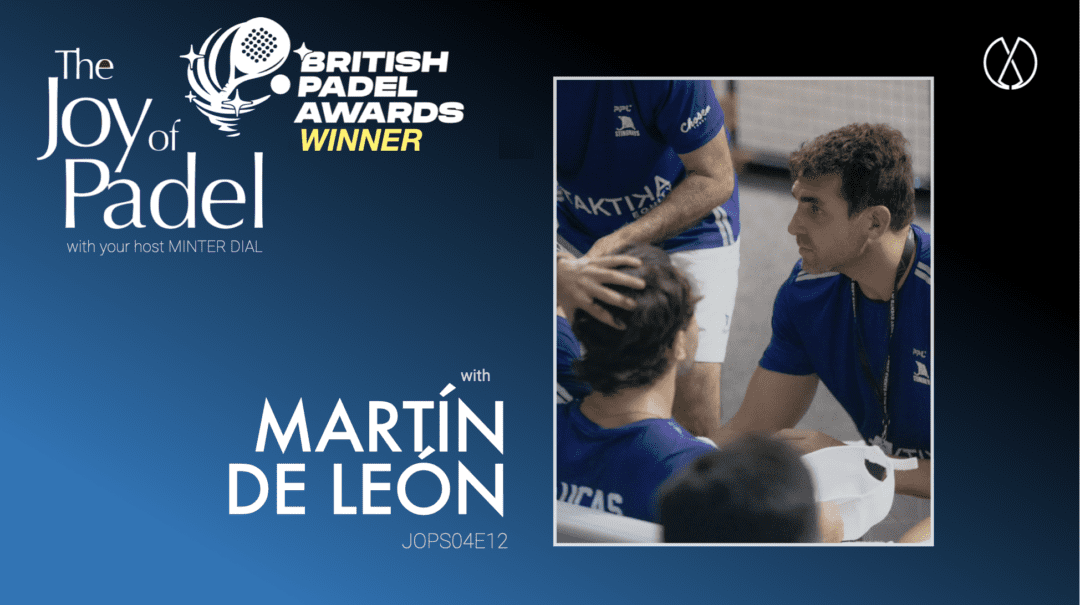
The Joy of Padel podcast with Martín de León (JOPS04E12)
On this latest episode of the Joy of Padel podcast, I was lucky enough to have a conversation with Martín de León, a remarkable guest who embodies the entrepreneurial spirit and infectious enthusiasm that padel seems to attract. From architect to globetrotting sport lover, Martín’s trajectory is as layered and inspiring as the game itself. After meeting on court, sharing some competitive rallies, and trading stories, I knew I had to invite him on the show—especially with a major event about to light up New York.
Background on Martín de León
Martín is originally from Uruguay and now finds himself based in London. Architecture may be his foundational calling, but sports—and particularly padel—have defined his most recent adventures. Love was the catalyst that brought him to London, but it’s the pursuit of athletic community, competition, and camaraderie that drives his day to day. Like so many, he dove headfirst into padel during the pandemic, when it was one of the rare sports permitted on court. That twist of fate kicked off a journey through padel clubs across three continents, from Uruguay to California to the UK, even taking him to Madrid’s elite Star by Academy for more immersions with the pros.
Main Topics Covered
The conversation focused on the explosive growth and unique character of padel, tracking its affordability and accessibility across Uruguay, San Diego, and London. One concept discussed was the contrasting cultures: padel is a cheap, community-driven activity in Uruguay and many parts of Spain, yet surprisingly exclusive and costly in the UK and cities like Miami and New York. A key theme that emerged was how the level of play varies: while hundreds of thousands are picking up padel in the US and UK, the game’s highest level is still dominated by South American and Spanish players.
The discussion explored what makes a successful padel club, highlighting the essential roles of a great manager and dedicated coaches—not just the facilities or flashy equipment. Building community and having a personal touch are central. Several points were raised, including the role of the newly created PPL (Professional Padel League) in the United States, which is bringing fresh, franchise-driven energy to the sport—NBA style team loyalty, event-based excitement, and a focus on building true fanbases.
Three Takeaways from My Conversation
- Community is the heart of padel. Behind every thriving club or league are passionate people dedicated to nurturing fun, inclusivity, and the joy of shared play. The personal connection—from staff to coaches to players—is what keeps everyone coming back.
- Padel’s growth is powered by diversity and adaptability. The sport adapts to its cultural context—affordable and open in Uruguay and Spain, aspirational in the US and UK. Yet, everywhere, its addictive gameplay and mix of challenge and teamwork win hearts.
- The future of padel is being written now. Initiatives like the PPL in the US are mixing American “event” energy with padel’s Latin roots, aiming to build not just players, but lasting fandom. Building lasting clubs and leagues needs vision, patience, and always, the human touch.
If you’re fascinated by how sports evolve—or just want to hear firsthand insights on the buzzing world of international padel—don’t miss this episode of the Joy of Padel. Whether you’re a seasoned competitor or curious newcomer, there’s never been a better time to join this vibrant, growing family.
To find out more about Martín de León:
- Follow the Professional Padel League (PPL) on Instagram for updates on events, team news, schedules, and tickets: @propadelleague
- Follow the San Diego Stingrays for team-specific updates: @stingrayspadel
- Find Taktika Padel, Tincho’s club, on Instagram: @taktikapadel_sandiego
To listen to the show:
To listen to The Joy of Padel podcast, you can use the embedded player above, or go find it on Spotify, Apple Podcasts or any number of other podcasting services listed here.
Send in your questions or reactions:
Please send me your questions — as an audio file if you’d like — to nminterdial@gmail.com. Otherwise, below, you’ll find the show notes and, of course, you are invited to comment. If you liked the podcast, please take a moment to review and/or rate it! ¡VAMOS!
To listen to the show:
To listen to The Joy of Padel podcast, you can use the embedded player above, or go find it on Spotify, Apple Podcasts or any number of other podcasting services listed here.
Send in your questions or reactions:
Please send me your questions — as an audio file if you’d like — to nminterdial@gmail.com. Otherwise, below, you’ll find the show notes and, of course, you are invited to comment. If you liked the podcast, please take a moment to review and/or rate it! ¡VAMOS!
Further resources for The Joy of Padel:

The Joy of Padel podcast, hosted by Minter Dial, a padel tennis player since 1974, is an exhilarating show that delves into the captivating stories of notable padel personalities worldwide.
Meanwhile, you can find Minter's other Evergreen podcasts, entitled The Minter Dialogue Show (in English and French) in this podcast tab, on Spotify, Megaphone or via Apple Podcasts.
About the host: Minter Dial
Minter Dial is an international professional speaker, author & consultant on Leadership, Branding and Transformation. His involvement in sports has been a lifetime passion. Besides playing 18 years of rugby, captaining athletics teams, coaching tennis and playing squash for his university, he’s been a lifelong player of padel tennis, starting at the age of 10, from the time of its very first public courts at the Marbella Club in 1974.
Then, after a successful international career at L’Oréal, Minter Dial returned to his entrepreneurial roots and has spent the last twelve years helping senior management teams and Boards to adapt to the new exigencies of the digitally enhanced marketplace. He has worked with world-class organisations to help activate their brand strategies, and figure out how best to integrate new technologies, digital tools, devices and platforms. Above all, Minter works to catalyse a change in mindset and dial up transformation. Minter received his BA in Trilingual Literature from Yale University (1987) and gained his MBA at INSEAD, Fontainebleau (1993). He’s author of four award-winning books, including Heartificial Empathy 2nd edition (2023), You Lead (Kogan Page 2021), co-author of Futureproof (Pearson 2017); and author of The Last Ring Home (Myndset Press 2016), a book and documentary film, both of which have won awards and critical acclaim.
It’s easy to inquire about booking Minter Dial here.
Full transcript of interview via CastMagic
This transcription comes courtesy of Castmagic.io an AI service for podcasters.
Minter Dial: Hey, Tincho, Martín de León. What a great encounter I had with you on a padel court. You are a man of many talents and doing many fascinating things, and so we had to have you on, especially since there’s about to happen a big old event in New York. But in your own words, Tincho, who are you?
Martín de León: Who am I? That’s. I’m still figuring out who am I?
Minter Dial: As are we all?
Martín de León: Yeah, yeah. Well, I think if I had to be really quick with that answer, I think I’m a architect and a sport lover by far. Like, and mixing those worlds, I think it’s my next challenge in my life.
Minter Dial: So, you’re a man from Uruguay. You were living in San Diego and now you’re based in London. Tell us about your journey to London. How. How did that happen?
Martín de León: Well, well, it’s really easy and I’m really proud of saying that. Love bring me here. Yeah.
Minter Dial: Love in London. That’s beautiful.
Martín de León: Love in London. Yeah.
Minter Dial: But being from Uruguay, you played a lot of sports and then how did you get into padel? What was the journey to padel? And, and, and how have you become so good at playing padel?
Martín de León: Well, I don’t know if I became so good at padel. I just.
Minter Dial: Well, I’m going to tell you, you were good.
Martín de León: Okay, thank. Okay, thank. Thank you for. Thank you for the compliment. Okay, I will take that. I will take that. Okay. Well, I think like everybody during COVID and the Pandemics, okay, like, it was like the only sport that the governments let us play. So, these clubs that were shut down, they start opening. So, I can go with my friends. We can have a place there. We just started playing Padel and then something happened also with the world Padel Tour, then change and drift to premiere and all these players starting, like appearing and what is Padel and why is taking every. Everybody’s crazy. So, it’s like, yeah, like a verse. Like the COVID started, like it changed it to. To. To padel. So, yeah, like, I think. I think like most of it, we started playing there. And since then I just love it because I came from other sports. For example, golf. I also played tennis when I was younger, played rugby, soccer. But it’s something about Padel and this challenge that you don’t have, like in tennis, doubles, that you also have that variable of your partner that maybe you’re down, but your partner can pick your head up the water and maybe you’re up and you have to do the same. So, that variable in the game, for me, it’s amazing. If you’ve seen yesterday, the final at premiere. It was incredible with Chingolan.
Minter Dial: Oh, they were so close.
Martín de León: Incredible. Like, it’s. The momentum in battle drifts so, so, so quickly, and it doesn’t happen in other sports.
Minter Dial: Why, why do you think that is?
Martín de León: Because the game, the, the, the. The. The points are so fast. The points are very fast.
Minter Dial: They’re fast, yet they’re longer, let’s say, than tennis. So, tennis men’s doubles typically is two and a half shots a rally. In men’s padel, yeah. It’s typically around nine shots per rally. So, it’s fast, but there’s longer.
Martín de León: I know, I know. That’s. That’s why tennis doubles is not so attractive.
Minter Dial: Men’s anyway.
Martín de León: Yeah, yeah. But in padel, it’s so attractive when you see these guys, like, changing speeds, putting the ball in the spot, playing with margin, then stepping out of the court. Incredible. It’s, it’s. It’s really, it’s really nice to watch them and, and, and see how they take this board so professionally in this last maybe two or three years. Because if you see padel from the beginnings, I know the chords, the battle rackets were so different. I. I’m not from that area, so I cannot give my opinion of how padel began and how it changed. I can definitely make my opinion of how I lived battle personally this last two years that I been very lucky to be involved with this. All these pro players train with them, getting to know them, see, they’re very, very accessible and really, really nice people. So, yeah, it’s. It’s. I don’t know. It’s incredible. And I hope it’s still growing. The fans, the fan base gets bigger. At some point, the TV gets into the sport, and when the TV gets into the sport, this will. If it’s already rising this deep, imagine if the TV hits it.
Minter Dial: Yeah. Well, I’ve had Johannes Thomhave on the show. He does a padel TV. And so. And I know how we have Kenneth plus with TV in France. I know that they have some TV licensing for the PPL in the U.S. i want to get to all that. But let’s say just stick with your experience in padel. You. You started learning in Covid. In. In San Diego.
Martín de León: No, no, in. In Uruguay.
Minter Dial: In Uruguay.
Martín de León: Yeah.
Minter Dial: Okay. Okay. Yeah.
Martín de León: Yeah. Co. I was in Uruguay. Yeah. I studied there. Yeah. And last year, I was so thrilled with this that I traveled to Madrid to this high-performance battle center called Star by Academy with Maxi Grabiel, that we became really good friends. And there I met all these pro Players.
Minter Dial: Sweet. All right, so how would you describe a padel today? 2026 in Uruguay, you also have the San Diego scene that you know well and the London, or if not the UK scene. How would you look at those three markets and what’s the distinguishing features?
Martín de León: Well, they’re very different, for example, in, in Uruguay. But it’s a sport that is really accessible to everybody. Okay. So, it’s, it’s a sport that you can consider like cheap, not expensive. Of course you can.
Minter Dial: More like it was in Argentina.
Martín de León: Yeah, yeah, quite. Yeah, quite similar. Okay. Of course you can take it wherever you want. You, you, you can buy the, the more expensive racket, the better bag. But taking that aside, like renting a cord, buying balls, having a beer, like in Uruguay, that is really accessible so you don’t have to have money to play padel. In San Diego, it’s also quite similar. Like, it’s really like locally people playing there for, for, for, for example, in our courts. Because for example, Taktika has Barnes, that is a huge record center with tennis, pickleball and padel.
Minter Dial: I’ve played there.
Martín de León: Yeah. And we have like open courts. So, yeah, you, you find like more locally people playing there. It’s not like a training facility that we have. Okay, we’re. But it’s not our main purpose. Our main purpose is like building the community and having all that around Padel. It’s what we really look for. And in London, for example, it’s a sport that. It took my attention how expensive it is. I thought Miami was expensive.
Minter Dial: Going New York, New York is still expensive.
Martín de León: No, no, New York. Of course, New York. It’s something out of your mind because playing in Manhattan, in Brooklyn, in these places, you have like 8 million people living in 20 square meters. So, yeah, yeah, it’s offer on demand. So. But here in the UK you have a lot of clubs, a lot of facilities, really nice ones, and they’re all quite the same. Also the fans here are the best ones or the whatever have the best location or the best facility. They charge a little more, but it’s quite expensive because if you think of a 80, 90, 100 pounds accord, I paid that in reserve, for example, in Miami.
Minter Dial: In Miami.
Martín de León: But yeah, the difference is what you get in reserve. You paid maybe $50 if you’re a member, or 60 if you’re not a member. But you go there, they gave you the balls, you have air conditioning, they gave you the towels, you have this best locker rooms, you can hit the gym, they bring you the waters. They have like a cold boss. Yeah. Yeah, it’s like a. They treat you different. So, at the end, if I go to whatever club and I. And I spend £30, they’re almost $50. And then I have to pay for the towel if I take a bath, and then I have to pay the water. And they. So, it’s the same. And the treatment that I receive, it’s. It’s in. It’s a lower quality. Maybe the facility is amazing, but I receive a lower.
Minter Dial: Much less.
Martín de León: Yeah. So, yeah, it’s. That’s something that really shook me in a. Okay, so here. Parallel. It’s aiming to maybe. Yeah. People with. With money, for sure. Yes. It’s not for everybody here.
Minter Dial: No, no, no. And I mean, like in Spain, it’s now much more an affordable sport for everybody.
Martín de León: In Spain, it’s another equation. You get. You can play for €7.
Minter Dial: Yeah. So, you won’t get. You won’t get any water or towel.
Martín de León: No, no, that’s for sure. That’s for sure. But playing for seven euros, again, 33 pounds.
Minter Dial: All right, so I can play.
Martín de León: I can play one week.
Minter Dial: What about the levels, you know, between Monte, the Montevideo or San Diego or Miami? How do you see the levels of these countries?
Martín de León: How do you know in the us in the us. In the US the level, it’s. It’s really low. In San Diego, they’re. They’re getting a lot of good players, but all the players that really are achieving or having success in the USPA market are Argentinians, Spaniards, Mexicans, Chileans. Yeah, you don’t, you don’t have Americans yet. The Americans, they’re thrilled. They love. It’s incredible. The Americans love playing the sport. They don’t like competing. They don’t. They don’t try to get better. They just want to go there, have fun, have beer. It’s like pickleball. Okay. They. They just don’t care. They think it’s more fun than pickleball, but it’s quite of the same. They compare to pickleball all the time. And it also depends on the area. Miami, it’s crowded and there are a lot of racket. Racket club, because the Hispanic influence, it’s so. It’s so high in San Diego, you don’t have that. Maybe you have Mexicans, but that can. That, that part of Mexico is not so into Padel. So, yeah, it’s getting there. But they just go and play. They don’t like to play in tournaments. They don’t like to compete. They don’t. They don’t care. Playing a USP around. So, yeah, and here in the UK the battle is getting somewhere. There are a lot of good players but the mass like the 90, 95 of people, they don’t know how to play. They’re just starting. This is something. It’s so, it’s so fresh here. It’s so virgin. It’s incredible how we compare it with tennis. For example, that Tenny has a hundred year old and Pal has three.
Minter Dial: Well, I’ve been playing for 50 odd years so for me it’s not quite as young as that.
Martín de León: No, no, no. I, I, I, I, Yeah but I’m
Minter Dial: saying like in the way it’s taken up.
Martín de León: Yeah, for sure. Boom. The boom of battle or how we think. Oh no battle have. We have to chill. Okay, this going to be time. Relax. Just like it’s like we’re so, we’re so anxious with everything like in life we, we have this, the phone, everything’s so quick. So, we expect like okay, next year ESPN has to get into here. CNN, Fox, sky and yeah, we have to. Yeah. 50 million subscriber and yeah, no, no, it’s not like that.
Minter Dial: All right, let’s go. I have one, one question about Taktika and your experience as a CEO of Taktika to where I played in San Diego. When you look at a club, what, what do you think are, let’s say the two or three things to watch out for if you’re the club owner or managing the club or you know, I just have a business mind. What are the things that they need to be thinking about to make for a successful padel club?
Martín de León: First of all, the manager of the club because the manager of the club is the one who’s going to bring the players and build a community like Padel. It’s a community sport. It’s the only thing you have to care because at the end if you see it as a business, you have a lot of surface with all these courts and it’s a real estate business. So, the only way to get that feel is to having really competent people but that have this human touch to really bring people making it love that love so to really own them. So, for me a manager of a club is the most important guy in a club because he’s the one that’s going to feel it like his own. His house is going to push it. He’s going to care the fmb he’s going to like be the energy. Yeah, exactly. Because a quarter padel you can play wherever. Okay. That you can have the location. This is closer to my place the other One is so far, blah, blah, blah. But if, if I have to choose, okay, I’m going to, I’m going to take a train and travel 40 minutes. I have this club 10 minutes by bike, but there I have so much fun because this guy is there that blah, blah. So, okay, so at the end it drags you to the place you’re going to have fun. I like the music, I like the people. I don’t know, the, the, the. The beer is colder. You can, you can name whatever reason you, you, you like, but that guy, it’s the main, main character of your club. At the end, it doesn’t matter who is the CEO, it doesn’t matter who is the owner, it doesn’t matter who am I, it doesn’t matter nothing. He’s the, he’s the guy put in the face every single day, pushing to be matches, pushing the people, creating tournaments, bringing a dj, making it fun. So.
Minter Dial: Yeah, well, there’s lots to go into that. What about the coach? How do you assess the importance of the coach or coaches at the club?
Martín de León: Well, yeah, like, like I was saying, like a really good coach is like a manager. Like the manager is the most important, but the coaches also, because. No, I’m going to go there because that coach is more fun. Explains better. He’s prettier. I don’t know.
Minter Dial: It’s a, it’s, it really is about the human touch.
Martín de León: It’s, it’s everything how you build a community. It’s, it’s, it’s, it’s, it’s that bonding between people and controlling that energy. So, for me, coaches, managers, staff, they’re the, is the essence of every club.
Minter Dial: All right, let’s get to the last part of which I wanted to chat with you about. Enjoy. Is the, the ppl, the profession, the Professional Paddle League of the United States. I’ve had Marcus on, on the show and I’ve, I’ve had also one of the owners of the Hexagon Cup. So, I’ve, I’ve had a chance to sort of look in to these non premier padel leagues and what’s happening in the US is extremely interesting to me. Especially since at the end of the day, the United States is way behind in the padel world. As you were saying with the players in San Diego. Yeah, but. So, tell us about your role in the PPL and what’s coming up soon in New York.
Martín de León: Well, my role in the bbl, I have the best job ever. I have to. I had the chance to hang out with these pro players, meet them, train with them, learn Also as human beings, because the life they have, it’s very, very sacrificed. And they’re very, very nice. Like all of them. I have nothing to say about none of it. Like, all the players from all the teams are very, very nice and very, very polite with everybody. So, in those weeks, we have a lot of fun. It doesn’t matter who wins. Yeah. In that case, this. That’s. This. It’s a really nice event.
Minter Dial: All right, so let’s, let’s break out what is the ppl? Because most of the people who are listening probably don’t know that much about it.
Martín de León: Okay.
Minter Dial: You know, and as you were saying before, a lot of times people don’t even want to know what the pros are doing. They just want to play and have fun and not even learn how to improve.
Martín de León: Yeah, yeah.
Minter Dial: I am a student of the game. I love watching. And I think that the ppl is on to something, something very different, very interesting. So, give us what, what is the ppl and where are we and what are we about to experience in New York?
Martín de León: I’m going to define it. Like I try to explain to everybody who doesn’t know what PADDLE is or the pples or premieres or they just like Padel. For me, ppl, it’s the NBA of padel. In the US we’re trying to become the NBA of Padel or the NFL or whatever. It’s franchises competing against each other in this five event calendar. This year, next year, we’re going to have 10 to be like the owners of the padel world in the US So that’s as simple as I can explain it. Right.
Minter Dial: Brilliant. And so, you have the San Diego Stingrays, which is the team that you manage. And talking about a franchise, it. One of the things that I feel is missing in PADDLE is when you, when you watch padel, it’s only your affiliation with one of the two or the two players eventually. But it’s very often difficult to have, oh, I’m. This is my team, this is my country. You know, I’m. I don’t have a Spanish Argentinian nationality yet, but, you know, who am I going to support? Well, I like this guy or this woman, so I do that. There’s no real sort of team investment. Whereas, like with Hexagon, at the least, you guys really have this proposition and talk us through what you’ve been doing to. To shift the dynamics.
Martín de León: So. Right. You’re so right. Well, that’s the challenge that we have right now. That’s what I’m working on. It’s so Hard. Okay. Our plan and we talk it with all the owners. We have the owner of a. Of my team, Gabriel. Gabriel Perez. Yes. He’s number one. He’s the best person I’ve ever met, ever. He’s really nice. He trusts, he trusts me a lot. He gave me this really nice car to do whatever I want. So, yeah, I’m very, I’m very happy about that and I’m very loyal to him. And also Ryan, the CEO and also his partner with Gabriel. They’ve been very, very nice to me. Let me work, let me be part of this, experience this. So, I’m very comfortable with them and I trust them a lot. So, regarding to your question, we’re trying to. Well, like I was telling you at the beginning, this change of scenario with the ppl now making the draft, bringing the US players, bringing people that really want to commit and play with us no matter what is happening on Premiere. So, that gave us the leverage to now really have a team for long term. So, from there it’s easier to make, to make a fan base to bring our players. Now they’re going to be our players. Okay. So, for two years they’re going to be our players. They’re not going to play Premiere, they’re just not going to come and play one event and leave. So, they’re going to be our players. They’re going to maybe train at our clubs. They’re going to make Activation our club, meet our, our members. So, from there it’s going to be easier to start building the franchise this year from that is happening. We. I don’t know if you heard about the NPL, the National Battle League. Well, in the U.S. i don’t know if here in the UK you have. I think you might. Well, the National Ballet League, it’s like they play regionals, then they play okay. And they have the finals in each state. So, this year we, we start this Taktika. This Stingray is powered by Taktika and we had this incredible recruitment of 50 people that they even they play in Taktika and they don’t even know that we own a ppl team. So, with Jenny Ryan we’re, we’re trying to develop that part. So, there is going to be easier for have to have funds because when we play in la we have a, we have an event there. I hope that this 50, 100 people go and cheer for us. So, that’s something that happened this year. So, it’s going to be easier the kick point or the kickstart to develop that.
Minter Dial: So. So, for Obviously I follow United States Sports and this whole notion of the NBA and NFL is that the teams at the end of the year, the worst teams get the pick of the crop. The following the, of the youngsters and then the, the, the one that won the whole thing gets generally speaking, the last draft pick, which makes for a rotation constantly. So, you always have a chance, no matter which your franchise in your lifetime, that your franchise gets to win the crown or whatever it is, super bowl or. Yeah, so is. So, I’ve seen the Stingrays. You for the match in, in July, which is coming up shortly. You’ve got Macau Jensen, you’ve got Luia Sans, you’ve got. You know about Maxi. Yeah, exactly. So, you’ve got some really key players. And, and so all these players were, were you. You got them through a draft selection?
Martín de León: No.
Minter Dial: You worked on how did you get that?
Martín de León: These players, these premier players, they just, they just come from last year setup. Okay. So, because we already built the team at the beginning of the year and this change happened like in February, end of February or March, something like that. But we already have the team already drafted. We already make the contracts. This has happened after everybody build a team. But when we start asking to our players, hey, if the major of Dubai is changing, are you willingly to play with us? Are you going to leave for the major? So, we start making these questions and all our players commit to play with us no matter what. So, we honor the contracts. This. There was only one player that couldn’t like accept those terms. So, he retired and we understood it completely and we got the chance to go to the draft for one player. Only one player this year, for the next two. And that plays Jose Sanchez. Yeah, he’s an amazing player. He’s really influential in the U.S. he has, he’s really charismatic and I hope he’s going to be our franchise player for the next two years because next year I know there’s, there’s not going to be any premier player playing, playing with us. Maybe we’re going to have like from the 30 position down maybe in, in the roster for the 2027 draft.
Minter Dial: Yeah. So, this basically liberates you from the issues of premier padel their tour and, and, or hexagon or whatever because they’re now competing for their time.
Martín de León: Yeah, the commitment. The commitment. They don’t have time. We’re spending like a lot of money. It’s. It’s unsustainable.
Minter Dial: Right. So, just, you know, obviously, good luck to the Stingrays. What my perspective on this is that you Guys are bringing some American know how on how to create events and teams and franchises in this respect. Because what I liked was you’ve got a, you got a uniform, a color, there’s a branding component to each of the teams. You wear a shirt that looks the same, same. There is a feeling to the team. Then the second thing, which I understand about the US and you can correct me if I’m wrong, is this idea of making it really an event, a big deal. Every event is run, you know, like showtime. It’s just a, an entertaining experience and, and frankly from 30 to 200 in the world, it’s still, you know, top notch quality play. You’re still going to be able to deliver the sort of inspirational padel play
Martín de León: a hundred percent from. For the American crowd. They don’t even understand what ranking that player have. It’s because they play so good. They play really good. Last year I have, I have some, some experience like I was working for example with Tapia, your favorite player. My, the love of my life. And nobody, nobody even like, stop him for a, for a picture. They don’t care. Also in Miami. Miami. They don’t, they don’t mind Tapia. Enter reserve. There were like 50 people eating there at the Puravida. Maybe two people recognizing.
Minter Dial: Yeah, well, first of all, you have to speak Spanish. It helps.
Martín de León: Yeah.
Minter Dial: You know, might as well learn some English. And that’s not the strong point of the padel world. But as you say, one of the other strong points is this humility. They’re sort of down to earthness, approachability. And I have to wonder at one point that will change when everyone has the same contract as Arturo. You know, there’s going to be a moment where maybe the, the old culture of padel will be overtaken by money.
Martín de León: Yeah, but, but, but, but until now, for example, Arturo also house. Arturo was here two weeks ago and, and we got the chance to go there with the padel foundation and with Palair. So, I was there. We were like 10 people. And Arturo is really nice for sure. I, I have lunch with him. Hey, what are you doing here? Nice to see you again. So, they’re very, they’re very nice in that way.
Minter Dial: I wonder just because making me think about this is that and, and your opinion. I think that padel requires a degree of humility in order to be good. In fact, the more arrogant you are on a padel court, the less good your results will be.
Martín de León: Yeah.
Minter Dial: So, I. Do you feel that in the same way. I mean it’s inherent in the sport.
Martín de León: 100%. I heard this coach. I don’t. I don’t remember. Who was it that he said, everybody has the partner that they deserve? And it was so accurate. Like, I don’t. I don’t remember. Who was it? I’m going to look it. I’m sure if you. If we put that on YouTube or Instagram, whatever, it will pop up.
Minter Dial: Well, for now, I’m going to say it’s from Tincho.
Martín de León: I will steal the credits. Oh, my God, he’s going to find.
Minter Dial: No, no, no, no, no. It’s me. It’s me who’s giving. It’s giving us all good.
Martín de León: But he’s. He’s so true. Like, everybody. Everybody has the. The partner that they deserve. For example, we can put this example of. Of live it on. I know he’s maybe a low. He’s really nice, but when he steps in the court and I know maybe he’s frustrated, he wants to win. I’ve been in that part of the competition, and maybe it pops up, you’re out of your mind, and you react a lot. And then when it’s settled, he said, what have I done? Okay, you. You. You don’t notice that, but he will definitely be with Galan if he wouldn’t be in that position, like you were telling. And they will be number one in the world by far. So, yeah, in this sport, you have to be really nice with your partner, very humble. Understand that maybe you have a day and your part doesn’t. That’s. That’s. I talk about this at the beginning of the interview. It’s. It’s one of the variables that I like so much.
Minter Dial: Yeah. This notion of, you know, understanding.
Martín de León: Understanding that you can win or lose a match, and it doesn’t really, Like, inflex on how did you play? Maybe you play an awesome match and your partner missed two shots and you feel you play really bad, but. Or otherwise you’re playing shitty and your partner plays amazing, and you play and you think you play good. So, I think that valuable. It’s amazing.
Minter Dial: This notion of knowing how to buck up your partner if they screw up, not putting your head down and sort of shake, you know, even if they don’t see you, that energy is negative. And so, as you say, you deserve the partner you get. Um, let’s finish Tinchot with a couple things. One is, what. What sort of. What’s your favorite shot on the court?
Martín de León: Me? The Smash. Of course. I. I prefer trying to bring it home.
Minter Dial: Bring it back. Yeah, yeah.
Martín de León: That’s the challenge.
Minter Dial: Yeah, yeah. Certainly it depends on the chord, speed, balls and all that depends.
Martín de León: Depends on everything. But yeah, that will be. If not, if not even in a slow court, I will love my right hand volley. Yeah.
Minter Dial: Sweet. All right, what about, you’ve been playing, you’ve had the chance to play with some of the best players in the world, if not all of them. When you’re on the court with them, what do you, what do you feel is the shot that you need to work on the most?
Martín de León: I love them.
Minter Dial: Is that or maybe just the shot that you’d like to improve on? I’ve seen you play. You’re better.
Martín de León: Born again. That’s my feeling.
Minter Dial: Yeah, it’s, it’s a very humbling experience to play with them. They sort of, they walk around, they
Martín de León: make it so easy. They make it so easy. Believe me, I play, I played against him like, like a cross match. Sometimes it’s like impossible. It’s like, okay, this one. And they put this love. It’s perfect. And they walk so easy and so smoothly and they touch the ball and you’re all struggling, all frustrated, trying to be the best, hitting it hard, doing whatever, and they’re like walking around Kilo, where it’s going. No, no, no, no. I have the chance to play a lot with Heido. He’s one of my best. Yeah.
Minter Dial: Well, do you, do you play on the right with him? Because he, he plays on the left, right?
Martín de León: Yeah, I play on the right. But I also, I, I trained with him a lot. We traveled a lot. Last year he invited me to Rolanda Ross. I went to Malaga because he’s from there. So, I, I, I, I, I, I was with him in a lot of tournaments, so we got the chance to train or me hit some balls with him to warm up. And also we, we play a little bit. No, it’s impossible. I couldn’t even make one point.
Minter Dial: I know, I know how it goes. And so, just to finish the intro, last question. This is the Joy of Padel. Do you have in your memory some joyous moment that just makes you still laugh today that you had on or near padel?
Martín de León: I think, yes. I think last year after the finals in New York when we were runner ups and I, and I’ve seen like all the scenario from above, seeing what we achieved because the, the year, the previous year, we don’t even qualify for the finals. The Stingrays didn’t qualify. So, it was like, I don’t know, I have this like proud moment, like everybody was happy and do what we achieved. Last year was a really rough year. And this one, we. We almost win. We lost against Ari and with the girls, and we lost with Tapi and Chingotto on the finals. And just for one point, we didn’t win like the team’s finals. So, we’re really, really happy about that. And I was really glad and of course, thankful of the experience. I think that moment was one of the best moments of last year, like, by far.
Minter Dial: All right, well, so for anyone who’s listening, tell us about how they can sign up. Find out more about the PPL batch. Follow you the intro. Follow about the Stingrays tactica. Whatever links or places for you’d like people to go check out.
Martín de León: Yeah, yeah, of course. I think the best link they could ever follow is the BBL PPL League in the. In Instagram. They will find everything that they should know about tickets, schedules, when are we playing, who are the. Who are the teams? They will find a lot. And from there they can. They can link up to the teams. Of course, I. I repost and I’m not the best Instagram person. I try to catch up. But yeah, the ppl. The Stingrays also, they should. Everybody should follow the Stingrays.
Minter Dial: Beautiful. And work. Is it on television?
Martín de León: I. I think we’re the funniest with the best energy in the bbl. Yeah, I can assure that.
Minter Dial: Do you know the Savannah Bananas? It’s a baseball team from Atlanta.
Martín de León: Yeah.
Minter Dial: From Georgia. So, maybe you were the equivalent.
Martín de León: Something like that. Yes.
Minter Dial: Do you guys just. Last question. Do you have a television distribution or how does. How does someone watch what’s going on without buying tickets?
Martín de León: All the matches in the PPL channel. In YouTube.
Minter Dial: Yeah, on YouTube.
Martín de León: Right.
Minter Dial: So, I’ll put that in there as well.
Martín de León: Yeah. All right.
Minter Dial: Superb. Thank you so much. See you on a court soon.
Martín de León: Yeah, Please, please. Whenever you want. Bye. Bye.







It’s really interesting how much the community aspect differs depending on where you are playing. The idea of trying to build that NBA-level fandom is a smart strategy for the US PPL.