Finding your path is less about discovering a single, pristine road and more about learning to walk through the mess, to make sense of it, and to turn it into meaning—for yourself and for others. It is, to paraphrase the Stoics, less about what happens to you and far more about how you choose to respond to what happens. Along the way, I believe we can do much to help with the plague of mental health that beleaguers so many people today.
Four phases of a life in pasta
In his latest book, What to Make of a Life, best-selling author Jim Collins describes how, at various stages of our lives, we can enter into a fog that clouds our ability to craft a purposeful path. There are many types of fogs, Collins relates. He talks about the early fog of life when you’re young. The fog of failure when you hit a major roadblock. The fog of success as you reach some kind of peak. He then uses other metaphors, including that of the cliff as a significant event that ends life as you knew it, altering your trajectory of one’s life, and the hedgehog for someone who simplifies everything into a single, organising idea or principle that guides all their decisions. What irked me somewhat was the mix of metaphors, so I searched for a more unified way to describe these stages (and types) of life. How do we internalise what happens around or outside us? To the extent food is a central concern of our lives, I took to a culinary metaphor: pasta. I thought of the ways you can make pasta, why and when different pastas serve for different dishes (and purposes). After all, we are what we eat, some say. Anyway, mealtime is a great time to connect over a good conversation. As I’ve argued in my work on meaningful conversations, we only start to connect the dots and “make sense of what’s happening within and around us” when we slow down enough to observe, listen and reflect. In this case, pondering the dish that life has served you up.
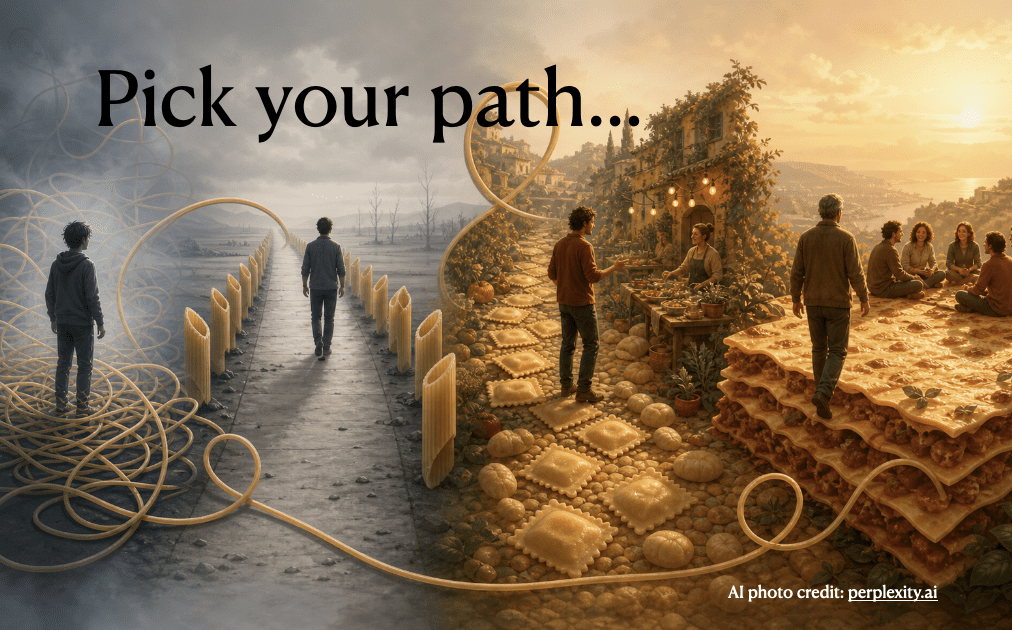
As I lay it out below, these four pasta phases are an embodied metaphor of the journeys we take: from fog (spaghetti) to form (penne), through substance (ravioli/gnocchi) to layered fulfilment (lasagna). We move between them, sometimes forwards, sometimes back, as life serves up its generous mix of luck, loss and learning.
Phase 1 – Spaghetti: the fog of youth
Spaghetti is the tumble of pickup sticks on the table: you grab one strand, then another, trying things out with no obvious order or logic. In this early phase, you experiment with identities, subjects, jobs, relationships; you’re sampling life’s buffet, not yet committed to a main course. The classic case, that of the youth who’s just started out on life’s journey, is confusing as there aren’t enough data points, perspective on what works and what doesn’t.
Jim Collins would say this is the necessary, messy laboratory where you discover your encodings through “trial and error, experimentation, missteps, happy accidents, and disappointment.” In my book, You Lead, I described something similar for leaders: the importance of knowing yourself and owning your story, including the zigzags and mishaps, instead of pretending you’ve always followed a clean, linear plan. The spaghetti years may feel chaotic, but they are the compost of meaning later on.
Phase 2 – Penne: form, but still hollow
Penne is more orderly. It’s shaped, stackable, easier to portion and serve. But the tubular penne is still empty inside. This is the phase where you’ve tidied up the surface of your life—degree, job title, LinkedIn profile—without yet filling it with what really matters to you.
In Futureproof, Caleb Storkey and I wrote about how many leaders and organisations chase growth and digital transformation without anchoring themselves in a deeper purpose, values or impact. It looks good from the outside but feels strangely hollow on the inside. In my Dialogos (Substack) piece on “What makes a conversation meaningful?”, I describe a similar phenomenon at the dinner table: polished talk that leaves you “drained” because nothing truly essential was exchanged. Penne is that kind of life: structured, maybe efficient, but fundamentally undernourishing.
Phase 3 – Ravioli: substance and texture
Ravioli (and I could replace with gnocchi) are different: each piece has weight, texture, and something inside—spinach and ricotta, perhaps, or a dense potato body that carries flavour. This is the phase where your days begin to feel more deliberate. You find work, causes and relationships with “meat on the bone,” where you can engage your real talents and values. In this phase, you may have found the right life partner.
Jim Collins might call this moving closer to your “personal hedgehog”—that intersection between what you’re encoded for, what you love, and where you can make a contribution. In Heartificial Empathy, I argued that this is also where empathy becomes non‑negotiable: you orient your leadership and even your use of technology toward serving others, not just yourself or your shareholders. A ravioli life is one in which your calendar contains more encounters that move you, more conversations with “bond and e‑motion,” my two metrics of meaningfulness.
Phase 4 – Lasagna: layered fulfilment and logos
Lasagna is the image of a life lived in full. It is layered intentionally—pasta slices, rich sauces, cheese, meats, perhaps vegetables—each element distinct, yet all working in harmony. It has structural integrity: unlike spaghetti, it holds its shape and stands firm even when cut, a sign of maturity and coherence.
Crucially, lasagna is rarely made for one person. It’s cooked to be shared—a family lunch, a community table, a team offsite. That echoes the five pillars of meaningfulness Caleb and I laid out in Futureproof: Prize (where there is challenge and play), People (who matter deeply), Profit (or growth), Planet (impact beyond ourselves), and Purpose (the “why” that transcends our ego). A lasagna life scores high on all five: you are doing work that feels like a prize rather than a sentence, with people you care about, in ways that help you grow, contribute to the wider world, and align with your deeper purpose.

I liken the layers of lasagna to Viktor Frankl’s logos. For Frankl, logos is meaning, and logotherapy is the healing that comes from aligning yourself with a “will to meaning” rather than a submission to pleasure or search for power. The first chapter of Futureproof was entitled, Meaningfulness, because new tech and disruption without it is, well, meaningless. Each lasagna layer is a choice: what you will “choose to be responsible for,” as Collins puts it, rather than what simply falls onto your desk or into your inbox.
The work of moving between phases
No one is born in lasagna mode. You have to cook. And you may well burn the bottom a few times. Moving from one phase to another always requires work—inner and outer.
From spaghetti to penne is the work of attention. In my Dialogos essays on meaning, I stress the need to slow down, listen more than you speak, spot the patterns in your experience and take baby steps. Collins calls this “simplex stepping”: when lost in the fog, take “the next best visible step,” then reassess, step again, and let the path emerge over time.
From penne to ravioli is the work of honesty. You admit that the polished shell isn’t enough; you begin to ask bolder questions: What truly energises me? Where do I feel most alive and useful? In You Lead, I invite leaders to “stop pretending to be who they are not” and instead play to their uniqueness, even when that means changing course.
From ravioli to lasagna is the work of integration. You move from isolated “good bits” to a coherent narrative. Here, conversation becomes a powerful technology: by telling your story, listening to others, and connecting dots across experiences, you weave a life that “makes more sense” and taps “a deep well of discretionary energy.” This is also where Frankl’s insights bite: you may not control the shocks and losses, but you always retain “the last of the human freedoms—to choose one’s attitude in any given set of circumstances.”
Seasoning: who and what surrounds you
A bit of salad and seasoning on the side is always a healthy idea: these are the people around you and the material elements you add to your life. Collins insists that perhaps the most important question in life is not what, but who: “First who, then what.” In Futureproof and in my talks on empathy, I make a similar case: your network is not just your “net worth,” it’s your mirror, your amplifier, and sometimes your conscience.
Surrounding yourself with status symbols but empty relationships is like sprinkling truffle oil over overcooked pasta: it smells rich but tastes disappointing. By contrast, choosing to spend time with people who challenge you, listen to you and care enough to disagree respectfully is a profound seasoning for your evolution. These are the companions with whom you can dare to have the “meaningful conversations” that feel essential, energising and transformative. Furthermore, acknowledging and making your way through the phases can have a most salutary effect on one’s mental health.
A life well lived: more lasagna, not no spaghetti
A life well lived is more abundantly phases 3 and 4—but it never entirely escapes phases 1 and 2. Even in our later years, a crisis, a loss, a sudden disruption can throw us back into spaghetti (fog) or penne (hollowness). In Futureproof, we wrote precisely about preparing for the “next disruption,” knowing that change is the rule, not the exception.
Frankl reminds us that meaning is always available, even in suffering, if we are willing to look for it and to adopt a stance of responsibility. Life is not what happens to you—that, in many ways, is given. It is what you decide to stand for, how you respond, whom you serve, and how courageously you keep layering your lasagna even when the oven door slams unexpectedly.
If you look at your current moment through this pasta lens, which phase feels most true for you today? How close are you to moving on to the next phase? What does the lasagna layer (hedhehog according to Collins) represent for you?