
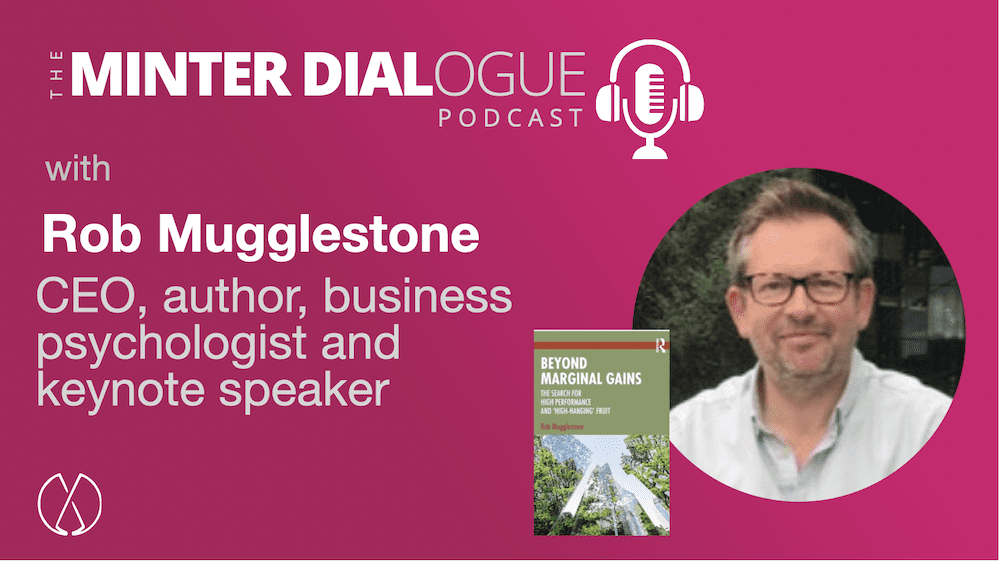
Minter Dialogue with Rob Mugglestone
I recently had the pleasure of chatting with Rob Mugglestone, author of “Beyond Marginal Gains: A Search for High Performance and High Hanging Fruit”. Rob’s insights on high performance are truly eye-opening.
We explored how traditional marginal gains philosophy might be limiting us, and why we should be reaching for those “high hanging fruits” instead. Rob shared fascinating examples, including how rapper AJ Tracy focused on exposure rather than just music to kickstart his career.
We also discussed the dangers of relying solely on incremental changes in our fast-paced world, and how to distinguish between optimal and maximal performance. Rob’s frameworks offer a fresh perspective on achieving breakthroughs in both personal and organizational performance.
Whether you’re a business leader, athlete, or simply someone striving for excellence, this episode is packed with actionable insights. Don’t miss Rob’s advice on fostering a culture of high performance while avoiding burnout.
Tune in to hear our full conversation and learn how you can go beyond marginal gains in your own pursuits!
Please send me your questions — as an audio file if you’d like — to nminterdial@gmail.com. Otherwise, below, you’ll find the show notes and, of course, you are invited to comment. If you liked the podcast, please take a moment to rate it here.
To connect with Rob Mugglestone:
- Check out the dedicated book site: Beyond Marginal Gains
- Find/buy Rob Mugglestone’s book on Routledge here or on Amazon here
- Find/follow Rob Mugglestone on LinkedIn
P.S. A hat tip to Peter Sears who was a prior guest on my podcast for putting us in touch! Check out Peter’s book, Empathic Leadership
Further resources for the Minter Dialogue podcast:

Meanwhile, you can find my other interviews on the Minter Dialogue Show in this podcast tab, on my Youtube Channel, on Megaphone or via Apple Podcasts. If you like the show, please go over to rate this podcast via RateThisPodcast! And for the francophones reading this, if you want to get more podcasts, you can also find my radio show en français over at: MinterDial.fr, on MegaphoneFR or in iTunes. And if you’ve ever come across padel, please check out my Joy of Padel podcast, too!
Music credit: The jingle at the beginning of the show is courtesy of my friend, Pierre Journel, author of the Guitar Channel. And, the new sign-off music is “A Convinced Man,” a song I co-wrote and recorded with Stephanie Singer back in the late 1980s (please excuse the quality of the sound!).
Full transcript via Flowsend.ai
Transcription courtesy of Flowsend.ai, an AI full-service for podcasters
Minter Dial: Rob Mugglestone. Now there’s a name. I haven’t come across a name like that before. I suppose you had to live with that one in school. What. And who is Rob Mugglestone?
Rob Mugglestone: Well, yes, I’d like to think I was getting Harry Potter royalties from the name, but sadly not. Well, I’m someone who has quite a strong interest in, I guess, the motivations of people and what makes people work and particularly what makes people perform at a high level. We all start off much the same when we come into the world, but over time we develop and we do different things and some of us end up as exceptional in our field and I’m really intrigued as to how that happens and, you know, what makes people reach those heights, stay at those heights, continue, and all of that kind of thing.
Minter Dial: And so, how did you get into that particular field?
Rob Mugglestone: Well, I’m going a long way back. A corporate background in banking and finance, leading to working with some really good consultants and then ultimately moving into the consulting field. But the. My interest in performance, I guess I’ve always done sport. I’ve always tried to do it at a high level and I’ve always been around people who are. Who are better than me. I mean, everyone experiences that and I. I kind of have a keen sense of that. And then it was, I suppose, working with a. With a client organisation and a colleague and. And friend, Roger Clark, and we started looking at, really initially looking at the sporting performance of our children and how they were competing and how we would develop those. That led to some of the theories that led to a master’s in organisational psychology. Gave me an opportunity to research and then. And then write the book.
Minter Dial: There you go. Well, So, you have a lot of analogies about sports in the book. And one of these types of questions that we have with regard to success, oftentimes we use the trifecta of skill, luck and hard work or work. How do you look at those three things in terms of making for success?
Rob Mugglestone: I think in particular, the models that we look at in the book, the accelerate the curve and the OMIT model, are about leveraging all of those things, really. So, it’s almost like an analogy might be kind of learning magic, where you see a. You see a trick and you can’t quite work it out. And then when you understand what’s behind the trick, it looks very simple and straightforward and with some practise and luck, you’re able to do that. But the simplicity of it remains. I guess what we’re My aim with the models is to unpack some of the secrets of how performance improvement comes about and whether you can do things ultimately to accelerate those improvements. Because if you can accelerate at a different rate, if you can improve at a different rate to others, then it means your. You will continue improve to improve and be better than them. So, it’s very. Well.
Minter Dial: Is that another way of seeing. By doing all that, then you can diminish the reliance on luck?
Rob Mugglestone: Well, I think it was Gary Player who said, the more I practise, the luckier I get, which the golfer.
Minter Dial: Right.
Rob Mugglestone: Yeah. And that is, you know, that’s. That’s fundamental, I think. I think luck is a part of. Well, you’re asking me now whether I kind of believe in luck and things like that, but, you know, the. I would like to think that if we all have the same share of luck, that how we. How we take advantage of that luck and, and whether we’re in the, you know, whether we have the opportunity and the experience to take advantage of it, we’re maximising it. Really.
Minter Dial: Yeah. I mean, the luck stories is an interesting one. At some level. You. You’re the talk about the tipping point that Malcolm Gavel wrote about and, and how you have So, many founders of huge tech corporations that became billionaires, basically because they’re all born within nine months of one another.
Rob Mugglestone: Yeah.
Minter Dial: So, Jobs, Gates and so, in company. And then you have in sports, the, you know, just take tennis, the example, the let chords and. And some games you get zero lead chords that go in your favour, they drop back on your side and the opponent gets three, let’s say maybe on a couple of killer points. So, Luck was on his side in that match. And, and what I’m hearing is actually a lot of that is just how you deal with the difference in luck.
Rob Mugglestone: Yeah. Yeah, I think so. I mean, there’s also a skill level which is. It’s probably ultimately down to how close the ball was to the top of the net and the closer and what.
Minter Dial: Spill and what spin you put on it as you drove it.
Rob Mugglestone: So, what looks like luck is probably. There’s. There’s probably some good judgement in there as well. But I think you raise another point, which is the ability to move on after each point. And you hear and see great players sometimes completely stuck because they’ve had a run of points that have gone against them and others who talk about their ability to play each point completely independently of anything that’s happened before. And that that ability in itself is one of the key skills of any sport, really, where you’re looking to perform.
Minter Dial: In the case of the scoring in tennis, what’s remarkable about it is that you can do that at the point level, at the game level, at the set level. And these resets every time is how you can get a 0660 kind of result. Because you know, how you figured out how to stop the bleed, you, you, you know, change the momentum and, and it does feel like, you know, as your book points out, there’s such. There’s So, many analogies within sports that we can bring to business. So, let’s talk, let’s talk about your book because. So, it’s called Beyond Marginal Gains, A Search for High Performance and Here’s the Catcher, High Hanging Fruit. So, let’s. What, what inspired you to write this book? And, and at what point did you realise that the traditional marginal gains philosophy we always talk about needed to be re. Examined?
Rob Mugglestone: Yeah, I think it was. Well, the book came from some research, which was the research that I did around the timing of development activity, whether you front load that or backload it or kind of do a linear approach. So, we very simply, from a very limited study that I did, we managed to prove the hypothesis that if you front load development time, you get an advantage without having to spend any more overall time. And the thinking behind it was that if you practise early on and you get above a threshold, any subsequent practise you do, even if it’s only little will, is all you’re practising at a higher level. And contrast that with not doing very much at the beginning and then cramming at the end. So, there was a little. That was the original thinking and the hypothesis. Yeah. And that’s what led to. We should write this up in a book. The OMIT model, the optimal maximal incremental threshold, came out of some work I was doing with a client organisation and it seemed to fit very nicely with the other model, the accelerate the curve model. So, both of those things. And then of course I realised that all of that talks about that there’s a strong link with marginal gains. So, it felt a nice way of writing the book would be to contrast it with marginal gains and to see or show how traditional marginal gains, if you like, fits into my models, but they’re a relatively small part of it. And then I love the fact that marginal gains is talked about a lot. It’s very easily understood, it sounds great. And for a lot of people, pretty much anything you do to improve your performance will improve your overall performance. But the closer you get to optimal performance or the highest level, the harder it is to find things to improve. You’re also competing with plenty of other people who are also trying to improve. So, looking for something that gives you an advantage was key. Hence the, the high hanging fruit. Because the low hanging fruit’s easy. So, the marginal, easy, marginal gains, low hanging fruit, everyone can do. You don’t need the help of a psychologist or my book to do that.
Minter Dial: It sort of feels like a lot of those high hanging fruits would be in the form of a marginal gain for a top sports person. For example, you know, I, I, you know, let’s say I’m a high-ranking player, I can hit a forehand into the corner 95 of the time, let’s say 1 metre square corner. So, So, the high hanging fruit is hitting 96%.
Rob Mugglestone: Yeah, maybe. I suppose at this point I should add that I’m not a sports psychologist.
Minter Dial: Unlike Peter Sears who put us in touch.
Rob Mugglestone: Of course what I like about sport is that the analogies fit So, well with organisational psychology. And of course a lot of sports people and teams and organisations are very clear about what performance looks like. It’s easier to be a, you know, you know, if you’re in the top 100 tennis players in the world, I’m not sure, you know, if you’re in the top hundred CEOs in the world, how would you know? So, yes, the thing for me about marginal gains is everyone might be looking for the same gain, So, they might all be looking to improve their percentage of hitting that spot or their percentage of first serves in, or whatever. But what, but my broader theory is that, well, this is coming to kind of some of the specifics of the book, but not all gains are marginal, not all gains can be marginal. And some of them, for example, that I would call threshold, you don’t see any difference in performance at a marginal level until you reach the next threshold. So, my, my, my go to example is always about if you’re trying to lift a 25 kilo weight and you can only lift 20 kilos, that’s your capacity marginally improving to 21 or 22 or 23 or 24, you, you will see those individual improvements, you will be able to say to yourself, I am marginally improving, I’ve gone from 20 in marginal increments all the way up to 24, but you still can’t lift a 25 kilo bag or weight or whatever it is and you might have 10 or 20 different aspects of your performance that are all that are all analogous to that weight. And you might be seeing individual performance improvements in all of those areas, but the outcome is not there. So, that’s one aspect. The other aspect is that I think, and I’ve seen this particularly with high performers, they tend to over rely on strengths and downplay their weaknesses. So, they.
Minter Dial: Run around their back end.
Rob Mugglestone: Exactly. They have allowable weaknesses and often it’s because their overall performance is good enough to overcome their weaknesses, which is why they’re allowable. But if you were looking in absolute terms for high performance, you would look at those weaknesses and say, what can we do about those? Are they below a key threshold?
Minter Dial: Yeah. There’s always a cost, right? In necessity, yes. Which one I should be plugging or figuring out to optimise or to transform. And the cost can be an opportunity cost, amongst other things, because you’re doing this instead of that, and then it might take more time, it might take more energy.
Rob Mugglestone: Yeah, yeah. And I think the more you’re aware of all of the different facets to your performance, you know, if we’re looking at sport, you’re looking at diet, nutrition, health, fitness, injury, as well as all the techniques of. Of whatever it is you play. And you can be, I think, easily overwhelmed with the sheer volume of things that you could work on to improve performance. And if we compare that organizationally, you could say the same. In any kind of organisation, there are So, many things that the organisation could work on and choosing those always comes with a cost and an opportunity cost. So, if we upgrade the IT system, that’s a budget that we can’t spend on something else. If we recruit more people, that’s coming out of a budget that doesn’t get to go on anything else. So, yeah, there’s always a. Organizationally, it might be down to cost. From a sports perspective, whether you’re, you know, amateur or professional, there will be costs too.
Minter Dial: So, how would you describe. I want to. There are two parts to this question. How would you describe the dangers of relying on incremental changes? And to what extent is that a more pregnant question in today’s sort of VUCA world? Volatile, chaotic, fast world?
Rob Mugglestone: Yeah. Well, the danger of relying on traditional marginal gains, if you like. I don’t like calling them that. It feels like I’m trying to replace them. But we know what we mean when we say that. I guess the danger is they will become less meaningful as you go on, So, they’ll have a smaller impact. You’re reliant, to a degree on some luck in Finding the right marginal gains to improve. But the impact, My guess is the impact will diminish over time. And we need to contrast that with, of course, the expectation that performance improvements decline over time. So, I think part of it is because we have an expectation. You know, all learning curves are kind of steeper at the beginning and then flatten off. So, there is an expectation that. How did I. Roger Federer, in the first five years of his tennis career was improving at a greater rate than in the middle five years. So, some of it is about. Let me, Let me, let me try and just answer your question, though. I think the danger is you’re relying on luck of picking the right things and continuing to pick the right things to marginally improve, and relying on the fact that each of those marginal gains will have an overall impact on performance, and they might not in the, the risk in the, in the VUCA world is that time and resources might appear restricted because there’s. There’s a much greater need to do things quickly or have an impact more quickly. I think the other impact might be that as we, as we see in most things, the spread of resources is So, much wider. Now, watching Tour de France this week, and the top teams, their budget is four or five times the budget of the smaller teams to do the same, effectively the same job. So, I think that degree of uncertainty and the chaos that that brings is that everyone’s trying to do different things with all the same thing, with different results or different resources, rather. So, what, what I’m promoting, if you like, is to spend some time mapping it out and applying some science and thinking to it and saying, of all these things that I could do, how do I choose which ones are going to have the greater impact? How do I choose? How do I work out what the cost is for each marginal gain and choose accordingly?
Minter Dial: So, I wanted to swing back into something you talk about, which I had not been aware of, which is the cap on spending in the formula one that you write about, which is comparable to the sort of way that the sports are operated in the United States, where there’s a cap on the amount of salaries you’re allowed to have. And. And so, you’re all supposed to be operating within some sort of similar framework, which means you’re. You’re not benefiting from having deep, deeper pockets, one team versus the other. And to what extent is that cap idea parallelable in a corporate world? Or is it, you know, or should we be thinking unlimited at some level? In the corporate world, as you get bigger, you just have more, more strength and you can monopolise. Yeah.
Rob Mugglestone: Wow, that’s a good question to a degree. In the corporate world, I guess it is almost unlimited. I think if you’re, you, if you’re comparing competitors within the same industry, the likelihood is they’re operating with roughly the same cost base, roughly the same revenue stream and pricing structure for what it is they’re selling. But yeah, there’s, there’s, there’s volume, there’s economies of scale, there’s all kinds of things which are, are pretty well established. I, I think in a way what I’m promoting in my book is not, is not increasing the level of fairness, it’s increasing the level of unfairness. So, all of the, all of the other theories I talk about, I am really promoting them as ways of manipulating these things to your advantage. So, I’m saying if there is a cost cap, work out what the penalty is for exceeding it and work out whether that is worth doing in a corporate world. I guess that would be. I don’t know what kind of things can you. Oh, well, I, I think things like, if I bring it back to the examples I talk about in the book, things like cumulative advantage, So, we know there’s a real advantage for being first or, or even in the top 10 or whatever, you know, if my book won’t be and definitely isn’t, but if I was in the Sunday Times top 20 bestsellers, I would sell a lot more copies by virtue of being in that list. So, you could argue that getting in that list should be a, should be an aim. I, I could prove my own theories by getting into that list. Yeah.
Minter Dial: You remind me of a type of a mantra which is break the rules and ask for permission later. Just, you know, go for it. One of the areas that intrigued me when I worked in a corporate. I worked at L’ Oreal for 16 years and we were a very financially driven company and it drove me bonkers. The way we would incrementally look at our budget line by line and say, you know, budget for 20, 26, we have a, we have a target of plus 10. This line has to go down minus 2, this line has to go down minus 1. And these lines has to go up, obviously, in order for us to get the profitability and the revenue growth. And it does feel like the financial world. And most of the trainings, if you will, seem to follow on incremental approaches as opposed to transformational approaches. And there’s no P L that’s really good at explaining the decay that you talked about of business or skill sets and the need for revolution.
Rob Mugglestone: Yeah, I think. I mean, if you look at things like, I don’t know, the rollout of, let’s say a rollout of a new piece of software in an organisation, if you did it like most organisations do, learning and development, they just roll it out over a long period of time. So, let’s even say over two years. By the end of two years, everyone is now up to speed. But you only really get the benefits once everyone has the new way of working or whatever it is. So, actually the. Whilst it’s not simpler to do and it would be harder and it would impact budgets and all the rest of it, the better way to do it would be to implement it all as soon as you can. But most organisations don’t do that. They look at all the things they’ve got to implement and they implement them all as gradually as they need to in order to have a manageable impact on the organisation. Rather than saying, well, instead of implementing these five things slowly, what would be the impact if we launched one of them quickly at the expense of the other four? Then when we’ve done that one, let’s do the second one quickly.
Minter Dial: Yeah, prioritisation.
Rob Mugglestone: Yeah.
Minter Dial: Understanding the opportunity costs, something that politicians could probably do well with understanding as well.
Rob Mugglestone: Yeah. And I think you raised a great example about corporate budgets that everyone is. Everyone then looks at their Bitcoin. And I think when. When you look at. I. I think. I still think the great example of Jeff Bezos in the early days of Amazon with his. With his wooden door as his desk, he could have spent money upgrading his door. Sorry, upgrading his desk. But it wouldn’t have. It wouldn’t have fundamentally changed the way he was building the business. But if it had been run like a traditional organisation, that had been an office furniture budget and somebody would have been responsible for spending that budget and their job would have been to find the best way of buying desks and everyone might have ended up with a different desk and they’d have done their job. And that’s what I mean by not all incremental gains make a difference on the end result.
Minter Dial: No doubt.
Rob Mugglestone: So, if you’re looking for ultimate final. Is this going to have a. An impact? You need to. You need to be really focused on what that goal is.
Minter Dial: It does make me feel like I want to wobble into the idea of culture and how that is. But before. Maybe this is an opportunity to start talking about your frameworks. But how and when should an organisation strive to bust out of the threshold or get a new threshold or go for a massive transformational change.
Rob Mugglestone: I think it’s got to come down to, down to the goal. I’m not a big fan of transformational change just for the sake of it. A lot of, lot of change happens when new people come into an organisation. So, a new CEO will often feel that they have to make changes. It feels like there’s not a lot of kudos attached to a CEO coming in and doing nothing.
Minter Dial: First hundred days, or should I say the first 47 days now, Mr. Trump?
Rob Mugglestone: Yeah, and that’s the thing, isn’t it? What can I do differently in that time rather than can I do, can I do nothing but maintain everything? That’s great. I, I don’t know you. That comes down to why the CEO changed in the first place. I guess one of the nice things about the models in the book is that they work at all levels of granularity. So, you could be one person in a 10,000-person organisation saying, this is my job. These are all the bits of my job that all lead to my overall performance. And I can look at those and work out how I shift. You could go more granular than that and take one of those aspects and break that down into multiple parts and say, what impact? Which of those smaller bits do I work on? Or you can look at it whole organizationally and say, what’s the organization’s goal? What are the different things that impact on that and how can we break it down and which ones do we work on? And then you can work out which ones are incremental and which ones are threshold. Which ones. Because the other thing I haven’t talked about yet is the maximal optimal dichotomy. Not everything needs to be taken to its maximal. So, it might be nice to keep upgrading my laptop, but if it does everything I need it to do, then its own threshold is an optimal one. I don’t need to keep upgrading it. And so, recognising what’s optimal and what’s maximal is important. I mean, sales, you could argue that sales are, could be either. And that might be different for each organisation because some organisations, if they go, if they bring in too many sales, they might not be able to deliver or that might impact, you know, all.
Minter Dial: Kinds of other things, including next year’s budget.
Rob Mugglestone: Yeah. Or they might not have enough people or they might not be able to recruit as many people. Or So, sometimes sales, which we always think of as being surely maximal, surely as much as possible, would be brilliant.
Minter Dial: What Are the things that are getting in the way of organisations, leaders from distinguishing between optimal and maximal. I want to put out there ego and vanity are a couple of the things which people get swayed by. What. How would you look at that, Rob?
Rob Mugglestone: I. I think that’s a. Yeah, I think ego and vanity probably have a bigger impact than we think. Even my, the example of upgrading my laptop, you know, to some degree, or my phone to some degree is a vanity thing. Is it important when I’m travelling, if I’m with a group of clients from an investment bank, how would it look if I was using a 20-year-old Nokia?
Minter Dial: Right. And it sort of brings up like the door, you know that on Bezos’s desk, maybe for clients coming in. What sort of image does a door as a desk have? And maybe this is where it brings up this notion of culture where, how do we actually operate?
Rob Mugglestone: Yeah, I mean ultimately that is what culture is, isn’t it? How do we do things around here is how we often describe culture and understanding. Having an easy way to describe that culture helps everyone. You don’t want to start putting it in a 10 page document and examples of things like a door whilst they look like. On the one hand you say, well, that might offend somebody’s vanity or ego. Actually, I think it’s probably the other way around. If you go far enough, it actually gives people an opportunity to say I’m glad you asked me about my desk because there’s a reason why I have a, an old door for a desk. And that. And that in itself embodies the, the culture of the organisation, which is we, we don’t do things that are unnecessary or we have to be really clear. Yeah, yeah.
Minter Dial: I mean really, frankly, the door is neither optimal nor maximal. It’s just. You don’t give a toss about it. We work on other things that are more important for the business.
Rob Mugglestone: Yeah, well, I think it is absolutely optimal. Is it big enough and stable? Does it do the job of a desk? And if it does the job of the desk then it doesn’t need to do it any better than that unless there’s a really clear advantage, another threshold where significantly better would deliver some better outcomes.
Minter Dial: Well, Chris, I have a door that has bevels in it and sort of is not straight. So, that’s what I was thinking about, how it’s not optimal. Yeah, but let’s talk. I want to talk about high hanging fruit because that’s a term that I’ve absolutely never really come across. It’s. I mean, of Course you, you have it in your mind. Low hanging fruit, high hanging fruit. How, where, where do business leaders look for the high hanging fruit? How can they start to categorise this element of my business as a high hanging fruit to go after?
Rob Mugglestone: Yeah, that’s a good question. I think it, in part it’s cultural and in part it’s about saying, in a way you’re saying that the easy stuff will look after itself, but if we’re, if we’re going to put some effort into this, let’s apply some very focused effort and find the more difficult bits. And partly that’s because you know that everyone else will be looking at the low hanging fruit still. So, I think there’s a competitive advantage to saying what is the more difficult things that we could do. What are the, you know, you’re looking for nuance, you’re looking for, you’re looking for the science of psychology to deliver some results. You know, ultimately I, I see my role and my psychology as a, as a science and I want it to deliver results. I don’t want psychology to be seen as just a list of things that make that sound like common sense to people. I want it to be hard science with, with real kind of fundamentally deliverable outcomes.
Minter Dial: In order for it to qualify as high hanging, I’m suspecting that it means it’s got to be expensive or difficult.
Rob Mugglestone: Not necessarily. I’m glad you’ve asked it like that because it’s making me think about it. I think it could just be harder to find. So, yes, there could be a cost in, yeah, there’s an inherent cost in stopping and searching and finding it and then saying what is it that we do? I’d also like, I don’t know, I’d like to be able to throw some examples in at this point of, you know, where some of the high hanging fruit would be, would be cheap and easy.
Minter Dial: But maybe without having one you can sort, you can just talk about being counterintuitive, for example, try to think in a different way and, and that may not be the standard, but by having a different prism, all of a sudden it becomes an accessible high hanging fruit. Just because you’re looking at it from, you come into an industry from a different industry’s perspective. Maybe it would be a good time to talk about a, one of the case studies. You have many case studies. Most, they seemed like most of them were around sports, but the one that really piqued my interest was the rapper AJ Tracey. Of course, I have no idea. I haven’t listened to any of his music, but also called Che Grant in real life. Talk us, give us a little bit of background on the case and how the OMIT and ATC models work into the case of a rapper, of all people.
Rob Mugglestone: Exactly. I was listening. I. The. The great Jake Humphrey and Damien Hughes who do the High Performance podcast. I should add, before I say that the examples from the book I pick up from anywhere and some of the. Some of them were old examples that I, you know, you just hear somebody talking and you think without them knowing it, they are describing my theories and it’s. It’s great to hear that. So, when, when Damian and Jake interviewed aj, Tracy, Che, I just really liked that there were just examples that were popping out all the time. So, I think the clearest one was that he was, he was a. He is a rapper. The genre of music is irrelevant. Ultimately. He’s a. He’s a music artist and was trying to be a big music artist instead of a little one. And he was at university at the time and his mum said to him, if you want to pursue this music thing, I’ll support you for a year. Drop out of university, give music your best shot and we’ll see what happens. And I’m sure that’s happened multiple times for lots of different people in lots of different industries and things where they’ve had the opportunity to focus on one thing and see if they can make it work.
Minter Dial: If I can add, not many mothers do that. So, that’s a hat tip to his mother.
Rob Mugglestone: Yeah, definitely. So, what he then did, which I thought was different and really speaks to the. To my book, was that he didn’t then focus on his music. The. The kind of. The obvious thing is you go, right, well, if I’m going to be a musician for a year to see if I can make it, what I need to do is knuckle down and write some really good music. He talks about what was important for his success was that he wasn’t. He wasn’t well known enough. So, he put, he put his effort and focus and attention into becoming recognised. So, really putting high quality effort into sending demos into radio stations, personalising the messages that he was sending to DJs and thing in order to get his first break, I suppose. So, the nice thing for me is that, or not the nice thing for me that the way I see it in the book was that the key threshold that he had to reach was his audience. He had to be mainstream enough to get radio play. If he got radio play, he would. That kind of accelerates everything. So, there’s lots of things there about cumulative advantage. There’s lots of. There’s lots of links to different bits of the book. Even things like, oh, I don’t know, the. There’s something called the Galatea effect, which is linked to. What’s it called? The Pygmalion effect, where. So, Galatea effect is effectively, you meet your own expectations. So, his expectations, where I can make this work, I know where I need to focus, which is on my exposure. And I’ll put a lot of effort and exposure into getting noticed. And I think it was Sean Anderson on Radio 1 or one of the Radio 1 Extra programmes. Listened to his. One of his demos, played it and it went from there. But the key thing for me, or why I’ve got it as an example in the book is that I think certainly look at it from. Looked at it from my own experience and thought if I went away for a year to focus on one thing, I’d have focused on the music, not on the. Not on the exposure.
Minter Dial: Yeah. So, his accelerating the curve in this was looking at a. Exposure, getting his name to be known and he focused on that as opposed to what typically would have done, which is write some more music.
Rob Mugglestone: Yeah. If I can just write a better song, it’ll get me all the exposure I need. And maybe that is the case. But to have recognised that it was exposure that he needed. And for me, with the book, what I’ve wanted to do all the way through it is to say all of the things I’m talking about really exist in the natural world. So, there are plenty of people like Che who have done thing and got over the threshold and have done it. So, they all exist. What I’ve done is put some science behind it and say if he hadn’t done that. If you sat down with a rap artist, rap artist and said all of these things, your map of all of the things that contribute to your success as an artist. Which ones are you overachieving on? Which ones are you underachieving on? Which ones could you develop? What would be the cost of developing? I’d like to think that some of the time I’d like to think specifically with. With A.J. Tracey that he’d have said he’d looked at the map and said, my music’s already good enough. How do I get it out there? So, that’s. That’s where I’m kind of thinking the. The science of the book is about and is. Is very applicable to every situation where you say, what are the things that contribute to my success. Which ones can I focus on? Which ones can I develop?
Minter Dial: All right, So, a couple. As we wind down, a couple last questions. The first one is for new or leaders in general, there’s clearly a lot of burnout, a lot of anxiety, depression, mental health issues, not to mention diminishing returns from doing So, much. What advice would you have for leaders who are listening, who want to foster a culture of high performance, and yet avoid these other issues, which are so, you know, mainstream?
Rob Mugglestone: My. My initial response would be that. Yeah, my initial response would be that resilience is part of everybody’s skill set and we all have resilience to a greater or lesser degree. It is something that absolutely can be developed. I would. I kind of want to put a caveat with that, which is. I’m not. What I’m not saying for burnout and everything. What I’m not saying is just get tougher because that seems to diminish entirely the nature of it. I think. I think what I’m saying generally is that physical health, mental health and the ability to turn up and do a good job are things that we no longer should be taking for granted. It’s no longer a case that you just kind of expect that people will work through everything, whatever’s thrown at them, because there will be a cost. Going back to your earlier point, there will be a cost. In a way, what I’m kind of saying is all of those aspects of performance should be undertaken knowing what the costs are. So, I’ve gone around in circles a bit, partly because when you said it, you know, there is. There is a. There’s quite a big bit in the book about resilience. One of the things I like about resilience is that it’s both individual and organisational, and it’s also. It’s also developable. So, if it was just something that, you know, you can’t change, like your height or. Or something like that, it was just innate, then we’d be looking at how to deal with it differently. But the fact that it’s not innate, the fact that it is developable, the fact that we understand resilience and the nature of it, it’s not. Yeah, I think what I’m not saying is develop resilience So, that you compile more on people. I think it’s about. Develop resilience So, that you can, as just one of the aspects of your performance, if resilience helps you to perform better. And I’m talking about performance, not in a kind of not in a corporate. There’s a. One of my favourite Dilber cartoons going back a long time is the, the, the agenda for the annual company away day, which is how can we get people to do more for less? That was item one and two is why is why is morale So, low? So, I don’t see resilience as a way of how can we get people to do more for less. I see it as if people are high performing, we need to create the conditions that allow them to perform at their best and taking into account physical and mental attributes. You know, if you’re, if you’re a, if you’re a tennis player, we would want you to not, not roll over on your ankle, not get tennis elbow, not have shoulder injuries, not, you know, and there will be players who are more susceptible to those things than others.
Minter Dial: It does bring up, we can’t wade into it, but this notion of risk and failure in cultures. Let’s just finish with the last question, which is you obviously writing a book takes a whole bunch of effort, a lot research and I was just wondering for you, Rob, to what extent you might, your views on high performance might have evolved in the writing of it.
Rob Mugglestone: Oh yeah, yeah, massively. I think partly because writing a book like this, you can’t help but do it in a reflective way. Noticing how much your own high performance is about writing a book and delivering a book on high performance.
Minter Dial: Very meta.
Rob Mugglestone: Yeah. Oh totally. And there would be days when I would be completely consumed and get absolutely nothing done because I’d be navel gazing at the bizarre contrast between trying to write a book about high performance and also at the same time being seemingly unable to write anything at all. So, yes, quite matter in one respect. And the other aspect was going down the, the kind of the, the psychology research rabbit holes of finding theories and you know, seeing things connect with mine. Not in a way. So, years ago I actually, when these theories, these ideas first came about, I assumed somebody else had thought of them already and it was just a question of me finding them So, that I could find what they were about. And you know, some years later you realise that they don’t exist anywhere else, So, you’re going to have to write them up yourself. But what I liked is that I was able to find So, many theories from, you know, learned optimism to relative age effect, cumulative advantage, Pareto, you know, all these things which allowed me to say that they all kind of feed into it in some way. So, yeah, it was a huge learning experience. I think the original, the original outline for the book was the two concepts, how they might link to other theories and some, some examples in the real world and at that level definitely delivered all of those three. But the content of those three changed.
Minter Dial: Completely the cases and everything, the OMIT and the ATC. All right, Rob, great. Thank you for joining me for a fun chat conversation about this. What would be the way for someone to be able to get the book or get in touch with you should they wish to explore further working with you?
Rob Mugglestone: The book’s available through Amazon and all good booksellers. It’s available also direct through Routledge, the publisher often discounted on Routledge. So, do have a look there. There is a. Yeah, there’s a website beyond marginal gains.com where I, I will look to build that as we go and ultimately I’d love it as a community where people can kind of wade in and ask me questions and get kind of really practical. Yeah, get, get practical in how they develop. So, lots of opportunities. Email me through that. I’d love to hear from people who are reading the book and either getting something from it or not getting something from it.
Minter Dial: Feedback. Hey listen, Rob, thank you very much.
Rob Mugglestone: Thank you, Minter.

Minter Dial
Minter Dial is an international professional speaker, author & consultant on Leadership, Branding and Transformation. After a successful international career at L’Oréal, Minter Dial returned to his entrepreneurial roots and has spent the last twelve years helping senior management teams and Boards to adapt to the new exigencies of the digitally enhanced marketplace. He has worked with world-class organisations to help activate their brand strategies, and figure out how best to integrate new technologies, digital tools, devices and platforms. Above all, Minter works to catalyse a change in mindset and dial up transformation. Minter received his BA in Trilingual Literature from Yale University (1987) and gained his MBA at INSEAD, Fontainebleau (1993). He’s author of four award-winning books, including Heartificial Empathy, Putting Heart into Business and Artificial Intelligence (2nd edition) (2023); You Lead, How Being Yourself Makes You A Better Leader (Kogan Page 2021); co-author of Futureproof, How To Get Your Business Ready For The Next Disruption (Pearson 2017); and author of The Last Ring Home (Myndset Press 2016), a book and documentary film, both of which have won awards and critical acclaim.
👉🏼 It’s easy to inquire about booking Minter Dial here.