Minter Dialogue with Pete Steege
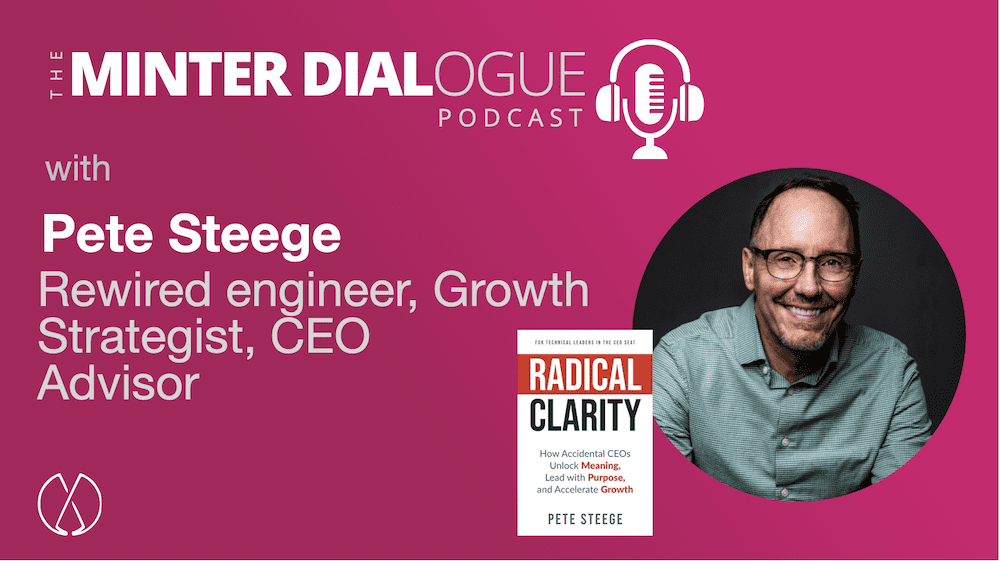
I had the pleasure of speaking with Pete Steege about his new book, “Radical Clarity.” We explored the concept of meaning in business and how it’s essential for CEOs, especially “accidental CEOs” who may not have initially aspired to leadership roles. Pete emphasized that meaning is like oxygen for businesses and life, driving success and purpose.
We discussed his CMP framework – Clarity, Meaning, and Purpose – and how it can help leaders uncover their true story and connect with customers. Pete shared insights on the importance of radical clarity in our noisy, complex world and how it reveals meaning.
We also touched on the challenges of leadership, including the loneliness CEOs often face, and the need for calculated risk-taking in business. Pete stressed the importance of aligning personal values with business goals and the power of shared meaning.
Throughout our conversation, we highlighted the significance of purpose-driven leadership and how it can lead to more durable success and better succession planning. Pete’s insights offer valuable guidance for leaders seeking to find and leverage meaning in their businesses.
Please send me your questions — as an audio file if you’d like — to nminterdial@gmail.com. Otherwise, below, you’ll find the show notes and, of course, you are invited to comment. If you liked the podcast, please take a moment to rate it here.
To connect with Pete Steege:
- N.B. Check out Pete’s site, where there’s a special offer for listeners here
- Find/buy Pete Steege’s book, “Radical Clarity,” here
- Find/follow Pete Steege on LinkedIn
- Find/follow Pete Steege on X (formerly Twitter)
Further resources for the Minter Dialogue podcast:

Meanwhile, you can find my other interviews on the Minter Dialogue Show in this podcast tab, on Megaphone or via Apple Podcasts. If you like the show, please go over to rate this podcast via RateThisPodcast! And for the francophones reading this, if you want to get more podcasts, you can also find my radio show en français over at: MinterDial.fr, on Megaphone or in iTunes.
Music credit: The jingle at the beginning of the show is courtesy of my friend, Pierre Journel, author of the Guitar Channel. And, the new sign-off music is “A Convinced Man,” a song I co-wrote and recorded with Stephanie Singer back in the late 1980s (please excuse the quality of the sound!).
Full transcript via Flowsend.ai
Transcription courtesy of Flowsend.ai, an AI full-service for podcasters
Minter Dial: Peter Steege, great to have you on the show again. Round two, book two for people who don’t know you. Pete, give us an intro, a swirl on who is Pete?
Pete Steege: Thanks Minter. So, great to be on your show again. I am a, I like to say I was born an engineer. I’m a rewired engineer. I’ve spent my career helping businesses grow from the inside and now out on the outside. And my career has been spanned a whole bunch of different businesses. The things they had in common were that they were all in technology industries and I had a lot of experience on the marketing side, but also strategy, sales, even some operations. And I guess I have a real passion for this idea that meaning matters in business. And stories are really at the center of how things work. And purpose is, is what unites customers and businesses. So, I’ve just found, as I’ve worked with now I work with CEOs and helping them grow their business. I found that that’s really where I live. Where I get excited is, is finding that meaning for them and how they can share it with their, their market and their audience and their employees too to make everything work better.
Minter Dial: So, there’s a lot of things that we’re going to unpack you in your book, you, you have this really interesting CMP framework. You talk about the accidental CEO. In fact, that’s in your subtitle, Radical clarity. How accidental CEOs uncover meaning, lead with purpose and accelerate growth. So, for starters, Pete, does can everyone find meaning? Does everyone find meaning?
Pete Steege: Yes. It’s oxygen. It’s like oxygen for life. That’s my belief. Think about. Well, first, let’s just talk about it from the business perspective. I believe that the simple definition of business viability is meaning is purpose. And the reason I say that is to do something, to transact, to choose whether you pay for it or invest in it, whatever you do, you really have to have a reason for doing that. It might be a very surface level reason, but the deeper it is, the more you’re willing to commit to it. And businesses that recognize that, right, that that’s at the core of every interaction, every decision by customers, partners, investors to commit comes from that shared meaning. Personally, I have, I have found that, you know, meaning makes the world go round. It’s that same thing about transactions applies to me when I wake up in the morning, right? What am I going to do with this day? Is it, is it more than just this satisfying this itch, right, that I have? And so, I’m just a real big believer that meaning Just is the oxygen for life.
Minter Dial: Well, so I entirely agree with you, Pete. I mentioned before we started recording about John Vervake and the crisis of meaning, or the meaning crisis that he talks about. It feels like a lot of people lack oxygen, to use your term, and. And therefore, aren’t finding meaning or are not. Are sort of oblivious of the potency of a real meaning. And to use your second idea of the sort of the lighter touch versions of meaning, these could be, as you know, the meaning. We want to be profitable. However, that is about as, let’s say, banal as it gets. And I don’t think that that really inserts oxygen into people’s lives just being profitable. It can for some, for a time, but then it runs out.
Pete Steege: Simon Sinek wrote a book called the Infinite Game. Have you read that book?
Minter Dial: I certainly have.
Pete Steege: That came to mind with what you just said. I believe the companies that view their business as a win loss, a finite game, are the ones that put profit at the top or the corporately designed and manipulated mission statement that’s all about winning now, whether it’s this year and three years or with the stock price, getting this level, selling whatever it might be. The infinite game is what you and I are talking about or aspiring to. It’s this idea that you never win, you progress, right? And that progression is towards that. Meaning is what provides stability for you personally and for your business, because it can withstand the shifts and the unexpected changes. Because it’s not about, well, this happened, I’m not going to win that thing that I have in my mind. Rather it’s, oh, this is the new situation. How do I apply that new input to my destination that I’m on a journey to, right? And that perspective, to me really makes the difference between that superficial meaning, I guess, if you want to call it that, the superficial reason versus true meaning.
Minter Dial: I mean, usually the sort of variability or vagueness of the term is around the word purpose as opposed to meaning, what’s your purpose? Well, we’re here to please the shareholder. We’re here to make money for the shareholder. That sort of purpose is. That’s where it gets a little bit typically clogged down. And in listening to Pete, the glory of conversations, it made me think of the notion of durability. Whereas you might have the finite leaders who are there, know how to drive, you know the results, extract every juice from every orange that they squeeze, but at the end of the day, when they have to turn over the handle to somebody else, the wheel just doesn’t going to work. And so, maybe the idea that came into my mind was meaning provides true success. Succession as in it allows for a more durable form of success, as opposed to, look at me, the hero of the leader, as opposed to us as a communal success trip.
Pete Steege: When you get to the true meaning, I believe it transcends ego, it transcends a personality. And there are examples of CEOs that have such a gift of a charismatic personality, and maybe that gift has warped their understanding of their role and their value and it becomes about them. And to your point, that doesn’t work long that for the infinite game, that doesn’t work for the finite game, it.
Minter Dial: Does, or it can anyway.
Pete Steege: Can not always.
Minter Dial: You’re right, because I mean, you know, just whipping people and say, do better, do more, pay you more, can actually go, go south. It reminds me that about four or five years ago I had this be in my bonnet to write another book which was all about the, the, the true leadership is selfless and that the root to that is to drop a dose of LSD and, and learn how to sublimate your ego and, and to understand the, the infinitely infinitesimally small meaning that, or, you know, value that you are in the universe and think differently about, yes, you know, who we are and why we’re together and so on and so forth. But alas, that book is still in the. In the cobwebs. All right, so let’s talk about this accidental CEO, which you talk about the accidental CV. Right? Accidental CV. CEOs are good at their job. Their businesses are robust with aggressive goals and huge potential. Their industry peers respect them, but inside, they don’t always feel that way. They wonder if they can do better. So, talk to us about how you came up with this idea, the origin of the idea of the accidental CEO. And how many are there really accidental CEOs?
Pete Steege: Well, I don’t have any extensively researched studies that are quantified on how many there are, but my belief is that about half of the CEOs you run into would relate to that idea that accidental CEO. I have the experience of meeting people and telling them what I do and say I help CEOs grow their business. Accidental CEOs. And before I explain what I mean, they laugh or nod or. Oh, you know, they get it at their core. Right? Yeah. My belief is that in my experience is that technical, technically forward people, they might be engineers by training or scientists or policy wonks or soldiers. They, they have a passion for a skill, something, and they’ve, they’ve Invested in it. And they. They. It. It turns them on, right? It’s. They’re good at it. They. Those that end up starting a company or taking over a company from the lens of that technical or domain expertise, they’re vulnerable to that imposter syndrome. Maybe more so than the person that decided early on I have the identity or the aspiration to have to be a CEO. These technical people, first of all, they don’t have that identity. Seeing that label is uncomfortable. It’s a piece of. It’s a garment that doesn’t fit very well, at least at first. So, that’s part of that imposter syndrome. The other part of it is just the difference between logic and emotion. When you’re the product leader or you’re the technical leader and you’re succeeding in your industry based on that, a lot of that is based on quantified data or things that. Facts, right? And when you cross over to the CEO, you’re still in charge of that stuff, but now you have a team that needs meaning. And you might not even understand that that’s what they’re hungry for. But that’s such a different domain than that, making that product sing. And then what about, I have to do fundraising. I have to. You name it, right? There’s all these new things that are not only overwhelming, the stakes are so much higher because it’s no longer just you and your career and me, your family. It’s these employees career, it’s the stockholders. It’s, you know, it’s just such a bigger arena. So, all those things together make the accidental CEOs have more struggles with that imposter syndrome or those blind spots even.
Minter Dial: I was reading about how they have this clinic in Switzerland. I think it’s in Switzerland that’s designed for a maximum of four people at a time in order for each to be completely isolated one from the other. And the idea of the clinic is to help the oh so depressed, oh so lonely famous people in the world, big, big CEOs amongst them. And they. They do it in ways discretionary because you don’t want to be seen at this, you know, depressed clinic as the CEO of somebody much less than newspapers. But it does feel like not only do a lot of CEOs come to the table without the requisite trainings or understandings of the amplitude of the job, they are inevitably isolated because people put them on pedestals. And the way people approach them is that it makes for a very lonely job.
Pete Steege: Oh, it’s. It’s such a lonely job. And it, it’s not just due to what other people choose that put them on that pedestal. The fact is, when you are the decider, when, when the decisions come to you and nobody else, by definition, you’re alone with that. Nobody else can carry that with you. To a certain extent, I believe that some people have skills, personal skills that allow them to manage that, cope with it, you know, maybe even use it in a positive way, but it’s not, that’s a, that’s a gift, if they have that right. There’s a lot of accidental CEOs who don’t have that special gift. And it is lonely, it’s very lonely job.
Minter Dial: So, let’s talk about this notion of meaning, because at the end of the day, it’s sort of essential to your two pieces, your two books and, and essential to the whole. Even, let’s say your, your CMP framework. Meaning is the quiet power that truly drives business success. As you write, you argue that meaning isn’t just a nice to have, it’s a business imperative. But let’s sort of batten down the hatches, maybe put some qualifying elements to what is meaning. We talked at the very beginning about sort of the superficial type of meaning. Is there a hierarchy of meaning? Is there too much meaning? How do you establish meaning in a business context?
Pete Steege: I believe that their meaning is like truth. It’s related to truth and it’s a universal, pure thing. And finding meaning in your business is a matter of how, of tapping into that pure truth. And it’s, it has degrees in terms of how much of that pure, powerful meaning you uncover. So, I view it as, it’s this maybe mostly hidden, powerful core truth that drives, in your business case, that particular story. But you know, in our world, I just believe it’s that pure super thing and it’s really about uncovering it and how to what extent you can find it and share it with. First of all, own it yourself, share it with your team, like inject it into your team and then share it with your, your market. Right? It’s really about tapping into something that doesn’t change. It’s just so it’s degrees of how much you can, can use, if that, that may be a little abstract, but I really think it’s true.
Minter Dial: Going in. If you look at companies, why is it that they need to read your book? Why? In other words, how is it that we’re still talking about meaning if, if it’s such a, an evident thing to look for? How many companies actually orient themselves, organize Themselves at a personal and professional level around a singularly true meaning.
Pete Steege: I think that meaning, you know, I just said I think it’s so important. One, I don’t think the culture or, or business school for sure, or engineering school talks about it as being important. So, it does have to be discovered that, you know, you have to decide that, that it’s there and it’s important. The other reason it’s not tapped into, even though it’s important, is that it’s so much easier and reassuring and I’m in control of activity and doing things. I can, you know, automate this. I can, you know, do these, this email campaign. I can, you know, create this program over here, all these things and more and more with AI and other tools. Doing is easy and you don’t have to know, you don’t have to think about the meaning, which is harder work to do. But doing it that way, you are, I believe meaning is not a vacuum. Right? It’s there. So, if you don’t choose your meaning, your meaning will get chosen for you by these things you do subconsciously, the activities you do. You just end up with your company represents this thing, or you personally represent this value or this thing. You didn’t choose it, but there has to be a meaning, so it’s getting chosen for you. So, I think that’s what happens is people don’t respect the power of meaning, don’t acknowledge that there’s a truth that they stand for or they want to stand for, and therefore they go and do things and end up being whatever their, the consequences of their activity and their investments and their decisions end up with. And the companies that succeed are the ones that intentionally do the hard work to uncover that true meaning. And by the way, if I may think of exercise, think of diet, think of other habits that are work. But at the end of the day, if you commit to that, it’s so much value there, right? It’s the same kind of thing.
Minter Dial: Well, there’s a sense of achievement, of getting through a struggle that, that also provides meaning. I want to circle in on, on this notion of radical clarity and your, your framework, the CMP framework. You write clarity reveals meaning, meaning sparks purpose, and purpose activates your business and your life. Which I thought was a really interesting sequence of expressions, of course underpins the CMP. Clarity, meaning and purpose. To what extent must this be a personal quest? Or can it just be relinquished, if you will, or delegated to being a specifically professional quest of meaning?
Pete Steege: My experience is with CEOs that are in are responsible for us. You know, it’s not a mega corporation. So, you know, my experience is focused on these businesses where there is a person in charge. They may not even have a board. They might. And in that environment I believe it only works. Is the CMP in a company setting really only works if you have a leader that is driving it. And that’s because you can’t as a company, you can’t find your true story without the CEO. Right. The, the person in charge has to be at the center of that truth. Otherwise, you know, the alternative is, let’s say the team, you know, gets together because the CEO’s busy or whatever doing fundraising and comes up with this is what our truth is. How can it be your truth if the one that makes the core decisions wasn’t part of that? It can’t happen. That’s my belief. So, it has to start with the, the leader. And in my experience it’s one person. And that one person has to drive back to the point about the exercise, the discipline of it. You have to make choices that are for the infinite game and there, there’s going to be some short-term sacrifice and if the, if the leader isn’t on board with this direction, then, then those decisions won’t happen.
Minter Dial: Okay, and then let’s just focus on this leader and think about the leader’s personality and personal beliefs and personal, you know, lifestyle. To what extent is this quest for meaning have to jive with the leaders personal elements, personal values, personal stories, personal experience?
Pete Steege: When I work with CEOs we take the tack of starting with their belief system or their meaning about their business. As an accidental CEO, they are in this leadership seat because they believe in this thing. They have a vision for this product, the solution, this technology and how it’s going to make a difference. Sometimes they might not say that’s true, but if you peel it away, they couldn’t make any revenue if they didn’t have a solution for somebody. Right. It really does come down to solving a problem. So, we start there. Why did you do this? What’s behind it? What’s the per. We’re getting to their meaning. We’re uncovering that meaning for them. The company is not them. But my belief is this meaning is bigger than the CEO and the company. And so, when we’re doing that uncovering of the CEO’s purpose and for this business, we’re getting at something that’s bigger than the, the CEO, but it’s totally in sync with the CEO. Right. So, it’s really, I Guess the short answer to what you’re saying is we don’t start with the personality and the motives of the CEO. We start with the valuable thing that they wanted to give the world that has meaning beyond just them. They tapped into it and then that becomes the center of this CMP and this growth and this true story for the business. And, and that, that can be, that’s consistent with the CEO because they came up with it or the origin. Right. But it also travels to the others, employees, customers, market.
Minter Dial: Yeah, that’s where I maybe really had enlightenment when I was running Redken. Because what I did like you, I, I, I sort of found this meaning. And the part that I was very intentional about was relating that into me as in what about this meaningful quest, this mission is meaningful to me. And in the specific example, as we were dealing with hairdressers and hairdressers each have a certain number of people, let’s say 1200 people that they have in their black book. You’ve seen them every so on. And for them, for these customers, that hairdresser is a very special moment. And therefore, and the personal relationship I had with that thought was with my mother in law, how she would tell me about how the hairdresser was such an important part of her week once a week. So, that made it really meaningful to me and that’s part of that crafting idea that I think can maybe ratchet it up from just being a truth about the company to a truth that’s going to drive the inner me, maybe the child me as well.
Pete Steege: As I wrote the book, the term meaning started to shift to shared meaning. And I think that’s what we’re talking about. Meaning’s value comes from it going, crossing between. Right. And being shared, being transmitting the value.
Minter Dial: I think that’s so, yeah. So, going to radical clarity. What does radical clarity mean to you and why is it so essential in the, in your framework when you’re, you know, we’re having so many complex different, you know, pulls on us, pressures. How does it reveal meaning? Radical clarity.
Pete Steege: You know, we’ve talked a lot about this meaning, the power of this meaning. And it is there, but it’s hidden, I believe. Look at our society, look at the lives we live. You know, I don’t know about you, but I have way more that I could do than I could ever do. There’s so many options in our lives. It’s true for business. We have too many priorities, we have too many emails in our inbox. We have, you know, all those things it’s true. For me personally, I wish I had more hours in the day, you know, I could do more things. And society, the volume of society is getting turned up every month. And I see that continuing, especially with the changes in technology and our lives are going to continue to be a subset of the possibles. So, in that noisy, complex world where I can choose something with a click of a button, I can take a new path with just a nod of my head almost. The easier it gets for me to choose things, the more I’m totally. I’m living in a level above the quiet truth. So, radical Clarity is saying that you have to do something different if you really want to tap into the powerful meaning. And you know, a saying I have that summarizes it all to me, Minter is, well, two things. One, make room for meaning. That’s a, you know, that’s a new mantra for me, make room for meaning. It applies to me in my personal life is don’t look on the, don’t look on my phone when I can just sit and look at the trees. Right. Sometimes that kind of thing. It’s true for business. Well, everything we’re talking about, it’s about CEOs making room for meaning. That’s what the CMP process is about too. And how do you do that? Find your truth and get out of the way. That’s a, that’s my advice for a CEO. In a nutshell. Find that true story that everything we’ve been talking about, that nugget of, of value and meaning and truth. And then rather than adding things and creating more and more, we got enough. Take away things, right? Get out of the. What’s blocking that truth from getting to your employees? What’s preventing that truth from spreading to your prospects, your clients and your investors in the market? So, it’s a reverse radical. Clarity says it’s a subtraction opportunity. We all have enough. We have too much in every category. And, and you’re, you’re, you got to make room for this valuable stuff or it won’t show up. It’ll stay.
Minter Dial: I, again, I like the way you express that. This idea of the ease and convenience and the number of choices that creates a sort of a cloud and, and or layer that removes you one step or several steps away from what is the true story. So, I really like that. But I mean, if we stay thinking about true story, what makes a story true to everybody and how do you actually do that in a way that unites and unifies customers and your employees?
Pete Steege: I have a Framework, a work process that we go through together. Clients. It’s called the truth chain. And the, the premise of it is that the there is that truth. And the reason it’s not available for you to share is that especially if you’re an accidental CEO, your first knee jerk reaction is to tell them about what you created, tell them about this cool technology, tell them about this capability that’s going to change the world. And don’t get me wrong, it may change the world, but when you’re talking about yourself, your business, it goes right over the head of your prospects because your prospects care about their problems and how you can help them solve it. So, what the truth chain does is translates your, your understanding of your truth, why you started this business, which is one end of this chain, this five link chain to the other end of the chain, which is that target customer you have that you know you can help them. You absolutely know if they, if they knew what you could do for them, they would drop everything and work with you because they’re such a perfect client. So, with the exercise we go through is we first get really clear on why did you start this business? Like what I was saying before, that’s that clarity. Saying what, what gets me up in the morning? Why are my employees here every day? Why do I fight through the hard times? So, we got that. Then we say, and who is it that that’s for? Right? Because you have to picture somebody that this, this amazing thing you do helps. Okay, let’s get really, really specific about them. I like to describe them as bullseye customers rather than target customers. And then those are the two ends of the chain. And then we go one chain closer from our side, we say, and what is our special sauce? What is it that we’re our superpowers that make us the only ones that can do this special thing? Right. And then from the customer side, what is it that person we can help that keeps them up at night? What are the pains that they’re thinking about all the time that are relevant to what we can do? At that point, you’re one link away. Then we work on the linchpin, which is how we can help you with that problem. And that’s the nugget that’s the center of this true story. Because now you’re not talking about me, I’m not talking about myself. You’re talking about your client and how you can help them. So, it’s other focused. Right. Generosity is a really big part of this. I’m a big believer in customer centricity but on steroids. It’s really, if it’s not about your client, it’s getting in the way. If at the end your motive for a meeting, for an investment, whatever else is not about your client, a strategy, then back to the infinite game. You’re not playing for the long game.
Minter Dial: That makes consummate sense. And it’s a really powerful set of links. I was really following you into that. Pete and I liked it very much. So, we live in a world that is extremely chaotic. And you write about that. You said clarity of purpose is also the glue that holds things together as you chaotically scale feels like having that truth sort of approach to seeking truth and linking it to the customer is a great way. However, or at least what. What are the. One of the things that one can smell sometimes is being too missionary and being too purpose led. And if you’re, you know, you, you drank too much of the Kool Aid, then you have dogma that sort of seeps in and can you. And how do you bend rules and bend over or adjust, let’s say, when you might have an ethical question that competes performance with purpose?
Pete Steege: That’s a great question. And I guess as I think about it, to me the key to that is a lightness of structure here. And we talk about this truth. As the CEO, my role in, in that is once I know what it is, that is the gold, that is the precious, you know, it’s not much, it’s a nugget, right? It’s just, it’s a, it’s a simple expression of my, our purpose, our shared meaning. To me, the answer to your question, to avoid it becoming dogma, is to. Don’t be too rigid in your documentation and your process and your this and that. Back to what I said about, you know, the corporate driven mission statement that is, that’s brittle and it’s, it’s overbearing and it’s, you know, it’s not reflecting the spirit of this meaning. And so, it’s really the CEO’s job, the accidental CEO’s job to be the bearer of the guardian of this truth. And every day, if you’re in a meeting and the topic of, you know, maybe the meeting’s about a product design, you, you make sure if nobody else does, to ask the questions. Now, how does this affect our bullseye customer? What about this? What about that? It’s modeling and being the keeper of the flame for this, this reason that drives everything. That’s not dogma, right? Because it’s not a bureaucracy. And it’s up to you to keep it fresh. And then you do all your processes and all your priorities and all of your project management happens as it should, with good rigor and all that. But it’s fueled by the meaning rather than stratified by it.
Minter Dial: One of the great answers. One of the segments of your book that appealed to me immensely was this notion of taking risks. And maybe my reason for that is I feel like we’re a society that has lost its taste for risk from a societal perspective, but also from a business perspective. You’re right. The only way for businesses to stand out is to take a risk. If you find your truth, that becomes a well calculated risk, one that you need to be willing to take because that’s who you are. You say that standing out requires risk, but how can leaders identify which risks are the ones worth taking? And how do you encourage more calculated, I suppose, risk taking?
Pete Steege: Well, the first risk is I’m a big believer in what I call market singularity. Once you’ve got that true story, the next thing that we usually work on is positioning and how do we fit in the world. And I’m a big believer that every company should aspire to and most can achieve the ability to be the only alternative for the thing they do. And what I mean by that, there’s a guy named Chris Lochhead who’s written several books. Do you know Chris?
Minter Dial: Of course. I’ve had him on my show.
Pete Steege: So, category design is pirates. There you go. That’s the spirit of this. The idea that you’re leaving something up on the table if you don’t come up with the true. Not make it up, find the true way that what you do, the combination of your capabilities and people or whatever it might be, cannot be replicated for this target you have. That is the so much, so much power. Right. Because now you’re no longer on a spreadsheet with five other vendor choices that you know, we have to work with you because we want that thing. You. You promise, right? I bring that up because that’s a risk. That is totally a risk. That’s the first risk we’re going to totally commit to being this thing that nobody else is. That’s scary. It could be scary. And then this is maybe a trite answer, but how do you adapt to how much risk and how much. If that’s your focus, we’re going to be that thing and we’re going to be the only ones. And what does success look like? And we envision that success across our customer, journey across our product Roadmap across the market landscape. That’s where we’re going. What risks do we need to take to get there? And that’s the appropriate risks. And you balance, you’re a good manager of your funds and all that. So, you do appropriate risks, but your risk options are driven by your destination.
Minter Dial: It feels like a couple of things. On the one hand, we have all the, the barriers to taking risks, as in your HR person, your legal officer, maybe your shareholders saying, you know, you better be fiduciarily responsible and the press can eat you up. And so, we have all these things that sort of, you know, iron out the idea of standing out. And then you have the other one, which is sort of the other end of the spectrum where people take risks because they can or because they think that’s what they ought to do. So, I’m going to make a really steamy social media post where I’m going to say something entirely provocative because that’ll get me press and no press is bad press kind of attitude. So, how do you qualify the, the good risk in this, in this sense, you know, that setting.
Pete Steege: What’s your motive? What’s your motive? Are you moving the company forward with the shared meaning or are you getting a, a little high from getting noticed on, on social media? Because there might be a scenario that with this shared meaning, you have the right tool for that is to make a big storm on social media. I’m not a fan, I don’t like it personally. But if that’s in service to that higher goal, then you should do it appropriately with the right risk. I would question the motives of CEO that has a habit of getting on the, you know, getting noticed because of the outrageous things they do. I think more often than not that’s, that’s a more selfish motive than helping move the advance the, the company along that really important goal. But I think it comes down to motive. I really do.
Minter Dial: Well, I think it’s a really great way of phrasing it. Pete, again, what you were coming back to, something we talked about the very beginning, is this idea of succession, as in I am just a captain in the night of one day, one year of a century of this company. And having that type of orientation where we are clear, the radical clarity on what is our motive, what is our purpose. Then if you want to have a provocative statement, that becomes our mojo. But that’s how we’re going to hire people. That’s what we do going on. The two biggest. And one of the biggest typical mistakes I see is sort of hiring a provocative social media manager who gets all the likes. And in this. And that’s. But then leaves and then. Then what? But you haven’t crafted a sort of a more textured, full boat, everybody’s in the same boat type of approach to that motive. And therefore, it’s more like a thrashing in the night as opposed to some sort of bigger, more momentous movement over time.
Pete Steege: Your example, even if they don’t leave, what price did they pay to get those likes? Did they stay true to that message and that purpose? Maybe. But if you prioritize the likes or, you know, if that’s, if that’s what’s driving the behavior, you end up on a different trajectory. Right? You can end up on a different trajectory. But I love what you said. It’s not about you as a CEO. It’s not about you. It’s bigger than you.
Minter Dial: Hence the notion of a psychedelic idea as well. But let’s finish with somewhere you close your book talking about unbounded potential of meaning. You write, the meaning behind your company has unbounded potential. You may not achieve it, the market may not be there now, or there’s something else in the way that you want that you won’t see without moving forward. But isn’t it worth the effort to evolve as a CEO, to try? What advice do you have for anyone who’s listening, even if they’re not the CEO or an accidental CEO, just a leader in general who are hesitant to pursue this path, fearing it might not pay off or they might look silly or something like that.
Pete Steege: I’m going to go back to what I said before about making room for meaning. I think we all are hungry for that truth about why we’re here, what we’re doing. And for accidental CEOs that are considering leading a company or growing a company, scaling a company, and all the sacrifice and the challenge and risk of doing that and the work. I encourage them to get quiet, take some time to get. Let the dust settle, let the clouds, the smoke clear and ask yourself, is this important to me? Is this important to the world? And choose. It’s not for everyone for sure. There’s a lot of sacrifice, but I’ve seen a lot of accidental CEOs fulfill, you know, their, their destiny in a way. Right. That’s why they’re here. And they’ve. They’re getting a lot of satisfaction from delivering on that. That meaning that they discovered in their career.
Minter Dial: Well, where our paths cross. Steve Steg. And I was going to say Steve, no, Pete Stag. Is this quest for meaning. And I feel like this is not something that just accidental CEOs should be striving for. Whether you died in the wool CEO accidental or not, it feels like the biggest issue we have in our world today is a lack of meaning. And people I feel need to lift the hood on what is like your radical clarity presumably is the method for that. But for us to, to re-engage with maybe that quiet that you’re talking about. Put your hands in the soil. Johann Hari’s book “Lost Connections” is a great book I think for any leader to think about as well and help us return to some kind of sense, common sense maybe as another way of putting it in our world and in the businesses we run. Comment and then we’ll finish.
Pete Steege: Amen. I totally agree.
Minter Dial: So, Pete, great chatting with you again. How can someone grab your book? It’s came out just in the month of June and, and or get in touch with you to, to hire you, understand what you’re up to.
Pete Steege: Well, the book’s available on Amazon and it’s, it’s in all the formats they can get it there. I’ve created a landing page for your listeners that I’m going to have some bonus resources, access to other, some frameworks from the book available for people that want to get it. It’s going to be at my website, www.b2b-clarity.com/Minter, so anybody that goes there, hopefully you can put that in the show notes and we’ll have bonus resources just for you guys.
Minter Dial: Well, you know all listeners if you listen this far, there you have it. You’ve got a bonus. A gift from Pete. Many thanks, Pete. I look forward to staying in touch and catching on how this meaning progresses in our world.
Pete Steege: Thank you so much. Look forward to our next chat.

Minter Dial
Minter Dial is an international professional speaker, author & consultant on Leadership, Branding and Transformation. After a successful international career at L’Oréal, Minter Dial returned to his entrepreneurial roots and has spent the last twelve years helping senior management teams and Boards to adapt to the new exigencies of the digitally enhanced marketplace. He has worked with world-class organisations to help activate their brand strategies, and figure out how best to integrate new technologies, digital tools, devices and platforms. Above all, Minter works to catalyse a change in mindset and dial up transformation. Minter received his BA in Trilingual Literature from Yale University (1987) and gained his MBA at INSEAD, Fontainebleau (1993). He’s author of four award-winning books, including Heartificial Empathy, Putting Heart into Business and Artificial Intelligence (2nd edition) (2023); You Lead, How Being Yourself Makes You A Better Leader (Kogan Page 2021); co-author of Futureproof, How To Get Your Business Ready For The Next Disruption (Pearson 2017); and author of The Last Ring Home (Myndset Press 2016), a book and documentary film, both of which have won awards and critical acclaim.
👉🏼 It’s easy to inquire about booking Minter Dial here.