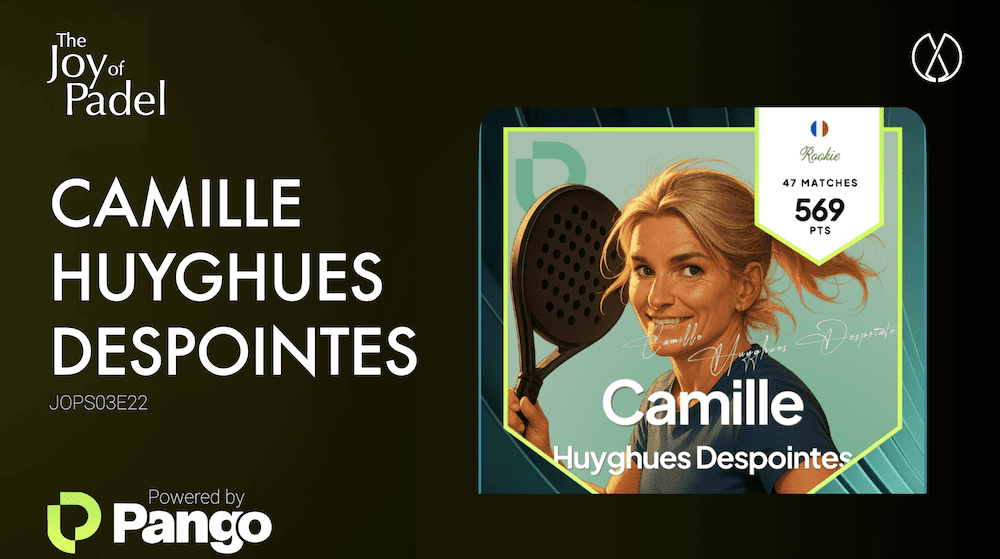
The Joy of Padel podcast with Camille Huyghues Despointes (JOPS03E22)
On the latest episode (and the last of season 3) of the JOY OF PADEL podcast, I had the pleasure of sitting down with my co-founder, friend, and fellow padel enthusiast, Camille Huyghues Despointes. This conversation was particularly special because Camille isn’t just a passionate player—she’s a serial entrepreneur who recently pivoted her talents into the padel world. Our journey together with Pango, our startup, has given me a front-row seat to her infectious energy and strategic thinking.
Background on Camille
Camille’s entrepreneurial spirit didn’t start in sport but in creative and educational fields. As she shared, her first ventures were in theatre and children’s workshops—including a company called “Come play at the house,” which she successfully exited. Later, she built “World is a Village,” an Airbnb-like concept for teenagers to travel globally, which unfortunately met its end due to Covid. But, as her husband wisely predicted, Camille is never out of ideas for long. Her journey led her to discover padel and eventually to develop Pango with me—a platform designed to serve the needs of players rather than just clubs.
Main Topics Covered
During our conversation, Camille opened up about the transition from competitive horse riding to padel and how those sporting experiences shaped her approach: understanding energy, building chemistry, and the importance of body awareness. She noted how the joy and addictive strategy of padel caught her, but also emphasized how accessible it is for amateurs—regardless of technical prowess.
We dove into the distinctions of playing padel as a woman. Camille highlighted how playing with women versus men feels like two different games due to differences in strength, velocity, and style—but both offer valuable experiences and community building. We also explored the nuanced challenge of mixed games and how our Pango algorithm aims to make rating and matchmaking more fair—reflecting reality without bias or self-evaluation pitfalls.
Naturally, the essence and vision of Pango permeated our chat. We discussed the pains padel players face—fragmented apps, inaccurate skill assessment—and how we’re solving it. By blending performance-based ranking with peer review, the platform not just enhances play, it fosters connection and honest growth.
Three Takeaways from My Conversation with Camille
- Padel is an accessible, joy-filled sport that welcomes everyone. Whether you’re an experienced athlete or a complete newbie, padel offers laughter, quick learning, and endless strategy. It’s this vibrancy and inclusiveness that makes the sport addictive.
- Community and honest feedback fuel growth. With Pango, we’re building a global padel community where players are evaluated fairly—not just by data, but by the perspectives of their peers. This dual approach pushes us to grow and face our real strengths and areas for improvement.
- Innovation comes from real needs and a love of the game. Camille embodies entrepreneurial resilience. By identifying the genuine needs of padel players (not just clubs), she’s helping shape a platform that could become a global reference—making padel more fun, social, and rewarding.
If you’re curious about your padel level or simply want to join an enthusiastic, supportive community, download Pango today. And remember Camille’s quote from Mark Twain: *“They didn’t know it was impossible, that’s why they did it.”* Here’s to paddling forward, together!
Ready for more? Listen to the full JOY OF PADEL episode or visit Pango Sports to take your game—and community—to the next level.
To find out more about Camille Huyghues Despointes and Pango:
- Find or follow Camille on Instagram: @camillehdespointes
- Find Pango Sports for iOS or Android here.
To listen to the show:
To listen to The Joy of Padel podcast, you can use the embedded player above, or go find it on Spotify, Apple Podcasts or any number of other podcasting services listed here.
Send in your questions or reactions:
Please send me your questions — as an audio file if you’d like — to nminterdial@gmail.com. Otherwise, below, you’ll find the show notes and, of course, you are invited to comment. If you liked the podcast, please take a moment to review and/or rate it! ¡VAMOS!
Further resources for The Joy of Padel:

The Joy of Padel podcast, hosted by Minter Dial, a padel tennis player since 1974, is an exhilarating show that delves into the captivating stories of notable padel personalities worldwide.
Meanwhile, you can find Minter's other Evergreen podcasts, entitled The Minter Dialogue Show (in English and French) in this podcast tab, on Spotify, Megaphone or via Apple Podcasts.
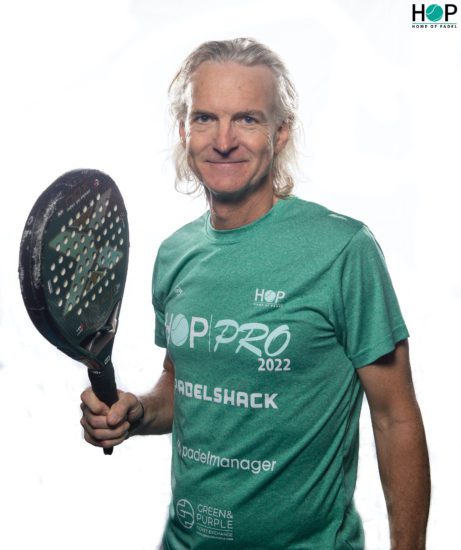
About the host: Minter Dial
Minter Dial is an international professional speaker, author & consultant on Leadership, Branding and Transformation. His involvement in sports has been a lifetime passion. Besides playing 18 years of rugby, captaining athletics teams, coaching tennis and playing squash for his university, he’s been a lifelong player of padel tennis, starting at the age of 10, from the time of its very first public courts at the Marbella Club in 1974.
Then, after a successful international career at L’Oréal, Minter Dial returned to his entrepreneurial roots and has spent the last twelve years helping senior management teams and Boards to adapt to the new exigencies of the digitally enhanced marketplace. He has worked with world-class organisations to help activate their brand strategies, and figure out how best to integrate new technologies, digital tools, devices and platforms. Above all, Minter works to catalyse a change in mindset and dial up transformation. Minter received his BA in Trilingual Literature from Yale University (1987) and gained his MBA at INSEAD, Fontainebleau (1993). He’s author of four award-winning books, including Heartificial Empathy 2nd edition (2023), You Lead (Kogan Page 2021), co-author of Futureproof (Pearson 2017); and author of The Last Ring Home (Myndset Press 2016), a book and documentary film, both of which have won awards and critical acclaim.
It’s easy to inquire about booking Minter Dial here.
Full transcript of interview via CastMagic.io
This transcription comes courtesy of Cast Magic, an AI service for podcasters.
Minter Dial: So, this is a very special podcast. It’s certainly I, I, I’ve had some French speaking padel players, but I’ve never had a padel entrepreneur from France to say the least. So, in your own words, Camille, let’s start with who are you?
Camille Huyghues Despointes: Hi Minter. I’m Camille indeed, as you may recognize, I’m French and I’m a padel player in an amateur level. And I’m also the co-founder of a startup called Pango.
Minter: What? I’ve never heard of it. You’re the co-founder. Who’s the other founder?
Camille: I think you are.
Minter: Oh, that’s it. So, we’re going to talk about Pango afterwards and that, that journey. But let’s start with just a little bit about more about you, your, your background. You’re an entrepreneur and you’ve done several startups. Talk. Tell us about a couple of the startups that you’ve done that you’d like to explain to us.
Camille: First of all, I started my, I started studying a theater. So, I was not born and meant to be an entrepreneur, but finally entrepreneurship finds me. I don’t know. And so, I created some startups in education mainly. One was called Viens Jouer à la Maison, it was a workshop for children.
Minter: In English, that’s Come play at the house.
Camille: Yes, exactly. It was a workshop for children from 0 to 10 years old. Sports, music, playing, theater, lots of activities for young children. And I sold this company to a bigger one than mine.
Minter: It’s called an exit.
Camille: Exactly. And telling my husband that I may won’t have any other idea to create a new company, a new startup.
Minter: Famous last words.
Camille: Exactly. And my husband just laughed a lot and told me, okay, let’s talk about it in 18 months. And he was right. He knows me very well. And 18 months later I created a new startup called the World is a Village. And World is a Village was a kind of Airbnb for teenagers to give them the opportunity to travel all over the world. Unfortunately, Covid arrived at this moment, so we had to close. Well, there’s a village and.
Camille: I don’t know after, after that I discovered Padel a few years after and now here I am creating a business in Padel.
Minter: Right, so talk us through your arrival. Did you come from other sports into padel or did you just sort of as in other racket sports? No, or, or other sports. So, because I know you’re a, in cavalier. A horse. A horse lady.
Camille: Yeah.
Minter: And I’m just wondering if, is there any relationship between riding a horse and playing padel?
Camille: Not very much. It’s not as easy to say that there are lots of common things, but they do. So, you’re right. Before playing Padel, I was doing a show jumping in competition. So, it’s very, very, very different. But what I still learning a sport and the technique, when you’ve done that before, whatever the sport is, it helps when you learn a new one because you understand better your body. Your body is. You have more, you know, you have.
Minter: More.
Camille: Conscience of your body. So, it’s easier, I believe, to understand what to do and how to do it. Even if the sport is very different. It helps, I would say, but it’s even. It’s still difficult when you have not done any racket sports before. I think when you play tennis, for example.
Minter: Yeah. The thing that we talked about, which is the relationship you have with your partner.
Camille: Yeah.
Minter: But it’s not, it’s, it’s not the same type of partner. It’s not even the same type of race, if you will. It’s a horse. But the relationship with your horse is very special. And I’m just wondering what sort of crossovers you might have ever found in the way you deal with your horse as opposed to your partner on a padel court.
Camille: I would say the energy, meaning that when you ride a horse and when you’re doing show jumping, your horse, he feels everything. And when you play pedal, when your energy on the court is not good or when you’re stressed, your partner can feel it. And it’s the same with the horse. So, I would say the energy. The energy is very important in both sports.
Minter: You. You can see that. I mean, when you watch the pros play Chingalan, so it’s Chingotto and Ale Galan. It’s amazing to see how the. There’s an energize. Well, first of all, Chingotto is the Energizer Bunny. He’s the guy who’s bringing all the energy. Ale Galan is positive as well.
Minter: But it’s, it’s remarkable how you can be consciously creating that energy.
Camille: Yeah.
Minter: And you know, you just lost a game, you just lost the set. What are we going to do about it? Moan and groan, Sit there, slump shoulders? Or are we going to try to vivify each other up, each other up, even if you screwed up, let’s keep going. Keep that energy going. Is that something that you feel that in when you’re riding a horse you can do as well in the same kind of way?
Camille: Yeah. I would say a horse is a living person, so of course he has bad days or Good days. And you can feel it. And it’s the same for you. Sometimes you do not ride with the same energy. So, the chemistry of the couple is very different.
Minter: All right, so playing, playing padel, coming from horse, very different sport. What do you, what do you. What’s the thing that really makes you love padel?
Camille: Different things. The first one is that there is a lot of joy when you play padel. It’s fun. And even if you don’t know how to play, you do not have to be very good in technique or even in sport in general to enjoy playing pedal. So, I love this very much. And I would say the strategy and that’s, I believe, why people are very addict when they start playing pedal. Because you think that everything is in your head. You have to.
Camille: And because you’re in a square, you. You understand easily what you should do. It’s not because you understand how, what you should do that you can do it, but, you know, it’s something with your head, something strategical, which I really like. And I would say also meeting new people, because that’s the. That’s really part of the battle. And I think that’s why it’s working so much in our days.
Minter: Yeah, in the strategic thing, there’s an accessibility to it, but the fact that everything’s within the court, so the ball’s going to bounce on the sidewall, sidewall, it’s going to come out here. It’s mathematical. I mean, if it’s hit with a certain speed and all you need to do is get to the right place, theoretically, it’s a whole other thing, as you say, to do it, but it’s accessibly interesting. So, even if you’re not good, you have an idea of what you want to do. You don’t get to it. You don’t get to it, but there’s that thirst for learning, the opportunity to grow in padel that certainly for me as an older person, I see a lot of older people thrilled with the idea of learning again.
Camille: Exactly. You always learn. And it’s funny and completely addictive for this for those reasons.
Minter: All right, so let’s say since you’re a woman, talk about your experience of playing padel with women in particular. What do you like about it as a sport amongst yourselves?
Camille: So, that’s a big difference with horse riding. Because when you, when you are doing show jumping and horse riding, there is no difference when you play, when you are having a competition, if you are a male or a female. So, for me, experiencing that when you play pedal, there is a difference if you are a male or a female was really something new I had to experience. And now I can tell you that when you play padel with women only is not the same pedal as when you play with men. Not at all. So, what. When you play only with women, it’s really nice because the strength is the same, the velocity is the same, even if the levels are different. Of course it happens.
Camille: You have something which is a good balance when you play with men for women. For me at my level, it’s really a challenge each time it’s. It’s much more difficult. I like playing with men. It’s not a problem at all. I love it, but it’s not the same. So, it’s, it’s really, it’s as you were playing two different type of games finally.
Minter: Well, I mean, we say the same thing about the pro level. When you watch the. The men at the pro level and the women at the pro level, the very best, it is somewhat different. I mean, they’re obviously, let’s put things in perspective. There’s lots of things in the same, but the quality of the game, the, the speed of the game, the shots that are being made and the power and this very different. And then the tactics become different because all of a sudden you’re playing much longer points. Typically in a women’s game, there’s, there’s much more communication, in my opinion, in the women’s game than there is in the men’s game. And, and then you, you know, if you’re an amateur, like, keep on pounding the table and saying, just watch the women’s game.
Minter: Because that’s so much more accessible. That’s so much more what we might aspire to as amateurs, because to pretend like we’re Agustin Tapio or Arturo Coyo is pipe dream. And we’re not going to get that. I’m certainly not going to get there anyway. All right, so let’s talk now about Pango that we have co-founded together. How do you describe. And when you’re talking to customers, investors, how do you describe what is Pango? I’d love to hear it.
Camille: For me, Pango was built to solve the problem for the players. Lots of the application, all the applications were built for clubs. Pango has this new vision, a new way of addressing the market, saying that we are going to solve the problem of the players. Lots of the older players, they have to deal with different kind of application and it’s a mess for them. And Pango really tries to solve this problem. This is really what we want to do.
Minter: So, in today’s world. Well, you’re based in Paris. How do you describe the problems for padel players in the OR in France or in Paris region?
Camille: In France, the problem is that there is one application per club and nobody has no idea of your level, because the level in France, But I believe it’s the same in the UK and in lots of countries. The level is something you declare. So, people say, okay, I’m on level 5 or level 4, but nobody can challenge this. And Pango, the heart of Pango is its algorithm where you can classify the players when they enter all their matches. And it gives you not a supposition of your level, but the reality of your level according to who you play with who you play. And this is a big difference.
Minter: So, one of the things that we have put together in Pango is an ability for the algorithm based on performance against prediction. And there’s also the ability for other players to rate you. Talk us through how that’s done.
Camille: Yeah. The idea is to stop these habits of self-evaluation. So, the result on Pango and your level is based on your score at the end of a match. But also you have a. We’ve gained fight a lot the application, because we believe that it’s even more fun if the applications, you know, you’re happy to use it. So, you have a very beautiful player and on it you have stars. And those stars, they are filled by the other players at the end of each game. So, it gives you the.
Camille: The vision of the other players of your game.
Minter: Right. So, it’s not just you saying I’m great, it’s how the others look at you directly. And what’s interesting, of course, is that we’ve got different skills that we’re looking at according to the levels. So, that when you’re at a beginner level, there are certain competencies you can do, and then as you get better, they change the competencies so that this will become an interesting thing, a feature for everyone to start looking at. And then how does that. How do you think that that’s going to work out in terms of impacting the algorithm, I mean, or at least the rating. When you have the. The numbers coming in from others, do you.
Minter: How do you. I mean, obviously it’s an experiment. Experiment that we’re doing, because there’s no other application or rating system in the world in sports that does that kind of combination factor. How do you see that playing out?
Camille: I believe that it’s combination between the vision of others plus the reality of the score. And this define your level. And it’s much more. It’s much more realistic than having your own vision of your levels or your level. So, of course, sometimes for players, it can be disappointed because they believe that the score is much higher than they thought or than they really are, but sometimes face reality with the, you know, the, the. It’s not only about winning the. The game, it’s also about who you win against. I don’t know if this is very English.
Camille: This.
Minter: I don’t know well, what I can say. I’m reading. I’m just reading a book right now by a guy called Brian Lowery, black PhD American professor. And his book is called Selfless. And. And it makes me think of how.
Camille: Who.
Minter: Who are we? The idea of who am I? And in this case, you know, how good am I as a padel player? Who am I as a padel player? And in his book he goes to great lengths to explain that you as an individual exist as an individual in a system, in an environment, in a group. And so, the regard that others have on you absolutely has a. An impact on who you are and whether or not it’s the one you like that people say or is in tune with who you think you are. This is part of our life in reality, not just on a padel court. You’re always thinking, I hit a good vibra or I hit a good shot, but the other people don’t see it that way. And the opportunity for us therefore is to be able to learn if we want to grow.
Camille: Exactly. And it is also about being part of a community. And this is what we want to build here. Community of Padel players. So, having the idea of others is also being part of a community because people take time to complete and give their opinion about who you. Who you are, how you play. And this is also what we want to build, you know, having. Taking time for others, playing with the good, with players who has the same level or if they don’t just know about it and have this opportunity to.
Camille: Yeah, to. To know who the others are. To create the best experience for everybody and also give the opportunity to meet people all over the world. This will be the next step of.
Minter: Bungo, the global community.
Camille: But yes, to create this global padel community and be a reference concerning the level.
Minter: All right, so this next question is about the mixed game where men and women are playing. We talked a little bit before about how it is for you playing with women and how it can be different playing with men. And so, let’s just do a little bit of a dive into the notion of how we are handling mixed padel. So, when. When a woman gets on the court and she’s playing with three men, the. What we’ve done is we’ve given a compensation because the fact is this is. Our belief is that men and women are different and athletically there’s a difference. There’s.
Minter: There’s a. It’s not that it’s the worst, it’s just there’s a difference and that you have more strength, more height, more power in the male body generally than you do in a woman’s body. And. And so, the. The issue that I often have, Kami, is when I’m explaining this, not feeling like I’m jeopardizing my reputation to say that we’ve adjusted when we have women or woman playing on the court with men. How do you explain it?
Camille: I would say that what is interesting is to be as close as possible in the rating, to be as close as possible as the reality and create the good impact on the level. This is what we are talking about. So, it’s not a question of. Of course, when you play a match with two other three other men, it impacts. And the. It impacts the game. So, it impacts the result at.
Camille: At the same load, at the same level, of course. So, yeah, it’s not just about, you know, compiling the. The score. It is also about face reality of the game. Facing reality of the game.
Minter: Yeah. So, a little bit back to the question of who are you facing our reality? And. And yeah, so one of the things that we hope is that we become a global community. With Pango and I, I have this little. And I remember with a few conversations we had at the very beginning about what about the other things that padel brings to the world. You talked about joy. It’s also a great way to meet people. Isn’t it also a great way to meet your, you know, the new love of your life? And so, could we not be encouraging mixed padel to make more couples around the world?
Camille: It’s an option I don’t need for this. Lucky me. But I believe for others it could be an opportunity indeed.
Minter: Yeah. Well, I mean that. I mean, one of the things that I’m hoping we do with Pango is that, I mean, this whole. The. The whole name was based or, you know, a little bit of a hat-tip and wink to the tango. The tango, which is that sort of very svelte, sensuous Argentinian dance and the idea of having a couple on a court There is, there is lots of business being done. They say it’s the new Gulf of business, the new, the new networking sport. And I, I feel like it is also a great way to have fun, great way to have exercise, and a great way just to meet people in general.
Minter: So, who knows, more hookups or could be possible it. If we can get the mixed rating algorithm correct. That’s what I’m thinking about anyway. So, other things. So, let’s say where, where are we in Pango? What. How would you like to describe the status of Pango today?
Camille: I believe we, we launched Pango at Roland-Garros two months and a half ago with very, very good return from the users, from the players. We are working very hard each day to improve what we are doing, the application to be as close as possible as what the players need and what the plebs needs. But to be honest, I’m very happy of the, of this first of those first months. We really can see that there is really a need here. And the way we approach it seems to be the good way to develop Punggol. So, very happy. Clubs and players here in France are very, very curious. And the one who download the application, they really use the app to create games and etc.
Camille: And we can really feel that it is the beginning of a community because people feel really at ease to contact us, give us their feedback. So, we are really in the game. I would say love, raise money, like every startup, raise money and develop and work hard to give the best experience for battle players. And this is it.
Minter: Beautiful. So, we’re recording this. I’m looking at my computer, it is December 1st in the late afternoon. This recording will be going out on December 3rd. What incentive can you give to anybody who’s listening to go and immediately download Pango?
Camille: I would say at start you download Pango for your Pango card, which is really cool. But you stay to get your Pango level, which is even more cool, and you stay for this and the community and lots of new things coming very soon on Pango.
Minter: You don’t want to give away the scoop, eh?
Camille: No, I think it’s cool. Download Pango and you’ll see what surprises we have for you.
Minter: There we go. All right. So, how can somebody go download Pango? Because I mean, I, I, when I look on the App store, I see lots of Pangos for kids.
Camille: Sports, Pango pedal on Google and on the App Store. So, just type Pango sports or Pango pedal. Both works very well.
Minter: And talk about how much how much it costs and how long it takes to actually create your app, your profile.
Camille: Oh, it takes less than one minute and a half, I would say, to create your profile. And for now, the app is completely free.
Minter: That, hopefully, is a good enticement. Kemi, lovely to get you on my podcast. We’ve been talking about this for a while. I’m wearing my Pango jacket. It’s there on over the heart, and we will play more. Good to have you on the show. Well, that’s the famous last words or the famous new words I say for the future of padel.
Camille: I would. I would take a quote from Mark Twain, which says, they didn’t know it was impossible. That’s why they did it.
Minter: Thank you, Camille.
Camille: You’re welcome, Minter. Bye. Bye.