
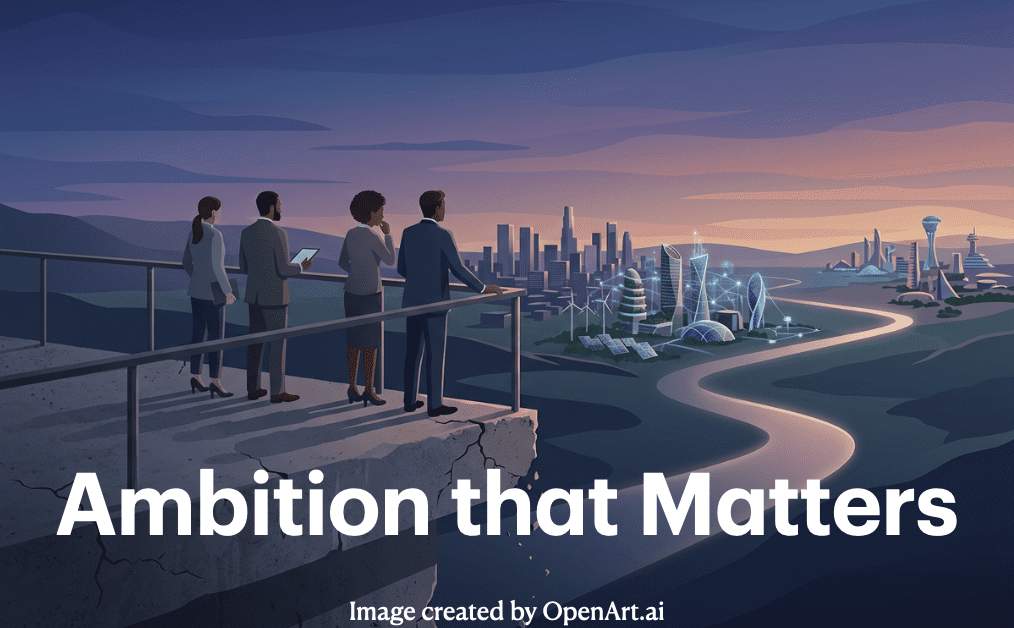
Is “success” possible without ambition, innovation, or growth?
I’ve been thinking a lot about success lately — not the glossy version we post about, but the quieter, more uncomfortable questions underneath it: what’s the relationship — or the difference — between success and winning? And what makes winning so attractive to most of us?
In sports, when I see blatant cheating that leads to victory, I wonder how on earth the cheaters look at themselves in the mirror. Think of the shirt-shanking and diva-diving in football — it sets a dreadful example, especially for youngsters. Not that I don’t want to win. I do. I’m competitive. But I want to win the right way. The reality, though, is that the right way isn’t always the winning way. For some, winning seems existentially important. I’ve seen men my age smash their (even expensive) racquet on the cage or the floor in a fit of rage after losing a match. This behaviour is hard to fathom, but it certainly speaks volumes — as does the matter of how you lose. If the loss is so painful, it will clearly drive some to bend the rules to get the win.
There are plenty of examples that show how cheating gets results. Maradona’s hand-of-God goal in the 1986 World Cup is still seared in my mind. Studies suggest that results achieved through cheating or immoral means tend to be short-lived, yet Argentina will forever be in the history books as the 1986 champions. So, what is the moral of the story? I think it boils down to your own version of success — how you define it and what it means to you. The irony is that the best lessons, and a form of growth, come through the losses, no?
Success in the boardroom
What does success mean in the boardroom? From a business perspective, it typically reduces to increased profits and higher shareholder value. But the truth is more nuanced when you examine the individuals around the table.
When I look at the “successful” executives with whom I worked — especially in my last corporate role — many left me with a bad taste in the mouth. While I fortunately forged great and lasting friendships with some colleagues, many of the top brass were simply not the type of people I’d invite to dinner. I didn’t consider them friends and, more fundamentally, I didn’t trust them. In short, many of the people around me didn’t inspire admiration, let alone respect — even if they weren’t, by conventional measures, unsuccessful. They rose to the top and had excellent careers. L’Oréal is certainly an enduring success story.
But I got to thinking: do good people ever get to the top? Or are we bound to have senior leaders who reek of egocentrism, daggers for eyes, and a dearth of scruples? As much as that stereotype may hold true, it was never a path I wanted to follow. I was never prepared to pay that price. Yet you do need special qualities to lead in larger organisations — to break through the deadwood, the bureaucracy, and the fear of failure. The incentive to grow shareholder value, and at the individual level, personal glory, is a powerful one.
When did ambition become a problem?
Somewhere along the way, ambition picked up a bad reputation — and not for the first time.
The ancient philosophers were among the earliest critics. The Roman Stoic Seneca warned against ambition throughout his Moral Letters, arguing that it ties one’s well-being to the judgement of others, and that “success is often won at the cost of life.” [SOURCE: Seneca, On the Shortness of Life; Moral Letters, Letter 69] Plato, the Greek philosopher, was equally sceptical of ambition’s corrupting pull. The Irish-British author C.S. Lewis continued this tradition, writing in God in the Dock that if ambition means “the desire to get ahead of other people — then it is bad,” while conceding that the desire simply to do something well is an entirely different matter. [SOURCE: C.S. Lewis, God in the Dock, essay on ambition]
Today, the case against ambition is alive and well. A contributor to Psychology Today has written that ambition may correlate with success, but not with happiness — a view backed by academic research from the University of Notre Dame, whose longitudinal study found that highly ambitious people are only slightly happier than their less-driven peers and tend to live somewhat shorter lives. [SOURCE: Judge & Kammeyer-Mueller (2012), “On the Value of Aiming High: The Causes and Consequences of Ambition,” Journal of Applied Psychology] Ambition has also become tainted by its association with capitalism. And social media pours fuel on the fire: it is the cauldron of comparison culture, the tinder for FOMO (the Fear of Missing Out) and a compulsion to keep up with the Joneses. The anxiety created by measuring ourselves against others is making many of us genuinely unwell.
Progress? What Progress?
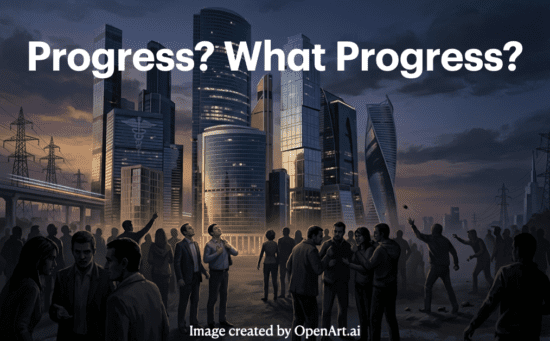
Without the engine of capitalism, would the world have seen such remarkable progress? Consider the discovery and widespread availability of electricity, the advances in communication and transportation, and the breakthroughs in medicine and medical care. And yet many look at the titans of industry and triumphant entrepreneurs with scorn. The media, politicians, and the tax authorities have targets on the backs of these “successful” businesspeople.
Wealth, success, and capitalism have a target on their back
Society, at large, lives in a paradox — if not an outright contradiction: we benefit from and celebrate progress, yet are all too eager to denigrate or punish those who made it possible. We may well be living through one of those “in between” times. The French Ambassador and author Sylvie Bermann put it well when she paraphrased the Italian philosopher Antonio Gramsci, saying that the old world is dying, the new world has not yet been born, and in this chiaroscuro all the monsters emerge. [SOURCE: Gramsci’s original Italian: “Il vecchio mondo sta morendo. Quello nuovo tarda a comparire. E in questo chiaroscuro nascono i mostri.” — from his prison notebooks, widely cited via French translation by Gustave Massiah] If Bermann focuses on the monstrous uncertainty of geopolitical events, I think the same could be said for the uncertain future of capitalism, democracy, and the Western way of life.
The seductive myth of the “steady state” business
At the APM convention of entrepreneurs I attended recently in Paris, I sat beside a charming Frenchman who told me that growth was a dirty word in his mind. We need, he said, to embrace de-growth — to be happy with where we are, to accept that we have enough. It is a view that resonates with Becky Hall, a guest on my podcast who penned the book The Art of Enough. But truth is that “enough” is still relative. When or what is enough for you? And can enough ever remain a constant?
These thoughts lead me, inexorably, to the central question: is it actually possible to succeed without ambition, without growth, without innovation?
For most of my career, the answer would have seemed obvious. Ambition was the fuel. Growth was the metric. Innovation was the edge. But today the answer is not so simple — particularly against the backdrop of war, the erosion of institutional trust, and a growing cultural exhaustion with the relentlessness of modern business. When an existential threat looms, how important is the size of your car, the title on your business card, or your company’s profit on the next widget?
The idea of a business that simply runs — stable, profitable, unchanged — is deeply appealing. Earn enough for a good life. Loyal clients, consistent revenues, controlled costs. No constant reinvention. No pressure to expand. No external noise.
But here is the uncomfortable truth I’ve observed: that state never lasts.
Not because the model is flawed, but because the world doesn’t stand still.
- Customer expectations evolve
- Technology reshapes habits
- Competitors emerge from unexpected places
- Platforms rise and fall
- Talent wants different things
- Costs creep up in new ways
- And here is the kicker: you and your team get bored
Even if you don’t want to grow, the environment around you does. If you don’t adapt, you don’t stay still — you fall behind. Stasis is simply not a durable feature of business, or of life.
So, we ought to be careful not to swing too far the other way. “Growth at all costs” has left a trail of burnt-out teams, inflated valuations, broken business models, environmental strain, and hollow success stories. Innovation, too, has sometimes felt like theatre — change for the sake of visibility rather than meaningful progress. Think of all those “NEW” stickers slapped on unchanged products. It is, then, understandable that the pushback has gained momentum (and that marketers have become distrusted).
Can a business survive without ambition?
The short answer is: not really. But it depends on how we define ambition — and success.
If ambition means relentless expansion, bigger teams, more markets, higher valuations, then no, I don’t believe that’s necessary or even tenable for every business. Why are these one’s objectives? Consider the autobiography of André Agassi, who recounts how reaching number one was, far from triumphant, deeply destabilising. [SOURCE: Agassi, A. (2009), Open: An Autobiography, published by Alfred A. Knopf] Become number one and everyone has a target on your back. The drive to remain at the top is an ambition that is, at best, transactional, and at worst, vacuous. You never stay number one — some other force eventually dislodges you.
When you hear a civil servant or salaried employee say they see no value in growth, that is understandable. But when a businessperson or entrepreneur says “I don’t want to scale,” it’s harder to compute. There is a reassurance in steady revenues and predictable margins — control, freedom, a sense of enough. In theory, it’s about making sense rather than cents. But is it realistic? It implies that everyone else must play along — a kind of global zero-sum game, tipping toward a negative-sum one.
After years in business and latterly advising senior executives, I’ve come to believe that a core principle of business involves the embrace of risk, the thrill of adventure, and the drive to grow — for the benefit of employees and customers alike.
But if ambition means doing something truly meaningful, caring about future relevance, and contributing to the welfare of a wider circle, then it becomes essential. I’ve come to think of ambition less as scale, and more as intent:
- The intent to remain useful
- The intent to improve what you offer
- The intent to stay curious about your customers
- The intent to avoid drifting into irrelevance
- The intent to make your teams richer through experience and fulfilment
Without that, even the most comfortable business starts to decay. I’ve seen companies with strong margins and loyal customers slowly erode — not because they made bad decisions, but because they stopped making any bold decisions.
Redefining success
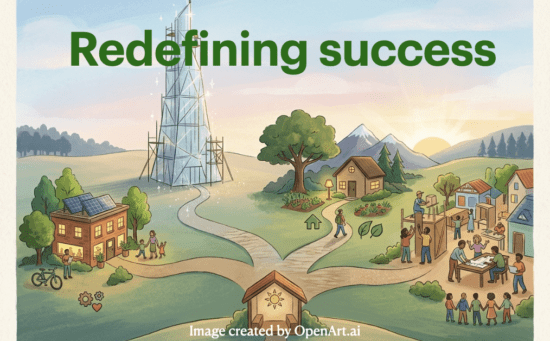
All of this brings me back to the core issue: we talk about success constantly, but rarely define it clearly.
For some, success is scale or being number one. For others, it’s independence. For others still, it’s impact, reputation, or simply peace of mind.
My own definition has evolved. I no longer see success as pure growth. Nor do I see it as static stability. I see it as enduring relevance. A company’s purpose serves no purpose if the company ceases to exist — so profit is entirely desirable. That’s endurance. And relevance? That’s about ensuring the enterprise remains meaningful for all its stakeholders, throughout the entire value chain.
A successful business, in my view, is one that:
- Continues to create value over time
- Adapts without losing its core identity
- Balances financial health with human sustainability
- Evolves deliberately, not reactively
- Carries a meaningfulness that touches everyone involved.
That evolution might include growth. But getting better does not have to mean getting bigger. It’s about mattering. It’s about having ambition that matters.
So, is success possible without growth?
If by growth we mean endless expansion, then yes — success can absolutely exist without it.
But if by growth we mean any form of forward movement, then no.
A business cannot survive, let alone succeed, without evolving in some way. You can choose your pace. You can choose your direction. You can — and must — choose your definition of success. But you cannot opt out of change. That is the constant.
And how you respond to it — that is where ambition, in its healthiest form, still matters.
As I’ve long held, with a hat tip to my mentor and friend, Sam Villa:
Change is for sure. Growth is the option.