

Is Britain Really an AI Superpower – or Just a Great Press Release?
London Tech Week’s opening salvo in the AI Arena was less a series of isolated keynotes and more a coordinated narrative about Britain’s AI moment: ambitious, human‑centred, and increasingly entangled with questions of sovereignty and power.
The UK sells itself to itself
From PM Keir Starmer to Mayor of London Sadiq Khan and the major corporate presentations, the first half‑day of London Tech Week 2026 felt like a carefully choreographed campaign to persuade Britain that it really is an AI nation. Starmer leaned heavily into the UK’s position as a world leader in AI, talking up tech sector growth, skills initiatives and a ramp‑up in tech as a national priority, while framing AI as something that can “make us more human” by stripping out drudgery from public services. Sadiq Khan’s line, that London is “busy writing” the future of AI while acknowledging “dizzying” risks, played the same tune: the UK as both laboratory and lighthouse, simultaneously managing threat and opportunity.
What was striking was how systematically this narrative was echoed by the corporate speakers. Each “scoop” – multibillion‑pound commitments from Microsoft, AWS, AMD and others – served as validation, proof that the world’s biggest technology firms are willing to bet serious capital that the UK can be a durable AI hub. Yet beneath the self‑congratulation you could hear a more anxious subtext: Britain needs to prove that this isn’t just a brief AI sugar high, but a moment where it converts talent, research and capital into enduring capability.
Human + AI, not human vs AI
If last year’s tone was somewhat defensive and doom‑laden, this year’s opening felt like a deliberate attempt to drag the AI conversation out of dystopia. Several speakers argued explicitly that we have over‑indexed on fear‑mongering and under‑invested in a positive vision. Judith Dada (General Partner, Visionaries) warned that, without a drastic change of course, Europe risks stagnation and political marginalisation; yet she insisted that AI could be the engine of renewed prosperity, if leaders articulate a compelling story of how it improves lives and work.
That insistence on human‑centric AI recurred throughout. Darren Hardman’s “Shaping the Future of Work and Opportunity in the UK” put it crisply: AI’s real promise is not to replace people but to strip away the “paperwork and bureaucracy” that dehumanise public services. Hardman cited a study that showed that 80% of employees feel overwhelmed. There are just too many tabs open, messages to read and send, and things to keep up with. Anxiety and burnout are prevalent. Microsoft has been piloting AI tools across UK public services, including the NHS, to reduce admin burdens so clinicians can spend more time with patients and less time in front of screens. The message: AI is not the enemy of humane care; done well, it is the precondition for it.
Alison Kay, Managing Director at AWS UK & Ireland made a similar argument through numbers. She cited UK government departments already using generative AI to triage tens of thousands of daily letters and cases, collapsing processing times from weeks to a single day and routing queries to the right human on “day one instead of week five.” In healthcare and social protection, she argued, the point is not replacing caseworkers or clinicians but freeing them to do the parts of the job that require empathy and judgment.
Productivity, skills and the adoption gap
If the speeches were bullish about the technology, they were sober about the people and processes. Kay’s talk painted the UK as an early adopter – nearly a quarter of organisations have some form of AI in production, putting the country ahead of the European average – but highlighted that most are still stuck in “wave one” use cases: chatbots, document summarisation, generic productivity tools. Only about a quarter are deploying more advanced, agentic AI systems that combine models, tools and data to reengineer workflows, and that figure has barely moved in a year.
The underlying issue, she argued, isn’t the tech; it’s skills and organisational courage. Almost half of UK businesses cite AI skills shortages as the single biggest barrier to deeper adoption, even as two‑thirds of employees say they want to learn. To her, the real leadership challenge is not whether AI will deliver; it is whether leaders will invest in human capital with the same zeal that they announce capex in data centres.
That human‑capital lens also reframed the sovereignty debate: if Britain wants leverage in the AI era, it cannot rely solely on hardware and data centres; it has to become a place where skilled people can build, deploy and govern AI systems at scale. In other words, talent and institutional capacity are as “sovereign” as any chip fab.
Perplexity, the “new computer” and the Billion Pound Build
In that context, Perplexity cofounder and CEO Aravind Srinivas’s keynote was the standout of the morning: less a product demo, more a philosophical intervention about what a Computer is in the age of AI – and what that might mean for a country like the UK.
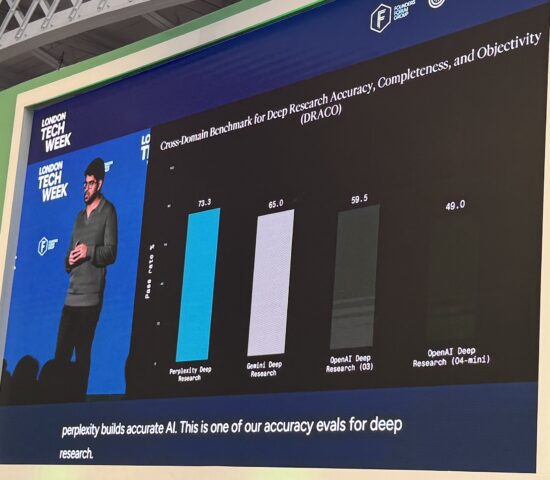
He began by distinguishing Perplexity (I’m a big fan) from commodity chatbots. Where web search has historically given “10 blue links” and left humans to do the cognitive heavy lifting – wading through SEO sludge and reconciling conflicting sources – Perplexity set out to build an “answer engine” obsessed with one metric: accuracy. Years ago, he recalled, investors actually advised him to make the system hallucinate more because users allegedly found “funny mistakes” entertaining; Perplexity deliberately went the other way, sacrificing gimmickry for truthfulness. Srinivas showed a slide on the DRACO measurement (a Cross-Domain benchmark for Deep Research Accuracy, Completeness and Objectivity), comparing the Deep Research of each, Perplexity achieved a 73.3% pass rate, versus 65.0 for Gemini, 59.5 for Open AI 03, and 49.0 for Open AI 04-mini. {Here’s a Feb 2026 report by Perplexity about DRACO}.
From there he pivoted to a bolder claim: that we are witnessing a redefinition of the word “computer” itself. Historically, computers were devices that processed instructions; now, AI systems reason over the entirety of the world’s knowledge, turning information into judgment, inference and decisions, and increasingly executing against objectives rather than step‑by‑step commands. In his framing, Perplexity’s new product – called “Computer” – is an AI operating system and orchestrator: a conductor that coordinates teams of specialised agents across 15 different models, tools, data sources and even chips, including models running locally on your own device for highly sensitive work.
This orchestration, he argued, is where sovereignty, privacy and performance converge. By deciding when to use a compact local model and when to reach out to a frontier model in the cloud, the system “perfectly balances intelligence, accuracy, privacy and cost,” keeping the most sensitive data literally “on your lap” while still tapping global compute. In doing so, it hints at an answer to one of the later panel’s questions: how a mid‑sized country might reconcile sovereignty with the reality of global AI infrastructure?
But Srinivas did not stop at infrastructure. His most provocative idea was social: the “Billion Pound Build” challenge. After running a similar programme in the US – targeting the first one‑person billion‑dollar company powered primarily by Perplexity Computer – he announced a UK edition: one‑ or two‑person teams, eight weeks, a credible path to a £1 billion valuation, and £1 million of Computer credits up for grabs. The premise is simple and radical: if AI really is a Ferrari for the mind, why shouldn’t tiny teams, anywhere in the UK, have a shot at building the next great company?
In a room full of policymakers and incumbents, this was a subtle but sharp reminder: if you truly want Britain to be an entrepreneurial powerhouse, you have to embrace the possibility that leverage shifts to small, aggressive teams with access to powerful tools. The real work and growth will come, not from governmental policies and stooges, but from private enterprise and risk-taking entrepreneurs.
Sovereignty: leverage, not autarky
The final panel discussion I attended was on “The Emerging Case for Sovereign AI Development in Europe” that took head-on the tension between dependence and leverage. Rather than treating sovereignty as the fantasy of owning “every layer of the stack,” Minister Kanishka Narayan framed it as a question of outcomes and leverage: can Britain chart its own course on technologies that matter for national security, economic progress and human dignity, and does it have “enough chips on the table” to be taken seriously at the negotiating table with the US, Taiwan, Korea or the Netherlands?
That framing found rare cross‑party agreement. George Osborne – now at OpenAI – called it a “fool’s errand” to attempt full autarky, noting that even the US and China cannot fully own every layer. Instead, he argued, countries should focus on relevance: are they adopting AI at scale, developing skilled populations, attracting research centres and building infrastructure that makes them indispensable partners? Judith Dada broadened the lens to Europe, warning that without bold moves on data centres, labour‑market flexibility and a positive political narrative, the continent risks stagnation and a loss of its cherished welfare model.
Matt Harris, MD of HPE UK, Ireland, ME and Africa, perhaps best captured the corporate view: AI effectiveness depends on a full stack – energy, clean data, models, applications, talent and capital – and the real strategic question is “who owns the operational intelligence layer” of organisations. If the UK fails to build at least some sovereign capability and control points in that stack, he warned, it will be “borrowing someone else’s intelligence” and exporting the economic upside that should accrue to its own citizens.
The implicit conclusion: Britain cannot, and should not, go it alone – but nor can it be content as a perpetual customer of US platforms. It needs to pick its battles, harness its strengths in research, semiconductors and regulation, and build the institutional capacity to be a smart “picker of winners” rather than a passive taker of others’ roadmaps.
From fear to agency
Threaded through the morning – from Kay’s call to put people at the heart of transformation, to Hardman’s insistence that AI can “put humanity back” into public services, to Srinivas’s Ferrari‑for‑the‑mind metaphor – was a quiet but important shift: from AI as something happening to us, to AI as something we actively shape.
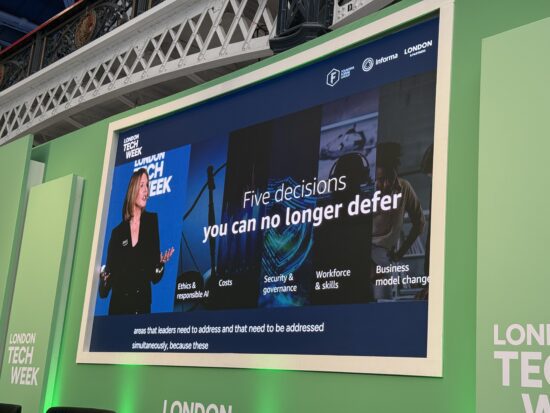
That doesn’t mean naivety; the speakers and panellists were clear about trade‑offs, external dependencies and the political difficulty of building data centres and infrastructure at scale. But there was a palpable impatience with paralysis. Sovereignty, in this telling, is less about walls and more about choices: where the UK chooses to specialise, how it invests in its people, what kinds of AI systems it chooses to build and deploy, and whether it dares to let small, ambitious teams rewrite the rules with tools like Perplexity’s Computer. As Kay said, we need to move fast… and, to her opinion, deciding decisively on five key areas:
- Ethics and responsible AI
- Costs
- Security and governance
- Workforce skills
- Business model change
If the rest of London Tech Week lives up to its opening morning, the most interesting question won’t be whether AI will transform Britain, but who will own the intelligence that runs through its economy – and whether that intelligence will be guided by fear, or by a more generous, human‑centred sense of what is possible.