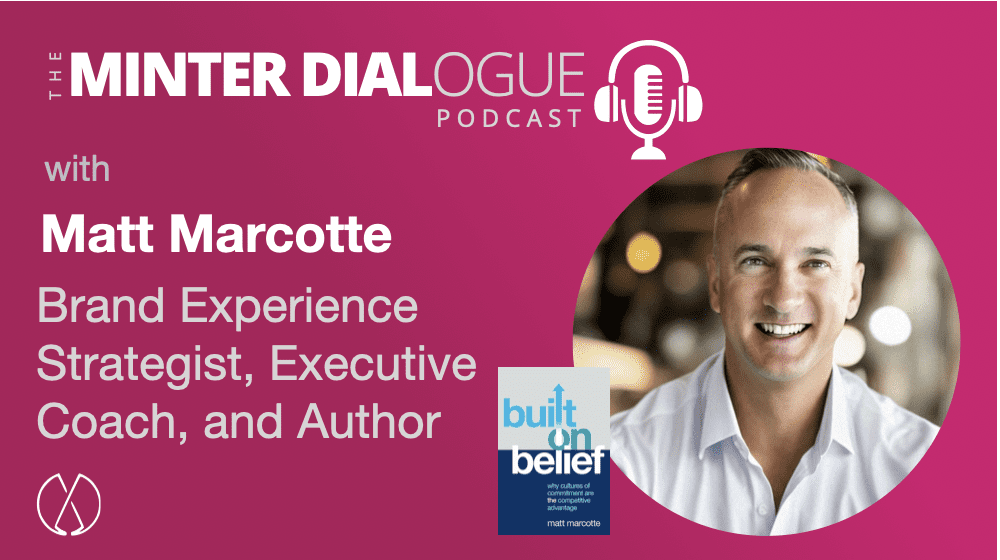
Minter Dialogue with Matt Marcotte
Our conversation delved deeply into the mindset required to uncover what truly drives individuals and organisations. From the origins of personal belief to the challenge of aligning company culture with authentic internal values, Matt’s experiences illuminate how depth and self-awareness unlock organisational commitment and lasting brand relevance.
Key Points:
- The Role of Belief and Purpose: The discussion explored how belief is an internal force—the spark behind any founder’s journey—while purpose is its external manifestation that galvanises others. Without clarity on both, a brand’s vision is hollow and unconvincing, particularly when actions fail to match declared values.
- Curiosity and Cultural Fit: A key theme that emerged was the importance of curiosity, both in hiring and self-development. Matt argued that companies and individuals should audit not only what they believe, but what they do not believe, so that people can opt out if there isn’t genuine alignment. This self-knowledge prevents performative, surface-level cultures and enables real loyalty.
- Moving from Compliance to Commitment: The conversation focused on strategies for shifting large organisations from a model of compliance—where employees do what they’re told when supervised—to commitment, where people are internally motivated and aligned with the company’s beliefs. Matt’s practical “heart, head, hands” framework engages people emotionally first, then intellectually and behaviourally.
Takeaways:
- Authentic brands do the hard work of clarifying—and living—their beliefs, encouraging those who don’t align to opt out, rather than trying to attract everyone.
- Real organisational change happens not at the one-off seminar, but through sustained, ongoing follow-up that turns theory into action and embeds new beliefs.
- We must create opportunities for honest, sometimes difficult conversations if we are to move beyond curated personas and tap into the deeper purpose and commitment that fuel lasting success.
To connect with Matt Marcotte:
- Check out Matt Marcotte’s eponymous site here
- Find/buy Matt Marcotte’s book, “Built on Belief: Why Cultures of Commitment Are the Competitive Advantage,” here
- Find/follow Matt Marcotte on LinkedIn
Other mentions/sites:
- Brian Solis (previous podcast guest on the Minter Dialogue) here
- Bergdorf Goodman here
- “Built on Belief: Why Cultures of Commitment Are the Competitive Advantage,” by Matt Marcotte here
- “Tell Me More,” by Rob Volpe here
- Jim Collins (“What Makes a Life Worth Living”) here
- Esther Perel here
- Simon Sinek here
Further resources for the Minter Dialogue podcast:

Meanwhile, you can find my other interviews on the Minter Dialogue Show in this podcast tab, on my Youtube Channel, on Megaphone or via Apple Podcasts. If you like the show, please go over to rate this podcast via RateThisPodcast! And for the francophones reading this, if you want to get more podcasts, you can also find my radio show en français over at: MinterDial.fr, on MegaphoneFR or in iTunes. And if you’ve ever come across padel, please check out my Joy of Padel podcast, too!
Music credit: The jingle at the beginning of the show is courtesy of my friend, Pierre Journel, author of the Guitar Channel. And, the new sign-off music is “A Convinced Man,” a song I co-wrote and recorded with Stephanie Singer back in the late 1980s (please excuse the quality of the sound!).
Full transcript via Castmagic.io
Transcription courtesy of Castmagic.io, an AI full-service for podcasters
Minter Dial: Let’s do it. Matt Marcotte, you and I got into touch with one another, thanks to our mutual friend Brian Solis, who’s also been on this podcast.
Matt Marcotte: Love that man.
Minter Dial: Great man indeed. But for those of the listeners who don’t know who Matt is, who are you?
Matt Marcotte: How is that possible? People don’t know who I am. Yes. So, who am I? I just start very quickly. Grew up in the retail and consumer business. Spent 30 years there. And then where I met Brian was when I moved over to the technology side and worked at Salesforce for three and a half years. And so, my whole kind of career has been built around, I would call it experience. Right. Whether it’s consumer experience and brand experience, whether it’s how we use technology to build experiences, to build connection, to drive results in a way through. Through those things. So, I would say that that has pretty much been how I have worked in my entire life, is to think about who brands are, how you translate those brands to consumers, both internal employees and external customers, and drive profitable, scalable results through that real, deep, authentic connection using all the tools at your disposal. And then I left the corporate world about two years ago and started my own practice. So, I do a combination of executive coaching and team dynamic work, some brand consulting around what I just talked about. And then I really felt compelled. And partly Brian was a huge support in this because, as you know, he’s very prolific. I felt the kind of desire to write a book talking about my beliefs around how you build incredible brands. And it’s called Built on why Cultures of Commitment Are the Competitive Advantage, which I know we’ll talk a little bit more about. But that kind of brings us to where we are today.
Minter Dial: Beautiful. Well, we are certainly going to be talking about that. I also understand you are teaching.
Matt Marcotte: Oh, yes, that’s right. Oh, my God. Talk about a great love. Yes. So, I teach an MBA course at Boston College is where I went to school about brand and consumer relationships. And it’s such a fun and rewarding experience. I’m a big believer and I would recommend to anybody listening who has the opportunity, if you have the potential to pay it forward or give back or share your experience with the next generation of leaders. Do it. There’s nothing else like it.
Minter Dial: What must have been like, Matt, to go back to the school where you went, I mean, presumably a few decades before, what was that feeling? Can you describe to us what that felt like when you walk into the classroom the first time?
Matt Marcotte: Yeah. It was both a feeling of coming home and also a feeling of Imposter syndrome. Like, why am I here teaching something? Because it’s also an incredible school. It’s very highly ranked within the US and whatnot. So, that wasn’t lost on me. But yeah, it was one of those. I just was so excited to be back on campus and it was an amazing four years of my life. So, very positive experience and positive memories. But it was also, like I said, that kind of feeling of wow, I get to participate in the journey and the experience that these students have being at Boston College. So, I don’t take that lightly. I think it’s interesting maybe you’ve been this, seen this before, felt this way before. I’m sure you probably have. A very early learning of mine was you forget when you get to a certain part of your career, among a number of decades of experience, you forget how much you actually know and you assume everyone knows what you know because it’s become so natural to you. But you don’t think about it took 30 years to acquire all of that knowledge. Good battery. Different. I’m not saying I was savant. I’m just the stuff that you know. And so, I learned very early on in the first semester of the first year, when I saw the deer in the headlights look of like that I’m like giving them all this information and they’re like, wait, what? So, it made it even more special to say, oh, let me actually unpack this in a different way, but realize how much value that you can add just because you’ve been in the world longer. So, yeah, it’s been a really fun experience.
Minter Dial: So, that is something I can relate to. Being of a certain age. The idea of accessing things in our memory bank, it. Generally speaking, there’s some sort of jargon that says that we only use a small portion of our brain. I was listening to a lady who runs Amazon AWS in the UK, Ireland, and she said that only 24 of people use deep research on AI. It’s like there’s all these texts out there, all these things that we can know, but we only ever use or access a small portion of it. Yeah, so do you. I mean like you say, we’ve, we’ve developed all these thoughts and experiences, but how do they come back out? And is it. Do we need more time in the shower, more time walking in nature without the devices? What do you think it is that allows us to access?
Matt Marcotte: Yes, the answer to that, what you just said. Those are two very good examples. I think we need more time to, to, to sit with our, Our Memories to sit with our thoughts, to explore concepts. So, for example, even writing the book as an example was almost cathartic for me because in framing out what I wanted to talk about and then filling out the content, I had to dig deep on experiences I probably haven’t thought about in 20 years. And that the kind of process, like you said, being in the shower, going for walks, being present and still and allowing your brain to do its work was critical and hard. Right. I don’t know if you find this or not, but this, we all suffer from a form of trigger finger and add because we’re just our brains have rewired themselves to take in massive amounts of information and stolen real estate from the parts of our brain that are about focus. And so, for me, I found that having something super clear I was trying to solve for allowed me then to say, okay, well if this chapter is about this or this class is about this particular topic, how do I fill in all the blanks with what I know or what I need to research? So, take time was a huge part of that 100%. Do you find that for yourself?
Minter Dial: Well, absolutely. One of the things that I suffer from is, is usually given the name recency bias. The latest thing I read will take up a big sp. Oh, that’s really cool. I got that. And it’s like the new thing in town as opposed to foraging back into an old thing. So, in, in that year, teaching new students, it struck me an interesting question is where you described yourself and sort of your belief system, your purpose at this point in your life, at what point do you believe that you sort of got on that journey? You talked about early learning earlier. However, as you’re talking to, let’s say 20-year-olds in their 20s going out in their lives, the brands you work for, Bergdorf Goodman, Salesforce, Apple, incredible brands.
Matt Marcotte: Yeah.
Minter Dial: For you, were you really aware of the brands that we’re talking about or was that a little bit of luck? And what advice do you have about trying to pick a company whose brand you believe in or from the outside you believe in. How do you actually know what the belief systems are truly within from without?
Matt Marcotte: Yes. So, there’s a couple things. One of the, one of the classes or one of the sessions that I have now started adding on to my class and this is getting to. Your question is around personal brand. And what I mean by that is helping people to start thinking about the impact they want to make on the world and what’s important to them and how they see themselves. And it’s really about your internal belief structure that you then figure out how to kind of translate into an external proposition so that people know who you are. And you can also then interview companies to compare what you want and the impact you want to make and the conditions you want to be in to what they have to offer. And so, for me, I realized that looking back, I’ve never been a hired gun. Like, I’m not a person that can go work anywhere. I’ve always been very, very clear in the interview process of not only being interviewed, but interviewing. Now that can be ahead of time in research, that can be going and spending time in stores when I was in retail or online and understanding the experience, but really asking a lot of questions about their. Their culture, their belief structure, how they handle disagreement when they have it. Like, depending on what the role I was going to be in, what they believe as far as development, how much time do they spend developing their people? What do they think about internal promotion versus external hire? How do they think about their next five years? Do they have an or. All these questions that you can come up with, but all related to what I think is important and how I want to kind of exist within an organization. And I will tell you, if you do that, it becomes pretty clear pretty quickly, unless you only meet with one person. Because the other thing I found is inconsistencies with interviewers are a really incredible tell. When someone that you’re interviewing with has this story and talks about what they focus on and believe in, and then the next person tells you something different, you very quickly realize there’s not alignment within an organization. And so, you have to do with that what you want. Right? I’m not saying you should run away, but depending on what you’re looking for. So, I think for me, as I said, I look back, I’ve always been incredibly focused on the culture of the company, how they think about scale, how they think about the customer, how they think about the employee. Obviously being the number one thing. I think those have been important to me. I will tell you, the thing that I found holds us back from that conversation, but also I think holds companies back from really being successful is the lack of curiosity. There’s a point in which I’ve seen the majority of people in organizations stop being curious and they think they can solve every problem in front of them with the paradigms they have from behind them. And so, for me, as an interviewee, curiosity and how, you know, questions are really important to me. And as a person who wants to be part of a brand. How curious are people about me? I had this one brand years ago. I won’t say who they were, but they were a very, very large brand. Is when I was working at Apple and they clearly had been told to go hire someone from Apple. The four interviews, quote unquote, I went on, they never asked me one question to understand my skill set. They spent four interviews trying to sell me on the company because they just were told, go hire someone from Apple. I was a person from Apple, therefore. And so, I thought, wow, how limiting for you. I might be horrible, Apple might be like, please take them. But, you know, so that idea of, like, curiosity is super important, but also kind of, you know, what are you solving for? So, anyway, the curiosity piece is super important for me.
Minter Dial: So, I hear two things in what you say, Matt. The first is it feels like an early knowledge of self in order to ask those questions. And the second was kind of having those strong insights into what actually is culture. Because if I go back to Minter, at 27 years old, before I went to INSEAD, I had no idea what marketing was, even though I professed to do marketing when I was at DLJ and so on forth. And I really didn’t understand the subtleties of it. I had even less understanding of culture and brand. Those were super abstract for me. Is that how does a young person accumulate and get into a position like you, where they can start to know themselves better and ask the tough questions up front?
Matt Marcotte: Yeah, you know, I write about this in the book, and I don’t think this is a complete, complete answer, but I think it’s a huge part of why I was early developed, quote, unquote, in that skill is growing up as a gay person in the 90s. I’ll just say, for me it was the 90s. I mean, you could go back even further. But for me, being in the 90s, it was before people were out. And so, what you do is what I did. You grow up trying to figure out how to stay safe. And so, what you get really good at is scanning environments to understand the currency of the environment, the players in the environment, what’s tolerated, what’s not, the safety, the fear, how much risk you can take. And then you learn to manipulate that, the energy to create an environment where you can be safe, essentially. And I think in doing that, what you kind of inadvertently develop is a form of emotional intelligence because you’re so. You’re so used to seeing what’s happening in the world that you were able to manage yourself to Be successful. Right. And so, and eq is that. Right. It’s internal and external. Right. So, self-management. Self-awareness. Self-management. Social awareness. Social management. So, I think for me, I just became really, really good at understanding environments and knowing how to pick the ones that I thought would be the best for me. So, I think for me it was a little bit more necessity, probably.
Minter Dial: Fascinating. I mean, I love the way you describe that and, and, and surely being gay made you more aware of who you were at some level.
Matt Marcotte: Yes.
Minter Dial: You had to consider that because it’s different.
Matt Marcotte: Yes.
Minter Dial: From the narratives that we’re given.
Matt Marcotte: Yep.
Minter Dial: Right. So, the word belief, of course, is probably the, the, the word that sticks out the most. It’s obviously in the title, built on belief. And when I first looked at it before I started reading was, well, how different is belief from purpose? How? Well, I mean, because I’ve long spoken written about purpose, but I haven’t really ever focused on belief in purpose per se, at least what is the difference between us? To help us understand how you define both.
Matt Marcotte: Yes. So, for me, I’d be curious to get your perspective. Belief is internal. And so, the beliefs that you have. So, as a person who starts a company, there’s a belief that there’s a space, a hole, a need, a better mousetrap to be built. There’s some belief that creates that kind of momentum of like, oh, what if I think I believe this is something that I really feel strongly about. And so, to me, it’s an internal kind of like process. Purpose is an external manifestation of belief that allows others to join in. That’s how I tend to use those two, because belief can just be, I believe this thing. But if you’re actually doing something with others, you have to turn it into some version of an understandable and attachable kind of meaning that people go, oh, I see myself in that, or yes, I agree, or I, I want to know more, sign me up. Or no, that’s not for me. Right. So, it’s the ability to translate the internal to the external. I mean, that’s kind of how I’ve looked at it.
Minter Dial: Well, I’ve really not pondered the question more deeply. I mean, except for obviously reading the book and thinking about it. And what I liked about your book was that turn on of the idea of belief. And as I look back on the brands for which I worked, I was thinking about, well, what did we believe in? And it wasn’t really part of our language, not when I was at l’ Oreal anyway. I mean, we believed in ourselves, you know, we believe because I’m worth it. Those type of. I would say, sillier nonsense or these not profound thoughts. And something that I came out with was thinking that branding has to be personal. And in this respect, it sounds like you would agree that beliefs have to be personal?
Matt Marcotte: 100%, and they’re highly emotional. And so, I think to your point, companies that don’t. And by the way, most companies don’t talk in terms of belief because it feels. If I were to simplify this, in my experience, it feels soft and it feels kind of like nebulous. And like, what. What does it matter what we believe? Purpose. Exactly. Purpose feels like a corporate word because it can be on a poster somewhere. But, you know, I always. There’s a thing I always tell. There’s like, okay, there’s what you believe, there’s what you say you believe, like, what you say, and then what you do and which of those actually reflects your actual belief is the. What you do. And so, unfortunately, so many people say what they. What they quote, unquote. We believe. We believe, but it’s usually based on what they think is. The. The thing to say is, but your actions are actually what people really believe when push comes to shove. And so, I always say, look at what companies do, what their actions are when times are tough, what decisions they make, because that is a reflection of what they actually believe.
Minter Dial: Touche. Yeah. I think your book does a great job at rendering belief a far more pragmatic, structured kind of concept. And yet, of course, it’s. It is, at the end of the day, something that is deeply personal. So, the question then becomes. And you write, belief fuels vision. I’m quoting that. Belief. Vision is hollow without. Belief is static. Yeah. The. The challenge seems to be, is. Is to be able to unearth the common beliefs that we have, because the belief of a company, the thing you believe in internally, in the company, doesn’t can’t represent 100% of all your personal beliefs of Matt or Minter.
Matt Marcotte: Right.
Minter Dial: There is an overlap, but it. The. And the issue is outing, to use your word, those beliefs in a way that’s comfortable for everyone to say, well, I’m all in. Here are my chips. I’m good with this portion of my beliefs overlapping with this portion of the company’s beliefs.
Matt Marcotte: Yes.
Minter Dial: And it feels like that is actually the hardest component of making a great brand.
Matt Marcotte: Yeah, I think I agree with that 100%. I think in my experience, what I have seen and one of these. I talk to companies I work with about is it’s very important to clarify the beliefs that you have, what they are, right, as far as the things that are going to help you to achieve what you’re trying to achieve as a company. The second part of that, which is what people don’t spend much time on, is in that same conversation, which is what don’t you believe? Because what you’re trying to do, and this is where people sometimes have a moment, what you want to do is create such clarity that people can opt out. And the problem is companies want everyone to opt in. And the reality is you don’t need every customer in the world. You need the ones that see themselves in your brand, that love the brand, that connect with the brand, and then you need to love them deep. So, the work of companies, and you obviously having led many, and you could, you know, please feel free, push back if you disagree. So, many companies spend time on acquisition and not enough time on retention. There’s a hole in the bottom of the boat. And I had a conversation with a company I was working with, and they’re like, I don’t understand. Like, like, we’ve had such great acquisition. We’ve, you know, increased acquisition 30% year over year, but our customer file is still the exact same size. And when we literally ask this, the question of, well, what’s your retention rate? It was like 25%. So, once they had this customer, they weren’t doing the work of getting to know them or being relevant or, by the way, they were just giving them a coupon. So, it was a transaction. The customer didn’t really see themselves in that brand. It was just a moment in time, was a transaction. Right? And so, to me, that’s part of the challenge, right, which is to be super clear about who you are and who you aren’t and have enough belief and enough confidence that if you have a small subsection of the world that really, really loves you and you love them and you really build that authentic connection, they’re going to stay with you for a while, maybe not forever, but as long as you’re still relevant to them. Does that make sense to you?
Minter Dial: It does. I mean, neither feel free to push
Matt Marcotte: back after that soliloquy.
Minter Dial: No, it’s beautiful. Neither forever nor perfection. Correct. And so, not. Not desirable. What I. I’m thinking about is, and this is perhaps more storytelling than truth, but in the sense that it wasn’t like we did this all the time, but one of the things we used to do at Redken, which is the brand, which I. Where My heart still is, you know, 25 years later is we used to have certain habits, doings that were part of our culture, the explicit elements of what we were underneath. And we believe that we were, we thought love was an important word in our organization. We had a person called the director of love. We would have hugs that were seven seconds long. And, and so if someone said to me, I don’t hug, that’s totally cool. Thank you for saying that because there are plenty of other companies who’ll be very happy. You are a great talent.
Matt Marcotte: Yes, yes.
Minter Dial: Need to go somewhere else yet that’s not always the language we had because we had a lot of internal hirings which had to come in and, and so we weren’t always true to that knowledge. And when you say like you need to know what you believe in and what you don’t believe in, a lot of the times I still believe that we’re highly performative. I don’t believe in, in. Oh, I believe in, you know, full inclusion, whatever the, the thing is. But to what extent is that truly happening and how do you get to that, that bare buckle truth?
Matt Marcotte: Yes, but I think this, not to keep recycling words, but this is the work of executive teams, is to, as you said, get to genuine belief, like to strip away the performative nature and to really be clear because startups are really clear about this by the way. The majority of them, they have an idea. You start with this kind of disruptive idea and, and there’s a lot of problems, but there’s this passion around we really believe in. Somewhere along the line when businesses become more professionalized, what happens is we bring in people from the outside or they bring in people from the outside that have their own set of beliefs. And what I have witnessed is there’s not enough vetting of the beliefs and cultural understanding and kind of ecosystem of the person you’re bringing in. And does it align with the culture and belief system of what is existing? Doesn’t mean you can’t evolve. But there are certain things that are foundational to your point, like not the performative stuff, but what are we really actually trying to solve for here? And when you don’t do that, which most don’t you actually hire them for their resume and their experience or their Rolodex, you don’t hire them for their culture, their belief or their kind of like that part of it is then when you, that’s when you see this clash happening and you see it with founders and new people. And I’m not saying it’s right or wrong and the founder. Because some founders, it’s time to move on and some don’t like to let go. But they’re part of the reason they sometimes don’t let go is because they see a different culture than they wanted. And so, this idea, to your point of like, the work is really around getting super real and super raw about what is going to fuel this brand in the truest sense of the word, and not being afraid of those conversations. But I think you’re right, Most people don’t either want to have them or know how to have those conversations.
Minter Dial: Yeah. It strikes me, Matt, that a lot of the problems will come more from the heritage brands. Because if you go in there and say, let’s spin some beliefs, let’s get the team to go on, but you’ve got 70,000 people or whatever that you need to now do that extra little homework on which is spreading and figuring out to what extent all 70,000 people have some alignment with that belief.
Matt Marcotte: Yeah.
Minter Dial: How do you even contemplate trying to do that? Is that something that you do personally? And if you do or don’t, what anyway would you recommend as a path for legacy companies to figure out this?
Matt Marcotte: Yeah, I mean, it’s a great. And I agree with that 100%. It’s a great question and a good challenge. I mean, the largest group of people I’ve actually had to do it with is 25,000 when I was at Apple. And so, what’s important is the first thing, which is getting super clear. And the first line in the book, what I ask is, when’s the last time you asked yourself, what do you believe? And it was a question for the brand. So, I think until there’s a re-centering about, okay, before we start asking both to change, what do we ask them to change to or keep or stop, Start, Continue, whatever. So, the first part becomes like, let’s get super clear what’s going to benefit us and what our belief structure is. The second piece, which I talk about, which is in the title, which is how do you create commitment versus compliance? That’s the work when you’re trying to. Because what I realized with 25,000 people spread across the globe, I’m not in every single location to make sure my thumb is on them to do right. So, if you are relying on compliance, that’s checklist, that’s doing something because you were told to or someone’s actually supervising you. And as soon as that person’s gone, I do what I want to do, which is Usually not what you were asked to do. Commitment is to build this understanding and this attachment that the people that are the 70,000, or in my case, the 25,000, all believe in the same things you do and all want to have the company succeed for themselves to succeed. They have a voice, they have agency, they have the ability to be part of something. And there’s many ways to go about doing that, but it really is this about getting people to want to do what you are asking them to do. And we could spend 5, 15 hours on the, the tactics. So, I won’t get into that now, but this is what I spend my time doing with a lot of companies is helping them to figure out an actual operationalized, let’s just say strategy to move from compliance to commitment. Because it’s about, it’s part of part, it’s change. Right. It’s, it’s the human journey of how people buy into things.
Minter Dial: And in that knowledge of moving from compliance to commitment.
Matt Marcotte: Yeah.
Minter Dial: You need them to open up their kimono a bit in order to have skin in the game per se.
Matt Marcotte: Yes, yes.
Minter Dial: Using mixed metaphor. But actually it comes out to be real. If you take your clothes off, you know, that’s skin. But the idea of allowing somebody to say, well, I, this is what I believe.
Matt Marcotte: Yes.
Minter Dial: And, and you know, I’m religious. Oh, I, I believe in something that you don’t believe in.
Matt Marcotte: Yeah.
Minter Dial: Oops. How, how are we going to manage all these situations that are personal? And the way I feel most companies look at that or absolve themselves is by saying, well, let’s just keep a professional. We’re here to do a job. Tick your boxes, be compact.
Matt Marcotte: Yes, 100%.
Minter Dial: And that, that. But I mean, it strikes me that your role, if you’re coming in as a consultant, is to get the kimonos off at the boardroom to begin with. And that is an awfully tall task in many cases.
Matt Marcotte: But here, so here’s, here’s a framework that I use with a lot. Well, I use with everyone, which is heart, head, hands. It’s in the book. And essentially what it means is that people feel first, think second and act third. And it’s science based. So, if you’re talking to people who are trying or more intellectual, you can lean on the science because the way that our actually brains work, what we feel faster. The part of your brain that feels moves faster than the part of your brain that thinks. So, if you don’t actually address the feeling part first, people already have opinions about what you’re about to ask them. And usually it’s not good. And so, you can attack that concept in many different ways based on your audience and how they actually see the world to get them to at least be open to the idea. But most companies, to your point, operate on either head or hands level. That’s why if you ever go into a board meeting, all the decks start with. With metrics and data and facts. But that’s not how humans. You have to connect them to. Why should I care first? Then tell me what you want me to care about, then tell me how to care about it. And if we. If you Google and I this. I talk about this in the book, too. If you Google the words heart, head, hand, the majority of search results come back reversing the first two words to head, hard hands, because we’re more. It’s more common and more accepted to use that framework, even though really what that means is you’re going from head to hands. And so, it’s really trying to get people to understand, at your point, at all levels, why it’s important to create emotional resonance before intellectual adoption.
Minter Dial: Yeah, I think. I suspect that some people might think of it because it’s sort of the top is the head, the heart’s in the middle, the hands are in the bottom. There’s almost a geophysical.
Matt Marcotte: Well, this difference in the movie My Big Fat Greek Wedding I did, I
Minter Dial: don’t remember very well.
Matt Marcotte: So, one of my favorite lines ever, and I use this because I’m going to use your framework. So, let’s say the head is the top, which it truly is, just biologically you see here. So, there’s a scene in which Tula wants to marry her boyfriend. He’s not Greek, and the father says no. So, she’s crying in the basement of the family home, and the mother comes downstairs and she’s like, tula, it’ll be fine. She’s like, it can’t be fine. Dad said no. She’s like Tula. The father is the head of the family, the mother is the neck, and the neck decides which way the head turns. And what she was describing was the emotional influence which she was talking about. Influence. It. Influence is an emotional thing. Right. So, how we move people is emotional before we actually get them to sign on to something intellectual.
Minter Dial: Love it. All right, well, that’s Tula. Now,
Matt Marcotte: the rule of Tula, rule of tool, or the law of tool or whatever you call it, Love to make something.
Minter Dial: Earlier you mentioned, like, when the founders meet somebody new and maybe they’re not adapted the, the, the, my, my mind, perhaps my emotion went there first. But I’m thinking when the founder meets a private equity dude, it could be a dudette, but let’s just call it typically some fellow who is a financier who’s prepared to invest. I believe, I believe, I believe in money, I believe in you. But I also believe in my exit in three years time.
Matt Marcotte: Yes.
Minter Dial: So, basically that’s the, the law of the land shareholder situation. If at the end of the culture, you as a CEO with all your charming beliefs are not performing, you’re out.
Matt Marcotte: Yeah.
Minter Dial: So, how do you manage that tension between the need to perform and, and the belief in your beliefs?
Matt Marcotte: Yes. So, I think, I think there’s two things. One, I’ll give you a very quick anecdote. I was, I was listening to this or reading it was on LinkedIn. I was reading this person who was a founder of a company who had been, the company had been bought by private equity and they were railing about they’re ruining the company. And it’s, you know, all the things that people talk with private equity and they can’t believe it. And the comments were like, you know, it’s kind of piling on. And I’m sitting there thinking, what did you think they were going to do? Private equity in general, as you said, what, who they’re, what they’re solving for is very clear. There’s an exit, there’s, there’s, there’s, there’s value extraction, there’s shareholder value, all the things that are private equity and, and they’re not really. I mean if you actually dig under the covers, they make, tell you something, but that’s what they’re built for. And by the way, nothing wrong with that, but if you actually have one way of actually operating and want to operate a business and you get in bed with somebody who has a completely different way of operating, you cannot complain about it when they show you who they are. And so, the, the, the big question is always what are you? I know, I get what are you trying to accomplish? What are the things that are non negotiable for you for this brand? And are the partners that you are working with in agreement that the things that are non negotiable will stay non negotiable? So, I think sometimes people either have no choice, quote, unquote, they need the actual like infusion or they get, or they see a different, they see the top, you know, the money they’re going to get or the, whatever it might actually be and they have filters for what they make, how they make decisions. But you have to be very clear what those filters. Filters are for. Once again, vetting the partners that you work with and how aligned are they with what you’re trying to accomplish and how willing are you to change your beliefs to move in that direction? Because it’s potentially going to change.
Minter Dial: So, I need to maybe batten down the contours of belief. And I was. Maybe it’s a trite way of saying it, but what is a good belief if I can contextualize it? Well, I believe we should save the world. I do not believe that’s a good belief. I think that’s just zany. I believe that I deserve a lot of money. Another belief. How do you. How do you architect a good belief, one that somehow jives with being. Doing the right thing, but just enough of the right thing without it becoming some sort of rope around your neck?
Matt Marcotte: Yeah. Well, it’s interesting. Altitude is such an important concept. And I think it’s interesting listening to your two examples. If we stay save the world, that’s a very high altitude concept. And the question I would have would be, what does that even mean? What does that look like? What is. What’s your version of saving the world? So, we talk about definition and clarification matters. I think going back to the conversation between belief and purpose, when you take a belief and actually translate to purpose, you have to. The exercise of doing that is hopefully a forcing function to create something that someone’s going to go, oh, I could do that versus whoa, that is way too ambitious. Or that’s so unclear, I don’t know what that actually means. And so, I think any belief can be good, any belief can be bad. But how you harness it and refine it and clarify it is super important. Which is why I was saying before, not only about what it is, but what it’s not. And the exercise of constantly getting to that kind of prime number where you’re like, this is now very clear and actually actionable. Like, I can do something with. This is part of the work. Otherwise it’s aspiration. Right. Like to say the world. Great aspiration. Like, I guess I don’t know how you’re going to do that, but if that’s your aspiration, have at it.
Minter Dial: What I like to do is what world are you talking about?
Matt Marcotte: But it’s true, though. No, but. Right. You’re all those questions that keep creating a tighter and tighter response. You were talking about the beginning. Sorry to interrupt you, but you were talking about the beginning. About the more showers, more walks, this process of introspection and reflection and refinement and questioning and what does that mean? We don’t do any of that. And now we’re outsourcing it to AI, which I won’t even get into. But that process, your question of what does it mean to have a good belief is a great question that takes a long time to really unpack. Or do people give themselves the time to come up with something that’s quality versus just like, yep, good enough, move on.
Minter Dial: Cool. I like the interruption. By the way, I recently read Speaking of Recency Bias, Jim Collins’s new book, which is what makes a life, or you know, basically what makes a life worth living. And so, it’s not a business book, it’s about meaningfulness. And he describes immense number of cases that through parallel examples, typically start figuring out the need for purpose, the need to do something bigger and meaningful later in life. So, I, I, I, I, that rhymes with me, you know, you, you, the idea of writing a book, the idea of, oh, I’m going to die soon enough, what’s my legacy? You don’t need to have a near death experience because we are nearer death as opposed to, you know, wake up at 20 years old and be paralyzed. And then that’s a wholly different kettle of fish.
Matt Marcotte: Yeah.
Minter Dial: So, you’re teaching these young kids, younger kids, I’ll call them, they’re young adults at Boston College, the Eagles. And how much does the notion of belief resonate with them and to what extent do you think that they’re ready to understand their beliefs? Yeah.
Matt Marcotte: Yes. Here’s what I will tell you. The feedback that I have gotten, I guess I’m on my fourth year teaching and the conversations that I’ll have at the end of this semester versus the beginning would tell me that it resonates deeply with them. It also would tell me it’s not a concept that they’ve been challenged on much before. And when you have people tell you, not only has it changed the way I see work, it has changed the way I see my life is a very, well, it’s very rewarding, let’s put that. But it also shows, as you said, purpose, meaning, impact are really important ideas and concepts to start reflecting on. And to your point, when you’re younger, it’s going to change over time, but if you’re aware of them, you might be more intentional and deliberate about how you, how you filter things that you want to do or how you start to ask yourself, is this right for me? Is this not right for me. I’m also a big one when I talk to younger kids, all the kids, younger students, all the time. I said, at your age, before you have families, not that many people having families nowadays, but before you have families and obligations and mortgages and bills, do a lot of different things, try a lot of different things, get context, get experience, put more golf clubs in your bag. Like this is the time to take risk because the older you get in that middle age part, right, you become risk averse because you have so many more responsibilities and if you make a mistake, it’s more costly. I think to your point, when you said as we get older, we then kind of go back into the world of we can take more risks because we’re actually probably a little bit more aware of what they cost us. We can navigate them a little bit more. And it’s just different. The things you want out of life may be a little bit more, a little different than they were when you were 25 years old.
Minter Dial: I love that, Matt, because what you’re saying is do, do, do, figure out stuff, test stuff, test and learn. And then you end up with this other phase of your life where you have commitments like mortgages, marriages, children and the like. And I always thought I, I wrote this about 25 years ago, that 37 years old is the witching year in your life from a stereotypical standpoint, because this point, typical generalizations being what they are, you might be married, as you say, not so many kids, but typically, you know, if, if you want to have kids by 37, that’s a good time to add them. So, you’ve got the mortgage. You’re also at work probably either going to be the high potential next GM CEO kind of track or about to get put in the closet, downshifted, side shift.
Matt Marcotte: Yeah.
Minter Dial: And, and so the boss comes to you and says, hey, listen dude, you’re doing really well. We really love you. We’re now we want you to step up our gear and work some more. You’ve only been working 60 hours now. We’re going to go for 80 hours. But the good news is I’ve got this bigger paycheck and you’re ready for that. And, and I think so many people miss that tack that moment because there’s the glitz, the external, the I’m doing great piece of it and it’s not reconnected into the who am I?
Matt Marcotte: Yes.
Minter Dial: And, and I think that too many of us don’t have enough pause and don’t follow Your class at that younger stage where they’re in the mode of do, do, do to figure out what I believe. Yes, they’re just in a mode of, oh, I got a job, I’m lucky. Oh, I got another job. Someone offered me a job, I’m going to do it. But it’s, it’s disconnected, it’s discombobulated.
Matt Marcotte: I, I that’s so well said. Yes, I agree. I, that’s, that is what I have seen. It’s partly why I put that personal branding part in the class, because I was hearing the way people were thinking about making decisions was exactly what you were just saying, which is the either external or transactional or I should, should, should, should, should versus what do you want? And maybe you don’t know exactly what you want, but what are some things that are interesting to you? Yeah, it’s, it’s true. I agree. I think that’s a very interesting. The witching of 37.
Minter Dial: It’s the witching hour. And I wrote a piece just recently inspired by Jim Collins’s work. He talks about the fog. And I decided to use a pasta analogy that as kids, as you’re younger, the plate put in front of you is spaghetti. And you have lots of options. You have many years ahead of you. And which strand of spaghetti are you going to curl around your fork? And, and you slurp it down and it’s not really filling, but you’ve done one strand and then you take up another strand and maybe add some Parmesan. But it’s, it’s sort of messy.
Matt Marcotte: Yeah.
Minter Dial: And there’s no order to it all. And then you get to penne, which is a little bit more structured. They can building blocks, but they’re hollow. There’s some pasta, but there’s nothing inside the pasta. There’s no, nothing substantive. And then you move to ravioli and you’ve got an idea that there’s something within it a little bit more substantive, let’s say the premises of a first belief or two, to use your language. And the ultimate is lasagna, where you have layered, substantive, different tastes, meats, sauces. And you’ve got a much more filling thing, by the way, which you can share with others, because lasagna is a shareable thing.
Matt Marcotte: Yeah.
Minter Dial: As opposed to the other ones, which are much more individualistic. Of course, it’s not totally true. If you speak to Italian, they’ll say everything. However, it’s just a story. Anyway, I’ve been thinking about this because I feel like too many young people have Idealism, want to save the world and become attached to whatever is the next Chinese subject becoming an influencer hashtag whatever it is as opposed to some deeper connection within the self. And shy of a near death experience, it feels like so many people don’t actually get that reveil, that true wake-up that is I’m going to go deep into what are my beliefs and find out what they are stat. Be static, you know, feel the heaviness of them within you. I want to refer back to the way you began out Mart Matt where you Matt Mark works for me, I guess. So, Mark caught. But where you did that work early in life? Yeah. How do you reveil this in. In a younger classroom?
Matt Marcotte: Yeah, I mean I think it goes to what you. It’s. It’s the idea that if you didn’t do it from necessity. So, if I had no choice, I mean I guess I had a choice, but I, I didn’t feel like I had a choice. So, necessity is the mother invention. Right. So, it’s like I’m up against a wall, I got to do something. In the cases where people aren’t up against the wall as obviously as maybe I was what you just said, and I love that and by the way, it made me completely hungry what you just said. The sharing and creating moments of awareness for others is a way to stimulate hopefully curiosity. Like oh wait, tell me more. Because if we had more time I would be like, all right, unpack that for me. Let’s talk about what those things are and what might that. What might the emptiness in that penne actually be from like, like that. Because that’s, that’s where the dialogue gets really interesting. But it had to start with you sharing that, that kind of what’s it metaphor with me. And I think the thing that we get to do as more let’s say experienced people, if you’re. If it’s possible is to share those things that people can start to. Wait, wait, what? Like share your experience and like hey, some ways I thought about this, but I think what you need to think about is this and let me then show you how to do it. So, for example, when I go back to that personal branding, what I got from my. I asked them afterwards whether they thought it was valuable and they were all like it was the best this or that. And I’ll tell. And this is why it wasn’t about me. They said, you know, I’ve had bosses or professors that had said you need to be a better leader, but no one tells you how to do it they just put out this weird like kind of like statement of be a better leader. Well, all right, I actually am interested in being a better leader, but how. And what I was trying to do in the personal branding was they gave them like eight steps to how do you build like something they could actually action on, cut their teeth on knowing it was a new thing for them. So, I think, you know, we have to take theory and make it practical and actionable to where people are in their ability and their own journey. And I’ll, if you will indulge me, I’ll give you kind of a, an example that is, it’s not exactly, exactly, but I think it’ll, it’ll kind of give us little bit of this idea of understanding where people are and meeting them there. So, I had this session I did with a team out in the Middle east actually and we talk, we were talking about change and one of the things I share with them was the change curve. Right? Like a basic change curve. Many people have never seen one. Oddly, you’d think. See this goes back to. We all think everyone’s seen one, not everyone’s seen one. So, we talk about change and how people go through, everyone goes through change but people anyway, blah, blah, blah. So, they had a six month follow up from that session and I was back with them. And so, this one particular woman was talking about the change curve and how she took it and used it with her team when they were going through a change in the organization. And she said what she loved about it was she showed it to them and said, based on what I’m asking you, where are you on this change curve? And each one of them, individually, not in the group, came to her and told her where they were. And what she said was so useful about it was that it allowed her to coach them, each individually, based on where they were in the change curve. So, if someone was in denial, she wasn’t coaching them on you’re an acceptance. If someone was in resistance, she wasn’t actually doing. You know what I mean? So, the point was it was a framework that allowed her to take an idea of change and make it very, very applicable and something someone could react to and say, I don’t have the language for this on my own, but you put something in front of me and that’s where I am. Which allowed her to be able to coach and develop them and help them more specifically. And I think we tend to love Todhawk and sound bites and Instagram posts and like big ideas. We think everybody should get. And the reality is they, people don’t. And that’s not, that’s not wrong. It just means they haven’t had the experience set. So, our ability to translate ideas into things people can use is really important.
Minter Dial: So, three things and we’re going to close off shortly. But first of all, you mentioned the notion of Tell me more. Be curious about other people. And I wanted to cite my good friend co author Rob Volpe, who wrote the book Tell me more. Oh, great insight. To, to follow up with something to do other than read your book, of course. Matt.
Matt Marcotte: No, no, please do so I’m, I’m going to read it. I’ve not read it.
Minter Dial: The second thing is, and in my book, a leadership book, I wrote about you lead. And what I, I focus on is you lead you. And rather than sort of aspire to be the great leader with all these other skills that I don’t know how to acquire yet, start with leading yourself, which starts of course with knowing thyself.
Matt Marcotte: Yes.
Minter Dial: And then you’re going to be better off to understand when you are not acting well, when you are not good within yourself and you won’t be hiding things or chips on the shoulder won’t suddenly emerge. And the third comment was how you had a follow up after your seminar. And a personal curiosity is, did you sell in the follow up as part of your seminar? I fundamentally believe most companies just do the seminar and the real work is actually in the follow up. And actually that’s how shit gets done in my opinion. Change happens.
Matt Marcotte: Yes. And I wish I could take that as I did that. That was the company. So, kudos to them. But I agree with you 100%. And I always say to people when they, when they bring me in for say day sessions, I’m very clear, this is an event. And when you leave this room, the gravity of the everyday is going to pull you right back down to where you were before you left here. So, what are you going to do to keep that from happening? How do you create escape velocity from the behaviors you don’t want to get to the ones that you do? So, I agree with you wholeheartedly that things that are events, they’re events.
Minter Dial: A knife in the lake.
Matt Marcotte: Yes, exact.
Minter Dial: Exactly. Or a knife in the butter. Something like that. But so, the last question is a little bit personal and refers back to your book, which you say is a testament the transformative power of belief and I’m its living proof.
Matt Marcotte: Yeah.
Minter Dial: Which is a lovely personal line. What’s the story behind that? And how, where is the transformation happening in you?
Matt Marcotte: Yeah, I mean, for me, it’s a combination of my belief in myself and pushing through and staying true to that belief. So, I was. And this goes back to what we said about risk because I didn’t have kids and I was in a probably different situation. But I also think, because genetically, I had a little bit of a. Not hubris, but, like, I’ll find another job. Like, I didn’t have that fear that I think a lot of people have. And so, if I didn’t align with the beliefs of a company, I left. Now, I was lucky because I spent a lot of time in 6 years, 10 years, 9 years, 5 years, like 10 year relative to my generation. I spent good years. I worked for some amazing companies, but there was a point where it just didn’t work anymore potentially. And so, it was like, not good, not bad time to go. And I think that is a huge. That leap is that I believed in what I brought. I believed that they believe what they believe. We didn’t align anymore. And I also believe that if I jumped, there’d be something there. Right. So, there’s that, which is my own belief, but I’m also the product of parents and a community of people who believed in me. And I think that is where it all starts from, especially my parents. Right. And having that ability, whether it’s your biological parents or someone in your life that literally feels and sees you and says you can do quite a unquote, anything you want, right? Like you, you can be the best version of you. Like, that is so, so critical. And I think in the world we live in, technology, which was supposed to bring us closer together, has only made us more isolated. I think this epidemic of loneliness is only going to be solved by communities coming together and believing and supporting each other. And I know that sounds very much like a slogan for some sort of like, you know, telethon or whatever, it’s not meant to, but I truly believe that is. That is the case. And I think the human spirit, we’re wired to connect. We are wired for community. And I think belief and confidence is a function of someone believing in you and you having enough belief in yourself. And confidence is hugely important.
Minter Dial: I did want to just maybe push back a second, say it’s not just biological parents, it’s also adopted parents. For.
Matt Marcotte: No, I’m saying it could be anybody in your life. Oh, no, that’s why I said that it could be anybody in your life. It does not have to be your parents.
Minter Dial: It does not have to be Sorry,
Matt Marcotte: Let me be clear. This is not about parents. It’s. It’s. But it’s someone who has that. That mentorship or that it’s a different relationship than just your peers, let’s just say. Although that’s important too, of course.
Minter Dial: No, I love that. And just thinking about the last part of what you said, I think that we could all have someone. Some wind in our back and that ability to have the confidence to face risks. And maybe the last thing I would say is that in that connection, the thing that I feel is missing and why we are so lonely is that we’re all connected, but we’re actually not connecting.
Matt Marcotte: Correct.
Minter Dial: And in that connection, the missing piece is the ability to have conversations that are more difficult, as opposed to safe conversations, so you can have a safe place to have a hard conversation. And the issue is we. We. We’ve no longer tolerate or have the time for. To tell me more about you. To. To listen without, you know, storytelling. Performative.
Matt Marcotte: 100%. I mean, we were in echo chambers now. Right. And so, to your point, we’ve lost. There’s a psychologist or therapist. Her name is Esther Perel. Have you heard of her?
Minter Dial: She’s Belgian. I was born in Belgium.
Matt Marcotte: Oh, well, there you go. I love her. But she was talking to. I think she was talking to Simon Sinek, actually. And she. Maybe you’ve seen this. But he was asking her what she thought one of the most important, if not the most important, skill that young generations need to develop. And she said the ability to talk to strangers. And I just think it’s a convert. It’s a. It’s a build on to what you just said. And I think it’s so true. Our ability to actually create connection with people who aren’t already in our sphere or in our echo chamber is hard. And when you think about the line at Starbucks and everyone’s with their head in their phone, before there were phones, if I was in back of you and we’re in a long line, you might turn around to me and say something. And then all of a sudden we get talking and we chat and we. Whatever. And that’s a scary skill set to learn. So, to your point, it’s a. It’s an additional build on what you’re saying. We have to be able to be with others we don’t know well. And as you said, have real conversations in a safe way, but that allow for difference of opinion. Yeah. So, a lot of work.
Minter Dial: Yeah. And if I might, because I’ve written a few. Couple of books on empathy. Sometimes it’s harder to have a conversation with someone you know well. So, true. So, on this we have a lot of work to say. As you have said, Matt, how can someone follow your work, hire you, listen to you, read your book? What are some of the actionable steps we take now?
Matt Marcotte: So, there’s the book, which is on Amazon. So, built on belief, why cultures of commitment are the competitive advantage. There is my website, which is m2collaborative. So, m2collaborative.com which you can actually go in there and see the different kind of services that I have. Matt Marcotte.com you can just email me directly or follow me on LinkedIn. So, Matt Marcotte, there’s a podcast that I currently do now with a fellow practitioner called Been There, Done that, still learning, sharing what we’ve learned over running companies over the last 34 years. And there’s a new podcast that I will be starting called My why. Behind every great leader are the beliefs that shape them. And that’s coming out this summer. So, that will be more these types of conversations.
Minter Dial: I did it. My why.
Matt Marcotte: Oh my God. If you don’t mind, I’m going to actually just take that sound but and make it the theme song. I’ll give. I will give you a royalty of whatever money I get. So, maybe a cent here.
Minter Dial: Old year.
Matt Marcotte: I didn’t buy one.
Minter Dial: So, good. Thank you so much, Matt. Lovely chat.
Matt Marcotte: It’s so great. Thank you so much. Minter. It was so nice to actually talk with you.

Minter Dial
It’s easy to inquire about booking Minter Dial here.