Minter Dialogue with Jesse Cole
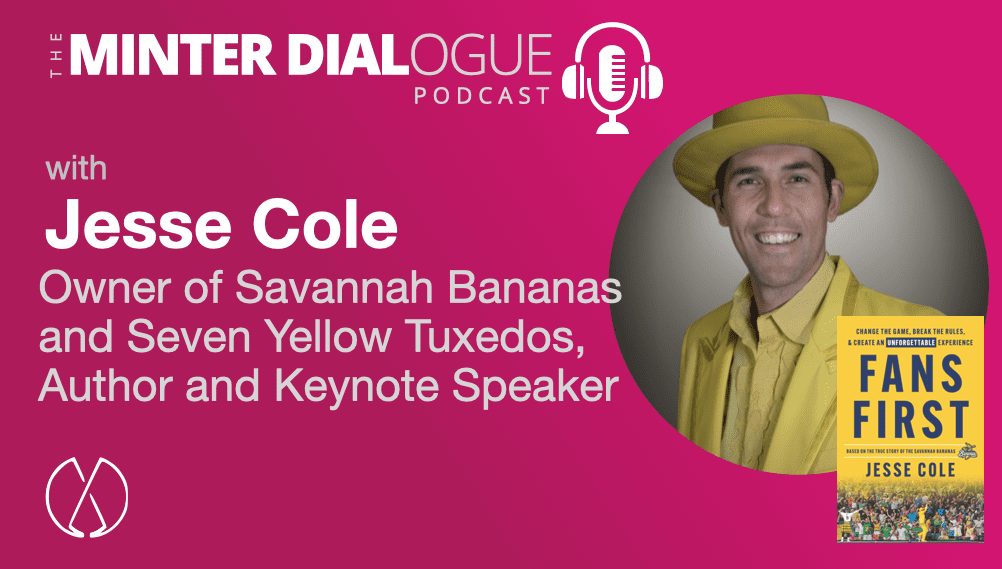
Jesse Cole is the owner of Savannah Bananas, a minor league baseball team based in Savannah, Georgia. Through his leadership, with his wife, Jesse has radically transformed how baseball is played. He’s the author of two books, the last of which came out this year, “Fans First: Change the Game, Break the Rules & Create an Unforgettable Experience.“ In this conversation, we explore Jesse’s epic entrepreneurial journey, and pick out some of the key ideas and lessons learned from the creation and running of this outlier baseball team, and going ‘all in’ on differentiation and making a fans first business. As Jesse clearly believes, every business could do the same thing.
Please send me your questions — as an audio file if you’d like — to nminterdial@gmail.com. Otherwise, below, you’ll find the show notes and, of course, you are invited to comment. If you liked the podcast, please take a moment to rate it here.
To connect with Jesse Cole:
- Check out Jesse’s main site: Find Your Yellow Tux
- You can follow Yellow Tux Jesse Cole and his Savannah Bananas on Twitter: @YellowTuxJesse
- Follow Jesse Cole on Linkedin
————–
Further resources for the Minter Dialogue podcast:

Meanwhile, you can find my other interviews on the Minter Dialogue Show in this podcast tab, on Megaphone or via Apple Podcasts. If you like the show, please go over to rate this podcast via RateThisPodcast!
And for the francophones reading this, if you want to get more podcasts, you can also find my radio show en français over at: MinterDial.fr, on Megaphone or in iTunes.
Music credit: The jingle at the beginning of the show is courtesy of my friend, Pierre Journel, author of the Guitar Channel. And, the new sign-off music is “A Convinced Man,” a song I co-wrote and recorded with Stephanie Singer back in the late 1980s (please excuse the quality of the sound!).
***If you like my writing and are interested in fostering more meaningful conversations in our society, please check out my Dialogos Substack. This Substack, that was mostly written between 2022-2024, features articles on why and how we can all improve our conversations, whether it’s at home, with friends, in society at large or at work. I will be returning to it once I’ve completed my new book! Subscription is free, but if you see value in it, I’d be delighted if you would contribute through your comments. Sign up here:
Transcript via Castmagic
Minter Dial: Hello and welcome to Minter Dialogue, episode number 492. My name is Minter Dial and I’m your host for this podcast, a proud member of the Evergreen Podcast Network. For more information or to check out other shows on the network, please go and visit evergreenpodcast.com. So, this week’s interview is with Jesse Cole. Jesse is the owner of Savannah Bananas, a minor league baseball team based in Savannah, Georgia in the States. Through his leadership with his wife, Jesse has radically transformed how baseball is played. He’s the author of 2 books, the last of which came out this year, Fans First: Change the Game, Break the Rules, and Create an Unforgettable Experience. In this conversation with Jesse, we explore his epic entrepreneurial journey and pick out some of the key ideas and lessons learned from the creation and running of this outlier baseball team and going all in on differentiation and making a fans-first business. As Jesse clearly believes, every business could do the same type of thing. You’ll find all the show notes on mintodile.com. And if you have a moment, please do go and drop in a rating and review. And of course, don’t forget to subscribe. To catch all the future episodes. Now for the show.
Minter Dial: Jesse Cole, banana dude, crazy man, founder of the Savannah Bananas, author of a really interesting book, Fans First: Change the Game, Break the Rules, and Create an Unforgettable Experience. But in your own words, Jesse, who are you?
Jesse Cole: I’m still just a kid trying to make his dad proud. You know, I grew up as an only child and, you know, with baseball as a love and end up to build something that I love that gives me energy. And, you know, not only my dad, I have a wife and 3 kids. We’re foster parents and, you know, they matter the most to me. So, I’m trying to make them proud and create something that makes an impact in the world.
Minter Dial: I do love that. Naturally, we’re going to get into all sorts of things, but I wanna start with a little bit of a maybe deeper philosophical question, which is, your sense of self-awareness and at what point, how much did you know about yourself? How much do you think you knew about yourself before the Savannah Bananas? And then how much at all has changed since you’ve launched this whole project?
Jesse Cole: Well, I was never intentional on learning. You know, I was forced, you know, I went to school like anybody else, but, you know, I wasn’t, I didn’t love school. I did well again, trying to make my dad proud, but I didn’t love it. And when I started in the industry at 23 years old as a GM of a team in North Carolina, I started to learn rapidly and not only just by doing, which I think is you get the greatest learning by also reading every book I could. And as I read every book I could and I surrounded myself with mentors, not physically, but through books, I started to find a lot of correlations and I started to, you know, see myself and be inspired by Walt Disney and P.T. Barnum. And some of the amazing people of this generation, Steve Jobs and Jeff Bezos. And I started to see these big thinkers, these dreamers, and I started to become aware. And then, obviously, meeting Emily, my wife, she helped tremendously. I think when you have a spouse that can see you in a different way and see all your faults and your challenges and areas of improvement, you become more aware.
Minter Dial: Getting some tough love.
Jesse Cole: Yeah, but it’s very well-spirited. So, I think I’ve been able to learn a lot more. You learn the most when you go through challenges and adversity. And I’ve had a lot of challenges and adversity starting as a kid and obviously with the business and what we had to do and sell our house and empty out our savings account. And so, when we learn, we learn more about ourselves and how we respond to those things. It’s very easy to say you’re self-aware when things are going well, but when things start to hit some bumps in your life, that’s when you really learn. So, yeah, I’ve been fortunate, but I’m still a long way from there. My first book, Finding Your Yellow Tux, I wrote my obituary. but I was 30 years old and I would change most of it now, you know, 8 years later, I would change a lot of it. It was a different mindset then as a 30-year-old with no kids, no family. So, constantly the evolution of self-awareness and I think we’re all on that journey.
Minter Dial: Yeah, it’s beautiful. I mean, writing your obituary is a great way to sort of at least put something in the sand, you know, because, but then who knows and things change. I think that when you have a partner, spouse, and you go through real challenge, that is a far greater test of the couple, the relationship. And if you can go through that, then you can really weather so much. And you look at people who have not encountered challenge, and they’re happily so, you always feel like there’s something around the corner.
Jesse Cole: Yeah, I mean, I can understand that. I mean, I never seek out challenges and adversity. I seek out things that give me energy and things that motivate me and inspire me. And from that, whenever you do something that’s big, that’s scary, there will always be challenges around the corner.
Minter Dial: Alright. So, most of the audience is not from America And so, won’t be too specific about baseball or knowledgeable about it. And the funny thing is, as I read the book, you talk about it and I want to say that a little disparagingly, pre-Savannah Bananas, even though you love the game, you talked about how slow it is, and how there’s little action. I mean, you can watch a game. I was watching the Philadelphia Phillies. Disclosure, that’s my team. And they— the recap is 17 minutes long. Whereas it’s usually like 3 hours, 4 hours at the game and how much pizza and and hot dogs, whatever you buy. Talk to us about how you got into baseball and what was your love of baseball? What is it that you love about baseball?
Jesse Cole: Yeah. And today I don’t consider ourselves in the baseball business at all. We are 1000% in the entertainment business. And I would argue most businesses are in the entertainment business. They just might not know it. But yeah, for me, I started a love of baseball. It’s the one bond me and my dad had. He’d get home from work and we’d go play catch in the backyard. He’d take me to the field and he was catching my bullpens all the way going up through high school when he was, you know, in his sick, you know, in his late 50s, he was catching me.
Minter Dial: And so, bending down to the poor knees.
Jesse Cole: Bending down and catching 85, 88 miles an hour fastballs when I was in high school. Yeah. So, he, you know, we still play catch and he’s 74 years old. And so, that was my love and I loved it. I loved it, but I took it too seriously. I was fortunate to get a full college scholarship. I chose the school I went to over some big schools and put so much pressure on because the whole dream was to get drafted and play professional baseball. That was the only thing I was chasing. And from there, I didn’t have as much fun as I should have. And when I started playing as a kid, I played it because I had fun. And so, my love of baseball, when it ended with a career-ending shoulder surgery and an injury, everyone thought I was going to go into coaching. And so, I went into coaching and within the first game. I was bored out of my mind. I was like, there’s a difference about playing, but watching is boring. And from then I started thinking, could I resurrect, could I reimagine, could I make this game fun for fans and players in a different way than it has been in a long time?
Minter Dial: Uh, well, I love that. And I mean, at some level, all sports is by nature entertainment. I mean, even all sports should be thinking of themselves as entertainment because the fans pay for everything. Right.
Jesse Cole: Yeah. And I, and I, and I would, like I said, I’d take it further. I think the definition of entertain is to provide enjoyment. You know, P.T. Barnum said the noblest art is that of making others happy. Enjoyment. So, I think no matter what business we’re in, no matter what we’re selling, we are entertaining. How do we provide joy, entertainment, amusement, happiness? And so, yeah, obviously in sports it’s a no-brainer and you’re talking to a guy in a yellow tuxedo, but I think whatever you do, how can you entertain your guests, entertain your customers, bring joy to them? I think it’s an important characteristic of a strong business.
Minter Dial: How important is yellow to the flavor?
Jesse Cole: I don’t think much about yellow, even though my kids would say, Jesse, that, that’s dad, that’s all you wear. They, my wife is like, that’s all you wear is yellow. I believe in standing out. I believe in brand. I believe in getting people’s attention. And I believe, you know, you have to get their eyes and their ears before you get their hearts. And so, I’m adamant about— you may look at me like, what’s wrong with this guy? Or think things that aren’t true. And I may be misunderstood. But once you know the heart, then it all makes sense.
Minter Dial: Well, for those who are listening, Jesse is wearing a yellow tuxedo, true to form, and a yellow top hat. And my thought, or the question I was just asking, really refers to a program called Insights, which tends to look at personalities across 4 different colors, red, yellow, green, and blue. And the characteristics of yellow per insights are all about enthusiasm, shining, extroversion, going out there, positivism. So, I feel like it’s a, it’s well appropriate for anyone who studies insights.
Jesse Cole: I love that. Well, I’ll take all those. That’s definitely me. I try to bring enthusiasm, energy, and every single day.
Minter Dial: So, in the beginning of the Savannah Bananas, lovely name, fun to say, as you say in the book, you obviously had to gain attention for this 2-bit, lost, uninhabited stadium. And you were desperately trying to get attention, or at least at the beginning when you were serious, and then you sort of figured out you had to try to get attention. And what I was really interested about is you said, well, you trained your team to deal with what I call the naysayers, the criticism. Talk us through how that happens because clearly that, that was really elemental in helping you get over the first hump.
Jesse Cole: Yeah, it’s hard to coach that. You know, you, you know, you can talk about getting punched in the face until you get punched in the face and it, and how you react. You could be coached for months on it and it’s still going to be different. That’s got full credit to my wife, Emily. I don’t think like that. I always constantly think about what’s next. Where are we going? What are we doing? How are we bringing joy, fun, and entertainment? She thinks about when things go wrong. She’s a refiner. And so, that was her idea. She goes, we’re going to get criticism. And what are people going to say when fans or media or people ask, how are they going to be able to handle that? So, she set that up. And the same thing when we announced we were going all to banana ball and no longer playing traditional baseball, and all that we’re doing is this fast 2-hour game with fans catching a foul ball for an out. She wrote out a whole FAQ and shared with our whole team, and we went over literally coaching, teaching, and to prepare for that. And I think that’s just— a mindset of, you know, be ready for what’s to come, even though sometimes when you expect it, it either doesn’t happen as much or it happens worse. But it’s having that plan B and that plan C.
Minter Dial: Well, for me, as a business runner of a large business, more traditional selling shampoos, there’s a level of professionalism in what you say. Yet there’s also this notion of how do you garner that energy in a team to deal with the shit, the negative issues. And that somehow for me speaks into the notion of your mission and how you federated, how you chose the people you worked with. To what extent was that important in giving them that extra enthusiasm to deal with the shit?
Jesse Cole: Yeah, I mean, our biggest fans are the people that show up to the office every day and I’m very clear on that. And so, if they aren’t happy, enjoying what they do, and come to the ballpark with excitement and energy, good luck with them trying to deliver that to fans. And so, it’s very intentional. Our hiring process is very intense. It’s a lot of steps. We have over 2,000 now people on our waitlist to work with us, which is crazy, especially now as hiring is a challenge. And I believe in the attract over recruit. So, I’m intentional as the leader. Emily’s intentional. Jared, our president, our team, we get on top of the mountaintops. and scream who we are and what we stand for and to attract the right people. And when we show all the entertainment on our social media, which is crazy now, we have over 5 million social media followers. People are like, that looks fun. And we have to live up to that. If we make baseball fun, we got to make work fun too. So, I think that’s everything we do. There is intentionality to it. No player gets a uniform until they go through a Bananas orientation in a fans-first way with me. You know, they have to go through it. I mean, everything we do is fans first. And if you think you’re going to try to do things for money and not to put the fans first, you don’t belong and you won’t last in our organization.
Minter Dial: So, Jesse, this is a point of contention for me because I totally subscribe to everything you’re doing, but I call it employee first.
Jesse Cole: So, we’re on the exact same page.
Minter Dial: Right.
Jesse Cole: But actually not contention.
Minter Dial: Right. Well, exactly. But the point is that I don’t say fans first or clients first. Although what you’re doing is you’re saying the fans really encompass the employees.
Jesse Cole: I’m saying the biggest fans
Minter Dial: are
Jesse Cole: our employees. So, if once, you know, again, I talk about turning your customers into fans the whole 2/3 of the book.
Minter Dial: Fanatics, right?
Jesse Cole: Fanatics. But the second, the final third of the book goes on to make your team members, your employees, the biggest fans. And so, I mean, 1% of our top line budget goes to solely surprise and delight our people. And we do epic trips and epic surprises almost every quarter for our people because we want them to love what they do. And so, it’s actually, it’s semantics on the outside. Most people think it’s our fans that come to the ballpark, but we know internally it’s our own team.
Minter Dial: Yeah. Beautiful. I want you, since you mentioned the second third, the story of Reginald popped out as just a beautiful story. I think of my life when I was running a company and, and little moments when you might go to the janitor and say, hey, thanks for doing cleaning the bathroom. And the smile that engendered from the CEO comes and does that. Could you just talk us through the Reginald story? Because it’s so powerful and I think so revealing of your whole fans first, employees being biggest fans.
Jesse Cole: Sure. Reginald, or what many people call Reggie, is a gentleman in his 40s, mental disability, and he reached out to us that first season wanting to work for us. And he called Every single week trying to get a job. And like, we weren’t even hiring at that point. Like, we were trying to figure out our name. And he called every week, every week, every week. So, he showed up, big smile, and he said, I’ll do anything. And so, he did. He did concessions, he did maintenance, he did trash, he did everything around the ballpark. And within the first year, he was the most noticeable in our stadium. Not the players, not me in my yellow tux, Reggie with his big smile. And what Reggie would do is every day he’d come in, Great day for a ballgame. Great day for a ballgame. Even if it’s about to rain, Reggie’s like, great day. The most optimistic person ever. So, it was a couple of years ago that Reggie said, hey, Jesse, my birthday’s on a game day. I go, oh, that’s great, Reggie. That’s great. He goes, just wanted to let you know. And so, then he proceeded to tell every single person on the staff for the next 3 weeks, everybody, players, coaches, staff, Spurs. He let everybody know. He let everybody know. And so, finally it was his birthday. It was the game day and we’re having our pep rally before the game. And I grab Reggie and bring him to the pep rally and all of a sudden everyone starts singing Happy Birthday. And Reggie goes, for me? Of course, Reggie, it’s for you. You told everybody on the staff. So, you know, we had a cake and we had balloons and we sang Happy Birthday and it was fine. But then I said, Reggie, one more thing. And I learned this from Steve Jobs. Always have one more thing when you really want to surprise and delight someone. So, can you come down to the dugout before the game? He goes, whatever you need, whatever you need, Jesse, whatever you need. So, comes down the dugout, sold-out crowd, 4,000+ people, band on the dugout, everyone going crazy. We do the starting lineup, batting first, batting second, batting third, and then we say, last but not least, you know him, you love him, let’s hear it for Reginald. And all of a sudden he lifts his arms up in the air and runs through the tunnel, high-fiving all the players. At the end of the tunnel is our coach. They are waiting for him with a jersey with his name on it, and they hand him the jersey. Reggie stands for the national anthem, and you can see a tear coming down his face. By the end of the night, Reggie said it was the best day of his life. After that season, players came up to me and said, Jesse, we’d love Reggie to be a coach. I go, a coach? And they go, we want him to coach with us. I go, what does that look like? They go, I don’t know, but he brings so much energy to us and he can also make Regenade. I go, what is Regenade? I asked him. He goes, well, it’s just Gatorade, ice, and water. Gatorade mixed ice and water. It’s Regenade. All right, Reggie, whatever you need to make, buddy. And so, he starts making it. Regenade gets the guys all pumped up. starts giving pep talks to the guys. I mean, literally goes to the hitters one game. I was like, hey guys, don’t swing at anything unnecessary. And I was like, that is good advice, Reggie. Good advice. And so, the first year as coach, we go to the championship, win the championship. Reggie traveled with every game, went on the road, went every— he was every single game. We’d always have to get him an Uber every night to go home, even late at night, or drive him home. We found a way to get him home. And so, finally they win the championship and they hand him the trophy in the whole stadium. starts chanting Reggie. And so, now Reggie travels with us on our world tour. He’s going to all 33 cities. He’s the biggest level of inspiration. We won the championship again this last year before we left our league to do the world tour. And people love him and he’s actually empowered and inspired us more than I think we’ve done for him.
Minter Dial: And what a charming lesson that is for people that you look over and maybe look down at work in terms of I, you know, recognizing people, thanking people, and then, you know, catalyzing that energy. So, going back to the naysayers and the criticism you dealt with, there was a sentence you wrote, and just before we recorded, I mentioned how this resonated with me. You wrote, well, we couldn’t control the response. In other words, people criticizing you and being a naysayer, stupid idea, bananas, hate that. But we could control how we responded to
Jesse Cole: it.
Minter Dial: And this, for me, is out of a playbook by Viktor Frankl, who says the only thing they can’t take away from you is the freedom to choose how you respond. And I was just wondering, you know, Emily is in maybe embodying, incarnating that spirit. You even talk about it later when you have a game which is rained out. And you’re like, oh, shit, that’s not good for the game. But the situation is that now it’s a new situation. And then you write, instead of letting that affect you and choosing to be upset, you choose joy instead. I got to feel you are Frank Kellyan in your heart.
Jesse Cole: Well, I appreciate that. Obviously, he’s been one of the most inspirational people for millions. And his book is still a must-read for people all over the world. So, I appreciate that. But we’re just learning every day. We’re learning every day. And I think that is something that we have learned. And, you know, you can take this approach, but everything, everything is how you respond to it. And, you know, the only thing we can really control is our thoughts. We can’t control what happens to us, but we can control our thoughts and our reactions and how we respond to things. And so, I struggle with this when things go wrong. It’s tough because I have this perfect scenario. I’m very, Probably Steve Jobsian. And I gave Steve Jobsian, that’s an interesting way of wording it, or Jeff Bezos in the thing that I want things to be perfect. I am a perfectionist. I even learned that from Michael Jackson, who’s arguably one of the greatest performers ever. You know, I want things to go perfect. So, when they don’t, I struggle. Like when we’ve had our final tour stop in Kansas City, we had thousands of fans waiting for hours and they rushed the gates. They literally rushed past security. 4,000 or 5,000 fans rushed past security. And I was so upset. Emily went to me instead of going to the fans. Emily went to me, said, Jesse, calm, calm, calm. It’s OK. It’s OK. Because she knew. I picture how the opening goes with our whole march and our pep band. And we do this wonderful Disney-like opening that sets the tone for the entire night. And our final game on the tour, we’ve got 2,000 fans just sitting, and they didn’t get any of that. I was upset. I was bothered. But again, Emily calmed me down. And I said, we’re going to make the most of it. And we went out and did the best march we could for the fans that were still out there. We went from there.
Minter Dial: Yeah, perfection is a tough thing to seek.
Jesse Cole: Yeah, yeah, it’s a blessing and a curse.
Minter Dial: Indeed. Well, speaking of blessing and a curse, something which I scraped various sentences from your book, which I thought were really interesting. And this one goes, I’m not entirely sure how we did it. it being get the success and make this thing happen. If there’s a word that somehow splits the difference between cursed and magical, that would be the one I’d use to describe opening night, which I love. I don’t know what the word is in between. But the question I had out of that was, how do you keep it going? What are the— what’s the mojo that allows you to keep that flame going between cursed and magical?
Jesse Cole: Well, we’ve learned you got to get through the messy to get to the great. If anything we do, we’re not embarrassed looking back at it for the first time, we waited too long.
Minter Dial: Hmm.
Jesse Cole: Our first broadcast with one camera, our first banana ball game where like the walk turned into a home run and people were throwing the ball around and people were stepping out. Everything we do is messy in the beginning. So, you know, whether it’s cursed or magical, sometimes you need to get through that to get to what can be magical. That opening night was a disaster. But so, was July 17th, 1955, which was what many people refer to as Black Sunday, the day Disneyland opened up. And the rides didn’t work. There was flooding. There were bathrooms that were overflooded. There were people getting— women’s heels were getting stuck in the cement because they poured it that day. There were electrical fires. I mean, it was a disaster. They were expecting 10,000. They had 27,000 people show up. And so, they weren’t ready. But 3 months later, they had over a million guests come through Disneyland and it was a huge success. They were able to pay off all their debts within the next 2 years. So, I think anybody that achieves anything truly great experiences messiness.
Minter Dial: All right. So, as you get bigger, dreams potentially get bigger. Growth is a thing you probably need to manage. How, where do you envision Where are you going with this?
Jesse Cole: Yeah, I get asked that question a lot. And it’s funny, we did a 2025 vision back in 2020 during COVID And I think we said by 2025, we’ll play in 8 cities in front of a quarter million fans. This year in 2023, we’ll be in 33 cities and a half million fans. So, you know, I think sometimes when we have visions, we can think too small or sometimes we think too big. The key that I’ve learned Is to have a singular focus. For me, every day, if I show up and try to create the greatest show possible, the greatest show in sports, the best possible fan experience, if I do that every day with a fanaticism, an obsession on meeting with our team and saying, how are we entertaining better than anyone else every single day? Then all of a sudden, things start taking care of themselves. But do I see us playing all over the world? 100%. 100%. Do I see an eventual Banana Ball League that is changing lives? Millions. Do I see us, you know, making a bigger impact than maybe anyone in sports and entertainment? Yeah, that’s crazy. But it’s one day at a time, one fan at a time, and one experiment at a time, which we do a lot of experiments.
Minter Dial: So, at one point you mentioned, or at least in the footnotes, Southwest as being a sort of a I would say an iconic example of an airline that does things differently despite everything. And I certainly subscribe to that. And they have a purpose which they write on the website, connect people to what’s important in their lives through friendly, reliable, low-cost travel. I was wondering, and I maybe I just didn’t find it, do you subscribe to the notion of having a purpose for Savannah Bananas?
Jesse Cole: Yeah, I do think people can get that misconstrued. I think people can spend hours, days, weeks, months, years trying to find their purpose.
Minter Dial: Intellectualizing it, right?
Jesse Cole: Correct. Just writing it down over and over again. I think, and I was the same person who did that. I probably started writing what our purpose is many years ago. And I listened to How Great Leaders Inspire Action, Start with Why by Simon Sinek. And he actually called me once, which was a funny thank you experiment that happened. But I always thought, hey, we bring people together and we bring families together to bring joy. And I was like, that is our purpose. But I don’t know if that’s necessarily what drives us. What I see that drives us is a feeling. It’s a feeling, and you know it when you feel it. So, for instance, when we did our One City World Tour, and yes, we did a One City World
Minter Dial: Tour. The very first one, right?
Jesse Cole: Exactly. Another experiment. Again, that’s how my book opens with that march, the One City World Tour march. And the first night was a disaster. The sound didn’t work. Our announcer saying, take me off the ballgame instead of the national anthem. A lot of things didn’t work well. It was almost— But the night 2, we got a lot of things right. And when the game finished, we had a surprise fireworks show to P.T. Barnum’s Greatest Showman soundtrack. And I remember a couple of our staff members said they were walking through the crowd and they say they saw mothers with their kids in their arms and they were emotional, crying. Because, you know, this was after COVID or while COVID was still going on, bringing people together. And then at the end of the night, fans didn’t want to leave. And I remember out in front of the stadium, our whole team, our staff, our characters, everyone was out there greeting the fans and thanking them, but the fans didn’t want to leave. And like 30 minutes and our pep band is playing their hearts out. I mean, this is like 9:30, 10 o’clock. They’re playing their hearts out.
Minter Dial: Another encore.
Jesse Cole: Yeah, 30, 45 minutes. They just keep playing. They keep playing. Finally, I see like the drummer just playing by himself because Like all the trumpets and saxophones and trombones need a breather. And then finally I look at them and the tuba player comes out and he steps up in front of the big crowd and starts playing the opening beats to Stand By Me. And I remember vividly what happened next, and I can feel it. As he started doing that, I watched the players, both teams, the cast, the mananas, the breakdancing coaches, and the fans. put their arms around each other, and everyone started singing Stand By Me. And I looked around hundreds of miles from where we started in Savannah, Georgia, and to feel the togetherness, to feel the love, to feel a moment that you never want to end. That’s why we do what we do. And that feeling drives me to bring that to more people because I saw the joy that I’ve never seen before.
Minter Dial: Lovely story, Jesse. And it makes me think, and certainly what I’ve been writing about today is that in that joy that you are feeling, it’s filling for me what I perceive as a gap in meaningfulness in people’s lives. So, I’m wondering if that resonated with you.
Jesse Cole: Yeah, I think we’re constantly searching for something maybe we didn’t have. And you can either channel that as something that’s bad for you or something that had happened to you or a gift. And as someone who didn’t have really my mother in my life, my father constantly worked, never said the words I love you until now. We say it regularly now, but never said it back then. I was searching for that. I was a kid, like I said, trying to make my dad proud, but searching for love. And now when I get to feel it, it is what I see as a very positive addiction. It is something that it doesn’t— if I don’t get it, it doesn’t mess with me. But when I do get it and I feel it for what we’re doing, it drives that feeling to bring that to more people. After games, when people thank me, I want our entire team to feel that. I want everyone to feel that love because so many people go to work every day, they do their job, they go home, their spouse asks them how was their day, they say fine, they have dinner, they come back.
Minter Dial: Fine, honey.
Jesse Cole: Yeah, they have dinner, they go to bed and they repeat. How many people get recognized for the work they do, get love for the work they do? So, for me, I’m always filling that void and I want to give it to everybody.
Minter Dial: Well, I got triggered by the word addiction because Frankl says it’s one of the 3 bad things that we got out there. Yeah, it’s a tough word. Yeah. Aggression and depression.
Jesse Cole: What’s a positive word for it? What’s a positive reframe of that?
Minter Dial: Love. You know, if you love something,
Jesse Cole: you want more of it. Okay.
Minter Dial: Yeah. Okay. I mean, I didn’t get triggered in any psychological ways. I can, I can deal with that. One of the things I wanted to ask you about was recruitment. So, you have 2,000 people waiting to join the Savannah Bananas. Bananas sounds better than bananas.
Jesse Cole: To work for us, not players. That’s a whole nother level.
Minter Dial: Oh, yeah, we’ll get to that. But what is the criteria for saying yes to somebody who you want? How do you select somebody who has genuine fit with your culture? Because I’m sure that a lot of happy people and a lot of keen people say, I really want to work with a successful organization. I mean, who doesn’t? Like when you go to apply for a big name school, you say, well, I want to go there because it’s a big name.
Jesse Cole: Yeah.
Minter Dial: But how do you sort through and get the right people?
Jesse Cole: We weren’t good at this at all when we started. Again, there’s a theme here. We struggled, but we just kept persevering, kept persevering, kept trying to get better. It’s, you know, innovation starts with a lot of iteration. And so, we were constantly iterating the process. But, you know, it’s, you have to go through a pretty extensive pre-application process, which includes a video cover letter. So, we want to see In 2, 3, 5 seconds, we can see, is this a person I want to be around more based on their energy? If you can’t show that in a video, then good luck coming in. If you know this video is being sent to a place you want to work with, if you can’t bring that energy, enthusiasm, fun, good luck. So, that’s number one. Yeah. Number 2 is a fan’s first essay. So, our fan’s first core beliefs always be caring, different, enthusiastic, fun, growing, and hungry. We want them to say how in their life with stories and examples have they lived these values. Got to have the values. And then finally, uh, the future resume. So, we’re not interested in what you’ve done in the past. We want to know what you plan to do in the future. And this is a great, more than anything, an exercise for them to get them to think bigger, to dream bigger. And then we can judge that in the sense that when we look at it, do they want the same position with the bananas for the next 5 years? We actually look for people that want something bigger than us.
Minter Dial: Hmm.
Jesse Cole: And that we want to help them pursue their dreams. And so, if you, we look at all those 3 touches, then We start having our first phone interviews, then we start having culture interviews, which is over a month long where you actually interview with other people on our team, people that have been there since the first year. And then we go into skill set after that. It’s a 2 to 3 month process.
Minter Dial: So, skill set is the end of the process.
Jesse Cole: Skill set’s the last thing. Yeah, skill set’s the last thing. And to be honest with you, unless it’s a very specific job, most of the jobs we’re hiring, the skill set has very little relevance.
Minter Dial: Well, I’m thinking of Reginald at this point. You didn’t hire him to be a coach.
Jesse Cole: Yeah, 100%. But what personalities unveil themselves every single day. We’ve moved people around left and right because we also do what I believe is one of the most valuable things anybody can do that I learned was to create my energy list. Everyone says, Jesse, you have so much energy, you have so much fire every day. How do you do it? Because I do what gives me energy. They’re like, it can’t be that easy. I’m like, yeah, it is. And it wasn’t for us. I looked at my calendar back when I started in the industry and I was doing financials, selling sponsorship operations, and I was exhausted at the end of each day.
Minter Dial: Blah, blah, blah.
Jesse Cole: Burnt out. And then I started thinking my best days. I looked at my calendar, what do my best days look like? What am I doing? And then I started saying, let’s create my energy list. And I realized it was 3, fit in 3 buckets. Creating, sharing, and growing. If I’m doing things in those 3 buckets, creating, coming up with ideas, promotions, creating on a podcast, giving a speech, sharing, same thing, sharing with our leadership, sharing with our team on a stage, growing, learning, you know, what am I learning? What am I listening to? Our fans. What books am I reading? What podcasts every single morning? If I’m doing those 3, good luck at the end of the day because when I pick up my kids, I’m a ball of energy even after working my butt off since 4:30 in the morning, which I wake up every morning and start work. Because I do things that give me energy.
Minter Dial: Oh, well, I, you know, I so subscribe to that, Jesse, which is one of the reasons why I was so attracted to you. I just did a speech in Vancouver and the name is Energy and Connection. And I described how little, when I was starting off at L’Oréal, little my day was filled with energy. It’s just like, you know, meeting after meeting and meetingitis and dealing with shit and corporate politics and hassles and how little of my day was filled with joy. So, now I color my day. Now I specifically color my day with things that are part of bringing me enjoyment or energy? Because some things are not about joy. Because, you know, doing hard work for somebody else, sometimes that’s important and gives you energy, but it’s not necessarily enjoyment. And that’s okay because not all life can be full of joy. You have to deal with shit and you have to know how to overcome those moments. But they can also be Invigorating for you and learning because you’re—
Jesse Cole: 100%. And sometimes you have to do more. See, what I subscribe to is say yes to everything and then start saying no. Like in the beginning when you start your career, say yes to as many. If someone says, hey, I’m doing this project, I’ll help, like learn. And because you don’t know until you start doing. And that’s a huge thing that we think about is we learn by doing. We learn by doing. We have no idea. how to do a world tour. I mean, this year we’re traveling thousands of miles with 120 to 140 people, which is 4 to 5 times what the GlobeTrotters travel with.
Minter Dial: Right.
Jesse Cole: We have no idea how to do it. We did a live draft like the NFL Draft to announce the cities we were going to. We had no idea how to do it, but we ended up having 28,000 unique people watching it, watching where we’re going to play. And then that night, 55,000 people shut down our website. They went on the same moment. And they shut down our website. You can’t necessarily prepare for that. You have to go through it. Okay, here’s what happened. I saw it as a glorious lesson. Oh, shit.
Minter Dial: Yeah.
Jesse Cole: I saw it as a glorious lesson to get through the messy to get to the great. And then now, once we announced all those 33 cities, we hear Texas, literally the one market we’re going to in Texas, it’s got 50,000 people wanting tickets. So, Texas, we need to expand. Michigan, we heard a ton from Michigan. Why did you come to Michigan? So, like, Michigan, huge market. So, you learn by making these announcements. And a lot of people, they sit doing business strategy, business models, thinking, thinking, thinking, thinking, start doing. And that’s where you learn fastest.
Minter Dial: So, true. And that’s such a great lesson for anyone who’s younger listening to this, who’s sort of worried about being perfect and getting it right. Just go out there, fuck it up and learn along the way. Excuse my beautiful French. So, you mentioned Globetrotters and naturally that was something that crossed my mind as I thought about you guys. Have you talked with that organization? Is that, or do you look at them? Do you, other than the, you know, P.T. Barnum and other, do you have other role models and other—
Jesse Cole: Yeah, I mean,
Minter Dial: yeah,
Jesse Cole: 100%. I mean, Cirque du Soleil, WWE, learned a lot from those 2. Globetrotters, yes. And Becoming the Globetrotters is one of my biggest fears for our business.
Minter Dial: Huh.
Jesse Cole: So, being the Globetrotters of the 1940s and ’50s and ’60s would be one of our greatest achievements. In the 1940s, ’50s, and ’60s, they fundamentally changed the game of basketball, and they were arguably the most popular— not even arguably, they were the most popular, entertaining, and biggest draw of any sports team in the world. They went to Berlin and played in front of 75,000 people. They sold Madison Square Garden out twice in one day. The NBA would book them so they could sell tickets. Literally, they would get the Globetrotters and hope fans would stay for NBA games. They beat the Lakers and George Mikan. They had movies, they had TV shows, they were everything. And then they stopped innovating. They stopped reinventing. They stopped reimagining. The same confetti shtick they do, they still do now. The same show, to an extent, they still do. And they’ve reached a challenging point and they have reached— I’ve talked to 2 former CEOs and I have a lot of respect for them. They did. I mean, they brought in the 3-point line when they first started in the ’40s, ’50s, and ’60s. They brought in dunks, they brought in all the cool things that made basketball better. But then they became irrelevant.
Minter Dial: Sense of humor. They brought in sense of humor.
Jesse Cole: They brought fun. They changed the game. And so, we get compared to the Globetrotters more than anyone else. But I always challenge people. I said, when was the last time you saw a Globetrotters t-shirt? or Globetrotters jersey. They unfortunately have become a lot less relevant because they haven’t reinvented and reimagined. They haven’t been willing to cannibalize themselves and the way of doing things. We literally just shut down the league we were in. We shut down our team that we were in a league where we had zero player payroll because it was college. And now we’re literally doing our own thing in our own league and going into a 7-figure payroll, which doesn’t make any business sense. But it does when you say we realize it’s the best possible fan experience and 98% of our fans stay till the end of the game. So, the Globetrotters, I’ve learned a lot from, but I also am learning more from what not to do to make sure that we continue to prevent even more so now.
Minter Dial: Right. So, let’s talk a little bit about the players and actually the sport of baseball. So, talk to me about the impact of the Savannah Banana Thesis, ambiance on the sport itself? Because it’s not something you cover deeply in the book.
Jesse Cole: Well, it’s something I don’t think about. I don’t necessarily think about things I can’t control. I think about one fan at a time. I think about creating the best possible, greatest show in sports. And if that does, the impact climbs dramatically. So, yes, where are we now? We have over 5 million social media followers, more than any Major League Baseball team. We have an extremely young fan base. We’re doing hundreds of orders of merchandise all over the world, which I was told is more than a lot of the NFL teams, which doesn’t make any sense.
Minter Dial: And that’s profitable.
Jesse Cole: We’re very fortunate, but we have zero advertising, zero sponsorship. We got rid of that because we don’t believe anybody comes to a ballpark to be sold to, marketed to, or advertised to. Everyone in the industry would say we’re idiots for that, and maybe so, but we want to stand true to who we are, and we mean every fan’s first thing. We pay fans taxes. Literally, if they buy a $25 ticket, we pay your taxes. We pay shipping fees on merchandise, at least domestically. We do everything that we can to leave money on the table, but to create fans in the long term. So, Major League Baseball is challenged, but I don’t see them as a competitor. The only competitor we have is ourselves. So, Major League Baseball, what Major League Baseball is, they have the best baseball players in the world. We will never have that. And I’m okay with that. But we’ll have the most entertaining players in the world. And so, when you’re clear on that and clear on who you’re not for and who you are, it’s very easy to stand out.
Minter Dial: Right. At the same time, I am a big believer of the sort of the karma component so that when you’ve got happy people in the stands, you’ve got happy people, you know, brushing the lines, whatever you do in baseball, That has to spill over into the animus and the feelings of your players and that sort of warm feeling, that desire to do more that comes from being part of this gang. I just have to believe, I mean, you mentioned you won a few championships, that that’s contributed to— I mean, you can take a bunch of average players, but if you give them some sort of elevation through a purpose, through a feeling of belonging and teamness, you can really do a lot more. And I’m just wondering to what extent that’s come true or not.
Jesse Cole: Yeah, everything starts there. So, everything starts by the atmosphere and how we create a fans-first experience for our team. And because our players are having more fun, They are performing better. And I believe anybody, you go into work and you have a good time, you’ll perform better. And you got energy. They get everything comes. It’s in a full circle that we have. So, literally our players give our fans energy, our fans give our players energy. For all these other teams that play in front of 200 people and not sold-out crowds like we do, it’s hard to get energy. When we score our first run, our entire team runs through the crowd high-fiving all the fans. It’s crazy. But you’re going to tell me that doesn’t give you energy? We are so intentional when we open our gates and we have 2 hours before the game, 2,000, 3,000, 4,000, 5,000 fans depending on what stadium we’re playing at. Waiting, waiting, and they’re waiting, and we give them the march. And at the march, we have our players, our pep band, our male cheerleading team, our Banana Nanas, our players on stilts, our breakdancing coaches, our mascot, myself. We all go out and dance and greet all our fans. And you tell me, when you’re part of that cast or you’re a player and you see thousands of fans taking video, pictures, smiling, all in your gear, And they’re there to watch you put on a show that doesn’t give you purpose in what you’re doing.
Minter Dial: It also certainly helps fill in marketing budget with word of mouth and all when, because the best thing, you know, you can say what you do, then hopefully you do what you do. But the best thing is when other people say what you do.
Jesse Cole: Yeah, 100%. We spend $0 on traditional marketing, zero. But we pay for an entire pep band to travel to 33 cities all over the country with all their equipment, which makes no sense. In the short term, that wouldn’t affect attendance at all. We’d sell every ticket. We’d be very good. But in the long term, what’s our commitment to that experience? We want people to come in and say, you wouldn’t believe what happened at tonight’s game. It was the most fun I ever had at a baseball game. So, that’s every touchpoint. And so, yeah, we will invest 6 figures plus on a pep band, which you don’t need. No one else has one in baseball. There’s no such thing as a pep band. The Globe Trotters would never travel with a pep band. That makes no sense. It’s too many people, but we will. And you have to do the unscalable sometimes to do the scalable. And we are going to continue to do the unscalable because it creates a better experience.
Minter Dial: Yeah, I’m thinking of the Phillies, the Philadelphia Phillies. This is my only real reference because my mom lives outside of Philadelphia and they had the Phanatic. They’ve always had little things, right? You know, the professional teams, they might have some kind of the 7th inning stretch and and the Star-Spangled Banner at the beginning because that’s sort of de rigueur, right? But for the rest, it seems so serious. And I’m wondering when you watch, I suppose you still watch other baseball, I don’t know. But when you see somebody on the mound who’s serious and looking just too unhappy, you just don’t feel like you want to reach out to them and say, you know what? Get with the plot. Life’s short.
Jesse Cole: Yeah, I’m weird. I don’t watch any baseball. I struggle with it. You know, I try to do more things that give me energy and baseball wears me out watching it. So, but yeah, I mean, 100%. I mean, you know, I watch that as we’ve had now major leaguers join us, Cy Young Award winners, All-Stars, and I watch as they have more fun. I mean, Jonathan Papelbon, one of the biggest competitors ever for the Red Sox, to see him dancing with a kilt and pitching our last few games. And Jake Peavy, you know, Cy Young Award winner and World Series champion, pitching with his Gold Glove and smiling and laughing. It’s— it shows you that even the major leaguers, they wanted that as a kid. They missed that. They want to finish their career doing that.
Minter Dial: Well, it’s funny, a lot of them in Europe, we have professional football, which is, you know, soccer game. And all the big players, Beckham And so, on, they always go to America for the big bucks. It is more entertaining in America. Because if you think of how sports are done in America compared to Europe, where there’s already even a chasm there. So, I’m thinking, you know, Savannah Bananas World Tour, Paris, London.
Jesse Cole: Why not?
Minter Dial: Well, so last question, which is around the competition. And I’m thinking about when I just sort of like, as a sportsman, when the competition comes to you, how do you negotiate that? Because I mean, is there this— now you’ve got so big at some level, it’s, you know, my way or the highway, this is how we do things. But at the beginning, I’m thinking that, you know, some of the players of the other teams would have felt obnoxious or felt that that’s not cricket, as we say in England, or that’s just not appropriate or you’re cheating? Or how did that sort of level out to a point where you can now do whatever you want?
Jesse Cole: Yeah, I mean, we’ve put so much content out in the world that now you know who we are. But at first there was a lot of challenges and, you know, players weren’t for it. But the biggest thing that I’ve learned is to— not the biggest thing, I’ve learned a lot. But one thing I’ve learned when it comes to this is to understand not just who you are for, but who you are not for. And for other players that come and have this skepticism and are baseball purists and play the game the right way, we’re not for them. You can spend all your time, all your money, all your energy trying to convert people, or you can focus on the people that love what you do and go all in on that. And so, that’s where we’re spending most of our energy.
Minter Dial: Alright. Last question, Jesse, then before we close is for somebody who’s working at a desk job selling widgets, What word of advice would you give them?
Jesse Cole: You know, obviously the book that we’ve referenced today is Fans First, and I talk about creating fans of customers, creating fans of your team members. But the biggest fan has to be yourself. And if you’re waking up every day and you’re not a fan of what you do and you don’t believe in what you do, I would challenge you to reevaluate and find something where you do. Because if you want to have great joy and you want to bring great joy, you got to find it first with yourself. And I think so many people show up and it’s hard. It’s hard to leave a job you’ve been with 5, 10, 15, 20 years. You’re making a good salary and you’re just doing the same thing over and over again. But when we’re done, when we’re all said and done and, you know, life’s about to be over for us, I don’t think anyone’s going to think about all the money they had in the bank account or all the things they bought. They’re going to think about the moments, the memories, the experiences, the joy that they had and they brought for others. And if you go and sit down and think of yourself at 80, 90 years old, I think it makes decisions a lot easier.
Minter Dial: On those wonderfully cheerful words, Jesse, how can anybody contact you, follow you, get part of your vibe? What are the best links you’d like to send out to the world?
Jesse Cole: I’m easy. If you search Yellow Tux, you’ll find me. My website, findyellotux.com. But I spend most of my time on LinkedIn. You know, I believe in obviously sharing your story, sharing who you are. And I write on LinkedIn. I share probably 5, 6 times posts a week. And that helps me with clarity. And I think great leaders write, right? And they write things down and that’s how I communicate. So, for to understand what’s going on in our world, you can follow our journey, my journey on LinkedIn and the Bananas. We’re, we’re everywhere, man. We’re trying to, from YouTube to TikTok with 3.5 million followers to all those different platforms. We’re having fun there.
Minter Dial: Well, I wish you all the success, the world of success on your world tour and more. Jesse, thank you a million times for Well, thank you.
Jesse Cole: This was a wonderful interview. I appreciate the very thoughtful questions.